developing a taxonomy to guide the grading and feedback for personal
development planning. Practitioner Research in Higher Education, 3 (1). pp.
43-51.
Downloaded from: http://insight.cumbria.ac.uk/id/eprint/3310/
Usage of any items from the University of Cumbria’s institutional repository ‘Insight’ must conform to the
following fair usage guidelines.
Any item and its associated metadata held in the University of Cumbria’s institutional repository Insight (unless
stated otherwise on the metadata record) may be
copied, displayed or performed, and stored in line with the JISC
fair dealing guidelines (available
here
) for educational and not-for-profit activities
provided that
• the authors, title and full bibliographic details of the item are cited clearly when any part
of the work is referred to verbally or in the written form
• a hyperlink/URL to the original Insight record of that item is included in any citations of the work
• the content is not changed in any way
• all files required for usage of the item are kept together with the main item file.
You may not
• sell any part of an item
• refer to any part of an item without citation
• amend any item or contextualise it in a way that will impugn the creator’s reputation
• remove or alter the copyright statement on an item.
The full policy can be found
here
.
Assessment of an ePortfolio:
developing a taxonomy to guide
the grading and feedback for
personal development planning
Wendy Clark and Jackie Adamson Northumbria University
[email protected] [email protected]
Abstract
This paper describes the rationale for, and the design, implementation and preliminary
evaluation of a taxonomy to guide the grading and feedback of ePortfolio assessment
of personal development planning (PDP) in a module where PDP is integrated into the
curriculum. Conventional higher education assessment methods do not adequately
address the requirements of this innovative approach to learning and assessment, and a
new assessment tool was felt to be necessary. Drawing on recent theories in the ields of
constructive alignment, relective practice and assessment for learning, a criteria-based
taxonomy was designed with the aims of articulating criteria for achievement aligned with
the learning outcomes of the module, and of ensuring valid and reliable evaluation of student
achievement. Analysis of student and tutor feedback and statistical comparison of marks
achieved after the pilot study have produced encouraging results. While this taxonomy was
designed to be used in speciic circumstances, it is capable of being adapted for use by others
who deliver modules or courses where PDP embedded in the curriculum is supported and
assessed by means of an ePortfolio.
Keywords
Taxonomy; PDP; ePortfolio; relection; assessment
Introduction
In these opening years of the 21st century, we have seen the changes affecting higher education gathering speed and force. In the words of the Burgess Group Final Report on measuring and recording student achievement (2007):
A range of related and highly compelling factors have converged to make the case for change inevitable, and indeed, long overdue.
The ‘compelling factors’ driving this particular project include the growing numbers and diversity of the student population; the indings of the Leitch Review of Skills (2006) which stressed the need for a highly skilled workforce to enable the UK to lourish in the information economy; and the shift of focus from teaching to learning (Meighan, 1999, Havnes and McDowell, 2008) with its subsequent requirement for students to be active learners taking responsibility for their own learning. Dearing’s (1997) recommendations for student progress iles have led to the introduction of personal development planning (PDP) in higher education institutions, with the aim of enabling all students to become autonomous lifelong learners. Various strategies have been tried to engage students with the PDP process, but research has shown (Thompson, 2002) that ‘extra’, non-assessed work, however beneicial to their learning, is dismissed as irrelevant by
Practitioner Research in Higher Education
The relective process, so necessary for the development of learning autonomy, is also a key element of PDP, and in recent years the portfolio has been recognised as an effective means of not only collecting personal evidence of achievement, knowledge and skill, but also of providing opportunities for relecting on learning, and for hosting records of that relection (Grant, Strivens and Marshall 2004). The Burgess Report (2007) concluded that:
There is a need to do justice to the full range of student experience by allowing a wider recognition of achievement.
and it has been argued that portfolios support this. For example, assembling a portfolio allows a student to showcase a much wider range of achievement for assessment or as proof of employability than can be evidenced by more traditional forms of assessment. In addition, however diverse the modern student population, the majority of them, except perhaps some mature students, do have one attribute in common – they are ‘digital natives’ (Prensky, 2001), more at home in the digital world than in a traditional classroom. Handling a paper-based portfolio is a sterile and demotivating experience for them; the ePortfolio, however, allows them to organise their learning and experience in a way they ind natural and stimulating.
However, the use of ePortfolios to support learning and to assess personal development planning presents a challenge to universities and other institutions. Many educators have argued that portfolios should not be assessed summatively because of the personal, non-standard nature of the work submitted (Snadden, 1999, Pitts et al., 2001, Rees and Sheard, 2004). Some statistical analysis has established an acceptable level of construct validity (which ensures that a test measures what it claims to be measuring), and reliability (Rees, Shepherd and Chamberlain, 2005), whereas attempts to establish inter-rater reliability to ensure consistency of evaluation when assessment is carried out by a team of markers did not always succeed (Pitts, Coles and Thomas, 2001). However, much of this research was carried out by medical educators using quantitative methods.
Social scientists such as Baume and Biggs take a more qualitative view of validity and reliability. Baume (2002) believes that an assessment task is valid if, in order to accomplish it, a student has to achieve one or more of the intended outcomes of the course. The assessment process is valid if the assessor judges the work against the intended outcomes. The portfolio format scores well on both task and process validity; because it contains a wide variety of student work, it can show the full range of learning, including additional discretionary evidence of competence and knowledge. The reliability of the portfolio assessment can be assured by making clear the task(s) the students must undertake, giving clear indications of the assessment criteria and marking scheme, and moderating carefully between assessors.
There is, therefore, a need for an accepted method of assessment for personal development planning by ePortfolio which is easily understood and applied by both students and staff and which enables consistency of evaluation and inter-rater reliability.
Any form of assessment must address the intended learning outcomes of the module, but in doing so it should encourage a deep approach to learning and not merely demand the regurgitation of facts. For PDP, therefore, a criteria-based form of assessment, where grades are awarded according to how well students meet the desired learning outcomes, is most suitable. The assessment framework for this module, where PDP is integrated into the curriculum and the ePortfolio used for both learning and assessment, needs to evaluate both the process of personal development and the work produced to meet the demands of the curriculum. The framework (or taxonomy, the two terms being often used interchangeably in the literature (see Moseley et al. 2004)) aligns the learning outcomes, the objectives and the grading criteria, while describing standards in terms easily interpreted by staff and students.
Some criteria, such as engagement with the learning experience and relection on learning, are common to all PDP environments, but other criteria speciic to the curriculum could replace our Practical Competence criteria, and the weighting could be altered as necessary. For example, this taxonomy, originally designed for a irst-year module, has been amended for use with a second-year employability module. Here the Practical Competence section is devoted to students’ performance in a mock job interview and the accompanying application documentation. This version is being piloted with this year’s cohort.
The context of the project
The design, implementation and evaluation of the taxonomy forms part of an action research project carried out in the Business Information Systems department of the School of Computing, Engineering and Information Sciences of Northumbria University, the aim of which is to design and implement an effective way to motivate students to engage in the process of personal development planning.
In 2003–2004 the University was eager to ind ways of delivering PDP effectively to all students, and several different models were tried in separate schools. Our model for the delivery of PDP integrated it into the curriculum in a speciic module – the irst-year 20-credit module ‘Skills for Information Systems Professionals’. The academic content of this module is delivered through the medium of the PDP concept, with an emphasis on experiential and problem-based learning, self evaluation, and relection on learning and progress. The PDP element is assessed by evaluation of the portfolio, while knowledge of the academic content is also assessed by an end-of-year examination. Since 2005 the ePortfolio facility of the Blackboard virtual learning environment (VLE) has been used to support learning and to act as an assessment tool. The module was redesigned for this, using Biggs’ (1999) notion of constructive alignment. The basic premise of this system, based on constructivist theories of learning, is that the curriculum is designed so that the learning activities and assessment tasks are aligned with the intended learning outcomes of the module. Biggs argued that this strategy could encourage ‘most students to use the higher cognitive level processes that the more academic students use spontaneously’, which is one of the main aims of PDP.
At the end of each academic year since then, each iteration of the action research project has been analysed using both quantitative and qualitative methods. Student achievement of the learning outcomes has been monitored and analysed statistically, and student opinion has been gathered from their relective writing and from formal and informal interviews and discussions. Relection on these indings has informed improvements to the following year’s programme. As Houghton (2004) puts it:
Constructive alignment is actually extremely difficult to achieve: it is virtually impossible to get it right first time, through so-called rational top-down course design. That is why the ILTHE, for example, emphasises the importance of the reflective practitioner; the teacher who constantly modifies course design and delivery, constantly trying to work closer to the unattainable perfect constructive alignment.
Nevertheless, this model of PDP delivery has been recognised as effective, and has lately been implemented not only in the second-year module ‘Professional Development Planning for IS/IT Professionals’, which prepares students for a year-long industrial placement that takes place after their second year, but also in more subject areas of the School, so that the irst-year cohort now numbers more than 200. This means that the teaching team has grown to four members, making even more urgent the development of a reliable taxonomy to ensure consistency of assessment across the module.
This irst-year module in particular poses challenges to staff, in that it is offered across a range of degree programmes, ranging from an ICT Foundation Degree which emphasises technological skills to the ITMB Degree (Information Technology Management for Business), a lagship programme within the university, which is sponsored by leading companies in the UK and which recruits from the best qualiied A-Level students. The module content, delivery and assessment must therefore challenge the ‘best’ students, while encouraging and developing the knowledge and skills of those who may lack conidence in their own ability to develop as learners.
In contrast, academic Susan is highly motivated, very focused on her studies, reads above and beyond the recommended reading, and is comfortable discussing her work with both tutors and peers. Subsequently, as a learner, Robert is considerably more fragile than Susan, as he is easily distracted from his course by the many other things going on in his life. Susan’s determination and tenacity make her less fragile as a learner, and in fact indicate the type of person who is very resilient, as her approach to her studies is less likely to be affected by other things. The PDP module, therefore, has to be ‘constructively aligned’ (Biggs, 1999) to elicit from both of these prototypes of student their best approach to the tasks in hand, and to develop their capacity to become an autonomous lifelong learner.
The taxonomy for assessment, while encouraging these higher cognitive level processes, brings a measure of objectivity to the evaluation of the ePortfolio; evaluating personal learning and development is more problematical, as discussed later.
On the premise that ‘Teach yourself autonomy does not work’ (Wall, 1997), the irst-year module has been designed around a fairly prescriptive learning schedule that encompasses a range of both individual and collaborative learning opportunities. Students are required to attend a number of speciic sessions which include lectures, workshops and seminars, but also take part in collaborative sessions both online and in face-to-face groups. Many of the sessions have required outputs that are intended to be placed within the student ePortfolios as evidence to address the learning outcomes of the module. The students are expected to work on their ePortfolios on a weekly basis, keeping them up to date, thus exhibiting good time management and organisational skills.
There are a number of key review dates built into the module when the ePortfolios are looked at by the tutors, and formative feedback given to the students via the ePortfolio comments section. At the end of the irst semester, the students are required to have submitted all the required tasks and to have written a 1500-word relective personal statement. At the end of the second semester, there should be more evidence of learning presented via the ePortfolio, including another relective commentary on the learning experience of the module.
It is widely acknowledged that assessment is one of the main drivers of student learning, and it is therefore important to make the learning goals and assessment criteria transparent for learners. However, students often have dificulty understanding the academic phraseology in which assessment criteria are expressed, and need to be ‘inducted’ into their assessment culture; they respond best if they can play an active part and contribute to the process. Therefore, as well as using clear, simple English to describe the criteria, the taxonomy is carefully explained to the students, and they are given the opportunity to use it formatively in self- and peer-evaluation tasks. They are also encouraged to formulate speciic assessment criteria for some of the tasks, and to give formative feedback to a learning ‘buddy’ on the inished product. In this way they become familiar with the criteria used.
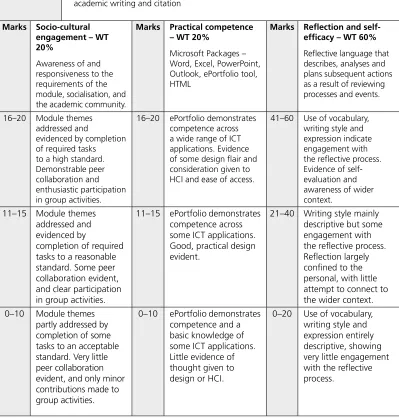
The taxonomy presented here (Table 1) seeks to evaluate three elements of importance to this PDP/ePortfolio project.
1 Engagement with concept
It has been shown in several recent studies (Peters, 2006, Clark, 2006) that the level of student engagement with PDP and metacognitive skills has a measurable effect on their overall academic performance. It is therefore essential that all students are made aware of this connection, and motivated to engage with the concept, from the ‘Roberts’ who may be reluctant to relect on their own learning processes because of perceived ‘failures’ in academic experiences in the past, to the ‘Susans’ who may regard emphasis on engagement, planning and relection as a waste of time and a diversion from their acquisition of knowledge. The fact that these elements of PDP are part of the summative assessment of this module ensures some measure of student engagement, and the move to the ePortfolio as a vehicle for assessment increased both enthusiasm and achievement. These comments from two students can be regarded as typical:
The e-portfolio facility has been a very effective tool in assisting my learning during this module. It has helped me to easily group together my work for analysis and reflection. This method of review allows me to refine my work so that it meets the standards required.
Student achievement as measured against the learning outcomes of the module also improved with the introduction of the ePortfolio, 35% of the students achieving a irst-class (70%+) result as compared to only 11% in the days of the paper-based portfolio.
Students are also required to work collaboratively to support each other’s learning, which can increase commitment, provide peer feedback and introduce them to the idea of communities of practice, which are common in both the academic and professional worlds.
The taxonomy for assessment therefore includes a measure of engagement with the PDP/ePortfolio concept. It is considered that the number and quality of completed tasks and the way they are presented in the portfolio is a good indicator of student engagement with the process. First-year students are therefore asked to submit all tasks as indicated on the teaching and learning schedule. They can also add any other relevant material they wish, if it is accompanied by an appropriate rationale. Evidence of collaboration with peers in the giving and receiving of feedback (and of acting on it), and enthusiastic participation in group activities are also rewarded.
2 Practical Competence
The students studying this module all have an ICT background and are expected to exhibit a competent level of ICT skills throughout all of their work. Development of skills and experience in this area is included in the learning outcomes of this module. There is an expectation that the evidence they produce using a number of ICT resources will be an indicator of their competencies in this area. Such skills relate to the actual production of the ePortfolio in accordance with the assignment brief using the university’s VLE (Blackboard) and its ePortfolio tool. Evidence presented within the ePortfolio should have been produced using a fairly full range of Microsoft products, including Word, Excel, PowerPoint, Outlook, and in addition, some evidence of HTML experience can be encouraged. Also, use of the blog and wiki tools which are embedded as a part of the VLE is expected. This expectation of a high level of technological competence in the digital environment allows students to reveal and gain recognition for creative and artistic talents outside the conines of the module content. This provides our students with additional motivation to engage with the PDP/ePortfolio concept.
This type of competence is obviously not required in all subjects, and it could be replaced by context-speciic requirements for other courses.
3 Reflection
There is widespread acknowledgement that relection is an integral part of PDP and of the development of life-long learning skills. According to Grant, Strivens and Marshall (2004):
A key process in PDP is reflection, and to support reflection effectively, the learner needs to be given opportunities both to reflect and to record reflection in words.
Although there is not yet true consensus about what constitutes evidence of relection, approaches to relection have been around for many years now. Dewey (1933) talked about consciously looking at one’s actions, and those of other people, with a view to informing future changes in relation to those actions. Habermas (1971) presents us with ideas around three kinds of knowledge, and discusses how human beings process those ideas. Kolb’s (1984) ‘Relective Learning Cycle’ is a well known model suggesting shifts and patterns through which relection and subsequent experimentation revolve, leading towards a more well informed learner, able to build on and move forward as a result of consciously working through this process. Schon (1983, 1987) brought attention to the links between theory and practice, and presented two modes of relection – ‘relection-on-action’ and ‘relection-in-action’. All of these writings are very relevant with regard to informing today’s thinking around relection and its relationship to learning, both ‘deep’ and ’surface’ learning (Marton, Hounsell and Entwistle, 1997). Opinion on the subject in higher education seems to be coalescing; Jenny Moon has developed these ideas and discusses how learning might be represented – i.e. in writing, orally, graphically – and suggests that:
In the context of these modules, the elements of PDP such as self-evaluation, or the collection of appropriate evidence to support a job application, could be regarded as the complicated or unstructured ideas mentioned by Moon, in that they need conscious, deliberate relection to achieve coherence. In addition, one of the six ‘key conditions’ of Assessment for Learning, as formulated by the Centre for Excellence in Teaching and Learning at Northumbria, is an emphasis on authentic and complex assessment tasks, such as those required for the ePortfolio. A criteria-based assessment taxonomy can cope with any ‘unexpected outcomes’ of the relection, and give credit for original insight. Relective practice is an important part of ‘learning how to learn’, of developing into an autonomous life-long learner. It could be said that these students have a greater need of this than most, as their chosen ield – information technology – is evolving at an ever-increasing rate. It has been estimated (Wiliam, 2008) that 60% of what a computing student learns during a university course will be obsolete by the time s/he graduates. An ability to relect on previous experience and knowledge to help ‘construct’ new knowledge will be a vital skill for these information age workers.
Various taxonomies for the evaluation of relective writing have been produced over the last few years, such as Biggs and Collis’ SOLO taxonomy (1982) as well as those by Hatton and Smith (1995) and Jenny Moon (2001).
Biggs and Collis’ Structure of the Observed Learning Outcome (SOLO) taxonomy was developed to address the need for qualitative criteria of learning that have formative as well as summative value. They consider that:
… matching learning outcomes with the original intentions of learning should be done in such terms that the information thus provided becomes valuable feedback for both teacher and student.
The taxonomy is presented in the form of a table, with ive ‘levels’ of understanding ranging from pre-structural (minimal) to extended abstract (maximal) with criteria under the headings of capacity, relating operation, and consistency and closure. Each stage adds to the previous cognitive responses. By deining curriculum objectives and evaluating learning outcomes, the levels at which students are performing can be identiied. According to Moseley et al. (2004):
The SOLO taxonomy can be used to classify the quality of students’ responses to assessment items.
Jenny Moon (2001) developed a framework for the evaluation of relective writing from the work of Hatton and Smith (1995), in which four types of writing are identiied:
• descriptive writing • descriptive relection • dialogic relection • critical relection.
The deining characteristics of these types of writing represent increasing amounts of relection and metacognition. The framework can be used to evaluate relective writing as well as identifying learning outcomes.
Although useful, neither of these taxonomies can be used to assess all elements of an ePortfolio. They are mainly designed to be used for the evaluation of written documents, and would be dificult to apply to tasks where the use of technology is assessed, for instance. In addition, they were mainly written for academics, and as such present the criteria in language not readily understood by irst-year technology students. Therefore, while we have drawn considerably on the ideas and expertise of these authorities, we have added incremental criteria for the evaluation of elements other than the relective writing, and tried to express all criteria in a student-friendly way. The addition of mark ranges with the criteria show the students exactly what they have to do to succeed.
Our taxonomy has these advantages: • It is expressed in clear, simple English
• It is consistent with, but extends the range of, accepted taxonomies for the assessment of learning and relection
• It is easily understood and remembered, making it a suitable model for practical use by teachers and learners • It indicates the grades equivalent to the standard reached
Table 1 A taxonomy for the assessment of PDP/ePortfolios
Context: Business information systems
Module title: Skills for Information Systems Professionals
Module learning outcomes:
By the end of this module students should be able to:
• Assemble and maintain an ePortfolio of work providing evidence of their knowledge, skills and competences, and demonstrate relection on their learning progress over the year • Use technology effectively for communication and demonstration
• Communicate effectively and conidently, choosing methods appropriate to the situation encountered
• Demonstrate management skills such as time management, team building/working, decision making and problem-solving techniques
• Conidently use academic sources of reference, and understand the conventions of academic writing and citation
Marks Socio-cultural engagement – WT 20%
Awareness of and responsiveness to the requirements of the module, socialisation, and the academic community.
Marks Practical competence – WT 20%
Microsoft Packages – Word, Excel, PowerPoint, Outlook, ePortfolio tool, HTML
Marks Reflection and self-efficacy – WT 60%
Relective language that describes, analyses and plans subsequent actions as a result of reviewing processes and events.
16–20 Module themes addressed and
evidenced by completion of required tasks to a high standard. Demonstrable peer collaboration and enthusiastic participation in group activities.
16–20 ePortfolio demonstrates competence across a wide range of ICT applications. Evidence of some design lair and consideration given to HCI and ease of access.
41–60 Use of vocabulary, writing style and expression indicate engagement with the relective process. Evidence of self-evaluation and awareness of wider context.
11–15 Module themes addressed and evidenced by
completion of required tasks to a reasonable standard. Some peer collaboration evident, and clear participation in group activities.
11–15 ePortfolio demonstrates competence across some ICT applications. Good, practical design evident.
21–40 Writing style mainly descriptive but some engagement with the relective process. Relection largely conined to the personal, with little attempt to connect to the wider context. 0–10 Module themes
partly addressed by completion of some tasks to an acceptable standard. Very little peer collaboration evident, and only minor contributions made to group activities.
0–10 ePortfolio demonstrates competence and a basic knowledge of some ICT applications. Little evidence of thought given to design or HCI.
Back to Robert and Susan and the learning journey
Making qualitative judgements in relation to student work is a fundamental part of a tutor’s role, and it is not easy to present a taxonomy that seeks to ease this burden. Robert may engage with relective writing in his ePortfolio just as enthusiastically as Susan – perhaps even more so – and the depth of that subsequent engagement may be signiicant to Robert, yet Susan may view his evidence as being of a lesser quality than hers. However, the way in which students engage with self-eficacy and relection in relation to their own learning journey can be something that is purely an individual gain that may take either a short time or a long time for that individual, depending upon the circumstances. Although individual pieces of work can be assessed, the journey is dificult – if not impossible – to evaluate objectively to satisfy the demands of the current higher education assessment regulations, and the tutor’s role here should perhaps be limited to encouragement, formative feedback and comment. The ePortfolio environment provides ways of doing this in a timely and eficient manner.
Evaluation and conclusions
This taxonomy was piloted by the module team in the marking of approximately 100 irst-year ePortfolios in academic year 2007–2008. It was found to be an eficient marking scheme, easy to interpret and apply, giving valid and reliable results when used by two markers. The student marks produced by the use of the taxonomy were commensurate with those of the previous year, and the average marks of the assessors were within 1% of each other (61.7% to 60.6%) The taxonomy will be more rigorously tested this year, in that it will be used by a total of four markers on the irst-year cohort, two of whom are new to the module, and have had no part in the design of either the module or the taxonomy. The taxonomy will also be used this year, with some modiication, to assess the second-year employability module. Data for both modules will be collected and analysed in a more formal way, and will include:
• student opinion and comment on the taxonomy as given in focus group sessions and interviews • staff opinion as recorded in relective blogs and given in interviews
• external moderator comments
• comments by colleagues offered at conferences after presentation of the taxonomy.
This module links relection, PDP and ePortfolio and presents them as intertwined entities that exist in their own right, but can also be dependent on each other for success. Although this model of delivering and assessing PDP by ePortfolio may not it naturally into the conventional higher education assessment programme, the taxonomy outlined here goes some way towards
… balancing and rebalancing the dilemmas of assessment of and for student learning.
(Havnes and McDowell, 2008)
References
All websites accessed 15.12.08
Anderson, L. W. and Krathwohl, D. R. (2001) (eds) A Taxonomy for Learning, Teaching and Assessing, New York: Longman.
Baume, D. (2002) Portfolios, learning and assessment. Centre for Recording Achievement. www. recordingachievement.org/downloads/Assess_Portfolios.pdf
Biggs, J. B. (1999) Teaching for Quality Learning at University. Buckingham: SRHE and Open University Press. Biggs, J. B. (2003) Teaching for Quality Learning at University, 2nd edn. Buckingham: SRHE and Open University Press.
Biggs, J. B. and Collis, K. F. (1982) Evaluating the Quality of Learning: the SOLO Taxonomy. New York: Academic Press.
Burgess, R. (Chair) (2007) Beyond the honours degree classification: The Burgess Group final report. Universities UK
Clark, W. (2006) PDP and ePortfolios: evaluating the effect on the quality of student learning. PDP-UK Newsletter Issue 9, December, HEA
www.recordingachievement.org/pdpuk/newsletter/PDPUK-Issue9-Dec2006.pdf
Dearing, R. (Chair) (1997) Higher Education in the learning society; report of the National Committee of Enquiry into Higher Education. London: HMSO
Dewey, J. (1933) How We Think. Boston, MA: D C Heath and Co.
Grant, S, Strivens, J. and Marshall, A. (2004) E-portfolio systems supporting learning and personal development planning. www.simongrant.org/pubs/ep2004/maintext.html
Hatton, N. and Smith, D. (1995) Relection in teacher education – towards deinition and implementation. Teaching and Teacher Education 11(1): 33–49.
Havnes, A. and McDowell, L. (2008) Assessment dilemmas in contemporary learning cultures. A Havnes and L McDowell (eds) Balancing Dilemmas in Assessment and Learning in Contemporary Education. Routledge. Houghton, W. (2004) Constructive Alignment – and why it is important to the learning process. Engineering Subject Centre Guide: Learning and Teaching Theory for Engineering Academics. Loughborough: HEA Engineering Subject Centre.
www.engsc.ac.uk/er/theory/constructive_alignment.asp
Kolb, D. (1984) Experiential Learning as the Science of Learning and Development, Englewood Cliffs, NJ: Prentice Hall.
Leitch, S. (Chair) (2006) Prosperity for all in the global economy – world class skills: Leitch Review of Skills. London: The Stationery Ofice.
Marton, F., Hounsell, D. and Entwistle, N. (1997) The Experience of Learning. Edinburgh: Scottish Academic Press. Meighan, R. (1999) Some principles of educational reconstruction. 21st Century Learning Initiative.
www.21learn.org/archive/articles/meighan.php
Moon, J. (2001) PDP Working Paper 4 – Relection in Higher Education Learning. LTSN Generic Centre Moon, J. (2004) Relection and employability. Learning and Employability Series (4). LTSN Generic Centre. Moseley, D., Baumield, V., Higgins, S. et al. (2004) Thinking skill frameworks for post-16 learners: an evaluation, Learning and Skills Research Centre.
Peters, J. (2006) Researching student attitudes to personal development planning (PDP). PDP-UK Newsletter Issue 7 March, HEA.
Pitts, J., Coles, C. and Thomas, P. (2001) Enhancing reliability in portfolio assessment: ‘shaping’ the portfolio. Medical Teacher 23(4): 351–356.
Prensky, M. (2001) Digital Natives, Digital Immigrants. On the Horizon, MCB University Press, 9 (5), October 2001. Rees, C. E., Shepherd, M. and Chamberlain, S. (2005) The utility of relective portfolios as a method of assessing medical students’ personal and professional development. Reflective Practice 6(1): 3–14.
Rees, C. E. and Sheard, C. E. (2004) The reliability of assessment criteria for undergraduate medical students’ communication skills portfolios: the Nottingham experience. Medical Education 38: 138–144.
Schon, D. (1983) The Reflective Practitioner. San Francisco: Jossey-Bass
Schon, D. (1987) Educating the Reflective Practitioner. San Francisco: Jossey-Bass
Snadden, D. (1999) Portfolios – attempting to measure the unmeasurable? Medical Education 33:478–479 Thompson, J. (2002) Personal development planning at Northumbria. LTSN Workshop on Using portfolios to assess learning outcomes, Northumbria University.