A Scale for Crawler Effectiveness on the
Client-Side Hidden Web
V´ıctor M. Prieto1, Manuel ´Alvarez1, Rafael L ´opez-Garc´ıa1, and Fidel Cacheda1
Comunication and Information Technologies Department - University of A Coru ˜na Campus de Elvi ˜na s/n - 15071 (A Coru ˜na - Spain)
{victor.prieto, manuel.alvarez, rafael.lopez, fidel.cacheda}@udc.es
Abstract. The main goal of this study is to present a scale that classifies crawling systems according to their effectiveness in traversing the “client-side” Hidden Web.
First, we perform a thorough analysis of the different client-side technolo-gies and the main features of the web pages in order to determine the basic steps of the aforementioned scale. Then, we define the scale by grouping basic scenarios in terms of several common features, and we propose some methods to evaluate the effectiveness of the crawlers ac-cording to the levels of the scale. Finally, we present a testing web site and we show the results of applying the aforementioned methods to the results obtained by some open-source and commercial crawlers that tried to traverse the pages.
Only a few crawlers achieve good results in treating client-side technolo-gies. Regarding standalone crawlers, we highlight the open-source crawlers Heritrix and Nutch and the commercial crawler WebCopierPro, which is able to process very complex scenarios. With regard to the crawlers of the main search engines, only Google processes most of the scenarios we have proposed, while Yahoo! and Bing just deal with the basic ones. There are not many studies that assess the capacity of the crawlers to deal with client-side technologies. Also, these studies consider fewer tech-nologies, fewer crawlers and fewer combinations. Furthermore, to the best of our knowledge, our article provides the first scale for classifying crawlers from the point of view of the most important client-side technologies. Keywords:Web Search, Crawlers, Hidden Web, Web Spam, JavaScript
1.
Introduction
The World Wide Web (WWW) is the biggest information repository ever built. There are huge quantities of information that are publicly accessible, but as important as the information itself is being able to find, retrieve and gather the most relevant data according to users’ needs at any given time.
forms, pop-up menus, redirection techniques, mechanisms for maintaining user sessions, different layers which are shown or hidden depending on users’ ac-tions, etc. The pages that can only be accessed through these technologies constitute what we call Hidden Web [2] and, particularly, the set of pages that are “hidden” behind client-side technologies are called the “client-side Hidden Web”. They represent a big challenge for programmers, since it is not easy to implement techniques that deal with them in a fully automatic way.
The objective of this paper is to present a scale for classifying crawlers ac-cording to their treatment of the client-side Hidden Web. This crawling scale will allows us a) to determine the capacities of each crawler dealing with client-side web technologies b) to know the percentage of the Web which has not been covered by crawlers and c) to know whether it is necessary to improve current crawling systems in order to deal with client-side web technologies in a better way.
The paper is organized as follows. In section 2 we analyse the related works. Section 3 shows the most important client-side technologies. In section 4 we list the difficulties that crawlers can find during their traversal and we classify them to create a scale. Section 5 shows this scale, which takes into account the level of use of each technology on the Web, the computational difficulty of each scenario and whether the crawlers have dealt with them. We also discuss some methods to assess the effectiveness of the crawlers at processing the aforementioned difficulties. In section 6 we show the website we have created to evaluate the crawlers and the results that each of them has obtained when traversing its pages. Finally, in sections 7 and 8 we explain the conclusions of the study and possible future works respectively.
2.
Related works
There are many studies on the size of the Web and the characterisation of its content. However, there are not so many studies on classifying Web pages ac-cording to the difficulty for crawlers to process them. Weideman and Schwenke [20] published a study analysing the importance of JavaScript in the visibility of a Web site, concluding that most of the crawlers do not deal with it appropri-ately. However, according to the data submitted in [19] [4], currently the 90% of the Web pages use JavaScript.
From the point of view of crawling systems, there are many works aimed at creating programs that are capable of traversing the Hidden Web. There are some researches that tackle the challenges established by the server-side Hid-den Web, by searching, modelling and querying web forms. We highlight HiWE [18] because it is one of the pioneer systems. Google [14] has also provided the techniques that it has used to access information through forms. Nevertheless, there are fewer studies about the client-side Hidden Web and they basically follow these approaches: they either access the content and links by means of interpreters that can execute scripts [16] [9], or they use mini-browsers such as
There are also studies about the client-side technologies from the point of view of Web Spam. Their objective is to analyse the use of technologies in order to detect Web Spam techniques [10] such as Cloacking [21] [23], Redirection Spam [6] or Link Farm Spam [22].
Nevertheless, we do not know any scales that allow researchers to classify the effectiveness of the crawling systems according to their level of treatment of client-side Hidden Web technologies.
3.
Client-side Web technologies
In order to define the scale, the first step is to understand the impact of the dif-ferent client-side technologies on the Web (“Web Coverage”). For this purpose,
we have used “The Stanford WebBase Project”1 dataset, which is part of the
“Stanford Digital Libraries Project”2.
This dataset contains different kinds of sources and topics and more than 260 TB of data. For this analysis, we have created a 120 million page subset from the latest 2011 global datasets. In this dataset we have analysed technolo-gies typically used to improve the user experience, such as:
– JavaScript [8], dialect of the ECMAScript standard, is an imperative and
object-oriented language. It allows programmers to generate the interface dynamically.
– Applet, Java component of an application that is executed in a Web client.
– AJAX [11], technology that uses JavaScript for sending and receiving
asyn-chronous requests and responses.
– VBScript [13], interpreted language created by Microsoft as a variant of
Visual Basic.
– Flash [3], application that allows programmers to create vectorial interfaces.
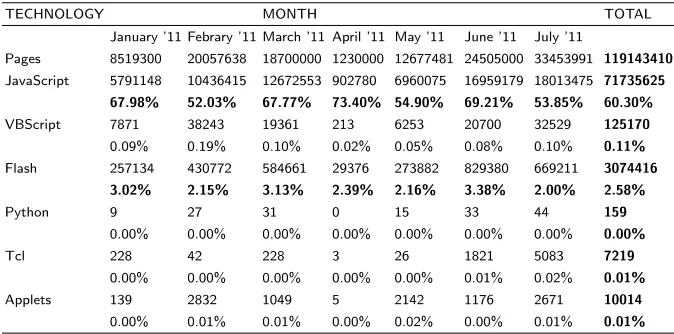
Table 1 shows the results obtained by each technology (row) per month (col-umn). According to these results, 60.30% of the documents contain JavaScript while only 2.58% contain ActionScript (Flash). The degree of occurrence of technologies like VBScript, Python and Tcl, is merely symbolic.
In short, these results confirm our assumption about the importance of knowing whether the crawlers treat the client-side technologies, since the use of JavaScript is generalized.
4.
Occurrence of the main technologies
To define the basic levels of the scale we have identified the most commonly used mechanisms for generating links. To do this, we have relied on the tech-nology analysis done in the “Client-side Web technologies” section and on a
1
http://dbpubs.stanford.edu:8091/ testbed/doc2/WebBase/
2
Table 1.Analysis about Web technologies.
TECHNOLOGY MONTH TOTAL
January ’11 Febrary ’11 March ’11 April ’11 May ’11 June ’11 July ’11
Pages 8519300 20057638 18700000 1230000 12677481 24505000 33453991 119143410
JavaScript 5791148 10436415 12672553 902780 6960075 16959179 18013475 71735625
67.98% 52.03% 67.77% 73.40% 54.90% 69.21% 53.85% 60.30%
VBScript 7871 38243 19361 213 6253 20700 32529 125170
0.09% 0.19% 0.10% 0.02% 0.05% 0.08% 0.10% 0.11%
Flash 257134 430772 584661 29376 273882 829380 669211 3074416
3.02% 2.15% 3.13% 2.39% 2.16% 3.38% 2.00% 2.58%
Python 9 27 31 0 15 33 44 159
0.00% 0.00% 0.00% 0.00% 0.00% 0.00% 0.00% 0.00%
Tcl 228 42 228 3 26 1821 5083 7219
0.00% 0.00% 0.00% 0.00% 0.00% 0.01% 0.02% 0.01%
Applets 139 2832 1049 5 2142 1176 2671 10014
0.00% 0.01% 0.01% 0.00% 0.02% 0.00% 0.01% 0.01%
manual analysis of a subset of 1000 pages selected randomly from the dataset discussed above. We have also considered the Web design common practices [7] [12].
The following features have been identified:
– Text links, which constitute the lowest level of the scale.
<a href="a 110001001000000000 test...html">Luis Ramirez Lucena</a>
– Simple navigations, generated with JavaScript, VBScript or ActionScript.
This feature includes links that are generated by means of “document.write()” or similar functions in other languages, which allow designers to add new links to the HTML code dynamically.
<a href="JavaScript: ...">Paolo Boi</a>
– Navigations generated by means of an Applet.
– Navigations generated by means of Flash.
– In the case of Applets and Flash, we divide links into two types: those which
are passed as an argument to the application and those whose URL is created as a string inside the code.
– Navigations generated by means of AJAX.
– Pop-up menus, generated by a script that is associated to any event.
– Links that are defined as strings in .java, .class files or any other kinds of
text and binary files.
– Navigations generated in script functions. They can be written in any
script-ing language and the script can be either embedded inside the HTML or located inside an external file.
• Redirections specified in the<meta>tag.
• Redirections generated by the “onLoad” event of the<body>tag.
• Redirections generated by a script when an event in another page is
fired (e.g.: the “onClick” event).
• Other redirections in script blocks, which are executed the moment the
page is loaded.
• Redirections executed in an applet when the page is loaded.
• Flash redirections, executed when the page and its corresponding Flash
file are processed.
In addition, the navigations that are generated with any of the methods we identified can create absolute or relative URL addresses. For the addresses that are generated by means of any scripting language, it is possible to recognize the following construction methods:
– A static string inside the Script.
menu static embedded relative(){
document.location="a 10010101100000000...html";
}
– A string concatenation.
function menu concatenated embedded relative(){
var out="";
out="a 10010010100000000000 test menu" + " concatenated embedded relative.html"; document.location=out;
}
– Execution of a function that builds the URL in several steps.
function menu special function embedded relative(){
var a1="win",a2="dow",
a3=".location.",="replace",a5;
a5="(’a 1001000110000000000 test menu special function"; var a6=" embedded relative.html’)"; var i,url=""; for(i=1;i<=6;i++){
url+=eval("a"+i);
}
eval(url);
}
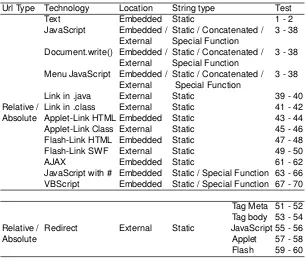
The 70 scenarios we have proposed are combinations of the types of URLs, technologies, locations and methods of construction of URLs we identified, all of them shown in the columns of Table 2. At the bottom of the table we show the different types of redirections. The number of scenarios could be higher, but it would not provide more information about the use of client-side technologies on the Web or about the methods that crawlers use to discover links. For ex-ample, it is not necessary to take into account the combination of menus and “document.write()” because we can deduce the capacity of the crawler from the two base cases that have been included separately.
Table 2.Combination of the types of links.
Url Type Technology Location String type Test
Text Embedded Static 1 - 2
JavaScript Embedded / Static / Concatenated / 3 - 38 External Special Function
Document.write() Embedded / Static / Concatenated / 3 - 38 External Special Function
Menu JavaScript Embedded / Static / Concatenated / 3 - 38 External Special Function
Link in .java External Static 39 - 40
Relative / Link in .class External Static 41 - 42 Absolute Applet-Link HTML Embedded Static 43 - 44 Applet-Link Class External Static 45 - 46 Flash-Link HTML Embedded Static 47 - 48 Flash-Link SWF External Static 49 - 50
AJAX Embedded Static 61 - 62
JavaScript with # Embedded Static / Special Function 63 - 66 VBScript Embedded Static / Special Function 67 - 70 Tag Meta 51 - 52 Tag body 53 - 54 Relative / Redirect External Static JavaScript 55 - 56
Absolute Applet 57 - 58
Flash 59 - 60
5.
The scale for web crawlers
To create the scale from the 70 scenarios we have proposed, we have imple-mented a grouping process based on their difficulty:
– Theoretical difficulty of processing each scenario.
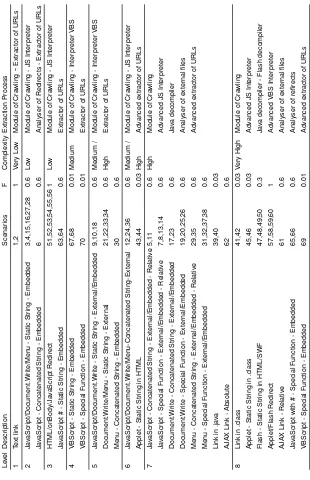
Regarding the first issue, we have performed a theoretical and an empirical analysis of the scenarios in order to determine the necessary modules for a crawler to process them. The theoretical analysis consists in calculating the processing modules that a crawling system would need to process each kind of difficulty (“Extraction Process” column in Table 3). For example, to treat the plain text scenario (level 1), we only need the crawler and a basic URL extractor. However, to extract URLs embedded in JavaScript code (level 2), we would also need a JavaScript interpreter, thus increasing the complexity.
After this, we have assessed our analysis by empirically processing the sce-narios by means of well-known existing tools (JavaScript interpreters, Flash decompilers, and so on). Depending on the number and complexity of the mod-ules that are needed to process a scenario, we have assigned a discrete score to it, which is shown in “Complexity” column of Table 3. The values are based on the difficulty of developing such modules and the computational expenses of their execution. Our grouping is based on the assumption that the scenarios which require a bigger number of modules are more difficult to treat.
To learn how crawling systems process the different scenarios, we have implemented a web site (see section 6.1) that contains all the scenarios shown in Table 2. Table 6 and Table 7 (see section 6) show the results obtained by the different crawlers that traversed the example website, grouped by technology and link building method. In this case, we have grouped the scenarios that have been processed by the same number of “crawling systems”, because they are considered to have the same complexity.
Based on these analyses, we have clustered the pre-defined scenarios to form the 8 levels of the scale we propose, which is shown in Table 3. For each level there is a brief description, the scenarios that are part of it and their com-plexity. Table 3 also shows the frequency of appearance on the Web of each web technology that has been used in each scenario (column “F”). This fre-quency has been obtained from the results of the Web analysis we show in section 3 (Table 1). For example, the percentage of use of JavaScript is 60.30%, so, normalising to 1, the scenarios based on JavaScript will have a frequency of 0.6. In the case of text links, we have assumed that all the web pages have at least a text link, therefore we will use a frequency of 1. This information com-plements our scale and allows determining more accurately what portion of the Web is treated by each crawling system, as well as the maximum complexity level reached.
In the next section, we propose various evaluation methods for measuring the effectiveness of a crawler according to the scale.
5.1. Scale evaluation method
preliminary step, we specify the following concepts to help us formally define each method:
– Let beS ={F ull set of scenarios}, being|S|the total number of scenarios
andSia binary value which establishes “1” if the crawler achieved thei−th
scenario ofSor “0” in another case.
– Let be N = {F ull set of levels that the crawler processes successf ully}
being|N|the total number of levels and|Ni|each element ofN.
– Let beC={F ull set of crawlers}, being|C|the total number of crawlers,
Ci={Set of crawlers that achieved the scenario i}. The values ofCiare
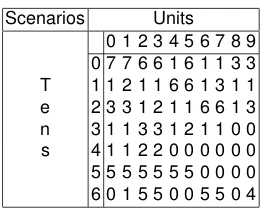
shown in Table 4. The set of 70 scenarios are shown in a matrix where the scenario ids are built taking the value of the upper row as the units, and the value of the left column as the tens.
Table 4.Values ofCi.
Scenarios Units 0 1 2 3 4 5 6 7 8 9 0 7 7 6 6 1 6 1 1 3 3 T 1 1 2 1 1 6 6 1 3 1 1 e 2 3 3 1 2 1 1 6 6 1 3 n 3 1 1 3 3 1 2 1 1 0 0 s 4 1 1 2 2 0 0 0 0 0 0 5 5 5 5 5 5 5 0 0 0 0 6 0 1 5 5 0 0 5 5 0 4
– Let befithe frequency (see Table 3) of occurrence ofi.
We now describe each of the methods we propose:
– Simple Average: it treats the scenarios defined for each level in the same
way, without taking into account their difficulty. It highlights the crawlers which treat the highest number of scenarios, and consequently pay more attention to the Hidden Web in general.
SA=
1
|S| |S|
X
i=1 Si
– Maximum Level: this model sorts crawlers according to the highest level of
difficulty they can process. A crawler obtains a scoreiif it has the capacity of
a crawler is capable of dealing with a leveli, it should be able to deal with lower ones.
M L=i | ∀i, j∈1. . .|N|Ni, Nj= 1Λ i≥j
– Weighted Average: this measure depends on the number of crawlers that
have previously been able to process each scenario (Ci) and whether the
new crawler has been able to process it (the binary value we have called
Si). Assuming that all crawlers can deal with most of the easiest scenarios,
this method gives importance to the crawlers that can obtain the highest number of difficult resources in the client-side Hidden Web, since they are the only ones with can get points in the difficult scenarios.
W A=
1
|C|+ 1
∗
|S|
X
i=1
((Ci+Si)∗Si)
– Eight Levels: in this model each level has a value of one point. If a crawler
processes all the scenarios of one level it obtains that point. For every
sce-nario that the crawler processes successfully, it gets1/npoints, wherenis
the total number of scenarios that have been defined for that level.
LetL = {L1. . . L8} be the sets of scenarios which represent the 8 levels
previously defined. ThenLijis thej−thscenario ofi−thlevel. The number
of elements of each set can be different from the others.
L11. . . L1p →L1
..
. ... ... ... ...
L81. . . L8w→L8
EL=
8 X
i=1
|Li|
X
j=1 Lij |Li|
These models allow researchers to measure crawling systems capacity of obtaining links with a certain difficulty. However, in order to get a more con-clusive opinion about which crawler processes the client-side Hidden Web the best, it is important to contextualise the technologies and their degree of occur-rence in the Web. A crawler is not better than another if it processes a higher level in the scale when that level has few Web resources.
To solve this problem, we have defined the “Crawling Web Coverage” metric as the number of scenarios that a crawler solves, weighing up the technolo-gies involved according to their frequency on the Web. We have also extended Weighted Average and Eight Levels, creating two new methods, called “Ranked Weighted Average” and “Ranked Eight Levels”, which work like the basic meth-ods but consider the degree of occurrence of each scenario on the Web.
According to their data 90% of the web pages use it, but in our study this number has decreased to 60%. We have chosen our result because their data are based on an analysis of pages included in the top 1 million or top 10,000 visits. We do not consider that those pages represent the reality of the Web, since they have high traffic and use innovative technologies to offer a better user experience.
The F (Frecuency) column of Table 3 shows the occurrence frequency of the base technology of each level. In this way, a crawler that processes a level with frequency 1 will be more valuable than one that processes a level with a lower frequency, since the probability of finding a link of the first type on the Web is much higher. On the other hand, a crawler that obtains links with a value of 0.01 will not get a high result, since this kind of links are scarce on the Web.
– Ranked Weighted Average
RW A=
1
|C|+ 1
∗
|S|
X
i=1
((Ci+Si)∗Si ∗fi)
– Ranked Eight Levels
REL=
8 X
i=1
|Li|
X
j=1
fi,j∗Li,j |Li|
The Simple Average and Weighted Average methods and their ranked coun-terparts should be normalized in order to obtain values between 0 and 8, which make the methods easier to use and to compare.
As we can see, each method provides a different point of view on the capa-bilities of a crawler. Therefore, it is precisely this set of all methods that gives us a global vision of the processing capacity of the client-side technologies and the percentage of the web that is being treated.
6.
Experimental results
In this section we describe the results of the experiments for the creation of the scale and its application in the classification of open-source and commercial crawlers. As a preliminary step, we describe the website we have designed to perform the tests.
6.1. Testing web site
In order to check how crawling systems deal with the different scenarios, we
have created a Web site3for performing experiments. This Web site contains
70 links representing the 70 scenarios shown in Table 2. Those links use and combine the different technologies explained previously. With the purpose of
3
stimulating the indexing of the Web site, we have linked it from the main Web page of our institution Web site, we have written its content in English and we have added the biography of a famous chess player to each scenario. The latter measure was taken in order to avoid confusion with Web Spam sites.
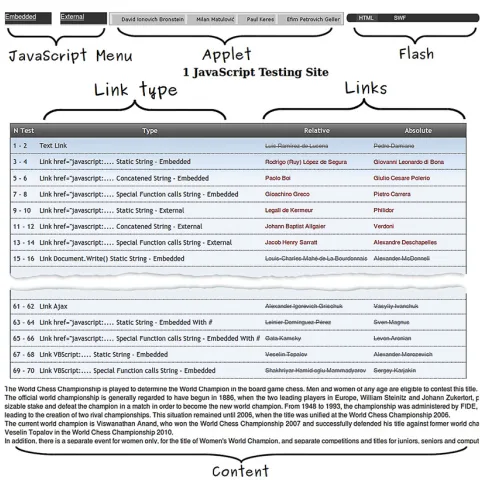
Fig. 1.Main page of the prototype.
Fig. 1 shows the main page of the prototype. It contains the following parts:
– At the top, from left to right, there are links in a JavaScript menu, links
generated in an Applet and links in Flash.
– In the middle of the page, there is a table with four columns containing the
test number, its type and the relative and absolute links respectively.
– At the bottom, below the table, it is the content.
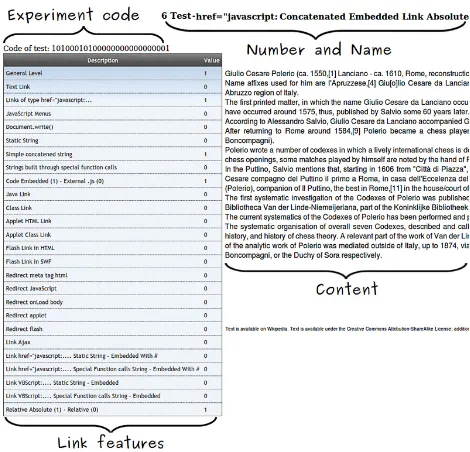
Apart from that, we have created a page for the result of each test, so if a crawler can access certain contents, it will mean that it has been able to process the corresponding links. Fig. 2 shows a result page, consisting of the following elements:
– At the top-centre, it shows the test number and name.
– At the top-left it shows the reference code of the test, a binary mask that
represents the features of the test.
– On the left side, it shows a table that enumerates the features of the test.
Fig. 2.Target Web page associated to the link of one scenario.
6.2. Experimental setup
For both the realization of the scale and the classification of crawling systems according to the evaluation methods, we have obtained two types of results.
The first one is based on the fact that a crawling system indexes the re-sources it obtains, and puts the data in a certain repository. Hence, we can extract information by querying this repository. On the other hand, we can ex-tract access information from the log files of the Web server that maintains the testing Web site, in order to identify the crawlers that were accessing any page of that server. With this study we want to get further detail on how crawlers try to process each level. We have used the User-Agent and IP pairs published in the
official robots page4 to identify and remove non-independent crawlers, that is
to say, those which depend on the crawler of a third party. In order to accelerate the process of visiting and indexing the site, we have registered the site in these
crawlers: GoogleBot5, Bing6, Yahoo!7, PicSearch8and Gigablast9.
For both the data in the logs and those obtained in the repositories, we have analysed the results of the crawlers of the major search engines as well as the
4http://www.robotstxt.org/ 5
http://www.google.es/addurl/
6
http://www.bing.com/webmaster/SubmitSitePage.aspx
7
http://siteexplorer.search.yahoo.com/submit
8
http://www.picsearch.com/menu.cgi?item=FAQ
9
results of open-source and commercial ones. We have compared the global results in terms of the type of link and in terms of the method of construction of the URL string. First, we have studied each type of crawler independently, and then, comparing the results of both types.
These results have been used to evaluate each crawling system by means of the proposed methods and to obtain a final classification of each one in the scale we have proposed.
6.3. Open-source and commercial crawlers
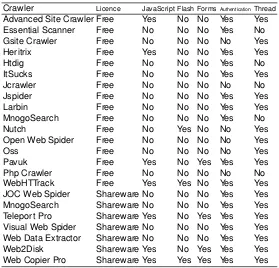
We have analysed 23 open-source and commercial crawlers. Table 5 shows their most important characteristics from the point of view of the client-side tech-nologies, along with the treatment of forms.
Among the features that they share, but we have not shown, we highlight: options about the use of a proxy, limitations in the number of documents, dif-ferent protocols, inclusion/exclusion of file extensions, cookies, User-Agent, op-tions about domains/directories, logging and some more.
Table 5.Open-source and Commercial Crawlers.
Crawler Licence JavaScript Flash FormsAuthenticationThread
Advanced Site Crawler Free Yes No No Yes Yes Essential Scanner Free No No No Yes No
Gsite Crawler Free No No No No Yes
Heritrix Free Yes No No Yes Yes
Htdig Free No No No Yes No
ItSucks Free No No No Yes Yes
Jcrawler Free No No No No No
Jspider Free No No No Yes Yes
Larbin Free No No No Yes Yes
MnogoSearch Free No No No Yes No
Nutch Free No Yes No No Yes
Open Web Spider Free No No No No Yes
Oss Free No No No No Yes
Pavuk Free Yes No Yes Yes Yes
Php Crawler Free No No No No No
WebHTTrack Free Yes Yes No Yes Yes
JOC Web Spider Shareware No No No Yes Yes
MnogoSearch Shareware No No No Yes Yes
Teleport Pro Shareware Yes No Yes Yes Yes Visual Web Spider Shareware No No No Yes Yes Web Data Extractor Shareware No No No Yes Yes
Web2Disk Shareware Yes No Yes Yes Yes
After examining these and other features, and taking into account the eval-uation of their results in the treatment of client side technologies, we have se-lected the seven best crawlers among those shown in Table 5.
Among the open-source crawlers, we have chosen Nutch10 [5], Heritrix11
[15], Pavuk12and WebHTTrack13, and among the commercial crawlers we have
chosen Teleport14, Web2disk15and WebCopierPro16.
6.4. Results for open-source and commercial crawlers
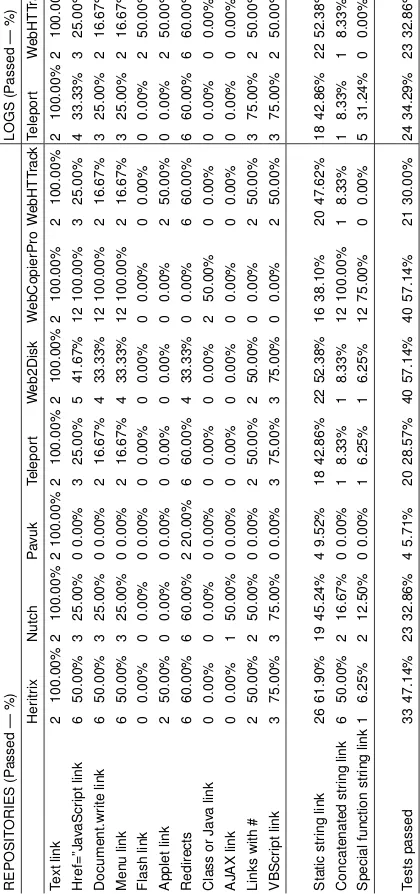
First, we have studied the results according to the content of the Web site that has been indexed by the different open-source and commercial crawlers. To that end, we have analysed the repositories that the crawler generated during its execution. The crawler that achieves the best results is WebCopierPro (left side in Table 6), which processed 57.14% of the levels, followed by Heritrix with 47.14% and Web2Disk with 34.29%. Only a few of them get values beyond 25% in most types of links, and even those are unable to get links in many cases.
It is also important to notice the poor results that they have obtained for redirections, especially in the case of WebCopierPro, which has not been able to deal with any of them, although it has got results of 100% in harder levels. None of the crawlers has reached the 100% in redirections, because they have not been able to process pages with redirections embedded in Applets or Flash. Although they have downloaded the pages, they have not executed the Flash or the Applet that generates the redirection.
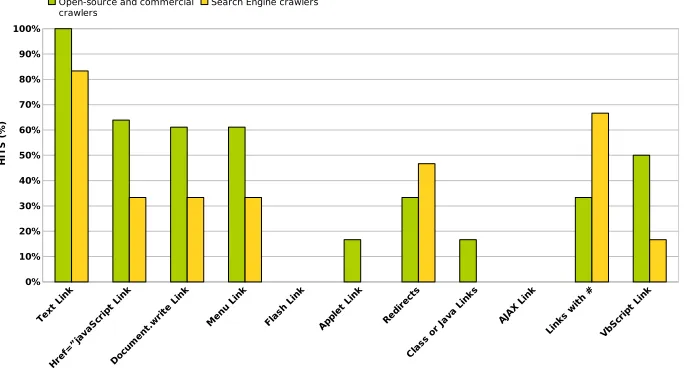
If we analyse the results by type of link, which are shown in the left columns of Fig. 3 (section 6), we will obtain a vision about which types of links are pro-cessed by a bigger number of crawlers. Apart from the 100% obtained for text links, we can verify that they can complete 35% to 40% of the scenarios of href=“javascript...”; “document.write()”; menu links; links with “#” and VBScript.
They only achieve 7% of the links in .class or .java files and those which have been generated with AJAX. None of them has got links from Flash, but this can be due to the scarce attention that crawlers pay to these kinds of links. The last rows of Table 6 classify the links by their construction method and show how many of them have been processed by each crawler. If we calcu-late the mean of the percentages, we have 42.52% for static links, 27.38% for links generated by string concatenation and 15.18% for links that generated by means of functions. This indicates that most of the crawlers search URLs by means of regular expressions.
10
http://nutch.apache.org/
11
http://www.archive.org
12
http://www.pavuk.org
13
http://www.httrack.com
14
http://www.tenmax.com/teleport/pro/home.htm
15
http://www.inspyder.com/ products/Web2Disk/Default.aspx
16
Table 6.Summary of results for open-source and Commercial crawlers. On the left side in the repositories and on the right side in the logs.
From these results, we conclude that the probability of finding links by means of regular expressions or treatment of text is inversely proportional to the diffi-culty of generation of the link.
Summarizing the data of Table 6, we conclude that only one third of the links that are generated with client-side technologies are treated by open-source or commercial crawlers.
As a complement to these results, we have analysed the entries that each crawler has generated in the logs of our Web server. The right side of Table 6 shows the results of the crawlers in the logs for the cases where these are dif-ferent from the results of analysing the repository (left side). Those differences are due to:
– WebHTTrack has tried to access Flash scenarios, but it has not taken into
account that the structure to pass parameters to Flash is “parameter1=data1& parameter2=data2&...” so it considers the whole string as an URL although it is not.
"GET mad/resources/projects/jstestingsite/1 test/ link relative=a 10000100100001000000000000
test flash link html relative.html&link absolute= http://www.tic.udc.es/∼mad/resources/projects/ jstestingsite/1 test/a 10000100100001000000000001
test flash link html absolute.html"
– Teleport has tried to access absolute URLs that have been generated by
a function. It detected “http...” patterns and searched the corresponding “.html” patterns that indicate the end of the address. Nevertheless, it has not detected that some variables have been defined in the middle, so the URL it has generated is incorrect.
"GET /∼mad/resources/projects/jstestingsite/1 test/"; var%20a6="a 10001001100000000000000001
test document write function special embedded absolute.html"
6.5. Results for crawlers of the main web search engines
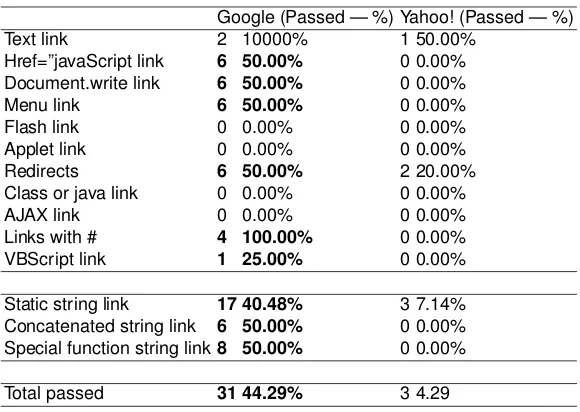
In order to perform the analysis of the crawlers that the main Web search en-gines use, we registered the Web site on the 23rd of May of 2011 in the different search engines. Once it was available, we waited for 70 more days. Then, we checked the logs of the Web site in order to know which crawlers had accessed at least the main page of the Web site. Table 7 contains the results we obtained. It does not show the results for Alexa, Ask, Bing, Gigablast and PicSearch, since they have not indexed the testing Web site. Only Google and Yahoo! indexed it. Among the factors that could induce some of the crawlers to skip the Web site, we could remark the following:
Table 7.Summary of the results for crawlers of the main Web search engines. Google (Passed — %) Yahoo! (Passed — %)
Text link 2 10000% 1 50.00%
Href=”javaScript link 6 50.00% 0 0.00% Document.write link 6 50.00% 0 0.00%
Menu link 6 50.00% 0 0.00%
Flash link 0 0.00% 0 0.00%
Applet link 0 0.00% 0 0.00%
Redirects 6 50.00% 2 20.00%
Class or java link 0 0.00% 0 0.00%
AJAX link 0 0.00% 0 0.00%
Links with # 4 100.00% 0 0.00%
VBScript link 1 25.00% 0 0.00%
Static string link 17 40.48% 3 7.14% Concatenated string link 6 50.00% 0 0.00% Special function string link8 50.00% 0 0.00%
Total passed 31 44.29% 3 4.29
– It is stored in a deep level inside the Web site of the department.
– High content of code. This can make crawlers’ heuristics decide that the
Web site might contain Malware or links too difficult to analyse.
Google processed 44.29% of the links. This implies that neither the design nor the content nor the other variables inhibited crawlers to try to traverse the Web site. Yahoo! also processed some links, but only the easiest ones.
GoogleBot processed 50% of many of the levels we proposed. The other half was not processed because the code was stored in an external file that the crawler did not analyse. If these files were analysed, we suspect that GoogleBot would achieve much better results. The links that GoogleBot did not process included technologies like Flash, Applets and AJAX or file types like .class and .java. These crawlers have shown the same results in the indices (querying their search engine) and in the logs of our Web server. Hence, we do not show the results separately.
6.6. Result comparison
Looking at the overall results (last row) of Tables 6 and Table 7, we see that generally, open-source and commercial crawlers achieve better results. Only Google, getting processed 34 of the 70 scenarios, has similar performance.
Text Lin
k
Href =”ja
vaSc ript
Link
Docu men
t.w rite
Link
Men u Li
nk
Flas h Li
nk
Appl et L
ink
Redi rect
s
Clas s or
Java Lin
ks
AJAX Lin
k
Link s w
ith #
VbSc ript
Link
0% 10% 20% 30% 40% 50% 60% 70% 80% 90% 100%
Open-source and commercial
crawlers Search Engine crawlers
H
IT
S
(
%
)
Fig. 3.Comparison among crawlers by link type.
Fig. 3 compares the results by technology used in the links. Once again, open-source crawlers have been more effective. One thing we would like to highlight is that the curve that every group of crawlers draw is similar. Hence, we can conclude that despite achieving a lower number of links in each technology, crawlers show the same interest in processing the same kind of technologies.
6.7. Classification of the crawlers according to the scale
After obtaining the results of each crawler in the website, we evaluate the crawl-ing systems in the scale, uscrawl-ing the evaluation methods we have proposed. Fig. 4 shows these results.
– For Simple Average, WebCopier gets the best results, followed by Heritrix
and Google.
– For Maximum Level, Google places first since it processes level 8 links. It is
followed by WebCopier, which obtains 7 points, and Heritrix, which obtains 6 points. As Google achieves the maximum level in this model but not in others, we can conclude that it has the capacity to deal with every scenario, but it does not try some of them because of internal policies.
– For the Weighted Average measure, WebCopier is followed by Google,
Her-itrix and Nutch.
– For Eight Levels, top places are for Heritrix, Web2Disk and WebCopier.
0,00 1,00 2,00 3,00 4,00 5,00 6,00 7,00 8,00
Heritrix Nutch Pavuk Teleport Web2Disk WebCopier WebHTTRack Google Yahoo
Simple Average
Maximum Level Weighted Average
Eight levels Crawling Web Coverage
Weighted Average 2 Eight levels 2
Fig. 4.Results according to the proposed scales.
However, the frequency of the technologies in the Web should be taken into account too. That is why we also show the Crawling Web Coverage metric and the results of the Ranked Weighted Average and Ranked Eight Levels methods, which are based on such metric. WebCopier, Google and Heritrix get the best results, so they are the ones that deal with the biggest portion of the Web.
– For Ranked Weighted Average, crawlers obtain lower results, but quite
sim-ilar to the previous ones. Once again, WebCopier and Google are at the top at a certain distance from the rest.
– For Ranked Eight Levels, almost all crawlers decrease their performance
between 1 and 2 points.
When a crawler gets a high score in the previous assessments and a low one in these, it means that it has been able to traverse difficult links, but that the technologies these links are made of do not have a significant number of occurrences on the Web.
7.
Conclusions
This article proposes a scale that allows us to classify crawling systems ac-cording to their effectiveness when they access the client-side Hidden Web. It takes into account a global study on 120 million pages to determine the most commonly used client-side technologies and another one to explain the specific methods to generate links. It also includes the crawlers of the main search en-gines, as well as several open-source and commercial ones. Hence, we believe it is more exhaustive than the work by M. Weideman and F. Schwenke [20].
In order to classify the distinct crawling systems, we have created a Web site implementing all the difficulties that we had included in the scale.
The results we have obtained show that, for both the levels that the crawlers have tried and the levels they have achieved, most of the times they try to dis-cover new URLs processing the code as text and using regular expressions. It is true that this allows them to discover a big amount of scenarios and that the computational expenses are not high, but we conclude that most of the URLs which are located inside client-side technologies are not discovered. The only crawlers that achieve good results at processing the client-side Hidden Web are WebCopier and GoogleBot. They surely are using an interpreter that allows them to execute code.
8.
Future works
One of the future works is the design, implementation and testing of an algo-rithm that is capable of dealing with all the levels proposed in the scale. The algorithm should be composed of different modules for each level, starting with an analysis based on text and regular expressions, and finishing with the use of interpreters and mini-browsers. As a consquence, each module would have more computational cost, but they should be executed only if there are evi-dences pointing to the possible finding of new URLs in web pages that are not Web Spam. The tests should measure both the efficacy and the efficiency of the algorithm, since it would be designed to be included in a global crawling system.
A long term work would be modelling and implementing a high-performance crawler that includes the aforementioned algorithm and the Web Spam detec-tion module. With both features we would have a high-performing safe crawler which would grant access to the hidden web content that, as we proved in this article, is not completely processed by crawlers.
References
2. Bergman, M.K.: The Deep Web: Surfacing Hidden Value. Journal of Electronic Pub-lishing 7(1) (Aug 2001)
3. Braunstein, R., Wright, M.H., Noble, J.J.: ActionScript 3.0 Bible. Wiley (Oct 2007) 4. BuiltWith: Web Technology Usage Statistics. http://trends.builtwith.com/ (2011) 5. Cafarella, M., Cutting, D.: Building Nutch: Open Source Search: A case study in
writing an open source search engine. ACM Queue 2(2) (2004)
6. Chellapilla, K., Maykov, A.: A taxonomy of javascript redirection spam. In: Proceed-ings of the 3rd international workshop on Adversarial information retrieval on the web. pp. 81–88. AIRWeb ’07, ACM, New York, NY, USA (2007)
7. Danielson, D.R.: Web navigation and the behavioral effects of constantly visible site maps. Interacting with Computers 14(5), 601–618 (2002)
8. Flanagan, D.: JavaScript: The Definitive Guide. O’Reilly & Associates, Inc., Se-bastopol, CA, USA, 3rd edn. (1998)
9. Google: V8 JavaScript Engine. http://code.google.com/p/v8/ (2011)
10. Gyongyi, Z., Molina, H.G.: Web Spam Taxonomy. In: First International Workshop on Adversarial Information Retrieval on the Web (AIRWeb 2005) (2005)
11. Holdener, III, A.T.: Ajax: the definitive guide. O’Reilly, first edn. (2008)
12. Kalbach, J., Bosenick, T.: Web page layout: A comparison between left- and right-justified site navigation menus. J. Digit. Inf. 4(1) (2003)
13. Kingsley-Hughes, A., Kingsley-Hughes, K., Read, D.: VBScript Programmer’s Ref-erence. Wrox Press Ltd., Birmingham, UK, UK, 3rd edn. (2007)
14. Madhavan, J., Ko, D., Kot, L., Ganapathy, V., Rasmussen, A., Halevy, A.: Google’s deep web crawl. Proc. VLDB Endow. 1, 1241–1252 (August 2008)
15. Mohr, G., Kimpton, M., Stack, M., Ranitovic, I.: Introduction to heritrix, an archival quality web crawler. In: 4th International Web Archiving Workshop (IWAW04) (2004) 16. Mozilla: Mozilla rhino javascript engine (2011), http://www.mozilla.org/rhino/ 17. Page, L., Brin, S., Motwani, R., Winograd, T.: The pagerank citation ranking: Bringing
order to the web. Tech. rep., Stanford Digital Library Technologies Project (1998) 18. Raghavan, S., Garcia-Molina, H.: Crawling the hidden web. In: Proceedings of the
27th International Conference on Very Large Data Bases. pp. 129–138. VLDB ’01, Morgan Kaufmann Publishers Inc., San Francisco, CA, USA (2001)
19. W3Techs: World Wide Web Technology Surveys. http://w3techs.com/ (2011) 20. Weideman, M., Schwenke, F.: The influence that JavaScript has on the visibility of a
Website to search engines. Information Research 11(4) (Jul 2006)
21. Wu, B., Davison, B.D.: Cloaking and redirection: A preliminary study. In: AIRWeb ’05: Proceedings of the First International Workshop on Adversarial Information Re-trieval on the Web (May 2005)
22. Wu, B., Davison, B.D.: Identifying link farm spam pages. In: Special interest tracks and posters of the 14th international conference on World Wide Web. pp. 820–829. WWW ’05, ACM, New York, NY, USA (2005)
23. Wu, B., Davison, B.D.: Detecting semantic cloaking on the web. In: Proceedings of the 15th International World Wide Web Conference. pp. 819–828. ACM Press (2006)
Manuel ´Alvarezis an Associate Professor in the Department of Information and Communication Technologies, at the University of A Coru ˜na (Spain). He received his Bachelor’s Degree in Computer Engineering from the University of A Coru ˜na in 1999 and a Ph.D. Degree in Computer Science from the same University in 2007. His research interests are related to data extraction and in-tegration, semantic and Hidden Web. Manuel has managed several projects at national and regional level in the field of data integration and Hidden Web ac-cessing. He has also published several papers in international journals and has participated in multiple international conferences. He also teaches a Master’s degree at the University of A Coru ˜na and is consultant for Denodo Technologies (a telematic engineering company).
Rafael L ´opez-Garc´ıagot his Degree in Computing Science at the University of A Coru ˜na in September of 2006. In the years that followed, he has focused on teaching and research, studying the postdegree at the same university. His primordial fields of interest in Computing Science are web technologies and distributed systems in Information Retrieval (IR), field in which he wants to write his Ph.D. Thesis.
Fidel Cachedais an Associate Professor in the Department of Information and Communications Technologies at the University of A Coru ˜na (Spain). He re-ceived his Ph.D. and B.S. degrees in Computer Science from the University of A Coru ˜na, in 2002 and 1996, respectively. He has been part of the Department of Information and Communication Technologies, the University of A Coru ˜na, Spain, since 1998. From 1997 to 1998, he was an assistant in the Department of Computer Science of Alfonso X El Sabio University, Madrid, Spain. He has been involved in several research projects related to Web information retrieval and multimedia real time systems. His research interests include Web informa-tion retrieval and distributed architectures in informainforma-tion retrieval. He has pub-lished several papers in international journals and has participated in multiple international conferences.