CSUSB ScholarWorks
CSUSB ScholarWorks
Electronic Theses, Projects, and Dissertations Office of Graduate Studies
2-1986
Progenitors Involving Simple Groups
Progenitors Involving Simple Groups
Nicholas R. Andujo
Follow this and additional works at: https://scholarworks.lib.csusb.edu/etd
Part of the Control Theory Commons, Numerical Analysis and Computation Commons, Other Applied Mathematics Commons, and the Special Functions Commons
Recommended Citation Recommended Citation
Andujo, Nicholas R., "Progenitors Involving Simple Groups" (1986). Electronic Theses, Projects, and Dissertations. 758.
https://scholarworks.lib.csusb.edu/etd/758
A Thesis
Presented to the
Faculty of
California State University,
San Bernardino
In Partial Fulfillment
of the Requirements for the Degree
Master of Arts
in
Mathematics
by
Nicholas Raymond Andujo
A Thesis
Presented to the
Faculty of
California State University,
San Bernardino
by
Nicholas Raymond Andujo
September 2018
Approved by:
Dr. Zahid Hasan, Committee Chair Date
Dr. Rolland Trapp, Committee Member
Dr. Belisario Ventura, Committee Member
Dr. Charles Stanton, Chair, Dr. Corey Dunn
Department of Mathematics Graduate Coordinator,
Abstract
I will be going over writing representations of both permutation and monomial
progenitors, which include 2∗4 : D4, 2(∗7) : L2(7) as permutation progenitors, and
monomial progenitors 7(∗2) :m S3×2, 11∗2 :m (5 : 2)•5, 11∗3 :m (25 : 3), 11∗4 :m (4 :
5)•5. Also, the images of these different progenitors at both lower and higher fields and orders.
We will also do the double coset enumeration ofS5 overD6,S6 over 5 : 4, A5×A5 over
(5 : 2)•5, and go on to also do the double coset enumeration over maximal subgroups for larger constructions. We will also do the construction of sporatic group M22 over
maximal subgroup A7, and also J1 with the monomial representation 7(∗2) :m S3×2
over maximal subgroup P SL(2,11).
We will also look at different extension problems of composition factors of different
Acknowledgements
First off, I would like to thank Dr. Hasan for all his help and guidance
through-out the years. I had a five gap in between my undergraduate graduation, and my return
to school as a master’s student, and also didn’t believe I had the knowledge in me
any-more to continue on. Dr. Hasan was very patient, understanding, and believed that I
could finish strong. I’d also like to give thanks to both Dr. Trapp, and Dr. Ventura
for their assistance, and understanding my different ways of thinking. Going back years
before that in San Bernardino Valley College, I also like to take the time to thank Dr.
Mayne, Dr. Strong, and Dr. Reid for seeing the potential in me to go far and succeed.
I probably would’ve been lost what my focus in Valley College if it wasn’t for their
acknowledgments. Each one of them inspired me to go for my masters in mathematics
and to never give up as well.
I also give all the thanks in the world to my parents Ray and Anna Andujo
for pushing me hard, and I mean very hard, to finish and not to give up. They always
believed in me through the tough times, especially my mom Anna Andujo who stayed
behind me growing up, showing everybody how smart I was, and helping me in any
way she can. So many others helped me in my journey understanding Group Theory.
Whether I was in the classroom, on campus, or even out and about with silver glasses
and a fedora understanding the many groups out there in the world. Thank you everyone
for believing in me and staying behind me as I pursued my career in teaching at college
Table of Contents
Abstract iii
Acknowledgements iv
List of Tables viii
List of Figures x
Introduction 1
1 Writing Monomial Progenitors 2
1.1 Progenitor Preliminaries . . . 2
1.2 Permutation Representations . . . 5
1.2.1 2∗4 :D4 . . . 5
1.2.2 2∗7 :L 2(7) . . . 7
1.3 Monomial Representations . . . 9
1.3.1 7∗2 :mD12 . . . 9
1.3.2 11∗2: m(5 : 2)•5 . . . 15
1.3.3 11∗3 :m (25 : 3) . . . 19
1.3.4 11∗4 :m (4 : 5)•5 . . . 24
2 Double Coset Enumeration 29 2.1 Preliminaries . . . 29
2.2 Permutation Progenitor Double Coset Enumeration . . . 30
2.2.1 Construction ofS5 over D6 . . . 30
2.2.2 Construction ofS6 over 5 : 4 . . . 34
2.2.3 Construction ofA5 ×A5 over [(5 : 2)•5] . . . 40
2.2.4 Construction ofM22 over Maximal Subgroup A7 . . . 47
2.2.5 Construction ofP SL(2,17) over Maximal Subgroup 12 : 2 . . . . 54
2.3 Monomial Progenitor Double Coset Enumeration . . . 63
2.3.1 Construction ofS5 over D8 . . . 63
3 Progenitor Images 84
3.1 Permutation Progenitors . . . 84
3.1.1 2∗6 :S4×2 . . . 84
3.1.2 2∗7 : (7 : 3) . . . 85
3.1.3 2∗8 :D16 . . . 86
3.1.4 2∗11:D22 . . . 87
3.1.5 2∗11:L2(11) . . . 88
3.1.6 2∗11:M11 . . . 89
3.1.7 2∗12:S4 . . . 90
3.1.8 2∗15:S5×3 . . . 91
3.1.9 2∗19:D38 . . . 92
3.1.10 2∗26:D52 . . . 94
3.1.11 2∗28: (7 : 2)•4 . . . 96
3.1.12 2∗55: (55×10) : 2 . . . 97
3.1.13 2∗64:D128 . . . 98
3.1.14 2∗100 : [(25×10) : 2]•2 . . . 99
3.2 Monomial Progenitors . . . 100
3.2.1 3∗3 :A4 . . . 100
3.2.2 5∗2 :D8 . . . 101
3.2.3 5∗2 : 16•4 . . . 102
3.2.4 5∗4 : 16•4 . . . 103
3.2.5 7∗2 :S3×2 . . . 104
3.2.6 13∗4:D8×S3 . . . 105
3.2.7 17∗2:D16 . . . 106
3.2.8 17∗2:D96 . . . 107
3.2.9 19∗2:D72 . . . 108
3.2.10 23∗2:D22 . . . 109
3.2.11 31∗2:D10×3 . . . 110
3.2.12 67∗2:D66 . . . 111
3.2.13 97∗2:D 96 . . . 113
4 Isomorphism Types 117 4.1 Isomorphism Group Preliminaries . . . 117
4.2 Direct Product . . . 119
4.3 Semi-Direct Product . . . 121
4.4 Central Extension . . . 123
Appendix A: MAGMA Code for Monomial Presentation of
11∗2: (5 : 2)•5 126
Appendix B: MAGMA Code for Monomial Presentation of
Appendix C: MAGMA Code for Monomial Presentation of
11∗4: [(5 : 4)•5] 133
Appendix D: MAGMA Code for the DCE of S5 over D12 136
Appendix E: MAGMA Code for DCE of S6 over 5 : 4 139
Appendix F: MAGMA Code for DCE of S5 over D8 143
Appendix G: MAGMA Code for DCE of A5×A5 over (5 : 2)•5 147
Appendix H: MAGMA Code for the DCE of P SL(2,17) over
Maximal Subgroup A4 155
Appendix I: MAGMA Code for the DCE of Sporadic Group
M22 over Maximal Subgroup A7 164
Appendix J: MAGMA Code for the DCE of Sporadic Group
J1 over Maximal Subgroup P SL(2,11) 173
List of Tables
1.1 Character Table ofG. . . 9
1.2 Character Table ofH . . . 9
1.3 Labeling oft0is . . . 14
1.4 Permutations oft0is ofA(x) . . . 14
1.5 Permutations oft0is ofA(x) . . . 14
1.6 Character Table ofG. . . 15
1.7 Character Table ofH . . . 16
1.8 Labeling oft0is . . . 17
1.9 Permutations oft0is ofA(x) . . . 17
1.10 Permutations oft0is ofA(y) . . . 18
1.11 Character Table of G. . . 19
1.12 Character Table of H . . . 20
1.13 Labeling oft0is . . . 21
1.14 Permutations oft0is ofA(x) . . . 22
1.15 Permutations oft0is ofA(y) . . . 22
1.16 Character Table of G. . . 24
1.17 Character Table of H . . . 25
1.18 Labeling oft0is . . . 26
1.19 Permutations oft0is ofA(x) . . . 27
1.20 Permutations oft0is ofA(y) . . . 27
2.1 Labeling of 5∗2:D8 t0is. . . 63
2.2 Labeling of 7∗2:S3×2t0is . . . 68
3.1 2∗6 :S4×2 Progenitor Images . . . 85
3.2 2∗7 : (7 : 3) Progenitor Images . . . 86
3.3 2∗8 :D16 Progenitor Images . . . 87
3.4 2∗11:D22 Progenitor Images . . . 88
3.5 2∗11:L2(11) Progenitor Images . . . 88
3.6 2∗11:M11 Progenitor Images . . . 89
3.7 2∗12:S4 Progenitor Images . . . 90
3.8 2∗15:S5×3 Progenitor Images . . . 91
3.10 2∗26:D52 Progenitor Images . . . 95
3.11 2∗28: (7 : 2)•4 Progenitor Images . . . . 96
3.12 2∗55: (55×10) : 2 Progenitor Images . . . 97
3.13 2∗64:D128 Progenitor Images . . . 98
3.14 2∗100: [(25×10) : 2]•2 Progenitor Images . . . 99
3.15 3∗3 :A4 Progenitor Images . . . 100
3.16 5∗2 :D8 Progenitor Images . . . 101
3.17 5∗2 : 16•4 Progenitor Images . . . 102
3.18 5∗4 : 16•4 Progenitor Images . . . 103
3.19 7∗2 :S3×2 Progenitor Images . . . 104
3.20 13∗4 :D8×S3 Progenitor Images . . . 105
3.21 17∗2 :D16Progenitor Images . . . 106
3.22 17∗2 :D96Progenitor Images . . . 107
3.23 17∗2 :D96Progenitor Images . . . 108
3.24 23∗2 :D22Progenitor Images . . . 109
3.25 31∗2 :D10×3 Progenitor Images . . . 110
3.26 67∗2 :D66Progenitor Images . . . 112
List of Figures
2.1 Construction of S5 overD6 . . . 34
2.2 Construction of S6 over 5 : 4 . . . 39
2.3 Construction of A5×A5 over (5 : 2)•5 . . . 46
2.4 Construction of M22 over Maximal Subgroup A7 . . . 53
2.5 Construction of P SL(2,17) over Maximal SubgroupA4 . . . 62
2.6 Construction of S5 over Maximal Subgroup D8 . . . 67
Introduction
We are interested in finite groups. Since every finite groups is composed of
simple groups and we are able to solve extension problems, we are interested in finite
non-abelian simple groups. Now it has been shown that progenitors factored by
appro-priate relations give finite non-abelian simple groups including Sporadic simple groups.
So I am interested in finding homomorphic images of progenitors.
The automorphisms of M∗n are permutations of the free generators ti. If
M = 2 then N will simply act by conjugation as permutations of the n involutary
symmetric generators. Thus, elements of N can be gathered on the left, every element
of the progenitor can be represented as P w, where P ∈ N and w is a word in the
symmetric generators. Indeed this representation is unique provided w is simplified
so that adjacent symmetric generators are distinct. Thus any additional relation by
which we must factor the progenitor must have the form P w(t0, t1, ..., tn−1). Let N
be a group of permutations on n letters. 2∗n : N means 2∗n extended by N acting as automorphisms (by conjugations). The objective here is to factor the progenitor by
relations, that equate elements ofN to the product oftis, that give finite homomorphic
images.
We will illustrate the method of construction through the following example. The
progenitor 2∗7:D14 is the free product of seven copies of the cyclic groupC2 of order 2
extended by D14, the dihedral group of degree 14. In order to find finite homomorphic
Chapter 1
Writing Monomial Progenitors
1.1
Progenitor Preliminaries
Definition 2.1.1(Permutation). IfX is a nonempty set, a permutation is the bijective
mapping f :X→X.
Definition 2.1.2. (Semigroup) A semigroup(G,∗) is a nonempty set G equipped with
an associative operation ∗ [Rot95]
Definition 2.1.3 (Group). A group is a semigroup G containing an element e such
that
(i) e∗a=a=a∗efor all a∈G
(ii) for every a∈G, there is an element b∈G witha∗b=e=b∗a. [Rot95]
Definition 2.1.4. (Free Group) If X is a nonempty subset of a group F, then F is a
free group with basisX if, for every group Gand every function f :X→G, there exists
a unique homomorphism ϕ:F →Gextending f. Moreover, X generatesF. [Rot95]
Definition 2.1.5. (Presentation) Let X be a set and let ∆ be a family of words on
X. A group G has generators X and relations ∆ if G ∼== F/R, where F is the free
group with basis X and R is the normal subgroup of F generated by ∆. The ordered
Definition 2.1.6. (Symmetric Group)The symmetric group, denoted Sn is the the set
of all permutations of the nonempty set X ={1,2, ..., n}. Sn is a group of order n! on
n letters.
Definition 2.1.7. (Disjoint)Two permutationsα, β∈SX are disjoint if everyxmoved
by one is fixed by the other. In symbols, if α(a) 6= a, then β(a) = a, and if α(b) =b,
then β(b)6=b.
Theorem 2.1.8. Every permutation of Sn for n≥2 is a product of disjoint cycles.
Theorem 2.1.9. Letα∈SX,αis either a cycle or a product of disjoint cycles. [Rot95]
Definition 2.1.10. (Order)LetGbe a group. The order ofGis the number of elements
in G, denoted |G|(#G in Magma).
Definition 2.1.11. (Progenitor) A member of a family of innite groups, the members
of which include among their homomorphic images all the non-abelian simple groups, is
called a progenitor.
Definition 2.1.12. (Character) Let A(x) = (aij(x)) be a matrix representation of G
of degree m. We consider the characteristic polynomial of A(x), namely
det(λI−A(x)) =
λ−a11(x) λ−a12(x) ... λ−a1m(x)
λ−a21(x) λ−a22(x) ... λ−a1m(x)
... ... ...
λ−am1(x) λ−am2(x) ... λ−amm(x)
This is a polynomial of degreeminλ, and inspection shows that the coefficient of−λm−1 is
ϕ(x) =a11(x) +a22(x) +..+amm(x)
It is customary to call the right-hand side of this equation the trace ofA(x), abbreviated
We regard ϕ(x) as a function on G with values in K, and we call it the character of
A(x).[Led87]
Theorem 2.1.13. The number of irreducible character of G is equal to the number of
con jugacy classes of G.[Led87]
Definition 2.1.14. (Degree of a Character) The sum of squares of the degrees of the
distinct irreducible characters of G is equal to|G|. The degree of a character χ isχ(1).
Note that a character whose degree is 1 is called a linear character.[Led87]
Definition 2.1.15. (Lifting Process) Let N be a normal subgroup of G and suppose
that A00(N x) is a representation of degreem of the group G/N. Then A(x) =A0(N x)
defines a representation of G/N lifted from G/N. If ϕ0(N x) is a character of A0(N x),
then ϕ(x) = ϕ0(N x) is the lifted character of A(x). Also, if u ∈ N, then A(u) =
Im, ϕ(u) =m=ϕ(1). The lifting process preserves irreducibility.[Led87]
Definition 2.1.16. (Induced Character)Let H ≤Gand ϕ(u) be a character ofH and
dene ϕ(x) = 0 ifx∈H, then
ϕG(x) ={
ϕ(x), x∈H
0x /∈H
is an induced character of G.[Led87]
Definition 2.1.17. (Formula for Induced Character) Let Gbe a finite group and H be a subgroup such that [G: H] = n. Let Cα, α = 1,2, ...m be the conjugacy classes of G with |Cα|=hα, α= 1,2, ...m. Let ϕ be a character of H and ϕGbe the character of G induced from the character α of H up to G. The values of αG on the m classes of G are given by:
ϕGα(x) = n
hα
X
ω∈Cα∩H
1.2
Permutation Representations
1.2.1 2∗4 :D 4
We want to write the progenitor 2∗4:D4. Our control group with this
progen-itor is N =D4. We want to first write a presentation for D4 given by, G < x, y >=< x, y|x4=y2 = (x−1y)2= 1> .
We check in Magma if the above presentation gives D4.
> G<x,y>:=Group<x,y|xˆ4,yˆ2,(xˆ-1*y)ˆ2>; > f,G1,k:=CosetAction(G,sub<G|Id(G)>); > s,t:=IsIsomorphic(G1,DihedralGroup(4)); > s;
true
We see that the corresponding permutation representation is N =< x, y >, where in this case, x = (1,2,3,4) and x = (1,3). Now we add the free product 2∗4 to this group to form our progenitor. Since we now have 2∗4 in our progenitor, that would mean that we have 5 t0s of order 2. We will add at of order 2 and let tcommute with the point stabilizer of 1 in N. Therefore, a presentation for the progenitor 2∗4 : N is given by
G < x, y, t >=< x, y, t|x4, y2,(x−1y)2, t2,(t, N1) >, where t ∼ t1. (t, N1) means that 1g= 1 for everyg∈N1. Using Magma, we can see that the point stabilizer of 1 inN is equal to <(2,4)>. Now we use the Schreier System to convert the permutations into words. Thus, we have N1 =< x2y >(see below).
> S:=Sym(4);
> xx:=S!(1, 2, 3, 4); > yy:=S!(1, 3);
> N:=sub<S|xx,yy>;
> NN<x,y>:=Group<x,y|yˆ2,xˆ4,(xˆ-1*y)ˆ2>; > Sch:=SchreierSystem(NN,sub<NN|Id(NN)>); > ArrayP:=[Id(N): i in [1..8]];
> for i in [2..8] do
for> P:=[Id(N): l in [1..#Sch[i]]]; for> for j in [1..#Sch[i]] do
for|for> if Eltseq(Sch[i])[j] eq 1 then P[j]:=xx; end if; for|for> if Eltseq(Sch[i])[j] eq -1 then P[j]:=xxˆ-1; end if; for|for> if Eltseq(Sch[i])[j] eq 2 then P[j]:=yy; end if; for|for> end for;
for> PP:=Id(N);
for> for k in [1..#P] do
for|for> PP:=PP*P[k]; end for; for> ArrayP[i]:=PP;
> Stabiliser(N,1);
Permutation group acting on a set of cardinality 4 Order = 2
(2, 4)
> for i in [1..8] do if ArrayP[i] eq N!(2, 4) then Sch[i]; for|if> end if;
for> end for; xˆ2 * y
So, a representation of the progenitor G= 2∗4:D4 is given by
1.2.2 2∗7 :L 2(7)
We now want to write the progenitor 2∗7 :L2(7). Our control group with this progenitor is N = L2(7). The presentation for the control group L2(7) , which is of
order 168, is the following,
G < x, y >:=Group < x, y|x7, y2,(yx−1)3,(xyx2)4 > .
We check in Magma if the above presentation gives L2(7).
> G<x,y>:=Group<x,y|xˆ7,yˆ2,(y*xˆ-1)ˆ3,(x*y*xˆ2)ˆ4>; > f,G1,k:=CosetAction(G,sub<G|Id(G)>);
> s,t:=IsIsomorphic(G1,PSL(2,7)); > s;
true
We see that our presentation is isomorphic to P SL(2,7), which is also iso-mophic toL2(7). The corresponding permutation representation isN =< x, y >, where in this case,x= (1,2,3,4,5,6,7) andx= (1,2)(3,6).Now we add the free product 2∗7 to this group to form our progenitor, which would mean that we have 7 t0s of order 2 (|t0is|). Lettingtcommute with the one point stabilizerN1, we now have a presentation for the progenitor 2∗7 :N is given by
G < x, y, t >:=Group < x, y, t|x7, y2,(yx−1)3,(xyx2)4, t2,(t, N1)>, where t∼t1.
Us-ing Magma, we will now see what the point stabilizer comes out to be and also convert it into words for our presentation.
> S:=Sym(7);
> xx:=S!(1, 2, 3, 4, 5, 6, 7); > yy:=S!(1, 2)(3, 6);
> N:=sub<S|xx,yy>;
> NN<x,y>:=Group<x,y|xˆ7,yˆ2,(y*xˆ-1)ˆ3,(x*y*xˆ2)ˆ4>; > Sch:=SchreierSystem(NN,sub<NN|Id(NN)>);
> ArrayP:=[Id(N): i in [1..168]]; > for i in [2..168] do
for> P:=[Id(N): l in [1..#Sch[i]]]; for> for j in [1..#Sch[i]] do
for|for> if Eltseq(Sch[i])[j] eq 1 then P[j]:=xx; end if; for|for> if Eltseq(Sch[i])[j] eq -1 then P[j]:=xxˆ-1; end if; for|for> if Eltseq(Sch[i])[j] eq 2 then P[j]:=yy; end if; for|for> end for;
for> PP:=Id(N);
for> for k in [1..#P] do
for|for> PP:=PP*P[k]; end for; for> ArrayP[i]:=PP;
for> end for; > Stabiliser(N,1);
Order = 24 = 2ˆ3 * 3 (3, 7)(5, 6) (2, 5)(4, 6)
(2, 3, 5)(4, 7, 6) (3, 5)(6, 7)
> for i in [1..168] do if ArrayP[i] eq N!(3, 7)(5, 6) then Sch[i];
for|if> end if; end for; xˆ3 * y * xˆ-3
> for i in [1..168] do if ArrayP[i] eq N!(2, 5)(4, 6) then Sch[i];
for|if> end if; end for; y * xˆ-2 * y * xˆ2 * y
> for i in [1..168] do if ArrayP[i] eq N!(2, 3, 5)(4, 7, 6) then Sch[i];
for|if> end if; end for; x * y * xˆ3 * y * xˆ-2 * y
> for i in [1..168] do if ArrayP[i] eq N!(3, 5)(6, 7) then Sch[i];
for|if> end if; end for; x * y * xˆ-3 * y * xˆ3
We see now that point stabilizerN1 contains 4 permutations,
N1 =<(3,7)(5,6),(2,5)(4,6),(2,3,5)(4,7,6),(3,5)(6,7)>. We have 3 of order 2, and 1 of order 3. Thus 23∗3 = 24 and the order of N1 = 24. Converting these to words,
have have,
N1 =< x3yx−3, yx−2yx2y, xyx3yx−2y, xyx−3yx3 > . We must now have all the per-mutations in the point stabilizer N1 commute with t to complete our representation.
Therefore we have:
G < x, y, t >:= Group < x, y, t|x7, y2,(yx−1)3,(xyx2)4, t2, tx3yx−3 = t, tyx−2yx2y =
1.3
Monomial Representations
1.3.1 7∗2 :
m D12
We will now move on to writing monomial progenitor representations. In this process, we will take a subgroupH of a groupG, and induce characters of the rows of the character table ofHusing the lifting process. Once we find the right character row to induce in H, we will write matrix representations A(x) andA(y). Once we have the matrix representations reduced in the field of the free group, we will use the characters in the matrix to generate the new permutations that will be in our monomial progenitor.
In this example, we have G = 7∗2 :m D12, which represents 2 t0s of order 7 with the
control group N =D12. The control group will be having a presentation of
D=< x, y|x6 =y2= (xy)2 = 1>, andx= (1,2,3,4,5,6), y= (1,4)(2,3)(5,6).
Let us now look at the character table ofG.
Table 1.1: Character Table ofG
Conj. Classes e (14)(25)(36) (14)(23)(56) (15)(24) (135)(246) (123456)
Size 1 1 3 3 2 2
Order 1 2 2 2 3 6
χ.1 1 1 1 1 1 1
χ.2 1 1 −1 −1 1 1
χ.3 1 −1 1 −1 1 −1
χ.4 1 1 −1 1 1 −1
χ.5 2 2 0 0 −1 −1
χ.6 2 −2 0 0 −1 1
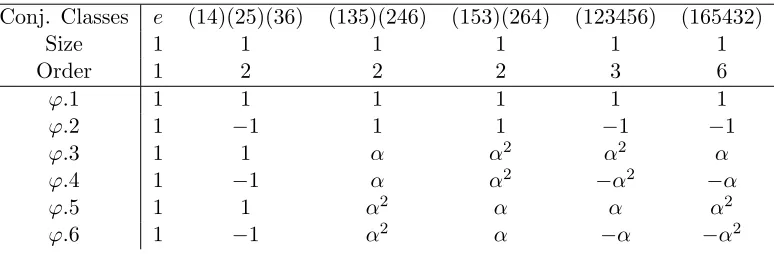
As you see, there are 2 rows that have an index of 2. Let H be a subgroup of G of index 2 such that ||HG|| = 2. That is 126 = 2, |H|= 6. So, we have a subgroup H≤Gof order 6, with a presentationH =< a, b|(a4b2) = (a2b2a2) = 1>, anda= (1,2,3,4,5,6),
b= (1,5,3)(2,6,4).Lets now take a look at the character table ofH.
Table 1.2: Character Table ofH
Conj. Classes e (14)(25)(36) (135)(246) (153)(264) (123456) (165432)
Size 1 1 1 1 1 1
Order 1 2 2 2 3 6
ϕ.1 1 1 1 1 1 1
ϕ.2 1 −1 1 1 −1 −1
ϕ.3 1 1 α α2 α2 α
ϕ.4 1 −1 α α2 −α2 −α
ϕ.5 1 1 α2 α α α2
(αis the 3rd root of unity)
We will need to see which character row ϕ.nof H equals eitherX.5 orX.6 ofG(since both X.5 andX.6 have index of 2). To do this, we use the formula to induce characters of H up to D12.
ϕGα(x) = n
hα
X
ω∈Cα∩H
=ϕ(ω), α= 1,2,3, ..., m
First, we find the smallest field that definesα, in which we getZ7\ {0}. So, this implies
that α= 2,α2 = 4 andα3= 8≡7 1.
For ϕG1
ϕG1(1) = 2 1
X
ω∈1∩H
=ϕ(1)1 = 2ϕ(1)1 = 2
ϕG1((14)(25)(36)) = 2 1
X
ω∈(14)(25)(36)∩H
=ϕ((14)(25)(36))1 = 2ϕ(1)1 = 2
ϕG1((14)(23)(56)) = 2 3
X
ω∈(14)(23)(56)∩H
=ϕ(∅)1 =
2
3ϕ(0)1= 0
ϕG1((15)(24)) = 2 3
X
ω∈(15)(24)∩H
=ϕ(∅)1 =
2
3ϕ(0)1= 0
ϕG1((135)(246)) = 2 2
X
ω∈(135)(246)∩H
=ϕ((135)(246) + (153)(264))1 = (1)ϕ(1 + 1)1 = 2
ϕG1((123456)) = 2 2
X
ω∈(123456)∩H
=ϕ((123456) + (165432))1 = (1)ϕ(1 + 1)1 = 2
ForϕG2
ϕG2(1) = 2 1
X
ω∈1∩H
=ϕ(1)2 = 2ϕ(1)2 = 2
ϕG2((14)(25)(36)) = 2 1
X
ω∈(14)(25)(36)∩H
=ϕ((14)(25)(36))2= 2ϕ(−1)2 =−2
ϕG2((14)(23)(56)) = 2 3
X
ω∈(14)(23)(56)∩H
=ϕ(∅)2 =
2
3ϕ(0)2= 0
ϕG2((15)(24)) = 2 3
X
ω∈(15)(24)∩H
=ϕ(∅)2 =
2
3ϕ(0)2= 0
ϕG2((135)(246)) = 2 2
X
ω∈(135)(246)∩H
= 2
ϕG2((123456)) = 2 2
X
ω∈(123456)∩H
=ϕ((123456) + (165432))2 = (1)ϕ(−1 + (−1))2=−2
ForϕG3
ϕG3(1) = 2 1
X
ω∈1∩H
=ϕ(1)3 = 2ϕ(1)3 = 2
ϕG3((14)(25)(36)) = 2 1
X
ω∈(14)(25)(36)∩H
=ϕ((14)(25)(36))3 = 2ϕ(1)3 = 2
ϕG3((14)(23)(56)) = 2 3
X
ω∈(14)(23)(56)∩H
=ϕ(∅)3 =
2
3ϕ(0)3= 0
ϕG3((15)(24)) = 2 3
X
ω∈(15)(24)∩H
=ϕ(∅)3 =
2
3ϕ(0)3= 0
ϕG3((135)(246)) = 2 2
X
ω∈(135)(246)∩H
=ϕ((135)(246) + (153)(264))3= (1)ϕ(ω+ω2)3=
2 + 4 = 6≡7 −1
ϕG3((123456)) = 2 2
X
ω∈(123456)∩H
=ϕ((123456) + (165432))3= (1)ϕ(ω2+ω)3=
4 + 2 = 6≡7 −1
ForϕG4
ϕG4(1) = 2 1
X
ω∈1∩H
=ϕ(1)4 = 2ϕ(1)4 = 2
ϕG4((14)(25)(36)) = 2 1
X
ω∈(14)(25)(36)∩H
=ϕ((14)(25)(36))4= 2ϕ(−1)4 =−2
ϕG4((14)(23)(56)) = 2 3
X
ω∈(14)(23)(56)∩H
=ϕ(∅)4 =
2
3ϕ(0)4= 0
ϕG4((15)(24)) = 2 3
X
ω∈(15)(24)∩H
=ϕ(∅)4 =
2
3ϕ(0)4= 0
ϕG4((135)(246)) = 2 2
X
ω∈(135)(246)∩H
2 + 4 = 6≡7 −1
ϕG4((123456)) = 2 2
X
ω∈(123456)∩H
=ϕ((123456) + (165432))4 = (1)ϕ(−ω2+−ω)4 =
−4 + (−2) =−6≡7 1
ForϕG5
ϕG5(1) = 2 1
X
ω∈1∩H
=ϕ(1)5 = 2ϕ(1)5 = 2
ϕG5((14)(25)(36)) = 2 1
X
ω∈(14)(25)(36)∩H
=ϕ((14)(25)(36))5 = 2ϕ(1)5 = 2
ϕG5((14)(23)(56)) = 2 3
X
ω∈(14)(23)(56)∩H
=ϕ(∅)5 =
2
3ϕ(0)5= 0
ϕG5((15)(24)) = 2 3
X
ω∈(15)(24)∩H
=ϕ(∅)5 =
2
3ϕ(0)5= 0
ϕG5((135)(246)) = 2 2
X
ω∈(135)(246)∩H
=ϕ((135)(246) + (153)(264))5= (1)ϕ(ω2+ω)5=
4 + 2 = 6≡7 −1
ϕG5((123456)) = 2 2
X
ω∈(123456)∩H
=ϕ((123456) + (165432))5 = (1)ϕ(ω+ω2)5 = 2 + 4
= 6≡7 −1
ForϕG
6
ϕG6(1) = 2 1
X
ω∈1∩H
=ϕ(1)6 = 2ϕ(1)6 = 2
ϕG6((14)(25)(36)) = 2 1
X
ω∈(14)(25)(36)∩H
=ϕ((14)(25)(36))6= 2ϕ(−1)6 =−2
ϕG6((14)(23)(56)) = 2 3
X
ω∈(14)(23)(56)∩H
=ϕ(∅)6 =
2
3ϕ(0)6= 0
ϕG6((15)(24)) = 2 3
X
ω∈(15)(24)∩H
=ϕ(∅)6 =
2
ϕG6((135)(246)) = 2 2
X
ω∈(135)(246)∩H
=ϕ((135)(246) + (153)(264))6= (1)ϕ(ω2+ω)6=
4 + 2 = 6≡7 −1
ϕG6((123456)) = 2 2
X
ω∈(123456)∩H
=ϕ((123456) + (165432))6 = (1)ϕ(−ω+−ω2)6 =
−2 + (−4) =−6≡7 1
We therefore see thatϕ6 =χ.6. Next, we put together matrix representations A(x) and A(y) using the following formula.
A(n) =
B(T1nT1−1) B(T1nT2−1) ... B(T1nTm−1)
B(T2nT1−1) B(T2nT2−1) ... B(T2nTm−1)
... ... ...
B(TmnT1−1) B(TmnT2−1) ... B(TmnTm−1)
Where we would have B((14)(25)(36)) = −1, B((135)(246)) = 4, B((153)(264)) = 2,
B((123456)) = 5,B((165432)) = 3,and B(g) = 0, g /∈G. Also, with H ≤G, we would have the right transversals be T1 =eand T2 = (1,4)(2,3)(5,6) since we have an index of order 2. Having x= (1,2,3,4,5,6) andy = (1,4)(2,3)(5,6), we then have
A(x) =
B(T1(1,2,3,4,5,6)T1−1) B(T1(1,2,3,4,5,6)T2−1) B(T2(1,2,3,4,5,6)T1−1) B(T2(1,2,3,4,5,6)T2−1)
A(x) =
B((1,2,3,4,5,6)) B((1,3)(4,6))
B((1,5)(2,4)) B((1,6,5,4,3,2))
A(x) =
5 0
0 3
A(y) =
B(T1(1,4)(2,3)(5,6)T1−1) B(T1(1,4)(2,3)(5,6)T2−1) B(T2(1,4)(2,3)(5,6)T1−1) B(T2(1,4)(2,3)(5,6)T2−1)
A(y) =
B((1,4)(2,3)(5,6)) B(e)
B(e) B((1,4)(2,3)(5,6))
A(y) =
0 1
1 0
Verifying the the orders of the matrices. < A(x), A(y)>and |A(x)|= 6,
|A(y)|= 2 can generate|A(x)A(y)|= 6∗2 = 12.
Thus, we can write permutation representations of the above matrices using the follow-ing formula. For each matrix entry, aij =n implies ti goes totnj The labeling of t0sis
Table 1.3: Labeling oft0is
1.t1 2.t2 3.t12 4.t22 5.t13 6.t23
7.t14 8.t24 9.t15 10.t25 11.t16 12.t26
Table 1.4: Permutations oft0isof A(x) 1.t1 2.t2 3.t12 4.t22 5.t13 6.t23
⇓ ⇓ ⇓ ⇓ ⇓ ⇓
9.t15 6.t23 5.t13 12.t26 1.t1 4.t22
7.t14 8.t24 9.t15 10.t25 11.t16 12.t26
⇓ ⇓ ⇓ ⇓ ⇓ ⇓
11.t16 10.t25 7.t14 2.t2 3.t12 8.t24
We will start by looking at the matrix A(x). Sincea11= 5, therefore t1 goes tot51 and
similarly for all powers of t1. Also, sincea22= 3,t2 is going tot23. Therefore, we have the following
This gives the permutation xx = (1,9,7,11,3,5)(2,6,4,12,8,10) for A(x). Now, for
A(y), sincea12= 1, thent1 goes to t2. Also, sincea21= 1, thust2 goes to t1. We then have the following
Table 1.5: Permutations oft0isof A(x) 1.t1 2.t2 3.t12 4.t22 5.t13 6.t23
⇓ ⇓ ⇓ ⇓ ⇓ ⇓
2.t2 1.t1 4.t22 3.t12 6.t23 5.t13
7.t14 8.t24 9.t15 10.t25 11.t16 12.t26
⇓ ⇓ ⇓ ⇓ ⇓ ⇓
8.t24 7.t14 10.t25 9.t15 12.t26 11.t16
This gives the permutation yy= (1,2)(3,4)(5,6)(7,8)(9,10)(11,12) forA(y).
This implies that we have the presentation for Gbeing
G < x, y, t|y2= (x−1y)2 =x6=t11= (t, N ormalizer(N, < t1 >)>
Where the N ormalizer(N, < t1 >) is the stabilizer of all powers of t1 in N, such as
t1, t12, t13, t14, t15, t16. Thus, we want the permutations in N that stabilize{1,3,5,7,9,11}
set wise. We get the following permutation group that stabilizes N.
N(1,3,5,7,9,11)=<(1,5,3,11,7,9)(2,10,8,12,4,6)>.
Converting the permutation group into words in terms of x and y, and also letting t
commute with the generators of the stabilizer. We have x−1 being in the stabilizer. Therefore, we have the presentation as follows 7∗2 :m D12
7∗2 :m D12=G < x, y, t|y2 = (x−1y)2 =x6 =t7 = (tx
−1
1.3.2 11∗2 :
m (5 : 2)•5
We will write a presentation for the monomial progenitor 11∗2 :m(5 : 2)•5.
11∗2 represents 2t0s of order 11.
Let G= (5 : 2)•5 =h(1,20)(2,16)(3,17)(4,18)(5,19)(6,11)(7,12)(8,13)(9,14)(10,15),
(1,7,5,6,4,10,3,9,2,8)(11,24,15,23,14,22,13,21,12,25)(16,18,20,17,19)i
First we need to induce a non-trivial linear character from a subgroupH of G
such that ||HG|| = 2 (the number of t’sin our presentation). |G|= 50, therefore we must have |H|= 25. So, letH=S[9] subgroup. Then S[9]subgroup=|H|= 25
Table 1.6: Character Table ofG
Classes C1 C2 C3 C4 C5 C6 C7 C8 C9 ...
Size 1 5 1 1 1 1 2 2 2 ...
Order 1 2 5 5 5 5 5 5 5 ...
X.1 1 1 1 1 1 1 1 1 1 ...
X.2 1 -1 1 1 1 1 1 1 1 ...
X.3 1 -1 Z1 Z12 Z13 Z14 Z13 Z1 Z14 ... X.4 1 1 Z1 Z12 Z13 Z14 Z13 Z1 Z14 ... X.5 1 -1 Z12 Z14 Z1 Z13 Z1 Z12 Z13 ... X.6 1 1 Z13 Z1 Z14 Z12 Z14 Z13 Z12 ... X.7 1 -1 Z13 Z1 Z14 Z12 Z14 Z13 Z12 ... X.8 1 -1 Z14 Z13 Z12 Z1 Z12 Z14 Z1 ... X.9 1 1 Z14 Z13 Z12 Z1 Z12 Z14 Z1 ...
... ... ... ... ... ... ... ... ... ... ...
Now, we must induce a non-trivial linear character of H, we will useX.9 up toGin this case. Next, we find the right transversals of HinG. Using MAGMA, these are {e,(1,20)(2,16)(3,17)(4,18)(5,19)(6,11)(7,12)(8,13)(9,14)(10,15)}
Which we label as:
T1 =e
T2 = (1,20)(2,16)(3,17)(4,18)(5,19)(6,11)(7,12)(8,13)(9,14)(10,15)
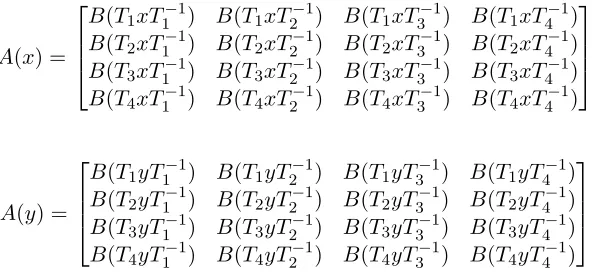
Now, the matrices A(x) and A(y) will be a representation ofG induced from the char-acter inH,X.9. The general forms forA(x) and A(y) are
A(x) =
B(T1xT1−1) B(T1xT2−1) B(T2xT1−1) B(T2xT2−1)
A(y) =
B(T1yT1−1) B(T1yT2−1)
B(T2yT1−1) B(T2yT2−1)
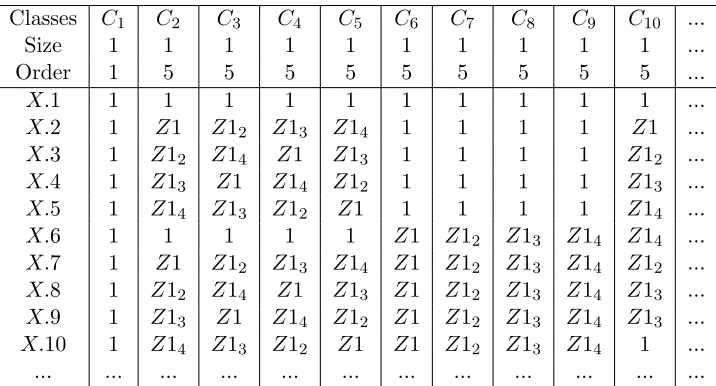
Table 1.7: Character Table ofH
Classes C1 C2 C3 C4 C5 C6 C7 C8 C9 C10 ...
Size 1 1 1 1 1 1 1 1 1 1 ...
Order 1 5 5 5 5 5 5 5 5 5 ...
X.1 1 1 1 1 1 1 1 1 1 1 ...
X.2 1 Z1 Z12 Z13 Z14 1 1 1 1 Z1 ... X.3 1 Z12 Z14 Z1 Z13 1 1 1 1 Z12 ... X.4 1 Z13 Z1 Z14 Z12 1 1 1 1 Z13 ... X.5 1 Z14 Z13 Z12 Z1 1 1 1 1 Z14 ... X.6 1 1 1 1 1 Z1 Z12 Z13 Z14 Z14 ... X.7 1 Z1 Z12 Z13 Z14 Z1 Z12 Z13 Z14 Z12 ... X.8 1 Z12 Z14 Z1 Z13 Z1 Z12 Z13 Z14 Z13 ... X.9 1 Z13 Z1 Z14 Z12 Z1 Z12 Z13 Z14 Z13 ... X.10 1 Z14 Z13 Z12 Z1 Z1 Z12 Z13 Z14 1 ...
... ... ... ... ... ... ... ... ... ... ... ...
Such that B(x) is the value of the induced character for the class of H con-taining x (recall ifx /∈H, thenB(x) = 0).
Let x= (1,20)(2,16)(3,17)(4,18)(5,19)(6,11)(7,12)(8,13)(9,14)(10,15)
also y= (1,7,5,6,4,10,3,9,2,8)(11,24,15,23,14,22,13,21,12,25)(16,18,20,17,19)
We also have classes of H
Class 1 = e
Class 2 = (1, 5, 4, 3, 2)(6, 10, 9, 8, 7)(11, 15, 14, 13, 12)(16, 20, 19, 18,17)(21, 25, 24, 23, 22)
Class 3 = (1, 4, 2, 5, 3)(6, 9, 7, 10, 8)(11, 14, 12, 15, 13)(16, 19, 17, 20, 18)(21, 24, 22, 25, 23)
. . .
Class 23 = (1, 16, 7, 24, 14)(2, 17, 8, 25, 15)(3, 18, 9, 21, 11)(4, 19, 10, 22, 12)(5, 20, 6, 23, 13)
Class 24 = (1, 14, 24, 7, 16)(2, 15, 25, 8, 17)(3, 11, 21, 9, 18)(4, 12, 22, 10, 19)(5, 13, 23, 6, 20)
Class 25 = (1, 7, 14, 16, 24)(2, 8, 15, 17, 25)(3, 9, 11, 18, 21)(4, 10, 12, 19, 22)(5, 6, 13, 20, 23)
We then have
B(T1xT1−1) = 0 B(T1xT2−1) = 1
B(T2xT2−1) = 0 B(T1yT1−1) = 0 B(T1yT2−1) = 4
B(T2yT1−1) = 5 B(T2yT2−1) = 0
Substituting into A(x) = and A(y) = we have
A(x) =
0 1
1 0
A(y) =
0 4
5 0
(With roots of unity represented as 4 and 5 from a field order of 11)
So, with < A(x), A(y)>and |A(x)|= 2,|A(y)|= 10 can generate
|A(x)A(y)|= 2∗52 = 50
Now, we can write permutation representations of the above matrices using the following formula. For each matrix entry,aij =nimpliesti goes totnj The labeling
of t0sis given as follows from a field of order 11.
Table 1.8: Labeling oft0is
1.t1 2.t2 3.t12 4.t22 5.t13 6.t23 7.t14 8.t24 9.t15 10.t25
11.t16 12.t26 13.t17 14.t27 15.t18 16.t28 17.t19 18.t29 19.t110 20.t210
We will start by looking at the matrix A(x). Sincea12 = 1, thereforet1 goes to t2 and similarly for all powers of t1 such ast12 going to t22. Therefore, we have the following
Table 1.9: Permutations oft0isof A(x)
1.t1 2.t2 3.t12 4.t22 5.t13 6.t23 7.t14 8.t24 9.t15 10.t25
⇓ ⇓ ⇓ ⇓ ⇓ ⇓ ⇓ ⇓ ⇓ ⇓
2.t2 1.t1 4.t22 3.t12 6.t23 5.t13 8.t24 7.t14 10.t25 9.t15
11.t16 12.t26 13.t17 14.t27 15.t18 16.t28 17.t19 18.t29 19.t110 20.t210
⇓ ⇓ ⇓ ⇓ ⇓ ⇓ ⇓ ⇓ ⇓ ⇓
12.t26 11.t16 14.t27 13.t17 16.t28 15.t18 18.t29 17.t19 20.t210 19.t110
This gives the permutation,
Table 1.10: Permutations of t0isofA(y)
1.t1 2.t2 3.t12 4.t22 5.t13 6.t23 7.t14 8.t24 9.t15 10.t25
⇓ ⇓ ⇓ ⇓ ⇓ ⇓ ⇓ ⇓ ⇓ ⇓
8.t24 9.t15 16.t28 19.t110 2.t2 7.t14 10.t25 17.t19 18.t29 5.t13
11.t16 12.t26 13.t17 14.t27 15.t18 16.t28 17.t19 18.t29 19.t110 20.t210
⇓ ⇓ ⇓ ⇓ ⇓ ⇓ ⇓ ⇓ ⇓ ⇓
4.t22 15.t18 12.t26 3.t12 20.t210 13.t17 6.t23 1.t1 14.t27 11.t16
then have the following
This gives the permutation,
yy= (1,8,17,6,7,10,5,2,9,18)(3,16,13,12,15,20,11,4,19,14) forA(y). So, we have the presentation for Gbeing
< x, y, t|x2, y10,(x∗y)5,(y−1∗x∗y2∗x∗y−1), t11,(t, N ormalizer(N, < t 1 >)>
Where the N ormalizer(N, < t1 >) is the stabilizer of all powers of t1 in N, such as
t1, t12, t13, t14, t15, t16, t17, t18, t19, t110. Thus, we want the permutations in N that
sta-bilize {1,3,5,7,9,11,13,15,17,19} set wise. We get the following permutation that stabilizes N.
(2,8,10,18,6)(4,16,20,14,12).
We now change the permutation into words in terms of x and y, and letting t com-mute with the generators of the stabilizer. Using MAGMA, we have y−1xy−2 being in the stabilizer. Therefore, the presentation of the progenitor 11∗2 :m (5 : 2)•5
< x, y, t|x2, y10,(xy)5,(y−1xy2xy−1), t11,(ty−1xy−2 =t)>
11∗2 :
1.3.3 11∗3 :
m (25 : 3)
We will write a presentation for the monomial progenitor 11∗3 :m(25 : 3). 11∗3
represents 3 t0sof order 11.
Let G=h(2,6,25)(3,11,19)(4,16,13)(5,21,7)(8,10,20)(9,15,14)(12,24,22)(17,18,23),
(1,2,3,4,5)(6,7,8,9,10)(11,12,13,14,15)(16,17,18,19,20)(21,22,23,24,25)i
First we need to induce a non-trivial linear character from a subgroup H of G such that ||HG||= 3 (the number of t’sin our presentation). |G|= 75, therefore we must have
|H|= 25.
So, let H =S[5]subgroup. Then S[5]subgroup=|H|= 25
Table 1.11: Character Table ofG
Classes C1 C2 C3 C4 C5 C6 C7 C8 C9 C10 C11
Size 1 25 25 3 3 3 3 3 3 3 3
Order 1 3 3 5 5 5 5 5 5 5 5
X.1 1 1 1 1 1 1 1 1 1 1 1
X.2 1 J -1-J 1 1 1 1 1 1 1 1
X.3 1 -1-J J 1 1 1 1 1 1 1 1
X.4 3 0 0 Z1 Z12 Z13 Z14 Z22 Z2 Z2 Z22 X.5 3 0 0 Z13 Z1 Z14 Z12 Z2 Z22 Z22 Z2 X.6 3 0 0 Z14 Z13 Z12 Z11 Z22 Z2 Z2 Z22 X.7 3 0 0 Z12 Z14 Z1 Z13 Z2 Z22 Z22 Z2 X.8 3 0 0 Z2 Z22 Z22 Z2 Z14 Z13 Z22 Z1 X.9 3 0 0 Z22 Z2 Z2 Z22 Z12 Z14 Z1 Z13 X.10 3 0 0 Z22 Z2 Z2 Z22 Z13 Z1 Z14 Z12 X.11 3 0 0 Z2 Z22 Z22 Z2 Z1 Z12 Z13 Z14
(note: J is the 3rd root of unity)
Now, we must induce a non-trivial linear character ofH, we will useX.5 up to
Gin this case. Next, we find the right transversals ofHinG. Using MAGMA, these are
{e,(2,6,25)(3,11,19)(4,16,13)(5,21,7)(8,10,20)(9,15,14)(12,24,22)(17,18,23),
(2,25,6)(3,19,11)(4,13,16)(5,7,21)(8,20,10)(9,14,15)(12,22,24)(17,23,18)}
Which we label as:
T1 =e
Table 1.12: Character Table ofH
Classes C1 C2 C3 C4 C5 C6 C7 C8 C9 C10 ...
Size 1 1 1 1 1 1 1 1 1 1 ...
Order 1 5 5 5 5 5 5 5 5 5 ...
X.1 1 1 1 1 1 1 1 1 1 1 ...
X.2 1 Z1 Z12 Z13 Z14 1 1 1 1 Z1 ... X.3 1 Z12 Z14 Z1 Z13 1 1 1 1 Z12 ... X.4 1 Z13 Z1 Z14 Z12 1 1 1 1 Z13 ... X.5 1 Z14 Z13 Z12 Z1 1 1 1 1 Z14 ... X.6 1 1 1 1 1 Z1 Z12 Z13 Z14 Z1 ... X.7 1 Z1 Z12 Z13 Z14 Z1 Z12 Z13 Z14 Z12 ... X.8 1 Z12 Z14 Z1 Z13 Z1 Z12 Z13 Z14 Z13 ... X.9 1 Z13 Z1 Z14 Z12 Z1 Z12 Z13 Z14 Z14 ... X.10 1 Z14 Z13 Z12 Z1 Z1 Z12 Z13 Z14 1 ...
... ... ... ... ... ... ... ... ... ... ... ...
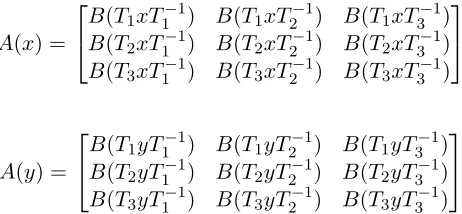
Now, the matrices A(x) and A(y) will be a representation of G induced from the char-acter inH,X.5. The general forms forA(x) and A(y) are
A(x) =
B(T1xT1−1) B(T1xT2−1) B(T1xT3−1)
B(T2xT1−1) B(T2xT2−1) B(T2xT3−1) B(T3xT1−1) B(T3xT2−1) B(T3xT3−1)
A(y) =
B(T1yT1−1) B(T1yT2−1) B(T1yT3−1)
B(T2yT1−1) B(T2yT2−1) B(T2yT3−1)
B(T3yT1−1) B(T3yT2−1) B(T3yT3−1)
Such that B(x) is the value of the induced character for the class of H containing x
(recall ifx /∈H, thenB(x) = 0).
Let x= (2, 6, 25)(3, 11, 19)(4, 16, 13)(5, 21, 7)(8, 10, 20)(9, 15, 14)(12, 24, 22)(17, 18, 23)
and y = (1, 2, 3, 4, 5)(6, 7, 8, 9, 10)(11, 12, 13, 14, 15)(16, 17, 18, 19, 20)(21, 22, 23, 24, 25)
We also have classes of H
Class 1 = e
Class 2 = (1, 22, 18, 14, 10)(2, 23, 19, 15, 6)(3, 24, 20, 11, 7)(4, 25, 16, 12, 8) (5, 21, 17, 13, 9)
... ... ...
Class 23 = (1, 13, 25, 7, 19)(2, 14, 21, 8, 20)(3, 15, 22, 9, 16)(4, 11, 23, 10, 17) (5, 12, 24, 6, 18)
Class 24 = (1, 19, 7, 25, 13)(2, 20, 8, 21, 14)(3, 16, 9, 22, 15)(4, 17, 10, 23, 11) (5, 18, 6, 24, 12)
Class 25 = (1, 25, 19, 13, 7)(2, 21, 20, 14, 8)(3, 22, 16, 15, 9)(4, 23, 17, 11, 10) (5, 24, 18, 12, 6)
We then have:
B(T1xT1−1) = 0 B(T1yT1−1) = 4 B(T1xT2−1) = 1 B(T1yT2−1) = 0 B(T1xT3−1) = 0 B(T1yT3−1) = 0
B(T2xT1−1) = 0 B(T2yT1−1) = 0 B(T2xT2−1) = 0 B(T2yT2−1) = 5 B(T2xT3−1) = 1 B(T2yT3−1) = 0
B(T3xT1−1) = 1 B(T3yT1−1) = 0 B(T3xT2−1) = 0 B(T3yT2−1) = 0 B(T3xT3−1) = 0 B(T3yT3−1) = 5 Substituting into A(x) = and A(y) = we have
A(x) =
0 1 0
0 0 1
1 0 0
A(y) =
4 0 0
0 5 0
0 0 5
(With roots of unity represented as 4 and 5 from a field order of 11) Now, < A(x), A(y)>with |A(x)|= 3,|A(y)|= 5 can generate
|A(x)A(y)|= 3∗52 = 75
Now, we can write permutation representations of the above matrices using the following formula. For each matrix entry, aij =nimpliesti goes totnj The labeling oft0sis given
as follows from a field of order 11.
Table 1.13: Labeling oft0is
1.t1 2.t2 3.t3 4.t12 5.t22 6.t32 7.t13 8.t23 9.t33 10.t14
11.t24 12.t34 13.t15 14.t25 15.t35 16.t16 17.t26 18.t36 19.t17 20.t27
21.t37 22.t18 23.t28 24.t38 25.t19 26.t29 27.t39 28.t110 29.t210 30.t310
We will start by looking at the matrixA(x). Sincea12= 1, thereforet1 goes to t2. Also,a23= 1, a31 = 1 indicatest2 goes tot3,t3 goes to back tot1 and similarly
Table 1.14: Permutations of t0isof A(x)
1.t1 2.t2 3.t3 4.t12 5.t22 6.t32 7.t13 8.t23 9.t33 10.t14
⇓ ⇓ ⇓ ⇓ ⇓ ⇓ ⇓ ⇓ ⇓ ⇓
2.t2 3.t3 1.t1 5.t22 6.t32 4.t12 8.t23 9.t33 7.t13 11.t24
11.t24 12.t34 13.t15 14.t25 15.t35 16.t16 17.t26 18.t36 19.t17 20.t27
⇓ ⇓ ⇓ ⇓ ⇓ ⇓ ⇓ ⇓ ⇓ ⇓
12.t34 10.t14 14.t25 15.t35 13.t15 17.t26 18.t36 16.t16 20.t27 21.t37
21.t37 22.t18 23.t28 24.t38 25.t19 26.t29 27.t39 28.t110 29.t210 30.t310
⇓ ⇓ ⇓ ⇓ ⇓ ⇓ ⇓ ⇓ ⇓ ⇓
19.t17 23.t28 24.t38 22.t18 26.t29 27.t39 25.t19 29.t210 30.t310 28.t110
Table 1.15: Permutations of t0isofA(y)
1.t1 2.t2 3.t3 4.t12 5.t22 6.t32 7.t13 8.t23 9.t33 10.t14
⇓ ⇓ ⇓ ⇓ ⇓ ⇓ ⇓ ⇓ ⇓ ⇓
10.t14 14.t25 15.t35 22.t18 29.t210 30.t310 1.t1 11.t24 12.t34 13.t15
11.t24 12.t34 13.t15 14.t25 15.t35 16.t16 17.t26 18.t36 19.t17 20.t27
⇓ ⇓ ⇓ ⇓ ⇓ ⇓ ⇓ ⇓ ⇓ ⇓
26.t29 27.t39 25.t19 8.t23 9.t33 4.t12 23.t28 24.t38 16.t16 5.t22
21.t37 22.t18 23.t28 24.t38 25.t19 26.t29 27.t39 28.t110 29.t210 30.t310
⇓ ⇓ ⇓ ⇓ ⇓ ⇓ ⇓ ⇓ ⇓ ⇓
6.t32 28.t110 20.t27 21.t37 7.t13 2.t2 3.t3 19.t17 17.t26 18.t36
This gives the permutationxx= (1, 2, 3)(4, 5, 6)(7, 8, 9)(10, 11, 12)(13, 14, 15)(16, 17, 18)(19, 20, 21)(22, 23, 24)(25, 26, 27)(28, 29, 30) for A(x). Now, for A(y), since a11 =
4, thent1 goes tot14. Also,a22= 5 implies thatt2 goes tot25, anda33= 5 also implies that t3 goes tot35. We then have the following
This gives the permutation yy = (1, 10, 13, 25, 7)(2, 14, 8, 11, 26)(3, 15, 9, 12, 27)(4, 22, 28, 19, 16)(5, 29, 17, 23, 20)(6, 30, 18, 24, 21) forA(y).
This gives us the presentation for G being
< x, y, t|x3, y5,(x∗y)3,(y−1∗x)3,(y−1∗x−1)3, t11,(t, N ormalizer(N, < t1 >)>
Where the N ormalizer(N, < t1 >) is the stabilizer of all powers of t1 in N, such as
t1, t12, t13, t14, t15, t16, t17, t18, t19, t110. Thus, we want the permutations in N that
sta-bilize {1,4,7,10,13,16,19,22,25,28}set wise. We get the following permutations that stabilizes N.
(2, 26, 11, 8, 14)(3, 15, 9, 12, 27)(5, 20, 23, 17, 29)(6, 30, 18, 24, 21) (1, 7, 25, 13, 10)(3, 12, 15, 27, 9)(4, 16, 19, 28, 22)(6, 24, 30, 21, 18)
We now change the permutation into words in terms ofx andy, and lettingt
to be
< x, y, t|x3, y5,(x∗y)3,(y−1∗x)3,(y−1∗x−1)3, t11,(txyx−1y−2 =t),(t(x−1,y)=t)>
1.3.4 11∗4 :
m (4 : 5)•5
We will write a presentation for the monomial progenitor 11∗4 :m(4 : 5)•5.
11∗4 represents 4t0s of order 11.
Let G=h(1,20,21,8)(2,16,22,9)(3,17,23,10)(4,18,24,6)(5,19,25,7),
(1,2,3,4,5)(6,19,21,15,10,18,25,14,9,17,24,13,8,16,23,12,7,20,22,11)i
First we need to induce a non-trivial linear character from a subgroup H of G
such that ||HG|| = 4 (the number of t’sin our presentation).
|G|= 100, therefore we must have |H|= 25. So, let H=S[9] subgroup. Then S[9]subgroup=|H|= 25
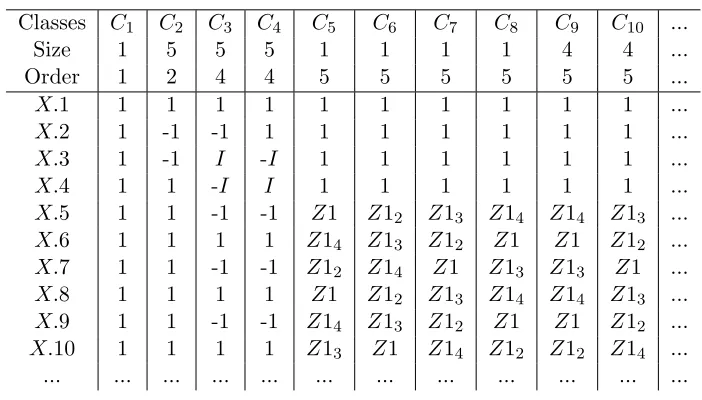
Table 1.16: Character Table ofG
Classes C1 C2 C3 C4 C5 C6 C7 C8 C9 C10 ...
Size 1 5 5 5 1 1 1 1 4 4 ...
Order 1 2 4 4 5 5 5 5 5 5 ...
X.1 1 1 1 1 1 1 1 1 1 1 ...
X.2 1 -1 -1 1 1 1 1 1 1 1 ...
X.3 1 -1 I -I 1 1 1 1 1 1 ...
X.4 1 1 -I I 1 1 1 1 1 1 ...
X.5 1 1 -1 -1 Z1 Z12 Z13 Z14 Z14 Z13 ... X.6 1 1 1 1 Z14 Z13 Z12 Z1 Z1 Z12 ... X.7 1 1 -1 -1 Z12 Z14 Z1 Z13 Z13 Z1 ... X.8 1 1 1 1 Z1 Z12 Z13 Z14 Z14 Z13 ... X.9 1 1 -1 -1 Z14 Z13 Z12 Z1 Z1 Z12 ... X.10 1 1 1 1 Z13 Z1 Z14 Z12 Z12 Z14 ...
... ... ... ... ... ... ... ... ... ... ... ...
(note: I is the 4th root of unity)
Now, we must induce a non-trivial linear character ofH, we will useX.9 up to
Gin this case. Next, we find the right transversals ofHinG. Using MAGMA, these are
{e,(1,20,21,8)(2,16,22,9)(3,17,23,10)(4,18,24,6)(5,19,25,7),
(1,8,21,20)(2,9,22,16) (3,10,23,17)(4,6,24,18)(5,7,25,19),
(1,21)(2,22)(3,23)(4,24)(5,25)(6,18)(7,19)(8,20)(9,16)(10,17)}
Which we label as:
T1 =e
Table 1.17: Character Table ofH
Classes C1 C2 C3 C4 C5 C6 C7 C8 C9 C10 ...
Size 1 1 1 1 1 1 1 1 1 1 ...
Order 1 5 5 5 5 5 5 5 5 5 ...
X.1 1 1 1 1 1 1 1 1 1 1 ...
X.2 1 Z1 Z12 Z13 Z14 1 1 1 1 Z1 ... X.3 1 Z12 Z14 Z1 Z13 1 1 1 1 Z12 ... X.4 1 Z13 Z1 Z14 Z12 1 1 1 1 Z13 ... X.5 1 Z14 Z13 Z12 Z1 1 1 1 1 Z14 ... X.6 1 1 1 1 1 Z1 Z12 Z13 Z14 Z1 ... X.7 1 Z1 Z12 Z13 Z14 Z1 Z12 Z13 Z14 Z12 ... X.8 1 Z12 Z14 Z1 Z13 Z1 Z12 Z13 Z14 Z13 ... X.9 1 Z13 Z1 Z14 Z12 Z1 Z12 Z13 Z14 Z14 ... X.10 1 Z14 Z13 Z12 Z1 Z1 Z12 Z13 Z14 1 ...
... ... ... ... ... ... ... ... ... ... ... ...
Now, the matrices A(x) and A(y) will be a representation of G induced from the char-acter inH,X.9. The general forms forA(x) and A(y) are
A(x) =
B(T1xT1−1) B(T1xT2−1) B(T1xT3−1) B(T1xT4−1)
B(T2xT1−1) B(T2xT2−1) B(T2xT3−1) B(T2xT4−1) B(T3xT1−1) B(T3xT2−1) B(T3xT3−1) B(T3xT4−1)
B(T4xT1−1) B(T4xT2−1) B(T4xT3−1) B(T4xT4−1)
A(y) =
B(T1yT1−1) B(T1yT2−1) B(T1yT3−1) B(T1yT4−1)
B(T2yT1−1) B(T2yT2−1) B(T2yT3−1) B(T2yT4−1) B(T3yT1−1) B(T3yT2−1) B(T3yT3−1) B(T3yT4−1) B(T4yT1−1) B(T4yT2−1) B(T4yT3−1) B(T4yT4−1)
Such that B(x) is the value of the induced character for the class of H containing x
(recall ifx /∈H, thenB(x) = 0).
Let x= (1, 20, 21, 8)(2, 16, 22, 9)(3, 17, 23, 10)(4, 18, 24, 6)(5, 19, 25, 7)
andy= (1, 2, 3, 4, 5)(6, 19, 21, 15, 10, 18, 25, 14, 9, 17, 24, 13, 8, 16, 23, 12, 7, 20, 22, 11)
We also have classes of H
Class 1 = e
Class 2 = (1, 5, 4, 3, 2)(6, 10, 9, 8, 7)(11, 15, 14, 13, 12)(16, 20, 19, 18, 17) (21, 25, 24, 23, 22)
... ... ...
Class 23 = (1, 16, 10, 24, 13)(2, 17, 6, 25, 14)(3, 18, 7, 21, 15)(4, 19, 8, 22, 11) (5, 20, 9, 23, 12)
Class 24 = (1, 13, 24, 10, 16)(2, 14, 25, 6, 17)(3, 15, 21, 7, 18)(4, 11, 22, 8, 19) (5, 12, 23, 9, 20)
Class 25 = (1, 10, 13, 16, 24)(2, 6, 14, 17, 25)(3, 7, 15, 18, 21)(4, 8, 11, 19, 22) (5, 9, 12, 20, 23)
We then have:
B(T1xT1−1) = 0 B(T3xT1−1) = 1 B(T1yT1−1) = 0 B(T3yT1−1) = 0 B(T1xT2−1) = 1 B(T3xT2−1) = 0 B(T1yT2−1) = 0 B(T3yT2−1) = 0 B(T1xT3−1) = 0 B(T3xT3−1) = 0 B(T1yT3−1) = 1 B(T3yT3−1) = 0
B(T1xT4−1) = 0 B(T3xT4−1) = 0 B(T1yT4−1) = 0 B(T3yT4−1) = 9 B(T2xT1−1) = 0 B(T4xT1−1) = 0 B(T2yT1−1) = 4 B(T4yT1−1) = 0 B(T2xT2−1) = 0 B(T4xT2−1) = 0 B(T2yT2−1) = 0 B(T4yT2−1) = 3
B(T2xT3−1) = 0 B(T4xT3−1) = 1 B(T2yT3−1) = 0 B(T4yT3−1) = 0 B(T2xT4−1) = 1 B(T4xT4−1) = 0 B(T2yT4−1) = 0 B(T4yT4−1) = 0
Substituting into A(x) = and A(y) = we have
A(x) =
0 1 0 0
0 0 0 1
1 0 0 0
0 0 1 0
A(y) =
0 0 1 0
4 0 0 0
0 0 0 9
0 3 0 0
(With roots of unity represented as 4, 5, 9 and 3 from a field order of 11) Now, < A(x), A(y)>with |A(x)|= 4,|A(y)|= 20 can generate
|A(x)A(y)|= 22∗(5∗22) = 100
Now, we can write permutation representations of the above matrices using the following formula. For each matrix entry, aij =nimpliesti goes totnj The labeling oft0sis given
as follows from a field of order 11.
Table 1.18: Labeling oft0is
1.t1 2.t2 3.t3 4.t4 5.t12 6.t22 7.t32 8.t42 9.t13 10.t23
11.t33 12.t43 13.t14 14.t24 15.t34 16.t44 17.t15 18.t25 19.t35 20.t45
21.t16 22.t26 23.t36 24.t46 25.t17 26.t27 27.t37 28.t48 29.t18 30.t28
31.t38 32.t48 33.t19 34.t29 35.t39 36.t49 37.t110 38.t210 39.t310 40.t410
We will start by looking at the matrixA(x). Sincea12= 1, thereforet1 goes
to t2. Also, a24 = 1, a43 = 1, a31 = 1 indicates t2 goes to t4, t4 goes to t3, t3 goes to
Table 1.19: Permutations of t0isof A(x)
1.t1 2.t2 3.t3 4.t4 5.t12 6.t22 7.t32 8.t42 9.t13 10.t23
⇓ ⇓ ⇓ ⇓ ⇓ ⇓ ⇓ ⇓ ⇓ ⇓
2.t2 4.t4 1.t1 3.t3 6.t22 8.t42 5.t13 7.t23 10.t23 12.t43
11.t33 12.t43 13.t14 14.t24 15.t34 16.t44 17.t15 18.t25 19.t35 20.t45
⇓ ⇓ ⇓ ⇓ ⇓ ⇓ ⇓ ⇓ ⇓ ⇓
9.t13 11.t33 14.t24 16.t44 13.t14 15.t34 18.t25 20.t45 17.t15 19.t35
21.t16 22.t26 23.t36 24.t46 25.t17 26.t27 27.t37 28.t47 29.t18 30.t28
⇓ ⇓ ⇓ ⇓ ⇓ ⇓ ⇓ ⇓ ⇓ ⇓
22.t26 24.t46 21.t16 23.t36 26.t27 28.t47 25.t17 27.t37 30.t28 28.t48
31.t38 32.t48 33.t19 34.t29 35.t39 36.t49 37.t110 38.t210 39.t310 40.t410
⇓ ⇓ ⇓ ⇓ ⇓ ⇓ ⇓ ⇓ ⇓ ⇓
29.t18 31.t38 34.t29 36.t49 33.t19 35.t39 38.t210 40.t410 37.t110 39.t310
Table 1.20: Permutations of t0isofA(y)
1.t1 2.t2 3.t3 4.t4 5.t12 6.t22 7.t32 8.t42 9.t13 10.t23
⇓ ⇓ ⇓ ⇓ ⇓ ⇓ ⇓ ⇓ ⇓ ⇓
35.t39 1.t1 12.t43 14.t24 27.t37 5.t12 24.t46 30.t28 19.t35 9.t13
11.t33 12.t43 13.t14 14.t24 15.t34 16.t44 17.t15 18.t25 19.t35 20.t45
⇓ ⇓ ⇓ ⇓ ⇓ ⇓ ⇓ ⇓ ⇓ ⇓
36.t49 2.t2 11.t33 13.t14 4.t4 18.t24 3.t3 17.t15 16.t44 34.t29
21.t16 22.t26 23.t36 24.t46 25.t17 26.t27 27.t37 28.t47 29.t18 30.t28
⇓ ⇓ ⇓ ⇓ ⇓ ⇓ ⇓ ⇓ ⇓ ⇓
39.t310 21.t16 28.t47 6.t22 31.t38 25.t17 40.t410 22.t26 23.t36 29.t18
31.t38 32.t48 33.t19 34.t29 35.t39 36.t49 37.t110 38.t210 39.t310 40.t410
⇓ ⇓ ⇓ ⇓ ⇓ ⇓ ⇓ ⇓ ⇓ ⇓
8.t42 38.t210 15.t34 33.t19 20.t45 10.t23 7.t32 37.t110 32.t48 26.t27
This gives the permutationxx= (1, 2, 4, 3)(5, 6, 8, 7)(9, 10, 12, 11)(13, 14, 16, 15)(17, 18, 20, 19)(21, 22, 24, 23)(25, 26, 28, 27)(29, 30, 32, 31)(33, 34, 36, 35)(37, 38, 40, 39) forA(x). Now, forA(y) witha13= 1, would indicatet1 goes tot39 sincea34= 9. Also, a42 = 3 implies that t39 goes to t439 ⇒ t45, and a21 = 4 also implies that t45 goes to t245 ⇒ t49. We then have the following
This gives the permutation yy = (1, 35, 20, 34, 33, 15, 4, 14, 13, 11, 36, 10, 9, 19, 16, 18, 17, 3, 12, 2)(5, 27, 40, 26, 25, 31, 8, 30, 29, 23, 28, 22, 21, 39, 32, 38, 37, 7, 24, 6) forA(y).
< x, y, t|x4, y20,(x∗y)5,(x−1∗y−1∗x−1∗y−1∗x2∗y),(x−1∗y−2∗x−1∗y∗x2∗y),(y−3∗
x2∗y−2∗x), t11,(t, N ormalizer(N, < t 1>)>
Where the N ormalizer(N, < t1 >) is the stabilizer of all powers of t1 in N, such
as t1, t12, t13, t14, t15, t16, t17, t18, t19, t110. Thus, we want the permutations in N that
stabilize {1,5,9,13,17,21,25,29,33,37}set wise. We get the following permutations that stabilizes N.
(2, 14, 18, 34, 10)(3, 35, 15, 11, 19)(4, 12, 36, 20, 16)(6, 30, 38, 26, 22) (7, 27, 31, 23, 39)(8, 24, 28, 40, 32),
(1, 13, 17, 33, 9)(3, 35, 15, 11, 19)(4, 20, 12, 16, 36)(5, 29, 37, 25, 21) (7, 27, 31, 23, 39)(8, 40, 24, 32, 28)
We now change the permutation into words in terms ofx andy, and lettingtcommute with the generators of the stabilizer. Using MAGMA, we have yx, and xy2x being all in the stabilizer. Therefore, the presentation of the progenitor 11∗4 :m (4 : 5)•5 ⇒
< x, y, t|x4, y20,(xy)5,(x−1y−1x−1y−1x2y),(x−1y−2x−1yx2y),(y−3x2y−2x), t11,(tyx =
t),(txy2x =t)>
Chapter 2
Double Coset Enumeration
2.1
Preliminaries
Definition 4.1.1 (Right Coset). Let K be a subgroup of G and h ∈ G. A right coset of K in Gis the subset of G dened as
Kh={kh|k∈K},
where h is a representative of Kh.
Definition 4.1.2 (Double Coset). Let H and K be subgroups of G. Then we define a double coset of G as
HgK ={Hgk|k∈K, g∈G.
We note that every double coset is composed of single cosets and G is the union of all double cosets of G.
Definition 4.1.3 (Stabiliser). The stabiliser of w in N, where w in a word of tis is given by
N w={n∈N|wn=w}.
Definition 4.1.4 (Coset Stabiliser). The coset stabiliser of w in N w, where w is a word of tis is given by
N(w) ={n∈N|N wn=N w}.
We note that N w≤N(w).
Definition 4.1.5(G-Orbit). Let x∈X. The set XG={xg|g∈G} is the G-orbit.
2.2
Permutation Progenitor Double Coset Enumeration
2.2.1 Construction of S5 over D6
Consider the group N = 2∗6 : D6 factored by the relations (yxt)3,(xt)5,(ytx)4 = 1
That is, G =S5 ∼= 2
∗6:D 6 (yxt)3,(xt)5,(ytx)4=1
With N being transitive on 6 letters of order 2.
2∗6 =< t1 >∗< t2 >∗< t3 >∗< t4 >∗< t5>∗< t6> N =D6
x ∼(1, 2, 3, 4, 5, 6)
y ∼ (1, 4)(2, 3)(5, 6)
t ∼t1
We will first expand the relations:
(1) (yxt)3 = 1 (2) (xt)5= 1
⇒ (yxt1)(yxt1)(yxt1) = 1 ⇒ (xt1)(xt1)(xt1)(xt1)(xt1) = 1
⇒ (yx)3(yx)−2t1(yx)2(yx)−1t1(yx)t1 = 1 ⇒x5x−4t1x4x−3t1x3x−2t1x2x−1t1xt1 = 1
⇒ yxte1tyx1 t1 = 1 ⇒ x5tx 4 1 tx
3 1 tx
2
1 tx1t1 = 1
⇒ yxt1t5t1 = 1 ⇒ x5t5t4t3t2t1 = 1
⇒ yxt1t5 =t1 ⇒ x5t5t4 =t1t2t3
⇒ N t1t5 =N t1 ⇒ N t5t4 =N t1t2t3
(3) (ytx)4 = 1
⇒ (yt2)(yt2)(yt2)(yt2) = 1
⇒ (yx)3(yx)−2t1(yx)2(yx)−1t1(yx)t1 = 1
⇒ y−1t2yt2y−1t2yt2 = 1
⇒ ty2t2ty2t2 = 1
⇒ t3t2t3t2 = 1
⇒ t3t2 =t2t3
We can also conjugate all the previous relation by all elements ofxandyfrom
N =D6. An example of this would be (N t1t5)x= (N t1)x. Since,x= (1, 2, 3, 4, 5, 6), we have N t2t6 =N t2. Taking the elements
D6 ={e,(1,2,3,4,5,6),(1,4)(2,3)(5,6),(1,6,5,4,3,2),(1,3,5)(2,4,6),(1,3)(4,6),
(1,5)(2,4),(1,5,3)(2,6,4),(1,4)(2,5)(3,6),(1,2)(3,6)(4,5),(1,6)(2,5)(3,4),(2,6)(3,5)}
So, we then obtain the following additional relations:
For N t1t5=N t1, we have:
(yxt1t5=t1)e ⇔ yxt1t5=t1 (yxt1t5 =t1)yx ⇔ yxt5t1=t5
(yxt1t5=t1)x ⇔ x3yt2t6 =t2 (yxt1t5 =t1)x
−2
⇔ x3yt5t3 =t5
(yxt1t5=t1)y ⇔ xyt4t6 =t4 (yxt1t5 =t1)x3 ⇔ yxt4t2 =t4
(yxt1t5=t1)x
−1
⇔ xyt6t4=t6 (yxt1t5=t1)x 2y
⇔ yxt2t4=t2
(yxt1t5=t1)x 2
⇔ xyt3t1 =t3 (yxt1t5=t1)yx 2
⇔ x3yt6t2=t6
ForN t5t4 =N t1t2t3, we have:
(x−1t5t4t3 =t1t2)e ⇔ x−1t5t4t3 =t1t2 (x−1t5t4t3=t1t2)yx ⇔ xt1t2t3 =t5t4
(x−1t5t4t3 =t1t2)x ⇔ x−1t6t5t4 =t2t3 (x−1t5t4t3=t1t2)x−2 ⇔ x−1t3t2t1 =t5t6
(x−1t5t4t3 =t1t2)y ⇔ xt6t1t2 =t4t3 (x−1t5t4t3 =t1t2)x 3
⇔ x−1t2t1t6 =t4t5
(x−1t5t4t3 =t1t2)x
−1
⇔ x−1t4t3t2=t6t1 (x−1t5t4t3=t1t2)x 2y
⇔ xt4t5t6 =t2t1
(x−1t5t4t3 =t1t2)x2 ⇔ x−1t1t6t5=t3t4 (x−1t5t4t3=t1t2)yx2 ⇔ xt2t3t4 =t6t5
(x−1t5t4t3 =t1t2)xy ⇔ xt5t6t1 =t3t2 (x−1t5t4t3 =t1t2)x3y ⇔ xt3t4t5=t1t6
Fort3t2 =t2t3, we have:
(t3t2=t2t3)e ⇔ t3t2=t2t3 (t3t2=t2t3)yx ⇔ t3t4=t4t3
(t3t2=t2t3)x ⇔ t4t3 =t3t4 (t3t2=t2t3)x−2 ⇔ t1t6 =t6t1
(t3t2=t2t3)y ⇔ t2t3=t3t2 (t3t2 =t2t3)x 3
⇔ t5t6 =t6t5
(t3t2=t2t3)x
−1
⇔ t2t1=t1t2 (t3t2=t2t3)x 2y
⇔ t6t1=t1t6
(t3t2=t2t3)x2 ⇔ t5t4 =t4t5 (t3t2=t2t3)yx2 ⇔ t4t5 =t5t4
(t3t2=t2t3)xy ⇔ t1t2 =t2t1 (t3t2 =t2t3)x 3y
⇔ t6t5=t5t6
We can also solve and use these relations to show the relations between cosets. Beginning the double coset enumeration, we first need to calculate the total number of unique cosets of N inG. This is the index ofGinN. The index will be the order of G
divided by the order ofN.
G
N =
120 12 = 10.
Now we know that we will have 10 unique single cosets.
Also, using the magma code “#DoubleCosets(G,sub< G|x, y >,sub< G|x, y >);”, you can calculate the number of double cosets in your double coset enumeration.
> #DoubleCosets(G,sub<G|x,y>,sub<G|x,y>); 3
This lets us know that there will be 3 unique double cosets. We will then use this information as we do the double coset enumeration of GoverN.
1st Double Coset [∗]
We have that N eN ={N en|n∈N} ={N}.
N is transitive on{1,2,3,4,5,6}; moreover, NN = 1212 = 1.
Thus, this indicates that there is 1 single coset in the double coset N eN. Therefore, orbit of N on {1,2,3,4,5,6} is the single orbit {1,2,3,4,5,6}. Now, select a represen-tative ti from orbit. We will select 1 from the orbit in this case.
1∈ {1,2,3,4,5,6} ⇒N t1∈[1]
2nd Double Coset [1]
We now have that N t1N ={N tn1|n∈N} ={N t1, N t2, N t3, N t4, N t5, N t6}.
The coset stabilizer N(1) are elements ofD6 that fix 1. So, we then have
N(1) ≥ N1 = < (2,6)(3,5) > ⇒ {e,(2,6)(3,5)} which shows us that there are two elements in the coset stabilizer. This would then imply that the number of single cosets in N t1N are NN(1) =
12
2 = 6. Thus, The orbits of N
(1) on {1,2,3,4,5,6} would be
{1},{2,6},{3,5},{4}.
From this, we could see that 2 and 6, and also 3 and 5 share the same orbit due to the coset stabilizer containing (2, 6)(3, 5). We will now select a representativeti from each
orbit.
1 ∈ {1} ⇒N t1t1
Since each ti is of order 2,t1 ∗ t1 =e, which implies that N t1t1 =N e∈ [∗]
2 ∈ {2,6} ⇒ N t1t2
This takes both N t1t2 and N t1t6 to a new double coset [12] 5 ∈ {3,5} ⇒ N t1t5
From the expansion of the relation (yxt)3, we have that N t1t5 = N t1. This would
indicate that both N t1t5 and N t1t3 loop back to [1] 4 ∈ {4} ⇒N t1t4
Which we will investigate later on.
3rd Double Coset [12]
N t1t2N ={N t1t2n|n∈N}= {N t1t1, N t1t2, N t1t3, N t1t4, N t1t5, N t1t6}.
The coset stabilizer N(12)are elements ofD6 that fix both 1 and 2. Which implies that
N(12) ≥N12 =< e > which happens to only be the identity e.
Let us further investigate to see if there are any other elements in the stabilizing group
N(12). Looking at relation (1)yxt1t5=t1, and from earlier seeing that, (yxt1t5 =t1)x⇒
x3yt2t6 =t2, which then implies,
t1x3yt2t6 =t1t2 (multiplying byt1 on the right hand side).
⇒x3yt
1t2t6 =t1t2.
From the relation (2) x−1t5t4t3 =t1t2, and also from earlier seeing that, (x−1t5t4t3 =t1t2)x
3
⇒x−1t2t1t6 =t4t5.
Finally, from relation (3) t3t2 =t2t3, and also from earlier seeing that,
(t3t2=t2t3)x−1 ⇒t2t1 =t1t2.
We have, x−1t1t2t6 =t4t5 (substituting (3) t2t1 =t1t2 into (2)x−1t2t1t6 =t4t5).
From this, we do see that both N t1t2t6 = N t1t2, and N t1t2t6 = N t4t5. Which then
implies thatN t1t2 =N t4t5. Also, having (t3t2 =t2t3)x
2
⇒t5t4=t4t5. We have,
⇒N t1t2 =N t5t4.
From these two equalities, we would have that (N t1t2)x3 = N t4t5 = N t1t2, and that (N t1t2)yx = N t5t4 = N t1t2. Which indicates that both elements x3 and yx are
in the coset stabilizing group. Thus, The coset stabilizer becomes N(12) ≥ N12 =
<(1,5)(2,4),(1,4)(2,5)(3,6)>
order 4, and the number of single cosets inN t1t2N are NN(12) = 12
4 = 3. Therefore, The
orbits of N(12) on {1,2,3,4,5,6}are {1,2,4,5}, and {3,6}. We will now select a representative ti from each orbit.
2 ∈ {1,2,4,5} ⇒ N t1t2t2.
Since each ti is of order 2, t2∗t2 =e, which implies thatN t1t2t2 =N t1. This indicates
that cosets N t1t2t1,N t1t2t2,N t1t2t4, and N t1t2t5 go back to the double coset. [1] 3 ∈ {3,6} ⇒ N t1t2t3.
From the relation N t5t4 =N t1t2t3, if we substitutet5t4 witht1t2 by the earlier expan-sion of the relations, we then have thatN t1t2 =N t1t2t3. Which then implies that both
N t1t2t3 and N t1t2t6 loop back to the double coset [12].
Finally, going back to 4 ∈ {4} ⇒ N t1t4 in the double coset N t1N = [1]. From the relation (1) N t1t5 =N t1. We have yxt1t5 =t1
⇒ yxt4t2 =t4 (Conjugating by x3)
⇒ t1yxt4t2 =t1t4 (multiplying by t1 on the left hand side).
⇒ yxt5t4t2 =t1t4
⇒ N t1t2t2 =N t1t4 (fromN t1t2 =N t5t4)
Simplifying, we get that, N t1=N t1t4.
Thus, we have that N t1=N t1t4 also loops back to [1].
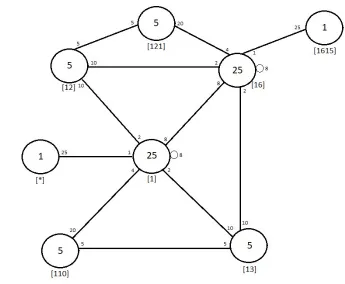
Now, we have completed the double coset enumeration since the right coset is closed under multiplication. We then conclude:
G=N ∪N t1N ∪N t1t2N, and that
|G| ≤(|N|+|N|N(1)||+
|N|
|N(12)|)× |N|
|G| ≤(1 + 6 + 3)×12
|G| ≤10×12
Figure 2.1: Construction ofS5 overD6
2.2.2 Construction of S6 over 5 : 4
Consider the group N = 2∗5 : (5 : 4) factored by the relation (yx−1tx)5 = 1 That is, G =S6 ∼= (yx2∗−51:(5:4)tx)5=1
With N being transitive on 5 letters of order 2. 2∗5 =< t1 >∗< t2 >∗< t3 >∗< t4 >∗< t5> N = (5 : 4)
x ∼(1, 2, 3, 4, 5)
y ∼ (1, 2, 4, 3)
t ∼t1
Expanding the relation we have:
1) (yx−1tx)5 = 1,
⇒ (yx−1tx)(yx−1tx)(yx−1tx)(yx−1tx)(yx−1tx) = 1
⇒ (yx−1t2)(yx−1t2)(yx−1t2)(yx−1t2)(yx−1t2) = 1
((yx−1)−1t2yx−1)t2= 1
⇒ yx−1t(2yx−1)4t2(yx−1)3t(2yx−1)2tyx2 −1t2 = 1
⇒ yx−1t2t4t5t3t2 = 1
⇒ N t2t4 =N t2t3t5
Conjugating all the previous relation by all elements of x and y from the group 5 : 4. We then obtain the following additional relations:
(yx−1t2t4=t2t3t5)e ⇔ yx−1t2t4 =t2t3t5
(yx−1t2t4=t2t3t5)yx−1 ⇔ yx−1t3t2 =t3t5t4
(yx−1t2t4=t2t3t5)x ⇔ x−1yt3t5 =t3t4t1
(yx−1t2t4=t2t3t5)x−1y ⇔ yt2t1=t2t4t3
(yx−1t2t4=t2t3t5)y ⇔ x−1yt4t3 =t4t1t5
(yx−1t2t4=t2t3t5)x
−2
⇔ yxt5t2 =t5t1t2
(yx−1t2t4=t2t3t5)x−1 ⇔ yt1t3 =t1t2t4
(yx−1t2t4=t2t3t5)x−1y−1 ⇔ yt3t4 =t3t1t2
(yx−1t2t4=t2t3t5)y
−1
⇔ xyt1t2 =t1t4t5
(yx−1t2t4=t2t3t5)y−1x ⇔ yxt2t3 =t2t5t1
(yx−1t2t4=t2t3t5)x2 ⇔ xyt4t1=t4t5t2
(yx−1t2t4=t2t3t5)y
−1x−1
⇔ x−1yt5t1 =t5t3t4
(yx−1t2t4=t2t3t5)xy ⇔ yxt1t5 =t1t3t2
(yx−1t2t4=t2t3t5)xy2 ⇔ xyt2t5 =t2t1t4
(yx−1t2t4=t2t3t5)xy
−1
⇔ yx−1t4t5 =t4t2t3
(yx−1t2t4=t2t3t5)yxy ⇔ yx−1t5t3 =t5t4t2
(yx−1t2t4=t2t3t5)yx ⇔ xyt5t4 =t5t2t1
(yx−1t2t4=t2t3t5)y 2x
⇔ yt4t2=t4t3t1
(yx−1t
2t4=t2t3t5)y 2
⇔ yxt3t1 =t3t2t5
(yx−1t2t4=t2t3t5)yx−1y ⇔ x−1yt1t4 =t1t5t3
Calculating the total number of unique cosets ofN inG. We have:
|G| |N| =
720 20 = 36.
Now we know that we will have 36 unique single cosets.
1st Double Coset [∗]
N eN ={N en|n∈N} ={N}. N is transitive on{1,2,3,4,5}; moreover,
|N|
|N∗| = 2020 = 1 So, N eN has one single orbit {t1, t2, t3, t4, t5}. Thus, orbit of N on
{1,2,3,4,5}is{1,2,3,4,5}. Now, select a representativeti from orbit. We will select 1
1∈ {1,2,3,4,5} ⇒N t1 ∈[1]
Now, we shall extend N t1 to a new double coset [1].
2nd Double Coset [1]
N t1N ={N tn1|n∈N}= {N t1, N t2, N t3, N t4, N t5}.
For the coset stabilizer N(1) we have,
N(1) ≥ N1 = <(2,4,5,3) > ⇒ {e,(2,4,5,3),(2,5)(3,4),(2,3,5,4)}. Which shows us that there are 4 elements in both the point stabilizer and coset stabilizer.
This would then imply that the number of single cosets in N t1N are
|N|
|N1| = 204 = 5 Thus, orbits of N1 on {1,2,3,4,5} are{1}, and{2,4,5,3}. Now, select
a representative ti from orbit.
1∈ {1} ⇒N t1t1 ⇒N e∈[∗]
2 ∈ {2,4,5,3} ⇒ N t1t2 ∈[12], which goes to a new double coset [12]
3rd Double Coset [12]
N t1t2N ={N t1tn2|n∈N}
For the coset stabilizer N(12) we have,
N(12)≥N12=< e >. Since, the coset stabilizer is only the identitye, this would imply that the number of single cosets in N t1t2N are |N|N(12)| | =
20
1 = 20. Thus, the orbits of N(12) on {1,2,3,4,5} are{1},{2},{3},{4} and{5}.
From this, we could see that each single coset in N t1t2N are distinct. To find each
distinct single coset, we must find the right cosets of N(12) inN. Which are
⇒
{N t1t2(1,2,3,4,5), N t1t2(1,2,4,3), N t1t2(1,5,4,3,2), N t1t2(1,3,4,2), N t1t2(1,3,5,2,4) , N t1t2(1,4,5,2), N t1t2(2,4,5,3), N t1t2(1,3,2,5), N t1t2(1,4)(2,3), N t1t2(2,3,5,4), N t1t2(1,5,3,4), N t1t2(1,4,2,5,3), N t1t2(1,5,2,3), N t1t2(1,4,5,3), N t1t2(1,3)(4,5), N t1t2(2,5)(3,4), N t1t2(1,5)(2,4), N t1t2(1,2)(3,5)}
Taking each element representative from each coset, we get the form the set of transver-sals, which consist of,
T12={(1,2,3,4,5),(1,2,4,3),(1,5,4,3,2),(1,3,4,2),(1,3,5,2,4),(1,4,5,2),(2,4,5,3),
(1,3,2,5),(1,4)(2,3),(2,3,5,4),(1,5,3,4),(1,4,2,5,3),(1,5,2,3),(1,4,3,5)}
Now, conjugating the single coset representative N t1t2 by the transversals, we have our distinct double cosets being,
N t1t2N ={N t1tn2|n∈N}= {N t1t2, N t2t4, N t3t2, N t3t5, N t4t3, N t5t2, N t1t3, N t3t4,
N t2t3, N t4t1, N t5t1, N t1t5, N t2t5, N t4t5, N t5t3, N t5t4, N t4t2, N t3t1, N t1t4}
by the relations.
We will now select a representative ti from each orbit.
1 ∈ {1} ⇒N t1t2t1 ∈[121], which goes to a new double coset [121]. 2 ∈ {2} ⇒N t1t2t2 ∈[1], which goes back to [1].
3 ∈ {3} ⇒N t1t2t3 ∈[123], which goes to a new double coset [123].
4 ∈ {4} ⇒N t1t2t4. Lets now look at the relation N t2t4 =N t2t3t5, Since, (N t2t4)x
−1
= (N t2t3t5)x
−1
⇒ N t1t3 = N t1t2t4, and we also have that N t1t3 ∈
[12]. This indicates that N t1t2t4 ∈ [12].
5 ∈ {5} ⇒N t1t2t5. Let us look again at the relation N t2t4 =N t2t3t5, Since, (N t2t4)y
−1
= (N t2t3t5)y
−1
⇒ N t1t2=N t1t4t5,
⇒ N t1t2t5 =N t1t4t5t5 (right multiplication by t5)
⇒ N t1t2t5 =N t1t4 and we also have that N t1t4 ∈[12]. This indicates thatN t1t2t5 ∈[12].
4th Double Coset [121]
N t1t2N ={N t1t2tn1|n∈N}
For the coset stabilizer N(121) we have, N(121) ≥ N121 = < e >. Which indicates that only the identity e fixes 1, 2, and 1. However, we have from our relation that,
xyt1t2 =t1t4t5,⇒ t5xyt1t2 =t5t1t4t5 (multiplying t5 on the left hand side).
⇒ xyt2t1t2 =t5t1t4t5
(also, since x−1yt5t1 =t5t3t4)
⇒ xyt2t1t2 =x−1yt5t3t4t4t5
⇒ xyt2t1t2 =x−1yt5t3t5
⇒ (xyt2t1t2)yx−1y = (x−1yt5t3t5)yx−1y (conjugating by yx−1y)
⇒ xyt1t2t1 =yx−1t3t5t3
⇒ N t1t2t1 =N t3t5t3
So, N t1t2t1 = (N t3t5t3)yx =N t1t2t1 implies thatyx is in the stabilizing groupN(121). Which implies N(121) ≥ N121 =< yx > = <(1,3,2,5)>. Since there are 4 elements in
N121 ={e,(1,3,2,5),(1,2)(3,5),(1,5,2,3)}, This would then imply that the number of single cosets inN t1t2t1N are|N|(121)N| |=
20
4 = 5. Thus, the orbits ofN(121)on{1,2,3,4,5}
are {1,2,3,5}, and {4}. Since we have 5 distinct single cosets in [121], and using the transversals
T121={e,(1,2,3,4,5),(1,4,3,5),(1,4,2,5,3),(1,3,5,2,4)}. We have that,
N t1t2t1 =N t3t5t3 =N t2t1t2=N t5t3t5, N t2t3t2 =N t4t1t4 =N t3t2t3=N t1t4t1,
N t4t2t4 =N t5t1t5 =N t2t4t2=N t1t5t1,
N t4t5t4 =N t1t3t1 =N t5t4t5=N t3t1t3, N t3t4t3 =N t5t2t5 =N t4t3t4=N t2t5t2,
We will now select a re