CSUSB ScholarWorks
CSUSB ScholarWorks
Electronic Theses, Projects, and Dissertations Office of Graduate Studies
9-2018
Tutte-Equivalent Matroids
Tutte-Equivalent Matroids
Maria Margarita Rocha
California State University - San Bernardino
Follow this and additional works at: https://scholarworks.lib.csusb.edu/etd
Part of the Discrete Mathematics and Combinatorics Commons, and the Set Theory Commons
Recommended Citation Recommended Citation
Rocha, Maria Margarita, "Tutte-Equivalent Matroids" (2018). Electronic Theses, Projects, and Dissertations. 759.
https://scholarworks.lib.csusb.edu/etd/759
A Thesis
Presented to the
Faculty of
California State University,
San Bernardino
In Partial Fulfillment
of the Requirements for the Degree
Master of Arts
in
Mathematics
by
Maria Margarita Rocha
A Thesis
Presented to the
Faculty of
California State University,
San Bernardino
by
Maria Margarita Rocha
September 2018
Approved by:
Dr. Jeremy Aikin, Committee Chair
Dr. Lynn Scow, Committee Member
Dr. Rolland Trapp, Committee Member
Dr. Charles Stanton, Chair, Department of Mathematics
Abstract
Matroid theory was introduced by Hassler Whitney in 1935. Whitney strived
to capture an abstract notion of independence. A matroid is composed of a finite set E,
called the ground set, together with a rule that tells us what it means for subsets of E to
be independent. We begin by introducing matroids in the context of finite collections of
vectors from a vector space over a specified field, where the notion of independence is linear
independence. Then we will introduce the concept of a matroid invariant. Specifically, we
will look at the Tutte polynomial, which is a well-defined two-variable invariant that can
be used to determine differences and similarities between a collection of given matroids.
The Tutte polynomial can tell us certain properties of a given matroid (such as the
number of bases, independent sets, etc.) without the need to manually solve for them.
Although the Tutte polynomial gives us significant information about a matroid, it does
not uniquely determine a matroid. This thesis will focus on non-isomorphic matroids
that have the same Tutte polynomial. We call such matroids Tutte-equivalent, and we
will study the characteristics needed for two matroids to be Tutte-equivalent. Finally, we
Acknowledgements
I extend my deepest gratitude to my advisor Dr. Jeremy Aikin, for his guidance
and patience in working on this project. He has been a role model as a mathematician
and teacher. I could not have done this without his help. Thank you to my committee
members, Dr. Rolland Trapp and Dr. Lynn Scow, for their support. To my mother,
Margarita Gomez-Diaz whose been so encouraging in every step. Lastly, to my fianc´e,
Bruce Valdez, who has been my pillar of support from the moment I applied to graduate
Table of Contents
Abstract iii
Acknowledgements iv
List of Figures vi
1 Introduction to Matroid Theory 1
1.1 Definitions . . . 1
1.2 Geometries . . . 4
1.3 Binary Matroids . . . 5
1.4 Duality . . . 6
1.4.1 Deletion and Contraction . . . 9
2 Matroid Invariants and Tutte-Equivalent Matroids 12 2.1 Matroid Invariants . . . 12
2.2 Corank-Nullity Polynomial . . . 13
2.3 The Tutte Polynomial . . . 14
3 Matroid Relaxation 22 3.1 Matroid Relaxation and the Tutte Polynomail . . . 22
3.2 Parent and Descendant Matroids . . . 25
4 Classifying Tutte-Equivalent Matroids 28 4.1 Binary Descendant and Parent Matroids . . . 32
5 Conclusion 35
List of Figures
1.1 The geometric representation of the matroid derived from the matrixA. . 5 1.2 A rank 3 matroidM and its dualM∗. . . 8 1.3 An example of a rank 2 matroid M, and the two matroids, M −a and
M/a, after deleting an contractingafrom M. . . 10
2.1 TheW3 matroid. . . . 13
2.2 Computing the Tutte polynomial of a rank 3 matroid . . . 19 2.3 The matroids Q6 and R6 are the smallest examples of non-isomorphic
matroids that have the same Tutte polynomial. . . 21
3.1 The non-Fano matroidF7− is a relaxation of the Fano matroid F7 . . . 23
3.2 Relaxing two different circuit-hyperplanes in M results in two Tutte-equivalent matroidsMA0
1 and M
0
A2 . . . 26
3.3 Relaxing a circuit-hyperplane from each matroid M1 and M2 results in
isomorphic relaxationsM10 ∼=M20. . . 27
4.1 Adding additional elements toM to create new Tutte-equivalent matroids. 31 4.2 Constructing additional matroids that have a common relaxation
descen-dant, by adding new elements to our ground set. . . 32 4.3 The matroid M = U2,3 ⊕U1,4 is in the only structure where a binary
matroid can have a binary relaxationM0. . . 33
Chapter 1
Introduction to Matroid Theory
Matroid theory was first introduced by Hassler Whitney in 1935, when Whitney
noticed properties of dependence common to graphs and matrices [Wel10]. Overall
matroid theory combines important ideas from linear algebra, graph theory, and finite
geometry [GM12]. Since its debut, matroid theory has grown significantly and remains
an important research area in mathematics.
1.1
Definitions
Although a matroid can be defined in many cryptomorophic ways, we will use
Whitney’s initial definition in terms of a generalized notion of independence. A matroid
M is built on a finite set of elements, E, called the ground set. Together with a family,
I, of subsets ofE calledindependent sets.
Definition 1.1.1. A matroid M consists of a finite set E, together with a family of
independent subsets I ofE, such thatI satisfies the following conditions: (I1) Non triviality: I 6=∅;
(I2) Closed under subsets: If J ∈ I and I ⊆J, then I ∈ I;
(I3) Augmentation: If I, J ∈ I with |I| < |J|, then there exists an element x ∈ J −I
such that (I∪x)∈ I.
r(X), is the cardinality of the largest independent set contained inX.
Definition 1.1.2. The rank of a matroid M is a non-negative increasing sub-modular function on subsets ofE. That is, ifA, B ⊆E, then:
(r1) 0≤r(A)≤ |A|;
(r2) If A⊆B, thenr(A)≤r(B);
(r3) r(A∪B) +r(A∩B)≤r(A) +r(B)
The rank also tells us the dimension of the geometry associated with a matroid,
according to the equation rank = dimension + 1. The maximal independent sets of a matroid are calledbases and the collection of all bases is denotedB(M). An element that is common to every basis is called a coloop, and an element that is in no basis is called a loop. Sets of a matroid that are not independent are said to bedependent. A minimal dependent set is called acircuit, and the collection of all circuits is denoted C(M).
Example 1.1.1. Consider the matroid M on the ground set E = {a, b, c, d} and with
I = {∅, a, b, c, d, ab, ac, ad, bc, bd, abd, acd, bcd}. Note that I satisfies axioms (I1), (I2),
and (I3).
• The cardinality of a maximal independent set (basis) (e.g, {abd},{acd}), is three.
Therefore, the rank of M is three.
• Notice that the element dis contained in every basis. Therefore,dis a coloop.
When a student first hears the word matroid, they might initially think of a
matrix. Indeed, a matrix over a given field is and example of a matroid. More precisely,
representable matroids are those whose ground set can be represented by the column vectors of a matrix over a field. We declare a subset of column vectors to be independent
whenever the vectors are linearly independent. A matroid that is representable over the
two element field F2 is said to be binary, and matroids that are representable over F3
are called ternary matroids. A matroid that can be represented over all fields is called a
regular matroid. One shall keep in mind, however, that not all matroids are representable. However, having a finite set of vectors as the ground set when working with representable
matroids allows us to see the independence axioms that define matroids in a more familiar
Example 1.1.2. A=
a b c d e f
1 0 0 1 0 0
0 1 0 1 1 0
0 0 1 0 1 0
LetE ={a, b, c, d, e, f} be the set of column vectors of matrix A. Note that A
is a rank 3 matrix over the field F2. Now consider the column vectors having nontrivial
linear combinations that result in a zero vector. These will be the dependent sets of the
associated matroid. All other sets of column vectors will be independent.
Notice the following:
• Since f is the zero vector, f is a loop. However, any single element from E− {f}
is independent.
• There are no dependent sets of column vectors of size 2 in E − {f}. So, any
combination of two vectors fromE− {f} is independent.
• Since, (1,0,0) + (0,1,0)−(1,1,0) = (0,0,0) and (0,1,0) + (0,0,1)−(0,1,1) =
(0,0,0), we see that{a,b,d}and{b,c,e}are dependent sets. All other combinations
of three vectors taken from E− {f}will be independent.
• Any combination of four vectors is dependent.
• Thus,I ={∅, a, b, c, d, e, ab, ac, ad, ae, bc, bd, be, cd, ce, de, abc, abe, ace, acd, ade, bde,
bcd, cde}. One can check thatI satisfies the independence axioms (I1), (I2), and
(I3).
Spanning sets are subsets A ⊆E such that r(A) = r(E), and the collection of all spanning sets of a matroidM is denotedS(M). A subset F ⊆E is a flat ifF isrank maximal, meaning that for all e∈ E−F, we have r(F ∪e) > r(F). It is important to note that loops will be found in every flat (since loops have rank 0 and never increase the
rank when added to a set). A hyperplane is a flat of rankr(M)−1, and the collection of all hyperplanes of a matroid is denoted H(M).
following:
• (B1) B(M)6=∅.
• (B2) If B1, B2∈ B(M) and B1 ⊆B2, thenB1 =B2.
• (B3) If B1, B2 ∈ B(M) and x ∈B1−B2, then there exist y ∈ B2−B1 such that
(B1− {x} ∪ {y})∈ B(M).
The properties that the collection of bases, B, will be used to define a matroid
in terms of bases in future lemmas.
1.2
Geometries
There are many perspectives from which to view matroids. One of the most
advantageous perspectives is that of finite geometry, which is the perspective we will
emphasize in this thesis.
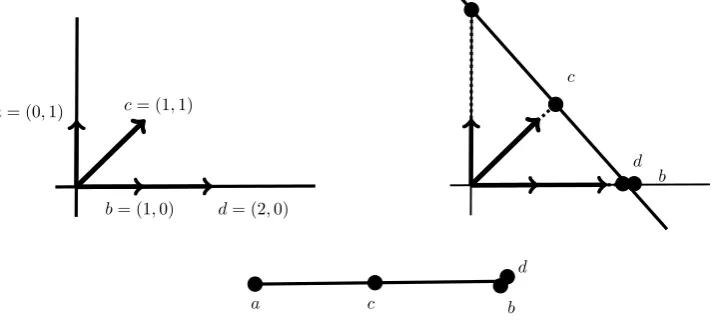
Example 1.2.1. Consider the following matrix:
A=
a b c d
1 0 1 2
0 1 1 0
Although one can easily find all the dependent and independent sets from
A, this is not an ideal approach since not all matroids can be represented by a
ma-trix. As the number of elements and rank of a matroid increases, creating a
geom-etry from the given matrix will facilitate our research. The rank of A is two, and
I(A) = {∅, a, b, c, d, ab, ac, bc, bd, cd}. Note the rank of a matroid also tells us the
di-mension of the associated geometry. So A will be a one-dimensional geometry. Next,
we will need to follow some simple guidelines to create our geometry. First, we plot the
vectors in a coordinate plane. Second, we place a line in “free” position, by making sure
it is not parallel to any of the vectors. Last, we extend or reduce the magnitude of each
vector, and/or reverse the direction of each vector so all vectors intersect the free line.
from the projected vectors (see Fig 1.1). Note, that any scalar multiple of a given vector
will result in the same projected point in the geometry.
b= (1,0)
a= (0,1) c= (1,1)
d= (2,0)
a
b c
d
a c b
d
Figure 1.1: The geometric representation of the matroid derived from the matrix A.
1.3
Binary Matroids
A binary matroid is one that can be represented by a matrix over the field
F2. Binary matroids play an important role since they contain unimodular matroids
and graphic matroids, two fundamental classes in matroid theory [Fou87]. Additionally,
binary matroids have many attractive properties that make them an interesting class of
matroids for research.
Proposition 1.3.1. If a matroid M is binary, then each of its minors are also binary.
Matroid duality will be discussed in Section 1.4, but the following result speaks
to the importance of matroid duality in that it behaves well with respect to matroid
represent-ability over a given field.
Proposition 1.3.2. If a matroid M is binary, its dual matroid M∗ is also binary.
Example 1.3.1. A rankr matroid on a ground set withn elements is called a uniform matroid if all of its circuits are of sizer+ 1. We denote such a matroids byUr,n. Uniform
matroids play a key role in matroid represent-ability. If we are trying to determine
whether a given matroid can be represented over a certain field, we look for the existence
within” will be made more precise in Section 1.4.1, where we will explore the concept of
matroid minors. For now, an important illustration of this idea is the following theorem.
Theorem 1.3.1. A matroid is binary if and only if it does not contain the uniform matroid U2,4 as a minor.
Binary matroids can be characterized in many ways aside from not having a U2,4 minor.
Below are some useful characterizations of binary matroids. Note, ifX and Y are sets in
M, thesymmetric difference, denoted X∆Y, is equal to (X−Y)∪(Y −X).
Theorem 1.3.2. Given a matroid M, the following are equivalent: (i) M is binary.
(ii) IfC1 and C2 are distinct circuits, thenC1∆C2 contains a circuit.
(iii) IfC1 and C2 are circuits, then C1∆C2 is a disjoint union of circuits.
(iv) M has no minor isomorphic to U2,4.
(v) Every rank r−2 flat of M is contained in at most three hyperplanes.
1.4
Duality
An important tool in matroid theory is the ability to construct new matroids
from those we already know about. One of the ways to create a new matroid is through
the concept of matroid duality. The theory of duality is one of the most important tools at our disposal when attempting to solve many matroid theory problems. This theory
was first introduced by Whitney in 1935 [Oxl11]. The dual of a matroid M is another
matroid, written M∗, and it is defined on the same ground setE as follows:
Definition 1.4.1. Let M be a matroid on the ground setE. Thedual matroid M∗ will have the same ground setE such that
B(M∗) ={E−B :B ∈ B(M)}.
The rank of a subsetAinM∗is denotedr∗(A), and can be found by the following
Theorem 1.4.1. Let M be a matroid with ground set E and rank function r. IfA⊆E, then
r∗(A) =r(E−A) +|A| −r(M).
Proof. Proof of this theorem can be found in [Oxl11].
Since the rank of a matroid is determined by the cardinality of its bases, and since the
bases of the dual matroid are the complements of the bases of the original matroid, we
get the following:
Proposition 1.4.1. |E| −r(M) =r(M∗)
The compliments of spanning sets, hyperplanes, and circuits also play an
im-portant role in matroid duality.
Proposition 1.4.2. Let M be a matroid on the ground set E and suppose S ⊆E. Then
S is spanning if and only if E−S is an independent set in the dual M∗.
Proposition 1.4.3. Let M be a matroid on the ground set E. Then circuits and hyper-planes of the dual matroid M∗ are determined as follows:
(i) C(M∗) ={E−H :H∈ H(M)}
(ii) H(M∗) ={E−C:C ∈ C(M)}
Proof. (i) Let H be a hyperplane in M. If H is non-spanning, then there exists an
xi ∈ E−H such that H∪xi is spanning. Then E−H is a dependent set in M∗, and
(E−H)−xi is independent inM∗. Therefore, E−H is a circuit inM∗.
(ii) Let C ∈ C(M), so C is a minimal dependent set and is therefore not contained in any basis of M. This implies that E−C is maximal with respect to not containing a
basis complement. Thus, E −C /∈ B∗ and r∗(E−C) < r∗(B∗). Therefore E−C is a
hyperplane in M∗.
At times a matroid will contain a set that is both a circuit and a hyperplane. Let the set
of circuit-hyperplanes of a matroid M be denotedU(M).
Corollary 1.4.1.1. Let M be a matroid with the ground set E. IfU is a circuit-hyperplane of M then its compliment will also be a circuit-hyperplane in M*. That is, U(M∗) =
Example 1.4.1. Consider the matroid M with ground set E = {a, b, c, d, e} in Figure 1.2.
• By Proposition 1.4.1, r(M∗) = 2.
• The basis of M areB={abd, abe, acd, ace, bdc, bce, bde, ade}, therefore the bases of
M∗ will beB∗ ={ce, cd, bd, ae, ad, ac, bc, be}
• Since C(M) ={abc, cde, bdae}, we see thatH(M∗) ={de, ab, c}.
• By Corollary 1.4.1.1, the circuit-hyperplanes inM areU(M) ={abc, cde}, therefore
U(M∗) ={de, ab}.
M
M∗ c
a
e
c e
b
d a b
d
Figure 1.2: A rank 3 matroidM and its dualM∗.
As you may have predicted, loops and coloops also have an interesting
relation-ship in duality. We already know the bases of the dual matroidM∗ are the complements
of the bases of M. Since a coloop eis in every basis of M, we can conclude that e will
be in no basis of M∗. Therefore, we have the following:
Proposition 1.4.4. Given a matroid M, e is a loop of M if and only if eis a coloop of
M∗.
For our research. matroid duality will allow us to work with some matroids of higher
ranks that might otherwise be difficult to work with (matroids of rank 5, 6, 7...). If the
dual of the matroid in question lives in rank 0, 1, 2, 3, or 4 it sometimes is easier for the
researcher to analyze the dual of the matroid in question. We can do this because the
dual of the dual gives us to the original matroid.
1.4.1 Deletion and Contraction
Another great tool in matroid theory is the deletion and contraction opera-tions.Construction new matroids from a given matroid through a sequence of these
op-erations produces something called a matroid minor. Both operations reduce the size of the ground set E by removing a chosen element.
Definition 1.4.2. LetM be a matroid with ground setE and independent setsI. 1. Deletion: For e ∈ E, where e is not an coloop. The matroid M−e has ground
setE− {e}. The independent sets ofM−eare the sets of I that do not containe.
2. Contraction: For any element e ∈ E, where e is not a loop, the matroid M/e
has ground set E − {e} and it’s independent sets are formed by selecting all the
members of I that containe, and then removingefrom such sets.
From Definition 1.4.2, we can see why it would be inconsistent to delete an coloop e.
Recall, that coloops are in every basis of M. Our matroid M −ewould have no bases,
which implies that I = ∅, violating (I1). Now lets see why we do not contract loops.
Assume e is a loop, this implies that e /∈ I(M). We would have no independent sets to
removeefrom when creatingI(M/e). As we begin to practice these operations it would be
easier for us to start by obtaining a list of all the independent sets of the original matroid
M. We then separate the independent sets into two lists. The first those containing our
element e, and our second, those that do not contain e. When applying the contraction
operation, we will use our first list and deleteefrom any independent set. When using our
deletion operation, we will simply use our second list without any modifications. Now,
since contraction instructs us to delete e from our list of independent sets, we are also
decreasing the cardinality of our bases by one. This leads us to the following proposition.
Proposition 1.4.6. Let M be a matroid.
1. Ife is not an coloop, then r(M−e) =r(M)
2. Ife is not a loop, then r(M/e) =r(M)−1
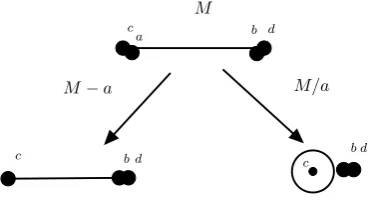
• For M −a we adopt all the independent sets of M that do not contain a. So
I(M−a) ={∅, b, c, d, bc, cd}. Also, our new matroid M −a has remained in rank
2.
• For M/a we adopt all the independent sets of M that contain a, which are
{a, ab, ad}, and delete afrom each set. Therefore I(M/a) = {∅, b, d}. Note that c
is still in the ground set of M/a, and sincec is in no independent set, then c is a
loop. Also note, by Proposition 1.4.6, our new matroid M/ahas decreased to rank
1.
M
M/a M−a
c d
a b
c bd b d
c
Figure 1.3: An example of a rank 2 matroidM, and the two matroids,M−aand M/a, after deleting an contracting afromM.
Although, the conversions of our independent sets give us a lot of information
about our new minor, we also need to give some attention to what occurs to the circuits
and hyperplanes ofM.
Proposition 1.4.7. Let M be a matroid and suppose e is neither a coloop nor a loop. Then
1. Deletion: C is a circuit of M−eif and only if e /∈C and C is a circuit of M.
2. Contraction: C is a circuit of M/eif and only if
• C∪e is a circuit of M, or
• C is a circuit of M and C∪econtains no circuits except C.
Proposition 1.4.8. Let M be a matroid and suppose e is not a loop. Then H(M/e) =
The process of deletion and contraction can be completed numerous times on
the same matroid. We can delete elements of a matroid until one element remains in the
ground set. Or, we can contract elements of a matroid until we’ve arrived at a rank 0
matroid. It is also important to note that the order of operations does not matter. If we
delete aand contract b from matroid M the resulting matroid will be the same as if we
first contracted band then deleted a. This gives us the following proposition:
Proposition 1.4.9. Let M be a matroid with ground set E, and a, b ∈E. Assume the elements being contracted are not loops, and the elements being deleted are not coloops. Then,
• (M−a)−b= (M−b)−a;
• (M/a)/b= (M/b)/a;
• (M/a)−b= (M−b)/a.
When we use the operations of deletion and contraction to create new matroids,
we are producing aminor of the original matroid. Recall from Proposition 1.4.9 that the order in which we delete and contract the elements ofaandbis not important. Our only
restriction is to not delete and coloop or contract a loop.
Our next goal is to draw our new matroid minors. The deletion operation
maintains the rank of M and only deletes e from the ground set E. The geometry of
M −e will look exactly the same as M, except of course, without the element e. The
geometry for M/e will require more attention. We know that the rank of M/e will be
one less thanr(M), which means that our dimension will also decrease. The geometry of
M/eis viewed by projecting the elements ofE− {e}through the pointeonto a space of
Chapter 2
Matroid Invariants and
Tutte-Equivalent Matroids
2.1
Matroid Invariants
In mathematics a quantity is said to beinvariant if it remains unchanged under transformations. For example, geometries in a Euclidean space are invariant under
iso-metric transformations. We can find invariants in every field of mathematics, and they
are extremely useful in classifying mathematical objects. The determinant, eigenvectors,
and eigenvalues of a square matrix are invariant under a change of basis. In graph theory,
thechromatic polynomialis an invariant. Evaluating the chromatic polynomial yields the number of k-colorings of any graphG, and this is invariant under graph isomorphism.
Matroid theory has several invariants. The most notable are thecorank-nullity polynomial
and Tutte polynomial. The latter will be the focus of our research. The Tutte polynomial captures a considerable amount of information about the matroid in question. However,
not all invariants, including the Tutte polynomial are complete invariants.
Definition 2.1.1. A matroid isomorphism invariant is a function f on the class of all matroids such that f(M) =f(N), whenM ∼=N.
The theory of invariants in matroid theory originated in graph theory, in the
2.2
Corank-Nullity Polynomial
In 1932, Whitney introduced a polynomial that can be computed for any matroid
with rank function r [Wel10]. The polynomial is a two variable polynomial, having
independent variables x and y.
Definition 2.2.1. The corank-nullity polynomial of a matroid M with a ground set E
and rank r is defined as:
s(M;x, y) = X
A⊆E
xr(E)−r(A)y|A|−r(A),
where the corank of A⊆E isr(E)−r(A) and nullity is |A| −r(A).
Notice that the corank-nullity polynomial is a matroid invariant. If we are given
two isomorphic matroids M and N containing the same ground set, then every subset
A ⊆ E(M) will have a corresponding subset in N, A0 ⊆ E(N). Thus every term of
the corank-nullity polynomial ofs(M;x, y) will have a corresponding term in the
corank-nullity polynomial of s(N;x, y).
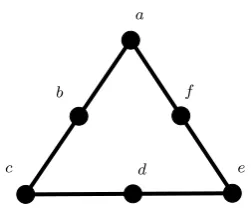
a
c e
b f
d
Example 2.2.1. Refer to the matroid W3 in Figure 2.1. The table below describes the
computation ofs(W3;x, y) by looking at all subsetsA ofE(W3) jnjnjnj
Polynomial of W3
A r(A) |A| r(E)−r(A) |A| −r(A) xr(E)−r(A)y|A|−r(A)
∅ 0 0 3 0 x3
a 1 1 2 0 x2
ab 2 2 1 0 x
abc 2 3 1 1 xy
abd 3 3 0 0 1
abcd 3 4 0 1 y1
abcde 3 5 0 2 y2
E 3 6 0 3 y3
Adding up the terms in the last column along with counting the possible ways
of obtaining our sets gives us:
s(M;x, y) =x3+ 6x2+ 15x+ 3xy+ 17 + 15y+ 6y2+y3
2.3
The Tutte Polynomial
Tutte’s motivation for his polynomial was inspired by the chromatic polyno-mial,χ(G, λ). Initially called thedichromatic polynomial, Henry Crapo later generalized Tutte’s work to matroids, and Brylawski proved many further results concerning the
Tutte polynomial [GM12].
Definition 2.3.1. Given a matroidM on ground setE, theTutte polynomial,t(M;x, y), can be computed recursively as follows:
For any element eof M, ife is neither a loop nor an coloop, then
t(M;x, y) =t(M−e;x, y) +t(M/e;x, y). (2.1)
If eis a loop, then
t(M;x, y) =y·t(M−e;x, y). (2.2)
If eis an coloop, then
t(M;x, y) =x·t(M/e;x, y). (2.3)
If E=∅, we define
The Tutte polynomial is a special evaluation of the corank-nullity polynomial.
Notice that r(M) is the highest power of x in t(M;x, y) while the nullity, n(M), is
the highest power of y in t(M;x, y). Therefore rank and nullity are invariants that are
computed by the Tutte polynomial. Additionally, since|E|=r(M)+n(M) the cardinality
of the ground set is also a Tutte polynomial invariant [BO92].
Theorem 2.3.1. The Tutte polynomial for a given matroid M is an evaluation of the corank-nullity polynomial, and a well defined matroid invariant.
t(M;x, y) =s(M;x−1, y−1)
Proof. Assume|E|= 1. Theneis either a loop or a coloop. If eis a loop thenr(E) = 0, and we get
s(M;x, y) =xr(E)−r(E)y|E|−r(E)+xr(E)−r(∅)y|∅|−r(∅)
=x0−0y1−0+x0−0y0−0
=y+ 1.
Therefore t(M;x, y) =y, and it follows thatt(M;x, y) =s(M;x−1, y−1).
If eis a coloop, thenr(E) = 1, so
s(M;x, y) =x1−1y1−1+x1−0y0−0
=x+ 1.
Therefore t(M;x, y) =x, and it follows thats(M;x−1, y−1) =t(M;x, y).
Now let |E| ≥ 2, and assume our theorem holds for all matroids on n−1 elements. We
need to show it holds for matroids on n elements. Let e ∈ E. Case 1: Assume e is neither a loop nor a coloop.We will denote r for the rank ofM,r0 for the rank function
of M−e, and r00 for the rank function of M/e. Thus,r0(A) =r(A) for allA⊆E− {e},
and r00(A−e) =r(A)−1, when e∈A.
The ground setEwill be separated into two classes. The classS1 will be the collection of
s(M;u, v) = X
A∈S1
ur(E)−r(A)v|A|−r(A)+ X
A∈S2
ur(E)−r(A)v|A|−r(A).
(1) SupposeA∈S, wheree∈A. Since the rank is lowered by one inM/e, then for each
of the subsets r00(A−e) =r(A)−1. Also, the corank of A equals the corank of A−e
computed in M/e. Thus, we have the following equation:
r(E)−r(A) =r00(E−e)−r00(A−e).
For the nullity, the rank and cardinality will both decrease by one when we remove e.
This implies
|A| −r(A) =|A−e| −r00(A−e).
Therefore,
X
A∈S1
ur(E)−r(A)v|A|−r(A)= X
A∈S1
ur00(E−e)−r00(A−e)v|A−e|−r00(A−e)
= X
B⊆E−e
ur00(E−e)−r00(B)v|B|−r00(B)
=s(M/e;u, v)
(2) Now supposeA∈S2. Sincee /∈A, thenr(E) =r0(E−e) andr(A) =r0(A). Therefore,
X
A∈S2
ur(E)−r(A)v|A|−r(A)= X
A∈S2
ur0(E−e)−r0(A)v|A|−r0(A)
=s(M −e;u, v).
Upon combining these equations, we obtain
s(M;u, v) =s(M/e;u, v) +s(M−e;u, v).
But, by definition, t(M;x, y) = t(M/e;x, y) +t(M −e;x, y). Applying our induction
hypothesis to this equation we have:
t(M;x, y) =s(M/e;x−1, y−1) +s(M −e;x−1, y−1)
=s(M;x−1, y−1).
(1) Consider the setsAinS1. The corank and nullity ofAcomputed inM are the corank
and nullity of A−e computed inM/e. Therefore, we have
X
A∈S1
ur(E)−r(A)v|A|−r(A) =s(M/e;u, v).
Now, if Ais a set in S2, because eis a coloop, we will comparer(A) and r00(A) inM/e.
When e /∈ A, we have r(A) = r00(A) in M/e, since contracting the coloop does not
affect the rank of the sets not containing e. So our corank will change in M/e, where
r(E)−r(A) = (r00(E) + 1)−r00(A), but our nullity will remain unchanged,|A| −r(A) =
|A| −r00(A). Then,
X
A∈S2
ur(E)−r(A)v|A|−r(A)= X
A⊆E−{e}
u(r00(E−e)+1)−r00(A)v|A|−r00(A)
=u· X
A⊆E−{e}
ur00(E−e)−r00(A)v|A|−r00(A)
=u·s(M/e;u, v).
Adding the results from the sets in S1, and the sets in S2, we get
s(M;u, v) =s(M/e;u, v) +u·s(M/e;u, v)
= (1 +u)·s(M/e;u, v)
Butu=x−1 andv=y−1, so
s(M;u, v) = (1 + (x−1))s(M/e;x−1, y−1)
=x·t(M/e;x, y).
Case 3: Assume e is a loop. We again partition our subsets in the same manner as in previous cases. For S1, since e is a loop and e∈ A, then r(A) = r0(A) in M −e. Our
corank will remain the same in M−e, r(E)−r(A) =r0(E−e)−r0(A), and our nullity
will change, |A| −r(A) =|A| −(r0(A)−1). Then,
X
A∈S1
ur(E)−r(A)v|A|−r(A)= X
A⊆E−{e}
ur0(E−e)−r0(A)v|A|−(r0(A)−1)
=v· X
A⊆E−{e}
ur0(E−e)−r0(A)v|A|−r0(A)
For S2, sincee /∈A, we have r(E)−r0(E−e) and r(A) =r0(A). Therefore,
X
A∈S2
ur(E)−r(A)v|A|−r(A)= X
A⊆E−{e}
ur0(E−e)−r0(A)v|A|−r0(A)
=s(M −e;u, v)
Adding the results from the sets in S1, and the sets in S2, we get,
s(M;u, v) =v·(M−e;u, v) +s(M/e;u, v)
= (v+ 1)·s(M −e;u, v).
But u=x−1 and v=y−1, so
s(M;u, v) = (y−1 + 1)s(M−e;x−1, y−1)
=y·t(M−e;x, y).
Although the Tutte polynomial is simply a special evaluation of the
corank-nullity polynomial, the Tutte polynomial allows us to recursively compute the polynomial
of a geometry or graph by using deletion and contraction. Ultimately, we will arrive at
a collection of matroid minors whose Tutte polynomials we know. The sum of these
polynomials gives us the Tutte polynomial for the given matroid.
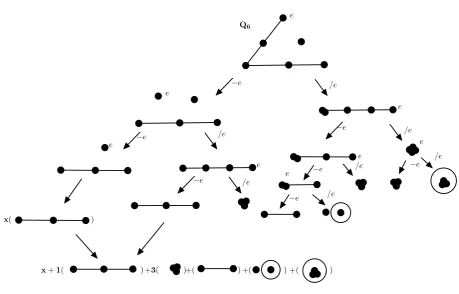
Example 2.3.1. Consider the matroid Q6 in Figure 2.2. The last row of the figure contains matroids U2,3,U1,3,U2,2,U1,1⊕U0,1, andU0,3. The Tutte polynomials of these
matroids are:
• t(U2,3;x, y) =x2+x+y
• t(U1,3;x, y) =x+y+y2
• t(U2,2;x, y) =x2
• t(U1,1;x, y)·t(U0,1;x, y) =xy
• t(U0,3;x, y) =y3
e
e
e
−e /e
−e /e
x( )
−e /e
−e
x+1( ) +3( )+( )+( )+( )
/e
/e
/e
−e
−e /e
−e e
e
e
e
e
Q6
Figure 2.2: Computing the Tutte polynomial of a rank 3 matroid
One can find the rank and cardinality of the ground set visually. In Example
2.3.1 the rank of Q6 is three and the ground set contains six elements. However, this is
only a small amount of information that the Tutte polynomial tells us.
Proposition 2.3.1. For any matroid M, the Tutte polynomial captures the following information:
• t(M; 1,1)gives the number of bases of M.
• t(M; 2,1)gives the number of independent sets of M.
• t(M; 1,2)gives the number of spanning sets of M.
• t(M; 2,2) = 2|E|, the number of subsets of M.
Tutte polynomial. Basically, if we know the Tutte polynomial of any given matroid, we
also know the Tutte polynomial of its dual.
Theorem 2.3.2. Given a matroid M, the Tutte polynomial of the dual matroid M∗ is found by
t(M∗;x, y) =t(M;y, x). (2.5)
Proof. We will use the corank-nullity polynomial for this proof. Additionally, recall that that the Tutte polynomial is an evaluation of the corank-nullity polynomial. Therefore,
s(M;u, v) = X
A⊆E
(x−1)r(E)−r(A)(y−1)|A|−r(A).
Before we begin, recall the following relationships:
Using Theorem1.4.1, the rank of the set A in the dual matroid is given by
r∗(A) =r(E−A) +|A| −r(E).
The corank is
r∗(E)−r∗(A) =|E| −r(E)−[r(E−A) +|A| −r(E)]
=|E−A| −r(E−A).
Also, the nullity is
|A| −r∗(A) =|A| −[r(E−A) +|A| −r(E)]
=r(E)−r(E−A).
Notice the corank of A inM∗ is equal to the nullity ofE−AinM, and the nullity ofA
From the observations, it follows that
s(M∗;u, v) = X
A⊆E
(x−1)r∗(E)−r∗(A)(y−1)|A|−r∗(A)
= X
A⊆E
(x−1)|E−A|−r(E−A)(y−1)r(E)−r(E−A)
= X
A⊆E
(x−1)r∗(E)−r∗(A)(y−1)|A|−r∗(A)
= X
A⊆E
(x−1)|A0|−r(A0)(y−1)r(E)−r(A0)(∵A0 =E−A)
=s(M;y−1, x−1).
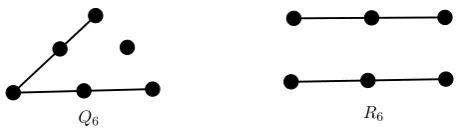
Our question now is to what extent does this information determine a unique
matroid. In other words, given two matroids that have the same Tutte polynomial, is it
possible that they will always be isomorphic? The answer is no. If we observe the two
matroids in Figure 2.3 we can see that although both matroids having the same Tutte
polynomial, the matroids are non-isomorphic. The remainder of this thesis is dedicated
to studying such matroids.
Q6 R6
Figure 2.3: The matroidsQ6andR6are the smallest examples of non-isomorphic matroids
Chapter 3
Matroid Relaxation
3.1
Matroid Relaxation and the Tutte Polynomail
A matroid operation that has allowed one to find other matroids is calledmatroid relaxation. Several well known matroids have been created through this operation, the Fano and non-Fano matroids, Pappus and non-Pappus matroids are just two examples
of this operation. Both, matroids have the same ground sets and almost the same bases.
This operation in particular will be very fruitful in finding Tutte-equivalent matroids.
Definition 3.1.1. If M1 and M2 are two non-isomorphic matroids that have the same
Tutte polynomial such that t(M1;x, y) = t(M2;x, y), then we say that M1 and M2 are
Tutte-equivalent.
Definition 3.1.2. Let M be a matroid having a subset A ⊂ E such that, A is both a circuit and a hyperplane. Relaxing A will result in a new matroid M0 with a new set of bases on the same ground set E such that B0 = B(M)∪A. Additionally, C(M0) =
C(M)−A.
When a circuit hyperplane A is relaxed in matroid M, our new matroid will be denoted
MA0 . The pressing issue now, is to prove that relaxing a circuit hyperplane does result in a new matroid.
F7 F− 7 relax{4,5,6}
1
2 3
7
4 6
5
1
2 3
7
4 6
5
Figure 3.1: The non-Fano matroid F7− is a relaxation of the Fano matroid F7
Proof. Assume M contains a circuit-hyperplane A ∈ C(M) and a collection of basis
B1, B2, B3, . . . Bn ∈ B(M). By definition, relaxing A will result in a new matroid MA0
where B(M0) =A∪ B(M). ThereforeM0 will satisfy ourB3 axiom in two cases.
Case 1: For allx∈A, there exist y∈Bi (for any i) such thatA− {x} ∪ {y} ∈ B(M0).
Let A ∈ C(M), so A− {x} ∈ I(M), now assume with out loss of generality, there exist
B2 ∈ I(M). So in M we have two independent sets I1 = A− {x} and I2 = B2, where
|I1|<|I2|. Then by our independent axiomI3, there exist an elementy ∈ I2−I1 such
that I1∪ {y} ∈ I(M). Additionally I1∪ {y} ∈ B(M).
But I1∪ {y}= (A− {x})∪ {y}. Since (A− {x})∪ {y} ∈ B(M) and B(M0) =B(M)∪A,
then we know (A− {x})∪ {y} ∈ B(M0).
Case 2: For allx∈Bi (for anyi), there existy∈A such thatBi− {x} ∪ {y} ∈ B(M0).
Assume A∈ B(M0) andB2∈ B(M). We need to show that there exist an elementy∈A
such thatB2−{x}∪{y} ∈ B(M0). If no suchyexist, then (B2−{x})∪{y}=r(M)−1 for
ally ∈A. Then we can assume thatyis in the closure ofB2− {x}andr(B2− {x})∪A=
r(M)−1. A contradiction.
Being able to create an additional matroid M0 from the original M is a
pow-erful tool when we are trying to find matroids having the same rank and ground set.
Additionally, if a matroid contains n circuit hyperplanes we can relax said matroid to
create at most n new matroids. The next question in order is, once we have relaxed a
circuit hyperplane and created a new matroidM0how does it affect the Tutte polynomial.
Luckily, one does not need to find the Tutte polynomial from scratch.
can be computed as follows,
t(M0;x, y) =t(M;x, y)−xy+x+y (3.1)
Proof. We will prove this theorem using the corank-nullity polynomial. Let M be a matroid with Bn ∈ B(M), and circuit-hyperplanes A1, A2, A3...An ∈ A(M). The set of
circuit-hyperplanes are computed in the corank-nullity polynomial as follows:
Recall the rank and cardinality of A are, r(A) =r(E)−1 and|A|=r(E),
X
A⊆E
ur(E)−(r(E)−1)vr(E)−(r(E)−1)
X
A⊆E
u1v1
.
The sets of bases, B(M), will also be computed at follows:
X
B⊆E
ur(E)−r(E)vr(E)−r(E)
X
B⊆E
u0v0
The circuit-hyperplanes and basis sections for our corank-nullity polynomial will be
de-scribed as
s(M;u, v) =. . .+i(uv) +j(1) +. . .
where irepresents the number of circuit hyperplanes and j the number of basis found in
M.
Without loss of generality we’ll now relax the circuit hyperplane A1 of M. Doing so,
we will obtain a new matroid M0 on the same ground set E whose basis will become
B(M0) =B(M)∪A1 andC(M0) =C(M)−A1.
s(M;u, v) =. . .+ (i−1)(uv) + (j+ 1)(1) +. . .
Recall that the Tutte polynomial is an evaluation of the corank-nullity polynomial,
t(M;x, y) = s(M;x−1, y −1). Then, we can redefine the corank-nullity polynomial
of M as:
t(M;x, y) =. . .+i(x−1)(y−1) +j(1) +. . .
t(M;x, y) =. . .+ixy−ix−iy+ (i+j) +. . .
Matroid M0 will be defined as
t(M0;x, y) =. . .+ (i−1)(x−1)(y−1) + (j+ 1)(1) +. . .
t(M0;x, y) =. . .+ixy−ix−iy+ (i+j)−xy+x+y+. . .
We can see that the difference between the Tutte polynomial ofM andM0 is−xy+x+y.
Therefore, when a circuit hyperplane of a matroidM is relaxed, we obtain a new matroid
M0 whose Tutte polynomial can be derived by
t(M0;x, y) =t(M;x, y)−xy+x+y
3.2
Parent and Descendant Matroids
The matroid relaxation tool has given us the ability to find at least one other
matroid with the same ground set and rank as our original. However, if a matroid contains
at least two or more circuit-hyperplanes it can produce two non-isomorphic matroids as
well.
Definition 3.2.1. Assume we have two non-isomorphic matroidsM1 andM2where each one contains at least one circuit hyperplane. If we relax each matroids respective
circuit-hyperplane so that M10 andM20 are isomorphic, then we can define M1 andM2 as having
a common relaxation descendant. See Figure 3.3
Definition 3.2.2. Assume we have a matroid M containing at least two circuit-hyperplanes, A1 and A2. If we can relax each circuit-hyperplane individually such that
M
MA01 MA02
A1 ={3,4,5} A2 ={5,6,7} 1 3 5 7 2 4 6 3 1 5 7 4 2 6 1 3 5 2 4 6 7
Figure 3.2: Relaxing two different circuit-hyperplanes inMresults in two Tutte-equivalent matroids MA0
1 andM
0
A2
.
Approaching matroids by finding a common relaxation descendant or common relaxation
parent allows us to find non-isomorphic matroids that will aways have the same Tutte
polynomial.
Corollary 3.2.0.1. If two matroids,M1 andM2 have a common relaxation descendant,
such that M10 ∼=M20 thent(M1;x, y) =t(M2;x, y).
Proof. Assume we have two matroidsM1 and M2 and we relax each matroid to discover
that M10 and M20 have isomorphic relaxations. By Theorem 3.1.2, we know the Tutte
polynomial of M10 andM20 will be t(M10;x, y) =t(M1;x, y)−xy+x+yand t(M20;x, y) =
t(M2;x, y)−xy+x+y respectively. Since the relaxations of M1 andM2 are isomorphic
their polynomials will be equal. That ist(M1;x, y)−xy+x+y=t(M2;x, y)−xy+x+y
If we wish to obtain the Tutte polynomial of the original matroid, we have to perform some
algebraic manipulation to the polynomial of the relaxed matroid. Thereforet(M1;x, y) =
t(M2;x, y).
The Tutte polynomial of matroid that is a common relaxation parent can be found as
Corollary 3.2.0.2. Suppose a matroid M contains at least two circuit-hyperplanes
A1, andA2, such that the respective relaxations result in two non-isomorphic matroids,
MA0
1 M
0
A2. Then, Tutte-polynomials t(M
0
A1;x, y) =t(M
0
A2;x, y).
Proof. This proof follows from Theorem 3.1.2.
M1 M2
M0 = (M10 ∼=M20)
Chapter 4
Classifying Tutte-Equivalent
Matroids
We have seen that the Tutte polynomial encodes a significant amount of
infor-mation about a matroid. Additionally, we have found a method to find Tutte-equivalent
matroids through matroid relaxation. The task now is to classify Tutte-equivalent
ma-troids. In what follows, we will develop additional tools to construct Tutte-equivalent
matroids within certain matroid classes. We begin by determining restrictions on the
rank and the cardinality of the ground set for Tutte-equivalent matroids.
Lemma 4.1. Any two rank 0 Tutte-equivalent matroids are isomorphic.
Proof. AssumeM1andM2 are two matroids in rank 0 each on the samen-element ground set. All elements in a rank 0 matriod are loops, hence there is only one way to build such
a matroid. Therefore, all such matroids will be isomorphic.
Additionally, we can easily compute the Tutte polynomial for rank 0 matroids on n
elements:
t(U0,n;x, y) =yn (4.1)
Lemma 4.2. Any two rank 1 Tutte-equivalent matroids are isomorphic.
Proof. Suppose we have two matroids M1 and M2, such that t(M1;x, y) = t(M2;x, y).
Necessarily, both matroids must contain the same number of loops and parallel elements
elements, respectively, in matroid Mi. However, since parallel elements in rank 1 can
only occur in a single parallel class, then the two matroids must be isomorphic.
For a rank 1 matroid M on n elements, containing ` ≥0 loops and n−` ≥1
parallel elements, it is not difficult to compute the Tutte polynomial of M:
t(M;x, y) =y`(x+y+y2+....+yn−`) (4.2)
Computing the Tutte polynomials for rank 2 matroids becomes more
compli-cated, since such matroids can contain multiple parallel classes of elements. We first
compute the Tutte polynomial for U2,n, where n ≥ 2. This can be seen by noticing
that any single element contraction in U2,n produces the matroidU1,n−1, while any single
element deletion in U2,n produces the matroid U2,n−1 (ifn≥3).
t(U2,n;x, y) =
x2+ (n−2)x+ (n−2)y+ (n−3)y2+...+ (n−k−1)yk+...yn−2 (4.3)
The Tutte polynomials for rank 2 matroids that contain ` ≥ 1 loops, but no parallel
elements have the following formula:
t(M2,n;x, y) =
y`(x2+ (n−`−2)x+ (n−`−2)y+ (n−`−3)y2+...
+ (n−`−k−1)yk+...+yn−`−2) (4.4)
If a rank 2 matroid contains ` ≥ 0 loops and k parallel classes of size m1, m2, ...mk,
where mi ≥2, then the Tutte polynomial forM is:
t(M2,n;x, y) =
yl
h Pk
j=1
Pmj−1
i=1 x+y+y2+...yn −Pj
r=1mr+(j−2)
+ x2+ (N−2)x+ (N−2)y+ (N −3)y2+...+yN−2
i
, (4.5)
where N =n−Pk
r=1mr+k.
Proof. Assume we have two matroids M1 and M2 in rank 2 that have the same Tutte polynomial. Then, both matroids will have the same number of loops, single elements
and the same number of parallel elements in each parallel class. Each parallel class of
elements, will correspond to a unique place on an affine line. Reordering these parallel
classes on this line simply creates isomorphic copies of M1 and M2, thus resulting in
isomorphic matroids.
The implications of these lemmas is that our search of Tutte-equivalent matroids
must begin in rank 3 and higher. However, as we see in the next results, the ground sets
of two Tutte-equivalent matroids must also not be too small with respect to the ranks of
the matroids. To prove this we recall Theorem 2.3.2, which implies the following:
Corollary 4.0.0.1. If M1 and M2 are Tutte equivalent matroids, t(M1;x, y) = t(M2;x, y), then t(M1∗;x, y) =t(M2∗;x, y)
Proof. SinceM1andM2are Tutte-equivalent, thent(M1;x, y) =t(M2;x, y). By Theorem 2.3.2 t(M1∗;x, y) = t(M1;y, x) and t(M2∗;x, y) = t(M2;y, x). Therefore t(M1∗;x, y) =
t(M2∗;x, y).
Corollary 4.0.0.2. IfM1 andM2 are Tutte-equivalent matroids, each having rankr ≥3, then |E(Mi)| ≥r+ 3, for i= 1,2.
Proof. Suppose, to the contrary, thatr≤ |E(Mi)|< r+ 3, for some i. SinceM1 andM2
are Tutte-equivalent, |E(M1)|=|E(M2)|. Therefore, r≤ |E(M1)|=|E(M2)|< r+ 3. If
|E(M1)|=|E(M2)|=r, thenr(M1∗) =r(M2∗) = 0, and by Lemma 4.1, M1∗ ∼=M2∗, which
impliesM1 ∼=M2. This contradicts the hypothesis thatM1 andM2 are Tutte-equivalent.
If |E(M1)|=|E(M2)|=r+ 1, then r(M1∗) =r(M2∗) = 1, and by Lemma 4.2,M1∗ ∼=M2∗,
which implies M1 ∼= M2. This again contradicts the hypothesis that M1 and M2 are
Tutte-equivalent. Finally, if |E(M1)|=|E(M2)|=r+ 2, then r(M1∗) =r(M2∗) = 2, and
by Lemma 4.3, M1∗ ∼= M2∗, which implies M1 ∼= M2. This once again contradicts the
hypothesis that M1 and M2 are Tutte-equivalent. Therefore, it follows that |E(Mi)| ≥
r+ 3, fori= 1,2.
Thus, our search for Tutte-equivalent matroids must begin with rank 3
ma-troids having at least six elements. Figure 2.3 illustrates the smallest example of
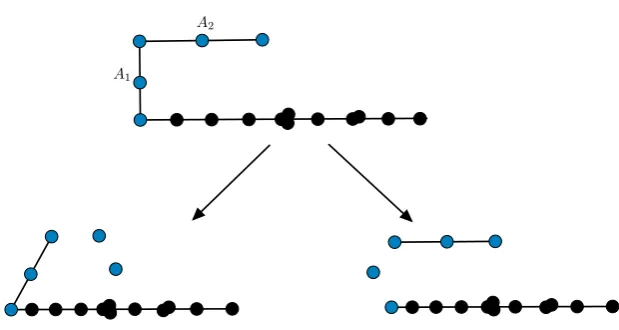
A1
A2
Figure 4.1: Adding additional elements toM to create new Tutte-equivalent matroids.
Once we have found a matroid M that is a common relaxation parent to at least two
matroidsM10 andM20 we can continue to relax circuit hyperplanes inM10 andM20 in hopes
of finding additional Tutte-equivalent matroids, See Figure 5.1. Additionally, we can also
use our parent matroid M as the foundation to construct new matroids by adding new
elements to our ground set. The only restrictions are:
1. An element eadded to the ground set cannot be a loop.
2. Elements cannot be added to the circuit-hyperplanes A1 and A2.
Example 4.0.1. The matroid in Figure 3.2 is in rank 3 with|E|= 7. We can construct another matroid in the same rank that is also a common relaxation parent by adding 10
additional elements as in Figure 4.1.
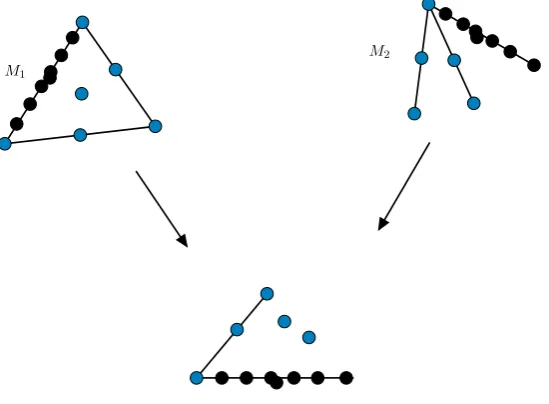
A similar approach is applied to matroids M1 and M2 that share a common relaxation
descendant with one additional restriction. See Figure 4.2.
1. Any element eadded to the ground set cannot be a loop.
2. Elements cannot be added to circuit hyperplane A.
3. The same amount of elements or parallel classes must be added to both M1 and
M2.
Our initial research began by finding ways to construct and classify Tutte-equivalent
quickly became a very useful tool to find Tutte-equivalent matroids. Matroid relaxation
along with the correct rank and ground set gave way to a plethora of Tutte-equivalent
matroids. However, our success in constructing Tutte-equivalent matroids has made it
very difficult to classify them in any order. Therefore, we will turn our attention to
explore the existence of Tutte-equivalent matroids in classes of matroids, particularly
the binary field. We will try to find additional restrictions, if any, that Tutte-equivalent
matroids need to hold to be in the binary field. Additionally, attempting to determine if
common relaxation parents, or common relaxation descendants, will also produce binary
matroids and other questions.
M1
M2
Figure 4.2: Constructing additional matroids that have a common relaxation descendant, by adding new elements to our ground set.
4.1
Binary Descendant and Parent Matroids
Binary matroids follow the same restrictions we have established for all
matroids. To find Tutte-equivalent binary matroids they must must be in rank 3 or
higher and contain r+ 3 elements. However, binary matroids can only contain at most
2r−1 elements. So for example, a matroidM withr(M) = 4 can have a ground set that only contains from 7≤ |E| ≤15 elements.
relax={a, b, c}
M M0
a c b g f e d a c g f e d b
Figure 4.3: The matroid M =U2,3⊕U1,4 is in the only structure where a binary matroid
can have a binary relaxation M0.
results we’ve found from this class.
Definition 4.1.1. Let M1 and M2 be two matroids on disjoint ground sets E1 and E2
respectively. The direct sum is a new matroid M1⊕M2 with ground set E = E1∪E2
and independent sets I1∪I2.
Lemma 4.4. A binary matroid in rank r with ground set |E| = n that has a binary relaxation can only be in the structure of Ur−1,r⊕U1,n−r.
Proof. Given a matroidM, its circuit-hyperplane is in the structure ofUr−1,r containing r
r−2
flats. Any r−2 flat will be contained in two hyperplanes. The first,r−2∈A and
the second is composed of Hi = (r−2)∪U1,n−r.Upon relaxing the circuit-hyperplane A
we turned our dependent set independent, and increased the number of hyperplanes by
one as well. Thus evey r−2 flat will be contained in at most three hyperplanes, and will
continue to satisfy Theorem 1.3.2.
IfM is a binary matroid with two Tutte-equivalent relaxationsM10 andM20, thenM must
contain at least two circuit hyperplanes and a ground set of at leastr+ 3 elements, where
every r−2 flat is contained in at most 3 hyperplanes.
Proof. IfM is a binary matroid where everyr−2 flat is contained in at most 2 hyper-planes, then M = Ur−1,r⊕U1,n−r. Thus, M is not a common relaxation parent. Now
assume M is a binary matroid, and every r−2 flat is contained in three hyperplanes.
If we relax A1, then there will exist a r −2 flat in A1 contained in more than three
hyperplanes. The same result will follow for A2. Therefore, M10 and M20 are not binary
matroids.
Lemma 4.6. Common relaxation descendant binary matroids do not exist.
Proof. Suppose, to the contrary. Assume M1 and M2 are two non-isomorphic binary matroid containing circuit-hyperplanes A1 and A2 respectively. Assume relaxing each
matroids’ circuit-hyperplane gives a binary relaxation where, MA0
1
∼
=MA0
2. From Lemma
4.4, the only binary matroids with a binary relaxation have structure of Ur−1,r⊕U1,n−r.
Therefore, if MA0
1 and M
0
A2 are binary, thenM1
∼
=M2.
Although it is possible to find a binary matroid that is a common relaxation parent to
two new matroids, once we relax a circuit hyperplane we’ve left our binary class. For
example the Fano matroid F7 can produce thirteen new matroids, none of which will be
Chapter 5
Conclusion
The goal of this thesis was to identify and study matroids that have the property
of being Tutte-equivalent. We began learning that every matroid can be represented by
a Tutte polynomial, and said polynomial encodes several pieces of information about our
matroid. Such as:
• t(M; 1,1) gives the number of basis ofM.
• t(M; 2,1) gives the number of independent sets of M.
• t(M; 1,2) gives the number of spanning sets ofM.
• t(M; 2,2) = 2|E| the number of subsets ofM.
However, this also implies that there are pieces of information about our matroid that
the Tutte polynomial can not capture. Therefore, it is possible that two geometrically
different matroids can have the same Tutte polynomial. The next step was to find
meth-ods that will help us find non-isomorphic matroids that have the same Tutte polynomial,
or Tutte-equivalent matroids.
We studied the Tutte-polynomial and the relation of the polynomial with the dual
ma-troid, and circuit-hyperplane relaxation. From here we noticed that matroid relaxation is
a very effective tool to help one find Tutte-equivalent matroids. We were able to classify
Tutte-equivalent matroids in two ways: Common relaxation descendants, which consist
of two matroids which have isomorphic relaxations. The other is a common relaxation
each circuit in two or more separate instances it creates at least two Tutte-equivalent
matroids.
The search for Tutte-equivalent matroids will begin in rank 3 and contain at least 3 more
elements than the cardinality of the rank. Once two Tutte-equivalent matroids are found,
they can be used as a foundation for Tutte-equivalent matroids with bigger ground sets.
However, these methods gave way to an unlimited amount of Tutte-equivalent matroids
making our attempt of classification very difficult. Instead, we turned our attention to
Tutte-equivalent matroids in the binary field.
Finding Tutte-equivalent matroids in the binary field turned out to be unfeasible. Our
research attempted to find binary matroids that would produce binary matroids through
matroid relaxation. However, we soon discovered that only one type of binary matroid
can have a binary relaxation. Therefore, one will not find common relaxation descendant
matroids in the binary field. This means that when a binary matroid M exists that is
a common relaxation parent, its descendants M1 and M2 will not be contained in the
binary field.
Although the results of Tutte-equivalent matroids in the binary field seemed somewhat
restrictive, it became a good starting point for future research. Ideally, future research
will begin to look into ternary matroids, geometries representable in the field F3, and
Figure 5.1: The stages of relaxing a circuit-hyperplane of the Fano matriod, F7,and the
Bibliography
[BO92] T. Brylawski and J. Oxley. The tutte polynomial and its applications. In Neil
White, editor, Matroid Applications, volume 40 of The Encyclopedia of Mathe-matics and Its Applications, pages 123–215. Cambridge University Press, 1992.
[Fou87] J.C. Fournier. Binary matroids. In Neil White, editor,Combinatorial Geometries, volume 29 ofThe Encyclopedia of Mathematics and Its Applications, pages 28–39. Cambridge University Press, 1987.
[GM12] G. Gordon and J. McNulty. Matroids: A Geometric Introduction. Cambridge University Press, 2012.
[Oxl11] J. Oxley. Matroid Theory. Oxford University Press, 2nd edition, 2011.