RESEARCH ARTICLE
ALGINATE IMPRESSION MATERIAL: KNOWLEDGE AND PRACTICE OF DENTAL
STUDENTS IN RIYADH, KSA
1
Ali Ahmed ALKhalifah,
1Mohammed ALHawal,
1Moataz ALSous and
2Shahzeb Hasan Ansari
1
Dental Intern, Riyadh Colleges of Dentistry and Pharmacy, KSA
2
Lecturer Preventive Dentistry, Riyadh Colleges of Dentistry and Pharmacy, KSA
ARTICLE INFO
ABSTRACT
Questionnaire was distributed to students practicing clinical sessions in Munseyah Campus of Riyadh Colleges Of Dentistry And Pharmacy from level eight up to level twelve to evaluate their knowledge and practice of Alginate impression material. Data were statistically analyzed and revealed that students of level twelve showed the higher percentage and the difference between them and students of level eight, nine and ten was statistically significant (P>0.05) while the difference between level twelve and eleven was statistically non-significant ( P<0.05). It could be concluded that immediate academic assessment to increase the awareness is required during training courses. Thus, small advances need to be made in this aspect to reap great and huge benefits.
Copyright©2017,Ali Ahmed ALKhalifahet al. This is an open access article distributed under the Creative Commons Attribution License, which permits unrestricted use, distribution, and reproduction in any medium, provided the original work is properly cited.
INTRODUCTION
Impression materials are used to record intra-oral structures for the fabrication of definitive restorations. Accurate impressions are necessary for construction of any dental prosthesis. The relationship between static and mobile oral structures must be reproduced accurately for an optimum cast. The more common types of impressions are used for fabricating diagnostic and master casts. Accurate impressions depend on identifying the applications that do or do not fit each material's characteristics. Materials used without adequate knowledge of their characteristics can impair a successful outcome. Often, the choice of impression materials depends on the subjective choice of the operator based on personal preferences and past experience with particular materials (Elsevier-Inc-2007). Alginate is an elastic, irreversible hydrocolloid impression material. Irreversible hydrocolloid impressions form an inseparable part of indirect restorations. Alginate is one of the most frequently used dental materials; and alginate impression is a simple, cost-effective, and indispensable part of dental practice. Yet very few people can make alginate impressions just right the first time. For many years, alginate impression material has been a staple of most dental practices. They form a major bulk of our clinical practice even today; therefore, it becomes mandatory to understand the material and follow certain fundamental guidelines for flawless, predictable
*Corresponding author: Ali Ahmed ALKhalifah
Dental Intern, Riyadh Colleges of Dentistry and Pharmacy, KSA
impressions and hence avoid repeat impression/restorations (Ashley 2005). Even with the introduction of more advanced and more accurate rubber base impression materials, irreversible hydrocolloid impression materials have stood the test of time (Vidyashree et al 2008). It is important to select the correct tray for the dental arch. The stock trays to be selected for alginate should be perforated. Alginate adhesives can be used, apart from perforations, for retention of alginate to the impression tray (Christensen GJ 2006). Disinfectant sprays are used for alginate impressions, but they do result in air bubbles in the cast. Immersion disinfectants can result in changes of 0.1%, and hence the quality of the impression surface may not be impaired if the recommended period of time is strictly followed (Ruble BS 2007). Set alginate undergoes imbibitions and syneresis if left in a normal clinical environment (Stewart 1997). Alginate can be described as a material which is an impression material which can be elastic and irreversible. Such hydrocolloid materials become an inseparable part of any restoration. From all the materials used Alginate is one of the most frequently used materials. The major reason is the fact that it is a vital part of the dental practices and also because it is cost effective and creates a simple expression. But even then not everyone can create the right impression using alginate. Alginate has been serving as one of the staple part of the dental practices for many years. They are used in bulk in the dental practices. Therefore it is essential to understand how it should be used to create a flawless and perfect impression so that the repetition can be ignored. The dos and don’ts of this material should be
ISSN: 0976-3376
Vol. 08, Issue, 12, pp.7223-7228, December,Asian Journal of Science and Technology 2017SCIENCE AND TECHNOLOGY
Article History:
Received 29th September, 2017
Received in revised form
22nd October, 2017
Accepted 19th November, 2017
Published online 30th December, 2017
Key words:
Alginate,
understood fully (May, 2014). The irreversible hydrocolloid can be used in the provisional crown and bridge impressions, primary impressions, dentition impressions and study models. Similarly, the alginates are used to create impressions for the bleaching trays, orthodontic models and mouth guards. Several studies have shown that the alginates can be used in creating the final impressions for the preparations when everything is complete (Shrinidhi, 2015). The infection control is a very essential issue in the health care operation. In the years recently, the presentation for the infection caused between the patient and the dental care professional has become one of the most essential parts of the control system. The control of the infection is very vital because it affects the health of the dental technicians, dentists, resident and patients. The microbial flora of the mouth is rich with the variable of food, proper temperature, moisture and such other types which act as a perfect surface for the microbial accumulation. Infections such as the Hepatitis B are considered one of the most dangerous infections for the dentist. The dental technicians are considered as one of the most serological and highest prevailing exhibit for the Hepatitis B. the studies have depicted that the dental PR actioners are one of the most exposed ones for the Hepatitis B and they are most open to such diseases than the common people. The dental infections can be transferred very easily from one person to another. Moreover, they are also transmitted because of lack of inspection and also because of the bad sterilization processes. It is essential that the knowledge of microbiology and infections are understood in the best manner possible because this way the use of tools and the procedures of disinfection and sterilization are best understood. The devices and the tools that are used in the dentistry are usually based on the classification in three ways how they transmit the infections; non critical, semi critical and critical. The infections usually fall in the second group of category because they come in contact with the mucus and the unhealthy skin. Therefore it is extremely important that the heat sterilization is carried out (Al-Enazi, 2016).
There was a survey carried out in the United States in which about 400 doctors were involved regarding the knowledge of the disinfecting procedures of the impressions that are taken. The impressions are usually disinfected longer that required by the dentists and the lab because they are not fully aware. These scenarios are usually more observed in the developing nations. There have been other several studies which have been carried out which stated that real lack of commitment has been seen regarding the disinfecting procedures. But doctors from the developed nation have found to be more educated and they do follow the right kind of protocols with regard to the disinfecting processes. The data which is usually collected regarding the cross infection control of the dental impression usually focuses how the doctor himself connects with the lab with regard to the procedure (Khalid, 2015). The oral cavity of the humans can serve to be an ideal place for the inoculation, transmission and the growth of the bacteria’s which can serve to be very dangerous and infectious diseases. This is exactly why the transmission of the diseases can be very easily carried out in the dental clinics. This can include; contact with blood, contaminants that are air Bourne, oral fluid, environmental surfaces, contaminated instruments and even operatory equipment’s. The dentists dealing with the patients usually do come in contact with the contaminated saliva and the patients’ blood which means that the dentists are more open to catch any kind of infections from the patient. This is exactly why the
rules regarding the infection control are one of the most essential parts in the field of dentistry (Wright & Bidra, 2015). The graduates from the field of dentistry all around the world are paid special attention with the knowledge of infection control, medical training and also clinical skills. This is exactly why it is subjected that students from their field are taught with the right kind of knowledge and how they should be treated with the infections. This is also important because when they do become professional doctors these are all the things which create the attitude of the doctors. Recently, there are a large number of students who are under graduate and they are being taught about they need to deal with their patients in the hospitals. The idea of cross contamination is way more probable in the younger dental students as compared to the experienced doctors. There have been several studies which show that the current doctors do not pay enough importance to the control measures of the infections. It is essential that the doctors correctly treat the infection control when they are working on their patients (Ibrahim et al, 2015).
Since the inception of alginate there have been a large number of publications made on the kind of properties it holds. It has been on the exclusive commercial products which were made. There have been several people who have carried out studies to understand the structure of the alginate when it is used for impressions. The dental infections need to be completely disinfectant when they are used for the sake of carrying out impressions. The blood and saliva from the impression surface can have several kinds of bacteria’s. There have been microorganisms which have been recovered from the stone casts which were made from the contaminated impressions. The immersion disinfectants and the sprays are used in order to disinfect the alginate impressions. Such practices can create several surface quality issues in the impressions. If there is availability for the self-disinfecting alginate then this would be of great advantage. I order to achieve such an alginate there are several formulations made with the assistance of the sodium alginate (Nicholson, 2013). The Alginate is made up of the agonic salts and acid. The compounds of the alginate are usually found in the walls of the brown algae. The alginates are usually very water absorbent and they are extremely flexible. Although the alginate acid was started to produce in Japan in the early 1920’s but the real production took place in the United States.
affect the tear energy and also the permanent set (Matsushige, 2013). The im0pression materials are usually used in order to take the structure of the intra oral structures which are related to the defective restorations. The results of these restorations greatly depend upon the kind of technique that is used and also on the impression material that is used. Some of the famous impression materials which are used include the hydrocolloids and also the addition silicon (Todd, 2013).
The properties of an ideal impression material should include being pleasant in odor and taste, they should not have any toxic or irritating qualities, the shelf life should be good, good
elastic qualities, good setting characteristics, easy
manipulations, should be compatible with the die and cast material, stability in dimension, there should be high reproduction details and should be economical. The material used as an impression material should be able to reproduce the soft and hard tissues in such an accurate manner that they can
create biologically, aesthetically, mechanically and
functionally acceptable restoration. The Alginate has such properties that they can produce good impressions of the restoration in the presence of the blood or saliva. Since it has a low wetting angle therefore it can handle creating all the full arch impressions. It has an ability to produce costs and details which are relatively lower than the other restorative materials. It is also used in the partial framework impression (Fatema, 2013). In comparison to the alginate acid salts which have metal ions which are monovalent, they are far more easily soluble in water. But the alginate metal ions when combined with bivalent metal ions create a low solubility since the link reaction between polymeric alginate acid and the molecules. When water is added to the powder of alginate, which has sodium salts which are easily soluble where calcium sulphate and the alginate acid work as reactants. They both dissociate into their own components. The elastic gel that is formed as a result soon starts to dry up because of the long chain linkage. The process discussed here is very fast and this why retarders are added in order to obtain some more time so that some work can be carried out using it. There are several retarders who are used for example the sodium phosphate which absorbs the calcium ions with in it and after that low soluble calcium phosphate is released. The setting time is altered by the
manufactures with the assistance of adding retarders (Gyakushi, 2015).
MATERIALS AND METHODS
Questionnaire was designed and delivered in hard copy to students participating clinical sessions from level eight up to level twelve at male portion of Riyadh Colleges Of Dentistry
And Pharmacy to evaluate their knowledge of Alginate impression material. Data was collected and statistically analyzed.
RESULTS
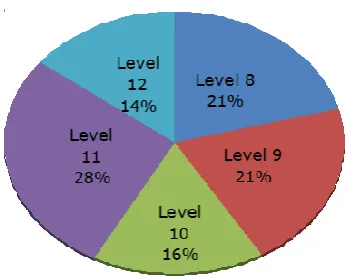
A total of 263 students responded to this survey. Figure 1 shows the distribution of students according to level. Just under three quarter (72.6%, n=191) responded appropriately that alginate is an irreversible hydrocolloid impression material (Figure 2).This meant that a majority of respondents agreed to the fact that alginate would always turn out to be the right kind of option for the impression material.
Figure 1. Distribution of students by level
One hundred nineteen (72.6%) students responded
appropriately on why they use alginate. One hundred eighty eight (71.5%) students responded correctly that perforated tray is used for making impression.
Table 1. Practice related questions of alginate impression material
Frequency (N)
Percentage (%)
Why you use alginate Ease manipulation 21 8.0
Does not need special device 21 8.0
Not expensive 30 11.4
All of the above 191 72.6
Tray used for making impression Perforated 188 71.5
Plain 16 6.1
Rim lock 28 10.6
Water cool 31 11.8
When mixing alginate Powder added to water 66 25.1
Water added to powder 197 74.9
Working time of fast set alginate 20-50 seconds 189 71.9
60-75 seconds 23 8.7
1.2-2.0 minutes 24 9.1
None 27 10.3
Working time of regular set alginate 1-1.5 minutes 21 8.0
1.6-2 minutes 21 8.0
2.5-3.75 minutes 190 72.2
3-4 minutes 31 11.8
Mixing time of fast set and regular set alginate 10,20 seconds 26 9.9
21.30 seconds 17 6.5
31,40 seconds 185 70.3
Figure 2. Distribution of knowledge on what is alginate impression material
Table 2. Knowledge related questions of alginate impression material
Frequency (N) Percentage (%)
After alginate is set, the process is termed Gelation 183 69.6
Crystallization 21 8.0
Evaporation 26 9.9
Solidification 33 12.5
When alginate impression exudes water the process is termed Syneresis 185 70.3
Imbibition 29 11.0
Another term 49 18.6
Alginate impression can be disinfected by spray or immersion True 200 76.0
False 63 24.0
It is preferred to pour alginate impression Immediately 191 72.6
After 20 minutes 24 9.1
After 30 minutes 22 8.4
After 45 minutes 26 9.9
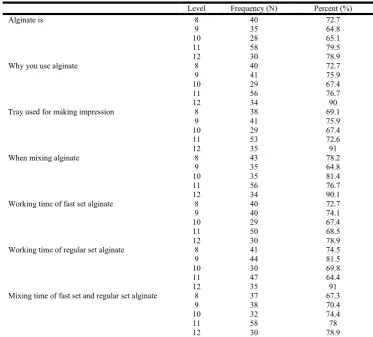
Table 3. Appropriate answers for practice related questions of alginate impression material by level
Level Frequency (N) Percent (%)
Alginate is 8 40 72.7
9 35 64.8
10 28 65.1
11 58 79.5
12 30 78.9
Why you use alginate 8 40 72.7
9 41 75.9
10 29 67.4
11 56 76.7
12 34 90
Tray used for making impression 8 38 69.1
9 41 75.9
10 29 67.4
11 53 72.6
12 35 91
When mixing alginate 8 43 78.2
9 35 64.8
10 35 81.4
11 56 76.7
12 34 90.1
Working time of fast set alginate 8 40 72.7
9 40 74.1
10 29 67.4
11 50 68.5
12 30 78.9
Working time of regular set alginate 8 41 74.5
9 44 81.5
10 30 69.8
11 47 64.4
12 35 91
Mixing time of fast set and regular set alginate 8 37 67.3
9 38 70.4
10 32 74.4
11 58 78
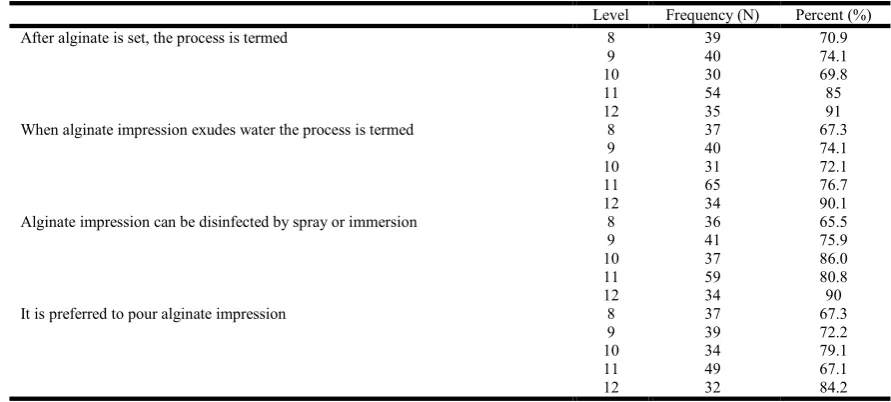
Three quarter (74.9%, n=197) of students responded appropriately that alginate is mixed adding water to powder. On the working time of fast and regular set alginate, 71.9% (n=189) and 72.2% (n=190) responded to correct answers of 20-50 seconds and 2.5-3.75 minutes respectively. Furthermore, 70.3% (n=185) students responded correctly for the mixing time of fast and regular setting alginate as 31 and 40 seconds respectively (Table 1). Table 3 and 4 shows the appropriate answers for practice and knowledge related questions of alginate impression material by level.
DISSCUSION
For many years, alginate impression material has been a staple of most dental practices. They form a major bulk of our clinical practice (Ashley 2005). Students of level twelve showed a good percent of knowledge and practice followed by students of level eleven who showed acceptable value. And the lower value was recorded by the rest of the students lack in their knowledge and practice ranged from (23%-33%). The present study showed that students of level twelve showed the higher value of knowledge and practice of alginate and the difference between them and students of level eight, nine and ten was statistically significant (P>0.05) while the difference between level twelve and eleven was statistically non-significant (P<0.05). This may be due to students of level twelve have more clinical practice and more advanced theoretical information 2015,Sonwane) As discussed in various studies it has been proved that in indirect restorations, the impression making is a very crucial step. With the passage of time dentists would be soon using the digital impression techniques to carry out the work.
They will serve to be more perfect since they will likely create such impressions which will be completely accurate and which will produce the best kind of work representing the past. Until this process is completely produced until then the right kind of techniques can be used for producing Alginate impressions. The factors which create a hurdle in producing the right kind of work can be diminished using the right criteria and also the clinical situations. Observation, techniques and advances can be used to produce the best impressions (Oguri, 2014). It was demonstrated that time and cost was not treated as being important factors which influenced the disinfecting processes.
The undergraduate doctors usually failed in carrying out the procedure right because of the lack of right attention which should be given when the courses are being taught. The study showed that about 26% of the undergraduate students believed that the courses which were taught to them were good enough to give good knowledge, the 66% of the undergraduates thought that the conferences, seminars and workshops were far more helpful to the. And only about 9% of the students believed that the pamphlets which were given to them had turned out to helpful in their academics. The results which were finally obtained showed that there was no good connection between the practice and the knowledge of the doctors who are currently working. This is why it was stated that practice and knowledge both should be empowered in the field of dentistry (Wismeijer, 2014). The idea of self-assessment is very essential when it comes to having satisfaction regarding the attitude of doctors regarding the infection control system. The results which were obtained from the following study had evaluated their knowledge about using alginate as being fair or good. The findings regarded that the student education towards the impression materials need to be more valid and more awareness should be brought in. moreover it was also subjected that the good infection control processes should be taught to the undergraduates so that they can develop the right kind of attitude towards the work. It was also stated that the students from the medical colleges must be presented with right kind of opportunities where they can learn how to use the best impression material and at the same time they can implement the knowledge regarding the infection control system (Guiraldo, 2015). From the study which was carried out it was stated that a large number of institutions which create dentists have the same amount of knowledge and practice with regard to the impression material which is used and at the same time they have the same kind of sufficient knowledge regarding the disinfecting material which used by the doctors. This should be upgraded more with the assistance of the conferences and seminars which are associated with Alginate as being the best kind of the studies which have been carried out can be used as sponsors so that the right kind of knowledge about Alginate can be taught through lectures, training programs and workshops (TA, 2015). The results from the studies have shown that most of the students and the professors have done disinfecting procedures on the Alginate. Although there are still quite a number of people who have not
Table 4. Appropriate answers for knowledge related questions of alginate impression material by level
Level Frequency (N) Percent (%)
After alginate is set, the process is termed 8 39 70.9
9 40 74.1
10 30 69.8
11 54 85
12 35 91
When alginate impression exudes water the process is termed 8 37 67.3
9 40 74.1
10 31 72.1
11 65 76.7
12 34 90.1
Alginate impression can be disinfected by spray or immersion 8 36 65.5
9 41 75.9
10 37 86.0
11 59 80.8
12 34 90
It is preferred to pour alginate impression 8 37 67.3
9 39 72.2
10 34 79.1
11 49 67.1
carried out such processes which is an alarming situation because this means that the ratio of getting diseases has become way more through the tools which are used. This is to be understood that if the students do not properly understand that what kind of impression material should be used and how they should be disinfected this means that they will not develop the right habits in their early ages which will turn out to be dangerous in their professional lives. Today it has become quite obvious that the impression material which is used can be of great danger since it carries a lot of such contaminating diseases which can be hazardous to the doctor. The teaching and the learning processes needs to be revised and taught in the right manner so that the students understand fully that what impression material should be used and how they should be handled (Ismail, 2016).
Conclusion
Within the limitations of our study it was concluded students of higher levels showed reasonable and acceptable value of knowledge and practice of alginate impression material. The results have proved that Alginate can be best material that can be used in restoration procedures and for provisional crown impressions. This study has proved that Alginate can be widely used in orthodontic models, mouth guards and in bleaching trays. They are even today used in the preparation of the indirect restorations . There are various benefits of using the Alginate as the impression material since it holds diagnostic properties as well. This is so because it can be poured several times and it also has less clean up time because of the preparation method. It also creates the best impressions which have the excellent property of being dimensionally stable and (AyaKitamura, 2015) it can always be poured later on
Suggestions
Immediate academic assessment to increase the awareness of students is required during training courses. Thus, small advances need to be made in this aspect to reap great and huge benefits beside continues clinical, oral and theoretical examinations.
REFERENCES
Al-Enazi, T. A. 2016. Disinfection of alginate and addition
silicon rubber-based impression materials. International
Journal of Stomatology & Occlusion Medicine, 44–48. Ashley M. Making a good impression: A "How to' Paper on
dental alginate. Dent Update 2005; 32:169-75
AyaKitamura. 2015. Basic investigation of the laminated alginate impression technique: Setting time, permanent deformation, elastic deformation, consistency, and tensile bond strength tests. Journal of Prosthodontic Research, 49-54.
Christensen GJ. 2006. Making fixed prostheses that are not too high. J Am Dent Assoc. 2006; 137:96–8
Elsevier Volume 51, Issue 3, July 2007, 629–642.
Fatema, S. 2013. A Comparative Study on Accuracy and Reproducibility of Alginate and Addition Reaction Silicone
as an Impression Materials. Update Dental College
Journal, 28-33.
Guiraldo, R. D. 2015. Influence of alginate impression materials and storage time on surface detail reproduction
and dimensional accuracy of stone models. Acta Odontológica Latinoamericana, 629-642.
Gyakushi, H. 2015. Alginic acid-containing aqueous composition, dental alginate impression material, and base material for dental alginate impression material. Tokuyama Dental Corporation, 11-22.
Ibrahim, A.A., Alhajj, M.N., Khalifa, N., Gilada, M.W. Does 6 Hours of Contact With Alginate Impression Material Affect Dental Cast Properties? 2015. US National Libaray of Medicine, 24-43.
Ismail, H. A. 2016. A self-disinfecting irreversible hydrocolloid impression material mixed with povidone iodine powder. European Journal of Dentistry, 507–511. Khalid, M. 2015. Comparison of mean dimensional
measurement of alginate impression using sodium hypochlorite versus gluteraldehyde. JKCD, 52-61.
Mantri, S. et al. Knowledge, attitude and practices of denture adhesives use among private dental practitioners' of
jabalpur city, madhya pradesh: a cross sectional survey. J
Indian Prosth. Soc., Sep;14(3):243-50
Matsushige, K. 2013. Kit for adhesion between alginate impression material for dental use and impression tray. Tokuyama Dental Corporation, 23-34.
May, T. 2014. Dimensional accuracy of alginate impression materials after different disinfection methods. General Practitioners Department of Prosthodontics, University of Dental Medicine, Yangon, 39-43.
Nicholson, J. W. 2013. The use of alginate impression material for the controlled release of sodium fusidate. Dental Forum, 41-52.
Oguri, M. 2014. Adhesive agent for adhesion between alginate impression material and impression tray for dental applications, and kit comprising the adhesive agent . Tokuyama Dental Corporation, 123-132.
Rubel BS. Impression materials: A comparative review of impression materials mostly used in restorative dentistry. Dent Clin North Am. 2007; 51:629–42.
Shrinidhi, U. 2015. Effect of mixing methods and disinfection on dimensional accuracy of alginate impression. Myanmar Dental Journal, 1-60.
Sonwane, S. 2015. Reliability of bolton teeth ratio in dual pour
alginate impression with plaster and. Original Research
Article, 23-43.
Stewart, Rudd, Kuebker. Clinical removable partial
prosthodontics. 2nd ed. Ishiyaku Euro America Inc Publishers; 1997.
TA, I. 2015. Dimensional Changes of Alginate Dental Impression Materials-An Invitro Study. Europe PMC, 1205–10.
Todd, J. A. 2013. Dimensional changes of extended-pour
alginate impression materials. American Journal of
Orthodontics and Dentofacial Orthopedics, S55–S63. Vidyashree Nandini, K Vijay Venkatesh, K Chandrasekharan
Nair. J. Conser. Dent., 11 (1) 37-41.
Wismeijer, D. 2014. Patients' preferences when comparing analogue implant impressions using a polyether impression material versus digital impressions (Intraoral Scan) of dental implants. cLINICAL oRAL iMPLANT, 1113–1118. Wright, R.A., Bidra, A.S. 2015. Retrieval of residual alginate
impression material from a small oral-nasal communication
defect in a maxillectomy patient. 2015. The journal of
prosthetic dentistry, 253–254.