New Zealand Journal of Ecology (2001) 25(1):83-88 ©New Zealand Ecological Society
SHORT COMMUNICATION
Colonisation of new areas by stoats: time to establishment
and requirements for detection
David Choquenot
1,*, Wendy A. Ruscoe
1and Elaine Murphy
21Landcare Research, PO Box 69, Lincoln, New Zealand
2Department of Conservation, Private Bag 4715, Christchurch, New Zealand
*Address for correspondence: Arthur Rylah Institute for Biodiversity Research, 123 Brown St, Heidelberg, VIC 3084, Victoria, Australia
__________________________________________________________________________________________________________________________________
Abstract: A simple deterministic accounting model was used to predict the rate at which a colonising stoat (Mustela erminea L.) population would reach specified sizes. The model was used to explore how the size and composition of the founder population, and the survival schedule to which it was exposed, influenced this rate. A function used in disease surveillance was modified to predict the number of tracking tunnels necessary to detect the presence of the colonising population with a specified degree of confidence. This function was used to assess how the detection characteristics of tracking tunnels (the probability that a stoat will enter a tracking tunnel), and the degree of certainty associated with detection, might influence the number of tracking tunnels required. Founder populations consisting of females and males established more quickly than those consisting of one or two pregnant females in the absence of males. Over and above the effects of founder population size and composition, survival schedules had little influence on the time establishing populations took to attain moderate sizes (<50 individuals). The number of tracking tunnels necessary to detect the presence of a newly establishing stoat population increased exponentially below a population size of about five. Both the detection characteristics of tracking tunnels and the degree of certainty associated with detection influenced the number of tracking tunnels necessary to detect stoats at low abundance.
__________________________________________________________________________________________________________________________________
Keywords: Stoats;Mustela erminea; colonisation; detection; tracking tunnels.
are able to establish significant populations may afford the best chance of maintaining areas such as islands free of stoats.
In this study a simple deterministic accounting model was used to predict the time a colonising stoat population requires to reach specified levels of abundance. The model used parameters estimated for stoats inhabiting forests dominated by beech (Nothofagus spp.), and so is most relevant to stoats establishing in this habitat. The model was used to assess how the size and composition of the founder population, and its prevailing demographic rates, influenced this period. In addition, a function used to determine sample size for detection of disease in animal populations was modified to predict how the number of tracking tunnels necessary to detect the presence of a colonising stoat population, varied with the size of that population. Tracking tunnels are the most commonly employed technique for detection and
Introduction
monitoring of stoat populations in New Zealand (King and Edgar, 1977; King et al., 1994; Murphy et al., 1998; 1999). This model was used to assess how the level of certainty associated with the detection of stoats and the detection characteristics of tracking tunnels influenced the number of tracking tunnels required, and the certainty of detection when the number of tracking tunnels is known.
Methods
The stoat model
The model predicted the growth of a stoat population through 1-month increments from a founder population made up of a specified number of females, immature males (<12 months old) and mature males (>12 months old). Because none of the demographic rates used in the model were density-dependent (see below), the modelled stoat population grew without limit. While this approach ignored the limiting effects social and extrinsic factors would obviously have had on stoat density, we were more interested in the period a colonising population took to grow to some specific size during the initial phase of establishment, than in the densities a colonising population might attain in the longer term. It should be noted that because the demographic data upon which the model was based came exclusively from beech forests, caution should be exercised in extending its results to the colonisation of other areas by stoats.
The founder population established in year 1 of each simulation. All females in the founder population gave birth in the following November, regardless of whether or not mature males were present (i.e., all females were pregnant at the time of colonisation). Thereafter, all females gave birth each November, as long as mature males were present. Males born each November became sexually mature 10-12 months later in September. The founder population reproduced according to specified reproductive parameters, but did not undergo mortality until the end of year 1. Thereafter, all individuals present were subject to specified annual rates of survival, rates being applied evenly across all months. While all females in the population reproduced at the same rate, the model differentiated 1-year-olds from older females so that different survival rates could be applied to each. Similarly, the model allowed different survival rates to be applied to immature and mature males. We considered ‘establishment’ to be the period between initial colonisation of an area by one or more stoats, and the rapid consequent increase in density facilitated by the presence of one or more mature males.
Scenarios modelled
The growth for three founder populations of different sizes and composition were modelled under two survival schedules (Table 1). A founder population comprising a single female was contrasted with that comprising a female and mature male to assess whether immediate fertilisation of females in the initial litter would appreciably increase the speed of population establishment. The founder population comprising two females allowed the effect of a doubling of the reproductive population to be assessed. In all scenarios, litter size was held constant at eight, and we assumed that the sex ratio amongst young at birth was even. All founder populations were placed into the model in March of year 1. The duration of establishment was assessed as the number of months the population took to increase to a size of 10, 50, or 100 stoats.
Detection requirements
The number of tracking tunnels needed to detect the presence of a stoat depends on the size of the area within which stoats occur, whether or not stoats are present, the proportion of that area occupied by stoats if they are present, and the degree of confidence required of the detection (Hone, 1994). In order to detect the presence of stoats in a given area, sampling must continue until the presence of a stoat is confirmed, or an appropriate degree of confidence can be associated with the conclusion that stoats are absent. We modified an equation developed by Cannon and Roe (1982) for disease surveillance to estimate the sampling effort required to establish the presence of a colonising stoat population with a specified degree of confidence. The modified equation had the form:
NT = (1 – (1 – c)1/d) (A – (d/2)) + 1 Eq. 1 whereNT was the sample size required, c was the
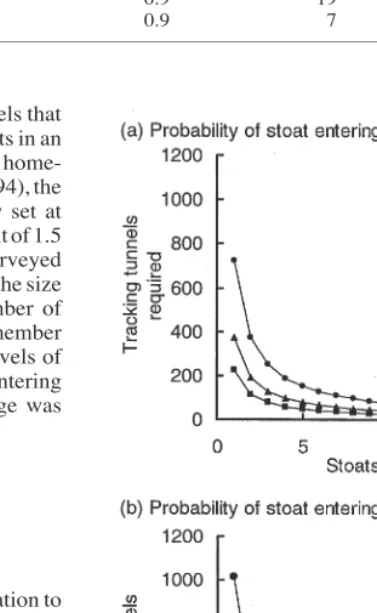
We estimated the number of tracking tunnels that would be required to detect the presence of stoats in an area of 10 000 ha, where the average exclusive home-range size was 50 ha (Murphy and Dowding, 1994), the degree of home range overlap was arbitrarily set at 20%, tracking tunnels had an arbitrary catchment of 1.5 ha and were deployed randomly through the surveyed area. We also derived the relationship between the size of a colonising stoat population and the number of tracking tunnels required to detect at least one member of the population, with 99%, 90% and 75% levels of confidence, assuming the probability of a stoat entering a tracking tunnel placed within its home range was either 1 or 0.7.
Results
Establishment of a stoat population
The time predicted for a colonising stoat population to reach three specified levels of abundance for various combinations of founder population composition and survival schedules is given in Table 1. The presence of a mature male in the founding population substantially reduced the time taken for a single female to produce a population reaching all three levels of abundance considered. In contrast, the presence of a second female reduced the time taken by a colonising population to reach 10 individuals, but had little effect on the time taken to attain larger population sizes.
Detection requirements
Fig. 1 shows the relationships between the number of stoats present in 10 000 ha and the number of tracking tunnels required to detect the presence of at least one stoat, for three levels of confidence assuming that the probability of a stoat entering a tracking tunnel placed within its home range is 1 or 0.7. Regardless of the level
Table 1. Months taken to attain three specified population levels for founder populations comprising different sizes and compositions, and two different survival schedules. Where the number of months required to attain successive population sizes is the same, the population reached the larger of the two population sizes within a single 12-month period.
__________________________________________________________________________________________________________________________________
Founder population Annual survival Months to attain specified
population size (n) Females Mature 1-year-old females >1-year-old females
males and immature males and mature males n = 10 n = 50 n = 100
__________________________________________________________________________________________________________________________________
1 0 0.7 0.5 31 43 55
1 1 0.7 0.5 19 31 31
2 0 0.7 0.5 7 43 43
1 0 0.9 0.9 31 43 43
1 1 0.9 0.9 19 31 31
2 0 0.9 0.9 7 31 43
__________________________________________________________________________________________________________________________________
of confidence employed or the probability of stoats entering tracking tunnels, the number of tunnels required to detect at least one stoat increased dramatically for stoat populations comprising less than about five individuals. The number of tracking tunnels required for detection of a stoat increased with the level of confidence required in the detection, and decreased with the probability of a stoat entering a tracking tunnel.
Discussion
Modelling stoat establishment
The model used to predict the effect of founder population composition on establishment rate did not invoke the demographic stochasticity that often characterises such small populations (Caughley and Sinclair, 1994). As such, we place more emphasis on what the model says about the effect that founder population composition has on the relative time to establishment, than on rate of population increase per se. We defined establishment as the period between initial colonisation of an area and the rapid consequent increase in density facilitated by the presence of one or more mature males. Using this definition, founder populations that include a mature male require no establishment phase, because founder females and their female offspring can be mated soon after the first births occur at the newly colonised location. This means that a founder population that included one or more mature males should increase more rapidly than a founder population that lacked mature males. The simulations summarised here indicated that the presence of a male stoat in the founder population reduced the time a colonising population based on a single female took to reach populations of 10, 50, and 100 stoats by 39%, 28%, and 44%, respectively. The reduced time to reach given population sizes reflects the elimination of a year in which mating could not occur immediately after parturition. Crouchley (1994) described a stoat trapping programme in which four young, non-pregnant females were caught in July 1983, 14 months after a confirmed sighting of an individual stoat on previously stoat-free Maud Island in May 1982. It is likely that the individual that was sighted was a sole colonising female who gave birth 4 or 5 months after the initial observation. The four young females trapped in July 1983 were probably her offspring, and were not pregnant because there were no mature males present at the time of their birth.
In the models described here, the presence of a second colonising female allowed the establishing population to reach 10 stoats more quickly (19 months) than when a single female colonised (31 months),
because more recruits could be produced from the embryos carried by the two females in the first year of establishment. However, the lack of mature males meant that neither the colonising females nor their female offspring reproduced in the second year, increasing the time a population derived from two females took to attain 50 and 100 stoats over that achieved by a single female founder accompanied by a mature male. The more rapid establishment of populations founded by a colonising female and male allowed them to attain higher densities over subsequent years than populations founded by either one or two females alone. The effect that the presence of a mature male has on the establishment period of a colonising stoat population suggests that, while populations based on single or multiple founder females may be viable, the window of opportunity a conservation manager has to detect and eliminate them may be 30 to 50% greater than that for founder populations comprising both females and males.
The survival schedules explored in the models described here were selected to represent more and less conservative guesses about natural rates of mortality for a stoat population reaching a previously unoccupied environment. Powell and King (1997) estimated survival rates of 0.22 to 0.36 for first-year stoats, and 0.40 to 0.70 for all other age-classes, in relation to beech mast cycles. In this study it was assumed that first year survival would be higher in a colonising population than the rates estimated for established populations, while survival amongst older stoats may or may not be higher. To that end, our conservative schedules were set higher than Powell and King’s (1997) estimates for first-year stoats in beech forests, and within their range of estimates for older stoats. To assess the consequences of survival being much higher in colonising populations than in established populations, or for habitats in which overall survival was higher than that estimated in beech forests, a survival rate of 0.9 across all age-classes was also modelled. Except for its effect on the time taken for a population derived from a single colonising female to reach 100 individuals, survival had little apparent influence on the time taken to reach the three population sizes considered.
Detecting a colonisation event
be deployed in order to detect a population of five or fewer stoats living somewhere within 10 000 ha, with 99% certainty. If more realistic detection characteristics are assumed (e.g., 30% of stoats do not encounter tracking tunnels within their home range, or do not enter them if they are encountered), the number of tracking tunnels required to detect five or fewer stoats in 10 000 ha with 99% certainty exceeds 200. Far fewer tracking tunnels are typically employed in monitoring extant stoat populations. For example, Murphy et al. (1999) used 99 tracking tunnels to monitor changes in stoat density over the course of a 1080 poisoning operation covering 8 577 ha. In general, fewer tracking tunnels will be required to monitor changes in known stoat populations, than to detect the presence of a small number of colonising individuals.
If a colonisation event is suspected, how should a management agency react? If the colonisation is natural (e.g., a stoat swims or is ‘rafted’ to a previously unoccupied island), it is unlikely to involve more than a single stoat. If the coloniser is a female, the period until she reproduces will be between <1 month (if she arrives in September or October), and 11 months (if she arrives in December). In the absence of a mature male to refertilise the colonising female or her female offspring, the population will remain at nine or less (assuming a maximum litter size of eight) from October/ November in the year of colonisation, until all surviving females are mated and give birth 2 years later (Crouchley, 1994). This suggests that an establishing population derived from a single colonising female will remain below 10 individuals for 25 to 35 months, depending on which month colonisation takes place. The number of tracking tunnels required to detect at least one member of this population during this period with a high degree of certainty would depend on the area over which the colonising population has established, the average home-range size of the stoats and their degree of home range overlap, and the probability that a stoat will enter a tracking tunnel placed within its home range. In this study, values for the area liable to a suspected colonisation event, the catchment of a tracking tunnel, the average home range of stoats, and the degree of overlap between these home ranges were assumed. While the required sample size will be relatively insensitive to the area of sampling considered, the catchment of each tracking tunnel and the ranging behaviour of stoats are more critical assumptions. To develop a better understanding of how tracking tunnels can best be used to detect the presence of stoats at low densities, the home ranges of stoats at these densities, and the pattern of home range usage by stoats needs to be better understood. In addition, the capacity of stoats to detect tracking tunnels within their home ranges, and their propensity to enter tracking tunnels once they find them, should be assessed.
Once the establishing stoat population contained mature males as well as females, incremental increases in density would be more rapid, making detection of at least one individual easier. However, once the population goes into a phase of rapid growth, it is likely to prove more difficult to eliminate than when it is restricted to less than 9 individuals, particularly if dispersal of individuals is associated with rapid growth in numbers (King, 1990).
If stoats are deliberately released into a previously unoccupied area, there is a greater chance that both females and males will be liberated. Under these conditions, colonising females and their female offspring can be mated in October/November of the year of colonisation, and rapid population growth is likely from year two on, assuming sufficient food resources. If a single male/female pair was released, the population would consist of those two individuals for <1 month if released in September or October, to 11 months if released in December. The population would then consist of 10 or fewer individuals until the subsequent October/November (13 months for a September/October release, to 23 months for a December release), before entering a phase of rapid population growth. Again, while detection during the initial establishment phase will be more difficult than it will be once the population begins to increase, elimination of the population during that phase will be more achievable.
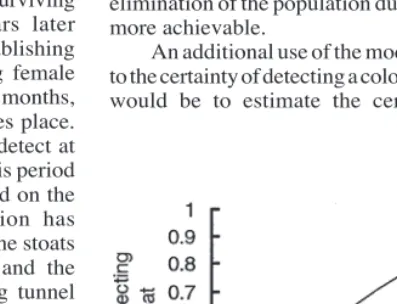
An additional use of the model linking sample size to the certainty of detecting a colonising stoat population would be to estimate the certainty with which a
single stoat (if it were present) would be detected by a given monitoring programme. This would mean that the results of a monitoring programme could be used to determine whether monitoring should continue (i.e., if an acceptable certainty of detection had been attained). To estimate the certainty of detection for a given monitoring program, Eq. 1 is rearranged to the form:
Hone, J. 1994. Analysis of vertebrate pest control. Cambridge University Press, Cambridge, U.K. King, C.M. 1990. Stoat. In:King, C.M. (Editor), The
handbook of New Zealand mammals, pp. 288-312. Oxford University Press, Auckland, N.Z. King, C.M.; Edgar, R.L. 1977. Techniques for trapping
and tracking stoats (Mustela erminea); a review, and a new system. New Zealand Journal of Zoology 4:193-212.
King, C.M.; O’Donnell, C.F.J.; Phillipson, S.M. 1994.
Monitoring and control of mustelids on conservation lands. Part 2. Field and workshop guide. Department of Conservation Technical Series No. 4. Department of Conservation, Wellington, N.Z.
Murphy, E.C.; Dowding, J.E. 1994. Ecology of the stoat in Nothofagus forest: home range, habitat use and diet at different stages of the beech mast cycle. New Zealand Journal of Zoology 19:
97-109.
Murphy, E.C.; Clapperton, B.K.; Bradfield, P.M.F. 1998. Effects of rat-poisoning operations on abundance and diet of mustelids in New Zealand forest.New Zealand Journal of Zoology 25: 315-328.
Murphy, E.C.; Robbins, L.; Young, J.B.; Dowding, J.E. 1999. Secondary poisoning of stoats after an aerial 1080 poison operation in Pureora forest, New Zealand. New Zealand Journal of Ecology 23: 175-182.
O’Donnell, C.F.J. 1996. Predators and the decline of New Zealand forest birds: an introduction to the hole-nesting bird and predator programme. New Zealand Journal of Zoology 23: 213-219. Powell, R.A.; King, C.M. 1997. Variation in body size,
sexual dimorphism and age-specific survival in stoats,Mustela erminea (Mammalia: Carnivora), with fluctuating food supplies. Biological Journal of the Linnean Society 62: 165-194.
where the parameters are as given above. For example, using Eq. 2 the certainty with which a single stoat occupying a home range in a specified area would be detected, can be estimated from the number of tracking tunnels deployed (Fig. 2). It should be noted that the equation returns estimates of the certainty of detecting sparse populations only (i.e., d must always exceed 2A).
Acknowledgements
We thank John Parkes, Bruce Warburton, Oliver Sutherland, Christine Bezar, Kim King and two anonymous referees for reviewing earlier drafts of the manuscript.
References
Cannon, R.M.; Row, R.T. 1982. Livestock disease surveys: a field manual for veterinarians. Australian Government Publishing Service, Canberra, Australia.
Caughley, G.; Sinclair, A.R.E. 1994. Wildlife ecology and management. Blackwell Scientific Publications, Oxford, U.K.
Crouchley, D. 1994. Stoat control on Maud Island 1982-1993.Ecological Management 2: 39-45.