Hematopoietic Stem Cells
Michael E. Trigg, MD
ABSTRACT. The hematopoietic system of the young child acquires, through time, the ability to cope with exposure to a number of environmental toxins and infec-tious agents. Occasionally, severe aplastic anemia occurs secondary to exposure to some of these toxins or infec-tious agents. The occurrence of severe aplastic anemia provides an opportunity to study the maturation of the hematopoietic system because often the immune system is partially intact. Hematopoietic stem cell transplants permit the study of the complete reconstitution of the hematopoietic and immunologic system. Stem cell trans-plants are often used to treat severe aplastic anemia or, alternatively, may be part of the treatment for an under-lying malignant disease or a genetic disease. Sources of stem cells and the age of the recipient and donor have an impact on the success of the stem cell transplant. A stem cell transplantation provides a window of opportunity to study and observe the normal maturation of the immune system and the sensitivity. Very clearly, children recover from severe aplastic anemia and stem cell transplanta-tions more readily with fewer problems and complica-tions than adults. The environmental risks that a child who received a stem cell transplantation faces are related primarily to the deficiencies of the hematopoietic system and immune system during the recovery phase. There-fore, diminished resistance to infectious agents, primar-ily viruses and other opportunistic organisms, are the primary risk that children who are recovering from these transplantations face. There are few data on the suscep-tibility of these children to the toxic effects of other environmental toxicants during the recovery period, which may take years before complete recovery. Pediat-rics2004;113:1051–1057;aplastic anemia, stem cell trans-plantation, pediatrics.
ABBREVIATIONS. GvHD, graft-versus-host disease; BSA, body surface area.
A
lthough there are a number of infectiousproblems that may have an impact on and effect the hematopoietic system at various stages of development, 2 key situations shed a tre-mendous amount of light on the vulnerability and the development of the hematopoietic system. The
first concerns severe aplastic anemia, the occurrence of this disease, the impact that this has on the child, and the potential treatment. The second is stem cell transplantation when, purposefully, agents are deliv-ered to poison the hematopoietic system to make room for new hematopoietic stem cells. This latter situation once again gives us a great deal of insight on the effects of toxins on the hematopoietic system and also gives us information about the development of immune-mediated cells from the hematopoietic stem cell and the length of time for adequate matu-ration.
In this article, the issue of aplastic anemia is ex-plored in detail with the purpose of identifying the cell or cells that have been effected and the treatment that brings back normal hematopoiesis. Once we have established an understanding of normal hema-topoiesis and what happens in severe aplastic ane-mia, the second issue to be discussed in detail is that of inducing severe aplasia as part of ongoing treat-ment for an underlying malignancy or as part of the curative therapy for a genetic disease and then ef-fecting recovery of immunopoiesis and hematopoie-sis through a stem cell transplantation.
SEVERE APLASTIC ANEMIA What Is a Hematopoietic Stem Cell?
Hematopoietic stem cells reside primarily in the bone marrow but do circulate in the peripheral blood. These cells may replenish damaged or miss-ing components of the hematopoietic and immuno-logic system. The cells can often withstand freezing for years; thus, these cells can be obtained from bone marrow or peripheral blood and cryopreserved for later use. These cells for clinical use may come from self (autologous) or from others (allogeneic), such as a related family member or an adult unrelated donor or an anonymously donated umbilical cord blood sample.1
Components of the hematopoietic system include red cells for carrying oxygen, all of the different white cells involved with infectious and oversight processes, and platelets. Tissue macrophages derive from monocytes produced by hematopoietic stem cells. Components of the immune system in the thy-mus gland and other lymphoid tissue also derive from these stem cells.
Pathophysiology
Aplastic anemia presents with an extremely hypo-cellular marrow and peripheral blood pancytopenia. The mechanisms that account for aplastic anemia include defects of hematopoietic stem cells; defects in From the Division of Blood & Bone Marrow Transplantation, Department of
Pediatrics, Alfred I. duPont Hospital for Children, Wilmington, Delaware. Received for publication Oct 7, 2003; accepted Oct 20, 2003.
Reprint requests to (M.E.T.) Division of Blood & Bone Marrow Transplan-tation, Department of Pediatrics, Alfred I. duPont Hospital for Children, 1600 Rockland Rd, Wilmington, DE 19803. E-mail: [email protected] A Collaboration between the Center for Child Health Research and the Environmental Protection Agency.
Drs Brent and Weitzman are the editors of this work; Drs Balk, Lanphear, Landrigan, and Reigart are the associate editors.
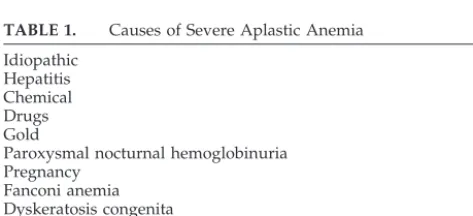
the marrow microenvironment; abnormal humoral or cellular immune control of hematopoiesis; and exposure to drugs and chemicals, infectious agents, and radiation.2The major causes are listed in Table 1.
The vast majority of cases of aplastic anemia are of unknown origin.3
Children usually present with bruising and bleed-ing as a result of low platelets. It is not uncommon in children that viral infections, which particularly predominate in early childhood as children acquire immunity to common environmental pathogens, suppress normal hematopoiesis. Blood count sup-pression is a hallmark of many childhood viral in-fections, and platelets may be low. However, it is rare that they reach the level as defined by pancyto-penia and hypocellular marrows, the hallmarks of severe aplastic anemia.
The case fatality rate from aplastic anemia is 50%.4
However, under ideal conditions, a higher percent-age of patients are cured. A response to treatment is defined as no longer needing red cell or platelet transfusions and having adequate protective num-bers of neutrophils. This definition means that blood counts may not return to normal levels; however, the children are generally out of danger from opportu-nistic and other infectious problems.
Unlike in adults who acquire aplastic anemia and often have well-documented long-term exposures to particular chemicals or environmental toxins that may precipitate the occurrence of this disease,4
chil-dren do not have the longevity to have been exposed to some environmental chemical that is a hematopoi-esis-inhibiting agent. Thus, most of the cases in chil-dren are either idiopathic without an adequate cause or attributable to hepatitis. Hepatitis viral infections are particularly common in childhood, and there seems to be differential sensitivity to the effects of the various hepatitis viruses from one child to another. Once the child has acquired some immunity, reexpo-sure usually does not result in a recurrence of the aplastic condition.
Therapy
Therapy for severe aplastic anemia takes various forms as shown in Table 2. Androgenic steroids stim-ulate hematopoiesis and were used as initial therapy for years. Immunosuppressive therapy, initially be-ginning with steroids, interestingly resulted in par-tial to complete hematopoietic and immunologic re-covery. Additional investigations demonstrated that in some patients, the triggering event for the
occur-rence of severe aplastic anemia was an autoimmune reaction. Infection may have triggered the autoim-mune reaction, but it remains unknown which lym-phocyte was responsible for the marrow suppres-sion. However, immunosuppressive therapy brings about clearcut recovery for some children.
Severe aplastic anemia responds better in children than in adults to the agents listed in Table 2. We know that those who undergo hematopoietic stem cell transplantations tend to do better the younger they are. Children who undergo such procedures may receive larger doses of stem cells from their donors, may tolerate cells from a different tissue type more readily, may clearly repair damage from pre-parative therapy more quickly, and may come to the point of transplant having been exposed to and ac-quired fewer infectious problems in their short lives. These and other factors have a significant impact on the improved survival that may occur in children over adults. In addition, it is vastly easier to generate a higher platelet count with a single platelet transfu-sion in a smaller patient than it is in a full-sized adult, which then may result in potentially fewer bleeding episodes.
Unfortunately, the inciting cell that triggers the autoimmune-type of reaction is not known.4 Such
knowledge would help in terms of providing uniquely directive therapy against the offending cell. The vast majority of children, like adults, with severe aplastic anemia do not have a fully matched sibling donor. Thus, they are given immunosuppres-sive therapy with the expectation that the therapy will suppress the portion of the immune system re-sponsible for turning off hematopoiesis and thus allowing cells to recover. It is interesting that in some patients who have undergone stem cell transplanta-tions, initially for the first couple of years posttrans-plantation, the only cells that grew were those of the donor, but then eventually host cells recovered com-pletely and donor cells were lost or a chimeric state was established. This certainly confirms that in many patients, the offending agent that triggered the initial aplasia may not persist long term, creating a suitable environment for return of normal hematopoiesis.
Umbilical Cord Blood Collections
Umbilical cord blood is another source of stem cells. Approximately 30% to 45% of all blood associ-ated with a fetus is circulating in the umbilical cord blood and in the placenta. At the time of birth, this blood contained within the placenta and umbilical cord is usually thrown out. The umbilical cord blood
TABLE 1. Causes of Severe Aplastic Anemia
Idiopathic Hepatitis Chemical Drugs Gold
Paroxysmal nocturnal hemoglobinuria Pregnancy
Fanconi anemia Dyskeratosis congenita Pure red cell aplasia Miscellaneous
TABLE 2. Therapy for Severe Aplastic Anemia3
Red cell and platelet transfusions Antibiotics
Androgenic steroids Corticosteroids
Hematopoietic growth factors Immunosuppressive therapy with
Antithymocyte globulin Cyclosporine
Cyclophosphamide
and placental blood are rich in hematopoietic stem cells, with a stem cell concentration per milliliter at least 100-fold greater than is found in the peripheral blood of a normal adult. These cells are naı¨ve and seem to have increased proliferative potential. Um-bilical cord blood can be collected in the first 5 to 10 minutes after delivery before the blood clots, and aliquots can be sent for infectious disease testing and typing with the remainder cryopreserved.
Two types of umbilical cord blood banks have been established. The first is the anonymous blood bank. Usually private funding or public funding will pay for the processing and storage, and these sam-ples of umbilical cord blood are then available for study and transplant purposes in individuals who need such umbilical cord stem cells. The original donor of the stem cells no longer would be able to have access to these because all identifiers would be removed. The second type is a private business whereby individuals direct that umbilical cord blood from their children be cryopreserved for their subse-quent use at a later time. A substantial amount of money is charged initially for cryopreservation and then a yearly fee for storage. Very clearly we do not know the full potential uses of these stem cells in the future or exactly the length of time through which these cells remain viable.
Because of the newness of this technology, only recently born children would have such cord blood saved. Already reported have been 2 individuals whose parents had saved their umbilical cord blood at the time of birth and who subsequently developed aplastic anemia and used their own umbilical cord stem cells to effect normal hematopoiesis and re-cover from the underlying problem (John Wagner, personal communication). A greater number of indi-viduals have received umbilical cord blood from sib-lings. In these situations, one child may have already developed a leukemia or other disease that is best treated with a stem cell transplantation and the mother then becomes pregnant with another child. At the time of delivery of the second or subsequent child, umbilical cord blood is saved, typed, and sub-sequently used to treat the effected child in the fam-ily.
A third situation has already developed whereby when a child has a genetic disease that is best treated with a stem cell transplantation, parents have under-gone collection of oocytes, fertilization of the oocytes in the laboratory, typing of some of the early cells in the blastocysts, and selection of those embryos de-veloping with an identical tissue type and without the underlying genetic disease, and then at the time of birth, umbilical cord blood is collected from the fully matched and otherwise genetically normal child and used for transplantation purposes in the child who needs new hematopoietic stem cells for disease correction.5
STEM CELL TRANSPLANTATION What Happens With a Stem Cell Transplantation?
Hematopoietic stem cell transplantations are often performed to replenish what was missing at birth.
This would be clear in the situation of someone with severe combined immunodeficiency, born without an intact immune system and therefore unable to fight most of the common infectious problems. How-ever, stem cell transplantations are more often per-formed to provide what has been eliminated as part of the treatment for an underlying disease. The best example is the child who undergoes a stem cell trans-plantation for the treatment of leukemia. Usually the leukemia has become resistant to previous therapies. The child then receives increased doses of chemo-therapy and radiation, thereby eliminating the hema-topoietic and immunologic system. These systems are then reconstituted after the completion of the chemotherapy/radiation preparative therapy by an infusion of hematopoietic stem cells from an alterna-tive source. These stem cells will then engraft, and reconstitute the immune system and the blood-form-ing system.1
The expectation is that the high-dose chemother-apy and radiation will have helped to eliminate all vestiges of the underlying leukemia. In the process, other parts of the body that are fast growing and have been irreparably damaged can be repaired with the infusion of the hematopoietic stem cells.
Many components of the immune system and the blood-forming system therefore will be reconstituted with an infusion of hematopoietic stem cells. The stem cells come from an alternative source, such as a sibling who is a perfect tissue match, an unrelated bone marrow or peripheral blood donor who also is very closely matched, or alternatively an umbilical cord blood sample saved anonymously and tissue typed.
Recovery After a Hematopoietic Stem Cell Transplantation
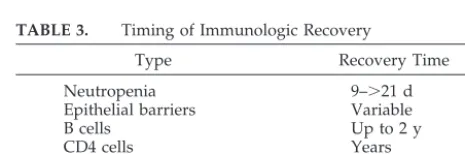
Table 3 provides an indication of the timing of hematopoietic and immunologic recovery after transplantation. The recovery of the immune system is critical after a hematopoietic stem cell transplan-tation because death or significant morbidity is often attributable to infectious problems that occur from an immature or incapable immune system. Prophy-lactic measures to prevent infectious complications are less costly and cause fewer problems than hos-pitalizations for significant infections. A number of prophylactic measures are often taken to try to pre-vent such infectious problems from occurring.6 –11
The obligate neutropenia that occurs after a hema-topoietic stem cell transplantation may last any-where from 9 to 21 days. Neutropenia beyond that point often means that the stem cells have failed to engraft. Epithelial barriers, which are not necessarily
TABLE 3. Timing of Immunologic Recovery
Type Recovery Time
Neutropenia 9–⬎21 d
Epithelial barriers Variable
B cells Up to 2 y
CD4 cells Years
CD8 cells Months
part of the immune system but certainly are the first barrier preventing the acquisition of infections, may be variable in terms of the recovery, depending on the occurrence of graft-versus-host disease (GvHD) or radiation-induced damage. Infectious problems that gain access through a damaged or defective epithelial barrier may either destroy immature he-matopoietic cells that are growing or alternatively suppress their growth. This will then result in a number of infectious problems. It is for this reason that patients who undergo hematopoietic stem cell transplantations are often kept in isolation not only to prevent the acquisition of infections resulting in significant morbidity and mortality but also to pre-vent exposure to bacteria, viruses, and fungi, which in essence will delay ultimate recovery. For example, even the occurrence of cytomegalovirus infection without disease is associated with a suppression of blood counts and delay in recovery.12
Mature T-lymphocytes and many of the lympho-cyte subtypes will take a minimum of 6 months but sometimes as long as 2 years to recover, depending on the type of transplantation that was done and depending on the occurrence of other infectious-re-lated problems, which often may delay recovery. B-lymphocytes may often take up to 2 years to re-cover fully. The pace of immune rere-covery is related to the occurrence of particular infectious problems posttransplantation. The characteristics of the immu-nodeficiency that occurs after a stem cell transplan-tation increases the susceptibility to almost all viral infections, fungal infections, parasitic infections, and bacterial infections.9,10In an example of immune
re-covery (Fig 1), studies done with peripheral blood lymphocyte subsets in those who underwent T-lym-phocyte– depleted transplantations showed that re-covery often took at least 12 months and perhaps as long as 24 months in some patients before they were fully protected against most of these opportunistic infections.9
Factors That Affect Speed of Hematopoietic Recovery
Many factors affect the speed of immune recovery. The age of the host and the age of the donor seem to be critical, although it is unknown exactly why this may be the case. There is no question that the pres-ence of a thymus may help with trafficking of lym-phocytes from the donor graft and thereby shorten the time for maturation of these lymphocytes. Thus, children who still have intact thymus glands have faster recovery of their immune system than adults after similar stem cell transplantations. Investiga-tions have taken place whereby thymic epithelium has also been transplanted into hematopoietic stem cell recipients with the idea in mind that this may actually help to process hematopoietic stem cells from the donor graft and help with the development and maturation of lymphocytes in the new host. Unfortunately, these investigations have failed to demonstrate any effect, but this may have been be-cause the thymic epithelium is usually not derived from the host or the donor but rather from a third party. It is perhaps possible that third-party thymic epithelium may not in any way be able to participate
in the maturation of lymphocytes of a different tissue type.
Younger hosts tend to do better and have a more naı¨ve immune system that then allows acceptance of the donor graft and permits a donor graft to take without a higher degree of GvHD. In addition, some hosts may get by without any GvHD preventive medications. This actual effect accounts for why in utero hematopoietic stem cell transplantations have been explored. Early inoculation of hematopoietic stem cells into a young fetus theoretically should permit the cells to grow unimpeded without any signs of rejection, and therefore the underlying prob-lem or genetic disease is corrected with these cells. To date, very few positive results have been seen from this method, but the theory still holds.13
Younger donors likewise behave in a similar man-ner in that the hematopoietic and immunologic cells derived from the donor graft seem more willing to accept the recipient as self, and thus there seems to be much less GvHD. In addition, cells from younger donors have increased growth potential and seem to reconstitute the hematopoietic and immunologic sys-tem more quickly. It is not known whether these cells proliferate and differentiate more quickly or their course is unimpeded by any GvHD, because GvHD occurs less frequently and less intensely than in adults. If the latter is the case, then the lack of acqui-sition of an infectious problem may allow the cells to mature more quickly and therefore reconstitute the patient more readily.
Many donors for smaller children are consistently larger; thus, it is possible from a larger donor to get an increased number of stem cells for transplantation purposes. It has been difficult in humans to docu-ment adequately that the number of hematopoietic stem cells transplanted will actually make a differ-ence in terms of long-term outcome. Some prelimi-nary information from umbilical cord transplants suggests this to be the case, and other information was available from other transplant investigations.14
It is interesting that the use of umbilical cord blood increased the possibility of using hematopoietic stem cells from widely tissue-typed– disparate hosts.
Long-Term Recovery
Do patients ever recover a normal immune sys-tem? The answer is complex and often depends on the occurrence of other problems posttransplanta-tion. It is likely that patients never recover a normal immune system and that some defects seem to per-sist long term. However, many children will be able to resume all previous activities and return to school with a markedly decreased susceptibility to acquir-ing opportunistic or common infectious problems. In addition, the tissue-related damage from the prepar-ative therapy may be more short lived in a younger patient as a result of enhanced abilities to recover and repair tissue damage.
are known to acquire infectious problems with tre-mendous ease. Because of the naı¨vete´ of the immune system of the very young child, particularly the pre-mature infant, a number of measures are used pro-phylactically to try to prevent infections until the immune system can mature. In addition, such indi-viduals often require repeated immunizations with the same antigens to effect a normal immune re-sponse that is protective. An example is the tetanus, diptheria, and pertussis immunizations that are pro-vided during the first year of life. For those older children and adults who have never had these im-munizations, less frequent immunizations are re-quired with smaller doses of antigenic material to effect an adequate response because those individu-als have an intact immune system. Despite that some children posttransplantation may have normal
num-bers of neutrophils within 2 months, these neutro-phils often do not migrate well or ingest or kill bacteria well, mimicking what is seen in the new-born. It may take several months before we see nor-mal maturation of neutrophil function, an example of the pace of immune recovery.
Infants are often susceptible to infectious prob-lems, particularly viral probprob-lems, if immunity has waned from the mother and an underlying immuno-deficiency is present. Children after hematopoietic stem cell transplantation proceed in the opposite direction in that they start out with a naı¨ve and immature immune system and slowly their own takes over and grows to protect them. Children after stem cell transplantation do not have the luxury of having immune cells or immune products from an-other source persisting unless these have been given
Fig 1. A, Time to recovery of normal lympho-cytes; shaded area is the normal range. B, Time to recovery of CD4⫹cells after stem cell
on a prophylactic basis. Thus, during the early months after hematopoietic stem cell transplanta-tion, the child remains susceptible to a wide variety of bacterial, viral, and fungal infections. The suscep-tibility persists for many months, awaiting recovery and maturation of the immune-mediated cells.
As children progress from the time of a stem cell transplantation and as their immune system begins to recover, there is much less concern regarding in-fectious problems. The same sort of progression oc-curs as a normal child matures in that we become much less concerned with fevers and other com-monly occurring infectious problems in the older infant and child than we are in the newborn.
Children tend to tolerate hematopoietic stem cell transplantations much better than adults for a num-ber of reasons. First, their tissues tend to repair much more quickly after the damaging effects of the pre-parative chemotherapy and/or radiation. Second, children are more likely to receive larger doses of hematopoietic stem cells in the transplant process because the donors tend to be larger or adults. Cell content and cell number may be critical in terms of the pace of immune recovery. Children still have an intact thymus gland that, although may be depleted of lymphocytes from the preparative therapy, still contains the architecture that allows for replenish-ment of germinal centers and trafficking of lympho-cytes through the gland itself. In addition, umbilical cord stem cells almost uniformly are used for trans-plantation only in children, and, as mentioned above, these may provide increased ability to grow well with much less GvHD in the situation in which GvHD would be looked on as an adverse event. For these and potentially other reasons, children tend to tolerate this noxious procedure.
SENSITIVITY TO CHEMOTHERAPY AS PREPARATION FOR A STEM CELL
TRANSPLANTATION OR AS TREATMENT FOR A MALIGNANCY
In the first and second National Wilms’ Tumor study, there were a number of toxic deaths in infants who had what was thought to be a highly curable tumor.15When these individual patient records were
reviewed, the cause of death during the treatment was attributed to a number of toxic effects on the liver and the lungs from the chemotherapy but also to prolonged cytopenia followed by the acquisition of an opportunistic infection while the white blood cell counts were low. On additional study, it was found that when chemotherapy doses were figured on body surface area (BSA) for the smallest of the children in these studies, the amount of drug given was almost twice as much compared with what would be given if the dose were figured on body weight, given that the usual conversion factor of 30 kg⫽1 m2of BSA. The ratio of BSA/body weight at
birth is approximately 0.06 and drops by the end of the first year of life to 0.04.15,16In subsequent studies,
the chemotherapy doses were halved for those younger than 1 year, with no change or decrement in the long-term survival rates for those with Wilms’ tumor.15,17
It therefore was clear that on the basis of the other clinical studies of the efficacy of certain chemother-apy drugs for those with Wilms’ tumor, for certain groups of patients, too much drug was administered when calculated on BSA, and subsequently the chil-dren had prolonged cytopenias leading to opportu-nistic infections or, alternatively, to hepatic or pul-monary toxicity.16 The same effect was seen with
other malignancies that occur in childhood and quire alterations in the chemotherapy doses and re-calculation if possible on body weight instead of BSA.
It is of interest, then, to consider the situation when Busulfan is used as preparation for stem cell trans-plantation. As discussed in the previous section, pa-tients who undergo stem cell transplantations need to have room made within the marrow cavities and lymphoid organs for the new stem cells to engraft. In addition, some children who undergo stem cell transplantations are treated with high-dose chemo-therapy to eliminate their underlying malignancy in addition to making room for the additional stem cells.
Busulfan is often used as part of the preparative therapy for children with genetic diseases such as a mucopolysaccharide disorder, sickle cell disease, thalassemia.18 In these children, there is no
malig-nancy to eliminate. The sole purpose of the prepar-ative chemotherapy is to suppress or eliminate per-manently the child’s hematopoietic stem cells, which give rise to the blood cells and immune cells, making room for new stem cells to engraft. By eliminating the child’s immune cells, this will help ensure that the new stem cells will not be rejected. For the new stem cells to work to correct an underlying hemato-poietic or enzyme disorder, the new stem cells have to engraft and have to function in a stable environ-ment.
Busulfan doses were figured per kilogram of body weight on the basis of all of the work done in the adult transplant world.19 –21When the doses for
chil-dren, particularly the young chilchil-dren, were then fig-ured per body weight, clearly the children were un-derdosed and there was inadequate elimination of the underlying hematopoietic and immune system, leading to eventual regrowth of the child’s own stem cells and eventual rejection of the stem cells from the donor. Unfortunately, this was not discovered until long after a great number of children were treated with doses calculated on body weight instead of BSA, in which case the stem cell transplants did not work. However, when Busulfan dosing and pharma-cokinetics were worked out, it then became clear that the doses were initially inadequate to get complete stem cell suppression/elimination, with eventual growth of the new stem cells leading to a curve of the underlying disorder.
CONCLUSION
Severe aplastic anemia and hematopoietic stem cell transplants permit the study of not only the effects of environmental toxins and chemicals but also drugs on the developing immunologic and he-matopoietic system and also permit one to observe the pace of recovery and ways to affect that recovery. Particularly with hematopoietic stem cell trans-plants, one can see the proliferative potential of he-matopoietic stem cells derived from a variety of sources and how these eventually will reconstitute the immune system. Very clearly, children recover from severe aplastic anemia and stem cell transplan-tations more readily with fewer problems and com-plications than adults, and, to some extent, this may be related not only to the dose of stem cells that they receive but also to the environment in which the transplantation takes place. The presence of a thy-mus, the more rapid ability to repair tissue-induced damage, and the greater ability to withstand the toxic effects of therapy all have an impact on the pace of recovery.
The environmental risks that a child who receives a stem cell transplantation faces are related primarily to the deficiencies of the hematopoietic system and immune system during the recovery phase. There-fore, diminished resistance to infectious agents, pri-marily opportunistic organisms, is the primary risk that children who are recovering from these trans-plantations face. There are few data on the suscepti-bility of these children to the toxic effects of other environmental toxicants during the recovery period, which may take years before complete recovery. The major risks that these children face are the disease for which the transplantation was necessary and the complications of the transplantation.
REFERENCES
1. Thomas ED. Bone marrow transplantation: a review.Semin Hematol. 1999;36:95–103
2. Young NS. Acquired aplastic anemia.JAMA. 1999;282:271–278 3. Storb R. A plastic anemia.J Intraven Nurs.1997;20:317–311
4. Young NS. Acquired aplastic anemia.Ann Intern Med.2002;136:534 –546 5. Verlinsky Y, Rechitsky S, Schoolcraft W, Strom C, Kuliev A. Preimplan-tation diagnosis for Fanconi anemia combined with HLA matching. JAMA. 2001;285:3130 –3133
6. Lum LG. The kinetics of immune reconstitution after human marrow transplantation.Blood. 1987;69:369 –380
7. Storek J, Ferrara S, Ku N, Giorgi JV, Champlin RE, Saxon A. B cell reconstitution after human bone marrow transplantation: recapitulation of ontogeny?Bone Marrow Transplant. 1993;12:387–398
8. Foot ABM, Potter MN, Donaldson C, et al. Immune reconstitution after BMT in children.Bone Marrow Transplant. 1993;11:7–13
9. Kook H, Goldman F, Padley D, et al. Reconstruction of the immune system after unrelated or partially matched T-cell-depleted bone mar-row transplantation in children: immunophenotypic analysis and fac-tors affecting the speed of recovery.Blood. 1996;88:1089 –1097 10. Kook H, Goldman F, Giller R, et al. Reconstruction of the immune
system after unrelated or partially matched T-cell-depleted bone mar-row transplantation in children: functional analyses of lymphocytes and correlation with immunophenotypic recovery following transplanta-tion.Clin Diagn Lab Immunol. 1997;4:96 –103
11. Hochberg EP, Chillemi AC, Wu CJ, et al. Quantitation of T-cell neogen-esis in vivo after allogeneic bone marrow transplantation in adults. Blood.2001;98:1116 –1121
12. MacKintosh FR, Adlish J, Hall SW, et al. Suppression of normal human hematopoiesis by cytomegalovirus in vitro.Exp Hematol. 1993;21:243 13. Hayashi S, Peranteau WH, Shaaban AF, Flake AW. Complete allogeneic
hematopoietic chimerism achieved by a combined strategy of in utero hematopoietic stem cell transplantation and postnatal donor lympho-cyte infusion.Blood. 2002;100:804 – 812
14. Rubinstein P, Carrier C, Scaradavou A, et al. Outcomes among 562 recipients of placental-blood transplants from unrelated donors.N Engl J Med. 1998;339:1565–1577
15. Corn BW, Goldwein JW, Evans I, D’Angio GL. Outcomes in low-risk babies treated with half dose chemotherapy according to the 3rd Na-tional Wilms’ Tumor Study.J Clin Oncol.1992;10:1305–1309
16. Reaman GH. Special considerations for the infant with cancer. In: Pizzo PA, Poplack DG, eds.Principles and Practice of Pediatric Oncology. Phil-adelphia, PA: Lippincott; 1989:263–274
17. Levie NS, deKraker J, Bo¨kkerink JPM, Appel IM, Aronson DC. SIOP treatment guidelines for renal tumours in small infants: fact or fantasy? Eur J Surg Oncol. 2000;26:567–570
18. Besa EC, Woermann U, Davis TH, et al. Bone marrow failure. e-Medi-cine. Available at: www.emedie-Medi-cine.com/MED/topic235.htm 19. Vassel G, Gouyette A, Hartmann O, et al. Pharmacokinetics of
high-dose Busulfan in children.Cancer Chemother Pharmacol. 1989;24:386 –390 20. Regazzi MB, Locatelli F, Buggia I, et al. Disposition of high dose Busulfan in pediatric patients undergoing bone marrow transplanta-tion.Clin Pharmacol Ther. 1993;54:45–52
2004;113;1051
Pediatrics
Michael E. Trigg
Hematopoietic Stem Cells
Services
Updated Information &
http://pediatrics.aappublications.org/content/113/Supplement_3/1051
including high resolution figures, can be found at:
References
#BIBL
http://pediatrics.aappublications.org/content/113/Supplement_3/1051
This article cites 19 articles, 5 of which you can access for free at:
Subspecialty Collections
sub
http://www.aappublications.org/cgi/collection/hematology:oncology_
Hematology/Oncology
following collection(s):
This article, along with others on similar topics, appears in the
Permissions & Licensing
http://www.aappublications.org/site/misc/Permissions.xhtml
in its entirety can be found online at:
Information about reproducing this article in parts (figures, tables) or
Reprints
http://www.aappublications.org/site/misc/reprints.xhtml
2004;113;1051
Pediatrics
Michael E. Trigg
Hematopoietic Stem Cells
http://pediatrics.aappublications.org/content/113/Supplement_3/1051
located on the World Wide Web at:
The online version of this article, along with updated information and services, is
by the American Academy of Pediatrics. All rights reserved. Print ISSN: 1073-0397.