Indian J. Plant Physiol., Vol. 4, No. 3, (N.S.) pp. 202-206 (July-Sept., 1999)
NONSTRUCTURAL CARBOHYDRATES AND NITROGEN OF MUNGBEAN GROWN
UNDER ELEVATED CARBON DIOXIDE CONCENTRATION
A. C. SRIVASTAVA, MADAN PAL, MAN ISH DAS AND U.K SENGUPTA Division of Plant Phvsiology, Indian Agricultural Research Institute, New Delhi - 110 012
RcceiveJ on 30 Oct., 1998, Revised on 17 July, 1999
SUMMARY
This study was conducted to determine the effects of anticipated increase in the levels of atmospheric C02 on no., structural carbohydrates and nitrogen of mungbeai' (Vigna radiata L. Wilczek cv. PS16). Plants were grown in 14' pots inside open top chambers and a C02 concentration of600±50 ppm was maintained from seedling emergence to maturity. Leaflet blades were sampled at 30, 40 and 50 days after germination for the estimation of carbohydrate and nitrogen content. At 30 days. starch, total sugars, non-reducing and reducing sugar content of leaflet blades increased significantly with increasing C02 from 365 ppm to 600 ppm but at later stages no significant diffe1·ences were obtained. Specific leaf weight also increased significantly at 30 days after germination and declined later on. High C02 grow>. leaves of mungbean had lower nitrogen concentration at all growth stages. However, no great difference for nitrogen concentration among treatment at final harvest was found. It
suggests that the main effect of C02 em·ichment on nitrogen metabolism occurred at early vegetative stage.
Key words: Carbohydrate, C02 enrichment, mungbean and nitrogen.
INTRODUCTION
It is \\idch accepted that the concentration of atmospheric CO-z IS increasing over the past century and expected to increase even at higher rates due to man made activities. In the recent past. fossil fuel buming. cement manufacture and land usc have added CO, to the atmosphere at a rate of about 8 Gt. of carbon per year (Post eta/.. 1990). These human activities arc creating problems for global atmosphere and C0
2 concentration has increased from about 280 ppmv in the early 1800's to about 355 ppmv at present. As partial pressure of C0
2 in the global atmosphere is increasing by about one Jl bar per year. it is predicted that it \\ill reach 3~W bar in 2000 and 534 bar in 2025 (Baes eta/ .. 1977). Therefore. the studies on the effect of increased C0
2 on plant grmvth and metabolism is of great interest.
Many :;tprfics have shown that doubling of CO. conccntratio1. will increase the carbon e··.changc rates between plant and the atmosphere (Cure and Aeock,
I 986: Jarvis. I 989). This is because C0
2 Is the pnmary substrate for photosynthesis and the level of current ambient C02 concentration is suboptimal for photosynthesis (Sengupta and Sharma. I 993 ). The increase in the rate of photosynthesis provides more carbohydrates for plant growth. Earlier experiments clearly showed that raising the concentration of C02 above ambient levels increased the plant gro,,th in many C3 species (Ghannoum eta!. 1997). The increase in gro\\th appears to be due to partitioning of greater assimilates to the growing organs and accumulation of starch and other non-structural polysaccharides in the leaves (Poorter et al ..
I 997).
ELEVATED C02 EFFECT ON MUNGBEAN
Photosynthetic rate of a plant on the other hand is also influenced by their nitrogen status. Some of the earlier experiments conducted on the effect of elevated C02 levels on nitrogen level in plant tissue indicate that C02 enrichment lowers the concentration of nitrogen in leaves and alter the distribution pattem of nitrogen within the plant (Hocking and Meyer, 1985: Peet et a!.. 1986; Lariguaderie et al .. 1988). In wheat it was observed that under elevated C0
2, plants accumulated more nitrogen but the proportional increase in the nitrogen content was unlike to dry matter accumulation (Hocking and Meyer, 1991) but in legumes where plants have nitrogen fixing ability, nitrogen rnetabolism under high CO, will be different because symbiotic nitrogen fixers
rec~ive
all of their carbon from photosynthates and provide a source of available nitrogen to their host plant. It is therefore. very important to understand the role of biological nitrogen fixation under high C02. The objectives of this study wereto determine the effects of elevated CO, on nonstructural carbohydrates and nitrogen content
~f
leaflet blades during different growth stages of mungbean.MATERIALS AND METHODS
Mungbean (Vigna radiata L. Wilczek cv. PS 16) was grov\11 in 14' pots at Plant Physiology Division, Indian Agricultural Research Institute, New Delhi. The soil prepared for pot was affine quality and thoroughly mixed with sufficient farmyard manure. Five plants in
~ach
pot vvere maintained after thinning. In this experiment, an open top chamber (OTC) was fabricated in our laboratory using pure C02 gas to study crop responses to elevated C0
2. The height and diameter of the open top chamber \\as 1.8 meter and 1.6 meter respectivelv lined with transparent PVC sheet. Plants were exposed to 600±50 ppm C0
2 from seedling emergence to maturitv without much affecting temperature (± 1 "C), RH (±4)-and light intensity (±4~-tE)
Leaves were sampled at 30. 40 and 50 days after gem1ination. Reducing sugar content \\ere estimated by Nelson's arsenomolybdate method (Nelson, 1944) using improved copper reagent of Somogyi ( 1952) Absorbance was measured at 630 nm in Spectronic-20 (Baush and
lndwnJ. Plant Physzol., Vol. 4, No.3, (N.S.) pp. 202-206 (July-Sept., 1999)
Lamb, USA). Non-reducing sugar were calculated by subtracting the reducing sugar content from the total sugar content. Dried samples of the residue left after extraction for reducing sugars were used for starch content (Pucher et al., 1950).
Non-protein and protein in form of reduced nitrogen in the trichloroacetic acid (TCA) preserved leaf material was determined by using N-Kjeltech Auto 1030 Analyser, following the procedure detailed in Tecator Manual,
1987.
RESULTS AND DISCUSSION
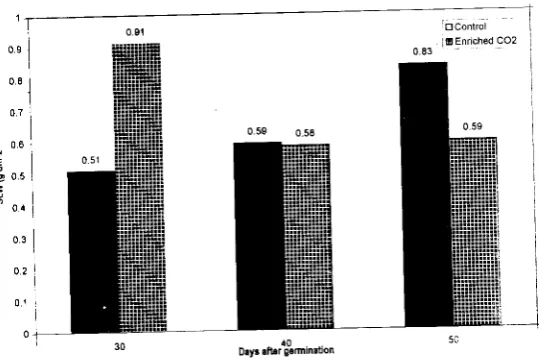
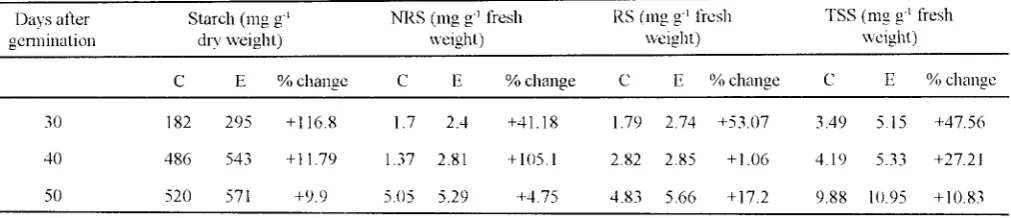
The specific leaf weight, starch, sucrose, reducing sugar and total sugar content of mungbeanleaves increased due to increase in C0
2 concentration at 30 days after gem1ination (Table I, Fig. 1). Starch levels showed the greatest change, with over a 116.88% increase for plants grown at 600±50 ppm C02 as compared to the control (365±ppm COJ For the same C02 concentration, non-reducing and non-reducing sugar levels also increased by 41.18% and 53.05% respectively. Specific leaf weight increased by 78.43%. Increase in starch, reducing and non-reducing sugar contents under elevated CO, over
0.8
0.7
0.6
l
2 0.5l5
"' 0.4
0.3
0.2
0.1 i
i
30 Days atter'ifermination
Fig. 1. Effect of eleYated C02 on specific leaf weight (SLW) :t:
different growth stages
~---~~---~~~~~~~~---~--
---~---A.C. SRJVASTAVAetal.
TABLE I. Starch. non reducing sugar, reducing sugar and total soluble sugar in leaves ofmungbean gro\\11 under elevated CO, concentrations.
Leaves were sampled from plants at 30, 40 and 50 davs after genmnahon.
Days atler gennination
Starch (mg g·' NRS (mg g·' fresh RS (mg g·' fresh TSS (mg g·' fresh
dry weight) \\·eight) weight) weight)
c E %change c E %change
c
E %changec
E %change30 182 295 +116.8 l.7 2.4 +41.18 1.79 2.74 +53 07 3.49 5.15 +47.56
40 486 543 + 11.79 1.37 2.81 +105.1 2.82 2.85 +1.06 4.19 5.33 +27.21
50 520 571 +9.9 5.05 5.29 +4.75 4.83 5.66 +17.2 9.88 10.95 +10.83
NRS =Non reducing sugar, R =Reducing sugar, TSS =total soluble sugar, C =Control (365 ppm) E =Elevated CO, (600±50ppm)
ambient C02 plants were narrowed do-vm at 40 and 50 days after germination. Almost equal non-reducing sugar was recorded at 50 days after germination for ambient and elevated C02 conditions. Similarly marginal increase in
reducing sugar was observed at 50 days after gem1ination under elevated C02 grown plants. It is therefore, no
significant difference for total sugar was found at 50 days after gem1ination.
There arc many reports in other plants \\hich showed that the starch content increases due to long tcnn C0
2 enrichment. Increase in starch content is reported in Cucumis sativus (Madore and Godinski. 1985). Glycine max(Havelkaeta/.. 1984:Cureetal.. l987)andPhaseolus satn•us (Hoddinott and Jolliffe. 1988).
In the present investigation. plants grown under high
C02 maintained a higher level of starch in the leaves throughout the growth period and no evidence of leaf malformation due to high starch accumulation was observed. The major increase in starch content which was observed at 30 days after gcm1ination not sufficient to cause inhibition of photosynthesis. Probably there was greater sink demand and greater export takes place during this phase to cause early gro\\ih of the plants. Earlier studies on short tcnn C02 enrichment in mungbcan have shown that starch accumulation occurs due to high C0
2 but the extra carbon fixed due to CO. enrichment is exported out ofthe source leaf within 24 hours (Sham1a, 1986 ). Thus, from this study it appears that the mung bean plants grown under elevated C02 (600 ppm) produce
204
greater amount of photosynthates which were partitioned to starch in the source leaf (short distance transport) and also to the growing sink such as shoot and roots (long distance transport). This resulted increase in dry weight of the leaves and stem.
Another important aspect is nitrogen utilization capacity of the plants under high C02 conditions. From the above discussion. it is clear that elevated CO. caused substantial carbon gain in the plants. The present study showed decreased level of nitrogen "hen the plants \Yerc gro\\n under elevated C02. As we knO\v major nitrogen source in plant is protein and in most proteins, nitrogen constitutes 16% of the total makeup. In the present study, protein nitrogen in dry leaves of mung bean harvested at 30. 40 and 50 days after germination was 1.89. 1.18 and 1.17% for ambient CO. conditions whereas 1.45. 1.00 and 1.06%forelevated C02 condition (Fig. 2) Thus a decrease in protein nitrogen was obtained due to elevated C0
2. Non-protein nitrogen \\as also lower in elevated C0
2 gro\vn plants at 30 and 40 days after germination. Percentage of total nitrogen in leaves ofmungbcan under elevated C02 conditions was consistently lower than in ambient C02 grO\m plants. Decrease in nitrogen content due to elevated C02 was 19.09~,~ at 30 days and 29.59% at 40 days after gennination. No significant difference was observed at 50 days after gcm1ination. Thus, it appears that the nitrogen taken up by the plants can not substantiate equally to the carbon gain by the plants under elevated C02 conditions. In several other C3 plant species
ELEV /\TED CO, EFFECT ON MUNG BEAN
4 ,---~
3.5
~
-~ 2.5 ~
~ 2
ai
g' 1.5
£!
z
0.5
3 51 TN
TN
30 40
Days after germination
50
•control F.aEnnched C02 •control I?:I!EnnchedCC2 •control
0 Ennched C02
TN
Fig. 2. Effect of elevated C0
2 on non-protein nitrogen (NPN),
protein nitrogen (PN) and total nirtogen (TN) in leaves of munghean at different growth stages
such as \\heat (Manderscheid eta!.. 1995; Billcs et a!.. 1993) and soybean (Allen er a! .. 1988; Reeves et a!.. 1994 ), lo\Yering in nitrogen content \Yas reported. Low
nitrog~.:n concentration due to elevated C0
2 is possible due to greater photosynthetic efficiency (Sage et a!..
1994) The performance of higher CO2 grown mungbean \\ith respect to photosynthesis and growth was not inhibited by the reduced nitrogen concentration. It seemed that greater stmcturalleaf weight caused the nitrogen dilution '' hich may be partially compensated by extra layer of mesophyll cells (Vu eta!.. 1989) thereby preserving the total photos: nthetic machinery per unit leaf ar~.:a (Soussana er of.. 1996). It is also possible that a C0
2 induced reduction in total nitrogen concentration may not be due to physiological changes in plant nitrogen usc efficiency. but is probably a size dependent phenomenon resulting from accelerated plant growth
ACKNOWLEDGEMENTS
The authors acknowledge the financial assistance provided by U.S. Department of Agricultural through PL 480 grant.
lnd~anJ. Plant Physwl., Vol. 4, No.3, (N.S.) pp. 202-206 (July-Sept., 1999)
REFERENCES
Allen, L H. Jr., Vu, J.C.V, Valle, R.R., Bolte, K.J. and Jones, P.IL
( 1988). Non stmctural carbohydrates and nitrogen of sovhean grown under C02 enrichment. Crop Sci .. 28 : 8-'1-'J-4
Baes, C.F , Goeller, HE.. Olson,.!. C. and Rotiv, R.M. ( 1977). CC\ and climate: The uncontrolled e\periment. Am Sciellfisl .. 66 · 310-320.
Rilles, G, Rouhier, H. and Bottner, P. (1993). Modification ofthe carbon and nitrogen allocation in the plant ( T. aestimm L) soil system in rcsponscto increased atmospheric CO: concentratiOn.
Planlwu!Soil .. 157:215-225.
Cure, J.D. (I 086 ). Crop responses to CO, doubling : A literature survev. Agricullural andJ(;resl me!e"arology., 38 125--145.
Cure, J.D, Israel, D.W. and Rufty, T.W. (1988). Nitrogen stress etlccts on growth and yield ofnonodulatcd sovhean c\posed to elevated carbon dioxide. Crop Sci., 28. 671-677.
Ghannoum, 0., Von. Gacmmercr, S., Barlow, E.W.R. and Conroy, J.P. ( 1977). The effect of CO, enrichment and irradiance on the growth,morphologv, and gas e\change ore, (J'anicum luxum) and
c4
(Panicum Wllidotale) grass. Aust. J Plmll I'hysiol., 2~• 227-237.
Havelka. V.D., Ackerson, RC._ Bovlc, M.G. and Wittenhach. V./\. ( 1984 ). CO, enrichment effects on sovbean phvsiologv. 1. Effects ofloi1g tcnn CO, c\posure. Crop Sci .. 2~ · 11-40-1149.
Havelka, V.D., Wittcnhach, VA. and Boyle, MG (l'JX4b) CO, enrichment etTects on wheat vie lei and phvsiologv. C 'rupSci., 2~
I 1 03-1168.
!locking. P l and Mevcr. C.l) ( 1985 ). l~csponses of noogorara hun
(Xalllhium occiden!ale Bertol) to nitrogen supplv and CO,
enrichment. .-Inn. 13o! .. 55 · l\35-894.
Hocking, P J and Mever, C.P. ( 1 'J'JI ). E!Tects of CO, enrichment and nitrogen stress on growth, and partitioning of dn matter and nitrogen in wheat and maize .. lust..!. 1'/an!l'hvsio/.. 18 · 133'J-135G.
Jarvis, P.G. (I 'JX'J). Atmospheric CO, and forests l'hilosophical
Transaction o(Jhe Roved Societv ~lf!.ondon., 32~8: 369-302.
Larigaudcrie. A., llilhert, D.W. and Oechel. WC (I 088) Effect of CO, emiclunent and nitrogen availa hi lit;· on resourct: acquisition and-resource allocation in a grass,Hranms mol/is. ( JecologJca ..
77 : 544-54')
Mackrscheid, R, Bender .1., Jager, I LJ and Weigel, J U. ( 1995) Etrects of season long CO, enrichment on cereals. ll. Nutrient concentration and grain qtta!ity . . ..Jgncu!Jure, Lcosystem and
Environmenl., 5~: 175-185.
Madore, M. and Grodizinski, B. ( 1985 ). E!Tect of CO, enrichment on growth and photoassimilatc transport in dwarf cucumber J
Plan/. Physiol., 121: 59-71.
A.C. SRIVASTAVA eta/.
Mccready, R.M.L Guggloz, J. and Oven, H.S. ( 1950). Detennination of starch and amylase in vegetable. Ann. Chem., 22 :
1156-1158.
Mckee, I. F. and Woodward, F.I. ( 1994 ). CO, enric!unentresponses of wheat : Interactions with temperature, nitrate and phosphate.
i\'nt• Phytol., 127: 447-453.
N clson, N. ( 1 944 ). A photometric adaptation ofthe Somogyi's method for the detennination of glucose. J. Bioi. Chem., 153 :
375-380.
Peet, M.M., Huber, S.C. and Patterson, D.T. (1986). Acclimation to high C02 in monoecious cucumber. !1. Carbon exchange rates,
enz}me activities and starch and nutrient concentration. Plant Phvsiol., 80: 63-67.
Poorter, II., Berkel, Y. V., Daxter, R., Hertog, J.D., DijkstraP., Gifford, RM., Griffin, K.L.,Roumet,C.,Ray,.T. and Wong, S C. (1997) The effects of elevated C02 on the chemical composition and constmction costs of leaves of 27 C
3 species. Plant Cell
f:IIVii'0/1., 20: 472-482.
Post W.M, Tsung-Hung,P, William,RE.,AnthmPi, W.K., Virginia, II.D. and Donald, L.D.A. (1990) The global carbon cycle
American scientist., 78 : 310-326.
Pucher, G.W., Leavenworth, C.S. and Vickery, H.B. (1948). Detennination of starch in plant tissues. Ann. Chem., 20
:850-853.
206
Reeves, D.W., Rogers, IU-I., Prior, S.A., Wood, C.W. and Runion. G.B. ( 1994 ). Elevated atmospheric CO, effects on sorghum and soybean nutnent status. J Plant Xutri:, 17 I 'J39-I 'J54.
Sage, R.F. ( 1994 ). Acclimation of photosynthesis to increasing atmospheric C02: The gas exchange perspective. Photo.l_vnth. Res., 39 · 351-368.
Sengupta, U.K. and Shanna, A (1993 ). CO, enrichm.::nt effects on photosvnthesis and plant growth. In : Eds Abrol YP; Mohantv P and Govindjee Photosynthesis Photorcactions to plant productivity. Oxton! and IBH publishing Co. Pvt. Ltd. New Delhi. pp. 479-508.
Sham1a, A. ( 1 986 ). Studies on relationship of CO, assimilation and translocation of assimilates in mungbean.
Ph.
D. Thesis. P G. School. WU. New Delhi.Somogvi, M. (1952) Notes on sugar detennination. J 13iol. Chem.,
195 : 19-23.
Soussana, JF. and Hartwig U.A ( 1996 ). The cfkcts ofeb·ated CO, on svmbiotic nitrogen tixation; a link between the carbon and nitrogen cycles in grassland ecosystems. Plant and Soil .. 187 _
321-332.
Vu, J.C. V., Allen, L.H.Jr. and Bowes, G. ( 1989). Leafultrastmcture, carbohvdrates and protein of soybean gro\\11 under CO enriclunent. Environ. Hxp. Bot., 29 : 141-14 7.