Multisite Survey of Pediatric Residents’ Continuity Experiences: Their
Perceptions of the Clinical and Educational Opportunities
Janet R. Serwint, MD*, and the Continuity Clinic Special Interest Group, Ambulatory Pediatric Association
ABSTRACT. Objectives. To survey a large group of residents from different institutions to delineate whether there are significant perceptive differences pertaining to the clinical and educational strengths and weaknesses of their continuity experiences by the 3 types of continuity sites.
Background. The residency review committee re-quires a 3-year continuity experience for pediatric resi-dents. Residents receive this experience at a variety of practice sites: hospital-based sites (HBS), community health centers (CHC), and private practices (PP)/health maintenance organizations (HMOs).
Design/Methods. Continuity clinic directors who at-tended the Ambulatory Pediatric Association Continuity Clinic Special Interest Group at the 1999 annual Pediatric Academic Societies Meeting were invited to participate in this cross-sectional study. Thirty-six agreed and dis-tributed a 60-item questionnaire to their residents at the end of the academic year. The questionnaire addressed quality and quantity of the educational and patient care experiences, overall satisfaction, and future career plans.
Results. Of the 1167 categorical residents (71%) who returned the questionnaire, 28% were postgraduate level (PL)-1s, 34% were PL-2s, and 37% were PL-3s. Ninety-four percent of the 36 programs had residents in HBS (nⴝ 807 residents), 58% in CHC (nⴝ106), and 69% in PP/HMO (nⴝ 254). Compared with other groups, resi-dents in HBS were more likely to report having seen patients more than once, being involved during patients’ hospitalizations, taking phone calls from patients, and perceiving that the parents identified them as the pri-mary care provider. HBS and CHC residents felt more autonomous and were more likely to believe that they were advocates for their patients, compared with PP/ HMO residents. The number of patients seen per session was greater in PP/HMO, whereas residents in PP/HMO were more likely to perceive that they had received the right amount of exposure to practice management and billing issues and the appropriate amount of nursing and office support. Although numbers of newborn visits were reported as adequate across sites, residents in HBS and CHC believed that they did not see enough adoles-cents. The majority of residents at all sites agreed that their preceptor was a good role model, was available for questions, and delivered the appropriate amount of teaching and feedback. Approximately two thirds of res-idents from all sites were satisfied with their experience
and believed that it was preparing them for their future career.
Conclusions. All 3 types of continuity sites have both strengths and weaknesses. No single type of continuity site met all expectations for clinical care or training. Most residents at all 3 types of sites reported overall satisfac-tion and believed that their continuity experience helped to prepare them for future career goals. The residency review committee, in collaboration with pediatric conti-nuity educators, needs to prioritize what constitutes the essential experiences in resident continuity practices and to reemphasize that the ongoing relationship is an im-portant component of the continuity experience.
Pediatrics 2001;107(5). URL: http://www.pediatrics.org/ cgi/content/full/107/5/e78;continuity experience, residency review committee guidelines, pediatrics, resident educa-tion, longitudinal care, patient numbers, office manage-ment, resident perceptions, graduate medical education, residency programs.
ABBREVIATIONS. RRC, residency review committee; APA, Am-bulatory Pediatric Association; PL, postgraduate level; PP, private practice; HMO, health maintenance organization; CHC, commu-nity health center; HBS, hospital-based site; FOPE, Future of Pe-diatric Education.
T
he continuity experience in its present form became a mandatory part of pediatric resi-dency training in 1990. Guidelines were further defined in 1997 regarding numbers of patient en-counters and resident patient panels. The residency review committee (RRC) is a committee of the Ac-creditation Council of Graduate Medical Education that makes recommendations to the Accreditation Council of Graduate Medical Education who then provide a standard of governance for all residency training programs in the United States referable to program requirements. Each discipline has its own set of requirements. Compliance with requirements is determined during the inspection process of pro-grams and facilities, review of documentation by the faculty, and direct discussion with individual mem-bers of the faculty and the housestaff.One of the major RRC requirements for pediatric residency training is a 3-year continuity experience.1
As developed in the RRC guidelines, a continuity experience consists of a recurring and longitudinal, clinical/educational exposure to pediatric primary care. The RRC requires a continuity experience one half day per week throughout all 3 years, with an additional one half-day session suggested. The core aspects of this training experience, as suggested by the RRC, include monitoring the biopsychosocial
as-From the *Department of Pediatrics, Johns Hopkins Hospital, Baltimore, Maryland.
Received for publication Oct 2, 2000; accepted Dec 27, 2000.
Reprint requests to (J.R.S.) Department of Pediatrics, Johns Hopkins Hos-pital, CMSC-143, 600 N Wolfe St, Baltimore, MD 21297. E-mail: [email protected]
pects of growth and development from birth through adolescence; promoting health and preventing dis-ease; managing acute and chronic medical condi-tions; and tailoring assessment and management to individual, family, and environmental circum-stances. Learning about practice management and functioning as a member of a health care team are other integral aspects of the continuity experience. Fundamental to the principle of continuity training is that each pediatric resident will develop a patient panel for whom he/she assumes primary responsi-bility for delivering and coordinating pediatric health care. Therefore, it is essential that patients in this panel be seen by their continuity house officer on a regular and continuing basis, rather than on a single occasion. Ideally, residents should be able to participate in their patients’ care during hospitaliza-tions, acute illnesses, and other circumstances to fa-cilitate and coordinate services, such as specialty re-ferrals.1
To meet those educational goals, each resident should be exposed to a patient population sufficient in number and adequate in diversity of age and diagnosis to develop generalist competencies. Based on input from the Ambulatory Pediatric Association (APA) and the Association of Pediatric Program Di-rectors, the RRC provided guidelines for recom-mended number of patient visits per session and total patient panel size.1Residents at the
postgradu-ate level (PL)-1 level should see 3 to 6 patients per session, PL-2 residents should see 4 to 8 patients per session, and PL-3 residents should see 5 to 10 pa-tients per session, in a setting conducive to efficient patient evaluation and management. Patients are generally recruited from a number of settings includ-ing the normal newborn nursery, neonatal intensive care unit, emergency department, inpatient services, general pediatric clinics, and subspecialty clinics. It is suggested that patient panels include individuals with chronic disease in addition to those that are healthy, so that residents develop skills in case man-agement and coordination of care.1
When the RRC required a pediatric continuity ex-perience, most programs, initially, placed residents in hospital-based clinics for this experience, adapting the clinical system to meet the new requirement. Many programs encountered difficulties in meeting the new requirement because of insufficient patient numbers, insufficient availability of faculty precep-tors, and unresponsive clinic systems not originally designed for continuity training. More recently, pro-grams have begun to expand into community sites for the continuity experience, using private practices (PPs), health maintenance organizations (HMOs), and community health centers (CHCs).2–9 This
ex-pansion was done in an effort to meet RRC require-ments for patient visits, to draw on a larger group of faculty, and to offer settings more akin to future practice experiences.1 Although the RRC provided
specific recommendations for patient numbers and panel sizes as objective evaluative criteria, recom-mendations or guidelines for other aspects of the continuity educational experience have not been ap-propriately provided.5,10,11
Past studies have compared experiences both within5,7,11–13 and across programs.6,14,15 However,
concern has been expressed regarding generalizabil-ity of results across pediatric training programs. Two studies14,15 queried pediatric residency program
di-rectors nationally, whereas the study by Dumont-Driscoll et al6relied on the perceptions of continuity
clinic directors and obtained information about op-erational issues. Comparisons among residents from a large number of training programs have not been previously undertaken, despite the fact that resident feedback is important in the educational process, both in meeting the RRC guidelines and as adult learner participants in their own education. The ob-jectives of this study were to survey a large group of residents from different institutions to delineate whether there are significant perceptive differences referable to clinical and educational strengths and weaknesses in the 3 types of continuity settings.
METHODS
A cross-sectional study was conducted at multiple pediatric training program sites. Continuity directors attending the 1999 annual Continuity Special Interest Group meeting (Annual Pedi-atric Academic Societies Meeting, San Francisco, CA) were invited to participate. One additional continuity director who was not at the meeting was informed about the project through a colleague and participated. A 60-item resident questionnaire was distributed to these individuals. This questionnaire had been developed and piloted during the previous academic year at one of the partici-pating sites (Johns Hopkins Children’s Center). Before distribu-tion, the questionnaire was further refined by the steering com-mittee members of the Continuity Special Interest Group. The individual continuity directors were each responsible for distribu-tion of the quesdistribu-tionnaire at the end of the academic year to the residents within their own programs. Institutional review board approval was obtained as required by each participating institu-tion. Questionnaires were completed anonymously from May 1999 through August 1999 and returned to a central site to facili-tate data entry and analysis, while maintaining program confiden-tiality. The data were analyzed across types of continuity settings rather than across individual institutions.
Only categorical pediatric residents in their first, second, or third year of training were included. Those in medicine/pediatrics programs, other combination programs, or residents beyond their third year of training were excluded because it was believed that their experiences and focus would significantly differ from the categorical residents.
Study Outcomes
The study outcomes were targeted toward categories men-tioned in the RRC guidelines.1These included: 1) the numbers and
Respondents were asked to consider the 1998 –1999 academic year when answering questions.
Data Analysis
The sample size calculation was based on the variable of resi-dent continuity with their patients. Based on a baseline estimate of continuity in hospital-based sites (HBSs) of 60% from past stud-ies,7,11,16we estimated a 10% difference in continuity comparing
HBSs and nonhospital sites to be a clinically significant difference. Using a 2-tailed ␣ of 0.05 and a power of 0.80, the estimated sample size would be 387 in each group. The original plan was to compare HBSs and non-HBSs (CHC, PP, and HMO). After the preliminary analysis, it was apparent that the CHC sites differed from the PP/HMO sites in several ways. Thus, analysis was performed comparing the 3 different types of sites, HBS, CHC, and PP/HMO. Analyses performed by level of resident training will not be presented in this manuscript.
Data analysis was performed using theStatistical Program for Social Sciences, Version 7.5(SPSS, Chicago, IL). Frequencies were calculated along with2and Fisher’s exact test for discrete
vari-ables.
RESULTS
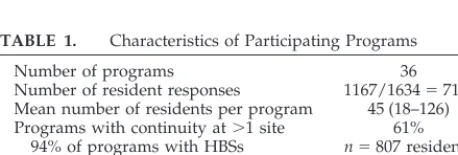
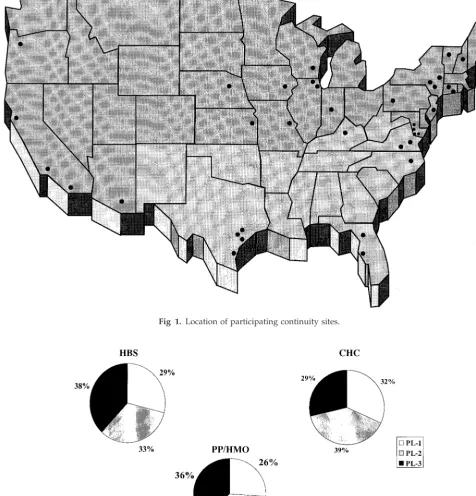
Table 1 describes the characteristics of the 36 resi-dency programs (17% of all pediatric training pro-grams nationwide) that participated. Of 1634 possi-ble participants, 1167 responded, yielding an overall response rate of 71% and representing 15% of resi-dents nationwide. The response rate per program ranged from 26% to 100%, with 6 of 36 programs having a 100% response rate. Ninety-four percent of programs (34) had residents at HBSs, which resulted in a total of 807 residents. Fifty-eight percent of grams had 106 residents at CHCs, and 69% of pro-grams used PP/HMO sites, with 254 residents at those sites. PP and HMO sites were combined be-cause they most resembled each other in the prelim-inary data analysis. There were 190 residents in PPs and 64 residents in HMOs. Sixty-one percent of pro-grams had continuity experiences at multiple types of sites, although only 1 program had residents placed at 2 different sites each week. The map in Fig 1 depicts the geographic locations of the participat-ing continuity sites. There was a scatter of sites na-tionwide, although there was a clustering in the Northeast and mid-Atlantic regions. Figure 2 dem-onstrates a fairly comparable distribution of levels of resident training among sites. These differences in distribution were not statistically significant. All items had a response rate of at least 97% except for 1 question.
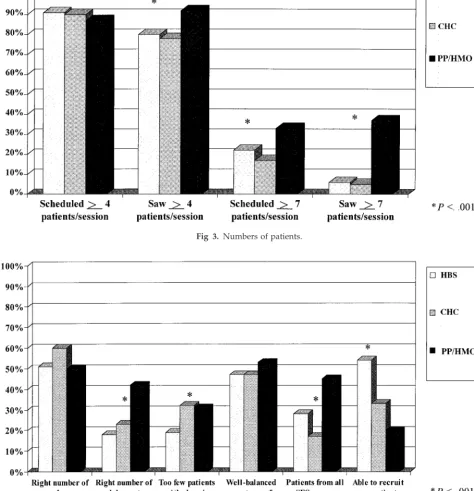
Figure 3 compares the numbers of patients seen in the different types of continuity practices: HBSs, CHCs, and PPs/HMOs. The proportion of residents who were scheduled for 4 or more patients per ses-sion was comparable across sites, but those in PPs were more likely to be scheduled for 7 or more
patients (22%, HBS; 17%, CHC; 33%, PP;P⬍.001). In comparing number of patients actually seen, resi-dents in PP sites were more likely to see at least 4 patients per session (80%, HBS; 78%, CHC; 92%, PP; P ⬍ .001). Even more striking are the differences across sites of residents seeing 7 or more patients per session (6%, HBS; 5%, CHC; 37%, PP; P ⬍ .001). When the number of patients scheduled per session was compared with the number seen, differences were found. Those at HBSs and CHCs were more likely to see fewer patients than scheduled, poten-tially reflecting the reduced show rate at these sites. The residents at PP sites saw a greater number of patients than were scheduled. A small number of residents (4%) at PP sites indicated that patients were never scheduled for them; they only examined either acute care patients or other providers’ patients.
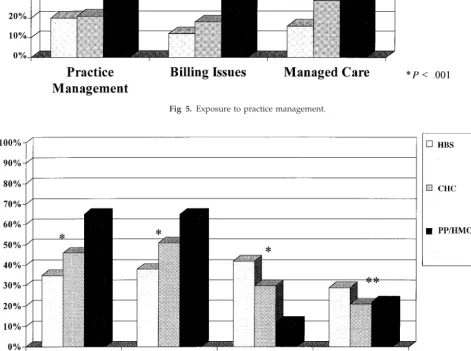
When types of patients were examined (Fig 4), residents in PP were more likely than those in other sites to believe that they saw the right number of adolescents (42% compared with 18% in HBS and 23% in CHC;P ⬍.001), and patients from all socio-economic groups (45% compared with 28% in HBS and 17% in CHC;P⬍.001). However, those in both CHCs and PPs believed that they saw too few pa-tients with chronic diseases. Equal proportions across sites believed that they saw the right number of newborns and had a well-balanced spectrum of patients. Those at HBSs perceived that they were more likely to recruit new patients (54% compared with 31% in CHC and 20% in PP;P⬍.001).
Concerning practice management (Fig 5), residents in PP were more likely to report more opportunities to learn about practice management (41%, PP; 21%, CHC; 20%, HBS;P ⬍.001), billing issues, and man-aged care, but the percentage of residents who be-lieved that they had the right amount of opportunity to learn about these issues never exceeded 41% at any type of continuity site. These differences were statistically significant.
In examining interactions with other staff (Fig 6), those in PPs were more likely to believe that they received the appropriate amount of office support (65% in PP, 46% in CHC, 35% in HBS) and nursing support (65% in PP, 51% in CHC, 38% in HBS; both P ⬍.001). Although PP provided more appropriate nursing and clerical support, ⬎30% of residents at this type of site did not believe that this was suffi-cient. Not surprisingly, HBS offered more opportu-nity for interactions with social workers and subspe-cialists, but only 42% and 29%, respectively, of residents in HBS believed that this was adequate.
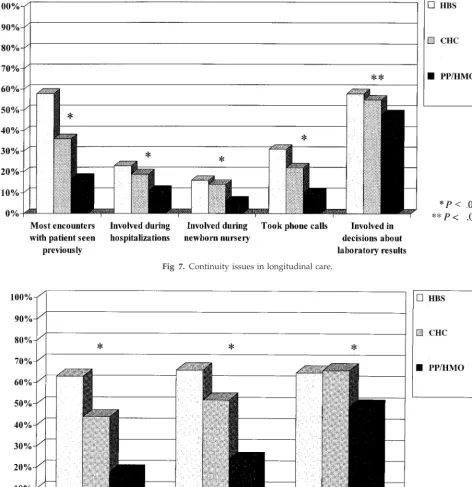
Residents in HBSs were more likely to agree that most encounters were with patients who they had seen previously (58% in HBS, 36% in CHC, 17% in PP;P⬍.001; Fig 7). Those in hospital sites reported that they were more likely to be involved with pa-tients during hospitalizations and in the newborn nursery, to take phone calls from continuity patients, and to be involved in decisions about laboratory results (P⬍ .001). However, even in HBS, only 58% of residents reported that most encounters were with patients who they had seen previously, only 58% were involved with decisions about laboratory
re-TABLE 1. Characteristics of Participating Programs
Number of programs 36
Number of resident responses 1167/1634⫽71% Mean number of residents per program 45 (18–126) Programs with continuity at⬎1 site 61%
94% of programs with HBSs n⫽807 residents 58% of programs with CHCs n⫽106 residents 69% of programs with PP/HMO
sites
sults, and less than one third were involved with their patients in the hospital, in the newborn nursery, and by answering telephone calls. Residents in PP had the lowest rates on all of these continuity of care indicators, and those in CHCs had rates intermediate between HBS and PP.
Residents at HBSs thought that parents were more likely to identify them as their child’s pediatrician (63% in HBS, 44% in CHC, 18% in PP; Fig 8), and they were more likely to believe that they were the primary care provider (66% in HBS, 52% in CHC, 24% in PP; bothP⬍.001). Those in HBSs and CHCs
were more likely to believe that they served as ad-vocates for their patients.
Teaching opportunities (Fig 9), such as attending didactic teaching sessions, receiving a handout or article, or receiving teaching points about individual patients, were more likely to occur in HBSs (allP ⬍ .01). Also, those in HBSs were more likely to have had the goals and objectives of the experience dis-cussed (P⬍.01).
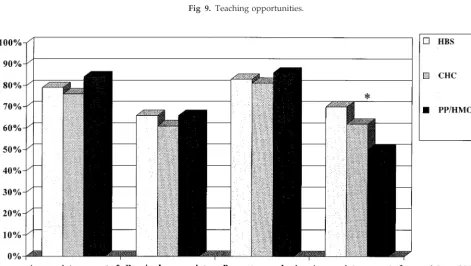
Preceptor characteristics were fairly comparable across sites (Fig 10). Residents were equally likely to think that their preceptor was available for help and
Fig 1. Location of participating continuity sites.
teaching, provided feedback, and served as a good role model. However, those in HBSs were more likely to perceive that they received the appropriate amount of autonomy with supervision when caring for their patients (70% in HBS, 62% in CHC, 50% in PP;P⬍ .001).
Finally, satisfaction and preparation for future ca-reer goals was compared. Approximately two thirds of residents stated that they were satisfied with the experience, with no difference across sites, and ap-proximately two thirds of residents stated that they believed that the continuity experience helped pre-pare them for their future goals. However, only 72% of residents answered this question, perhaps because it was placed at the very end of the questionnaire
grouped among some open-ended questions. If the results of only those who answered the question were tabulated, 90% of residents across groups per-ceived adequate career preparedness in the continu-ity experience. There were no differences among sites in the proportion who planned to enter either PP (48% in HBS, 48% in CHC, 53% in PP) or a subspecialty fellowship (29% in HBS, 27% in CHC, 28% in PP).
DISCUSSION
Our study demonstrated that residents perceive different strengths and weaknesses at different con-tinuity sites. The major strength of the study is the sampling of residents from a large number of
pro-Fig 3. Numbers of patients.
grams, representing 17% of pediatric programs and 15% of residents nationwide.
The perceived strengths of PPs/HMOs sites that were identified in this study included: 1) more pa-tients seen per session; 2) exposure to a greater num-ber of adolescents; 3) exposure to patients from a broader socioeconomic scope; 4) heightened aware-ness regarding practice management; and 5) appro-priate amount of help from ancillary staff. The iden-tified weaknesses of the PP sites included: 1) too few patients with chronic disease; 2) fewer interactions with subspecialists or social workers; 3) less continu-ity and exposure to longitudinal care; 4) less per-ceived responsibility as the primary care provider;
5) less autonomy regarding patient management; and 6) less didactic teaching and discussion about individual patients.
The strengths of the HBSs included residents’ per-ceptions of: 1) more continuity and longitudinal care in seeing patients; 2) greater regard of themselves as the primary care provider and acknowledging re-sponsibility for their patients; 3) their advocacy role regarding their patients; 4) the ability to recruit new patients; 5) appropriate amount of autonomy in pa-tient care; and 6) receiving more teaching in didactic sessions, receipt of handouts, and discussion about individual patients. Weaknesses included: 1) fewer patients seen; 2) less access to the appropriate
Fig 5. Exposure to practice management.
amount of nursing and office staff assistance; and 3) less exposure to practice management.
Residents at CHCs were most likely to have inter-mediate responses in most categories, ranking be-tween those in the PPs and the HBSs. Residents at CHCs were as likely as those at HBSs to believe that they served as advocates for their patients and to have too little exposure to practice management. They were as likely as those at PP sites to think that they saw too few patients with chronic diseases, to have too little interaction with subspecialisits, and to receive fewer teaching points about particular pa-tients. However, they had better exposure to
man-aged care and better ancillary support than those in HBSs and had better didactic teaching and perceived more autonomy than residents in PP sites.
Residents across sites had similar perceptions: 1) exposure to a well-balanced spectrum of patients; 2) preceptor availability; 3) receipt of appropriate feed-back; 4) preceptor as a good role model; and 5) personal satisfaction with the experience and prepa-ration for future career goals.
Our data revealed that pediatric residents tend to receive different types of experience at the different continuity settings. The RRC has specifically man-dated a continuity experience, but it has not
estab-Fig 7. Continuity issues in longitudinal care.
lished a definition of continuity,5,17,18 despite the
existence of many suggestions and formulas.13,18 –23
True health maintenance and the benefits of continu-ity, learning the art of medicine, understanding the intricacies of the doctor–family relationship, and fol-lowing the evaluation of a disease process over time are most easily achieved in an environment where repeat visits can be ensured. The Future of Pediatric Education (FOPE) II report specifically emphasizes the importance of a medical home for patients and that ongoing health maintenance and preventive care are important parts of the responsibilities of future pediatricians.24
Earlier studies have demonstrated increased con-tinuity and perceived responsibility for patients at HBSs compared with other sites.3,5,11The results of
this study verify these findings. HBSs have often been developed to address the educational needs of residents. In HBSs, the patients are assigned to a resident and this relationship is well established from the outset, which is more consistent with the standard of pediatric care. Recruiting newborns from the nursery at a home hospital site provides residents with the ability to see these patients in follow-up and on a continuous basis. This early consistency of care is enhanced by supervision guidelines that call for
Fig 9. Teaching opportunities.
more frequent visits in the earlier months and years of life.25The location of the continuity practice at the
academic center is also beneficial for continuity of care regarding hospitalizations, subspecialty care, and follow-up of radiologic and laboratory studies, although the proportion of residents who thought that these encounters were sufficient was low at all sites. It is much more likely that a resident will be informed about his/her patient’s admissions or emergency department visits if these occur at the same institution where the resident spends a major-ity of the time,3in addition to seeing patients for an
acute care visit or being involved in some of the management decisions.16Academic institutions and
HBSs often have contract agreements with the same managed care plans. This tends to make it easier to recruit patients encountered in the emergency de-partment, nursery, or on inpatient services. Because patients at HBSs often are members of underserved populations, the issue of enhanced advocacy is not surprising3,26; this is a competency that is
recom-mended by the RRC.1Additionally, the FOPE report
has emphasized the increased number of children in poverty and the importance of addressing both the needs of this population and the need to increase resident exposure to underserved populations.24
Several studies have emphasized the importance of the relationship that develops between patient and physician when there is continuity. Starfield27stated
that longitudinality is an essential element of good primary care, and Hjortdahl and Laerum28described
continuity as a cornerstone of the relationship. The benefits of continuity have been described: enhanced satisfaction for parents of children with chronic ill-nesses29; improved understanding of the need for
and results of a consultation30; improved
appoint-ment compliance with longitudinal care31,32;
im-proved medication compliance31,33,34; and reduced
hospitalization rates, episodes of illness, and number of laboratory tests performed.35 Mothers have been
found to be more likely to disclose behavioral prob-lems31,34; previously addressed problems are more
likely to be addressed again17; and visit satisfaction is
greater with the same provider.28,32,36 One needs
only to see the relationship between residents as they depart the training program and their continuity patients to appreciate the value of this experi-ence.37–39
Despite these attributes, continuity is difficult to achieve during resident continuity training. Limited by 1 to 2 half-day continuity sessions per week, it is quite challenging to convince patients and parents to wait regarding nonemergent issues. Similar chal-lenges arise in encouraging preceptors to keep resi-dents involved regarding ongoing patient manage-ment issues. It is difficult to achieve the type of continuity of care that exists in PPs, where pediatri-cians are exclusively devoted to patient care. Even at HBSs, which apparently had the best opportunity for continuity, only 58% of residents perceived that they had continuity and only 63% of them acknowledged their role as a primary care provider the majority of the time. Educators of pediatric residents must em-phasize the importance of continuity and
longitudi-nal care for training and, at the same time, determine what degree of continuity is necessary yet realistic to accomplish educational goals.
The finding of a greater number of patients seen per session at PP sites is consistent with data from individual programs.5,7,11This may reflect higher
pa-tient to physician ratios, a greater number of papa-tients presenting for acute care visits, or greater efficiency of the practices. Becoming skilled in seeing many patients enhances efficiency and is a career-reward-ing competency. However, numbers of patients seen depends on the complexity of their problems, the paper work and documentation involved, and the efficiency of the practice dynamics. With ancillary help available to carry out some of these tasks, resi-dents should be able to see more patients. This seems to vary by type of site. Although maximizing the number of patient encounters is a laudable goal, data need to be gathered to determine what is the opti-mum number of patients and patient visits necessary to achieve the educational goals, taking into account office efficiency and patient complexity. Of interest, those in HBSs were more likely to believe that they saw the appropriate number of patients with chronic disease, whereas those in PPs and CHCs believed that they saw too few. These findings differ from those of Osborn et al5in which similar numbers of
patients with chronic diseases were seen across sites. Although an appropriate balance of healthy children and those with chronic disease is important, longitu-dinal care of children with chronic disease allows residents to acquire skills in coordination of care, perspective regarding the impact of chronic disease on patients and families, as well as the opportunity to learn about particular diseases. These are all skills that the RRC and the FOPE report endorse.1,24
Work-ing with subspecialists, learnWork-ing skills to access con-sultation, and working in multidisciplinary teams with social workers are each quite important for pediatricians. Although these skills may be learned in the inpatient settings, there is a different refine-ment of the skills when a continuity patient is in-volved. The resident will need to have an ongoing relationship with the subspecialist or social worker in negotiating plans concerning the patient. PP set-tings seem to offer less opportunities to acquire and to develop these skills than do HBS and CHC sites. Residents were more likely to learn about billing issues and practice management at PP sites. Al-though these issues are important for residents who will later enter a PP setting, none of the sites, includ-ing the PP sites, had significantly high percentages in this category. In addition, these issues can probably be learned in venues other than a continuity experi-ence, eg, participation in a month-long elective in a PP setting. Program directors should take note of this and ensure that this important area is included in their respective curriculums. Residents in HBSs were more likely to have attended didactic sessions, re-ceived handouts or articles, rere-ceived teaching points about individual patients, and participated in the discussion of goals and objectives of the experience. APA educational guidelines and curricula40are more
teaching opportunities and a verbal commitment to the process. Additionally, the FOPE II report has endorsed structured curriculum for resident educa-tion.24
Residents across sites had similar perceptions re-garding their exposure to a well-balanced spectrum of patients, preceptor availability, receipt of appro-priate feedback, and preparation for future career goals. All residents gave high ratings concerning their preceptors as good role models, their availabil-ity, and receiving the appropriate amount of feed-back. Overall, residents were satisfied with their ex-periences and believed that they were prepared for future career experiences. The continuity experience was valued by residents regardless of career choice, even for those who were not planning to enter a private general pediatric practice. The approach to patients, the development of relationships, and a solid general pediatric knowledge base was relevant to all residents regardless of their future career plans. These data help to emphasize the importance and richness of this experience in residency training.
Limitations
It is important to acknowledge the limitations of this study. All of the responses were based on resi-dent perceptions and self-report. This limitation does not change the validity of the study because it ap-plied across all sites. In future studies, resident per-ceptions should be compared with normative data from program sites. In addition, as mentioned ear-lier, resident feedback is important in the develop-ment of educational curricula. The designation of the type of continuity site on the questionnaire was made by the resident. There may have been some confusion as to how to categorize a particular site. When this was apparent to the continuity director, the site designation was changed. Program partici-pation in this study was contingent on continuity directors who had attended the Special Interest Group meeting or who had heard about the project. The programs represented in this study may be a self-selected group who put more emphasis on a quality continuity experience resulting in resident perceptions that may be more positive than the norm. Additionally, there may be unrecognized vari-ations within sites of which we are not aware; not all hospital-based clinics are alike any more so than are all PPs. Finally, the scales used in this study have not been previously validated and grouping of responses for this report may have introduced some unantici-pated bias.
CONCLUSION
This study reports perceived strengths and con-comitant weaknesses of all 3 types of continuity sites. None of the sites met all expectations, and even for most variables regardless of site, an insufficient pro-portion of sites met the stated goal. This study an-swered some questions but raised many more. Pedi-atric educators must move forward and develop guidelines about key factors important to the conti-nuity experience. Hopefully, these data will be used not only to acknowledge the strengths and
weak-nesses at all types of sites, but also to promote col-laboration between members of the RRC and conti-nuity educators to prioritize what are the essential experiences in resident continuity practices and to reemphasize that the ongoing relationship is an im-portant component of the continuity experience.
ACKNOWLEDGMENTS
List of participating sites and investigators: Atlantic Health Systems, Randolph, NJ, Alan J. Meltzer, MD; Baylor College of Medicine, Houston, TX, Jan Drutz, MD; Brody School of Medicine at East Carolina University, Greenville, NC, John M. Olsson, MD, Karin Hillenbrand, MD; Children’s Hospital, Pittsburgh, Pitts-burgh, PA, Debra Bogen, MD; Children’s Memorial Hospital, Northwestern University, Chicago, IL, Robert R. Tanz, MD; Chil-dren’s National Medical Center, Washington, DC, Rachel Moon, MD; University of Connecticut, Farmington, CT, Paula Algranati, MD; Dartmouth Medical School, Lebanon, NH, Diane Kittredge, MD; Driscoll Children’s Hospital, Corpus Christi, TX, Daniel Vijjeswarapu, MD, William J. Riley, MD; East Virginia Medical School, Norfolk, VA, Lawrence Pasquinelli, MD; Indiana Univer-sity, Indianapolis, IN, Jill Mazurek, MD; University of Iowa, Iowa City, IA, Claibourne I. Dungy, MD, MPH; Johns Hopkins Chil-dren’s Center, Baltimore, MD, Janet Serwint, MD; Loma Linda University, Loma Linda, CA, Sharon Reisen, MD; Lucille Packard Children’s Hospital, Stanford, CA, Theodore Sectish, MD; Mai-monides Medical Center, Brooklyn, NY, Henry A. Schaeffer, MD; Medical College of Virginia, Richmond, VA, Keith Derco, MD; Naval Medical Center, San Diego, CA, Gregory Blaschke, MD, MPH; Westchester Medical Center/New York Medical College, Westchester, NY, Theresa Hetzler, MD; Oregon Health Sciences University, Portland, OR, Arthur Jaffe, MD; Rush Children’s Hos-pital, Chicago, IL, Beth Volin, MD; Uniformed Services, University of Health Sciences, Washington, DC, Joseph Lopreiato, MD; Uni-versity of Arizona, Tucson, AZ, Thomas M. Ball, MD, MPH; University of Florida, Gainesville, FL, Marilyn Dumont-Driscoll, MD, PhD; University of Kansas, Kansas City, KS, Lisa Campbell, MD; University of Kentucky, Lexington, KY, Rebecca Collins, MD; University of Maryland, Baltimore, MD, Susan Feigelman, MD; University of Nebraska and Creighton University, Omaha, NE, John A. Walburn, MD; University of South Florida, Tampa, FL, Sharon Dabrow, MD; University of Texas Medical Branch at Galveston, Galveston, TX, Michelle S. Barratt, MD, MPH, Laura E. Ferguson, MD; University of Vermont, Burlington, VT, Wendy Davis, MD; Washington University School of Medicine, St Louis Children’s Hospital, St Louis, MO, Ariane May, MD, MPH; Winthrop University Hospital, Mineola, NY, Gale Cantor, RN, MS, CFNP; University of Wisconsin, Madison, WI, Catherine Kelly, MD; and Yale University, New Haven, CT, Brian Forsyth, MB, ChB.
The APA Task Force of the Continuity Clinic Special Interest Group who worked on questionnaire and manuscript develop-ment consisted of Diane Kittredge, MD (cochairperson); Marilyn Dumont-Driscoll, PhD, MD (cochairperson); Paula Algranati, MD; Rebecca Collins, MD; Wendy Davis, MD; Jan Drutz, MD; Susan Feigelman, MD; John M. Olsson MD; and Sharon Reisen, MD.
I also thank my preceptor colleagues at the Johns Hopkins Children’s Center who helped to develop the questionnaire the year before this study: John Andrews, MD; Robin Chernoff, MD; Kevin Johnson, MD; and Modena Wilson, MD, MPH.
REFERENCES
1. Accreditation Council of Graduate Medical Education.Program Require-ments for Residency Education in Pediatrics. Chicago, IL: Accreditation Council of Graduate Medical Education; 1996:1–24
2. Sargent JR, Osborn LM, Roberts KB, DeWitt TG. Establishment of primary care continuity experiences in community pediatricians’ offices: nuts and bolts.Pediatrics. 1993;91:1185–1189
3. Drutz JE, Serwint JR, Feigelman S, Dumont-Driscoll M. The pediatric continuity experience: do academic sites still have a role?Arch Pediatr Adolesc Med. 1999;153:561–564
4. DeWitt TG, Roberts KB, eds.Pediatric Education in Community Settings: A Manual. Arlington, VA: National Center for Education in Maternal and Child Health; 1996
setting, and faculty supervision on the continuity clinic experience.
Pediatrics. 1993;91:1089 –1093
6. Dumont-Driscoll MC, Barbian LT, Pollock BH. Pediatric residents’ con-tinuity clinics: how are we really doing?Pediatrics. 1995;96:616 – 621 7. Recchia KC, Petros TM, Spooner SA, Cranshaw JL. Implementation of
the community outpatient practice experience in a large pediatric resi-dency program.Pediatrics. 1995;96:90 –98
8. Roberts KB, DeWitt TG. The office experience: don’t leave residency without it!Contemp Pediatr. 1992;9(suppl):15–20
9. Alpert JJ, Blodgett FM, Gargas DC, et al. A survey of community (out of hospital) sites used in pediatric training.Pediatrics. 1991;87:719 –721 10. Greenberg LW, Getson P, Brassiux C, et al. How are pediatric training
programs preparing residents for practice?Am J Dis Child. 1991;145: 1389 –1392
11. Rice TD, Holmes SE, Drutz JE. Comparison of continuity clinic experi-ence by practice setting and postgraduate level.Arch Pediatr Adolesc Med. 1996;150:1299 –1304
12. Ponitz KL, Needlman RD, Kilkenny TJ. Primary care relationships in pediatric hospital clinics vs. private offices.Arch Pediatr Adolesc Med.
2000;154:1209 –1213
13. Wilson EH, Weiner JP, Bender JC, Bergstrom SK, Starfield BH. Does a residents’ continuity clinic provide primary care?Am J Dis Child. 1989; 143:809 – 812
14. Barratt MS, Tanz R. A survey of the structure and function of pediatric continuity clinics.Am J Dis Child. 1992;146:937–940
15. Mulvey HJ, Ethan AB, Cheng TL, Johnson RL. Pediatric residency education.Pediatrics. 2000;106:323–329
16. Garfunkel LC, Byrd RS, McConnochie KM, Auinger P. Resident and family continuity in pediatric continuity clinic: nine years of observa-tion.Pediatrics. 1998;101:37– 42
17. Starfield BH, Simborg DW, Horn SD, Yourtee SA. Continuity and coordination in primary care: their achievement and utility.Med Care. 1976;14:625– 636
18. Rogers J, Curtis P. The concept and measurement of continuity in primary care.Am J Public Health. 1980;70:122–127
19. Magill MK, Senf J. A new method of measuring continuity of care in family practice residencies.J Fam Pract. 1987;24:165–168
20. Weiner JP, Starfield BH. Measurement of the primary care roles of office-based physicians.Am J Public Health. 1983;73:666 – 671 21. Fletcher RH, O’Malley MS, Fletcher SQ, Earp JL, Alexander JP.
Mea-suring the continuity and coordination of medical care in a system involving multiple providers.Med Care. 1984;22:403– 411
22. Eriksson EA, Mattsson LG. Quantitative measurement of continuity of care: measures in use and an alternative approach.Med Care. 1983;21: 858 – 875
23. Steinwachs D. Measuring provider continuity in ambulatory care: an
assessment of alternative approaches.Med Care. 1979;17:551–565 24. The Future of Pediatric Education II (FOPE). Organizing pediatric
ed-ucation to meet the needs of infants, children, adolescents, and young adults in the 21st century.Pediatrics. 2000;105(suppl):161–212 25. Green M, ed.Bright Futures: Guidelines for Health Supervision of Infants,
Children, and Adolescents. Arlington, VA: National Center for Education in Maternal and Child Health; 1994
26. Weitzman M, Byrd RS, Auinger P. Children in big cities in the United States: health and related needs and services.Ambulatory Child Health. 1996;1:347–359
27. Starfield B. Continuous confusion?Am J Public Health. 1980;70:117–119. Editorial
28. Hjortdahl P, Laerum E. Continuity of care in general practice: effect on patient satisfaction.Br Med J. 1992;304:1287–1290
29. Breslau N. Continuity reexamined: differential impact on satisfaction with medical care for disabled and normal children.Med Care. 1982;20: 347–359
30. Ruane TJ, Brody H. Understanding and teaching continuity of care.
J Med Educ. 1987;62:969 –974
31. Dietrich AJ, Marton KI. Does continuous care from a physician make a difference?J Fam Pract. 1982;15:929 –937
32. Alpert J, Kosa J, Haggerty RT, et al. Attitudes and satisfactions of low income families receiving comprehensive health care. Am J Public Health. 1970;60:499 –506
33. Charney EC, Bynum R, Eldredge D, et al. How well do patients take oral penicillin? A collaborative study in private practice.Pediatrics. 1967;40: 188 –195
34. Becker MH, Drachman RH, Kirscht JP. Predicting mothers’ compliance with pediatric medical regimens.J Pediatr. 1972;81:843– 854
35. Heagerty MC, Robertson LS, Kosa J, et al. Some comparative costs in comprehensive versus fragmented pediatric care. Pediatrics. 1970;46: 596 – 603
36. Lewis C. Does comprehensive care make a difference? What is the evidence?Am J Dis Child. 1971;122:469 – 474
37. Serwint JR, Johnson P. When patients and pediatricians say good-bye in a pediatric resident continuity clinic.Arch Pediatr Adolesc Med. 1995;149: 812– 816
38. Serwint JR, Wasserman BJ, Chernoff RG. The impact on families of pediatric resident departure from a continuity clinic practice. Arch Pediatr Adolesc Med. 1997;151:679 – 683
39. DeWitt TG, Roberts KB. Teaching residents about patient and practice termination in community-based continuity settings.Arch Pediatr Ado-lesc Med. 1995;149:1367–1370
DOI: 10.1542/peds.107.5.e78
2001;107;e78
Pediatrics
Pediatric Association
Janet R. Serwint and the Continuity Clinic Special Interest Group, Ambulatory
Perceptions of the Clinical and Educational Opportunities
Multisite Survey of Pediatric Residents' Continuity Experiences: Their
Services
Updated Information &
http://pediatrics.aappublications.org/content/107/5/e78
including high resolution figures, can be found at:
References
http://pediatrics.aappublications.org/content/107/5/e78#BIBL
This article cites 36 articles, 10 of which you can access for free at:
Subspecialty Collections
http://www.aappublications.org/cgi/collection/workforce_sub Workforce
ub
http://www.aappublications.org/cgi/collection/career_development_s Career Development
b
http://www.aappublications.org/cgi/collection/medical_education_su Medical Education
following collection(s):
This article, along with others on similar topics, appears in the
Permissions & Licensing
http://www.aappublications.org/site/misc/Permissions.xhtml
in its entirety can be found online at:
Information about reproducing this article in parts (figures, tables) or
Reprints
http://www.aappublications.org/site/misc/reprints.xhtml
DOI: 10.1542/peds.107.5.e78
2001;107;e78
Pediatrics
Pediatric Association
Janet R. Serwint and the Continuity Clinic Special Interest Group, Ambulatory
Perceptions of the Clinical and Educational Opportunities
Multisite Survey of Pediatric Residents' Continuity Experiences: Their
http://pediatrics.aappublications.org/content/107/5/e78
located on the World Wide Web at:
The online version of this article, along with updated information and services, is
by the American Academy of Pediatrics. All rights reserved. Print ISSN: 1073-0397.