195 |
P a g e
STATISTICAL PROBABILITY BUG TRACKING
SYSTEM USING NAÏVE BYES IN DATA MINING
1
Er. Amandeep,
2Er. Saurabh Mittal
1M. Tech. Scholar, CSE Department,
Galaxy Global Imperial Technical Campus, Dinarpur Ambala (India)
2
Associate Professor, CSE Department,
Galaxy Global Group of Institutions, Dinarpur, Ambala, (India)
ABSTRACT
Bug-tracking mechanism is employed in software development houses to track the bugs in the software. We are
aimed at distinguishing the very fast and the very slow bugs so as to prioritize them while working on them. We
computed our prediction model using Naïve Bayes classifier. Simply relying on shared lists and email to monitor the
status of defects is error-prone approach and the possibility is that the bug judged by developer to be unsignificant
is ignored.
Bug Tracking System or Defect Tracking System is an ideal solution for individual or groups of developers to track
the bugs of a product, solution or an application.
The Bug Tracking System can dramatically increase the productivity and accountability of individual employees by
providing a documented target based workflow and positive feedback for good performance.
Bug Tracking System allows below functionalities:
1. Creating & Changing Bugs at ease
2. Query Bug List to any depth
3. Reporting & Charting in more comprehensive way
4. Multi-level Priorities & Severities.
5. Attachments & Additional Comments for more information
I INTRODUCTION
In a Bug Tracking System, some Bug Reports are labeled as security bug reports (SBRs), whose associated bugs are found to be security problems. These SBRs must be fixed on priority than not-security bug reports (NSBRs), the subset of BRs that are believed not to have a security impact. Correctly labeling and fixing SBRs among BRs submitted to a BTS is important in security practice so that there is no delay causing serious damage to software-system stakeholders. The likelihood of unlabeled SBRs in a BTS could be high for at least three reasons.
196 |
P a g e
2) Some security bugs described in BRs are associated with recommended mitigations that may be unknown to bug reporters.
3) Bug related to general reliability problems can also be related to security problems and a bug reporter without sufficient security knowledge may report this bug as a NSBR.
Therefore, there remains a strong need of effective tool support for reducing human efforts in this process of identifying SBRs in a BTS, enabling this important security practice of SBR identification in either industrial or open source settings.
II LITERATURE REVIEW
C. Code Search and Recommendation Using Stackoverflow Zagalsky et al. describe a code search and a recommendation tool called as Example Overflow which mines information present in Stack Overflow (Q&A website for programmers) [12]. Their work is motivated by the need to minimize context switch between development environment and code-search tools.
In context to existing work, the study presented in this paper makes the following novel contributions:
1) The work described in this paper is the first focused study on integration of issue tracking systems with community driven question and answering websites such as Stack overflow. While there has been work in the area of code-editors & development environment integration (Section II-A) with Stack overflow as well as code-editor integration with web-search and external websites (Section II-B), the integration of Stack overflow with issue tracking systems is a unique research direction.
2) We present experimental results (based on a series of experiments conducted on publicly available dataset from two popular, large, complex and open-source projects: Google Chromium and Android) indicating presence of several links to Stack overflow question & answers facilitating the process of bug resolution. We conduct a characterization study and present our perspective on the correlation between Stack overflow references and mean time to repair a bug, top domains in issue tracking system threaded discussion forums and illustrative examples showing links to various Web 2.0 platforms in addition to Stackoverflow.
3) We present a solution based on analyzing textual eatures (textual similarity between bug report title and Stackoverflow questions) and contextual features (such as question tags representing the topic) to recommend a Stackoverflow question in response to a bug report. We believe that a recommendation engine (tool support) that automatically suggests relevant Stackoverflow knowledge-base to developers can save time during bug resolution. We present the proposed solution and empirical results ((performance evaluation and validation)) demonstrating the effectiveness of the method on dataset containing the ground-truth.
197 |
P a g e
We believe that there is a dearth of academic studies surveying the needs, problems encountered,human-factors and suggestions on the problem area discussed in this paper.
There are many bug tracking systems available in the industry to use. Bug tracking systems are also called as issue tracking system or issue reporting system or defect tracking system or defect reporting system, etc. Bug tracking systems are developed by open source community as well as closed source organizations as a proprietary software. Open source means the source code is being shared with everybody under the General Public License (GPL) policy. Anyone can contribute to the code voluntarily. There is no restriction towards the submission of code. The moderator will see and verify the reputation of the code submitter through his code submission pattern and its status can also be changed as moderator. While in closed source community, the source code is the property of the organization and the people who are outside the project may not be able to see/browse the code. Outsiders can submit only bugs through the feedback or e-mail to the sales/support person specified by the organization. In this article, we will consider the open source project development scenario except one or two closed source products. Some of bug tracking tools are from open source communities and some of them from closed source communities or commercial organizations. There are organizations which can also provide support for the open source solutions.
III PROPOSED SYSTEM
The Proposed System we have the end-user dataset excel sheet , and we will enter the parameter randomly ,it will predict the result on the basis of status of the bug. Benefit of the system we can check and remove the max probability parameter. Although bug reporters may not recognize that the bug they are describing is a security bug, the natural-language description of the bug in the BR may be adequate to indicate that the bug is security-related and thus the BR is an SBR.
a. Feature selection is iteratively performed until optimum points are reached. At the end of Step 5, there is a reduced feature set that performs optimally for the chosen classifier metric.
b. Using the reduced feature set, a classification model is trained. Although many classification techniques could be employed, this paper focuses on the use of Naive Bayes .
Its Advantages over Existing System are
The performance is increased due to well designed database, Security is increased,
Time saving in report generationand
Easy to update the details.198 |
P a g e
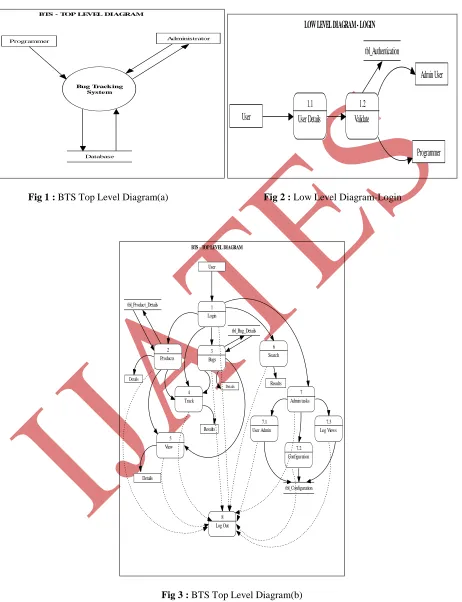
IV DATA FLOW DIAGRAMS
BTS - TOP LEVEL DIAGRAM
Bug Tracking System
Programmer Administrator
Database
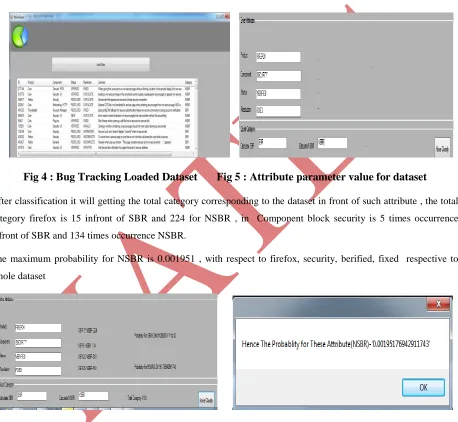
LOW LEVEL DIAGRAM - LOGIN
User 1.1 User Details 1.2 Validate Admin User Programmer tbl_Authentication
Fig 1 : BTS Top Level Diagram(a) Fig 2 : Low Level Diagram-Login
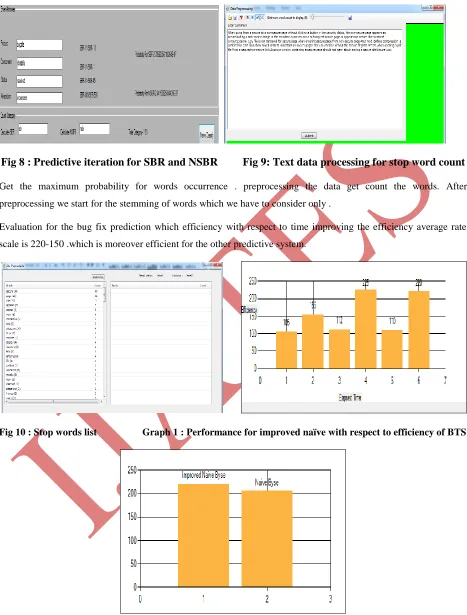
BTS - TOP LEVEL DIAGRAM
User 2 Products 1 Login 3 Bugs 6 Search 4 Track 7 Admin tasks 5 View 7.1 User Admin 7.2 Configuration 7.3 Log Views 8 Log Out Details Details Details Results tbl_Product_Details tbl_Configuration tbl_Bug_Details Results
199 |
P a g e
V RESEARCH METHODOLOGY
First find the likelihood of the two classes
For "yes" = 2/9 * 3/9 * 3/9 * 3/9 * 9/14 = 0.0053
For "no" = 3/5 * 1/5 * 4/5 * 3/5 * 5/14 = 0.0206
Conversion into a probability by normalization:
o P("yes") = 0.0053 / (0.0053 + 0.0206) = 0.205
o P("no") = 0.0206 / (0.0053 + 0.0206) = 0.795
5.1 Bayes' Rule
More generally, the above is just an application of Bayes' Theorem.
Probability of event H given evidence E:
Pr(E | H )*Pr(H)
Pr(H | E)=
Pr(E)
A priori probability of H= Pr(H)
o Probability of event before evidence has been seen
A posteriori probability of H= Pr[H|E]
o Probability of event after evidence has been seen
Classification learning: what's the probability of the class given an instance?
o Evidence E = instance
o Event H = class value for instance
Naive Bayes assumption: evidence can be split into independent parts (i.e. attributes of instance! Pr(E1 | H )*Pr(E2 | H )*... ………... Pr(En| H )*Pr(H )
Pr(H | E)=
Pr(E)
We used this above. Here's our evidence:
Outlook Temp. Humidity Windy Play
Sunny Cool High True ?
200 |
P a g e
Pr( yes | E)=Pr(Outlook=Sunny| yes)*
Pr(Temperature=Cool | yes)*
Pr(Humidity=High | yes)*Pr( yes) Pr(Windy=True | yes)*Pr(yes)/Pr(E) =(2/9*3/9*
3/9*3/9) *9/14) /Pr(E)
Return the classification with highest probability
Probability of the evidence Pr(E)
o Constant across all possible classifications;
o So, when comparing N classifications, it cancels out
5.2 Missing Values
Missing values are a problem for any learner. Naive Bayes' treatment of missing values is particularly elegant.
During training: instance is not included in frequency count for attribute value-class combination
During classification: attribute will be omitted from calculation
Eg.:OutlookTemp.Humidity Windy Play
? Cool High True ?%%
Likelihood of "yes" = 3/9 * 3/9 * 3/9 * 9/14 = 0.0238
Likelihood of "no" = 1/5 * 4/5 * 3/5 * 5/14 = 0.0343
P("yes") = 0.0238 / (0.0238 + 0.0343) = 41%
P("no") = 0.0343 / (0.0238 + 0.0343) = 59%
To fulfill our purposes, we propose our own procedures that may be useful for various domain areas.
Procedure 1:
PPR
.
Mining Specific Client’s Bug Usage
Input:
Database D of transactions, Specific Product attributesOutput:
Sites (info) used by individual userMethod
1. Accept input_Atr (Specific Attribute type) 2. for (int i=0; i<= D.size; i++)
3. if (input_Atr = = D_Atr)
201 |
P a g e
6.end
For the Web Site Maintainers, they should know the users’ interest rate on their sites. Depending on the users’ interest rate decreasing or increasing through the time, they can modify their site structure to attract more users from the aspect of economic benefits. We proposed the procedure AM especially for maintainers and developers as a result of Web usage over a specific period of time.
Procedure 2:
Find the users’ Component attribute to evaluate all state in datasetInput:
Database D of transactions, Specific componentOutput:
total transaction of Component attributeMethod
3. count= 0; temp[ ] =null; // initialization
4. while (component_state= =NSBR || component_state==SBR) 5. if( temp[ ] = =null)
6. temp[ ] = D_Atr 7. count ++ 8. else
9. while (temp [ ]) 10. if (temp [ ]== D_Atr ) 11. do nothing
12. else temp[ ] = = D_Atr 13. count ++
14. return count // total number of component attribute for class dependency
VI SIMULATION RESULTS
If the model classifies an SBR as an NSBR, or if the model classifies an NSBR as an SBR, then the result is a misclassification. A true positive (TP) is a verified SBR that is correctly classified by the model. A false positive (FP) is a verified NSBR that is incorrectly classified to be an SBR. A false negative (FN) is a verified SBR that is incorrectly classified to be an NSBR. A true negative (TN) is a verified NSBR that is correctly classified to be an NSBR. Model precision is the percentage of correctly classified SBRs among SBRs and NSBRs that have been classified by the model to be SBRs (i.e., exceeding a minimum probability).
202 |
P a g e
approximately 175 person-hours to analyze Apilot and determine whether the manually-labeled NSBRs are actually SBRs. If two security engineers disagreed on their evaluations of a manually-labeled BR, then they discussed their differences and reached an agreeable consensus.
Now we get the finite stage for the dataset , which depend on the product parameter, component parameter, status parameter, and resolution parameter. Corresponding to the SBR and NSBR class, we getting the fix stage to whole dataset.
Fig 4 : Bug Tracking Loaded Dataset Fig 5 : Attribute parameter value for dataset
After classification it will getting the total category corresponding to the dataset in front of such attribute , the total category firefox is 15 infront of SBR and 224 for NSBR , in Component block security is 5 times occurrence infront of SBR and 134 times occurrence NSBR.
The maximum probability for NSBR is 0.001951 , with respect to firefox, security, berified, fixed respective to whole dataset
Fig 6 : Find Fix State Value For The Dataset Fig 7 : Fix Probability For NSBR Value
After changing the attribute we gain the different probability ,now we have to consider the maximum probability to whole dataset.
203 |
P a g e
Fig 8 : Predictive iteration for SBR and NSBR Fig 9: Text data processing for stop word count
Get the maximum probability for words occurrence . preprocessing the data get count the words. After preprocessing we start for the stemming of words which we have to consider only .
Evaluation for the bug fix prediction which efficiency with respect to time improving the efficiency average rate scale is 220-150 .which is moreover efficient for the other predictive system.
Fig 10 : Stop words list Graph 1 : Performance for improved naïve with respect to efficiency of BTS
204 |
P a g e
VII CONCLUSION AND FUTURE SCOPE
Current bug tracking systems do not effectively elicit all of the information needed by developers. Without this information developers cannot resolve bugs in a timely fashion and so we believe that improvement to the way bug tracking systems collect information are needed.
While implementing a range of improvements may be ideal, bug tracking systems may instead prefer to specialize, thus providing a rich set of choices. This would be a healthy change to the current situation where they all provide identical functionality. Identify information needs in a large sample of bug reports through manual inspection. This will help to compile a catalog of questions that can be used for the expert system. Using this catalog, collect answers and defect locations for another large sample of bug reports. This dataset will be used to automatically learn a prediction model.Evaluate the predictions and conduct usability studies.
REFERENCES
[1] X. Wang, L. Zhang, T. Xie, J. Anvik, and J. Sun, "An Approach to Detecting Duplicate Bug Reports Using Natural Language and Execution Information" Proc of the ICSE, pp. 461-470, 2008.
[2] I. Witten and E. Frank, Data Mining, Second ed. San Francisco, Elsevier, 2005.
[3] Guzella, T. S., Mota-Santos, T. A., Uchoa, J. Q., & Caminhas, W. M. (2008). Identification of spam messages using an approach inspired on the immune system. Biosystems, 92(3), 215–225.
[4]Gyongyi, Z., & Garcia-Molina, H. (2005). Web spam taxonomy. In Proceedings of the first international workshop on adversarial information retrieval on the web (AIRWeb).
[5] Haider, P., Brefeld, U., & Scheffer, T. (2007). Supervised clustering of streaming data for email batch detection. In Proc of the int conf on mach learn.
[6] Hastie, T., Tibshirani, R., & Friedman, J. (2001). The elements of statistical learning. Springer. Hayes, B. (2007). How many ways can you spell V1@gra? Scientific American, 95(4),298–302.
[7]Haykin, S. (1998). Neural networks: A comprehensive foundation (2nd ed.). Prentice Hall.
[8] He, J., & Thiesson, B. (2007). Asymmetric gradient boosting with application to spam filtering. In Proc of the fourth conf on email and anti-spam.
[9] Hoanca, B. (2006). How good are our weapons in the spam wars? IEEE Technology and Society Magazine, 25(1), 22–30.
205 |
P a g e
[11] Jones, R. (2003). Spam. <http://www.annexia.org/spam> (visited on July 2008). Jorgensen, Z., Zhou, Y., & Inge, M. (2008). A multiple instance learning strategy for combating good word attacks on spam filters. Journal of Machine Learning Research, 8, 993–1019.
[12] T. Kalt. A new probabilistic method of text classification and retrieval. Technical Report IR-78, Center for Intelligent Information Retrieval, University of Massachussetts, Amherst, MA, 1996.
[13] A. McCallum. Multi-label text classification with a mixture model trained by EM. In AAAI Workshop on Text Learning, 1999.
[14] A. K. McCallum. Bow: A toolkit for statistical language modeling, text retrieval, classification and clustering,1996.