Breastfeeding, Long-Chain Polyunsaturated Fatty
Acids in Colostrum, and Infant Mental Development
WHAT’S KNOWN ON THIS SUBJECT: Several studies have reported positive associations between breastfeeding and children’s cognition. Parental factors are thought to explain a large part of this association. However, the potential role of long-chain polyunsaturated fatty acid (LC-PUFA) content in breast milk remains uncertain.
WHAT THIS STUDY ADDS: This study is the first to assess the association between LC-PUFA levels in colostrum and children’s mental development in a large population-based study. LC-PUFA levels seem to play a beneficial role, particularly in children who are breastfed for longer durations.
abstract
BACKGROUND:Breastfeeding has been associated with improved neu-rodevelopment in children. However, it remains unknown to what extent nutritional advantages of breast milk may explain this relationship.
OBJECTIVE:We assessed the role of parental psychosocial factors and colostrum long-chain polyunsaturated fatty acid (LC-PUFA) levels in the relationship between breastfeeding and children’s neurodevelopment.
METHODS:A population-based birth cohort was established in the city of Sabadell (Catalonia, Spain) as part of the INMA-INfancia y Medio Ambiente Project. A total of 657 women were recruited during the first trimester of pregnancy. Information about parental characteristics and breastfeeding was obtained by using a questionnaire, and trained psychologists as-sessed mental and psychomotor development by using the Bayley Scales of Infant Development in 504 children at 14 months of age.
RESULTS:A high percentage of breastfeeds among all milk feeds accumu-lated during the first 14 months was positively reaccumu-lated with child mental development (0.37 points per month of full breastfeeding [95% confidence interval: 0.06 – 0.67]). Maternal education, social class, and intelligence quotient only partly explained this association. Children with a longer du-ration of breastfeeding also exposed to higher ratios betweenn-3 andn-6 PUFAs in colostrum had significantly higher mental scores than children with low breastfeeding duration exposed to low levels.
CONCLUSIONS:Greater levels of accumulated breastfeeding during the first year of life were related to higher mental development at 14 months, largely independently from a wide range of parental psycho-social factors. LC-PUFA levels seem to play a beneficial role in children’s
mental development when breastfeeding levels are high.Pediatrics
2011;128:e880–e889
AUTHORS:Mònica Guxens, MD, MPH, PhD,a,b,cMichelle A.
Mendez, PhD,a,b,cCarolina Moltó-Puigmartí, DPharm,
PhD,c,dJordi Julvez, PhD,a,b,cRaquel García-Esteban,
MSc,a,b,cJoan Forns, BSc, MPH,a,b,cMuriel Ferrer, BSc,a,b,c
Martine Vrijheid, PhD,a,b,cM. Carmen López-Sabater,
DPharm, PhD,c,dand Jordi Sunyer, MD, PhDa,b,c,e
aCenter for Research in Environmental Epidemiology, Barcelona,
Spain;bHospital del Mar Research Institute, Barcelona, Spain; cCIBER Epidemiologia y Salud Pública, Barcelona, Spain; dDepartment of Nutrition and Food Science, Faculty of
Pharmacy, University of Barcelona, Barcelona, Spain; and
ePompeu Fabra University, Barcelona, Spain
KEY WORDS
child development, cognition, breastfeeding, fatty acids, unsaturated, intelligence
ABBREVIATIONS
LC-PUFA—long-chain polyunsaturated fatty acid IQ—intelligence quotient
ALA—␣-linolenic acid EPA—ecosapentaenoic acid DPA—docosapentaenoic acid DHA—docosahexaenoic acid LA—linoleic acid
GLA—␥-linolenic acid DGLA—dihomo-␥-linolenic acid AA—arachidonic acid ADA—adrenic acid OA—osbond acid CI—confidence interval
www.pediatrics.org/cgi/doi/10.1542/peds.2010-1633
doi:10.1542/peds.2010-1633
Accepted for publication Jun 29, 2011
Address correspondence to Mònica Guxens, MD, MPH, PhD, Centre for Research in Environmental Epidemiology, Carrer Dr Aiguader 88, 08003, Barcelona, Spain. E-mail: [email protected]
PEDIATRICS (ISSN Numbers: Print, 0031-4005; Online, 1098-4275).
Copyright © 2011 by the American Academy of Pediatrics
FINANCIAL DISCLOSURE:The authors have indicated they have no financial relationships relevant to this article to disclose.
Although several observational studies have reported positive associations be-tween breastfeeding and children’s cog-nitive development,1–13randomized tri-als with infant formulas supplemented with long-chain polyunsaturated fatty acids (LC-PUFAs) have generally not found any clear effects.14,15Factors re-lated to parental characteristics such as intelligence quotient (IQ), educa-tion, or social class,1,2,6,8,16as well as factors associated with the feeding environment, including physical and psychological contact between par-ents and children,10,17–20 have been postulated to explain associations be-tween child cognition and breastfeed-ing. Despite the inconclusive results of trials, the nutritional advantages of breast milk, in particular its greater content of LC-PUFAs than infant formu-lae, could also partly explain these as-sociations.21 Conversely, breastfeed-ing is a potential source of exposure to synthetic persistent lipophilic compounds,
such as organochlorine compounds,
which could potentially undermine the beneficial effects of this natural practice.22
Given the public health impact of breast-feeding, identifying biological and social factors that explain its effects on child health, including cognition, will enable the development of appropriate and ef-fective recommendations as well as in-terventions to improve breastfeeding practices. We aim to assess the role of 3 sets of potential explanatory factors in the link between duration of breastfeed-ing and children’s neurodevelopment at 14 months: parental factors such as IQ, education, and social class; psychologi-cal influences on the feeding environ-ment, as reflected in parent-child attach-ment and parental attach-mental health; and colostrum LC-PUFA levels.
METHODS
Design and Study Participants
A population-based birth cohort was established in the city of Sabadell
(Catalonia, Spain) as part of the INMA (Infancia y Medio Ambiente
[Environ-ment and Childhood]) Project.23
Be-tween July 2004 and July 2006, preg-nant women who visited the public health center of Sabadell for an ultra-sound in the first trimester were re-cruited, providing they fulfilled the in-clusion criteria (age older than 16 years, intention to deliver at the refer-ence hospital, no problems of commu-nication, singleton pregnancy, and no assisted conception); 99.5% of Span-iards have public health insurance, and an estimated 70% to 90% of women use public health services dur-ing pregnancy.24The participation rate was 60%. They were followed up dur-ing pregnancy, and their children en-rolled at birth and followed up through 14 months. Colostrum samples were collected at delivery in a random sub-sample. Informed consent was ob-tained from all participants, and the study was approved by the Clinical Re-search Ethical Committee of the Munic-ipal Institute of Health Care (Barce-lona, Spain).
Child Neurodevelopment Test
Mental and psychomotor development
of the children was assessed at⬃14
months of age (range: 12–17 months) using the Bayley Scales of Infant Devel-opment.25The mental scale consists of 163 items that assess age-appropriate mental development, including perfor-mance abilities, memory, and early
language skills. The psychomotor
scale consists of 81 items assessing fine and gross motor development. All testing was done in the health care center in the presence of the mother, by 2 specially trained psychologists. Psychologists were not aware of any exposure information. Bayley tests were performed on 568 children. Nine tests were excluded because of spe-cific pathologies. Psychologists also flagged children difficult to evaluate because of less than optimal
coopera-tion (n⫽24) who were classified as
having neurodevelopment tests of un-certain quality. Raw scores were stan-dardized to a mean of 100 and an SD of 15. We applied a strict protocol, includ-ing interobserver traininclud-ings and 3 sets of quality controls. The interrater reli-ability was estimated by intraclass correlation with 0.90 for mental scale and 0.96 for psychomotor scale. To
de-termine the internal consistency,
Cronbach’s ␣ coefficient was
calcu-lated as 0.78 for mental scale and 0.73 for psychomotor scale.
Breastfeeding Definition
Detailed information about child feed-ing was completed by
interviewer-administered questionnaires with
mothers at 6 and 14 months (
Supple-mental Fig 3).
Cumulative Intensity of Breastfeeding
Breastfeeding intensity was defined as the percentage of breast milk feeds among all formula or milk-based feeds.26,27Monthly breastfeeding inten-sity was calculated for each of the first 14 months of life. Cumulative intensity of breastfeeding was the sum of the monthly intensities of breastfeeding over this 14-month period. A 1-unit in-crease in this variable represents the equivalent of 1 month of full breast-feeding, whether accumulated in a sin-gle month or over several months of partial breastfeeding.
Exclusive Breastfeeding Duration
Exclusive breastfeeding was defined as receiving breast milk only but allow-ing supplementation of nonmilk liq-uids (eg, water or water-based drinks such as sweetened and flavored water, teas, infusions), fruit juice, oral rehy-dration salts solution, drops, and syrup forms of vitamins, minerals, and
medicines.28 Duration of exclusive
breastfeeding was categorized into 4 groups: children who were breastfed
group), short-term (ⱕ4 months, ac-cording to the Spanish law that pro-vides for maternity leave of up to 16 weeks), long-term (4 – 6 months, ac-cording to the World Health Organiza-tion recommendaOrganiza-tions), and very long-term (⬎6 months).
Women who chose not to breastfeed
were excluded (n ⫽ 41 [7.5%])
be-cause the focus of this study was on the duration of breastfeeding.
LC-PUFA in Colostrum
Colostrum was collected the first 48 to 96 hours’ postpartum at the hospital by an experienced nurse. The sample was collected in the morning and at the end of the feeding, in sterile poly-propylene tubes, by mechanical ex-pression of 1 breast using a breast pump. Milk was transported to the
lab-oratory in ice boxes ⬍2 hours after
collection, where samples were stored
at ⫺80°C until analysis. Fatty acid
methyl esters were prepared with so-dium methylate and methanolic boron trifluoride and extracted into hexane following the method developed and validated by Moltó-Puigmartí et al.29 Fatty acids were then separated and quantified by using fast-gas chroma-tography with flame ionization detec-tion. During the method validation, between-day precision values for the different PUFA (relative SD of the per-centages obtained analyzing the same sample in consecutive days) ranged between 0.37% and 6.51% for PUFA, showing a low assay variation.
Thirty-eight fatty acids were identified and quantified, including the fatty ac-ids of interest for the present study:
␣-linolenic acid (ALA; C18:3n-3), eicosa-pentaenoic acid (EPA, C20:5n-3), doco-sapentaenoic acid (DPA, C22:5n-2), do-cosahexaenoic acid (DHA, C22:6n-3), linoleic acid (LA, C18:2n-6),␥-linolenic
acid (GLA, C18:3n-6), dihomo-␥
-linolenic acid (DGLA, C20:3n-6), arachi-donic acid (AA, C20:4n-6), adrenic acid
(ADA, C22:4n-6), and osbond acid (OA, C22:5n-6).
Other Parental and Child Variables
Information on parental education (in years), social class (using the UK Reg-istrar General’s 1990 classification ac-cording to parental occupation by ISCO88 code), country of birth, age,
ma-ternal height and prepregnancy
weight, parity, diet, and marital status were obtained through questionnaires during the first trimester of preg-nancy. Maternal social class was coded from the longest-held job during the pregnancy or, if the mother did not work during pregnancy, the last job be-fore the pregnancy. When social class could not be derived, the last job of the father was used (n⫽49). Information regarding maternal tobacco and alco-hol use, secondhand smoke at home or in the workplace, and use of a gas stove at home during pregnancy were collected through questionnaires dur-ing the third trimester of pregnancy. Information related to the child’s ges-tational age, gender, anthropometric measures, and Apgar score at birth was obtained from clinical records. In a subsequent interview at 14 months, data on main caregiver, nursery atten-dance, child secondhand smoke expo-sure, and infections during the first year was collected. All questionnaires were administered face-to-face by trained interviewers. When children were 14 months of age, parental IQ were assessed by using scales 2 and 3 of Factor “G” of the Cattell and Cattell test, which seeks to measure nonver-bal IQ.30Parental mental health assess-ments used the 12-item General Health Questionnaire, recommended as an
easily administered and accurate
screening tool for common mental dis-orders.31Parental-child attachment was assessed through the self-administered Condon questionnaire, which scores parent’s emotional response to his or her infant.32,33Levels of
organochlo-rine compounds (hexachlorobenzene,
-hexachlorocyclohexane, dichlorodi-phenyl dichloroethylene, and polychlori-nated biphenyls) were analyzed in ma-ternal serum extracted in the first trimester of pregnancy, using methods described elsewhere.34,35Total mercury levels were analyzed in cord blood, using thermal decomposition, amalgation, and atomic absorption spectrometry.
Statistical Analysis
Only subjects with complete neurode-velopment and breastfeeding data were included. Among these subjects, multiple imputation of missing values for the remaining variables was per-formed using chained equations in which 100 completed data sets were generated and analyzed by using the standard combination rules for multi-ple imputation (Supplemental Table 8, Supplemental Table 9, Supplemental Table 10, and Supplemental Table 11).36,37
Generalized additive models were
compounds measured in mother and cord blood was performed to explore if the breastfeeding coefficient was mod-ified. Finally, a multivariable-adjusted model was performed including all pa-rental psychosocial variables plus
ad-ditional confounders identified as
specified in the following description.
Second, to assess the relation between PUFAs (high versus low levels dichoto-mized at the median) and mental de-velopment, multivariable linear
re-gression models were performed
using PUFA levels in colostrum as the exposure variable. Also, to assess the hypothesis that increases in infant mental scores were associated with higher PUFA concentrations in breast milk as well as with total breast milk intake, a variable combining PUFA lev-els (high versus low) with tertiles of cumulative intensity of breastfeeding were created. The reference group was subjects within the lowest tertile of cumulative breastfeeding who also had low PUFA levels. Interaction terms between cumulative breastfeeding du-ration and colostrum PUFA concentra-tions were also tested.
To assess the effect of potential ex-planatory factors on coefficients for
associations with each exposure
variable— cumulative intensity of
breastfeeding, exclusive breastfeed-ing duration, and PUFA levels in colostrum—a series of models were run for each exposure to assess the effect of additionally adjusting 1 by 1 for the characteristics of interest, af-ter adjusting for several core founders included a priori. Core con-founders included key predictors of test scores (children’s exact age at
testing, psychologist administering
the test, and quality of neuropsycho-logical testing), as well as parental ed-ucation, social class, attachment to the child, IQ, and mental health. These core variables were included in all models be-cause a primary objective was to assess
whether associations with breastfeed-ing variables remained significant inde-pendent of these key characteristics. Ad-ditional variables included in the final
multivariable-adjusted models were
those related to mental scores (P⬍.20) that also modified the coefficients of 1 of the exposure variables by⬎15%. These additional confounders were maternal age, maternal alcohol use during preg-nancy, and use of gas cooking at home during pregnancy.
In supplementary analyses, we con-firmed that excluding infants not born
at term (⬍37 and⬎42 weeks) (n⫽
18) did not meaningfully change re-sults (data not shown). Statistical
sig-nificance was set at ␣ ⬍ 0.05
(2-tailed). Statistical analyses were
conducted by using Stata 10.1 (Stata Corp, College Station, TX).
RESULTS
A total of 657 pregnant women were recruited at the first trimester of preg-nancy and then followed up during pregnancy (Fig 1). A total of 622 (94.7%) children were enrolled at birth, and 582 (88.6%) were followed up through 14 months. A total of 504 subjects with complete neurodevelop-ment and breastfeeding data were in-cluded. Between the 504 children
included and the original 622,
no differences in characteristics— including age, maternal alcohol and fish consumption during pregnancy, paternal education, parental country of birth, gestational age, or child’s
gender—were found (P⬎ .05).
How-ever, children not included had lower parental social class, lower maternal education, higher maternal smoking use, and lower mean birth weight. Chil-dren missing colostrum PUFA levels had a higher maternal social class, higher paternal education, low birth weight, and fewer siblings (P⬍.05). No differences in mental and psy-chomotor development,
breastfeed-ing, parental IQ, mental health, attach-ment to their child, and the rest of variables were found.
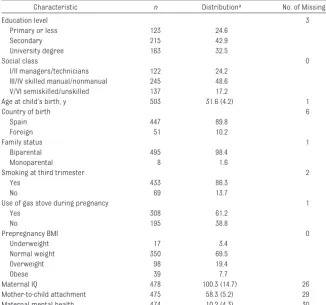
Child, maternal, and paternal charac-teristics of the study population are
shown in Tables 1, 2, and 3,
Supple-mental Table 12, andSupplemental Ta-ble 13. Mean mental development scores increased among tertiles of cu-mulative and groups of exclusive breastfeeding, whereas no association was found with psychomotor develop-ment scores (Table 4). Cumulative in-tensity of breastfeeding was linearly and positively associated with mental development scores (increase of 0.37 points [95% confidence interval (CI): 0.06 – 0.67]) on mental developmental score per each accumulated month of breastfeeding, whether accrued in a single month, or over several months of partial breastfeeding) (gain of lin-earity,P⫽.45) (Supplemental Figure 4). Duration of exclusive breastfeeding was also linearly and positively associ-ated with infant mental development (increase of 0.37 points [95% CI: 0.14 – 0.88]) on mental development score per month of exclusive breastfeeding) (gain of linearity,P⫽.47) ( Supplemen-tal Figure 4).
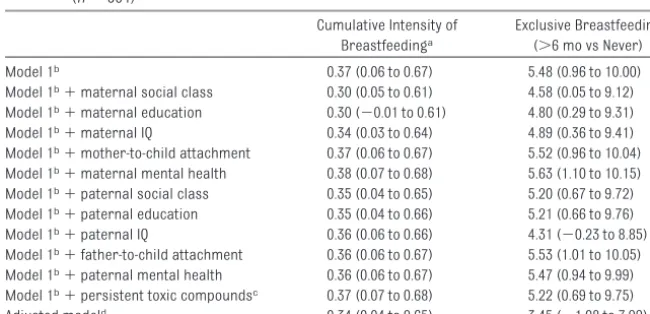
Adjusting individually for maternal ed-ucation, social class, and IQ only slightly attenuated the association be-tween cumulative intensity of
breast-feeding and mental development
(Table 5). Paternal social class and ed-ucational level had a weaker attenuat-ing effect, whereas paternal IQ, both parent’s attachment to the child, and parental mental health had no mean-ingful effect on this relationship. More-over, after adjusting for maternal lev-els of organochlorine compounds at the first trimester of pregnancy and mercury levels in cord blood, results remained almost identical. Children
exclusively breastfed for ⬎6 months
development score (Table 5), whereas no significant association was shown
at smaller durations of exclusive breastfeeding (increase of 2.23 points [95% CI:⫺1.26 to 5.72] for exclusively
breastfeeding ⬍4 months and 1.76
points [95% CI:⫺1.62 to 5.14] for exclu-sively breastfeeding between 4 and 6 months). Similar results for exclusive breastfeeding were obtained after
ad-justing for each of the parental charac-teristics examined, with the exception of paternal IQ, which had a somewhat stronger attenuating effect than those revealed on cumulative intensity of
breastfeeding variable.
Except for DHA/OA ratio, all n-3/n-6
PUFA ratios were ⬍1, signaling a
higher content ofn-6 PUFAs in colos-trum (Table 6). In general, higher lev-els ofn-3 PUFAs and higher ratios be-tween n-3/n-6 PUFAs were positively
associated with infant mental scores,
whereas most associations with n-6
PUFAs were negative, although none of these associations reached statistical
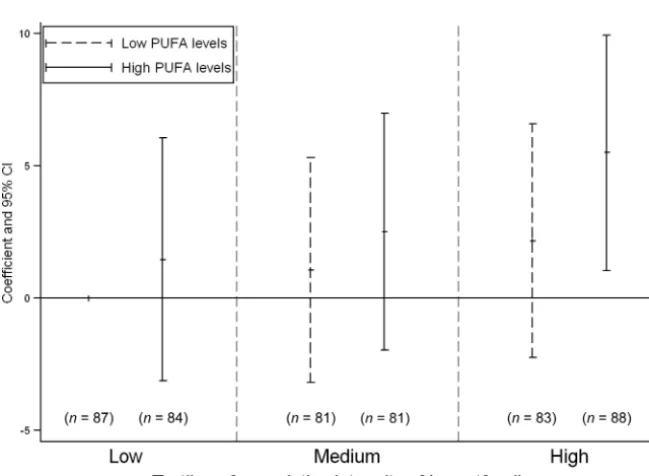
significance). When PUFA levels were combined with tertiles of cumulative intensity of breastfeeding (Fig 2 and Table 7), we observed a stronger posi-tive gradient between tertiles of
cumu-lative breastfeeding and infant mental development scores in the group with high versus lown-3 PUFA levels. More-over, subjects with high levels of total
n-3 PUFAs and n-3/n-6 PUFA ratios in
colostrum who also had a longer dura-tion of breastfeeding had significantly higher mental scores than did sub-jects with low levels of these PUFAs
and short breastfeeding duration (Fig 2 and Table 7). Among children with longer breastfeeding duration, associ-ations with mental scores were stron-ger when breast milk had a higher
con-tent of n-3 PUFAs. However, perhaps
due in part to the modest sample size, interactions between breastfeeding duration and the PUFA concentrations
Pregnant women at first trimester of pregnancy
N = 657
Pregnant women at third trimester of pregnancy
n = 628 (95.6%)
29 subjects excluded - 16 miscarriages - 13 withdrew
Newborns at delivery
n = 622 (94.7%)
6 subjects excluded - 3 miscarriages - 3 withdrew
Child at 14 mo
n = 582 (88.6%)
30 subjects excluded - 21 withdrew - 9 lost
10 subjects excluded - 3 died
- 5 withdrew - 2 lost
Child at 6 mo
n = 612 (93.2%)
Subjects with available data for analysis - Neurodevelopment and breastfeeding: n = 504 - LC-PUFAs: n = 319
Subjects with LC-PUFAs data in colostrum: n = 352
FIGURE 1
Main phases of the study.
TABLE 1 Child Characteristics of the Study Population (N⫽504)
Characteristic n Distributiona No. of Missings
Gender 0
Male 257 51.0
Female 247 49.0
Gestational age, wk 504 39.7 (1.4) 0
Birth weight 503 3257.6 (416.6) 1
No. of siblings at child’s birth 2
0 300 59.8
ⱖ1 202 40.2
Main caregiver at 14 mo 17
Mother 229 47.0
Both parents with/without grandparents 148 30.4
Other combinations 110 22.6
Nursery attendance at 14 mo 12
Yes 340 69.1
No 152 30.9
did not reach statistical significance (P⬎.05 for all interaction terms).
DISCUSSION
The present study is, to our knowledge, the first to assess the association be-tween LC-PUFA levels in colostrum and children’s mental development in a
large population-based study. Higher
cumulative breastfeeding during the
first 14 months of life was related with an increase in mental development scores at 14 months. Moreover, higher
levels of various n-3 PUFAs in colos-trum and high ratios betweenn-3 and
n-6 PUFAs had a beneficial effect on
mental development especially when children received high levels of breast-feeding. In this analysis, maternal edu-cation, social class, and IQ did not fully
explain the association between
breastfeeding and mental develop-ment. Adjusting for paternal educa-tion, social class, and IQ had little ef-fect. Parental attachment to the child and mental health had no confounding effect. Xenobiotic levels in maternal se-rum did not change these findings. No relation was found between breast-feeding and psychomotor score at 14 months.
Several systematic reviews have sum-marized the literature on the effect of breastfeeding on cognitive develop-ment using different approaches.1–12 The great majority of published arti-cles have important methodologic is-sues and, as some reviewers note, it is not yet possible to fully understand this relationship. The main limitations of previous studies are poor design and data quality (as a consequence of retrospective data collection), small sample sizes, and insufficient adjust-ment for critical potential confounders such as maternal IQ and parenting skills. Perhaps most importantly, the majority of studies also suffer from poor treatment of the breastfeeding variable, as most have examined ef-fects of any versus no breastfeeding, without taking into account both dura-tion and intensity, which are essential for estimating children’s cumulative exposure to breastfeeding. Our results are from a population-based birth co-hort study with prospective data col-lection. We incorporated multivariable adjustment for a large array of key fac-tors including parental IQ, education, and social class, parental attachment to their child, parental mental health, and infections during the first year of life, organochlorine and mercury lev-els during pregnancy, and PUFA levlev-els TABLE 2 Maternal Characteristics of the Study Population (N⫽504)
Characteristic n Distributiona No. of Missings
Education level 3
Primary or less 123 24.6
Secondary 215 42.9
University degree 163 32.5
Social class 0
I/II managers/technicians 122 24.2
III/IV skilled manual/nonmanual 245 48.6
V/VI semiskilled/unskilled 137 17.2
Age at child’s birth, y 503 31.6 (4.2) 1
Country of birth 6
Spain 447 89.8
Foreign 51 10.2
Family status 1
Biparental 495 98.4
Monoparental 8 1.6
Smoking at third trimester 2
Yes 433 86.3
No 69 13.7
Use of gas stove during pregnancy 1
Yes 308 61.2
No 195 38.8
Prepregnancy BMI 0
Underweight 17 3.4
Normal weight 350 69.5
Overweight 98 19.4
Obese 39 7.7
Maternal IQ 478 100.3 (14.7) 26
Mother-to-child attachment 475 58.3 (5.2) 29
Maternal mental health 474 10.2 (4.3) 30
aValues are percentages for categorical variables and mean (SD) for continuous variables.
TABLE 3 Paternal Characteristics of the Study Population (N⫽504)
Characteristic n Distributiona No. of Missings
Education level 5
Primary or less 171 34.3
Secondary 214 42.9
University degree 114 22.8
Social class 0
I/II managers/technicians 129 25.6
III skilled manual/nonmanual 214 42.5
IV/V semiskilled/unskilled 161 31.9
Age at child’s birth, y 502 33.4 (4.8) 2
Country of birth 3
Spain 441 88.0
Foreign 60 12.0
Paternal IQ 102 99.5 (15.0) 402
Father-to-child attachment 456 49.5 (4.0) 48
Paternal mental health 453 9.3 (3.7) 51
in colostrum. We also obtained accu-rate information on child feeding dur-ing the first year of life and examined breastfeeding patterns, taking into ac-count both duration and intensity.
Although colostrum PUFAs were used as a proxy of breast milk fatty acid pro-files during lactation, fatty acid per-centages in breast milk have been re-ported to vary during the course of lactation.38,39Despite typical decreases in LC-PUFA percentages over the first month of lactation, the increase in milk total fat content38,39 permits LC-PUFA concentration to remain fairly constant.38
Another weak point is that we did not have PUFA concentrations in colos-trum for all mother-child pairs. Never-theless, multiple imputation of missing values allows taking into account the entire sample in the analyses and pro-vides similar results that complete the case analyses (Supplemental Table 9, Supplemental Table 10, and Supple-mental Table 11). A second limitation was that we did not have information among partial breastfeeders on the amount or types of PUFAs provided by infant formulae, which may have highly variable composition. However, be-cause there is still not enough
evi-dence that LC-PUFA fortification of infant formula is beneficial for neuro-development,12,14,15,40 adjusting for LC-PUFA content in formula is unlikely to meaningfully change our results. In ad-dition, an important limitation of the exclusive breastfeeding definition was that all partial breastfeeders were classified together as nonexclusive, re-gardless of whether their level of breastfeeding intensity was relatively high.
Breast milk has a high content of LC-PUFAs, critical nutrients for brain de-velopment. Human and animal studies indicate that dietary insufficiency of LC-PUFAs is associated with impaired
learning and neurodevelopment.12
Some studies have reported an associ-ation between higher levels of
mater-nal fish consumption orn-3 LC-PUFAs
supplementation during pregnancy and cognitive development.41–43 How-ever, results of studies on maternal supplementation during lactation have been inconsistent.44Meta-analyses of randomized clinical trials of formula supplemented with LC-PUFAs reported that there is not enough evidence to conclude definitively that LC-PUFAs
supplementation is beneficial for
neurodevelopment.12,14,15,40
In our study, higher levels of various
n-3 PUFAs and high ratios betweenn-3 andn-6 PUFAs were positively associ-ated with infant mental development, especially among children with high levels of cumulative breastfeeding. We found positive associations with sev-eral LC-PUFAs hypothesized a priori to play a beneficial role in mental devel-opment, including the n-3 fatty acid DHA, the ALA/LA ratio, and the DHA/AA ratio. Gustafsson et al45reported find-ing colostrum LC-PUFA levels to be sig-nificantly associated with cognitive development at 6.5 years of age, spe-cifically reporting beneficial effects of DHA and the DHA/AA ratio, and a nega-tive relationship with AA, albeit in a TABLE 4 Mental and Psychomotor Development Scores According to Breastfeeding Status
Variable n(%) Mental Scorea Psychomotor Scorea
Mean 95% CI Mean 95% CI
Cumulative intensity of breastfeeding
First tertile 168 (33.3) 100.0 97.9–102.1 100.5 98.2–102.8 Second tertile 167 (33.3) 101.0 98.9–103.1 100.4 98.2–102.7 Third tertile 169 (33.3) 103.4 101.3–105.5 99.3 97.0–101.5 Exclusive breastfeeding
Never 82 (16.3) 99.4 96.5–102.4 101.2 98.1–104.3
ⱕ4 mo 162 (32.1) 101.7 99.5–103.8 100.6 98.4–102.9
4–6 mo 206 (40.9) 101.2 99.3–103.1 99.4 97.5–101.4
⬎6 mo 54 (10.7) 104.9 101.4–108.5 99.0 95.2–102.7
aAdjusted for psychologist, child’s age in days, and quality of the neuropsychological test. Cumulative intensity of
breast-feeding was also adjusted for age of food introduction.
TABLE 5 Association Between Breastfeeding and Infant Mental Development at 14 Months (n⫽504)
Cumulative Intensity of Breastfeedinga
Exclusive Breastfeeding (⬎6 mo vs Never)
Model 1b 0.37 (0.06 to 0.67) 5.48 (0.96 to 10.00)
Model 1b⫹maternal social class 0.30 (0.05 to 0.61) 4.58 (0.05 to 9.12)
Model 1b⫹maternal education 0.30 (⫺0.01 to 0.61) 4.80 (0.29 to 9.31)
Model 1b⫹maternal IQ 0.34 (0.03 to 0.64) 4.89 (0.36 to 9.41)
Model 1b⫹mother-to-child attachment 0.37 (0.06 to 0.67) 5.52 (0.96 to 10.04)
Model 1b⫹maternal mental health 0.38 (0.07 to 0.68) 5.63 (1.10 to 10.15)
Model 1b⫹paternal social class 0.35 (0.04 to 0.65) 5.20 (0.67 to 9.72)
Model 1b⫹paternal education 0.35 (0.04 to 0.66) 5.21 (0.66 to 9.76)
Model 1b⫹paternal IQ 0.36 (0.06 to 0.66) 4.31 (⫺0.23 to 8.85)
Model 1b⫹father-to-child attachment 0.36 (0.06 to 0.67) 5.53 (1.01 to 10.05)
Model 1b⫹paternal mental health 0.36 (0.06 to 0.67) 5.47 (0.94 to 9.99)
Model 1b⫹persistent toxic compoundsc 0.37 (0.07 to 0.68) 5.22 (0.69 to 9.75)
Adjusted modeld 0.34 (0.04 to 0.65) 3.45 (⫺1.08 to 7.99)
Values given ascoefficient and 95% CI.
aA 1-unit increase represents the equivalent of 1 month of full breastfeeding, whether accumulated in a single month or
over several months of partial breastfeeding.
bAdjusted for psychologist, child’s age in days, and quality of the neuropsychological test. Cumulative intensity of
breast-feeding was also adjusted for age of food introduction.
cOrganochlorine compounds in maternal serum at first trimester of pregnancy and mercury in cord blood.
dAdjusted for variables in model 1 plus maternal and paternal education, maternal and paternal social class, maternal and
very small sample (n⫽28). The study
of individual fatty acids is complex be-cause many of these compounds form part of the same metabolic chains. Moreover, infant levels of various n-3 andn-6 fatty acids depend not only on
maternal levels but also on metaboliz-ing enzyme activity as well as levels of preceding fatty acids in the same chain. Genetic polymorphisms
influ-encing maternal and child activity of enzymes involved in PUFA metabolism, such as the genesFADS1andFADS2,46 play an important role in determining
PUFA levels in breast milk47,48or in in-fants’ ability to convert precursor fatty acids into their long-chain derivatives. Caspi et al49found that the association
between breastfeeding and IQ was modified by a genetic variant inFADS,
which supports the effect of fatty acids on neurodevelopment. Future studies examining breast milk fatty acids in
re-lation to child development should take into account mother and child ge-netic variation in LC-PUFA–metabolizing enzymes.
CONCLUSIONS
Higher levels of accumulated breast-feeding during the first year of life were associated with an increase in
infant mental development scores at 14 months. LC-PUFA levels in colos-trum, specifically highn-3 versus n-6 fatty acids, seem to play a beneficial role in child neurodevelopment when
infants receive large amounts of breast milk during the first year of life;
parental psychosocial factors
ex-plained only a small part of this
asso-ciation. The follow-up of our birth co-hort will allow us to explore if this effect on cognitive development seem stronger at older ages. Overall, our
re-sults suggest that the effect of breast-feeding in child neurodevelopment seems to be driven in part by breast milk’s LC-PUFA content.
TABLE 6 Descriptive PUFA Levels and Association Between Infant Mental Development Score at 14 Months and PUFA Levels
PUFA Levels in Colostrum (Weight %) (N⫽504)
PUFA Levels in Colostrum (High vs Low) (N⫽504)a
Mean (SD)  95% CI
n-3 PUFAs
ALA (C18:3n-3) 0.35 (0.09) 1.25 ⫺1.43 to 3.93
EPA (C20:5n-3) 0.06 (0.02) 0.63 ⫺2.18 to 3.44
DPA (C22:5n-3) 0.40 (0.13) 1.35 ⫺1.39 to 4.08
DHA (C22:6n-3) 0.64 (0.27) 0.58 ⫺2.08 to 3.23
Totaln-3 PUFAs 1.45 (0.41) 1.76 ⫺0.88 to 4.40
n-6 PUFAs
LA (C18:2n-6) 12.62 (2.57) ⫺0.44 ⫺3.23 to 2.35
GLA (C18:3n-6) 0.04 (0.02) 0.18 ⫺2.56 to 2.93
DGLA (C20:3n-6) 0.85 (0.26) 0.64 ⫺1.87 to 3.15
AA (C20:4n-6) 1.08 (0.29) 0.70 ⫺1.94 to 3.34
ADA (C22:4n-6) 0.64 (0.22) ⫺1.03 ⫺3.67 to 1.61
OA (C22:5n-6) 0.16 (0.05) ⫺0.48 ⫺3.09 to 2.13
Totaln-6 PUFAs 15.38 (2.74) ⫺0.39 ⫺3.17 to 2.38
n-3/n-6 PUFA ratios
ALA/LA ratio 0.03 (0.01) 1.72 ⫺0.94 to 4.39
EPA/AA ratio 0.05 (0.02) 1.21 ⫺1.48 to 3.89
DPA/ADA ratio 0.65 (0.16) 1.60 ⫺1.05 to 4.25
DHA/OA ratio 4.20 (1.52) 1.04 ⫺1.63 to 3.71
DHA/AA ratio 0.59 (0.18) 1.26 ⫺1.47 to 3.98
Totaln-3/n-6 PUFAs ratio 0.10 (0.03) 2.00 ⫺0.78 to 4.78
Values are given ascoefficient and 95% CI.
aAll models were adjusted for psychologist, child’s age in days, quality of the neuropsychological test, maternal and
paternal education, maternal and paternal social class, maternal and paternal attachment to the child, maternal and paternal IQ, maternal and paternal mental health, maternal age, maternal alcohol use during pregnancy, use of a gas stove at home during pregnancy, and child’s age of food introduction.
FIGURE 2
Association between PUFA levels (totaln-3/n-6 PUFAs ratio), tertiles of cumulative intensity of breast-feeding, and infant mental development score.1The reference group was subjects with low tertile of
ACKNOWLEDGMENTS
This work was supported by grants from the Spanish Ministry of Health (FIS-PI041436); Instituto de Salud Carlos III (Red INMA G03/176 and CB06/02/0041); the Spanish Ministry of Education and Science and the Spanish Ministry of Sci-ence and Innovation (AGL2008-04124/ALI
and AGL2009-09730/ALI); the Generalitat de Catalunya-CIRIT (1999SGR 00241); the EU sixth framework project NEWGENERIS (FP6-2003-Food-3-A-016320); and the Fun-dación Roger Torner.
We acknowledge all the study partici-pants for their generous collaboration. We are also grateful to Silvia Folchs,
Anna Sa`nchez, Maribel López, and Nuria Pey for their assistance in contacting
the families and administering the questionnaires. A full roster of the INMA-Sabadell study investigators can be found at www.proyectoinma.org/ cohorts/sabadell/en_membres-sabadell. html.
REFERENCES
1. Anderson JW, Johnstone BM, Remley DT. Breast-feeding and cognitive development: a meta-analysis.Am J Clin Nutr. 1999;70(4):525–535
2. Der G, Batty GD, Deary IJ. Effect of breast feeding on intelligence in children: prospec-tive study, sibling pairs analysis, and meta-analysis.BMJ. 2006;333(7575):945
3. Drane DL, Logemann JA. A critical evaluation of the evidence on the association between type of infant feeding and cognitive development. Paedi-atr Perinat Epidemiol. 2000;14(4):349 –356
4. Gordon AG. Breast-feeding, breast-milk feeding, and intelligence quotient.Am J Clin Nutr. 2000;72:1063–1064
5. Ip S, Chung M, Raman G, et al. Breastfeeding and maternal and infant health outcomes in developed countries.Evid Rep Technol As-sess (Full Rep). 2007;(153):1–186
6. Jacobson SW, Jacobson JL. Breastfeeding and IQ: evaluation of the socio-environmental con-founders.Acta Paediatr. 2002;91(3):258 –260
7. Jacobson SW, Jacobson JL. Breast feeding and intelligence in children.BMJ. 2006; 333(7575):929 –930
8. Jain A, Concato J, Leventhal JM. How good is the evidence linking breastfeeding and intelligence? Pediatrics. 2002;109(6):1044 –1053
9. Kramer MS, Aboud F, Mironova E, et al; Pro-motion of Breastfeeding Intervention Trial (PROBIT) Study Group. Breastfeeding and child cognitive development: new evidence from a large randomized trial. Arch Gen Psychiatry. 2008;65(5):578 –584
10. Michaelsen KF, Lauritzen L, Mortensen EL. Effects of breast-feeding on cognitive func-tion.Adv Exp Med Biol. 2009;639:199 –215
11. Rey J. Breastfeeding and cognitive develop-ment.Acta Paediatr Suppl. 2003;92(442): 11–18
12. McCann JC, Ames BN. Is docosahexaenoic acid, ann-3 long-chain polyunsaturated fatty acid, required for development of nor-mal brain function? An overview of evidence from cognitive and behavioral tests in hu-mans and animals.Am J Clin Nutr. 2005; 82(2):281–295
13. Simmer K. An intervention promoting exclusive and prolonged breast feeding improved verbal intelligence scores in children at 6.5 years.Evid Based Med. 2008;13(6):181
14. Simmer K, Patole SK, Rao SC. Longchain polyunsaturated fatty acid supplementa-tion in infants born at term.Cochrane Data-base Syst Rev. 2008;(1):CD000376 TABLE 7 Association Between Infant Mental Development Score at 14 Months and PUFA Levels in Colostrum According to Tertile of Cumulative Intensity
of Breastfeeding
Low PUFA levels High PUFA levels
Low Tertile of Breastfeeding
Medium Tertile of Breastfeeding
High Tertile of Breastfeeding
Low Tertile of Breastfeeding
Medium Tertile of Breastfeeding
High Tertile of Breastfeeding
 95% CI  95% CI  95% CI  95% CI  95% CI
n-3 PUFAs
ALA (C18:3n-3) Ref 0.70 ⫺3.84 to 5.24 2.22 ⫺2.17 to 6.62 0.62 ⫺3.83 to 5.08 1.80 ⫺2.59 to 6.18 4.59 ⫺0.01 to 9.20 EPA (C20:5n-3) Ref 0.56 ⫺4.62 to 5.75 1.39 ⫺3.75 to 6.53 ⫺0.39 ⫺5.08 to 4.30 0.82 ⫺3.70 to 5.34 3.58 ⫺1.01 to 8.17 DPA (C22:5n-3) Ref ⫺0.07 ⫺4.45 to 4.32 2.05 ⫺2.34 to 6.44 0.04 ⫺4.46 to 4.54 2.02 ⫺2.38 to 6.43 4.01 ⫺0.35 to 8.37 DHA (C22:6n-3) Ref 0.04 ⫺4.49 to 4.56 2.19 ⫺1.97 to 6.35 ⫺0.53 ⫺4.92 to 3.85 1.26 ⫺2.88 to 5.40 3.44 ⫺0.90 to 7.78 Totaln-3 PUFAs Ref 0.47 ⫺4.03 to 4.98 2.56 ⫺1.72 to 6.84 1.22 ⫺3.23 to 5.67 2.56 ⫺1.73 to 6.85 4.85 0.48 to 9.23 n-6 PUFAs
LA (C18:2n-6) Ref 0.82 ⫺3.68 to 5.31 2.99 ⫺1.22 to 7.20 ⫺0.50 ⫺5.04 to 4.05 0.63 ⫺3.71 to 4.96 2.53 ⫺2.04 to 7.10 GLA (C18:3n-6) Ref 0.50 ⫺5.12 to 6.13 2.03 ⫺3.45 to 7.51 ⫺0.39 ⫺5.44 to 4.67 0.79 ⫺4.14 to 5.72 3.18 ⫺1.88 to 8.25 DGLA (C20:3n-6) Ref ⫺1.24 ⫺5.73 to 3.26 1.95 ⫺2.52 to 6.43 ⫺1.21 ⫺5.65 to 3.22 1.72 ⫺2.72 to 6.16 2.67 ⫺1.79 to 7.13 AA (C20:4n-6) Ref ⫺0.02 ⫺4.43 to 4.39 1.45 ⫺2.87 to 5.77 ⫺0.87 ⫺5.40 to 3.67 1.02 ⫺3.35 to 5.39 3.97 ⫺0.58 to 8.52 ADA (C22:4n-6) Ref 0.60 ⫺3.86 to 5.06 3.37 ⫺1.01 to 7.74 ⫺0.93 ⫺5.46 to 3.61 0.31 ⫺3.99 to 4.61 1.66 ⫺2.79 to 6.11 OA (C22:5n-6) Ref 1.52 ⫺3.27 to 6.30 3.81 ⫺0.66 to 8.28 0.59 ⫺3.96 to 5.13 1.10 ⫺3.23 to 5.44 2.81 ⫺1.79 to 7.40 Totaln-6 PUFAs Ref ⫺0.60 ⫺5.23 to 4.02 1.26 ⫺3.03 to 5.56 ⫺2.27 ⫺7.00 to 2.45 ⫺0.05 ⫺4.59 to 4.49 2.46 ⫺2.30 to 7.23 n-3/n-6 PUFA ratios
ALA/LA ratio Ref 2.86 ⫺1.47 to 7.19 2.99 ⫺1.38 to 7.36 2.90 ⫺1.61 to 7.41 2.07 ⫺2.38 to 6.52 6.12 1.63 to 10.62 EPA/AA ratio Ref 1.63 ⫺2.74 to 6.00 3.36 ⫺0.90 to 7.62 1.95 ⫺2.63 to 6.53 2.13 ⫺2.06 to 6.33 4.51 0.12 to 8.89 DPA/ADA ratio Ref 0.60 ⫺3.73 to 4.94 3.04 ⫺1.25 to 7.34 1.42 ⫺3.12 to 5.96 2.52 ⫺1.67 to 6.71 4.30 0.00 to 8.60 DHA/OA ratio Ref 0.49 ⫺3.83 to 4.80 2.59 ⫺1.64 to 6.83 0.43 ⫺4.12 to 4.98 1.76 ⫺2.40 to 5.91 3.84 ⫺0.47 to 8.15 DHA/AA ratio Ref 0.72 ⫺3.53 to 4.98 2.16 ⫺2.02 to 6.34 0.50 ⫺4.05 to 5.05 1.60 ⫺2.45 to 5.64 4.30 0.03 to 8.57 Totaln-3/n-6
PUFAs ratio
Ref 1.06 ⫺3.19 to 5.31 2.17 ⫺2.24 to 6.58 1.47 ⫺3.12 to 6.05 2.52 ⫺1.95 to 6.99 5.50 1.05 to 9.94
15. Smithers LG, Gibson RA, McPhee A, Makrides M. Effect of long-chain polyunsat-urated fatty acid supplementation of pre-term infants on disease risk and neuro-development: a systematic review of randomized controlled trials. Am J Clin Nutr. 2008;87(4):912–920
16. Jacobson SW, Chiodo LM, Jacobson JL. Breastfeeding effects on intelligence quo-tient in 4- and 11-year-old children. Pediat-rics. 1999;103(5). Available at: www. pediatrics.org/cgi/content/full/103/5/e71
17. Feldman R, Eidelman AI. Direct and indirect ef-fects of breast milk on the neurobehavioral and cognitive development of premature infants.Dev Psychobiol. 2003;43(2):109 –119
18. Poobalan AS, Aucott LS, Ross L, et al. Effects of treating postnatal depression on mother-infant interaction and child development: systematic review. Br J Psychiatry. 2007; 191:378 –386
19. Surkan PJ, Schnaas L, Wright RJ, et al. Ma-ternal self-esteem, exposure to lead, and child neurodevelopment. Neurotoxicology. 2008;29(2):278 –285
20. Treyvaud K, Anderson VA, Howard K, et al. Parent-ing behavior is associated with the early neu-robehavioral development of very preterm chil-dren.Pediatrics. 2009;123(2):555–561
21. Koletzko B, Lien E, Agostoni C, et al; World As-sociation of Perinatal Medicine Dietary Guide-lines Working Group. The roles of long-chain polyunsaturated fatty acids in pregnancy, lac-tation and infancy: review of current knowl-edge and consensus recommendations.J Perinat Med. 2008;36(1):5–14
22. Mead MN. Contaminants in human milk: weighing the risks against the benefits of breastfeeding. Environ Health Perspect. 2008;116(10):A427–A434
23. Guxens M, Ballester F, Espada M, et al. The INMA—INfancia y Medio Ambiente— (Environment and Childhood) Project.Int J Epidemiol. 2011; doi:10.1093/ije/dyr054
24. Regidor E, Martinez D, Calle ME, Astasio P, Ortega P, Domínguez V. Socioeconomic pat-terns in the use of public and private health services and equity in health care. BMC Health Serv Res. 2008;8:183
25. Bayley N.Escalas Bayley de Desarrollo In-fantil. Madrid, Spain: TEA Ediciones; 1977
26. Li R, Fein SB, Grummer-Strawn LM. Associa-tion of breastfeeding intensity and bottle-emptying behaviors at early infancy with in-fants’ risk for excess weight at late infancy. Pediatrics. 2008;122(suppl 2):S77–S84
27. Piper S, Parks PL. Use of an intensity ratio to
describe breastfeeding exclusivity in a na-tional sample. J Hum Lact. 2001;17(3): 227–232
28. World Health Organization. Indicators for Assessing Breastfeeding Practices. Geneva, Switzerland: World Health Organization, 1991. Available at: www.emro.who.int/cah/ pdf/bf_indicators.pdf. Accessed [January 6, 2011]
29. Moltó-Puigmartí C, Castellote AI, López-Sabater MC. Conjugated linoleic acid deter-mination in human milk by fast-gas chroma-tography. Anal Chim Acta. 2007;602(1): 122–130
30. Cattell RB, Cattell AKS.Manual de Factor “g.” Escalas 2 y 3. Madrid, Spain: TEA Ediciones; 1977
31. Goldberg DP, Gater R, Sartorius N, et al. The validity of two versions of the GHQ in the WHO study of mental illness in general health care. Psychol Med. 1997;27(1): 191–197
32. Condon JT, Corkindale CJ. The assessment of parent-to-infant attachment: development of a self-report questionnaire instrument.J Reprod Infant Psychol. 1998;16:57–76
33. Condon JT, Corkindale CJ, Boyce P. The assess-ment of paternal-infant attachassess-ment: develop-ment of a questionnaire instrudevelop-ment.J Reprod Infant Psychol. 2008;26(3):195–210
34. Goñi F, López R, Etxeandia A, Millán E, Amiano P. High throughput method for the determination of organochlorine pesticides and polychlorinated biphenyls in human se-rum. J Chromatogr B Analyt Technol Biomed Life Sci. 2007;852(1–2):15–21
35. Alvarez-Pedrerol M, Guxens M, Ibarluzea J, et al. Organochlorine compounds, iodine in-take, and thyroid hormone levels during pregnancy. Environ Sci Technol. 2009; 43(20):7909 –7915
36. Spratt M, Carpenter J, Sterne JA, et al. Strat-egies for multiple imputation in longitudi-nal studies.Am J Epidemiol. 2010;172(4): 478 – 487
37. Sterne JA, White IR, Carlin JB, et al. Multiple imputation for missing data in epidemiolog-ical and clinepidemiolog-ical research: potential and pit-falls.BMJ. 2009;338:b2393
38. Marangoni F, Agostoni C, Lammardo AM, Gio-vannini M, Galli C, Riva E. Polyunsaturated fatty acid concentrations in human hindmilk are stable throughout 12-months of lactation and provide a sustained intake to the infant during exclusive breastfeeding: an Italian study.Br J Nutr. 2000;84(1):103–109
39. Molto-Puigmarti C, Castellote AI,
Carbonell-Estrany X, Lopez-Sabater MC. Differences in fat content and fatty acid proportions among colostrum, transitional, and mature milk from women delivering very preterm, preterm, and term infants.Clin Nutr. 2010; 30(1):116 –123
40. Simmer K, Schulzke SM, Patole S. Longchain polyunsaturated fatty acid supplementa-tion in preterm infants.Cochrane Database Syst Rev. 2008;(1):CD000375
41. Mendez MA, Torrent M, Julvez J, Ribas-Fitó N, Kogevinas M, Sunyer J. Maternal fish and other seafood intakes during pregnancy and child neurodevelopment at age 4 years. Public Health Nutr. 2009;12(10):1702–1710
42. Hibbeln JR, Davis JM, Steer C, et al. Maternal seafood consumption in pregnancy and neurodevelopmental outcomes in child-hood (ALSPAC study): an observational co-hort study.Lancet. 2007;369(9561):578 –585
43. Helland IB, Smith L, Saarem K, Saugstad OD, Drevon CA. Maternal supplementation with very-long-chainn-3 fatty acids during preg-nancy and lactation augments children’s IQ at 4 years of age.Pediatrics. 2003;111(1). Available at: www.pediatrics.org/cgi/ content/full/111/1/e39
44. Jensen CL, Lapillonne A. Docosahexaenoic acid and lactation. Prostaglandins Leukot Essent Fatty Acids. 2009;81(2–3):175–178
45. Gustafsson PA, Duchén K, Birberg U, Karlsson T. Breastfeeding, very long polyun-saturated fatty acids (PUFA) and IQ at 6 1/2 years of age. Acta Paediatr. 2004;93(10): 1280 –1287
46. Glaser C, Heinrich J, Koletzko B. Role of FADS1 and FADS2 polymorphisms in polyun-saturated fatty acid metabolism. Metabo-lism. 2010;59(7):993–999
47. Moltó-Puigmartí C, Plat J, Mensink RP, et al. FADS1 FADS2 gene variants modify the asso-ciation between fish intake and the docosa-hexaenoic acid proportions in human milk. Am J Clin Nutr. 2010;91(5):1368 –1376
48. Xie L, Innis SM. Genetic variants of the FADS1 FADS2 gene cluster are associated with al-tered (n-6) and (n-3) essential fatty acids in plasma and erythrocyte phospholipids in women during pregnancy and in breast milk during lactation.J Nutr. 2008;138(11): 2222–2228
DOI: 10.1542/peds.2010-1633 originally published online September 19, 2011;
2011;128;e880
Pediatrics
López-Sabater and Jordi Sunyer
García-Esteban, Joan Forns, Muriel Ferrer, Martine Vrijheid, M. Carmen
Mònica Guxens, Michelle A. Mendez, Carolina Moltó-Puigmartí, Jordi Julvez, Raquel
Infant Mental Development
Breastfeeding, Long-Chain Polyunsaturated Fatty Acids in Colostrum, and
Services
Updated Information &
http://pediatrics.aappublications.org/content/128/4/e880
including high resolution figures, can be found at:
References
http://pediatrics.aappublications.org/content/128/4/e880#BIBL
This article cites 41 articles, 15 of which you can access for free at:
Subspecialty Collections
http://www.aappublications.org/cgi/collection/breastfeeding_sub
Breastfeeding
http://www.aappublications.org/cgi/collection/nutrition_sub
Nutrition
following collection(s):
This article, along with others on similar topics, appears in the
Permissions & Licensing
http://www.aappublications.org/site/misc/Permissions.xhtml
in its entirety can be found online at:
Information about reproducing this article in parts (figures, tables) or
Reprints
http://www.aappublications.org/site/misc/reprints.xhtml
DOI: 10.1542/peds.2010-1633 originally published online September 19, 2011;
2011;128;e880
Pediatrics
López-Sabater and Jordi Sunyer
García-Esteban, Joan Forns, Muriel Ferrer, Martine Vrijheid, M. Carmen
Mònica Guxens, Michelle A. Mendez, Carolina Moltó-Puigmartí, Jordi Julvez, Raquel
http://pediatrics.aappublications.org/content/128/4/e880
located on the World Wide Web at:
The online version of this article, along with updated information and services, is
http://pediatrics.aappublications.org/content/suppl/2011/09/12/peds.2010-1633.DC1
Data Supplement at:
by the American Academy of Pediatrics. All rights reserved. Print ISSN: 1073-0397.