LEAST SQUARE LINEAR PHASE
NON-RECURSIVE FILTER DESIGN
SIPNEEL KAUR
*M.Tech(ECE), University College Of Engineering, Punjabi University, Patiala, Punjab, India
RANJIT KAUR
Reader (ECE), University College Of Engineering, Punjabi University, Patiala, Punjab, India
Abstract
The paper represents the design of linear phase finite impulse response (FIR) digital filter under unconstrained optimization framework, which uses least squares design method for minimizing magnitude response error and thereby reducing the ripple content. Further least squares design is compared with least P-th Norm design of Finite Impulse Response (FIR) Filters. Normally optimization algorithms iteratively check the new solutions in order to achieve a true optimum solution. Here the digital filter design and analysis shows various parameters affecting the filter response.
Keywords: FIR filter; unconstrained optimization; least squares error.
1. INTRODUCTION
Filters are widely employed in signal processing and communication circuits systems in applications. To confine a signal into prescribed frequency band filters are used. For number of applications where high selectivity and efficient processing of discrete signals is required, finite-impulse-response (FIR) digital filters are preferred. The main problem in the design of Non- recursive digital filters is to meet the specified filter parameters like filter coefficients, pass band and stop band edges, and the weight factor. Rabiner L.R. [1] designed FIR filter using weighted chebyshev approximation to calculate the filter coefficients which provided set of conditions completely characterizing the optimal filter. Cortelazzo Guido [2] considered the simultaneous design in both magnitude and group delay of IIR and FIR filters based on multiple criterion optimization. Lai Xiaping [3] considered the constrained least square design and constrained chebyshev design of 1-D & 2-D nonlinear phase FIR filters with prescribed phase error. Wu et. al.[4] used Least Squares (OLS) algorithm to the design of Finite Impulse Response (FIR) filter. Panghal et.al. [5] presented the design using Parks McClellan algorithm and Sequential Optimization. Sequential optimization shows better stability of FIR filter as compared to Parks McClellan design. Selesnick, et. al. [6] described a modification of constrained least square algorithm that makes it converge for many multiband filter designs. Gopinath [7] proposed a simple orthogonal least squared error filters onto a linear subspace concluding that with a negligible increase in squared error the flat amplitude response can be obtained. Mollovo [8] proposed a new approach of fixed level least squares for linear phase FIR filter design by introducing a new set of equally spaced fixed levels in the transition band and thereby redefining the approximated weight functions. In this paper unconstrained optimization problem of Non-recursive filter to minimize the difference between actual and desired response of magnitude is solved using least squares design method for norm.
2. PROBLEM FORMULATION
The formulation of linear phase FIR problem using squared error criterion approximation provides a minimal error that completely characterizes the optimal filter. For each of the four cases of FIR filters function is tried to match with some ideal amplitude response.For an Ideal FIR filter:
-the magnitude response must be unity. -the phase response should be linear.
Finite length approximations to the ideal impulse response lead to the presence of ripples in both the pass band ( ) and the stop band ( ) of the filter, as well as to a nonzero transition width between the pass band and stop band of the filter. Both the passband/stopband ripples and the transition width are undesirable but unavoidable deviations from the response of an ideal lowpass filter when approximating with a finite impulse response.
3. LEAST SQUARES ERROR DESIGN
The design problem is essentially to find a filter that minimizes the maximum error between the desired and actual filters. This type of design leads to so-called equiripple filters, i.e. filters in which the peak deviations from the ideal response are all equal. The basic idea in each method is to design the filter coefficients again and again until a particular error is minimized. The firls function using least square method implements an algorithm to compute solution for linear-phase FIR filters in the L2-norm case. The purpose of most filters is to separate desired signal from undesired signals or noise. As the energy of the signal is related to the square of the signal, a squared error approximation criterion is appropriate to optimize the design of the FIR filters. An error function is defined as follows
∑| | (2)
Where and are L samples of the desired response, which is the error measure as a sum of the squared differences between the actual and desired frequency response over a set of L frequency samples. The method consists of the following steps.
First ‘L’ samples from the continuous frequency response are taken, where L >N (length of the impulse response of filter to be designed)
Then by using the following formula; L point filter impulse response is calculated.
∑ (3)
Then obtained filter impulse response is symmetrically truncated to desired length N.
The frequency response is calculated using the following relation.
∑ (4)
The magnitude of the frequency response at these frequency point for 2 / will not be equal to the desired ones, but the overall least square error will be reduced effectively this will reduce the ripple in the filter response.
To further reduce the ripple and overshoot near the band edges, a transition region will be defined with a linear transfer function. Then the L frequency samples are taken 2 / using which the first N samples of the filter are calculated using the above method. Using this method reduces the ripple in the interpolated frequency response.
4. RESULTS AND DISUCUSSION
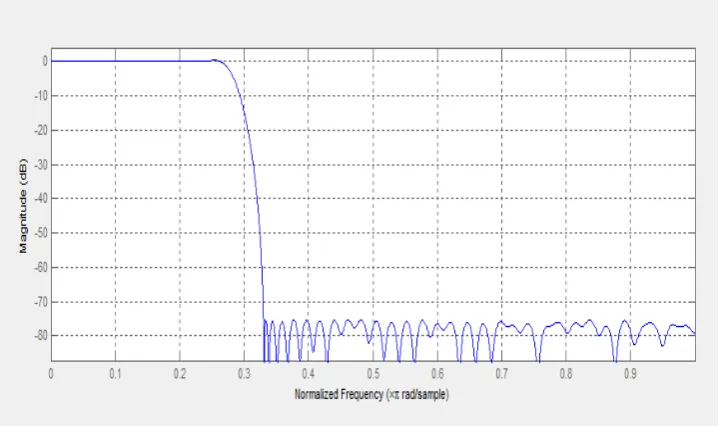
Fig 1.Lowpass FIR Filter response for order N=83, 0.23 Pass band edge , 0.33 Stop band edge
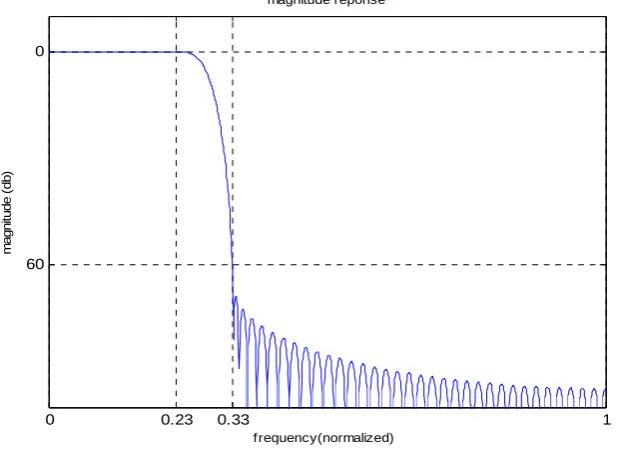
Fig 2. Lowpass FIR Filter response for order N=83, 0.23 Pass band edge , 0.33 Stop band edge using least Pth norm.
0 0.23 0.33 1
60 0
magnitude reponse
f requency(normalized)
m
agni
tude
(
d
Fig 3.Lowpass FIR Filter response for order N=96, , 0.23 Pass band edge , 0.33 Stop band edge..
Fig 4. Lowpass FIR Filter response for order N=83, 0.23 Pass band edge , 0.33 Stop band edge using least Pth norm
TABLE 1. COMPARISON OF LOWPASS FIR FILTER COEFFICIENTS FOR ORDER N=59
Coefficients Using least squares method Using least Pth Norm
a(0)
0.000367 -0.000451
a(1)
0.000053 -0.000700
a(2)
-0.000671 -0.000527
a(3)
-0.001224 0.000236
a(4)
-0.000823 0.001294
a(5)
0.000722 0.001719
a(6)
0.002461 0.000769
a(7)
0.002720 -0.001443
a(8)
0.000488 -0.003581
0 0.23 0.33 1
60 0
magnitude reponse
f requency(normalized)
m
agni
tude
(
d
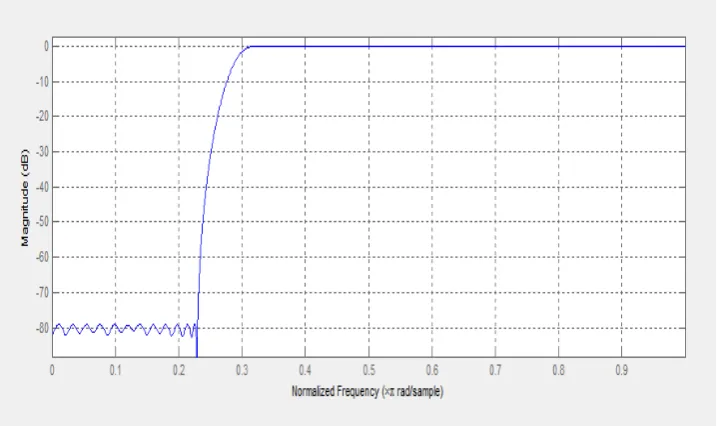
Fig 5. Highpass FIR filter response for order N=83, , 0.23 Stop band edge , 0.33 Pass band edge using least squares method.
Fig 6. Highpass FIR filter response for order N=83, , 0.23 Stop band edge , 0.33 Pass band edge using least P-th Norm.
TABLE 5.2 COMPARISON OF HIGHPASS FIR FITER COEFFICIENTS FOR ORDER N=83
Coefficients Using least squares method Using least Pth Norm
a(0) -0.000011
0.000180
a(1) 0.000053
-0.000201
a(2) 0.000139
-0.000015
a(3) 0.000143
-0.000195
a(4) -0.000022
0.000267
a(5) -0.000303
0.000155
a(6) -0.000470
0.000070
a(7) -0.000266
-0.000110
As discussed in [5] unconstrained optimization methods are applied to minimize norm objective function whereas for sequential optimization an optimization is carried out starting p=1 then p=2 and so on until the reduction in objective function between two successive optimization is less than a prescribed error. Here least squares method applied to minimize norm calculating it only for p=2 when compared with sequential optimization which carries it out for p=1,2,…. For least prescribed error shows that from stability point of view latter is better but when considered the ripple content least squares design proves to be better.
5. CONCLUSION AND FUTURE SCOPE
In this present work least square error design method is presented for the optimal design of FIR filter. The analysis shows that as the order of the filter is increased the ripple content in the stop band diminishes and can be seen with a greater amount for lower orders. The results when compared with the design using least p-th norm shows that the ripple content disappears in a similar way but the only difference that ripples diminish suddenly using least square error design and in latter case ripples smoothen the response and give a constant response in stop band. Further least square error design can be modified using optimization algorithms. Least square error design and least p-th norm designs can be extended in future to design optimal FIR filters using optimization algorithms for both linear phase and Non-linear phase as well as for multi-objective designs. Various works are being done to extend least squares error design orthogonally using Orthogonal Least Square (OLS) algorithm to design linear and Non-linear digital filters.
6. REFERENCES
[1] RabinerL.R. “FIR Digital Filter design techniques using Weighted Chebyshev Approximation”, Proceedings of IEEE, vol. 63, no. 4, April 1975
[2] Coretlazzo,C. and M.R. Lightener, “ simultaneous design in both magnitude and group delay of IIR and FIR filters based on multiple criterion optimization” IEEE trans. Acoust., speech, signal processing, vol. 32, pp. 949-967, 1984.
[3] Lai Xiaoping“ Optimal Design Of Nonlinear-Phase FIR Filters With Prescribed Phase Error”, IEEE Transactions on signal processing, vol. 57, no. 9, September 2009
[4] Wu Xiao-Feng, et. al,” An Orthogonal Least Squares based approach to FIR designs”, International Journal Of Automation and Computing 2 (2005) pg-163-170.
[5] Panghal Amanjeet , et. al. ,“ Comparison Of Various Optimization Techniques For Design Of FIR Digital filters”, NCCI 2010 -National Conference on Computational Instrumentation CSIO Chandigarh, INDIA, 19-20 March 2010.
[6] Elesnick Ivan W. S, et. al. , “A Modified Algorithm for Constrained Least Square Design of Multiband FIR Filters Without Specified Transition Bands”, IEEE TRANSACTIONS ON SIGNAL PROCESSING, VOL. 46, NO. 2, FEBRUARY 1998, pg 497-501.
[7] Gopinath Ramesh A. , “Least Squared Error FIR Filters With Flat Amplitude or Group Delay Constraints”, IEEE SIGNAL PROCESSING LETTERS, VOL. 10, No. 9.,SEPTEMBER 2003.