Lincoln University Digital Dissertation
Copyright
Statement
The
digital
copy
of
this
dissertation
is
protected
by
the
Copyright
Act
1994
(New
Zealand).
This
dissertation
may
be
consulted
by
you,
provided
you
comply
with
the
provisions
of
the
Act
and
the
following
conditions
of
use:
you
will
use
the
copy
only
for
the
purposes
of
research
or
private
study
you
will
recognise
the
author's
right
to
be
identified
as
the
author
of
the
dissertation
and
due
acknowledgement
will
be
made
to
the
author
where
appropriate
you
will
obtain
the
author's
permission
before
publishing
any
material
from
the
dissertation.
Web routers:
An explorative performance review
A Dissertation
submitted in partial fulfilment
of the requirements for the
B.Science(Honours)
at
Lincoln University
By
Richard Andrew Cattermole
Lincoln University
Abstract of a Dissertation submitted in partial fulfilment of the
requirements for the B.Science(Honours)
Abstract
Web routers: An explorative performance review
by
Richard Andrew Cattermole
In society, today almost everybody has used the internet and by extension the World Wide Web.
Over the past 30 years a lot of work has gone into infrastructure creation for the World Wide Web. A
common piece of infrastructure for the World Wide Web is web servers. Requests generated by
users are then sent to the webserver which decodes it for the routing mechanism. When used
appropriately it is nearly transparent to a profiler, when it isn’t it can slow down a website
significantly. The routing mechanism can have many different designs, and this research compares +
benchmark comment implementations regarding performance. Tree based approaches are found to
offer the best performance with least overhead compared to regular expression engine based
approaches.
Keywords: www, web, router, http, server, client, data structures, tree, list, regex, optimize,
Table of Contents
Abstract ... 1
Table of Contents ... 2
List of Tables ... 3
List of Figures ... 4
Chapter 1 Introduction ... 5
Chapter 2 Literature Review... 6
2.1 The World Wide Web...7
2.2 The Server ...8
2.2.1 Performance Issues ... 9
2.3 Data Structures ...9
2.4 Current Routing Processes ... 10
Chapter 3 Research Context ... 11
Chapter 4 Method ... 12
4.1 Implementation ... 13
4.1.1 Data sets ...14
4.1.2 The Routers ...16
Chapter 5 Experimental Results and Discussion ... 17
5.1 Time-period of Results ... 17
5.2 Case Studies ... 18
5.2.1 Case Study: List ...19
5.2.2 Case Study: Tree ...21
5.2.3 Case Study: Regex ...24
5.3 Case Study Overview... 27
Chapter 6 Conclusion ... 30
Chapter 7 Recommendations for Future Work ... 31
Chapter 8 Appendix set_10_sites_5.csuf... 32
List of Tables
Table 1 Data set creation parameters ...14
Table 2 Example routes ...15
Table 3 Example route explained ...15
Table 4 Time period R2 values ...17
Table 5 Case study list min-max ...19
Table 6 Case study tree min-max ...21
Table 7 Case study regex min max ...24
List of Figures
Figure 1 Web server operational theoretical process ... 6
Figure 2 The web (HTTP) request + response cycle ... 7
Figure 3 General HTTP request + response processing activities ... 8
Figure 4 R2 for routers over input sets ...18
Figure 5 list all min-max graphed ...20
Figure 6 list iteration min-max graphed ...20
Figure 7 tree iteration min-max graphed ...22
Figure 8 tree all min-max graphed ...22
Figure 9 optimized tree all min-max graphed ...23
Figure 10 optimized tree iteration min-max graphed ...23
Figure 11 regex all min-max graphed ...25
Figure 12 regex iteration min-max graphed ...25
Figure 13 optimized regex all min-max graphed ...26
Figure 14 optimized regex iteration min-max graphed ...26
Figure 15 average time per router all ...27
Chapter 1 Introduction
In today's society computers are taking a more and more prominent role in our lives; mobile devices,
Personal Computers (PC’s) and tablets allow us to interact and communicate with a vast array of
people and services at a push of a button. The most common communication mechanism used today
is the World Wide Web using Hypertext Markup Language (HTML) as the basis of transmission of
information to the user. The rendering of HTML is performed by a web browser, and is sent to the
browser from a web server. Web servers can contain applications either separated by a process or
embedded into it. To improve the user experience much work has been done to look at optimisation
of web systems.
During optimization stages three different areas are considered. Client side, the Javascript being run,
how it renders and what it’s doing in the background all determine its performance and how long it
takes to operate. The server side where by optimizing interaction with system resources such as
sockets and the file system to prevent sleeping. Lastly determining how resources get from the
server to client, typically this is done by caching of resources. Each of the three optimization methods
directly affects render times to users.
The focus of research in recent times has been on the client side of web development, as defined by
the Hyper Text Transfer Protocol (HTTP) specification (Berners-Lee, et al., Hypertext Transfer
Protocol -- HTTP/1.1, 1999). The main body of research has been to produce better ways to present
information, and improving the experience of the user.
The focus on the server side has been in making dynamic content (e.g. address book entries based
upon a query) more easily created and manipulated. Anecdotally there does not appear to be much
development in this area. This has left certain technologies in use by the web servers with limited
work done on them; an example of this would be the web router.
Web routers are the core technology that maps HTTP requests to the web service (code) that
produces the response to be sent back to the client. A web router does not interact with the user
directly, instead it is configured by descriptions (routes) of websites. Software developers implement
a web service to produce dynamic content for a website. Dynamic content and static content (e.g. a
websites logo) utilize a web server router to locate the resource handling code to produce a response
to the HTTP request.
While the web router implementation is unseen its performance is crucial to the overall of the
response times for a request. This research compares the performance of various web router
2.1
The World Wide Web
The World Wide Web was conceptualised in 1989 since then there has been a large uptake in its
usage by everyone across the globe to an estimate of 3.4 billion users as of October 8th of 2016
(World Wide Web Consortium, n.d.). With every one of those users working with the standards of
Uniform Remote Locator(Bernerss-Lee, 2005), Hypertext Transfer protocol and Hypertext Markup
Language(Berners-Lee & Connolly, Hypertext Markup Language (HTML), 1993) in some form or
another.
During the early days, many different web browsers and servers were created, the majority of these
have since long died off but the legacy that is the definition of each has not. As defined by the World
Wide Web Consortium (W3C) (World Wide Web Consortium, 2014):
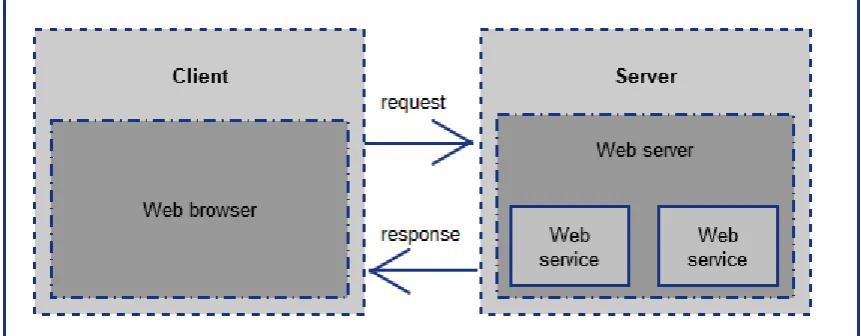
1. Web browser
A program which allows the display and execution of a web page for a user. Interacts with a web server to provide any data required. This is the most common form of client.
2. Web server
Retrieves files or resources from the file system or some form of backend such as a web application and sends them to the client as requested.
3. Web Server API or service
A standalone piece of software that will dynamically create content to send to a client. It communicates in some form to the web server to serve up content to the client.
These components are displayed in Figure 2.
With greater usage of the internet coinciding with greater speeds during 1990s as predicted by
Nielsen’s Law (Nielsen, 1998). Companies and developers alike have experimented with dynamic web
pages allowing for user interactions not possible with static web pages alone. The Common Gateway
Interface (Robinson & Coar, 2004) was created to allow for external programs to be executed as part
of the web page processing by a server. From this point on existing programming languages gained
new uses that were not seen before, which helped to introduce other new programming languages.
Examples of this are be PHP and JSP (Java Server Pages) which have the primary purpose of dynamic
page creation on each request by the client.
2.2
The Server
Web servers and web (server side) APIs alike are a field of research that continues to introduce new
areas of study in both academic and in industry circles for web servers and web API’s. They share a
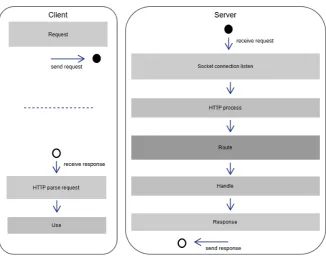
very similar technology set as shown in Figure 3, with only slightly different purposes and entry
points. The web router resides on a server and is a required component for the operation of both
web servers and web APIs.
A web routers, primary goal is to map an incoming request from a socket to a function (code) to
process it. The execution and processing of a request once mapped can be done on the server or
specific route handling code in a separate process. The handler can be written in any language. This is
shown in Figure 3; it is based upon HTTP 1.x.
The primary focus of web developers is coding the requests and manipulating of the response for the
client side. For the server side, the focus is upon handling the routes for a given purpose. There may
be little consideration by those who use an implementation about, its performance. This can cause
delays such as the time it takes to handle a request from getting it to sending a response back to the
client. The algorithms used in web routers (e.g. linked list, B-Tree) and data structures were originally
created for database engines. In the context of a database they have been optimised and analysed
for best performance. For a web router, these algorithms may give improved performance once they
have been analysed and optimised for this use case.
2.2.1
Performance Issues
The standard implementation of a web server has the following processing steps:
1. Asynchronous socket listener
2. Thread/Fiber router (choose the thread to handle the request)
3. HTTP request processing
4. Routing to handler function
5. HTTP response creation and return
In these steps there are a number of potential performance issues:
• Non-blocking asynchronous socket listening verses blocking synchronous socket listening
• Scheduling of the handling code on a thread/fiber
• Blocking operations (e.g. communicating with the database, file reading/writing)
These have been worked on by developers since the beginning of the web, but comparatively little
has been done in the routing component. Hence the focus of this study is on improving the
performance of the web router.
2.3
Data Structures
In computer science, there are two primary data structure families, Lists and Tree graphs. These data
structures are built on top of heap memory using two techniques, struct/class based storage and
arrays in the form of either static or dynamic. A dynamic array is a pointer to a location within the
heap or stack with a length to indicate how many indices has been allocated for (Leiserson, Rivest,
Stein, & Cormen, 2009).
Lists are a more expensive method (in amount of memory allocated and lookup times) to perform
storage of linear data. The benefit of using a List over an array is having faster insertion and removal
times.
A Tree graph instead of storing data linearly, stores data separated with multi layers of parents and
children. This separation is very good for decreasing lookup times for data that is similar but with
vast differences later on, which is the case with routes. Typically there is a root node with a set of
children associated with it. The root node itself doesn’t have a value but is the starting point for
2.4
Current Routing Processes
A web router maps incoming requests to a route handler (code). The approaches that are available to
implement the routing can differ in functionality and performance. These different approaches each
have a different set of costs (memory and CPU) and the performance will depend upon the profile of
the web traffic.
There is a variety of different methods used in implementing a web router. The main ones used are:
tree graphs such as a Red-Black as implemented in Nginx1 or a single Regular Expression (regex). A
single regex can simplify the code required (Popov, 2014), but a tree will result in a more limited
functionality for matching.
Current implementations typically use the path from the HTTP header to perform lookups. Routes
may contain constants as path segments, parameters or a “catch all” for all following path segments.
Existing basic data structures can handle paths in this format. E.g. regular expressions are typically
used to implement them. These can cover most cases by utilizing multiple instances of the router
implementation. Each instance of the router handles a different HTTP method such as GET and POST.
Some servers support a feature known as rewriting. Rewriting is the process by which requests are
transformed into another; however only internally. After a ‘rewrite’ of a request takes place it must
be evaluated as if it was a new request. The rules by which it can modify the request include the
path, domain, time stamp, client IP address and any other HTTP request field. Most web routers do
not implement this feature because of its complex nature however it is an add-on to many web
servers.
In non-regex approaches, more information is stored in the data structure (HTTP method, port etc.).
This allows the routing algorithm to use other conditions such as the HTTP request fields of
User-Agent, Referer or Host. Support for this significantly increases the complexity of the implementation
and limited research into this area was discovered in the creation of this proposal.
The data structure that the web router utilizes can take many forms including a list or a tree graph.
These data structures are simple in design but have many optimisation opportunities (such as cache
locality for children in a tree graph) which can improve performance by many magnitudes (Ross &
Rao, 2000).
1
Chapter 3 Research Context
The research proposal presented here has the goal of improving the web routing performance. This
could make the web faster over all. In previous work a considerable amount of research has gone
into making the web faster by focusing upon the total performance of the systems involved.
The overarching goal is to determine the performance of various web router algorithms for a given
set of web request scenarios.
From this set of sub-questions is formulated to help explore the overall research goal:
1. What are the current performance metrics associated with the request/response cycle?
2. What are the common algorithms that web routers use and how do they relate to those used in other fields?
3. What are the performance characteristics of commonly used algorithms to implement a web router given a range of routing scenarios as input?
The results of the investigation will allow for potential improvements in the web router performance
Chapter 4 Method
To explore the research question three web routers will be implemented and benchmarked. A
benchmark harness will be created to execute tests to record the timings for routing of requests. The
harness will provide a common interface to allow the timings to be gathered the same way for each
web router implementation to be tested and compared.
The input data for the benchmarking comprises of two different sets of information. The first is the
routes to be stored in the router data structure, the second is a set is of requests to be executed by
the router implementation. The routes will be preloaded before testing and will be fully optimised by
the router before the execution of the benchmarking.
The design of the routes used in the data sets include: static paths “/my/path/goes/here” with a
variable number of parts “/part”, a number of parameters (aka “variables”) “/my/path/:variable” and
a catch all “/my/path/*” for all values following the previous values. These will be combined in the
form: “/path/:vars/*”, “/path/*” and “/path/:vars” with path and vars being variable in number. The
combination and complexity will be produced algorithmically for the purposes of testing as many
corner cases as possible.
Different input sets will be generated by: how many path parts they contain, the number of
parameters/variables and how many have a catch all.
Each implementation is expected to run within a single thread. All input sets will be stored in
memory and initialisation will have been performed before a test starts. Each input set is ran in
multiples of a ten iterations giving: 10, 100, 1000, etc. The result for each multiple is then averaged
for comparison with the same multiple for all other inputs sets. Each test will occur without any
breaks (e.g. no thread sleeping) and will not include the time for pre-loading and optimisation.
The computer that will perform the benchmarking has the following specification:
• CPU: Intel Xeon v3 E5-2630, 8 cores at 2.4ghz base frequency and 20mb cache
• Memory: DDR4 64GB at 3200mhz
• OS: Windows 10
Storage of input and results will be done in memory. Once results are fully generated and testing has
concluded for a test set, they will then be stored on the hard disk. This will prevent performance
Once the results have been gathered, graphs comparing multiples for a test set as well as comparing
specific multiples between implementations for a test set. Particular attention will be paid to outliers
within these graphs to determine problems of the implementation. Comparisons will also be made
between test sets to determine how the type of web requests impacts performance.
4.1
Implementation
For the implementation two sets of artifacts were created, code and the data sets. The data sets
comprise of a variety of values generating a set of website route descriptors that are to be
benchmarked. Secondly the routers themselves as code within the benchmarking framework that
was as well created.
Three routers were created. List, tree and regex. Of the three they share a similar implementation of
a site lookup using an array which contained all parameters to decide the set of routes to search over
including, SSL status, HTTP error code and port. A site could include multiple hostnames, ports and
4.1.1
Data sets
The benchmark input data was generated using a generator which had its input provided by a script.
The input generator produceds a unique set of routes given a max number of entries, parts,
parameters and tests per route. These can be combined together to produce a multi-site input into
the router benchmarker suite.
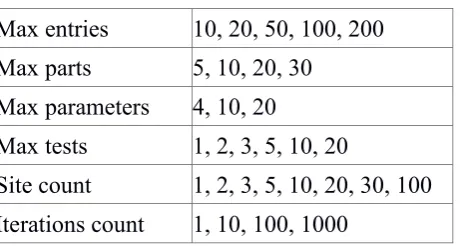
The benchmark data generator script used a variety of values for max number of entries, parts,
parameters, tests, specific number of sites and iterations. The number of catch all was derived from
max parts and max parameters. The set of values used was:
Table 1 Data set creation parameters
Max entries
10, 20, 50, 100, 200
Max parts
5, 10, 20, 30
Max parameters
4, 10, 20
Max tests
1, 2, 3, 5, 10, 20
Site count
1, 2, 3, 5, 10, 20, 30, 100
Iterations count
1, 10, 100, 1000
The above table provides the input parameters for the pseudo code below:
Foreach num-entries in set max-entries Foreach num-parts in set max-parts
Foreach num-parameters in set max-parameters Foreach num-tests in set max-tests
Foreach num-sites in set site-count
Foreach num-iterations in iterations-count Perform operation
set-count = set-count + 1
The naming of a data set is contributed by set-count and num-sites. Into the form of “set_<se
t-count>_sites_<num-sites>.csuf”. For output files it was “set_<set
-count>_sites_<num-sites>_iterations_<num-iterations>_result.csv”.Each entry has a number of test URI’s associated
with it. Each URI is made up by a number of parts, parameters and optionally a catch all. The number
of iterations used increases the reliability of the results by making it repeat them X number of times.
The values chosen were picked to try and get a range that fitted most web servers and web service
frameworks use cases, but because of how many web sites that exist today it is impossible to know if
it fits correctly to the use case that is 2017. A word dictionary was used to produce unique words per
path part, using a random number to pick which one to replace at each node for a tree graph. The
during development to determine the correctness of routing. What the router returned as part of the
benchmarking process was assumed to be correct and no checking went into this. The data that was
created came in the form (an excerpt from set_10_sites_5.csuf in Appendix Chapter 8):
Table 2 Example routes
Spec
Tests
Matches?
/Hollie/skyline/phlegmatic/
apical
/railwayman/coil_s/ulster/noncorrosive/belletristic/
Lebanese/mechanic/mercilessness
No
/Hollie/skyline/phlegmatic/apical
Yes
/witticism/:aerodynamics/
:greenmail/chest/*
/witticism/Joy/hookah/chest/proscription/link/Batu/
latecomer/bugler/dreariness
Yes
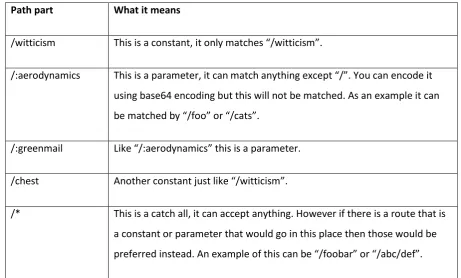
A route is separated into its path parts. The path parts being constant, parameter and catch all. To
understand this, it is shown for the second example in Table 2 in Table 3.
Table 3 Example route explained
Path part What it means
/witticism This is a constant, it only matches “/witticism”.
/:aerodynamics This is a parameter, it can match anything except “/”. You can encode it
using base64 encoding but this will not be matched. As an example it can
be matched by “/foo” or “/cats”.
/:greenmail Like “/:aerodynamics” this is a parameter.
/chest Another constant just like “/witticism”.
/* This is a catch all, it can accept anything. However if there is a route that is
a constant or parameter that would go in this place then those would be
preferred instead. An example of this can be “/foobar” or “/abc/def”.
From this the data set were created with each entry having a specification, tests (that may or may
not match it). In total 287 benchmark input sets were created as part of the generation process. Only
150 of these were run and took over a week to complete. The last of these took over 24 hours to run
and the following sets would only become longer in time as the complexity could only rise as per the
4.1.2
The Routers
Three routers were implemented. A tree graph, list (array) and regular expression (regex). The tree
graph was based on a rooted child array approach with multitude of specific node pointers per node
to support parameters, catch all and other children. The list was an array sorted by the route value it
contained. Lastly the regex router was implemented using D’s standard library implementation
(std.regex). This implementation does not perform JIT’ing or have any heuristics or optimisations to
make it significantly faster making it a good baseline for regular expression performance.
The list router utilised an array that was formatted based upon hostname, if there was a catch all and
the path itself. This was done so that once it started matching and didn’t find any more matchable
entries it would stop.
The tree graph used a hierarchical set of nodes with each node having its own children (the path
segment) and if the node had a variable node child. Preference was given to non-variables childrens
but if one could not be found then variable and finally catch all child nodes were used for routing.
Finally the last router regex was implemented by using D’s std.regex (available in the standard
library).
The optimized version of the tree graph allocates memory once for all nodes and put all the children
together before going down. The optimized regex router combines all the separate string into one
large one.
All routers and benchmarking suite was compiled using dmd 2.073.0 in release mode with
optimizations turned on. LDC (LLVM) during implementation was unable to compile the suite as it
Chapter 5 Experimental Results and Discussion
The results were gathered in a continuous benchmark execution that took over a week. In initial
analysis results gathered earlier in the benchmarking process appeared to be most representative of
real world usage and have less irregularities visible. This was based upon the time taken for the
amount of work done per input set and the resulting data. Because of this the assumption that the
input sets 100-150 results had irregularities and should be considered less viable was made.
It was observed during the benchmarking process that each input set contributed to the run
completion, the increases form a curve when plotted. This increase in time with the added potential
of irregularities can be studied by breaking down a routers benchmark results into three groups
(chosen for the even group numbers) of 50. Breakdown of the results occurs in 5.1.
Each router implementation results are studied in separate case studies in an attempt to understand
each of their characteristics.
5.1
Time-period of Results
The generation of results required long running processes which produced irregularities within the
output. Because of the long running processes the question of did this effect the results and if so by
how much must be answered. But it does beg the question, was the input set data too large for the
problem domain?
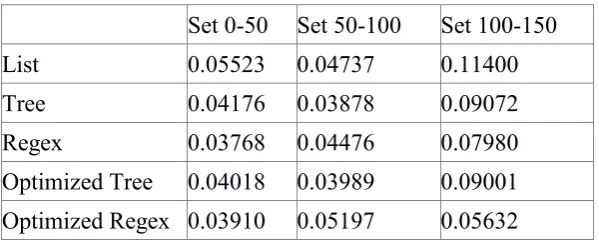
The following table of R2 was calculated from the means of the times taken to benchmark a given
input set to a router, not per iteration. A trend line was added to the given data set chosen using a
polynomial form with 8 degrees of points this is shown in Figure 4. The usage of three groups of 50
input sets. Were chosen to aid analysis.
Table 4 Time period R2 values
Set 0-50 Set 50-100
Set 100-150
List
0.05523 0.04737
0.11400
Tree
0.04176 0.03878
0.09072
Regex
0.03768 0.04476
0.07980
Optimized Tree 0.04018 0.03989
0.09001
Optimized Regex 0.03910 0.05197
0.05632
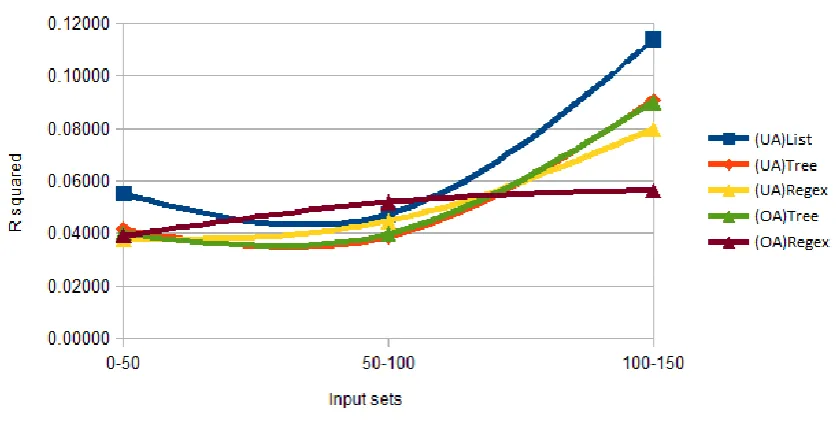
Figure 4 R2 for routers over input sets
The graph shows three very noticeable traits, firstly 0-50 and 50-100 are values for all algorithms
similar in value. Second the 100-150 sets of data tend to be significantly higher than the other two
sets. Lastly four out of the five router instances have the same curve shape. The router instance with
a different one is the optimized regex which shows a much more predictable result. For 50-100 input
sets mark, regex implementation (both optimized and unoptimized) was the only one to increase in R
squared which would align with it being very consistent but having set min/max consistency.
5.2
Case Studies
Each router type (List, Tree, Regex) is separated into its own case study, if included an optimized
router implementation is considered as part of the study. The notation used in the graphs below is:
<name>A, <name>I, <name>OA, <name>OI. The A stands for all, I stands for iteration, O for
5.2.1
Case Study: List
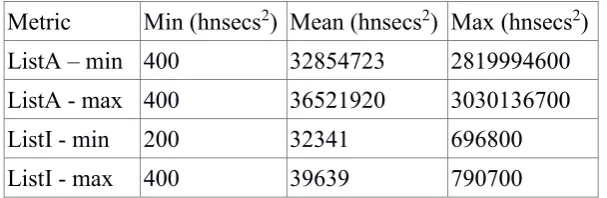
From the time series analysis Table 5 it is apparent that the list router for 0-100 input sets scales to
match the calculated formula highly. The differing R2 by around 0.008 is a reasonable number and is
supported by looking at the results by min-min, min-max, max-min and max-max of the entire
responses.
Table 5 Case study list min-max
Metric
Min (hnsecs
2) Mean (hnsecs
2) Max (hnsecs
2)
ListA – min 400
32854723
2819994600
ListA - max 400
36521920
3030136700
ListI - min 200
32341
696800
ListI - max 400
39639
790700
The means are all fairly large which implies although the minimums are small, there is a high cost in
larger number of sites + routes. This in turn is backed up by it being an array, array looks ups cannot
skip elements but it can quit the loop early assuming it is sorted. Larger the sites + routes, the longer
time it takes to search it for a given route.
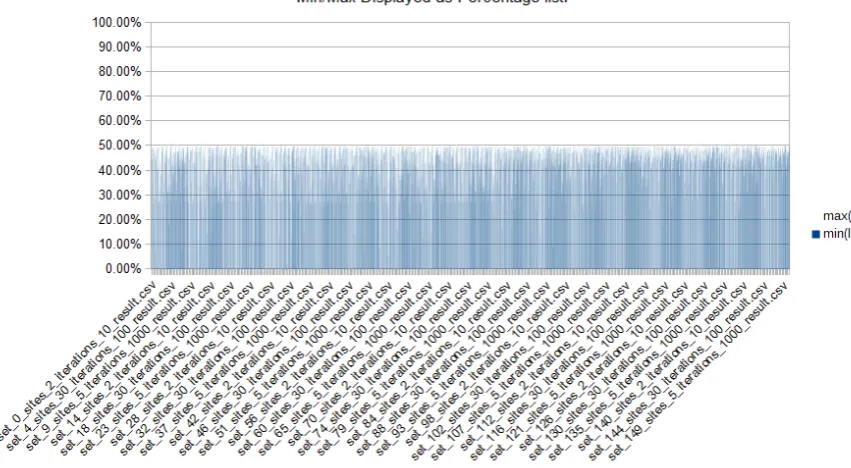
To observe the min/max of the results more carefully using the graphs Figure 5 and Figure 6,
observably all the results minimums were under 50% of the max and had a high concentration
around 30-40%. This means that this router implementation will typically be able to complete in at a
minimum of 30-40% of the maximum time. The determination which route takes the absolute
minimum time cannot be determined without the implementation making the list of routes available
at any given point in time to be analysed. The sorting of the array which gives order to the searching
is important to the functioning of the router so that it cannot support reordering with priorities for
commonly accessed routes.
Figure 5 list all min-max graphed
5.2.2
Case Study: Tree
From the time series analysis Table 6 it is apparent that the tree router for 0-100 input sets scales to
match the calculated formula highly. The differing R2 by around 0.003 is a highly desirable number
but it the differing values in the data do not quite show this. From the data it can be seen that there
is quite a difference between minimum and maximum. However when compared to the list router,
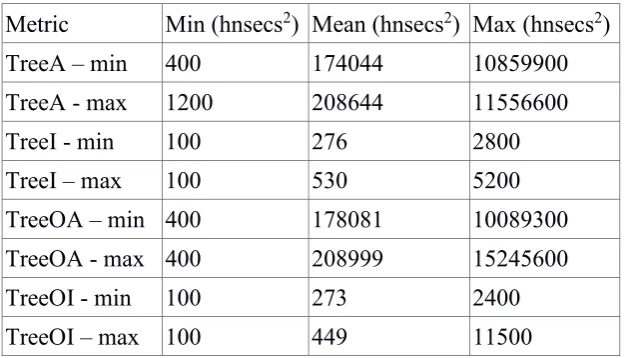
the mean is closer to min in the tree compared to the list.
Table 6 Case study tree min-max
Metric
Min (hnsecs
2) Mean (hnsecs
2) Max (hnsecs
2)
TreeA – min
400
174044
10859900
TreeA - max
1200
208644
11556600
TreeI - min
100
276
2800
TreeI – max
100
530
5200
TreeOA – min 400
178081
10089300
TreeOA - max 400
208999
15245600
TreeOI - min 100
273
2400
TreeOI – max 100
449
11500
Comparing the optimized version to the unoptimized version of the routers it can be seen that there
is almost no difference except that the best case scenario seems to be lower but worse case is a lot
higher. The only difference between the two is a single memory block versus lots of smaller ones
suggest that memory locality optimization could improve performance more than the currently
tested implementation.
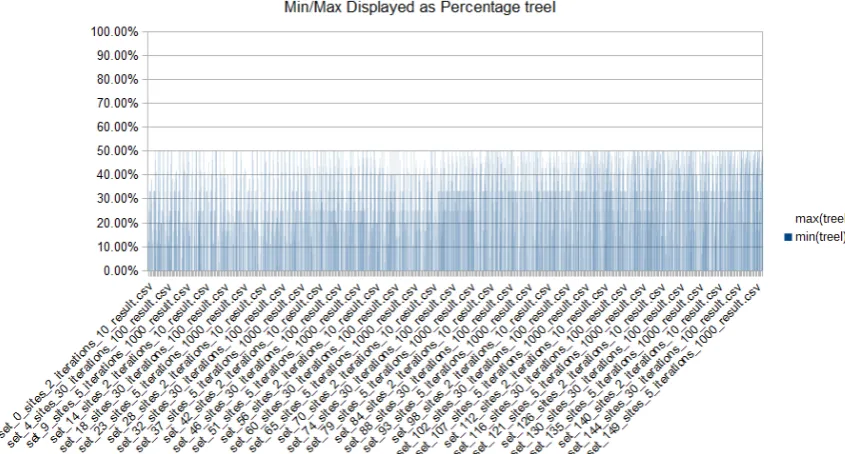
To observe the min/max of the results better, using the graphs Figure 8, Figure 7, Figure 9 and Figure
10, observably all the results minimums were under 50% of the max and had a high concentration
around 20-30%. This means that these router implementation will typically be able to complete in at
a minimum of 20-30% of the maximum time. However this is not affected by memory optimization
too much suggesting that perhaps such optimization may not be missed for the general case but is
Figure 8 tree all min-max graphed
Figure 9 optimized tree all min-max graphed
5.2.3
Case Study: Regex
From the time series analysis Table 7 it is apparent that the unoptimized regex router is the most
expensive compared to the other implementations. The optimized regex router has a different
profile with the 100-150 set being vastly higher than any others. In the unoptimized implementation
the input sets 0-100 there is a differing R2 value of 0.07 and for 100-150 of 0.021. In the optimized
implementation the input sets 0-100 there is a differing R2 value of 0.011 and for 100-150 of 0.004.
From this we can see that given the input set that there can be very high minimum times which is
backed up from the min-max’s of the time it took to perform. The max-max’s tend to be very close to
the min-max’s which implies a high overhead as the regex string grows.
Table 7 Case study regex min max
Metric
Min (hnsecs
2) Mean (hnsecs
2) Max (hnsecs
2)
RegexA – min
800
133211401
8161259700
RegexA - max
8500
145157883
8567889600
RegexI - min
800
155253
2016600
RegexI – max
4500
187002
2235800
RegexOA – min 800
498155614
24742495900
RegexOA - max 2100
536130030
28392916800
RegexOI - min 800
554891
10276600
RegexOI – max 1700
635525
11899700
The means are all large which implies although the minimums are reasonably small, there is a high
cost in larger number of sites + routes. The optimized versus unoptimized had one major difference,
one regex string (internally) versus one per route. The optimized tended to do better for smaller sets
of routes + sites, but for larger routes would do significantly worse for both min/max-max’s and
min/max-mean’s.
To observe the min/max of the results better, using the graphs Figure 11, Figure 12, Figure 13 and
Figure 14, observably all of the results minimums were under 50% of the max and had a high
concentration around 20-40%. This means that these router implementation will typically be able to
complete in at a minimum of 20-40% of the maximum time. However this is not affected by single
string optimization too much suggesting that perhaps such optimization may not be of benefit
Figure 11 regex all min-max graphed
Figure 13 optimized regex all min-max graphed
5.3
Case Study Overview
Each router implementation as a case study explore how a router performs through different inputs.
In each of the case studies observations as seen in Figure 15 and Figure 16, were made per the router
implementation performance across different metrics. Overall the tree graph performs the best, list
then regex. Optimized versus unoptimized this statement also holds true. Comparing the average
time per iteration and for all iterations the only change is the scale of the numbers, overall the
pattern is the same.
The treeA and treeOA do not show up on the graph yet are part of the data set. They are too small
given the scale that the others are.
Figure 16 average time per router iteration
For each router a comparison Table 8 of the number of route benchmarks above versus below the
Table 8 Case study overview ratio above:below:mean
Ratio above Ratio below Ratio at mean
ListA
56.6% 45.5% 0.1%ListI
55.7% 45.9% 0.6%TreeA
53.0% 48.2% 0.9%TreeI
30.2% 43.4% 28.5%RegexA
56.8% 45.3% 0%RegexI
54.8% 47.2% 0.1%TreeOA
55.0% 45.7% 1.4%TreeOI
32.9% 34.4% 34.8%RegexOA
56.6% 45.5% 0.1%RegexOI
54.3% 47.7% 0.1%The majority of the results were around the 50% mark, this is a baseline for both above and below.
Of note is that optimization on the tree graph did have significant impact in shifting more hits
towards the mean and above compared to below. However for regex implementation optimization
Chapter 6 Conclusion
This research explores the question as to “what are the performance characteristics of common web
router algorithms under a typical web request scenario”. Three research questions were established:
1. What are the current performance metrics associated with the request/response cycle? 2. What are common algorithms that web routers use and how do they relate to those used in
other fields?
3. What are the performance characteristics of commonly used algorithms to implement a web router given a range of routing scenarios as input?
The work that was conducted was limited to the web router and ignored the overhead that is socket handling, threading and decoding + encoding of the protocols involved. These are required to answer the first sub question of the characteristics of the request/response cycle in a web server/service.
The second sub question was answered through the literature review, this highlighted that tree graphs and regular expressions are currently used in web router implementations. A list router was implemented for a comparison to what should be the slowest data structure lookup method.
Each of the routers results answer the last question, what are the performance characteristics for the
techniques involved? The tree graph was fastest over all, list was two magnitudes slower than the
tree graph and regex engine was three magnitudes slower than tree graph. This is based upon the
minimums of the means (for all data sets used). The optimization versus unoptimized status did not
affect the results enough to show in magnitudes but may play a role in performance tuning of a web
server.
In conclusion, this work has found that the Tree graph data structure is best suited towards web
router implementation. It represents routes the most accurately. A common method for routing
using regular expressions to represent routes was found to be slowest and should not be used unless
Chapter 7 Recommendations for Future Work
This work did not cover exploring the request/response cycle and its associated metrics, this work
would be built on top of this one. A limited number of techniques were used in this research. To
further this several more web routers can be created:
• More Tree graph variants, Red-Black, Splay and AVL.
• Merging of a tree graph with regex on request, to provide more modeling power when required but reverting to a simpler algorithm lookup for performance.
• Using another data structure to represent sites to route storage. The current one used is a basic array with a child of the element to the root node.
• Validation of results during bench marking e.g. HTTP status codes.
• Using another regex implementation, PCRE2 and perhaps a JIT’d version.
Creating a different more randomized input set benchmarking. Instead of doing them linearly,
Chapter 9 References
Berners-Lee, T., & Connolly, D. (1993, June). Hypertext Markup Language (HTML). Retrieved from https://www.w3.org/MarkUp/draft-ietf-iiir-html-01
Berners-Lee, T., UC Irvine, Gettys, J., Compaq/W3C, Mogul, J., Compaq, . . . Microsoft. (1999, June).
Hypertext Transfer Protocol -- HTTP/1.1. Retrieved from https://tools.ietf.org/html/rfc2616
Bernerss-Lee, T. (2005, January). Uniform Resource Identifier (URI): Generic Syntax. Retrieved from https://www.ietf.org/rfc/rfc3986.txt
Leiserson, C. E., Rivest, R. L., Stein, C., & Cormen, T. H. (2009). Introduction to Algorithms. MIT Press. Nielsen, J. (1998, April 5). Nielsen's Law of Internet Bandwidth. Retrieved from Nielsen Norman
Group: UX Training, Consulting, & Research: https://www.nngroup.com/articles/law-of-bandwidth/
Popov, N. (2014, February 18). Fast request routing using regular expressions. Retrieved from http://nikic.github.io/2014/02/18/Fast-request-routing-using-regular-expressions.html Robinson, D., & Coar, K. (2004, October). The Common Gateway Interface (CGI) Version 1.1.
Retrieved from https://tools.ietf.org/html/rfc3875
Ross, K. A., & Rao, J. (2000). Making B+- trees cache concious in main memory. ACM SIGMOD
international conference on Management of data (p. 475486). ACM. Retrieved from
http://dl.acm.org/citation.cfm?id=335449
World Wide Web Consortium. (2014, March 14). How does the Internet work, 72360. Retrieved 10 8, 2016, from World Wide Web Consortium (W3C):
https://www.w3.org/wiki/index.php?title=How_does_the_Internet_work&oldid=72360 World Wide Web Consortium. (n.d.). Help and FAQ - W3C. (W3C) Retrieved 10 8, 2016, from World