IJSRR, 8(3) July. – Sep., 2019 Page 619
Research article Available online www.ijsrr.org
ISSN: 2279–0543
International Journal of Scientific Research and Reviews
Attrition Rate & Retention Management - A Study of Bpo Sector
Nityabh Singh and Nandini Shrivastava
Faculty of Commerce And Business Studies Manav Rachna International Institute of Research & Studies Sector-43, Surajkund –Delhi Road, Faridabad – 121001
ABSTRACT
Business Process Outsourcing primarily is about giving out work to a third party or taking support from a vendor to support business operations which can be back office, voice and can extend across all kinds of sectors which may include BFSI, insurance, banking, travel, etc. Any business that is donefrom a third country is called shoring and from a nearby country is called near off-shoring.
This sector has increased tremendously, and India continues to be the major player in this specific industry. The market share has increased for India to 36% in the BPO sector which is popularly known as Business Process Management in the current scenario. India has almost 65% of market share in US market of BPO market and is currently leading all the major market players but there are other countries that are coming up like Philippines, China, Bangladesh, etc. and India is at the risk of losing business to these countries as they are giving competition on the basis of cost advantage, business operations, etc
The biggest issue for this industry is Employee Attrition which is currently around 30-35%. There have been several studies around this and many factors that have amounted to high attrition rate in BPO industry which revolves around various reasons.
With this research study we are trying to innovate a new model to tackle this menace and come up with a new model to counter it and primarily target the early stage attrition which is currently trending around 60%-70%. We also aim to find options to look at how to retain employees in the early stage when he joins outsourcing sector, map their career and make strong recommendations around it.
KEYWORDS
– BPO, Business Process Management, BFSI, Insurance, Travel, Third Party, Outsourcing, Off- shoring*Corresponding author:
Nityabh Singh
G6/1, BPTP Parkland Villas
Sector – 89, Faridabad, Haryana – 122002 Designation- Assistant Manager
IJSRR, 8(3) July. – Sep., 2019 Page 620
EXPERIMENTAL SECTION
INTRODUCTION
Business Process Outsourcing means quick money, corporate environment, nice lifestyle, young college pass outs at work making it one of the youngest workforce, etc that is what this industry is best known for, however, the biggest pain that is currently faced by industry is high attrition and the challenges faced to retain the current population.
1.1Current Scenario
In last 14 years, outsourcing sector has seen tremendous improvement, in this industry. It’s total turnover 25 billion US dollars as of now in 2018. The industry has grown from a small amount of 565 million dollars to such high turnovers on date. The industry grew leaps and bounds and made some huge growth over the past decade and there is some great lifestyle it has offered to the current youth that changed the complete outlook of the current generation. The industry has seen some great changes over the years and has widened its horizon in almost all the sectors.
It does not mean that it has not been prone to its share of challenges and issues. The biggest challenge or menace that the industry is currently facing is of employee attrition and retention. The attrition is way above 35% in this industry and the major reasons identified for attrition is stressful working hours, work-life balance, growth factors, stagnancy in the organization, etc.
This has its own share of impact on the industry and the organization which is loss of productivity, loss of revenue, training cost, pass back to client, impact on performance, stability issues, etc. Thus, attrition and retention go hand in hand and must be curtailed to reduce the all-round impact.
BPO sector has grown tremendously and this industry is primarily popular for quick money, good lifestyle and is known as one of the fastest growing sector of the current era. This era is that will belong to the BPO industry with the pace it has grown and the revenue that it has generated. Also, it has become the need of the hour of all the organizations and they are particularly believing and investing in outsourcing as an option probably looking at the cost effectiveness, better quality service, meeting service level agreements, etc. This sector has given options to organizations virtually in all sectors i.e. banking, insurance, travel, e-commerce, etc.
IJSRR, 8(3) July. – Sep., 2019 Page 621
This research is basically not only targeted towards finding the actual concrete reasons for this high attrition which has been done in earlier studies as well but at the same time look for a model that can best fit in this situation and help curb attrition particularly in the early stages where there is maximum leakage and help this sector come in a stable state with respect to workforce and performance.
The attrition and retention are those factors that can make or break an organization. As mentioned above, employees may leave an organization for various reasons and may also get retained for some or the other factor. There is an enormous amount of difference between the actual reasons and the retention efforts to keep the employee with the organization.
LITERATURE REVIEW
2.1Overview
Literature review has suggested that there are various reasons for attrition and have also recommended ways to stop it Ramani and Raghunandan, 2008; Misra, 2007; Prakash and Chowdhary, 2004 here has been work done in the field like the HRM, its practices (Budhwaret al. 2006), job satisfaction (Sharma, 2006; E-sat survey 2005), organization factors for turnover (Porter and Steers, 1973) and prevention of burnout of employees. However, an all-round approach has been missing in all the directions to counter the most groaning problem of the modern times.
The major factors of attrition can be elicited below as following based on review of literature studied in this context:
Training & Development – These are other reasons why people leave outsourcing sector in the initial few days only. Training and development is the first face to the employees and they set the benchmarks of the organization. If they happen to set a poor example, this will set a negative example in front of the New Hires and they may decide to leave very early on in their career stage as there is a negative impression that has already been created for the employees.
Poor Recruitment – This is another reason for attrition. We may not be wary of the fact that this factor contributes humongous to attrition. Any wrong employee hired based on skill set or will issue will increase the likely chances of attrition but may also impact other employees within the organization, we have seen historically that these employee attrition costs dearly as they may amount to few other attritions, at the same time.
IJSRR, 8(3) July. – Sep., 2019 Page 622
talent pool through recruitment, training so that employees can perform and get rewarded accordingly. Rewards may not be restricted only to monetary terms, a certificate or a token of appreciation may do wonders and keep them motivated to stay with the organization.
Growth – This is another factor that is a major contributor to leave or stay with the organization. The employee who get tenured expect growth and in case, they don’t get it, they decide to move on with the organization. So it’s very important and critical that while we are focused on all other factors of attrition, we don’t neglect this important aspect of employee retention so that they stay with the organization motivated and continue to contribute positively.
Other Factors – Outsourcing sector is often regarded as a sector which has lot of money, fast paced growth and not as a career. There is a perception that employees want to join this sector in need of quick money, this has become more of a stop gap arrangement. People join and leave it as quickly as possible when their need for money is over. Gupta (2011) in his study on outsourcing industry concluded that the biggest reason for people leaving the outsourcing was because the industry was looked at as a stop gap arrangement.
Leadership needs to be empowered is the need of the hour. This will enable to make them take judicious decision, at the same time, they need to look forward to involving employees in decision making and practice participative management style, this will enable them to feel empowered and take part in management decision making and will enable them to feel motivated and stay with the organization.
Some more literature available by important writers:
Kariuki Elizabeth Wambui (2012) has suggested the reasons that impactattritionsarebelowthe expectationexperience from the job, job dis-satisfaction with the job, lack of recognition for work, job rotation missing, sway awayfrom the job among others lack of supervisor support, negative working environment, job stress, job description missing, work pressure, work life imbalance, incompetent leaders, inequality in pay for the same work, packages in the organization, training and development gaps, education level, presence of external options, larger environment and globalization. The author suggests SDV Transamimanagement to ensure clear job profile for workers, the management of SDV Transami can train its leaders on promoting work-life balance without impacting day to day work and look into their performance management and work on packages that are considered as per market to retain talent.
IJSRR, 8(3) July. – Sep., 2019 Page 623
as two of the most dominant experienced work emotions, in a model that is based on the job needs– resources model and affective events theory, to illustrate how emotions emerge and affect attrition reasons.
Vibha Gupta (2013) has concluded that the workers need balanced work, help and recognition from their co-workers and leadership, and opportunities for growth and new ideas. The study identified that approximately 30% of the staff leave the organization due to further studies & existing educational commitments, within next 1 year. Giving importance to ways of retaining new staff will become increasingly important to assure that the organization does not lose more of its human capital and with it, its ability to serve those in need. Another important factor is organization environment, and writer suggests that if culture or work environment is good organization then it is easy to control attrition within the organization.
Savneet Kaur (2013) has concluded that there‘s no wholistic attrition management resolution for organizations. Each organization has to build its own motivationalaspecton a balance between organization and individual needs. The writer suggests that the companies should adopt remedial measures like giving job profile at the hiring stage, offer skill testing, employees should have a say in the organization, hold exit interviews & regular review sessions etc., and should retain their efficient employees for as long they can. Along with the team members, the supervisors also need to be trained to control and retain their junior.
Janani (2014) has concluded that that most of the companies in IT sector even the top most companies are facing attrition due to many factors in the current stage. The most important of all is packages, because numerous options are available in the market for experienced, good qualified employees if they move over to other companies, they will better package. There are many factors that are involved for the turnover among the workers. Companies should be alert and work on steps to stop attrition so that they can reduce the expenditure of employees for recruitment, training and development.
Vidya Sunil Kadam and Thakar (2014) has suggested that those having average age of 24-28 years and the experience between 2 to 4 years are having more attrition. The writer suggested that the attrition rate has increased because of unhappiness with pay, career, packages & boss relation.
2.2Gaps in the study
IJSRR, 8(3) July. – Sep., 2019 Page 624
numerous reasons and suggested some great recommendations to curb it like new approach HRM and practices, recreation activity approach, burnout issues address, etc.
Most of the studies in this have been of qualitative in nature. They have revolved more around employee motivation and job satisfaction level, however, there is more to it and can’t be neglected especially with the fact that this industry growth rate and revenue generation capacity and attrition has been a groaning issue that needs to be immediately addressed to sustain the industry’s stability.
There are few specific gaps that can be ascertained from the literature review post reviewing the literature available on the issue:
1. It is limited to metro cities as of now
2. Stage wise attrition not targeted in the studies conducted so far 3. Study is only limited to survey or questionnaire technique
4. Survey population used in the studies is limited to managerial ranks only 5. Target population not being surveyed properly
6. Top to bottom study of attrition is required to ascertain the root cause
2.3Objectives of the study
The objective of the study primarilymoves around exploring reasons and retention strategies to combat attrition in this industry and bring it down to acceptable standard so that it has minimal impact on the organization be it productivity, revenue generation, training and development cost, etc to help it come to a stable state.
The objectives of the study are as follows:
i. To identify and rank the factors of attritions in BPO
ii. To analyze the data in the industrywith phase wise segregation to understand the trend and target the actual root cause
iii. Identify the various retention strategies available
iv. To suggest best strategy that suits the industry to combat attrition and focus on retention
SCOPE OF THE STUDY
There have been various studies in this field and there is lot of literature available on the topic.
IJSRR, 8(3) July. – Sep., 2019 Page 625
2. Earlier studies were base mainly based on smaller sample size, however, to have concrete reasoning we need to have a larger sample size
3. There has never been a stage wise break up to study the attrition so that target and resource could be invested to curtail attrition
4. The target interview sample has been restricted to managerial level and the front liners have been neglected
5. Model worked out to be implemented in a few organizations so that its impact can be gauged This is a the most important aspect of the study as this is the phase in research where we apply very statistical tests and techniques to check the validity and reliability of data collected so far and analyzed. This phase is mainly in alignment with the objectives of the research. We work on the various literature review and field study done so far basically:
Primary Data
Secondary Data
4. RESEARCH METHODOLOGY
4.1 Primary Data – Its Analysis
The data that is not gathered or available in secondary literature is what we find and figure out with the help of primary data.
This study looks at larger sample size and which encompasses across cities that has impacted attrition with special emphasis on the phase wise attrition where early life amounts to over to 60-70% of overall attrition in this sector.
Sampling design to be of probable technique or stratified sampling technique
Target population:adequate balance of early lifers (> 90 day old) & tenured employees (<90 days old)
Survey technique: structured questionnaires to be sent out to respondents through email or web surveys or CATI technique to be used in case, of low response
Sample size:1000 employees
Data Analysis: The data that is captured through surveys is put through statistical tests to check their reliability and validity and various analysis and appropriate statistical method will be used for analysis purpose.
IJSRR, 8(3) July. – Sep., 2019 Page 626
4.2Secondary Data
There is loads of literature available around attrition and retention in the outsourcing sector. There is data available that have used forced rank method with perceived value being ranked as no one, followed by higher salary expectation, etc.
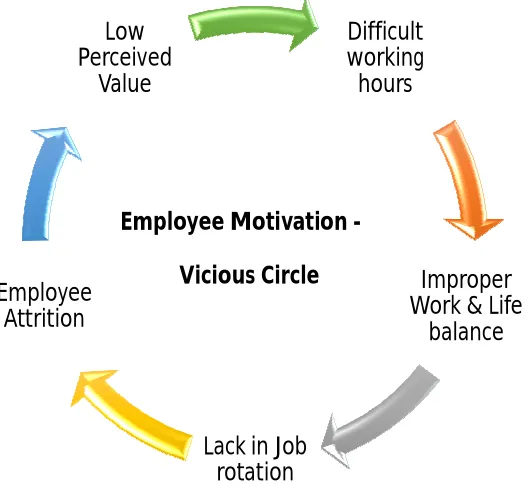
Outsourcing has become a vicious circle of dis-satisfaction leading to employee attrition and while the sector has grown over last 2 decades, however, the bridge between the actual employee motivation level has grown a lot and thus this needs to be immediately addressed.
Fig 1: Employee Motivation-Vicious circle
Source: self created
Expected Outcome of the Research
With the study undertaken we look forward to the concrete reasons for attrition and strong retention management to stop this leakage. It has been observed that this is more a Human resource management practice or issue anymore, this must be taken up by all the departments and leadership as this ultimately has an overall impact.
We look forward to having a strong model to curtail attrition in the outsourcing sector so that this industry can be benefitted from this and the menace of attrition can be stopped. While we
understand that attrition cannot be stopped, it can certainly be reduced and brought to acceptable standards.
The model and outcome of the research looks forward to:
a) Provide more comfortable working conditions to help the current situation and employees b) Better pay and perks
Difficult working
hours
Improper Work & Life
balance
Lack in Job rotation Employee
Attrition Low Perceived
Value
Employee Motivation -
IJSRR, 8(3) July. – Sep., 2019 Page 627
c) Help change the perception of the industry
d) Help innovate and change the current situation of the industry with respect to market challenges
References
1. 1.Doran A.An exploratory study of employee engagement in the financial services industry in Ireland,2013
2. Srivastava. Attrition and Retention of employees in BPO Sector,2011 3. Sunil Dhal..A Study on Employee Attrition in BPO industries in India,2015
4. James MJ..A study on human resource management in BPO with special reference to high employee Attrition, 2015
5. Research. Attrition in Indian BPO industry,2004 6. Scott Kendrick. Call Center Best Practices, 2016
7. Article.11th meeting of the Heads of NSOs of East Asian Countries, 2006 8. Katrina Menzigian. Defining and Discussing Contact Center Attrition, 2013 9. Goswami & Jha.Attrition Issues and Retention Challenges of Employees,2012 10.Thesis, Exploring the dimension of BPO in India
11.shodhganga.inflibnet.ac.in
12.Santoshi Sen Gupta. Exploring the Dimensions in the urban centric BPO industryshodhganga.inflibnet.ac.in, 2010
13.Ganapati, Alarming attrition rate in call center and BPO industry”, Raj management Journal 2010; 7(1): 424.
14.Ramakrishnan.BPO outsourcing deals analysis,2017
15.Gupta, S. S. Employee Attrition and Retention: Exploring the Dimensions in the urban Noida: Jaypee Institute of Information & Technology, 2011
16.Springer.How to write a better thesis, 1995
17. (Jhilam Rundra De. Attrition Vs. Management of Talents: An elusive delusion- A study on Indian Working women in BPO and ITES industry, 2011
18.Kreisman, B. J. Identification of the drivers of employee dissatisfaction and turnover (Unpublished Doctoral Dissertation). Austin. TX: University of Texas,2002
19.Madhuri Lotankar. Managing Attrition in BPO Industry,2008
20.T. Narayana Rao & Subbarayudu T.NINE ELEMENTS THAT TRIGGER EMPLOYEE ATTRITION – A STUDY ON BPO’S VISAKHAPATNAM, 2008
IJSRR, 8(3) July. – Sep., 2019 Page 628
23.Afzal Azam Mirza. The impacts of outsourcing on the organization & economy – A critical look on Ericsson transmission planning outsourced to India,2012
24.Mrs. A. Meenakshi & Bhuvaneshwar, Dr. Metilda Work Organization and Work-Life Balance in the BPO Sector, International Journal of Scientific and Research Publications. June 2013 ;3(6).
25.Ramani &Misra, Raghunandan. Reasons of attrition and recommendations to stop it, 2007 & 2008
26.Saini &Budhwar.HRM, its practices, 2004 27.Sharma. E-sat survey 2005, 2006
28.Porter and Steers. Organization factors for turnover,1973
29.Franklin, D.T. The scientists speak. New York Times, (2007, Nov 20)
WEBSITES:
www.busniessdictionary.com