© 2017 IJSRST | Volume 3 | Issue 7 | Print ISSN: 2395-6011 | Online ISSN: 2395-602X Themed Section: Science and Technology
Implementation of Complex Proportional Assessment Method in the Selection
of Mango Seeds
Mesran
1, Putri Ramadhani
2, Adriansyah Nasution
3, Dodi Siregar
4, Fadlina
5,
Andysah Putera Utama Siahaan
61, 2, 3
Department of Computer Informatics, STMIK Budi Darma, Indonesia 4
Department of Informatics, Sekolah Tinggi Teknik Harapan, Medan, Indonesia 5
Departement of Informatics Management, AMIK STIEKOM Sumatera Utara, Indonesia 6
Faculty of Computer Science, Universitas Pembangunan Panca Budi, Medan, Indonesia 6
School of Computer and Communication Engineering, Universiti Malaysia Perlis, Kangar, Malaysia
ABSTRACT
Mango is a high-level plant species with woody stems having a height of 10-40 m. Mango fruit in consumption because it tastes sweet and has a high fiber content. In selecting good mango seedlings, it needs the appropriate criteria to pick the best seeds, so that farmers are not wrong in cultivating mango tree seedlings. Complex Proportional Assessment (COPRAS) method is the best technique to determine the mango seeds, by providing positive and negative criteria.
Keywords: Mango, COPRAS Method, DSS
I.
INTRODUCTION
Superior seed is the main requirement for the development of a plant, how to obtain these superior seeds can be done by vegetative propagation such as grafting, grafting, and arrangement. One of the plants that are loved by the community is mango plants, to get superior mango seedlings required some election process done manually. This process sometimes does not result in an appropriate decision because it is done manually that the workmanship takes much time and the tendency of many mistakes caused by human limitations. Every commodity has its character regarding seed propagation. In ambarella fruit, propagation of good seeds is using young entres, while the durian using young entres with temple eyes are not woody.
Mango (Mangifera indica L) is a perennial crop (perennial). Mango is a plant originating from India then spread to Southeast Asia including Indonesia. Mango plants belong to the Anacardiaceae family. Mangoes include high-level plants, woody stems that have a height of 10 - 40 m. Many mangoes are consumed after being cooked because it tastes sweet. Mango fruit is a very useful source of fiber for digestion in the human body. Also can be, consumed as fresh fruit, mango can also be processed into various foods and beverages such
as mango syrup, mango juice, mango pudding and canned fruit.
Along with the rapid development of technology, the need for information is essential, especially information that produces contain the correct value, accurate, fast, and precise. It requires a system that can determine the best mango tree seedlings and to get tree seedlings the best mango; then Decision Support System is believed to be able to facilitate in determining the best mango tree seeds.
Decision Support System is a system that can provide problem-solving capabilities and alternative capabilities for problems with both structured and unstructured conditions. This system was created to make decisions in all abstract decision situations. This technique aims to provide information, guide, provide predictions and direct users to make better decisions [1][2][12][13].
Choice Translation Reality (ELECTRE), Simple Multi-Attribute Rating Technique (SMART) [3][4][5].
In the previous study conducted in STMIK Budi Darma Medan, in this case, choosing the best lecturer by using Elimination and Choice Translation Reality (ELECTRE) to improve the lecturer motivation so that the measurement of Lecturer Performance Index become more increase [6]. From the above explanation, the authors chose the COPRAS method because of this multicriteria decision-making method using gradual ranking and evaluate the alternative procedure regarding significance and degree utility; COPRAS method is very efficient that can be used in the selection of the best seedlings[7][8].
II.
METHODS AND MATERIAL
2.1 Decision Support System
DSS (Decision Support System) is an interactive information system assisting decision makers in providing information, modeling, and manipulation of data[9][10][11].
DSS (Decision Support System) is a tool for decision makers in expanding their capabilities, but not to replace the assessment. DSS (Decision Support System) is intended for decisions that require assessment or on decisions that algorithms can not support[10].
2.2 Mango
Mango (Mangifera indica) is the name of fruits and the name of the tree belonging to the clan Mangifera and Anacardiaceae tribe that has about 35-40 members. Mango plants and fruit Come from around the Indian border with Burma. Mango trees include high-level plants whose stem structure (habitus) belongs to the Arboretum group, i.e., woody plants having a stem height greater than 5 m. Mango can reach a height of 10-40 m.
2.3 Complex Proportional Assessment (COPRAS)
The COPRAS method assumes the direct and proportional dependence of the level of significance and utility of the alternatives, in the presence of conflicting criteria. It takes into account alternative performance concerning different criteria as well as corresponding
criteria weightings. This method selects the best decision considering an ideal and ideal-worst solution.
In this study, the application of COPRAS is used to evaluate Mango tree seedlings by the criteria set. It is useful to produce the best seeds that will be marketed to Mango Farmers. The use of COPRAS on decision support takes into account the positive (favorable) and negative (unfavorable) criteria, which are valued separately to process a decision[8].
This is the steps of COPRAS method[8][7]:
Step 1: Prepare the decision matrix.
D=
[
]
(1)
Step 2: Normalize decision-making matrix. To normalize the decision matrix using the following formula.
= ∑
(2)
Step 3: Determine a normalized weighted decision-making matrix.
D’= = . (3)
Step 4: Calculation maximizes and minimizes index for each alternative.
In this phase, each alternative is categorized as maximizing and minimizing indexes by formulas (4) and (5).
∑
(4)
∑
(5)
= + ∑ ∑
(6)
Step 6: Determine alternative positional order. Alternative priority sequences are compared based on their relative weights. An alternative with a relatively higher weight priority (rank) and an alternative with a relatively higher weight is the most acceptable alternative.
=
{
}
(7)Step 7: Calculate the Performance Index (Pi) of each value for an alternative. In the last section, the formula Pi is calculated by the following formula.
=
(8)
The best alternative is an alternative that has a value of one hundred (100) percent.
III.
RESULTS AND DISCUSSION
COPRAS Method in the process required criteria that will be used as a calculation material on the process of the rank type of best mango seeds. Criteria to be considered are as follows.
Table 1. Criteria and Weight
Criteria Weight Type Stem Diameter (C1) 0.20 Benefit Leaf Section (C2) 0.20 Benefit Plant High (C3) 0.10 Benefit Physical Condition (C4) 0.40 Benefit Number of Branches (C5) 0.1 Cost
Table 2 is an alternative to mango tree seedlings.
Table 2. The Alternative of Mango
Alternative C1 C2 C3 C4 C5
A1-Arummanis 01 1.5 cm
3 sheet
15 cm
Healthy Visual
2
A2-Arummanis 02
1.7 cm
4 sheet
15 cm
Healthy visual
3
A3-Arummanis 03
1.2 cm
3 sheet
5 cm Visually Damaged
1
A4-Arummanis 04
1 cm
2 sheet
10 cm
Visually Damaged
2
A5-Arummanis 05
2 cm
6 sheet
25 cm
Healthy Visual
1
The weighting for each criterion is determined by the importance of each criterion. The highest importance level is in the stem diameter and leaf criteria, then the plant height criteria and physical condition criteria have a second and equal importance level. Based on the weighted value of the importance of each criterion, the initial weight for each criterion (C1 – C5) of each alternative can be seen in the following tables:
Table 3 is the value range of the Stem Diameter criteria.
Tabel 3. The Value of Stem Diameter (C1)
Information Value 1 cm – 1.4 cm 3 1.5 cm – 1.9 cm 4
2 cm 5
Table 4 shows the range of values of the Leaf Section criteria.
Table 4. Criteria for Leaf Section (C2)
Information Value 1 sheet –2 sheet 2 3 sheet – 4 sheet 4 5 sheet – 6 sheet 5
Table 5 is a range of values from Plant High.
Table 5. Plant High (C3)
Information Value 1 cm – 9 cm 1 10 cm – 15 cm 3 16 cm – 19 cm 4 20 cm – 25 cm 5
Table 6 is a range of values from Physical Condition.
Table 6. Physical Condition (C4)
Information Value Healthy Visual 5 Visually Damaged 1
Table 7 is a range of values from Physical Condition.
Table 7. Number of Branch (C5)
Information Value
1-2 5
Based on table V and the range of values on each criterion, the results of each alternative are obtained as follows:
Table 8 is a list of Mango Tree alternatives to be selected the best with the range of table III – VII criteria.
Table 8. Mango Tree Alternative
Alternative C1 C2 C3 C4 C5
A1 4 4 3 5 5
A2 4 4 3 5 1
A3 3 4 1 1 5
A4 3 2 3 1 5
A5 5 5 5 5 5
In determining the best mango tree alternative use the following COPRAS calculation steps:
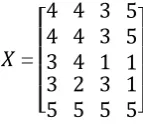
Based on equation 1 determine the decision matrix.
=
[
]
Then calculate the normalized matrix
C1 = (4 + 4 + 3 + 3 + 5) = 19 A11 = 4 : 19 = 0.21
A21 = 4 : 19 = 0.21
A31 = 3 : 19 = 0.16
A41 = 3 : 19 = 0.16
A51 = 5 : 19 = 0.26
C2 = (4 + 4 + 4 + 2 + 5) = 19 A12 = 4 : 19 = 0.21
A22 = 4 : 19 = 0.21
A32 = 4 : 19 = 0.21
A42 = 2 : 19 = 0.11
A52 = 5 : 19 = 0.26
C3 = (3 + 3 + 1 + 3 + 5) = 15 A13 = 3 : 15 = 0.20
A23 = 3 : 15 = 0.20
A33 = 1 : 15 = 0.07
A43 = 3 : 15 = 0.20
A53 = 5 : 15 = 0.33
C4 = (5 + 5 + 1 + 1 + 5) = 17 A14 = 5 : 17 = 0.29
A24 = 5 : 17 = 0.29
A34 = 1 : 17 = 0.06
A44 = 1 : 17 = 0.06
A55 = 5 : 17 = 0.29
C5 = (5 + 1 +5 + 5 + 5) = 21 A15 = 5 : 21 = 0.24
A25 = 1 : 21 = 0.05
A35 = 5 : 21 = 0.24
A45 = 5 : 21 = 0.24
A55 = 5 : 21 = 0.24
From the calculation obtained matrix Xij
0.24 0.29 0.33 0.26 0.26
0.24 0.06 0.20 0.11 0.16
0.24 0.06 0.07 0.21 0.16
0.05 0.29 0.20 0.21 0.21
0.24 0.29 0.20 0.21 0.21
Xij
The next stage determines the weighted decision-making matrix using equation 3.
A11 = 0.21 * 0.2 = 0.0421
A21 = 0.21 * 0.2 = 0.0421
A31 = 0.15 * 0.2 = 0.0315
A41 = 0.15 * 0.2 = 0.0315
A51 = 0.26 * 0.2 = 0.0526
A12 = 0.21 * 0.2 = 0.0421
A22 = 0.21 * 0.2 = 0.0421
A32 = 0.21 * 0.2 = 0.0421
A42 = 0.10 * 0.2 = 0.0210
A52 = 0.26 * 0.2 = 0.0526
A13 = 0.02 * 0.1 = 0.02
A23 = 0.02 * 0.1 = 0.02
A33 = 0.006 * 0.1 = 0.006
A43 = 0.02 * 0.1 = 0.02
A53 = 0.03 * 0.1 = 0.03
A14 = 0.29 * 0.4 = 0.117
A24 = 0.29 * 0.4 = 0.117
A34 = 0.05 * 0.4 = 0.023
A44 = 0.05 * 0.4 = 0.023
A54 = 0.29 * 0.4 = 0.0117
A15 = 0.23 * 0.1 = 0.23
A25 = 0.04 * 0.1 = 0.04
A35 = 0.23 * 0.1 = 0.023
A45 = 0.23 * 0.1 = 0.023
A55 = 0.23 * 0.1 = 0.023
0.024 0.118 0.033 0.053 0.053
0.024 0.024 0.020 0.021 0.032
0.024 0.024 0.007 0.042 0.032
0.005 0.118 0.020 0.042 0.042
0.024 0.118 0.020 0.042 0.042
Dij
Next, calculate the value of benefit (equation 4) and cost (equation 5) index for each alternative.
A1 = 0.042 + 0.042 + 0.020 + 0.118 = 0.222
A2 = 0.042 + 0.042 + 0.020 + 0.118 = 0.222 A3 = 0.032 + 0.042 + 0.007 + 0.024 = 0.104
A4 = 0.032 + 0.021 + 0.020 + 0.024 = 0.096
A5 = 0.053 + 0.053 + 0.033 + 0.118 = 0.256
Calculation of minimizes S- (C5)
A1 = 0.0238
A2 = 0.0048 A3 = 0.0238
A4 = 0.0238
A5 = 0.0238
The total of the Cost attribute, is : 0.100
Table 9 is a calculation of the relative weights of each alternative.
Table 9. Calculation of the relative weights of each alternative
1/ S- i S- * Total (1/ S- i)
42 0.0238 * 378 = 9 210 0.0048 * 378 = 1.8
42 0.0238 * 378 = 9 42 0.0238 * 378 = 9 42 0.0238 * 378 = 9 Total = 378
Specify an alternate priority sequence
Q1 = 0.2219 + (0.1/9) = 0.23
Q2 = 0.2219 + (0.1/1.8) = 0.28
Q3 = 0.1039 + (0.1/9) = 0.11
Q4 = 0.0962 + (0.1/9) = 0.11
Q5 = 0.2562 + (0.1/9) = 0.27
Max (Qi) = 0.28
Calculation of Performance Index (Pi) value for each alternative
P1 = ( 0.23/0.28 ) * 100 =80.98 %
P2 = ( 0.28/0.28 ) * 100 =100.0%
P3 = ( 0.11/0.28 ) * 100 =41.45%
P4 = ( 0.11/0.28 ) * 100 =38.67%
P5 = ( 0.27/0.28 ) * 100 =96.37%
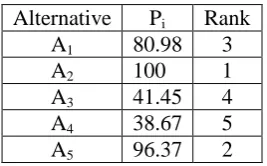
Table 10. Results of COPRAS
Alternative Pi Rank
A1 80.98 3
A2 100 1
A3 41.45 4
A4 38.67 5
A5 96.37 2
From the above alternative calculations then the A5 mango seeds A2-Arummanis was selected as the best
mango seeds.
IV.CONCLUSION
Discussion of the above research can be concluded: 1. Implementation of decision support system by
applying Complex Proportional Assessment (COPRAS) method although simple but able to solve problems well in a selection of mango tree seedlings. 2. Decision makers are able to make better decisions
more effectively.
3. The results obtained from the calculation of this system only as a tool for decision makers the selection of the best mango tree seedlings.
V.
REFERENCES
[1]. Khairul;, M. Simaremare, A. Putera, and U. Siahaan, "Decision Support System in Selecting The Appropriate Laptop Using Simple Additive Weighting," Int. J. Recent TRENDS Eng. Res., vol. 2, no. 12, pp. 215-222, 2016.
[2]. Fadlina, L. T. Sianturi, A. Karim, and A. P. U. Siahaan, "Best Student Selection Using Extended Promethee II Method," Int. J. Recent Trends Eng. Res., vol. 3, no. 8, pp. 21-29, 2017.
[3]. Mesran, K. Tampubolon, R. D. Sianturi, F. T. Waruwu, and A. P. U. Siahaan, "Determination of Education Scholarship Recipients Using Preference Selection Index," Int. J. Sci. Res. Sci. Technol., vol. 3, no. 6, pp. 230-234, 2017.
Support," IJSRST, vol. 2, no. 6, pp. 491-494, 2016.
[5]. Jasri, D. Siregar, and R. Rahim, "Decision Support System Best Employee Assessments with Technique for Order of Preference by Similarity to Ideal Solution," Int. J. Recent TRENDS Eng. Res., vol. 3, no. 3, pp. 6-17, 2017.
[6]. Mesran, G. Ginting, Suginam, and R. Rahim, "Implementation of Elimination and Choice Expressing Reality ( ELECTRE ) Method in Selecting the Best Lecturer ( Case Study STMIK BUDI DARMA )," Int. J. Eng. Res. Technol. (IJERT, vol. 6, no. 2, pp. 141-144, 2017.
[7]. E. Y. Ress., "Performance Evaluation Of Research Assistants By Copras Method," Eur. Sci. J., pp. 102-109, 2016.
[8]. P. Chatterjee, "Gear Material Selection using Complex Proportional Assessment and Additive Ratio Assessment-based Approaches : A Comparative Study," Int. J. Mater. Sci. Eng., vol. 1, no. 2, pp. 104-111, 2013.
[9]. S. Kusumadewi, S. Hartati, A. Harjoko, and R. Wardoyo, Fuzzy Multi-Attribute Decision Making (Fuzzy MADM). Yogyakarta: Graha Ilmu, 2006. [10]. T.-P. Turban, E., Aronson, J., & Liang, Decision
Support Systems And Inteligence System. US: Prentice-Hall, 2005.
[11]. Hasibuan, H.A., Purba, R.B., and Siahaan, A.P.U.: ‘Productivity Assessment (Performance, Motivation, and Job Training) using Profile Matching’, International Journal of Economics and Management Studies, 2016, 3, (6), pp. 73-77 [12]. Perangin-angin, M.I., Fitriani, W., Mayasari, N.,
and Siahaan, A.P.U.: ‘Tuition Reduction Determination Using Fuzzy Tsukamoto’, International Journal of Engineering Science Invention, 2016, 5, (9), pp. 68-72