Practical Approaches to Optimize
Adolescent Immunization
Henry H. Bernstein, DO, MHCM, FAAP, a Joseph A. Bocchini Jr, MD, FAAP, b COMMITTEE ON INFECTIOUS DISEASES
aDepartment of Pediatrics, Cohen Children's Medical Center of New
York, New Hyde Park, New York; and bDepartment of Pediatrics,
Louisiana State University Health Sciences Center, Shreveport, Louisiana
Drs Bernstein and Bocchini were jointly responsible for all aspects of conceptualizing, writing, and editing the document; they collaboratively reviewed and responded to questions and comments from all reviewers, including the AAP Board of Directors, and approved the fi nal manuscript as submitted.
This document is copyrighted and is property of the American Academy of Pediatrics and its Board of Directors. All authors have fi led confl ict of interest statements with the American Academy of Pediatrics. Any confl icts have been resolved through a process approved by the Board of Directors. The American Academy of Pediatrics has neither solicited nor accepted any commercial involvement in the development of the content of this publication. Clinical reports from the American Academy of Pediatrics benefi t from expertise and resources of liaisons and internal (AAP) and external reviewers. However, clinical reports from the American Academy of Pediatrics may not refl ect the views of the liaisons or the organizations or government agencies that they represent.
The guidance in this report does not indicate an exclusive course of treatment or serve as a standard of medical care. Variations, taking into account individual circumstances, may be appropriate. All clinical reports from the American Academy of Pediatrics automatically expire 5 years after publication unless reaffi rmed, revised, or retired at or before that time.
DOI: 10.1542/peds.2016-4187
Address correspondence to Henry H. Bernstein, DO, MHCM, FAAP. E-mail: [email protected]
PEDIATRICS (ISSN Numbers: Print, 0031-4005; Online, 1098-4275).
Copyright © 2017 by the American Academy of Pediatrics
abstract
With the expansion of the adolescent immunization schedule during the past decade, immunization rates notably vary by vaccine and by state. Addressing barriers to improving adolescent vaccination rates is a priority. Every visit can be viewed as an opportunity to update and complete an adolescent’s immunizations. It is essential to continue to focus and refi ne the appropriate techniques in approaching the adolescent patient and parent in the offi ce setting. Health care providers must continuously strive to educate their patients and develop skills that can help parents and adolescents overcome vaccine hesitancy. Research on strategies to achieve higher vaccination rates is ongoing, and it is important to increase the knowledge and implementation of these strategies. This clinical report focuses on increasing adherence to the universally recommended vaccines in the annual adolescent immunization schedule of the American Academy of Pediatrics, the American Academy of Family Physicians, the Centers for Disease Control and Prevention, and the American Congress of Obstetricians and Gynecologists. This will be accomplished by (1) examining strategies that heighten confi dence in immunizations and address patient and parental concerns to promote adolescent immunization and (2) exploring how best to approach the adolescent and family to improve immunization rates.
CLINICAL REPORT
Guidance for the Clinician in Rendering Pediatric CareINTRODUCTION
Immunization is a key preventive cornerstone of pediatric care. 1 Current data show a need for improvement in adolescent immunization rates. 2 Healthy People 2020 lists 3 adolescent health indicators, which focus on the proportion of adolescents who have (1) well visits, (2) medical insurance, and (3) vaccination coverage. 3 Unfortunately, there is a notable downward trend in health care utilization from childhood to early adulthood. One study found that the overall rate for any health care utilization was 88%, 83%, and 72% for 0- through 11-year-olds, 12- through 17-year-olds, and 18- through 25-year-olds, respectively. 4 Another study documented that early adolescents (11 through 14 years of age) had 3 times more preventive visits than late adolescents.5 Without
a consistent source of care, young adults have significantly lower rates of overall health services usage, lower rates of office-based utilization, 6 and higher rates of emergency department visits. These trends in health care utilization underscore the importance of the establishment of a longitudinal relationship within a medical home. It has been suggested that the adolescent immunization schedule would draw even more adolescents to the pediatrician’s office, where additional necessary screening and preventive services could be performed. 7, 8 Familiarity with this information should enable pediatricians to create better
implementation strategies to enhance vaccine coverage. An overview of the epidemiology, current recommendations, and barriers associated with the adolescent immunization schedule is discussed in a separate clinical report, “The Need to Optimize Adolescent
Immunization” (www. pediatrics. org/ cgi/ doi/ 10. 1542/ peds. 2016- 4186).
Physician recommendation and explanation are essential to boosting immunization rates. Yet, strikingly, up to 65% of parents reported not receiving a recommendation from a health care provider for immunizations. 9 The major reason for nonreceipt of tetanus toxoid, reduced diphtheria toxoid, and acellular pertussis, adsorbed (Tdap), and meningococcal vaccines was lack of health care provider recommendation. In a 2009 survey, 87.9% and 90.6% of parents whose
children did not receive the Tdap and meningococcal vaccines, respectively, reported not receiving a recommendation. Nonreceipt of human papillomavirus (HPV) vaccine was associated with a perception that the vaccine was “not necessary.” Similarly, a 2013 study revealed that only 64.4% of parents of girls and 41.6% of parents of boys reported receiving a recommendation for the HPV vaccine from their child’s health care provider. 10 Table 1 lists the major reasons for not receiving Tdap, meningococcal, and HPV vaccines. Parents were significantly more likely to report the intention to vaccinate their child if they received a health care provider recommendation, compared with parents who received no provider recommendation (48.9% vs 33.6%; P < .001).
The reader is advised to refer to the American Academy of Pediatrics (AAP) Training Guide ( https:// shar. es/ 1JRNmJ) and the Practice Procedure Manual as well as AAP immunization resources (www2. aap. org/ immunization/ pediatricians/ pdf/ TopStrategiesforI ncreasingCoverage . pdf) for useful resources to help improve immunization rates. In addition, the Centers for Disease Control and Prevention (CDC) lists quality-improvement projects and educational materials for providers (http:// www. cdc. gov/ vaccines/ ed/ index. html). The Immunization Action Coalition also has made available a checklist of suggestions to improve immunization rates
(“Suggestions to Improve Your Immunization Services”; available at: http:// www. immunize. org/ catg. d/ p2045. pdf). Figure 1 shows the major strategies that can be used to overcome barriers and improve immunization rates in adolescents, which will be discussed in further detail in this report.
STRATEGIES FOR IMPROVING ADOLESCENT VACCINATION RATES
Every encounter should be viewed as a potential opportunity to immunize. 2 In a 2010 survey, primary care physicians indicated that they often relied on vaccine-only visits and nurse prompts to identify and address vaccine need. Strategies physicians reported they would consider using, but had not implemented, included patient reminder/recall systems and electronic health record prompts. 11, 12 Through advancements in electronic health records, providers can set reminders for immunizations and make a patient’s immunization record accessible during any visit. 13 Providers can also set up a reminder/ recall system, which consists of sending reminders about upcoming recommended vaccines to patients along with recalls that encourage patients who are overdue for vaccines to return to the office for appropriate immunization. These population health management activities have the potential to be powerful and cost-effective tools.
TABLE 1 Major Reasons Parents Report Nonreceipt of Tdap, MenACWY, or HPV Vaccines
Reasons No Provider Recommendation, % (95% CI) With Provider Recommendation, % (95% CI)
Tdap MenACWY HPV Tdap MenACWY HPV
Provider did not recommend 33.7 (28.3–39.6) 49.1 (46.5–51.7) 16.3 (13.0–20.2) N/A N/A N/A
Lack of knowledge 23.7 (18.5–29.9) 19.1 (17.1–21.3) 17.0 (13.9–20.7) 32.6 (15.9–55.2) 7.4 (4.8–11.2) 22.3 (16.4–29.5) Not necessary 20.8 (16.1–26.5) 18.3 (16.2–20.7) 20.4 (17.5–23.7) 15.0 (7.1–29.0) 18.2 (13.5–24.1) 15.3 (11.6–19.9) Not age appropriate 5.8 (3.1–10.4) 4.4 (3.4–5.6) 5.8 (4.5–7.5) 5.7 (1.7–17.3) 15.2 (11.4–20.0) 7.2 (4.5–11.2)
Not a school requirement 1.9 (0.9–3.8) 5.7 (4.5–7.2) N/A 0.7 (0.1–5.0) 5.6 (3.2–9.6) N/A
Not sexually active N/A N/A 19.1 (16.3–22.3) N/A N/A 20.1 (15.9–25.1)
Overcoming Vaccine Hesitancy
Vaccine hesitancy in adolescent health care can be challenging to address. 14 The AAP has recently published a clinical report that provides information for pediatricians to address vaccine-hesitant parents. 14 The following are important approaches that providers should use to increase vaccination rates:
1. Strongly endorse all universally recommended vaccines as important for adolescents’ health. Offering immunizations as optional opens the door for vaccine dismissal. The health care provider should inform the patient and family about which vaccines are recommended at the current visit. Health care providers also should state the vaccines the
adolescent needs without seeming to favor one vaccine over another. Discussion of any concerns or questions can then begin, if needed.
2. When encountering hesitancy toward a vaccine, answer parents’ questions and concerns and remain unwavering, as medically appropriate. By asking an open-ended question, such as “What concerns do you have?, ” the health care provider can allow for better dialogue. Parents who ask questions may not be hesitant; they may be seeking more
information. Health care providers should always remember that immunizations are the core of preventive care. It is important to emphasize, “This is my job in helping you care for your child: to inform you of the recommended
vaccines and the diseases they prevent, and thereby protect your child the best way we can.”
3. Focus on the benefits of the vaccine. Educating the patient and family on the diseases that vaccines prevent is key. For example, patients and families are more likely to be receptive if the health care provider informs them and reinforces the fact that HPV vaccine can prevent cancer, that Tdap vaccine can prevent pertussis, and that meningococcal vaccine can prevent meningitis. Up-to-date information on current events and disease outbreaks is a tool to bring into the conversation about vaccines as well. Health care providers also can increase parental confidence and trust in vaccines by mentioning that they
FIGURE 1
give the same vaccines to their families.
4. Make the family aware of when the vaccines are needed. In addition to informing the family which vaccines the child needs or why they are needed, it is important for the health care provider to review the appropriate timeline for completing the vaccine series. For example, it is important for parents to be aware of the ages when HPV vaccine can be given, when to return for each dose in the series, and the importance of receiving the vaccine before a teenager is likely to be exposed to HPV through sexual activity. Follow-up immunization visits should be scheduled before the family leaves the care setting.
5. If vaccine refusal occurs, persevere. Although it may be challenging, it is important that health care providers offer the vaccine at the next most appropriate time. Perseverance is critical for vaccine uptake and immunization rates. In the Periodic Survey of Fellows (PS 66) conducted by the AAP in 2006 and a follow-up survey in 2013 (PS 84), pediatricians reported that they were able to convince approximately 30% of parents to vaccinate their children after they initially refused. 14 Another observational study found that up to 47% of parents who were initially resistant ultimately accepted vaccines when providers pursued their original recommendations. 15 The health care provider should document vaccine discussions and any vaccine refusal (http:// www. cdc. gov/ vaccines/ hcp/ patient- ed/ conversations/ downloads/ not- vacc- risks- color- office. pdf). The AAP clinical reports on responding to parental refusals of immunization are useful resources
that may assist physicians in overcoming this challenge. 14, 16
In further exploring the reasons for vaccine hesitancy, health care providers assess for vaccine readiness and the parents’ position and feelings on vaccines, emphasize the benefits of vaccines, clarify misconceptions, and determine whether there is a lack of understanding or education about a specific vaccine. It is also important to consider the beliefs, misperceptions, and concerns among specific ethnic populations and to be aware that culturally tailored, translated information can help inform strategies to improve adolescent vaccine uptake in these populations. 17 Sharing related statistics and educational material can be helpful, but information overload should be avoided. The concept of “chunking and checking” refers to the provision of information in small chunks followed by checking the person’s understanding. This technique contrasts with the common practice of providing much larger amounts of information before checking, which can lead to information overload. 18 Although 1 randomized trial did not show an effect of physician-targeted communication interventions on vaccine hesitancy, these suggestions can be helpful, even though their effects are not proven. 19 Most important, physicians should avoid confrontation, reflect on and
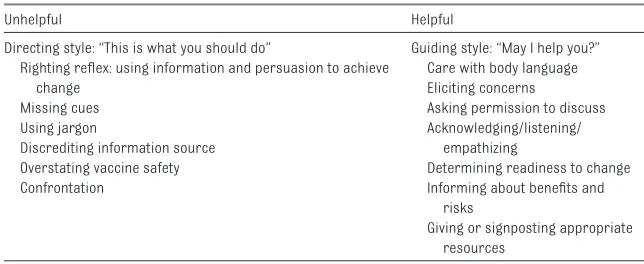
summarize the conversation, and schedule follow-up to reinforce the value of immunization. Table 2 lists helpful and unhelpful strategies in navigating a vaccine discussion.
Approaching the Adolescent Patient in the Offi ce Setting
Adolescents should be encouraged to follow the AAP preventive health care recommendations for routine visits; every visit can be viewed as an opportunity to update and complete an adolescent’s immunizations. 2, 20 Adolescent health visits are enhanced by fostering and maintaining a relationship with both the parent and the adolescent. Education about adolescent health issues should be a highlight of each encounter. A portion of the adolescent visit should be between the health care provider and the adolescent without the presence of a parent. To the extent permitted by applicable law, confidentiality is important and should be emphasized to all adolescents so they feel more comfortable sharing their perspectives. Health care providers can reduce vaccine hesitancy by establishing rapport and a supportive relationship with patients and by providing appropriate education. 21
Understanding adolescent cognitive development will facilitate the interaction with adolescents and their health care. The adolescent years are a stage in which the mind is developing and adolescents begin to acquire reasoning skills
TABLE 2 Unhelpful and Helpful Strategies
Unhelpful Helpful
Directing style: “This is what you should do” Guiding style: “May I help you?” Righting refl ex: using information and persuasion to achieve
change Missing cues Using jargon
Discrediting information source Overstating vaccine safety Confrontation
Care with body language Eliciting concerns
Asking permission to discuss Acknowledging/listening/
empathizing
Determining readiness to change Informing about benefi ts and
risks
Giving or signposting appropriate resources
and the ability to think abstractly. Adolescents may not perceive the consequences of risk-taking behavior. They also are in a period in which they seek independence and strive to obtain such independence. It is important to be aware of the aforementioned adolescent framework and to be attuned to the adolescent’s needs during office visits. 22
Motivational interviewing is a strategy that can be used when approaching the adolescent patient and family. 23 It is “a collaborative, person-centered form of guiding to elicit and strengthen motivation for change.” 24 Motivational interviewing is anticipated to result in changing behavior and encouraging self-reflection. The idea behind motivational interviewing is to allow the patient and parents to come to their own conclusion regarding the importance of and need for immunization. This behavioral change occurs by having the parent reflect on the need to protect the adolescent against preventable diseases (eg, cervical cancer and meningitis). Motivational interviewing can be used to improve vaccine acceptance and overcome hesitancy.
The core skills used in motivational interviewing include the following:
• asking open-ended questions, • affirming the patient’s efforts and
strengths,
• being a reflective listener, and • assessing readiness to change.
Approaching the Parent in the Offi ce Setting
To optimize adolescent
immunization, it is necessary to understand the range of parental attitudes toward vaccines. By doing so, providers are then able to address potential dilemmas. Approximately 40% of initially
vaccine-hesitant parents stated that health care provider information and reassurance were major reasons why they changed their mind. 21
Table 3 lists Halperin’s 8-step approach in responding to parents when encountering vaccine hesitancy. 25 The best approach to handling vaccine-hesitant parents requires understanding the common reasons for vaccine hesitancy and recognizing the types of vaccine-hesitant parents. This knowledge will then enable the health care provider to navigate and direct the vaccine conversation down different paths depending on the type of hesitancy that is being encountered.
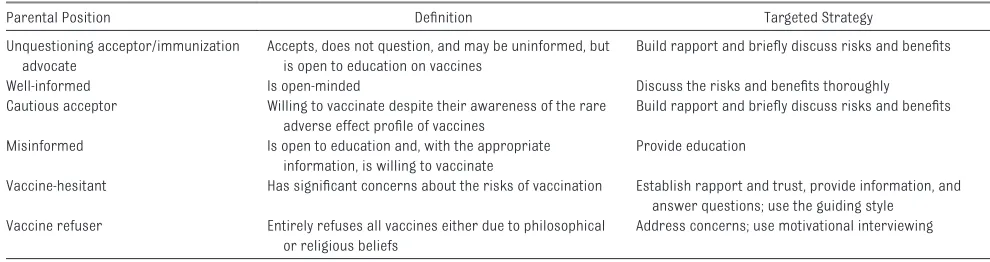
There have been attempts to classify the different types of parental positions toward vaccines. 26–28 The following is a summary of the different parental positions ( Table 4):
1. The parent who accepts, does not question, and may be uninformed, but is open to education on vaccines, 25 is considered to be the unquestioning acceptor 18 or the immunization advocate. 26 These parents may have previously heard about reasons not to immunize but are information seekers and want to hear the counter-argument from a vaccine-supporting health care provider. 25
2. The well-informed parent who is open-minded. These parents have a fair amount of knowledge and are considered to be “well read” regarding vaccine issues. 25 These
parents are willing to vaccinate with the appropriate information and facts. Discussing the risks and benefits thoroughly is necessary to enable vaccine acceptance. Parents may often have “phased agreement to immunization, ” meaning that they accept more vaccines over time. 25
3. The parent who is the cautious acceptor is willing to vaccinate despite their awareness of the rare adverse effect profile of vaccines. 25
4. The misinformed parent who is open to education and, with the appropriate information, is willing to vaccinate. 25 These parents have some degree of misinformation from the Internet or media, family, or friends and can be “resistant” to dismiss their originally held beliefs but tend to be “correctable” and open to change. 25
5. The vaccine-hesitant parent has significant concerns about the risks of vaccination. It is important for the health care provider to establish rapport and trust while providing information and answering questions. The parent may not be readily open to vaccine acceptance. This parent may also be viewed as the late or selective vaccinator. This group of parents may “delay or select only some recommended vaccines.” 18
6. The vaccine refuser is the parent who entirely refuses all vaccines because of either philosophical or religious beliefs. 18 These parents can also be described as “convinced and content” with their belief that immunization is not beneficial, but rather harmful. 25 Parents can also be strong opponents of vaccination and “not appreciate the value of immunization.” 25
Strategies aimed toward the diverse parental positions include the following ( Table 4):
TABLE 3 Approaches for Responding to Parents Unsure About Immunization
1. Listen, evaluate, and categorize 2. Recognize legitimate concerns 3. Provide context
4. Refute misinformation 5. Provide valid information
6. Recognize that it is the parents’ decision 7. Educate about potential consequences 8. Make a clear recommendation
1. Building rapport and having brief discussions explaining the benefits and risks of vaccines to the parent who is an unquestioning acceptor or a cautious acceptor.
2. Relying on a “guiding style” when approaching the vaccine-hesitant parent, which refers to having a helping attitude by (a) seeking permission to discuss immunization, (b) addressing concerns, (c) giving appropriate resources, and (d) determining readiness to change. Motivational interviewing can be used here. Providing detailed and up-to-date information on risks and benefits of vaccines is crucial. Furthermore, scheduling an appointment to further discuss the opportunity for immunization at a later visit is ideal.
3. Addressing concerns and
willingness to change while using motivational interviewing may be a strategy to approach the vaccine refuser.
The use of nonstandard schedules is a common issue when encountering the vaccine-hesitant parent. It is important to work with these parents to make it more likely that immunizations are given at the appropriate time. It is recommended that health care providers explain that the national vaccine schedule protects children, adolescents, and adults against diseases at the youngest age at which a given vaccine’s safety and effectiveness
have been shown. The national schedule has been studied for safety and effectiveness, but nonstandard schedules have not been examined. 29
Health care providers must establish a way to document parental
refusal of vaccines or requests for a nonstandard schedule. The AAP Refusal to Vaccinate Form may be used as a template to document discussion with the parent about the risks of failing to immunize the child (https:// www. aap. org/ en- us/ Documents/ immunization_ refusaltovaccinat e. pdf). Health care providers can also create a manual of resources to better address the vaccine-hesitant parent (see Supplemental Information).
Advocating for HPV Immunization
It is important to highlight all of the universally recommended vaccines in the adolescent immunization schedule, rates of which vary by vaccine. Indeed, because of various unique barriers, HPV vaccine immunization rates have lagged notably behind those of Tdap and meningococcal vaccines. 30 Therefore, the following is a summary of how to approach HPV vaccination and navigate the encounter (see Supplemental Information):
• Emphasize that HPV immunization prevents cancer. This is a major reason that parents accept the vaccine.
• Discuss the vaccine schedule with parents, particularly the
dosing schedule and the ages of administration. In October 2016, a 2-dose schedule for 9-valent HPV was approved by the Advisory Committee on Immunization Practices for individuals 9 through 14 years of age. 31 In a 2014 study by Perkins et al, 32 13% of parents reported that they thought their daughters were “too young” for the vaccine. Health care providers should instead emphasize that it is preferable to deliver the vaccine at a younger age, especially because this elicits a better immune response. Similarly, in a study of over 1500 participants, Iversen et al 33 found that geometric mean antibody titers against all HPV types in the 9-valent HPV vaccine were higher in the 9- through 14-year-old age groups than in the 16- through 26-year-old female adolescents and women. On the basis of these data, the HPV vaccine may potentially be recommended for individuals younger than 11 or 12 years of age in the future. The new dosing schedule also provides added flexibility and incentive because individuals younger than 15 years require only 2 shots compared with individuals older than 15 years who need 3 shots. • Do not delay vaccination, because
this can be detrimental. A recent study cohort showed that both providers and parents tended to delay HPV vaccine until there was a sign that the adolescent was approaching sexual activity.
TABLE 4 Summary of Parental Attitudes
Parental Position Defi nition Targeted Strategy
Unquestioning acceptor/immunization advocate
Accepts, does not question, and may be uninformed, but is open to education on vaccines
Build rapport and briefl y discuss risks and benefi ts
Well-informed Is open-minded Discuss the risks and benefi ts thoroughly
Cautious acceptor Willing to vaccinate despite their awareness of the rare adverse effect profi le of vaccines
Build rapport and briefl y discuss risks and benefi ts
Misinformed Is open to education and, with the appropriate information, is willing to vaccinate
Provide education
Vaccine-hesitant Has signifi cant concerns about the risks of vaccination Establish rapport and trust, provide information, and answer questions; use the guiding style
Vaccine refuser Entirely refuses all vaccines either due to philosophical or religious beliefs
Address concerns; use motivational interviewing
However, attempting to predict when the adolescent will become sexually active is difficult and impractical. In addition, it was noted that actual immunization might not occur at a later time as was previously negotiated between the parents and the health care provider. 32 Adolescents are less likely than other patients to follow up. Therefore, health care providers should view the current encounter with a “now or never” mentality when framing their efforts toward immunizing adolescents.
• Coadminister the HPV vaccine with other vaccines, because this can boost HPV immunization rates. Recommending all the adolescent vaccines at the same time increases adherence to the immunization schedule. It is also more practical to give all vaccines at once, because adolescent patients often do not return for medical care and fail to follow up. Adolescents tend to have low rates of immunization, and health care providers are known to overestimate immunization rates. 32
• State that HPV vaccine is part of the routine immunization schedule. A presumptive delivery strategy is an effective communication approach in which providers present vaccine recommendations as required immunizations to maintain optimal disease prevention. In a randomized clinical trial of 29 pediatric and family medicine clinics in North Carolina, Brewer et al found that practices trained in the presumptive delivery stratedgy exhibited a significant increase in HPV vaccine coverage for individuals 11 or 12 years of age when compared with the control group that did not receive any additional training. In contrast, a conversational delivery strategy did not exhibit a significant increase when compared with control. 34 The presumptive approach may work well with
some parents, however, and pediatricians may use it selectively based on their experience. 14 It is important to overcome the concept that the HPV vaccine is optional. Hull et al demonstrated that mothers and daughters were more receptive to discussion of the HPV vaccine as a routine vaccine that prevents cancer. 35
• Clarify the misconception that HPV vaccine can promote promiscuity, if that is a parental concern.
• Emphasize that HPV vaccine is a safe vaccine. Approximately 200 million doses have been distributed worldwide between 2006 and 2015, 36 and no serious adverse outcome has been
associated with HPV vaccine. 10 The safety of HPV vaccine continues to be monitored through the CDC Vaccine Safety Datalink and the US Food and Drug Administration PRISM programs. The AAP HPV Vaccine Talking Points provides additional information concerning vaccine safety (https:// www. aap. org/ en- us/ my- aap/ advocacy/ workingwiththemed ia/ speaking- tips/ Pages/ HPV- Vaccine. aspx? nfstatus= 200& nftoken= 177fa0a9- 08ac- 4bef- ac1d- a5f52c96bd0f& nfstatusdescripti on= Set+the+cookie+to ken).
Table 5 lists successful techniques in advocating for HPV immunization.
Reducing Missed Opportunities
Missed opportunities for adolescent immunizations are relatively common. Therefore, strategies to reduce missed opportunities are key in improving immunization rates. A retrospective study that reviewed electronic health records showed that there was a significant percentage of missed opportunities for immunization: 82% for meningococcal vaccine, 85% for Tdap, and 82% for the first dose of HPV vaccine. The majority of visits that were considered to
have a missed opportunity were sick visits or nonpreventive visits. 37 Furthermore, health care providers are more attuned to vaccinating younger adolescents than their older counterparts. 38
Most health care visits should be viewed as opportunities to review immunization records, provide vaccines that are due, and catch up on missed vaccinations. The concomitant administration of vaccines, when appropriate, is key to reducing missed vaccination opportunities. For example, in youth with special health care needs, vaccine coverage may be lacking, so concomitant administration of adolescent vaccines could reduce missed opportunities for this
vulnerable population. 39 The majority of vaccines are administered during well-child visits (eg, sports or camp physicals), and several surveys have shown that health care providers do routinely assess immunization status during such visits. 40 However, acute care visits or sick visits in the patient-centered medical home are also an opportunity to deliver vaccines or to discuss upcoming vaccines. 41 Assessing immunization status during sick and acute care visits is important. The Immunization Action Coalition has a valuable parent questionnaire entitled “Screening Checklist for Contraindications to Vaccines for Children and Teens.”
TABLE 5 Successful Techniques in Advocating for HPV Vaccine
Perspectives of parents • Want to prevent cancer • Trust provider recommendations • Think benefi ts outweigh the risks • Want a strong recommendation • Providers should emphasize cancer
prevention
Techniques shared by providers • Normalize the HPV vaccine • Coadminister with other vaccines • Give a strong recommendation
It is feasible for this checklist to be routinely used in the office setting during both well and sick visits. The CDC also has an online quiz for adolescents entitled “What vaccines do you need?, ” which is based on 8 questions that yield a list of vaccines the patient should receive when submitted.
The CDC Web site provides guidance on how to display immunization schedules onto a clinic’s Web site, which can serve as a helpful resource for providers, patients, and families (http:// www. cdc. gov/ vaccines/ schedules/ syndicate. html#easy- read). In addition, the CDC now has an available application for mobile devices entitled “CDC Vaccine Schedule.” The CDC Web site includes a tool for parents and providers to use to look up school immunization requirements. The AAP immunization Web site includes information for providers about case studies on vaccine hesitancy, resources for communicating with families, immunization technology, and vaccine financing, supply, and ordering (https:// www. aap. org/ en- us/ advocacy- and- policy/ aap- health- initiatives/ immunization/ Pages/ default. aspx). Health care providers should promote these resources among their patients and patients’ families.
The College Physicians of Philadelphia has created a Web site on the
history of vaccines, which provides many interactive learning tools on vaccines (historyofvaccines.org) and covers the history of antivaccination movements, with a focus on measles-mumps-rubella, the use of thimerosal, and autism. This information can help decrease parental vaccine refusal.
Using Offi ce-Based Technology
Prompts for Health Care Providers
Health care provider prompts are a useful and effective way to reduce missed opportunities in vaccine delivery. 42–44 Prompts can be electronic, paper-based,
or generated by immunization information systems (previously known as “registries”). The health care provider will see the prompt and then identify whether the adolescent is a candidate for immunization. If the patient is a candidate, the health care provider should then offer the indicated vaccine(s). It is important for electronic health records to incorporate the recommendations of the harmonized immunization schedule of the AAP, the American Academy of Family Physicians, and the CDC.
It is also important to establish continuity and to enable an adolescent to return for a subsequent vaccine dose. This result can be accomplished by direct communication regarding when the subsequent vaccine dose is needed, scheduling a follow-up visit for immunization during the current visit, and providing an after-visit summary to the patient and parent to serve as a reminder of when to return.
Prompts for Patients
Bright Futures handouts can be used in the waiting area or in the examination room to emphasize the value of immunizations in health promotion and disease prevention. The use of tablet computers in the waiting area also has been found to be effective in providing vaccine information to parents, although meaningful engagement with the material was low. 45 Vaccine Information Statements from the CDC can be incorporated on a day-to-day basis in the office setting as well. Pediatric offices should also make use of immunization information systems, because they can offer prompts regarding delayed immunization or whether a certain vaccine is indicated. The use of multiple prompts will maximize vaccine delivery. Another important way to improve vaccine delivery is by educating all staff members on the recommended immunization schedule.
It is helpful for the pediatric office to have access to the adolescent’s daily schedule (ie, being attuned to school hours, extracurricular activities, and work hours) and arrange appropriate office hours. Setting up exclusive immunization clinic days or hours is another strategy that can be incorporated. 46
Reminder/Recall Systems for Patients
Electronic health records and immunization information systems have the capability of running reports listing patients who are due or overdue for immunizations. Delivering reminders via phone call, text, or mail can be a useful way of targeting patients. 47 In a managed care organization serving publicly insured patients, adolescents 11 through 17 years of age who received reminders either by mail or telephone had greater immunization rates for quadrivalent meningococcal conjugate vaccine (MenACWY), Tdap, and HPV vaccine compared with adolescents who received no intervention. For adolescents who were not caught up with vaccinations at the start of the study, uptake significantly increased by 21% for mail-reminder groups and by 17% for telephone-reminder groups versus only 13% for control groups. 48 A study on HPV vaccination rates, conducted in managed care organizations, found that text message reminders had a modest effect on HPV dose 1 rates for those who were able to receive the text message with valid phone numbers in the database. 49 In another study, postal mail, e-mail, or text reminders were used to improve adolescent vaccination rates. All 3 reminder interventions were effective in improving adolescent vaccination rates. Although postal mail reminders were preferred by most parent participants, text messaging and e-mail were the more effective reminder methods. 50
a text-messaging intervention compared with usual care was associated with an increased rate of influenza vaccination. 51 Matheson et al 52 showed that 14% of adolescents and young adults who received text message reminders for their second and third HPV vaccine doses completed the vaccine series at the optimal time, compared with 3% who did not receive the intervention. The study also showed patient and parent support and eagerness for text message reminders. Both adolescents and parents reported that they had easy access to phones, preferred text messages, and found it convenient to communicate via phone.
Another successful way of boosting immunization rates was shown by using an immunization navigator intervention in a notable study, which entailed (1) a patient tracking database, (2) a reminder/recall system, and (3) home visits. 53 The patient tracking database allowed the entry of immunizations and well visits for adolescent patients. Staff members would engage in the reminder/recall system by calling families and mailing letters to notify them about upcoming vaccines and well visits. In addition, transportation would be facilitated. If this measure failed, then the final step would be to approach the patient and family via home visits. The overall immunization rate with the use of this intervention was 44.7% compared with 32.4% for the control group. Preventive care visits also increased among the intervention group compared with the control group: 68% versus 55.2%, respectively. 53 Another method of facilitating vaccine delivery is encouraging providers to schedule all follow-up vaccine appointments to complete a vaccine series, such as that required for HPV vaccine. 38
Extending Care Into School-Based Settings
The use of schools as a pathway to educate and vaccinate adolescents
could be helpful to increasing
immunization rates. Other vaccination sites that can facilitate immunizing adolescents include pharmacies, mobile vans, clinics for substance abuse or obstetrics/gynecology care, and shelters. Electronic recall/ reminder systems may also be used in these alternative vaccination sites. However, all vaccinations in any setting should be documented within the state’s electronic immunization information system.
The School as an Alternative Vaccination Site
School-based sites for vaccine administration offer additional ways of providing preventive care to adolescents 54 –57 and aid in overcoming barriers to access of health care. Models for delivering immunizations in schools include 3 strategies:
• School-based health centers Although some school-based health centers (SBHCs) can meet the definition of the medical home for their patients, SBHCs, in the context of this clinical report, are being used to improve adolescents’ health by helping to ensure that recommended vaccines are received. 58 The school venue is also capable of being a primary source of health education. 59 A better link between the health and educational departments should be fostered. Schools and health departments should offer routine immunizations at minimal expense to the patient, which can benefit individuals with financial barriers. In turn, schools administering vaccines should communicate with primary care clinics with regard to immunizations given. If an adolescent receives a vaccine outside of his or her medical home, such as at an SBHC, appropriate documentation of immunization should be provided to the adolescent for his or her medical home and entered into the state immunization registry, where possible. The CDC provides a vaccine administration template letter that
providers can use (http:// www. cdc. gov/ flu/ school/ school_ located_ vac. htm).
A retrospective study comparing community health centers and SBHCs of the Denver Health System revealed that SBHCs had significantly higher completion rates for the following immunizations in adolescents 12 to 18 years of age 54: hepatitis B (93% vs 84%), Tdap (71% vs 62%), varicella (20% vs 13%), measles-mumps-rubella (89% vs 83%), HPV vaccine for patients aged 16 through 18 years (18% vs 12%), and the HPV vaccine/ Tdap/MenACWY immunization series for female patients aged 16 through 18 years (17% vs 11%). 54 It has also been shown that adolescents who visit SBHCs are more likely to complete the hepatitis B immunization series compared with adolescents who visit hospital-based health centers. 60 SBHCs may represent one means of expanding access to adolescents for vaccinations, and they may serve as a “safety net” for adolescents who do not have reliable access to a medical home elsewhere. 57 Almost two-thirds of juniors in high school who completed a survey about vaccination outside the traditional medical home believe that SBHCs are definitely or probably acceptable locations for vaccinations.61
follows: low-income status, lower educational level, Hispanic ethnicity, residence in the western United States, and speaking a language other than English. 64, 65
•Partnering with local practitioners, community clinics, or other community organizations
Although many schools do not have SBHCs, another model for providing school-located vaccination is partnering schools with public health departments to identify underimmunized adolescents and provide needed vaccines. One study in North Carolina examined the partnership between the school system and the local health department to deliver the HPV vaccine in school-located vaccination clinics. Although HPV vaccine initiation rates among middle school girls did not reach study goals, the involvement of the local health department was key to the success of the school-located vaccination clinic, especially when the school did not have a health center, and the location of the clinic at the host school also increased vaccination rates. 66 Another collaboration between Denver Public Schools and Denver Public Health produced a school-located vaccination program in the 2009–2010 and 2010–2011 school years at 27 elementary and middle schools. The vaccination program successfully increased the proportion of enrolled students who received at least 1 dose of vaccine between the first and second years of the program (elementary school: 28%–31%; middle school: 12%–19%). 67 Billing and reimbursement can be an issue in school-located vaccination programs, but an alternate study in Denver Public Schools found that billing is feasible, and the program increased the likelihood of receipt of Tdap, MenACWY, and HPV vaccines in adolescents. 68 Another program in Florida similarly found that school-located influenza vaccination programs can be economically
sustainable by targeting adequate numbers of privately insured children and reducing costs through volunteers and mass vaccination. 69 • School nurses
School nurses who are part of a school health program that is enrolled as a Vaccines ForChildren program provider play an integral role in achieving and maintaining high coverage of adolescent immunizations. 70 They can be valuable resources for delivering vaccines because of their knowledge of the school and its students, and access to immunization information systems may help increase their ability to provide vaccines to adolescent students. 71 However, school nurses also hold many responsibilities and may not have the time to participate in school-located vaccine programs because of competing job obligations. 72
School Vaccination Requirements
It has been shown in the past that immunization requirements can help increase vaccination rates for some vaccines. 73, 74 Almost all 50 states have implemented immunization requirements for middle school entry, with wide variation. States with vaccine requirements for tetanus-diphtheria (Td)/Tdap and/ or MenACWY had significantly higher immunization rates for the respective vaccines compared with states with no vaccination requirements. 75, 76 Importantly, school entry immunization requirements have also been shown to increase the immunization rates of other vaccines not included in the mandate. For example, states with school entry immunization requirements for Tdap vaccination witnessed approximately a 5% increase in the HPV vaccination rate.77 For more information, the CDC provides a Web site to obtain information on school immunization requirements categorized by child care, kindergarten, middle school, and college/university (http://
www2a. cdc. gov/ nip/ schoolsurv/ schImmRqmt. asp). The Immunization Action Coalition also tracks school requirements (http:// www. immunize. org/ laws/ ).
The Role of AAP Chapters and the CDC
index. html). In addition, the AAP has developed an HPV toolkit to educate other health care professionals, discuss HPV vaccination with parents, and make necessary changes in practice to improve HPV vaccination rates (https:// www. aap. org/ en- us/ advocacy- and- policy/ aap- health- initiatives/ Pages/ HPV- Champion- Toolkit. aspx). The National Foundation for Infectious Diseases has developed a monograph available to providers and has established resource pages for parents, adolescents, and providers (http:// www. adolescentvaccina tion. org). Furthermore, the CDC’s Assessment, Feedback, Incentives, and eXchange (AFIX) program is a quality-improvement program that has had significant success in boosting childhood immunization rates. The program consists of an assessment of vaccine coverage and formulation of goals for improvement. AFIX can be conducted via in-person consultation or via webinar. In a randomized controlled trial in North Carolina, AFIX improved immunization rates in 11- through 12-year-old adolescents by 3 to 4 percentage points for Tdap vaccine, by 4 to 5 percentage points for meningococcal vaccine, and by 2 percentage points for HPV vaccine initiation. 80 AFIX has highlighted that actual immunization rates in a practice might not mirror clinicians’ perceptions of vaccine administration within their practice. To monitor immunization rates, a practice may periodically audit a sample of their patients.
CONCLUSIONS
This clinical report summarizes strategies to increase adolescent vaccination rates and addresses specific populations, technologies, and vaccination sites that are important in achieving this goal. Additional strategies to improve immunization rates need to be further explored and evaluated. Appropriate techniques for
approaching adolescent patients and their parents in the office to encourage immunizations are important skills for health care providers. The key to increasing immunization rates and decreasing vaccine-preventable diseases among adolescents is to focus on educating adolescents and strengthening health care providers’ recommendations by using all clinical opportunities to assess immunization status and provide needed vaccinations.
ACKNOWLEDGMENT
We acknowledge the significant contributions of Angie L. Hernandez, MD, FAAP, Department of Pediatrics, Hofstra Northwell School of Medicine.
AUTHORS
Henry H. Bernstein, DO, MHCM, FAAP Joseph A. Bocchini Jr, MD, FAAP
COMMITTEE ON INFECTIOUS DISEASES, 2016–2017
Carrie L. Byington, MD, FAAP, Chairperson Yvonne A. Maldonado, MD, FAAP, Vice Chairperson Elizabeth D. Barnett, MD, FAAP
James D. Campbell, MD, FAAP H. Dele Davies, MD, MS, MHCM, FAAP Ruth Lynfi eld, MD, FAAP
Flor M. Munoz, MD, FAAP Dawn Nolt, MD, MPH, FAAP
Ann-Christine Nyquist, MD, MSPH, FAAP Sean O’Leary, MD, MPH, FAAP Mobeen H. Rathore, MD, FAAP Mark H. Sawyer, MD, FAAP William J. Steinbach, MD, FAAP Tina Q. Tan, MD, FAAP
Theoklis E. Zaoutis, MD, MSCE, FAAP
FORMER COMMITTEE MEMBERS
Joseph A. Bocchini Jr, MD, FAAP Kathryn M. Edwards, MD, FAAP Dennis L. Murray, MD, FAAP Gordon E. Schutze, MD, FAAP Rodney E. Willoughby, MD, FAAP
EX OFFICIO
David W. Kimberlin, MD, FAAP – Red Book Editor Michael T. Brady, MD, FAAP – Red Book Associate Editor
Mary Anne Jackson, MD, FAAP – Red Book Associate Editor
Sarah S. Long, MD, FAAP – Red Book Associate Editor Henry H. Bernstein, DO, MHCM, FAAP – Red Book Online Associate Editor
H. Cody Meissner, MD, FAAP – Visual Red Book Associate Editor
CONTRIBUTORS
Angie L. Hernandez, MD, FAAP – Department of Pediatrics, Hofstra Northwell School of Medicine Julia Bractic, BA – Research Assistant, Cohen Children's Medical Center of New York Rebecca J. Schneyer, BA – Research Assistant, Cohen Children's Medical Center of New York Catherine Yang, BA – Research Assistant, Cohen Children's Medical Center of New York Patriot Yang, BA – Research Assistant, Cohen Children's Medical Center of New York Tiffany Yang, BA – Research Assistant, Cohen Children's Medical Center of New York
LIAISONS
Douglas Campos-Outcalt, MD, MPA – American Academy of Family Physicians
Amanda C. Cohn, MD, FAAP – Centers for Disease Control and Prevention
Karen M. Farizo, MD – US Food and Drug Administration
Marc Fischer, MD, FAAP – Centers for Disease Control and Prevention
Bruce G. Gellin, MD, MPH – National Vaccine Program Offi ce
Richard L. Gorman, MD, FAAP – National Institutes of Health
Natasha Halasa, MD, MPH, FAAP – Pediatric Infectious Diseases Society
Joan L. Robinson, MD – Canadian Paediatric Society Jamie Deseda-Tous, MD – Sociedad
Latinoamericana de Infectologia Pediatrica (SLIPE) Geoffrey R. Simon, MD, FAAP – Committee on Practice Ambulatory Medicine
Jeffrey R. Starke, MD, FAAP – American Thoracic Society
STAFF
Jennifer Frantz, MPH
ABBREVIATIONS
AAP: American Academy of Pediatrics
AFIX: Assessment, Feedback, Incentives, and eXchange (program)
CDC: Centers for Disease Control and Prevention
HPV: human papillomavirus MenACWY: quadrivalent
menin-gococcal conjugate vaccine
SBHC: school-based health center Tdap: tetanus toxoid, reduced
REFERENCES
1. Committee on Practice and Ambulatory Medicine; Bright Futures Periodicity Schedule Workgroup. 2016 recommendations for pediatric preventive health care. Pediatrics. 2016;137(1):e20153908
2. Schneyer RJ, Yang C, Bocchini JA Jr. Immunizing adolescents: a selected review of recent literature and US recommendations. Curr Opin Pediatr. 2015;27(3):405–417
3. Healthy People 2020. Adolescent health. US Department of Health and Human Services; 2014. Available at: https:// www. healthypeople. gov/ 2020/ data- search/ Search- the- Data. Accessed June 20, 2016
4. Lau JS, Adams SH, Boscardin WJ, Irwin CE Jr. Young adults’ health care utilization and expenditures prior to the Affordable Care Act. J Adolesc Health. 2014;54(6):663–671
5. Rand CM, Shone LP, Albertin C, Auinger P, Klein JD, Szilagyi PG. National health care visit patterns of adolescents: implications for delivery of new adolescent vaccines. Arch Pediatr Adolesc Med. 2007;161(3):252–259 6. Ziv A, Boulet JR, Slap GB. Utilization of
physician offi ces by adolescents in the United States. Pediatrics. 1999;104(1 pt 1):35–42
7. Kharbanda EO, Stockwell MS, Colgrove J, Natarajan K, Rickert VI. Changes in Tdap and MCV4 vaccine coverage following enactment of a statewide requirement of Tdap vaccination for entry into sixth grade. Am J Public Health. 2010;100(9):1635–1640
8. Committee on Infectious Diseases. Recommended childhood and adolescent immunization schedule— United States, 2016. Pediatrics. 2016;137(3):e20154531
9. Dorell C, Yankey D, Strasser S. Parent-reported reasons for nonreceipt of recommended adolescent vaccinations, national immunization
survey: teen, 2009. Clin Pediatr (Phila). 2011;50(12):1116–1124
10. Stokley S, Jeyarajah J, Yankey D, et al; Immunization Services Division, National Center for Immunization and Respiratory Diseases, Centers for Disease Control and Prevention. Human papillomavirus vaccination coverage among adolescents, 2007-2013, and postlicensure vaccine safety monitoring, 2006-2014—United States. MMWR Morb Mortal Wkly Rep. 2014;63(29):620–624
11. Humiston SG, Serwint JR, Szilagyi PG, et al. Increasing adolescent immunization rates in primary care: strategies physicians use and would consider implementing. Clin Pediatr (Phila). 2013;52(8):710–720 12. Fiks AG, Grundmeier RW, Mayne S,
et al. Effectiveness of decision support for families, clinicians, or both on HPV vaccine receipt. Pediatrics. 2013;131(6):1114–1124
13. Sittig DF, Teich JM, Osheroff JA, Singh H. Improving clinical quality indicators through electronic health records: it takes more than just a reminder.
Pediatrics. 2009;124(1):375–377 14. Edwards KM, Hackell JM; Committee
on Infectious Diseases; Committee on Practice and Ambulatory Medicine. Clinical report: countering vaccine hesitancy. Pediatrics. 2016;138(3):e20162146
15. Opel DJ, Heritage J, Taylor JA, et al. The architecture of provider-parent vaccine discussions at health supervision visits. Pediatrics. 2013;132(6):1037–1046
16. Diekema DS; Committee on Bioethics. Responding to parental refusals of immunization of children. Pediatrics. 2005;115(5):1428–1431. Reaffi rmed May 2013
17. Greenfi eld LS, Page LC, Kay M, Li-Vollmer M, Breuner CC, Duchin JS. Strategies for increasing adolescent immunizations in diverse ethnic
communities. J Adolesc Health. 2015;56(5 suppl):S47–S53
18. Leask J, Kinnersley P, Jackson C, Cheater F, Bedford H, Rowles G. Communicating with parents about vaccination: a framework for health professionals. BMC Pediatr. 2012;12:154
19. Henrikson NB, Opel DJ, Grothaus L, et al. Physician communication training and parental vaccine hesitancy: a randomized trial.
Pediatrics. 2015;136(1):70–79 20. Middleman AB, Rosenthal SL,
Rickert VI, Neinstein L, Fishbein DB, D’Angelo L; Society for Adolescent Medicine. Adolescent immunizations: a position paper of the Society for Adolescent Medicine. J Adolesc Health. 2006;38(3):321–327
21. Gust DA, Darling N, Kennedy A, Schwartz B. Parents with doubts about vaccines: which vaccines and reasons why. Pediatrics. 2008;122(4):718–725 22. Sanders RA. Adolescent psychosocial,
social, and cognitive development.
Pediatr Rev. 2013;34(8):354–358; quiz: 358–359
23. Rollnick S, Miller WR, Butler CC.
Motivational Interviewing in Health Care. New York, NY: The Guilford Press; 2008
24. Miller WR, Rollnick S. Ten things that motivational interviewing is not. Behav Cogn Psychother. 2009;37(2):129–140
25. Halperin S. How to manage parents unsure about immunization. Can J CME. 2000;12(1):62–75
26. Gust D, Brown C, Sheedy K, Hibbs B, Weaver D, Nowak G. Immunization attitudes and beliefs among parents: beyond a dichotomous perspective. Am J Health Behav. 2005;29(1):81–92 27. Benin AL, Wisler-Scher DJ, Colson E,
Shapiro ED, Holmboe ES. Qualitative analysis of mothers’ decision-making about vaccines for infants:
FINANCIAL DISCLOSURE: The authors have indicated they do not have a fi nancial relationship relevant to this article to disclose.
FUNDING: No external funding.
the importance of trust. Pediatrics. 2006;117(5):1532–1541
28. Downs JS, de Bruin WB, Fischhoff B. Parents’ vaccination comprehension and decisions. Vaccine.
2008;26(12):1595–1607
29. American Academy of Pediatrics. Immunization Training Guide. Available at: https:// www. aap. org/ en- us/ advocacy- and- policy/ aap- health- initiatives/ immunization/ Pages/ training- guide. aspx. Accessed June 20, 2016
30. Bratic JS, Seyferth ER, Bocchini JA Jr. Update on barriers to human papillomavirus vaccination and effective strategies to promote vaccine acceptance. Curr Opin Pediatr. 2016;28(3):407–412
31. Meites E, Kempe A, Markowitz LE. Use of a 2-dose schedule for human papillomavirus vaccination - Updated recommendation of the advisory committee on immunization practices.
MMWR Morb Mortal Wkly Rep. 2016;65:1405–1408
32. Perkins RB, Clark JA, Apte G, et al. Missed opportunities for HPV vaccination in adolescent girls: a qualitative study. Pediatrics. 2014;134(3). Available at: www. pediatrics. org/ cgi/ content/ full/ 134/ 3/ e666
33. Iversen OE, Miranda MJ, Ulied A, et al. Immunogenicity of the 9-valent HPV vaccine using 2-dose regimens in girls and boys vs a 3-dose regimen in women. JAMA. 2016;316(22):2411–2421 34. Brewer NT, Hall ME, Mato TL, et al.
Announcements versus conversations to improve HPV vaccination coverage: a randomized control trial. Pediatrics. 2017;139(1):e20161764
35. Hull PC, Williams EA, Khabele D, Dean C, Bond B, Sanderson M. HPV vaccine use among African American girls: qualitative formative research using a participatory social marketing approach. Gynecol Oncol. 2014;132(suppl 1):S13–S20
36. Global Advisory Committee on Vaccine Safety. Statement on safety of HPV vaccines. World Health Organization; December 2015. Available at: www. who. int/ vaccine_ safety/ committee/ GACVS_ HPV_ statement_ 17Dec2015. pdf. Accessed June 20, 2016
37. Wong CA, Taylor JA, Wright JA, Opel DJ, Katzenellenbogen RA. Missed opportunities for adolescent vaccination, 2006-2011. J Adolesc Health. 2013;53(4):492–497 38. Oster NV, McPhillips-Tangum CA,
Averhoff F, Howell K. Barriers to adolescent immunization: a survey of family physicians and
pediatricians. J Am Board Fam Pract. 2005;18(1):13–19
39. Reiter PL, McRee AL. Correlates of receiving recommended adolescent vaccines among youth with special health care needs: fi ndings from a statewide survey. Vaccine. 2016;34(27):3125–3131
40. Halpern-Felsher BL, Ozer EM, Millstein SG, et al. Preventive services in a health maintenance organization: how well do pediatricians screen and educate adolescent patients?
Arch Pediatr Adolesc Med. 2000;154(2):173–179
41. Szilagyi PG, Rand CM, McLaurin J, et al; Working Group on Adolescent Vaccination in the Medical Home. Delivering adolescent vaccinations in the medical home: a new era?
Pediatrics. 2008;121(suppl 1):S15–S24 42. Fiks AG, Grundmeier RW, Biggs
LM, Localio AR, Alessandrini EA. Impact of clinical alerts within an electronic health record on routine childhood immunization in an urban pediatric population. Pediatrics. 2007;120(4):707–714
43. Fiks AG, Hunter KF, Localio AR, et al. Impact of electronic health record-based alerts on infl uenza vaccination for children with asthma. Pediatrics. 2009;124(1):159–169
44. Merkel PA, Caputo GC. Evaluation of a simple offi ce-based strategy for increasing infl uenza vaccine administration and the effect of differing reimbursement plans on the patient acceptance rate. J Gen Intern Med. 1994;9(12):679–683
45. Dempsey AF, Maertens J, Beaty BL, O’Leary ST. Understanding how different recruitment strategies impact parent engagement with an iPad-based intervention to provide personalized information about adolescent vaccines. J Adolesc Health. 2015;56(5 suppl):S7–S13
46. Schaffer SJ, Humiston SG, Shone LP, Averhoff FM, Szilagyi PG. Adolescent immunization practices: a national survey of US physicians. Arch Pediatr Adolesc Med. 2001;155(5):566–571 47. Bar-Shain DS, Stager MM, Runkle AP,
Leon JB, Kaelber DC. Direct messaging to parents/guardians to improve adolescent immunizations. J Adolesc Health. 2015;56(5 suppl):S21–S26 48. Szilagyi PG, Albertin C, Humiston SG,
et al. A randomized trial of the effect of centralized reminder/recall on immunizations and preventive care visits for adolescents. Acad Pediatr. 2013;13(3):204–213
49. Rand CM, Brill H, Albertin C, et al. Effectiveness of centralized text message reminders on human papillomavirus immunization coverage for publicly insured adolescents.
J Adolesc Health. 2015;56(5 suppl):S17–S20
50. Morris J, Wang W, Wang L, Peddecord KM, Sawyer MH. Comparison of reminder methods in selected adolescents with records in an immunization registry. J Adolesc Health. 2015;56(5 suppl):S27–S32 51. Stockwell MS, Kharbanda EO, Martinez
RA, Vargas CY, Vawdrey DK, Camargo S. Effect of a text messaging intervention on infl uenza vaccination in an urban, low-income pediatric and adolescent population: a randomized controlled trial. JAMA. 2012;307(16):1702–1708 52. Matheson EC, Derouin A, Gagliano
M, Thompson JA, Blood-Siegfried J. Increasing HPV vaccination series completion rates via text message reminders. J Pediatr Health Care. 2014;28(4):e35–e39
53. Szilagyi PG, Humiston SG, Gallivan S, Albertin C, Sandler M, Blumkin A. Effectiveness of a citywide patient immunization navigator program on improving adolescent immunizations and preventive care visit rates. Arch Pediatr Adolesc Med. 2011;165(6):547–553
55. Golden SD, Moracco KE, Feld AL, Turner KL, DeFrank JT, Brewer NT. Process evaluation of an intervention to increase provision of adolescent vaccines at school health centers.
Health Educ Behav. 2014;41(6): 625–632
56. Kempe A, Barrow J, Stokley S, et al. Effectiveness and cost of immunization recall at school-based health centers.
Pediatrics. 2012;129(6). Available at: www. pediatrics. org/ cgi/ content/ full/ 129/ 6/ e1446
57. Daley MF, Curtis CR, Pyrzanowski J, et al. Adolescent immunization delivery in school-based health centers: a national survey. J Adolesc Health. 2009;45(5):445–452
58. Council on School Health. School-based health centers and pediatric practice.
Pediatrics. 2012;129(2):387–393 59. Dempsey AF, Schaffer S. Middle- and high-school health education regarding adolescent vaccines and human papillomavirus. Vaccine. 2010;28(44):7179–7183
60. Lancman H, Pastore DR, Steed N, Maresca A. Adolescent hepatitis B vaccination: comparison among 2 high school-based health centers and an adolescent clinic. Arch Pediatr Adolesc Med. 2000;154(11):1085–1088
61. Pyrzanowski J, Curtis CR, Crane LA, et al. Adolescents’ perspectives on vaccination outside the traditional medical home: a survey of urban middle and high school students. Clin Pediatr (Phila). 2013;52(4):329–337 62. Clevenger LM, Pyrzanowski J, Curtis
CR, et al. Parents’ acceptance of adolescent immunizations outside of the traditional medical home.
J Adolesc Health. 2011;49(2):133–140 63. Klein JD, McNulty M, Flatau CN.
Adolescents’ access to care: teenagers’ self-reported use of services and perceived access to confi dential care. Arch Pediatr Adolesc Med. 1998;152(7):676–682
64. Middleman AB. Coordinating the delivery of vaccinations and other preventive health care recommendations for adolescents.
Prev Med. 2011;53(suppl 1):S22–S28 65. Strickland BB, Jones JR, Ghandour RM,
Kogan MD, Newacheck PW. The medical home: health care access and impact for children and youth in the United States. Pediatrics. 2011;127(4):604–611 66. Stubbs BW, Panozzo CA, Moss JL, Reiter PL, Whitesell DH, Brewer NT. Evaluation of an intervention providing HPV vaccine in schools. Am J Health Behav. 2014;38(1):92–102
67. Shlay JC, Rodgers S, Lyons J, Romero S, Vogt TM, McCormick EV. Implementing a school-located vaccination program in Denver public schools. J Sch Health. 2015;85(8):536–543
68. Daley MF, Kempe A, Pyrzanowski J, et al. School-located vaccination of adolescents with insurance billing: cost, reimbursement, and vaccination outcomes. J Adolesc Health.
2014;54(3):282–288
69. Tran CH, Brew J, Johnson N, et al. Sustainability of school-located infl uenza vaccination programs in Florida. Vaccine. 2016;34(24):2737–2744
70. Peterson RM, Cook C, Yerxa ME, Marshall JH, Pulos E, Rollosson MP. Improving immunization coverage in a rural school district in Pierce County, Washington.
J Sch Nurs. 2012;28(5):352–357 71. National Association of School Nurses;
National Association of County and City Health Offi cials; Association of State and Territorial Health Offi cials. School-located vaccination clinics. Presented at the NASN, NACCHO, ASTHO Summit. Meeting summary. November 16–17, 2010;1–42. Available at: www. astho. org/ Immunization/ School- Located- Vaccination- Clinics- Meeting- Summary/ . Accessed June 20, 2016
72. Caskey RN, Macario E, Johnson DC, Hamlish T, Alexander KA.
A school-located vaccination adolescent pilot initiative in Chicago: lessons learned. J Pediatric Infect Dis Soc. 2013;2(3):198–204
73. Averhoff F, Linton L, Peddecord KM, Edwards C, Wang W, Fishbein D. A middle school immunization law rapidly and substantially increases immunization coverage among adolescents. Am J Public Health. 2004;94(6):978–984
74. Wilson TR, Fishbein DB, Ellis PA, Edlavitch SA. The impact of a school entry law on adolescent immunization rates. J Adolesc Health. 2005;37(6):511–516
75. Bugenske E, Stokley S, Kennedy A, Dorell C. Middle school vaccination requirements and adolescent vaccination coverage. Pediatrics. 2012;129(6):1056–1063
76. National Vaccine Advisory
Committee. Mandates for adolescent immunizations: recommendations from the National Vaccine Advisory Committee. Am J Prev Med. 2008;35(2):145–151
77. Dempsey AF, Schaffer SE. Human papillomavirus vaccination rates and state mandates for tetanus-containing vaccines. Prev Med. 2011;52(3–4):268–269
78. Reagan-Steiner S, Yankey D, Jeyarajah J, et al. National, regional, state, and selected local area vaccination coverage among adolescents aged 13-17 years - United States, 2014.
MMWR Wkly Rep. 2015;64(29):784–792 79. American Academy of Pediatrics.
Grant will support QI methods to improve HPV vaccination. AAP News. 2014;35(10):26
80. Gilkey MB, Dayton AM, Moss JL, et al. Increasing provision of adolescent vaccines in primary care: a
DOI: 10.1542/peds.2016-4187 originally published online February 6, 2017;
2017;139;
Pediatrics
DISEASES
Henry H. Bernstein, Joseph A. Bocchini Jr and COMMITTEE ON INFECTIOUS
Practical Approaches to Optimize Adolescent Immunization
Services
Updated Information &
http://pediatrics.aappublications.org/content/139/3/e20164187 including high resolution figures, can be found at:
References
http://pediatrics.aappublications.org/content/139/3/e20164187#BIBL This article cites 75 articles, 23 of which you can access for free at:
Subspecialty Collections
_sub
http://www.aappublications.org/cgi/collection/vaccine:immunization
Vaccine/Immunization
b
http://www.aappublications.org/cgi/collection/infectious_diseases_su
Infectious Disease
ous_diseases
http://www.aappublications.org/cgi/collection/committee_on_infecti
Committee on Infectious Diseases
http://www.aappublications.org/cgi/collection/current_policy
Current Policy
following collection(s):
This article, along with others on similar topics, appears in the
Permissions & Licensing
http://www.aappublications.org/site/misc/Permissions.xhtml in its entirety can be found online at:
Information about reproducing this article in parts (figures, tables) or
Reprints
DOI: 10.1542/peds.2016-4187 originally published online February 6, 2017;
2017;139;
Pediatrics
DISEASES
Henry H. Bernstein, Joseph A. Bocchini Jr and COMMITTEE ON INFECTIOUS
Practical Approaches to Optimize Adolescent Immunization
http://pediatrics.aappublications.org/content/139/3/e20164187
located on the World Wide Web at:
The online version of this article, along with updated information and services, is
http://pediatrics.aappublications.org/content/suppl/2017/02/03/peds.2016-4187.DCSupplemental Data Supplement at:
by the American Academy of Pediatrics. All rights reserved. Print ISSN: 1073-0397.