ISSN (e): 2250-3021, ISSN (p): 2278-8719
Vol. 09, Issue 5 (May. 2019), ||S (X) || PP 25-31
AI Based Crime Detection System
A.S. Osan
1, V. Thutheja
2, M. Mulchandani
31(CSE, JIT/ RTMNU, India) 2(CSE, JIT/ RTMNU, India)
Abstract :
In the present time frame, with the extension of advancement and beneficiaries there has been a steady addition in bad behavior. Reliably there is an article about robberies in open areas like ATMs, crisis facilities, malls and even at customary shops. There is an unfaltering need of an eye to watch such dread and prompt the pros meanwhile to endeavor appropriate exercises at the spot when required. We have seen in past that burglaries occur and examinations are done after the bad behavior has happened. Regardless, with the movement in development various open places and shops have CCTV cameras presented which is by and by favorable position. Regardless, still the bad behavior occurs and after the confirmation moves are made about who was the liable party.We have bleeding edge advancements like sensor-based structures at theaters and air terminals for metal recognizable proof that recognize metals and stop the bad behavior. In any case, overseeing such systems at open spots is so far unfeasible. Furthermore, the standard CCTV systems essentially record the situation and store it on the hard drive or on the cloud, there is a need of sending a notice about the bad behavior instantly. Thusly, we are proposing a structure ANTIROBO that through CCTV film uses object acknowledgment framework to distinguish weapons and expeditiously teach the security experts about the case and as such brisk moves can be made. We are using the most capable count YOLOv3 for the reason.
This gadget revelation structure comes as an extra security advantage for the starting at now acquainted security features with improve it as the precision given by this is basically higher involving least conclusions of a middle i3 processor with 3 Gigabytes of RAM and a relentless web affiliation. The huge good position of this structure is it sends the information of the perceived weapon nearby the territory to the owner and the nearest police home office with the objective that the police can make a move.
Keywords :
Fast RCNN, Object detection, Weapon Detection, Yolo, Yolov3.I.
Introduction
The AI BASED CRIME DETECTION SYSTEM is a framework that identifies the weapons by utilizing camera with the goal that we can control and stop theft in wherever like ATM's, banks, shops and so on and subsequent to distinguishing such weapons with culprits, this data will be sent to the expert so they can make a move according to the circumstance.
The working of this framework is firmly related with the investigation of article recognition strategies. We have likewise utilized vision-based strategy since it is a standout amongst the most favored procedure for traffic observations because of its low equipment cost. Item discovery is a procedure of discovering occasion of true articles, for example, weapons. We can utilize neighborhood paired examples; histograms of situated angles and Hough change descriptors. This product can keep running on any framework comprising of least particulars of a center i3 processor with 3 Gigabytes of RAM and a steady web association.
Artificial intelligence BASED CRIME DETECTION SYSTEM won't just support the general population yet in addition the general public. By utilizing this framework, the CCTV observation will be moved to a next dimension. Particularly in rustic regions where the odds of the ATM burglary or if consider bank theft is higher and thus, the guilty party will be accounted for to the experts sooner than previously. With the assistance of this framework the fear episode will decrease to the dimension of degree.
II.
Related Work
The prime reason for execution of this framework is to expand the security in times when the wrongdoing scale is at its pinnacle. This framework gives the direct warning to what game-plan is being prepared in the particular area. The article identification framework has a high rate of exactness relying on the preparation gave to the framework, for example, the items it can identify are the ones we train it for instance, in this AI Based Crime Detection System we focus on the weapons part or the particular instruments sort of articles that are superfluous in a spot like ATM, for example, hammer, screwdriver, blades and so on that are unrelatable to the circumstance, the framework identifies these item by means of the picture it has caught and through likelihood it precisely advises the article being used to the specialist and police and future move can be made after that.
The utilization of the CCTV cameras is done simply after the wrongdoing has occurred. The police specialist utilizes those records for finding the suspect and take the activities as needs be. What's more, utilize those recording as a proof for wrongdoing. However, this proposed framework will help police and specialist to avert and identify the unlawful things occurring around. The time taken in illuminating the police and afterward recording the FIR, and for the police to reach to the specific area will take a ton of time. Along these lines, at whatever point this framework will locate any unlawful activities circumventing then it will inform the individual specialist.
2.1 RCNN Algorithm
Creator - Ross Girshick, Jeff Donahue, Trevor Darrell1, Jitendra Malik's:
As per Ross Girshick, Jeff Donahue, Trevor Darrell1, Jitendra Malik's Article ID execution, as evaluated on the endorsed PASCAL VOC dataset, has leveled in the last scarcely any years. The best-performing techniques are amazing outfit systems that generally join different low-level picture features with anomalous state setting. In this paper, they propose a clear and flexible ID estimation that improves mean typical precision (map) by over 30% in regard to the past best result on VOC 2012—achieving a guide of 53.3%. Their philosophy joins two key bits of learning: one can apply high-limit convolutional neural frameworks (CNNs) to base up district recommendation in order to confine and divide things and when stamped getting ready data is uncommon, coordinated planning for an assistant errand, sought after by region express aligning, yields an important demonstration support. Since they join area proposals with CNNs, they call their system R-CNN: Regions with CNN features. They also present tests that give understanding into what the framework acknowledges, revealing a rich request of picture features.
Starting late, object acknowledgment execution had stagnated. The best performing systems were erratic troupes solidifying distinctive low-level picture features with irregular state setting from thing locators and scene classifiers. This paper shows a direct and flexible article ID count that gives a 30% relative improvement over the best past results on PASCAL VOC 2012.
They achieved this execution through two encounters. The first is to apply high-limit convolutional neural frameworks to base up locale suggestion in order to confine and parcel objects. The second is a perspective for getting ready broad CNNs when named planning data is uncommon. They exhibit that it is significantly convincing to pre-train the framework with supervision—for an assistant undertaking with unlimited data (picture request) and after that to change the framework for the target task where data is uncommon (distinguishing proof). They surmise that the "managed pre-getting ready/space unequivocal finetuning" perspective will be convincing for a variety of data uncommon vision issues.
2.2 FAST R-CNN Algorithm
Creator - Shaoqing Ren, Kaiming He, Ross Girshick, and Jian Sun:
while achieving forefront object disclosure precision on PASCAL VOC 2007, 2012, and MS COCO datasets with only 300 suggestions for each image. In ILSVRC and COCO 2015 competitions, Faster R-CNN and RPN are the foundations of the main spot winning sections in a couple of tracks. By sharing convolutional features with the down-stream area orchestrate, the region suggestion step is nearly sans cost. This system enables a bound together, significant learning-based article ID structure to continue running at close progressing packaging rates. The educated RPN furthermore improves region suggestion quality what's more, as such the general thing distinguishing proof precision.
2.3 YOLO Algorithm Creator - Joseph Redmon:
As indicated by Joseph Redmon and his group, they present YOLO, another approach to manage thing revelation. Prior work on article acknowledgment repurposes classifiers to perform distinguishing proof. Or maybe, they layout object disclosure as a backslide issue to spatially separated ricocheting boxes and related class probabilities. A lone neural framework predicts bouncing boxes and class probabilities clearly from full pictures in a solitary appraisal. Since the whole disclosure pipeline is a lone framework, it might be propelled all the way on acknowledgment execution. Their united plan is extraordinarily speedy. Their base YOLO exhibit frames pictures constantly at 45 plots each second. A more diminutive adjustment of the framework, Fast YOLO, shapes an astounding 155 housings for each second while so far achieving twofold the mAP of other consistent discoverers. Appeared differently in relation to forefront acknowledgment systems, YOLO commits more limitation errors yet is increasingly disinclined to foresee false positives on establishment. Finally, YOLO adjusts general depictions of articles. It beats other recognizable proof procedures, including DPM and R-CNN, while summing up from regular pictures to various spaces like work of art. They present YOLO, a united model for article area. Their model is anything but difficult to create and can be arranged really on full pictures. Not at all like classifier-based systems, YOLO is set up on an incident work that authentically thinks about to recognizable proof execution and the entire model is arranged together. Speedy YOLO is the fastest all-around valuable article locator in the composition and YOLO drives the top tier in persistent article acknowledgment. YOLO in like manner totals up well to new territories making it ideal for applications that rely upon snappy, ground-breaking article area.
2.4 FAST R-CNN Creator - Ross Girshick:
Concurring Ross Girshick, the paper proposes a Fast Region-based Convolutional System method (Fast R-CNN) for thing revelation. Snappy R-CNN develops past work to profitably arrange object recommendation using significant convolutional frameworks. Diverged from past work, Fast R-CNN uses a couple of headways to improve planning and testing speed while in addition growing recognizable proof precision. Brisk R-CNN trains the extremely significant VGG16 orchestrate 9× snappier than R-CNN, is 213× faster at test-time, and achieves a higher guide on PASCAL VOC 2012. Stood out from SPPnet, Fast R-CNN trains VGG16 3× snappier, tests 10× faster, and is progressively exact. Brisk R-CNN is executed in Python and C++ (using Caffe) and is available under the open-source This paper proposes Fast CNN, a flawless and snappy update to R-CNN and SPPnet. Despite reporting state of-the craftsmanship revelation results, they present bare essential preliminaries that they trust give new bits of learning. Of explicit note, small item recommendation appears to improve identifier quality. This issue was unnecessarily extreme (in time) to test already, yet ends up feasible with Fast R-CNN. Clearly, there may exist yet new frameworks that license thick boxes to execute similarly as pitiful suggestions. Such systems, at whatever point made, may help further revive object acknowledgment
III.
Problem Statement
To give better security framework through introduced cameras that are unfit to control or to help ceasing burglary by catching picture of any surprising device utilized inside where cameras are introduced with the apparatus location framework and the caught picture should be send to the related specialist so they can be alert about the circumstance that can be hurtful or unsafe and the moves will be made by police after physically giving grievances by power or giving data by somebody to the police expert.
Proposed Plan
takes numerous days. In any case, imagine a scenario in which we furnish a framework with instrument identification. In this way, we proposed the instrument location framework that recognizes every single abnormal apparatus like weapons that holed by looters and send warning to the police headquarters and we can undoubtedly quit happening theft. The goal is to distinguish the apparatus in spots where costly things are traded and security is given just through cameras. Our framework recognizes those articles and devices that are not commonly utilized in open spots, which are progressively hurtful to open like firearm, blade, and so on. When somebody like looter, cheat get inside the shop or ATM with having weapon like firearm, blade and wear a veil, the introduced cameras just catch the circumstance yet can't control or stop burglary yet with this device we can distinguish the item/weapon to stop theft by sending recognized picture to the adjacent police headquarters for further activities. This instrument when catch picture of hardware or weapon and can subtract foundation picture. This application with the web interface is helpful for better security in spots where costly things are traded. we can likewise stop burglary in houses and furthermore such related spots where cameras are introduced for security reason.
IV.
Implementation
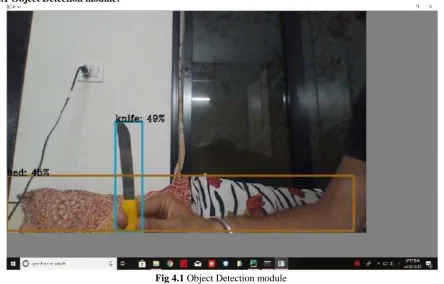
The system that we have developed basically consist of three modules 1.Object Detection Module2.Admin panel 3.User panel
4.1 Object Detection module:
Fig 4.1 Object Detection module
Fig 4.2 YOLO Internal System Layers
YOLO is an Object Detection framework focused for constant preparing which reframe the object discovery as a solitary relapse issue, straight from picture pixels to bouncing box facilitates and class probabilities.First the info picture is separated into a S x S matrix of cells. For each item that is available on the picture. One network cell is said to be responsible for foreseeing it. That is where the focal point of the item falls into. The design was made for use in the Pascal VOC dataset. where the creators utilized S=7, B=2 and C=20. This clarifies why the last component maps are 7x7, and furthermore clarifies the span of the yield (7 x 7 x (2'5+20)). The last layer utilizes a straight actuation work. Every other layer utilizes a defective RELU.YOLO predicts multiple bounding boxes per grid cell. At training time, we only want one bounding box predictor to be responsible for each object. We assign one predictor to be responsible- for predicting an object based on which prediction has the highest current IOU with the ground truth.
Admin Panel:
Fig 4.3 User Interface of Admin Panel
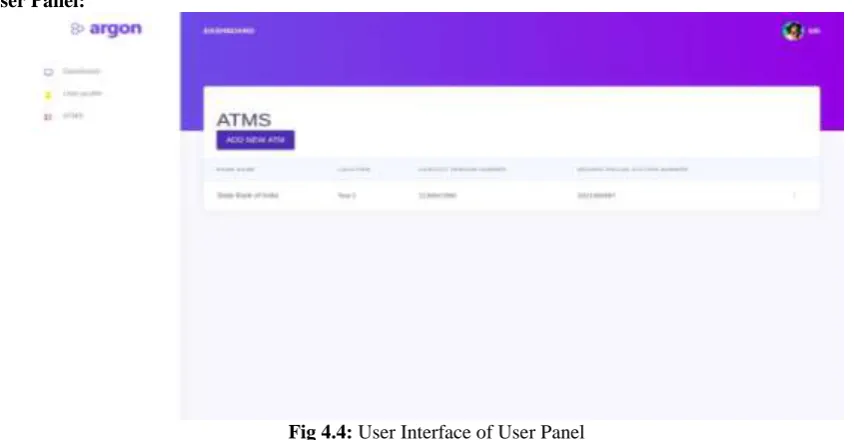
User Panel:
Fig 4.4: User Interface of User Panel
A user is the one who has installed the software in their CCTV cameras so that whenever a weapon is spotted on user place where the camera is installed. They will receive the notification regarding the weapon. Which will help the user to take immediate action on this. The User Interface for admin and user is created using HTML, CSS and JavaScript and server is developed on php. MySQL is used for database to store the data of users branches and notification alerts for unusual activities.
V.
Result
Parameters YOLO9000:Better, Faster & Stronger AI BASED CRIME DETECTION SYSTEM
Prediction Bounding Box Bounding Box
Class Prediction Softmax is used Independent logistic classifiers are used and Binary cross-entropy loss is used
Normalization Batch Batch
Feature Extraction Darknet-19 is used for feature extraction Darknet-53 is used for feature extraction
Real time Notification Not Provided Provided
VI.
Conclusion
The scenario presented here demonstrates the feasibility of real-time tools and the detection of objects with the help of artificial intelligence and machine learning.
The proposed technique is to detect weapons that are not necessary in public places. Our plan is to reduce crimes committed in public places such as robberies, murders, etc., while the purpose of the study is to find all the weapons that are not necessary in public places, which will increase the security of society and decrease the crime rate with the help of technology.
References
[1]. D. Erhan, C. Szegedy, A. Toshev, D. Anguelov, “ Scalable object detection using deep neural networks” , CVPR, 2014.
[2]. R. Girshick, J. Donahue, T. Darrell, J. Malik, “ Rich feature hierarchies for accurate object detection and semantic segmentation” , CVPR, 2014.
[3]. K. Simonyan, A. Zisserman, Very dep convolutional networks for large-scale image recognition” , ICLR, 2015. [4]. Joseph Redmon, Ali Farhadi, “ YOLO9000: Better, Faster, Stronger” 25 Dec 2016.
[5]. Joseph Redmon, Santosh Divvala, Ross Girshick, Ali Farhadi, “ You Only Look Once: Unified, Real-Time Object Detection,” University of Washington, Allen Institute for AI, Facebook AI Research May 2016.
[6]. S. Bell, C. L. Zitnick, K. Bala, and R. Girshick. Insideoutside net: Detecting objects in context with skip pooling and recurrent neural networks. arXiv preprint arXiv:1512.04143, 2015.
[7]. J. Deng, W. Dong, R. Socher, L.-J. Li, K. Li, and L. FeiFei. ImageNet: A large-scale hierarchical image database. In Computer Vision and Pattern Recognition, 2009. CVPR 2009. IEEE Conference on, pages 248– 255. IEEE, 2009.
[8]. M. Everingham, L. Van Gool, C. K. Williams, J. Winn, and A. Zisserman. The pascal visual object classes (voc) challenge. International journal of computer vision, 88(2):303 338, 2010.
[10]. Rohit Kumar Tiwari, Ganendra K. Verma, A Computer Vision based Framework for Visual Gun Detection using Harris Internet Point Detector, pp. 703-712, 2015.