ISSN (e): 2250-3021, ISSN (p): 2278-8719
Vol. 06, Issue 10 (Oct. 2016), ||V1|| PP 07-15
A Method for Design of Product-Related Services to Promote
Commodity Value
Suguru Nozue
1, Masahiro Arakawa
21Graduate School of Engineering, Nagoya Institute of Technology, Japan 2Graduate School of Engineering, Nagoya Institute of Technology, Japan
Abstract: - In the current production environment, it is clear that the inclusion of a service with a product offering is effective in enhancing its commodity value. However, since service design is a creative activity, it is ordinarily difficult for product designers to create a valuable service. In this study, we propose a method to systematically design services for inclusion with a product, to maintain commodity value. In order to evaluate the proposed method, we undertake a case study to design services for inclusion with an electric toothbrush. The results show that the proposed method is effective in creating services and that such services include functions that will maintain commodity value. Furthermore, the proposed method is introduced into educational program in the university and the evaluation of the students shows the proposed method is useful to design valuable services included in products in short period of time.
Keywords: Commodity value, Product design, QFD, Service design, Service dominant logic
I.
INTRODUCTION
In the current production environment, diversity of customer needs and shortening of the product lifecycle force a reduction in the period between product design and preparation for manufacturing, so that newly developed products are available in the market as soon as possible.
In practice, the period between product design and preparation for manufacturing is reduced by introducing numerical simulation methods for product design, and by introducing a common Bill of Materials (BOM) database at different divisions. In addition, an information system for Product Lifecycle Management (PLM) is used to effectively manage different activities in the product life cycle. High-level processes such as product planning and product design are creative activities. Functional requirements of products are defined and are embodied by technical objects in the process. Therefore, high-level processes are strongly influenced by the designer's experience and skill. On the other hand, since most of the value of products is defined during the design process, we need to develop a system that is aimed at designing products for the reduction of process time, while at the same time including a strategy to enhance product value.
It is known that the commodity value of a service in the marketplace can be enhanced by an accompanying service. Although a service is intangible, it could enhance the effectiveness of the product for users by realizing the functions of the product. Development of product-related services denotes a design method related to "service dominant logic" [1-2]. The methods for design of product-related services are discussed from good practices of the products developed in past [3-5]. However, many methods focus on after service of the products [6-7]. If the service is providing necessary functions -that were developed during the product lifecycle- to customers; this aspect could be used for continuous enhancement of the commodity's value in the long run.
In this study, we propose a method to design services for inclusion with a product in order to maintain commodity value in the long run. We perform a case study of an electric toothbrush. In addition, we introduce the proposed method into the educational curriculum for practice experiment in our university and evaluate the effectiveness of the proposed method from the experiment result.
II.
NECESSITY FOR DESIGN OF SERVICE INCLUDED WITH THE
PRODUCT TO MAINTAIN COMMODITY VALUE
the value of the hardware and software, and the value of products could be continuously enhanced in the marketplace.
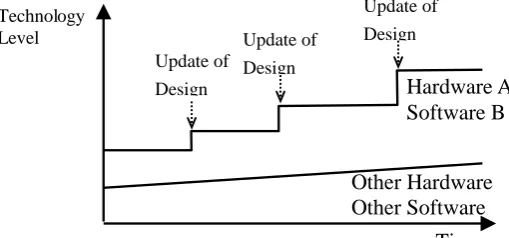
Figures 1 and 2 show schematic diagrams of the proposed management of product design to maintain commodity value in the long run. Figure 1 shows that a product is separated into hardware and software elements, and that core technologies are selected in both areas. Figure 2 shows that the core technologies require development to maintain commodity value in the long run. Since service is an intangible object, service can be realized by low cost. However, it is difficult to maintain the competitive value of services in the long run, since it is easily replicable for other products. In this study, we propose a method to maintain a product's attractiveness for users by designing services that include interaction and exchange of information between users and companies.
III.
CHARACTERISTICS OF DESIGN OF SERVICE INCLUDED
WITH PRODUCT
The design of product-related services is based on a "service dominant logic". This design is superior to a product-based design rooted in "goods dominant logic" with respect to the following characteristics:
(1) Services are intangible, and can therefore embody more types of functions; (2) Services can embody functions at a lower cost than goods; and
(3) High quality functions are easily embodied in services.
We assume that the usage of products is separated into three different periods, namely the periods before, during, and after usage of product. The typical service that is supplied before product usage includes a lecture on how to use the product, while the period after product usage includes an after-service for product repair.During product usage, a service is supplied that is combined with product usage. This service can provide a higher commodity value to users, compared with other services. The design of a service based on service dominant logic is valuable for maintaining commodity value in the marketplace.
Several past studies have focused on service design based on service dominant logic [5, 8]. These studies mainly discuss the concept of service design and the characteristics of the information used in service design, but do not adequately explore a systematic process of service design to maintain product commodity value in the long run. We therefore focus on a system of interaction and information sharing between users and companies, and construct a mechanism to maintain the commodity value of products.
Fig 1: Schematic diagram of selection of core technologies to maintain commodity value in the long run
Fig 2: Schematic diagram of the development of core technologies in product design to maintain commodity value in the long run
Product
Parts/Parts Structure/Modules
(Hardware)
Service (Software)
ervice (ソフト)
A
(Core technology)
B
(Core technology)Technology Level
Time
Hardware A
Software B
Other Hardware
Other Software
Update of Design
Update of Design
IV.
PROPOSAL OF METHOD TO DESIGN SERVICE INCLUDED
WITH PRODUCTIn this study, we introduce the Receiver State Parameter (RSP) [5] and Quality Function Deployment (QFD) [9] to embody the services designed in response to required product functions. RSP is a parameter that represents the state of the user based on the service that was received, as included in the product.
RSP describes the user's state of satisfaction after receipt of a product-related service, and is set to desirable when the service has been received. Therefore, we set the RSP status as desirable at the time of product usage. In addition, we construct a systematic process to ensure that the required functions generated by the RSP are embodied in an appropriate combination of product and service. In this study, users' reviews with respect to existing products are collected for use in product design. Thereafter, product characteristics that received high scores in reviews are analyzed. When many similar positive or desirable sentences are included in the reviews, we conclude that the sentences denote desirable states for users, and we score them according to the number of sentences that were included in all reviews.On the other hand, when many similar negative or undesirable sentences are included in the reviews, we conclude that the inverse of these negative or undesirable sentences are desirable states for users. The negative or undesirable states are evaluated according to the number of sentences.
The RSP is then generated by using the desirable states analyzed from the reviews. Furthermore, scenarios are generated to realize the desirable states according to 4W1H from multiple required items. Here, 4W1H denotes a combination of Who, What, When, Where, and How.
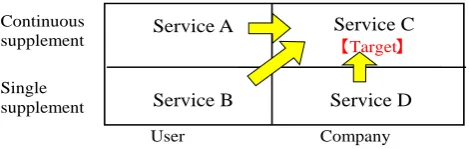
The execution of scenarios follows their generation, and we assume that this will create problems. We create ideas to resolve the problems, and these inform the creation of users' functional requirements. The required functions are deployed by means of a process of QFD.In addition, concrete ideas of products and services are generated by designers from the results of the function deployment. The concrete ideas of products and services are assigned to four categories (which are separated by timing) to act as a resource for value creation and to supply commodity value (see Figure 3). Here, the period of supply (timing) of commodity value is separated into "continuous supplement" and "single supplement." The resource of value creation is separated into "company" and "user."Products and services assigned to the combined area of "continuous supplement" and "company" are selected as a desirable service and product (see Figure 3).We consider the services assigned to the combined area of "continuous supplement" and "company" as useful for companies to continuously perform business with users. Here, "single supplement" denotes the usage of functions that are only included in products after users have bought the products. "Continuous supplement" denotes the continuous creation of new product value by updating and changing the functions included in products after they have been bought. "User" in the resource of value creation denotes the usage of products without the transfer of outside information. On the other hand, "company" in the resource of value creation denotes usage of products with transfer of outside information, or with interaction of information between users and companies.If the generated services are modified for assignment to the area of "continuous supplement" and "company," we consider that the modified services can continuously maintain commodity value for users. Figure 3 shows this modification of services. In this figure, Services A, B, and D are modified and defined as Service C, located at the area of "continuous supplement" and "company." We propose a method to design services for inclusion in products based on service dominant logic, by developing the evaluation process. The process of the proposed method is as follows: Step 1: Collection of reviews and opinions of users with regard to existing products;
Step 2: Extraction of desirable states of users from the reviews and opinions; Step 3: Generation of the RSP and scenarios to realize the desirable states; Step 4: Generation of required functions for expected products;
Step 5: Creation of ideas for services from deploying the required functions by using the QFD process; Step 6: Assignment of the created services to the two-dimensional table constructed by the resource of value
creation and the timing of commodity value;
Step 7: Selection of services assigned to the area of "continuous supplement" and "company" in the table; and Step 8: Creation of services considering the time coordinate.
Fig 3: Assignment of services to different categories in two-dimensional table in the proposed management of product design to maintain the commodity value of the product
Service A
Service B
Service C
【Target】
Service D
User Company Continuous
supplement
Step 8 is aimed at constructing a system to maintain the commodity value of products according to the time coordinate. When the services that are assigned to the area of "continuous supplement" and "company" in Figure 3 are selected, they are useful for collection of information related to the characteristics of users based on interaction between companies and users. Companies can continuously supply appropriate information to users and change the content of the services by evaluating the states of users from the collected data.
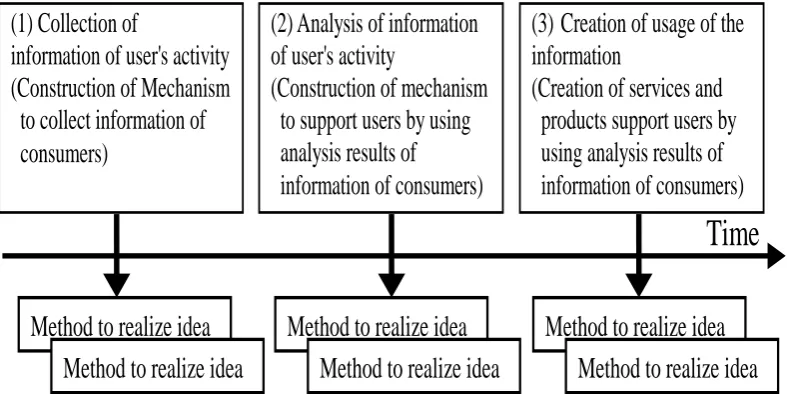
Figure 4 shows a schematic diagram for the creation of services in Step 8. This process consists of three consecutive steps: (1) collection of information of user's activity, (2) analysis of information of user's activity, and (3) creation of usage of the information. In step (1), parts of the required functions of products are generated as services in order to realize the RSP. In step (2), the services that are easily provided for users are created, considering the user interface in order to realize the RSP. In step (3), services are created or modified to maintain the commodity value of products. From these steps, the services include a function to promote interaction between companies and users, and a function of analysis of characteristics of users as well as dynamic adaptive content for users.
V.
CASE STUDY OF SERVICE DESIGN INCLUDED WITH ELECTRIC
TOOTHBRUSH
In order to evaluate the effectiveness of the proposed method, we design the services to be included with an electric toothbrush as case study. We use a total of 256 reviews and opinions of users with regard to 12 products. We explain the design of services according to the steps of the proposed method.
Step 1: Collection of reviews and opinions of users with regard to existing products
Verbs related to "desire" are selected as the representation of a preferable activity. In addition, verbs related to "impossible" are selected as the representation of an unpreferred activity. Words of subjects or objects connected to the selected verbs are collected. Then, the representation of subjects and verbs are reconstructed from the collected words.
Step 2: Extraction of desirable states of users from the reviews and opinions
Relationships of "desire" and "impossible," which are scored highly, are separately selected from the relationships of the words collected in Step 1. Then, the selected relationships are modified into a standard and simplified representation. Here, relationships related to "impossible" are modified to sentences of inverse meaning in order to generate the RSP.
Step 3: Generation of the RSP and scenarios to realize the desirable states
Standard representations of the relationship of noun and verb modified in Step 2 are unified as typical representations of noun and verb. Typical representations of noun and verb are assigned to the four required activities of "Effectiveness," "Motion," "Maintain," and "Selection." Then, the RSP is generated from the characteristics of the separated representations. In this case study, the required functions are generated from sentences of the typical representations as follows:
"Effectiveness:"
Fig 4: Schematic diagram of process to develop service in time coordinate
(1) Collection of
information of user's activity
(Construction of Mechanism
to collect information of
consumers)
(2) Analysis of information
of user's activity
(Construction of mechanism
to support users by using
analysis results of
information of consumers)
Method to realize idea
Method to realize idea
Method to realize idea
Method to realize idea
Method to realize idea
Method to realize idea
Time
(3) Creation of usage of the
information
(S1) Users hope to recognize effectiveness of the product, i.e., the electric toothbrush. (S2) Users hope to clean their teeth every time.
"Motion:"
(S3) Users hope to manipulate the product, i.e., the electric toothbrush, well. "Maintain:"
(S5) Users hope to habituate to polishing their teeth. (S6) Users hope to use products for a long period of time.
Here, sentences of standard representations related to "Selection" could not be generated.
We generate "Users exhibit the habit to clean their teeth by confirming the cleanness of teeth." as the RSP from these sentences.
Step 4: Generation of required functions for expected products
The required functions obtained in Step 3 are used to generate a scenario from the viewpoints of Who, What, How, When, and Where. The functions of the services that are required to resolve the problems included in the scenario are assumed. Then, the services are generated by embodying the functions of services.
In this study, "users confirm the state of their teeth by using a mirror after they have polished teeth in the bathroom" is generated as scenario (S1). "Confirmation of state of teeth" is regarded as a significant problem when this scenario is performed. In order to resolve the problem, (F1) is adopted as the required function of services:
(F1) Users objectively confirm cleanness of their teeth on their own.
Here, the required function (F1) also corresponds to the required function obtained from (S2). Step 5: Creation of ideas for services from deploying the required functions by using the QFD process
The required functions generated in Step 4 are deployed based on the process of QFD, and concrete ideas are created to realize the services. Here, designers focus on the different states influenced by the required functions, while products and services are used to create concrete services from the required functions.
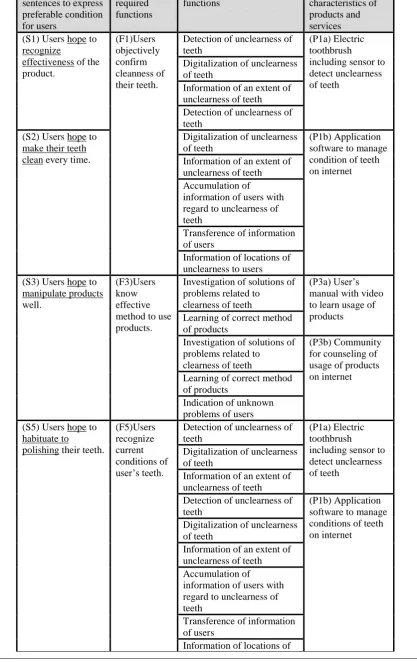
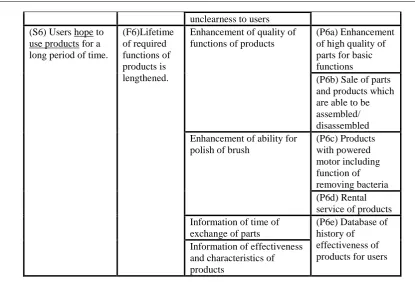
Specific functions are selected from the deployed functions. Here, the specific functions require intervention by companies while the product is being used. Table 1 shows samples of services created from the required functions by using the process of QFD.In this case study, the required functions of (F1) are deployed. Then, two types of combinations of service and product (i.e., the electric toothbrush) are created from the deployed functions as follows:(P1a) Electric toothbrush including sensor to detect teeth that is not clean, (This function is mainly realized by goods, parts, and constructs of parts, in the product.)
(P1b) Application software to manage the condition of teeth on the Internet. (This function is mainly realized by the service included in the product.)
Step 6: Assignment of the created services to the two-dimensional table constructed by the resource of value creation and the timing of commodity value, and
Step 7: Selection of services assigned to the area of "continuous supplement" and "company" in the table Table 2 shows a sample of the resultant table in which the created services are assigned. In Table 2, services (P1b) and (P6e) are selected as final designed services in the area of Service C in order to continuously supply services. Here, (P6e) denotes a database of history of the effectiveness of products for users.
Step 8: Creation of services considering the time coordinate.
Table 1: Creation of services from required functions based on QFD Simplified
sentences to express preferable condition for users
First level of required functions
Second level of required functions
Proposal of characteristics of products and services (S1) Users hope to
recognize
effectiveness of the product. (F1)Users objectively confirm cleanness of their teeth.
Detection of unclearness of teeth
(P1a) Electric toothbrush including sensor to detect unclearness of teeth
Digitalization of unclearness of teeth
Information of an extent of unclearness of teeth Detection of unclearness of teeth
(S2) Users hope to make their teeth clean every time.
Digitalization of unclearness of teeth
(P1b) Application software to manage condition of teeth on internet Information of an extent of
unclearness of teeth Accumulation of information of users with regard to unclearness of teeth
Transference of information of users
Information of locations of unclearness to users (S3) Users hope to
manipulate products well.
(F3)Users know effective method to use products.
Investigation of solutions of problems related to
clearness of teeth
(P3a) User’s manual with video to learn usage of products Learning of correct method
of products
Investigation of solutions of problems related to
clearness of teeth
(P3b) Community for counseling of usage of products on internet Learning of correct method
of products
Indication of unknown problems of users (S5) Users hope to
habituate to
polishing their teeth.
(F5)Users recognize current conditions of user’s teeth.
Detection of unclearness of teeth
(P1a) Electric toothbrush including sensor to detect unclearness of teeth
Digitalization of unclearness of teeth
Information of an extent of unclearness of teeth Detection of unclearness of teeth
(P1b) Application software to manage conditions of teeth on internet Digitalization of unclearness
of teeth
Information of an extent of unclearness of teeth Accumulation of information of users with regard to unclearness of teeth
Transference of information of users
unclearness to users (S6) Users hope to
use products for a long period of time.
(F6)Lifetime of required functions of products is lengthened.
Enhancement of quality of functions of products
(P6a) Enhancement of high quality of parts for basic functions
(P6b) Sale of parts and products which are able to be assembled/ disassembled Enhancement of ability for
polish of brush
(P6c) Products with powered motor including function of removing bacteria (P6d) Rental service of products Information of time of
exchange of parts
(P6e) Database of history of effectiveness of products for users Information of effectiveness
and characteristics of products
Table 2: Sample of the resultant table to which created services are assigned Time to supply commodity value
User Company
Continuous supplement
【Service A】
(P3b) Community for counseling of usage of products on internet
【Service C】
(P1b) Application software to manage condition of teeth on internet
(P6e) Database of history of effectiveness of products for users Single
supplement
【Service B】
(P1a) Electric toothbrush including sensor to detect unclearness of teeth
(P3a) User’s manual with video to learn usage of products
(P6b) Sale of parts and products which are able to be assembled/ disassembled
【Service D】
(P6d) Rental service of products
VI.
PRACTICAL EXPERIMENT IN EDUCATIONAL PROGRAM
The proposed method is introduced into the educational program for undergraduate students in our university in order to evaluate the effectiveness of the method.
In the program, two students make a single group and the class consists of eight groups. The program is performed by four weeks and it takes 90 minutes in the class each week. Two students propose services included in products in three weeks. All groups make presentation about the designed services at the final week. They evaluate the designed service by comparing their own ideas with the ideas of services designed by the other groups at the presentation.
Table 3 shows the comparison result obtained at the presentation. The service of each groups is evaluated by the five levels. In the level, five denotes the most valuable and one denotes the least valuable. The table shows that both questions score more than 3.0. Since many students evaluate that the services designed by other groups are more valuable than their own services, we think that many groups could design valuable services.
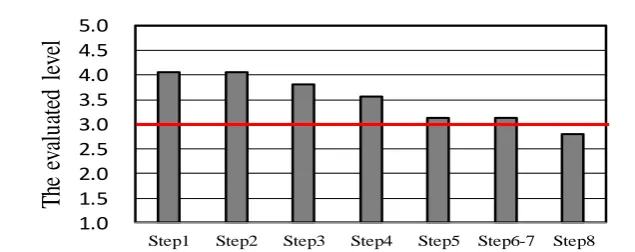
five levels. Five denotes the easiest level and one denotes the most difficult level. The bars denote the average of levels obtained by all students in Fig.5. The figure shows that the students could easily create ideas between Steps 1 and 4, since the evaluated levels are greater than 3.5 at these steps.
On the other hand, the evaluated level of Steps 6 and 7 is less than the levels between Steps 1 and 4 because it is difficult for the students to create suitable ideas of services to different elements in the matrix considering the time coordinate. The evaluated level of Step 8 is less than 3.0. From the result, we need to include a system to analyze characteristics of services considering the time coordinate.
However, these results show that even students, who have not had experience to design product and service, could design valuable service included in products in short period of time by using the proposed method. These results show that the proposed method is useful for even persons who have not had experience to design product and service to design valuable service included in products in short period of time.
Table 3: The evaluation of services designed by the other groups
The designed service is more effective than the service designed by our group 3.54 The originality of the designed service is higher than the service designed by our group 3.57
Fig.5: The levels of difficulty evaluated at different steps
VII.
CONCLUSION
In this paper, a method to design services for inclusion with products is proposed in order to maintain commodity value. In addition, the effectiveness of the method is evaluated through a case study of the design of services included with the electric toothbrush. The case study shows that the proposed method is effective for creating the services included with the product (i.e., the electric toothbrush). Furthermore, the proposed method is introduced into the educational program for undergraduate students in the university in order to evaluate the effectiveness of the method. The evaluation of the students shows the proposed method is useful to design valuable services included in products in short period of time.
In future research, an information system would be constructed to systematically use the proposed method, and the information would be applied to complex problems. In addition, a method to generate required functions in the marketplace would be developed by using Information and Communication Technology (ICT) or Internet on Things (IoT) technology.
VIII.
ACKNOWLEDGEMENTS
This work was supported by the Aid for Scientific Research (C) (15K01186) and Grant-in-Aid for Scientific Research (B) (26282088) from the Japan Society for the Promotion of Science
REFERENCES
[1] Fujikawa, Y., Service Management for Manufacturer: "Service-Dominant Logic" Approach, Panasonic Technical Journal, Vol.58, No.3,2012, 4-9 (in Japanese).
[2] Vargo, S.L., Lusch, R.F., Service-dominant logic: continuing the evolution, J. of. The Acad. Mark. Sci., 36, 2008, 1-10.
[3] Shostack, L.G, How to Design a Service, European Journal of Marketing, Vol.17, No. 1, 1982, 49-63. [4] Uchihira, N., Analysis of Service Businesses in Manufacturing Industry and Role of Knowledge
Processing Technologies, Toshiba Review, Vol.61, No.12, 2006, 2-7 (in Japanese).
1.0 1.5 2.0 2.5 3.0 3.5 4.0 4.5 5.0
Step1 Step2 Step3 Step4 Step5 Step6-7 Step8
T
he
e
va
lu
at
ed
l
ev
el
[5] Shimomura, Y., Hara, T., Watanabe, K., Sakao, T., Arai, T., Tomiyama, T., Proposal of the Service Engineering (1st Report, Service Modeling Technique for the Service Engineering), Transactions of the JSME Series C, 71 (702), 2005, 669-676 (in Japanese).
[6] Kaihara, T., Fujii, N., A Co-evolutional Approach on Service Value Creation with Sales-production Integration, Journal of the Japan Society for Precision Engineering, Vol.78, No.3, 2012, 201-207 (in Japanese).
[7] Shimomura, Y., Service Reliability and Service Engineering (Reliability of Service), the Journal of Reliability Engineering Association of Japan, Vol.31, No.1 (2009), pp.2-9 (in Japanese).
[8] Zhang, Q., Kosaka, M., Shirahada, K., Yabutani, T., A Proposal of B to B Collaboration Process Model based on a Concept of Service and its Application to Energy Saving Service Business, IEEJ Transactions on Electronics, Information and System, 132 (6), 2012, 1035-1040 (in Japanese).