Analysis and Optimization of Parameters of
Dissimilar Metal Welding
Hassan Kutty Nishad Naduthodi
Assistant Professor Student
Department of Mechanical Engineering Department of Mechanical Engineering MEA Engineering College, Kerala, India MEA Engineering College, Kerala, India
Shaimil Fithu Vignesh
Student Student
Department of Mechanical Engineering Department of Mechanical Engineering MEA Engineering College, Kerala, India MEA Engineering College, Kerala, India
Abstract
The aim of our work is to study the hardness that affects the welding joint of dissimilar metals and what are the parameters that attects the welding strength of dissimilar metals. Stainless Steel 304 was welded to mild steel using a metal inert gas welding which also known as gas metal arc is welding with the help of filler wire of stainless steel and also by electric arc welding. Argon gas was used as shielding gas in this process. Dissimilar metals welding have great scope in advanced technology nowadays owing to their high hardness, high strength and corrosion resistance properties. The welding voltage had a significant effect on the welding process, as higher voltage resulted in poorer appearance of the weld joint and led to defects for both type of samples, such as porosity and incomplete fusion. The hardness values of the welded seams in all the samples range from 249 to 292 HV in Vickers hardness and 29 to 37 HV in Rockwell hardness test, respectively. The fracture in the tensile test yielded the highest tensile strength of 489.1MPa for MIG welded specimen with ER304. The tensile strength of MIG Welded test sample has higher range of tensile strength than electric arc welded specimen. Based on the investigation throughout this study, it can be concluded that the welding voltage had a significant effect on the welding process.
Keywords: MIG, Butt-Joint, Dissimilar Welding, Mild Steel, Stainless Steel, Mechanical Property
________________________________________________________________________________________________________
I. INTRODUCTION
The stainless steel is one of the most popular materials for structural applications, due to their excellent physical properties but increase the structural cost. The additional benefits and the design codes of stainless steels have focused their industrial use for conventional structural engineering applications such as civil construction, nuclear reactors, thermal power plants, vessels and heat exchangers for several industrial applications. The better joint efficiency, simple process, low fabrication cost, welding reliability and efficient metal joining process are essential for production of many engineering and structural components. The metallurgical changes such as micro-segregation, precipitation of secondary phases, presence of porosities, solidification cracking, grain growth in the heat affected zone and loss of materials by vaporization are the major problems which produces poor mechanical properties in stainless steel welds. Besides that, this type of joining offers the potential to utilize the advantages of different materials, which often produces a whole structure with unique mechanical properties. Even so, the dissimilar welding process yields unwanted disadvantages in the weld joint, such as brittle intermetallic reaction phase formation at elevated temperatures the defects that may occur in the specimens of this project are due to the large difference between the melting points of the metals, thermophysical properties. Furthermore, differences in thermophysical properties, such as expansion coefficient, conductivity and specific heat, can lead to residual stresses after fusion welding the weld joint is the most important area and is heavily affected by the selection of filler metals. Several researches have shown that the selection of the filler metal to use in the welding process is crucial to the weld joint, as some fillers add to the base metal elements to improve the properties of the weld metals. However, no empirical study has been conducted to compare the effect of mild steel fillers and stainless steel fillers on mild steel-stainless steel metal inert gas (MIG) welding. This project looks into the effect of welding fillers on the quality of the weld joint and optimizing the parameters used for the different welding technique and mechanical properties of the weld joints are also investigated.
II. EXPERIMENTAL MATERIALS & METHODS
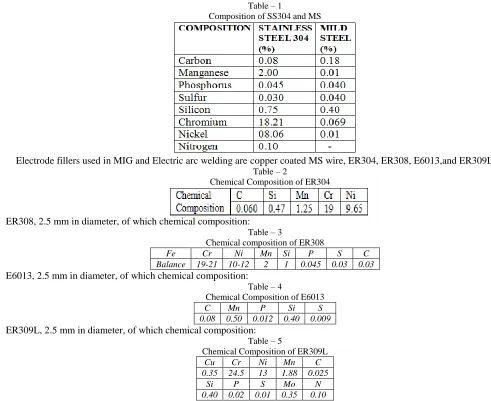
Table – 1
Composition of SS304 and MS
Electrode fillers used in MIG and Electric arc welding are copper coated MS wire, ER304, ER308, E6013,and ER309L Table – 2
Chemical Composition of ER304
ER308, 2.5 mm in diameter, of which chemical composition: Table – 3
Chemical composition of ER308
Fe Cr Ni Mn Si P S C
Balance 19-21 10-12 2 1 0.045 0.03 0.03 E6013, 2.5 mm in diameter, of which chemical composition:
Table – 4
Chemical Composition of E6013
C Mn P Si S
0.08 0.50 0.012 0.40 0.009 ER309L, 2.5 mm in diameter, of which chemical composition:
Table – 5
Chemical Composition of ER309L
Cu Cr Ni Mn C
0.35 24.5 13 1.88 0.025
Si P S Mo N
0.40 0.02 0.01 0.35 0.10
Stainless steel and mild steel were butt-welded using an MIG welding and also by electric arc welding. Two different sets of specimens were fabricated during the welding process for the tensile test and as well as a hardness analysis. Total five number of test samples are created with the above described filler metals and welding technique as shown in the table7
Mild Steel:
Mild steel is the most common form o steel because its price is relatively low while it provides material properties that are acceptable for many applications. Mild steel contains 0.16–0.29%carbon; therefore it is neither brittle nor ductile. Mild steel has a relatively low tensile strength, but it is cheap and malleable; surface hardness can be increased through carburizing. It is often used when large amounts of steel are needed, for example as structural steel. The density of mild steel is approximately 7.85 g/cm3 (0.284 lb/in3) and the Young's modulus is 210,000 MPa (30,000,000 psi).
Stainless Steels:
Type 304 Stainless Steels are well known in reference literature and more information can be obtained in this way.304 is a variation of the basic 18-8 grade Type 302, with a higher chromium and lower carbon content. Lower carbon minimizes chromium carbide precipitation due to welding and its susceptibility to inter granular corrosion. 304L is an extra low-carbon variation of Type 304 with a 0.03% maximum carbon content that eliminates carbide precipitation due to welding.
Table – 6
Parameters used in MIG welding process
PARAMETERS SPECIFICATON MIG
Shielding Gas Type Ar and CO2 (98% & 2% )
Current
Type DC
Polarity Electrode Negative Current Range 60-400 Amps Voltage Range 26-56 Volts
Pass Type Multiple
Electrode Number Single
Type of wire Copper Coated MSWire
The Vickers hardness test and Rockwell hardness and tensile test were conducted to analyze the mechanical properties of the samples. The Vickers hardness profile across the base metals and fusion zone was observed using the hardness tester with 30 kgf for 10 seconds dwell time. On the other hand, the fracture behavior was analyzed using a Universal Testing machine with 400 kN capacity. The tensile specimens were prepared with reference to ASTM D1002, namely for the lap shear test specimens.
Table – 7
Test sample prepared by MIG and electric arc welding
TS1,TS2 are prepared by MIG Welding technique and other samples are prepared by electric arc welding techniques.
III. RESULT & DISCUSSION
The welding of stainless steel was carried out with mild steel, the tensile test and hardness test was carried out for each welded samples of MIG and Electric arc welding processes.
Tensile Test
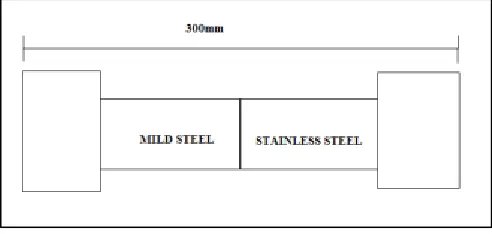
Tensile testing was carried out using Universal Testing Machine of 400 KN capacity and the geometry of the test specimen is as shown in Fig. 1.
Fig. 1: Schematic diagram of SS and MS for tensile test
Mechanical proprieties of MIG welded and electric arc welded dissimilar welds of, stainless steel and mild steel after tensile test are tabulated in Table 8 and 9 respectively. Tensile strengths of welded test samples vary from 337 to 482MPa depending upon the welding conditions. All the specimens broke in the weld region
Table – 8
Table – 9
Mechanical Properties of MIG welded SS and MS sample.
Chart 1: UTS and YS of test samples.
Hardness Test
Vickers Hardness
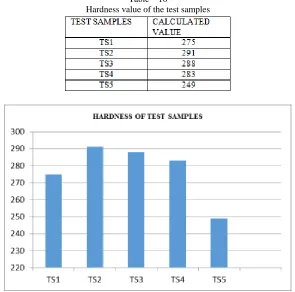
The Vickers hardness pattern across the base materials and the welded seam is measured using a macro hardness tester.. For the MIG welded seam, the average hardness value ranges between 275 and 292 HV. As for the Electric arc welding, the average hardness value ranges between 248 and 288 HV. The hardness value for MIG welded samples is higher than that of electric arc welded samples.
Table – 10
Hardness value of the test samples
Rockwell Hardness
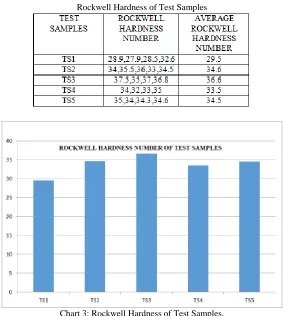
Rockwell scale is a hardness scale based on the indentation hardness of a material. The Rockwell test determines the hardness by measuring the depth of penetration of an indenter under a large load compared to the penetration made by a preload. When testing metals, indentation hardness correlates linearly with tensile strength.
Table – 11
Rockwell Hardness of Test Samples
Chart 3: Rockwell Hardness of Test Samples.
IV. CONCLUSIONS
Dissimilar welding between mild steel and stainless steel SS 304 was BUTT-joined successfully by MIG welding and electric arc welding Process. The conclusions from this study can be summarized as follows:
The welding voltage had a significant effect on the welding process, as higher voltage resulted in poorer appearance of the weld joint and led to defects on all the test samples, such as porosity and incomplete fusion.
Dissimilar welding butt-joint between mild steel and stainless steel SS 304 by MIG welding process was completed with good quality weld.
The low percentage of free carbon allows the product (welded stainless steel with mild steel) better corrosion resistivity, ductility and strength.
The percentage dilution in stainless steel is higher in MIG welded dissimilar joints which may be the reason of chromium loss due carbon precipitation in the joints and lower corrosion resistance.
The dissimilar metal joint of SS 304 and mild steel has poor ultimate tensile stress for both welding processes when mild steel based electrode are used.
Optimum penetration is obtained at 24V to 27V voltage
If we increase voltage more than 30V there is chances of spattering and if decrease the voltage then there is lack of penetration and fusion in base metal.
Based on the investigation throughout this analysis, it can be concluded that the welding voltage of 24-27 V and stainless steel filler ER309L is the optimum filler in joining dissimilar metal mild steel and stainless steel SS 304.
MIG Welded sample have better strength as compared to other samples.
REFERENCES
[1] Rakesh Kumar et al. (2011). “Study of mechanical properties in mild steel using metal inert gas welding”. Mater Character ; vol 23, issue59: pp 751–75. [2] Farzeen shadhid et al.(2007), “Mechanical and microstructure analysis of dissimilar metal welds “IJRRAS 2007;vol 25,issue 1:pp 6-14.
[4] Chandresh et.al “Parametric Optimization of Weld Strength Of Metal Inert Gas Welding and Tungsten Inerts Gas Welding By Using Analysis Of Variance And Grey Relational Analysis”. J Mater Process Technol 1998:vol 1,issue 3,pp 48-56.
[5] Rajendra Singh et.al(2009) “Analysis of Defects in MIG of A312tp3161 Stainless Steel pipe using Taguchi Optimization Method And Testing” materials processing technology 209 (2009) vol.3 issue 6,pp 11- 22.
[6] DaviSampaioCorreia, et.al (2005), “Comparison between genetic algorithms and response surface methodology in GMAW welding optimization” Journal of Materials Processing Technology vol64, issue160, pp 70-76.
[7] Yang WH, et.al.(1998), “Optimization of the weld bead geometry in gas tungsten arc welding by the Taguchi method”, Int J AdvManufTechnol; vol14,issue82 pp549-554
[8] Van wortel. et.al. (2000), “integrity of weld metal joints in hydrogen service” stainless steel world journal, vol58, issue 22 pp 4955.
[9] P. Kanjilal, T.K. Pal and S.K. Majumdar, Combined effect of flux and welding parameters on chemical composition and mechanical properties of submerged arc weld metal. Journal of Material Processing Technology, Vol.171: 223-231 (2006)
[10] R.S. Chandel, H.P. Seow, F.L. Cheong, Effect of increasing deposition rate on the bead geometry of submerged arc welds, Journal of Materials Processing Technology 72: 124–128 (1997).
[11] A text book on “Material Science and Engineering” by William D. Callistor, Jr.
[12] R.S. Chandel, H.P. Seow, F.L. Cheong, Effect of increasing deposition rate on the bead geometry of submerged arc welds, Journal of Materials Processing Technology 72: 124–128 (1997).
[13] J.Tusek, M. Suban, High-productivity multiple wire submerged-arc welding and cladding with metal powder addition, Journal of Materials Processing Technology 133: 207–213 (2003)
[14] K. Y. Benyounis, A. G. Olabi , Optimization of different welding processes using statistical and numerical approaches - A reference guide Volume 39: 483-496 (2008)
[15] SerdarKaraoğlu and Abdullah Seçgin, Sensitivity analysis of submerged arc welding process parameters, Journal of Materials Processing Technology, 202: 500- 507(2008)
[16] P. Yongyutph ,K. Ghoshp, C. Guptaa, K. Patwardha And SatyaPrakash, Influence of Macro/Microstructure on the Toughness of'All Weld' Multipass Submerged Arc Welded C-Mn Steel Deposits, ISIJ International. Vol.32: 771-778(1992)
[17] L.J. Yang, R.S. Chandel and M.J. Bibby, The effects of process variables on the bead width of submerged-arc weld deposits, Journal of Materials Processing Technology,Vol.29: 133-144 (1992)