Computer Graphics: Process and Applications
Dr. Mamta Awasthy
Associate Professor Govt. P.G. College, Damoh (M.P.)
Abstract
Computer graphics is an exclusive art of drawing lines, pictures, charts, etc using computers with the help of proper programming. It is made up of number of pixels. The smallest graphical picture or unit which is represented on the computer screen is called Pixel. Computer Graphics is used for manipulating and representing an image data by computer. The continuous development in this field has created a vast change in media like video game and animation industry. The paper aims to provide a step-by-step understanding of the process of developing computer graphics. The applications of computer graphics have also been discussed in detail.
Keywords: Computer, Graphics, Pixel, Media
________________________________________________________________________________________________________
I. INTRODUCTION
Computer Graphics is a pictorial representation of any collected information using a developed computer program. It is basically a set of methods, models and techniques used to transform the data into images so as to display on a graphics device. By using this technology of computer graphics, we can enhance the quality of a picture. It means that one can even modify a poor quality image into a high quality image.
Computer Graphics plays a major role in today’s generation. It is associated with almost each and every major field like education, medical, film and animation, aerospace etc. The researchers come up with new fields of usage day by day as it’s the era of modernization which is making everything to be automated and where there is a word automated there comes the usage of computer graphics.
Every image and figure displayed on any screen is made up of a group of small dots termed as pixel. These imaging can be either two-dimensional or three-dimensional majorly termed as 2D or 3D imaging depending on the needs these images are generated and used accordingly.
There are N numbers of usages of computer graphics in normal life you go to a doctor, he/she diagnoses your organ by studying the image of it and comes to conclusion. There are several such uses and examples which will be thoroughly highlighted further in the paper. As we proceed, the paper will also throw light on some of the processes involved in creating computer graphics.
II.MAJOR CONCEPTS AND PROCESS OF COMPUTER GRPAHICS:
Image
An image or a picture is an artifact that display and resembles a physical object or person. The term includes 2D objects like photographs and includes 3D representations as well. Images gets captured by optical devices such as lenses, cameras, telescopes, microscopes, etc. and natural objects and phenomena, such as the water surfaces or human eye.
The resolution of a picture is based on the pixel counts of that image. When the same image is seen in an enlarged or zoom portion, you can always notice the individual pixels as squares.
Fig. 2: Pixels
Rendering
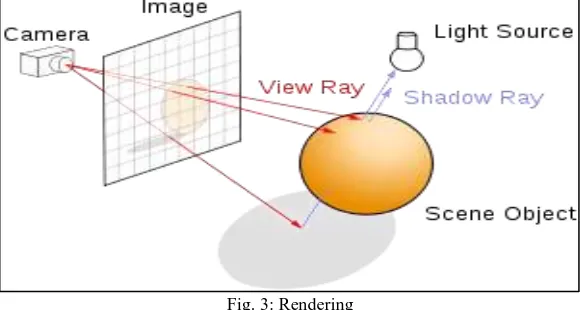
Rendering is the process of generating a 2D image from a model by the help of computer programs. The model is a type of description of 3D objects in a strictly defined data structure. It would contain texture, shading, lighting, geometry and viewpoint information. The image is a digital image.
3D Projection
3D projection is a method of mapping 3D points in a 2D plane. This projection is used extensively in drafting, computer graphics and engineering.
Ray Tracing
Ray tracing is a unique technique which uses tracing of path of light for generating an image through the pixels which are present in an image plane. Through this technique we can produce a very high-quality image that feels to be a real image which is usually of higher degree than the other rendering methods. This method usually has a higher computational cost.
Fig. 3: Rendering
Shading
Shading depict s the depth in 3D models by varying levels or stages of darkness. In this process the darkness levels are arranged as per the angle through which the object is seen and the shadows of light and dark shade are represented in the similar manner as the image is visible.
There are various techniques of shading which includes cross hatching in which perpendicular lines of certain different closeness are drawn in a grid pattern that is used to shade an area.
Fig. 4: Shading
Texture Mapping
Texture mapping is used to add texture to the images or color or any other sharp details to 3D model. This process is used to add paper texture to a plain white box. This is also one of the technique which is used to give grace to the 3D image.
Fig. 5: Texture Mapping
Volume Rendering
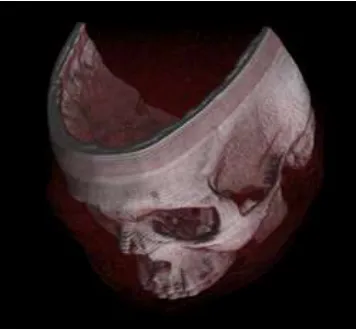
Volume rendering is a unique process that is used to display 3D sampled data sent into 2D projection. A typical 3D data set is a collection of 2D images acquired by a CT or MRI scanner. These are gathered in the regular patterns which have the regular count of image pixels in a regular pattern.
Fig. 6: Volume Rendering
3D Modelling
3D modelling is the process of developing a wireframe representation of any three-dimensional object is called as "3D model" with the help of specialized software. Models may be created manually or automatically.
The manual modelling process is similar to plastic arts such as sculpting. 3D models can be created using several approaches like through NURBS curves to generate smooth and accurate surface patches, polygonal mesh subdivision or polygonal mesh.
Fig. 7: 3D Modelling
III. APPLICATIONS OF COMPUTER GRAPHICS:
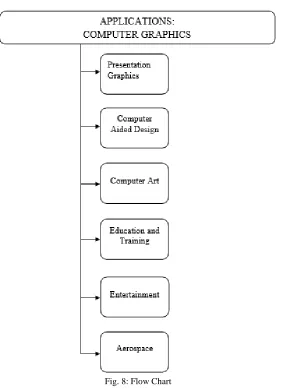
Fig. 8: Flow Chart
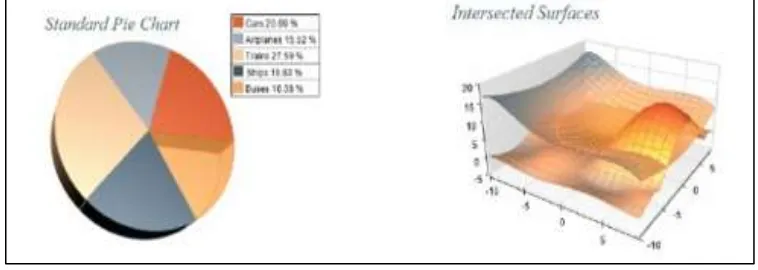
Presentation Graphics
Fig. 9: Presentation Graphics
Computer Aided Design (CAD)
This is highly used to design aircrafts, buildings, automobiles, textiles and many other products. There are various applications which are used for designing models or artifacts in various domains as mentioned above. This is used to design automobiles, aeroplanes, buildings, etc. before constructing or creating models. This can also be treated as a 3D blue print of a desired object.
Fig. 10: CAD Graphics
Computer Art
This is used in both commercial and fine art applications. They provide facilities to design different types of objects and shapes as per the needs and demands. In commercial art the photo realistic techniques are used. These are focused on TV commercials where the transformation of objects are shown.
Education and Training
Computer generated objects financial, biological, economic and physical are used as educational aids. This makes it easy to explain the objects clearly to students as this makes it easy to present 2D or 3D structures for elaborative understanding.
Entertainment
The various animation and cartoon movies and characters are the creation of computer graphics. The video games and its graphics are designed using computer graphics.
Aerospace
The trainers use 3D model of boeing or small fleets in-order to explain the complete structure and functioning of a plane. This somehow gives a type of live experience to the candidates getting trained may it be a pilot or crew members.
Therefore, these are few highlighted uses of computer graphics which we come across in our day to day life. There are hundreds of such uses which you can see around you in your daily routine.
IV. CONCLUSION
Computer graphics will continue to get more sophisticated. Their 3-D photo-realistic capabilities and ability to predict changes over certain time have revolutionized product marketing and development, as well as scientific research and education. They are responsible for high resolution special effects on televisions and in movies. Even many magazines and newspapers use only computer-generated graphics. They have a very unique dimension to text. Computer graphics affect everyone's life in almost every aspect every day.