Abstract— Phytoremediation under greenhouse condition was investigated as an alternative to clean up an industrially-multi-contaminated soil with both petroleum hydrocarbons and heavy metals. The aim of this work was to study the ability of three sunflower (Helianthus annuus) cultivars (M, H2, and P) to absorb/degrade V, Ni, Cu, Pb, benzo(a)pyrene, and TPH (total petroleum hydrocarbons) from multi-contaminated soil. Assays were performed with three sunflower cultivars, suitable for commercial biodiesel production, in pots containing 5 kg of soil for a period of 40 days. All three varieties were able to reduce the concentration of heavy metals, benzo(a)pyrene, and TPH in the soil, however, the contaminants removal varied according to the assay conditions employed. The highest removal percentage of Ni, Pb, and Cu were obtained for H2 cultivar. On the other hand, the highest removal percentage of V was obtained when the soil was treated with M cultivar. TPH removal did not vary according to the use of different sunflower cultivars. Nevertheless, the highest removal percentage of benzo(a)pyrene was obtained with the M cultivar. The results demonstrated the potential of the phytoremediation technique using sunflower for the treatment of soil multi-contaminated by heavy metals and hydrocarbon’s petroleum.
Index Term— heavy metals, hydrocarbons, multi-contaminated soil, phytoremediation, sunflower.
I. INTRODUCTION
The growth of industrial activity in the last century has resulted in a strong increase in anthropogenic substances being introduced into the environment [1]. The accidental or intentional emission of chemical products and wastes can lead to soil pollution, which is a significant problem in modern economic activities, such as in transport and civil construction. It is important to note that appropriate land use appears in the agenda of international discussions due to the increase in population, as well as the need for sustainable development as a strategic safety tool. Furthermore, soil contamination is a concern since it can negatively affect human, animals and plants health [2].
The current world economic model is strongly tied to the use of fossil fuels as energy source. Given that large quantities are necessary, the increase in the number of movements,
transformations, and storage operations can also increase the possibility of soil contamination. It is important to remember that petroleum is chemically defined as a mixture of chemical compounds, predominantly hydrocarbons, which also contains heavy metals, semi-metals, and various anions from organic material and rocks from formations and reservoirs [3]. The presence of inorganic material in fuel mixtures and oily wastes is also due to the use of additives, catalysts, and other compounds. Thus, it is clear that the presence of petroleum, petroleum derivatives, and their wastes in the soil can lead to contamination by organic and inorganic compounds.
Considering the importance of soil, various techniques, such as excavation, solidification, stabilization, and bioremediation, have been used to decrease the impact of contaminants on the soil environment [4]. Comparatively, operations based on biological processes are considered to be more efficient, less costly, and the least invasive. Biotechnology alternatives, however, are strongly related to the degradation of organic compounds in soil or their solubilization to facilitate extraction processes [5].
Among the biotechnological alternatives, phytoremediation is considered to be low-cost and not harmful to the physical, chemical, and biological characteristics of soil [6]. This technique consists of using plants to remove biota contaminants (phytoextraction), to absorb and convert them into non-toxic forms (phytovolatilisation) or to stabilize an inorganic substance, transforming it into a less soluble form (phytostabilisation) [7]. There are a number of reports that can be found in the literature regarding the use of plants to remove organic or inorganic compounds from soil.
Helianthus annuus (sunflower) is one of the target species that has excellent potential as a phytoextractor since it grows quickly, produces large amounts of biomass and is capable of hyper accumulate heavy metals [8; 9]. Many plants have been studied for the phytoremediation of hydrocarbons from soil [10; 11; 12; 13; 14]. However, only Tejeda-Agredano et al. [15] have related the use of sunflower to the phytoremediation of organic contaminants.
Many wastes from the petroleum and gas sector have both hydrocarbons and heavy metals, which can contaminate soil
Phytoremediation of Soil Multi-Contaminated
with Hydrocarbons and Heavy Metals Using
Sunflowers
Cristiane D. C. Martins
1; Vitor S. Liduino
1; Fernando J. S. Oliveira
2; Eliana Flávia C. Sérvulo
1* 1Escola de Química, Universidade Federal do Rio de Janeiro – UFRJ, Av. Athos da Silveira Ramos, 149, BlocoE Sl E-203 - Ilha do Fundão, RJ - Brasil CEP 21941-909.
2 Petróleo Brasileiro S.A. Gerência de Meio Ambiente. Av. Almirante Barroso 81, Centro, Rio de Janeiro, RJ –
20031-004.
with these two classes of contaminants when the contact or improper disposal of wastes occurs. It is also important to emphasize that the literature does not focus on the phytoremediation of soils co-contaminated with metals and hydrocarbons. One of the few studies in this field was published by Sun et al. [16], where Tagetes patula was used to phytoremediate soil that was artificially contaminated with benzo(a)pyrene, Cd, Cu, and Pb.
This study analyses the potential of sunflowers for the phytoremediation of a soil collected from a contaminated area within a petroleum refinery to remove both hydrocarbons and heavy metals (V, Ni, Cu, Pb, and Cd). Seeds from three different, low-cost, commercial cultivars of sunflower were tested. The 40 days long tests were conducted in greenhouse scale.
II. MATERIALS AND METHODS A. Soil
Soil from a contaminated area in a Brazilian petroleum refinery was used. Approximately 60 kg of multi-contaminated soil was dried, sifted (<2 mm), and homogenized before the physical, chemical, and microbiological analyses were performed to be later used in the phytoremediation tests.
B. Plants
Three commercial sunflower cultivars (M, H2, and P) were tested (Dekalb Ltda, Brazil). The growth of the plants was monitored weekly.
C. Analytical methods
The particle size distribution of the soil were determined according to the IAC [17], and the pH of the soil was determined in a 1:1 soil:water suspension (w w-1) using a digital pH meter.
The total amounts of nitrogen, phosphorous, and organic matter were determined according to the methodologies proposed by USEPA 351.2, USEPA 365.2 [18], and Walkley and Black [19], respectively. The soil’s water-holding capacity was determined using the method described by Veihmeyer and Hendrickson [20].
The concentration of the total petroleum hydrocarbon (TPH) was determined through the USEPA 8015C method [18]. Ten priority polycyclic aromatic hydrocarbons (PAH) described by the Dutch list (naphthalene, phenanthrene, anthracene, fluoranthene, benzo(a)anthracene, chrysene, benzo(k)fluoranthene, benzo(a)pyrene, benzo(ghi)pyrene, and
indeno(1,2,3cd)pyrene) were determined by gas
chromatography coupled with mass spectroscopy using the methodology described by USEPA 8270D [18]. The organic extracts were obtained using an ultrasound according to the method described in USEPA 3550C [18].
The concentration of heavy metals in the soil was determined by spectroscopy using the methodology described in USEPA 6010C [18]. The digestion was performed
previously in an acidic media using a microwave in accordance with the USEPA 3051A method [18].
The metal content in the plant biomass was determined by the methodology described above. Previously, the plant material was dried in an oven at 60ºC, ground in a porcelain mill, subjected to acidic digestion, and later analyzed by atomic absorption spectroscopy.
The total heterotrophic bacteria (THB) and total fungi (TF) in the soil were determined using the plate counting and the pour-plate methods [21] in nutrient agar and Sabouraud agar, respectively. The quantification of hydrocarbon-degrading microorganisms (HDM) was performed through the Most Probable Number technique in Bushnell Haas mineral media with the addition of a drop of light Arabian oil as the only carbon source [22].
All of the analytical results are reported as the average of three replicas for all the microbiological, physical, and chemical assays.
D. Phytoremediation tests
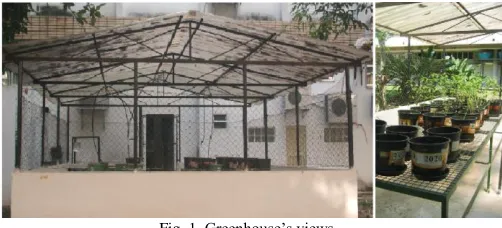
The experiments were conducted in greenhouse scale (Figure 1). The seeds were germinated directly in the multi-contaminated soil. The pots used in the tests had a surface area of 600 cm2. Five kilograms of soil were added to each pot, and equidistant furrows were made in the soil, with four seeds being deposited into each hole. When at least one of the seedlings in each hole reached a height of 10 cm, the plants were thinned to one plant per hole.
Fig. 1. Greenhouse’s views.
The phytoremediation tests were conducted for 40 days, during which the soil moisture was maintained at approximately 80% of its water-holding capacity.
Each soil sampling procedure consisted of taking five individual samples at equidistant points in each pot to obtain a representative sample. Individual samples of 50 g of soil each were mixed to obtain a single sample of 250 g. For each test, the sampling procedure was performed in triplicate.
At the end of 40 days, the heights of the plants were measured and the dry weight of the plant biomass was determined with an analytical balance. The plant drying process was performed in an oven at 50ºC for three days. All of the results from the phytoremediation tests were expressed as the average of three replicas.
planting sunflowers, and the biotic control, the soil in pots were treated with an AgNO3 solution (10% w w-1).
E. Statistical analysis
A two-way analysis of variance (ANOVA) was used in order to understand the effect of the different sunflower cultivars in the phytoremediation process. Comparisons of means were done using the Tukey’s HSD test (p≤0.05). All statistical analyses were performed using STATISTICA software v. 7.0 (STATSOFT, USA).
III. RESULTS AND DISCUSSION A. Soil
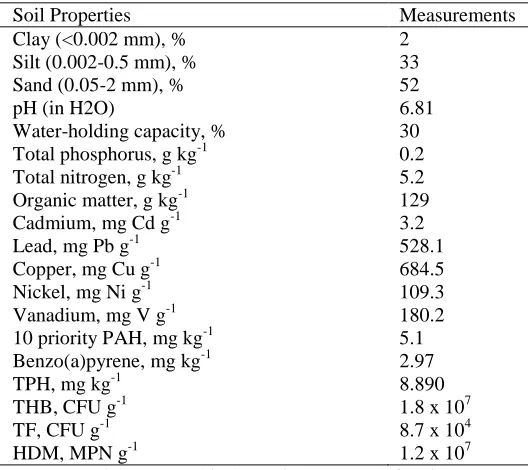
Table 1 shows the results of the physical, chemical, and microbiological characteristics of the multi-contaminated soil used in this study. The soil was sandy-silty with a neutral pH in water. The water-holding capacity was low, which is typical for tropical soils with low clay content. Soil phosphorous and, especially, N can serve as nutritional sources for the biota.
Lead, copper, nickel, and TPH were present in the soil at concentration values above the intervention limit set by local legislation for industrial used soils with low clay content. The local legislation uses the same intervention values listed in the Dutch Legislation [23]. The sum of the concentration of the 10 PAHs listed by the Dutch legislation (naphthalene, phenanthrene, anthracene, fluoranthene, benzo(a)anthracene,
chrysene, benzo(k)fluoranthene, benzo(a)pyrene,
benzo(ghi)pyrene and ideno(1,2,3cd)pyrene) were found to be below the intervention values according to the current local legislation.
Copper was the only metal present at a concentration higher than the intervention value listed in federal legislation [24]. Benzo(a)pyrene was near the limit of the intervention concentration (3.5 mg kg-1), and the other nine monitored PAHs exhibited concentrations below the limit of detection of the samples, which was 0.33 mg kg-1. Therefore, the dataset justifies the treatment of this soil.
The amount of hydrocarbon-degrading microorganisms (HDM) was similar to the total number of heterotrophic bacteria. This fact corroborates the data of increased concentration of petroleum hydrocarbons and PAHs in the soil, which can be used as a carbon source by these microorganisms. The natural selection of the native microbiota is probably due to the area contamination history by oily wastes.
The population of fungi found in the soil sample was elevated prior to the phytoremediation treatment, which also contributes to the degradation of organic compounds. According to the lab-scale study published by Atagana et al. [25], fungi showed the potential to degrade high-molecular-weight polycyclic aromatic hydrocarbons and other recalcitrant organic compounds due to their complex enzymatic systems with the ability to synthesize and excrete
various extracellular enzymes.
Table I
Physical, chemical, and microbiological composition of multi-contaminated soil
Soil Properties Measurements
Clay (<0.002 mm), % 2
Silt (0.002-0.5 mm), % 33
Sand (0.05-2 mm), % 52
pH (in H2O) 6.81
Water-holding capacity, % 30
Total phosphorus, g kg-1 0.2
Total nitrogen, g kg-1 5.2
Organic matter, g kg-1 129
Cadmium, mg Cd g-1 3.2
Lead, mg Pb g-1 528.1
Copper, mg Cu g-1 684.5
Nickel, mg Ni g-1 109.3
Vanadium, mg V g-1 180.2
10 priority PAH, mg kg-1 5.1
Benzo(a)pyrene, mg kg-1 2.97
TPH, mg kg-1 8.890
THB, CFU g-1 1.8 x 10⁷
TF, CFU g-1 8.7 x 10⁴
HDM, MPN g-1 1.2 x 10⁷
THB: total heterotrophic bacteria; TF: total fungi; HDM: hydrocarbon-degrading microorganisms.
In the chromatographs of organic extracts from the soils (Figure 2), compounds were detected mostly as an unresolved complex mixture (UCM). No linear hydrocarbons, pristane, or phytane were detected. The absence of pristane and phytane and the increase in the baseline indicate the weathering of the oily wastes, increasing their recalcitrance and, consequently, increasing the difficulty for biotreatment. Weathering refers to the result of chemical, biological, and physical processes on the waste that can affect the type of compounds that remain in the soil. In addition to the described factors, the elevated TPH concentration makes phytoremediation even more difficult.
Fig. 2. Chromatograph of the total petroleum hydrocarbons present in the multi-contaminated soil sample from the petroleum refinery. B. Phytoremediation of multi-contaminated soil
biomasses, respectively. These results were consistent with those reported in the literature for the treatment of soil contaminated with different lead concentrations [26].
Results of microbiological analysis of the soil after 40 days of phytoremediation with sunflowers are represented in Table 2. The results indicate that the presence of the sunflowers was beneficial to microbial activity, particularly for the fungal population. Fungi can be related to the release of chemical substances and enzymes by the plant roots, which favor microbial growth [27; 28].
The percentage of heavy metals removed from the soil by the three sunflower cultivars is shown in Figure 3. The largest percentage of vanadium removal from the soil (39.8%) was achieved by seeding cultivar P. The removal of nickel and cadmium was approximately 46 and 100%, respectively, for the three tested cultivars. The greatest percentage removals of lead (55.8%) and copper (73.3%) were observed when the H2 cultivar was used.
Usman and Mohamed [29] studied different conditions for soil phytoremediation by sunflowers for 60 days. They observed that the Zn removal varied between 2 and 4%, Cu removal varied between 1.6 and 3%, Cd removal varied between 2.6 and 4%, and Pb removal varied between 0.4 and 1.3%. The study published by Chen et al. (2004) showed removals of Pb, Cu, Zn, and Cd of 4, 16, 13, and 23%, respectively, after 53 days of phytoremediation by sunflowers. Thus, the promising results for the three tested Brazilian cultivars were confirmed.
Fig. 3. Removal of V, Ni, Pb, Cd and Cu by the sunflower cultivars (H2, M and P) in multi-contaminated soil from an industrial area. Values are means ± SE of three replicates. Different letters indicate significant differences among
the means of different treatments (p<0.05).
The concentrations of heavy metals in the plant biomass after 40 days of testing are shown in Table 3. There is no significant difference between the values for vanadium and cadmium found in the biomasses of the three cultivars. The greatest concentrations of lead and copper were found in the biomass of cultivar H2. However, the highest concentration of nickel was found in the biomass from cultivar M.
c
a
c
a
b b
a a
a
a
a a
b
a
b
0 20 40 60 80 100 120
V Ni Pb Cd Cu
R
e
m
o
val
(
%
)
M H2 P
Table II
Soil microbiology after 40 days of sunflower phytoremediation
Cultivar THB (CFU g-1) HDM (MPN g-1) TF(CFU g-1)
H2 5.0 ± 0.2 x 10⁸a 2.0 ± 0.1 x 10⁸a 8.6 ± 0.3 x 10⁶a
M 2.4 ± 0.1 x 10⁸b 7.8 ± 0.3 x 10⁷b 7.1 ± 0.2 x 10⁶b
P 1.7 ± 0.1 x 10⁸c 6.9 ± 0.2 x 10⁷b 4.3 ± 0.1 x 10⁶c
Biotic control 7.2 ± 0.3 x 10⁷ 9.5 ± 0.4 x 10⁷ 7.8 ± 0.3 x 10⁴
THB: total heterotrophic bacteria; TF: total fungi; HDM: hydrocarbon-degrading microorganisms; CFU: colony forming unit; MPN: most probable number. Values are means ± SE of three replicates. Different letters indicate significant differences among the means of different treatments (p<0.05).
Table III
Heavy metal concentration in plant biomass after 40 days of phytoremediation
Metals (mg kg-1) Sunflower cultivar
H2 P M
V 0.50 ± 0.01a 0.50 ± 0.01a 0.50 ± 0.01a
Ni 2.61 ± 0.08b 1.72 ± 0.07c 3.43 ± 0.1a
Pb 2.65 ± 0.05a 0.54 ± 0.01c 1.74 ± 0.05b
Cd 0.051 ± 0.010a 0.051 ± 0.010a 0.052± 0.010a
Cu 21 ± 1.5a 14± 1.0b 16± 1.0b
Sung et al. [6] studied the accumulation of copper, nickel, and chromium in various plants, including sunflowers, in phytoremediation assays with steel tailings. The authors found concentrations of Cu, Ni, and Cr in the plant tissues varying between 25-50, 25-80, and 50-80 mg kg-1, respectively. Turgut et al. [7] evaluated the accumulation of Cr, Ni, and Cd in two different cultivars of sunflower, teddy bear and dwarf sunspot. The two cultivars showed concentrations of Cr, Ni, and Cd in their plant tissues of approximately 190; 6.5 and 120 mg kg-1, respectively. Thus, it was inferred that the accumulation of metals in plant tissues is heterogeneous, corroborating the quantitative images of metals in plant tissues published by Becker et al. [31].
Table 4 shows the removal of benzo(a)pyrene after 40 days of phytoremediation of multi-contaminated soil by sunflower cultivars. Benzo(a)pyrene is a high molecular weight PAH, with a recognized persistence in the soil and half-life values varying between months to many years [32; 33]. The metabolites originating from benzo(a)pyrene are considered to be highly carcinogenic and mutagenic and are classified as carcinogenic group 1 by IARC [34].
Table IV
Removal of benzo(a)pyrene by sunflower cultivars (H2, M and P).
Initial H2 M P
Concentration (mg kg-1 soil)
2.97 2.01 ± 0.2 1.55 ± 0.1 2.42 ± 0.2
Removal (%) - 32.1 ± 3.2b 47.7 ± 4.2a 18.3 ± 2.0c Values are means ± SE of three replicates. Different letters indicate significant differences among the means of different treatments (p<0.05).
The largest percentage reductions of benzo(a)pyrene in the soil were obtained through the cultivation of the M and H2 cultivars, considering the losses in the biotic and abiotic control reactors. Liste and Alexander [35] performed phytoremediation tests over 56 days with the Avena sativa and Brassica napus var. radicola grains, resulting in a reduction in pyrene of 55.4 and 73.5%, respectively, 18% of which were a result of the microbial activity and the abiotic losses (control tests). Through the growth of the herbs Anethumgraveolens, Capsicum annuum, and Raphanussativus, the same authors found decreases in the concentration of pyrene varying between 51.2 and 66.9% after 28 days of phytoremediation, of which only 6.7% corresponded to losses in the control tests. Comparing the results now presented in the literature, the applicability of sunflower cultivars is verified for the removal of a high-molecular-weight PAH.
Phytoremediation was also investigated for the removal of TPH after 40 days of sunflower growth on multi-contaminated soil. In this period, there was a reduction of 10 ± 2% of the TPH in the soil, regardless of the sunflower cultivar used; these values were calculated considering the losses in the control reactors. The petroleum hydrocarbons are a class of organic compounds in which aromatic compounds, PAH, alkanes, and other substances that show various physicochemical properties are included. An increase in the
size of the carbon chain leads to a reduction in the solubility of the compound and an increase in the partition coefficient in octanol-water (Kow) and, consequently, a reduction in the availability of the contaminant to the plants [36].
Siciliano and Germida [37] reported a reduction of approximately 21% in the concentration of TPH in phytoremediation tests using forage species. However, these results were achieved only after 20 months of treatment for soil contaminated only with hydrocarbons. More recently, Moreira et al. [38] observed a decrease of 12% in the concentration of TPH in mangrove sediment also contaminated with only petroleum hydrocarbons, after 90 days of phytoremediation with Rizophora mangle L. Thus, the results in the present study are promising and innovative, as they demonstrate the concomitant removal of hydrocarbons and heavy metals in real soil from an industrial area.
Considering Dutch regulations to be among the most restrictive in the world, the seeding of H2 and M cultivars provided a reduction in the concentration of heavy metals that allowed the soil to be classified as rehabilitated for use in an industrial area (with reference to these parameters). However, there was insufficient removal of TPH to consider the soil rehabilitated for use in industrial areas in relation to all of the analyzed parameters. Nevertheless, considering the low cost and the short time required, the results prove that the treatment is promising for the treatment of this type of multi-contaminated soil.
IV. CONCLUSION
The three tested sunflower cultivars presented the same growth and biomass under multi-contaminated and non-contaminated soils. All of them were also capable of removing benzo(a)pyrene, TPH, and metals from multi-contaminated soil. The amount of contaminants removed from soil varied according to the sunflower cultivar used. Sunflower H2, P and M can hyperaccumulate Cu, Pb, Ni and V from multi-contaminated soil. Nevertheless, Cd absorption was lower than other metals. After the treatment with the H2 and M cultivars, the soil was considered rehabilitated for use in an industrial area, according to Brazilian federal legislation. Considering the costs and time required, the phytoremediation with sunflower proved to be an efficient, convenient, low-cost process for the treatment of soils contaminated with organic and inorganic compounds.
ACKNOWLEDGMENTS
The authors thank the Brazilian National Petroleum Agency (ANP) and Petrobras for providing financial support.
REFERENCES
[1] K. E. Gerhardt, X. D. Huang, B. R. Glick and B. M. Greenberg, “Phytoremediation and rhizoremediation of organic soil contaminants: potential and challenges”, Plant Science, vol. 176, 20–30, Jan. 2009.
[2] F. A. Pedron, R. S. D. Dalmolin, A. C. Azevedo and J. Kaminski, “Urban soils”, Ciência Rural, vol. 34, pp. 1647–1653, Nov. 2004. [3] I. Alajbega, G. Krnjević-Pezićb, I. Alajbega, A. Smeh-Skrbinb and
treatment”, Journal of Pharmaceutical and Biomedical Analysis, vol. 22, pp. 75–84, Feb. 2000.
[4] C. N. Mulligan, R. N. Yong and B. F. Gibbs, “Remediation technologies for metal contaminated soils and groundwater: an evaluation”, Engineering Geology, vol. 60, pp. 193–207, Dec. 2001.
[5] S. C. Wilson and K. C. Jones, “Bioremediation of soil contaminated with polynuclear aromatic hydrocarbons (PAHs): a review”, Environmental Pollution, vol. 81, pp. 229–249, Dec. 1993.
[6] M. Sung, C. Y. Lee, and S. Z. Lee, “Combined mild soil washing and compost-assisted phytoremediation in treatment of silt loams contaminated with copper, nickel and chromium”, Journal of
Hazardous Materials, vol. 190, pp. 744–754, 2011.
[7] C. Turgut, M. K. Pepe and T. J. Cutright, “The effect of EDTA and citric acid on phytoremediation of Cd, Cr, and Ni from soil using
Helianthus annuus” Environmental Pollution, vol. 131, pp. 147–
154, Jan. 2004.
[8] J. Zavoda, T. Cutright, J. Szpak and E. Fallon, “Uptake, selectivity and inhibition of hydroponic treatment of contaminants”, Journal
of Environmental Engineering, vol. 127, pp. 502–508, Nov. 2001.
[9] H. Chen and T. J. Cutright, “The interactive effects of chelator, fertilizer and rhizobacteria for enhancing phytoremediation of heavy metal contaminated soil”, Journal of Soils Sediments, vol. 2, pp. 203–210, Mar. 2002.
[10] J. Pichtel and P. Liskanen, “Degradation of diesel fuel in rhizosphere soil”, Environmental Engineering Science, vol. 18, pp. 145–157, Apr. 2001.
[11] W. Ling and Y. Gao, “Promoted dissipation of phenanthrene and pyrene in soils by amaranth (Amaranthus tricolor L.)”,
Environmental Geology, vol. 46, pp. 553–560, Dec. 2004.
[12] F. Viana, T. M. B. Correia, M. I. Machado, M. P. Zanela, E. M. Pederzolli, P. Baisch and C. B. Costa, “O uso da fitorremediação em área contaminada por resíduos da indústria petroquímica” [The use of phytoremediation in an area contaminated by petrochemical industry wastes]. Petro e Química, ed. 310, 2007.
[13] N. F. Tam and Y. S. Wong, “Effectiveness of bacterial inoculum and mangrove plants on remediation of sediment contaminated with polycyclic aromatic hydrocarbons”, Marine Pollution Bulletin, vol. 57, pp. 716–726, Jan. 2008.
[14] J. Rezek, C. Wiesche, M. Mackova, F. Zadrazil and T. Macek, “The effect of ryegrass (Lolium perenne) on decrease of PAH content in long term contaminated soil”, Chemosphere, vol. 70, pp. 1603–1608, Apr. 2008.
[15] M. C. Tejeda-Agredano, S. Gallego, J. Vila, M. Grifoll, J. J. Ortega-Calvo and M. Cantos, “Influence of the sunflower rhizosphere on the biodegradation of PAHs in soil”, Soil Biology &
Biochemistry, vol. 57, pp.830-840, Jan. 2013.
[16] Y. Sun, Q. Zhou, Y. Xu, L. Wang and X. Liang, “Phytoremediation for co-contaminated soils of benzo[a]pyrene (B[a]P) and heavy metals using ornamental plant Tagetes patula”, Journal of Hazardous Materials, vol. 186, pp. 2075–2082, Jan. 2011.
[17] Instituto Agronômico de Campinas (IAC) [Campinas Agronomic Institute]. (1986) Métodos de Análise Química, Mineralógica e
Física de Solos do Instituto Agronômico de Campinas [Methods
for Chemical, Mineralogical, and Physical Analysis of Soils from the Campinas Agronomic Institute]. IAC, Campinas, Brazil, 1986. [18] USEPA - United States Environmental Protection Agency (2007).
Test methods for evaluating solid waste, SW-846. Revision 6. Washington: Office of Solid Waste and Emergency Response [Online].
Available:http://www.epa.gov/osw/methods/sw648/online/index.ht m
[19] A. Walkley and I. A. & Black, “An examination of Degtjareff method for determining soil organic matter and a proposed modification of the chromic acid titration method”, Soil Science, vol. 37, pp. 29–37, Jan. 1934.
[20] F. J. Veihmeyer and A.H. Hendrickson, “Methods of measuring field capacity and permanent wilting percentage of soils”, Soil Science, vol. 68, pp. 75–94, Dec. 1949.
[21] A. A. Van Soestbergen and C. H. Lee, “Pour plates or streak plates?”, AppIied Microbiology, vol. 18, pp. 1092–1093, Apr. 1969.
[22] B. A. Wrenn and A. D. Venosa, “Selective enumeration of aromatic and aliphatic hydrocarbon degrading bacteria by a most-probable-number procedure”, Canadian Journal of Microbiology, vol. 42, pp. 252-258, Aug. 1996.
[23] Netherlands Government Gazette. (1994) Intervention values soil remediation. Netherlands Government Gazette, 95, May 24. [24] Brasil (2009) Dispõe sobre critérios e valores orientadores de
qualidade do solo quanto à presença de substâncias químicas e estabelece diretrizes para o gerenciamento ambiental de áreas contaminadas por essas substâncias em decorrência de atividades antrópicas [Regulation for guiding values and soil quality criteria for the presence of chemicals and establishes guidelines for environmental management of contaminated areas by these substances as a result of anthropogenic activities].
[25] H. I. Atagana, R. J. Haynes and F. M. Wallis, “Fungal bioremediation of creosote contaminated soil: a laboratory scale bioremediation study using indigenous soil fungi”, Water, Air and Soil Pollution, vol. 172, pp. 201–219, Sept. 2006.
[26] S. Romeiro, A. M. M. Lagôa, P. R. Furlani, C. A. Abreu, B. F. F. Pereira and M. F. Abreu, “Avaliação do potencial de Ricinus communis L. (mamona) e de Hellianthus annuus L. (girassol) na fitoextração de chumbo” [Evaluation of the potential of Ricinus
communis L. (castor bean) and Hellianthus annuus L. (sunflower)
in the phytoextraction of lead]. In: I Seminário Internacional Sobre
Remediação de Locais Contaminados [I International Seminar on
the Remediation of Contaminated Sites], São Paulo, Brazil, 2004. [27] S. Alvey and D. E. Crowley, “Survival and activity of an
atrazine-mineralizing bacterial consortium in rhizosphere soil”,
Environmental Science and Technology, vol. 30, pp. 1596–1603,
Oct. 1996.
[28] F. D. Dakora and D. A. Phillips, “Root exudates as mediators of mineral acquisition in low-nutrient environments”, Plant and Soil, vol. 245, pp. 35–47, Nov. 2002.
[29] A. R. Usman and H. M. Mohamed, “Effect of microbial inoculation and EDTA on the uptake and translocation of heavy metal by corn and sunflower”, Chemosphere, vol. 76, pp. 893–899, July 2009.
[30] Y. Chen, X. Li and A. Z. Shen, “Leaching and uptake of heavy metals by ten different species of plants during an EDTA-assisted phytoextraction process”, Chemosphere, vol. 57, pp. 187–196, Jan. 2004..
[31] J. S. Becker, R. C. Dietrich, A. Matusch, D. Pozebon and V. L. Dressler, “Quantitative images of metals in plant tissues measured by laser ablation inductively coupled plasma mass spectrometry”,
Spectrochimica Acta Part B, vol. 63, pp. 1248–1252, Oct. 2008.
[32] S. R. Wild, K. S. Waterhouse, S. P. McGrath and K. C. Jones, “Organic contaminants in an agricultural soil with a known history of sewage sludge amendments: polycyclic aromatic hydrocarbons”,
Environmental Science and Technology, vol. 24, pp.1706–1711,
June 1990.
[33] M. Trapido, “Polycyclic aromatic hydrocarbons in soil: contamination and profiles”, Environmental Pollution, vol. 105, pp. 67–74, Dec. 1999.
[34] IARC (International Agency for Research on Cancer), Certain polycyclic aromatic hydrocarbons and heterocyclic compounds. IARC Monogr Eval. Carcinog. Risk Chem. Man., vol. 3, pp. 1– 271, 1973.
[35] H. Liste and M. Alexander, “Plant-promoted pyrene degradation in soil”, Chemosphere, vol. 40, pp.7–10, Oct. 2000.
[36] C. D. Collins, “Implementing phytoremediation of petroleum hydrocarbons”, Methods in Biotechnology, vol. 23, pp. 99–108, Jan. 2007.
[37] S. D. Siciliano and J. J. Germida, “Degradation of chlorinated benzoic acid mixtures by plant-bacteria associations”, Environmental Toxicology Chemistry, vol. 17, pp. 728–733, Jan. 1998.