Student Student
Department of Electrical & Electronics Engineering Department of Electrical & Electronics Engineering Srinivas Institute of Technology, Mangaluru Srinivas Institute of Technology, Mangaluru
Vidyashree H V Student
Department of Electrical & Electronics Engineering Srinivas Institute of Technology, Mangaluru
Abstract
A normal grass cutter moving with IC engine will run based on the energy from petrol. The major drawbacks of this technology are high running cost; create noise pollution and air pollution. Also, an IC engine requires periodic maintenance such as changing the engine oil, mechanical maintenance. It is an innovative technology of cutting grass without any pollution, electric solar grass cutter are environmentally friendly. Nowadays, the labor charge is increased day by day. This technology can help the people who are living in rural areas. This project is mainly proposal for reduce the manpower and usage of electricity. The system control is done by the Schmitt trigger circuit. The grass cutter and vehicle motors are interfaced to a Schmitt trigger circuit that controls the working of all the motors.
Keywords: Solar Panel, Batteries, High Speed DC Motor, Blades, Schmitt Triggers Circuit
________________________________________________________________________________________________________
I. INTRODUCTION
This project is a proposed model of the automatic grass cutting machine by using the non-renewable energy (i.e. solar energy). Solar energy is the renewable energy. Grass cutter with a standard motor is an inconvenience, and no one takes pleasure in it. Cutting grass cannot be easily accomplished by elderly, younger, or disabled people. It creates noise pollution due to the loud engine, and local air pollution due to the combustion in the engine. Also, a motor powered engine requires periodic maintenance such as changing the engine oil. Even though electric grass cutter are environmentally friendly. Moving the grass cutters with a standard motor powered grass cutters is an inconvenience, and no one takes pleasure in it. Cutting grass cannot be easily accomplished by elderly, younger, grass cutter moving with engine create noise pollution due to the loud engine, and local air pollution due to the combustion in the engine. Also, a motor powered engine requires periodic maintenance such as changing the engine oil. Even though electric solar grass is environmentally friendly, they too can be an inconvenience. Along with motor powered grass cutter, electric grass cutters are also hazardous and cannot be easily used by all. Also, if the electric grass cutter is corded, mowing could prove to be problematic and dangerous. The prototype will also be will be charged from sun by using solar panels.
II. MAIN COMPONENTS AND BLOCK DIAGRAM
Solar panel Batteries
High Speed DC motor Blades
Schmitt trigger circuit
MOSFET
Fig. 1: Block Diagram
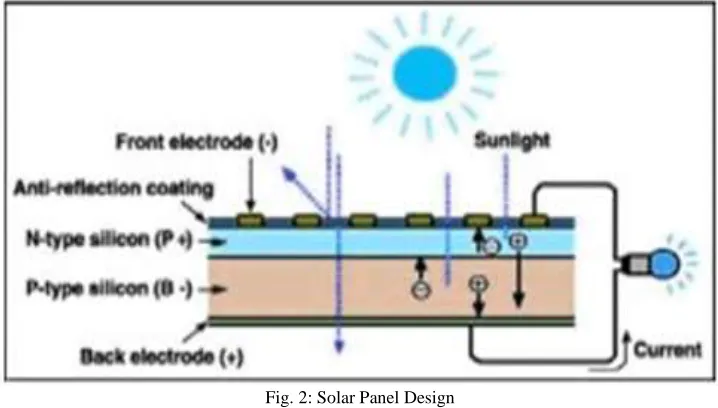
A junction of materials, which have different electrical properties, provides the electric field in most solar cells for the photon interaction in a semiconductor. A solar cell consists of Semiconductor in which electron hole pairs are created by the absorption of incident solar radiation. Region containing a drift field for charge separation and Charge collecting front and back electrodes.
Fig. 2: Solar Panel Design
The batteries are used as a storage device for solar energy which can be further converted into electrical energy. The only exceptions are isolated sunshine load such as irrigation pumps or drinking water supplies for storage, for small units with output less than one kilowatt. Batteries seem to be the only technically and economically available storage means. Since both the photo- voltaic system and batteries are high in capital costs, it is necessary that the overall system be optimized with respect to available energy and local demand pattern. To be economically attractive the storage of solar electricity requires a battery with following particular combination of properties:
Low cost Long life High reliability High overall efficiency
III. DESCRIPTION OF EXISTING PROBLEMS
A normal grass cutter moving with IC engine will run based on the energy from petrol. The major drawbacks of this technology are high running cost; create noise pollution and air pollution. Also, an IC engine requires periodic maintenance such as changing the engine oil, mechanical maintenance. It is an innovative technology of cutting grass without any pollution, electric solar grass cutter are environmentally friendly. Nowadays, the labor charge is increased day by day. This technology can help the people who are living in rural areas. This project is mainly proposal for reduce the manpower and usage of electricity.
engine cutter do not. An electric grass cutter with a solar charger will be easier to use. The unskilled gardener is enough to operate the grass cutter. Most importantly it eliminates the emissions of an internal combustion cutter which are mostly responsible for environmental pollution and causes the greenhouse gases effect believed to be responsible for the worsening global warming of our planet. This is so because solar energy is green/renewable energy.
Different designs have been made, each to suit a particular need or convenience. Making the process of cutting grass easier over the years, many individuals have added modification to the original design speed, efficiency and power of a mowing machine. The sun provides sustainable amount of the energy used for various purposes on earth for atmospheric system. The difference is just the application of the energy source. It uses the photovoltaic panel to generate the energy.
IV. CONTROL CIRCUIT AND MODEL
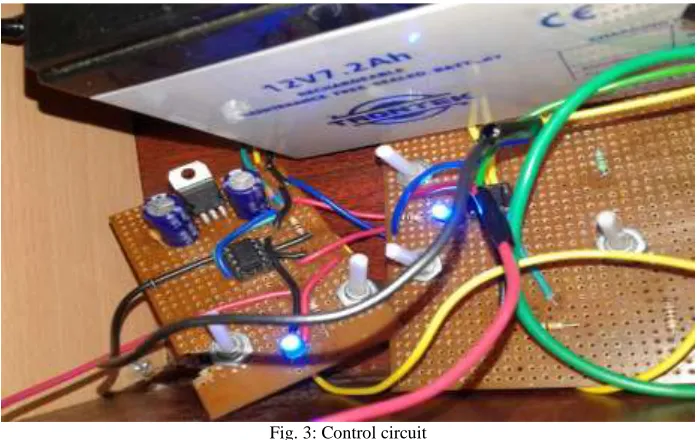
The positive feedback increases the switching speed, i.e. a slowly changing input wave form will become a fast (steep) changing output wave form. The hysteresis region reduces impact by input noise (as determined by VH). The major difference between a simple comparator and the Schmitt Trigger is how they respond to input noise. If the input signal Vin shows noise near VT, then the output signal Vout will show some corresponding chattering (i.e. bouncing between low and high), for the simple comparator in Fig.3
Fig. 3: Control circuit
V. GEOMETRIES OF SPECIMEN AND OPERATION
A Schmitt Trigger is essentially a comparator with hysteresis. It can be implemented by connecting positive feedback to the non-inverting input of a comparator or differential amplifier. In the non-non-inverting configuration, when the input voltage is > a chosen threshold (VTH), the output voltage is high. When the input voltage is < another chosen threshold (VTL), the output voltage is low. When the input voltage is between VTL and VTH, the output voltage maintains its present value. This dual-threshold behaviour is called hysteresis. In fact, we need to consider 2 output voltage levels, VOH and VOL, when we look at VTL and VTH.
Fig. 4: Schmitt Trigger Circuit
Now this electrical energy is stored in batteries by using a solar charger. The main function of the solar charger is to increase the current from the panels while batteries are charging, it also disconnects the solar panels from the batteries when they are fully charged and also connects to the panels when the charging in batteries is low.
The motor is connected to the batteries through connecting wires. Between these two mechanical circuit breaker switch is provided. It starts and stops the working of the motor. From this motor, the power transmits to the mechanism and this makes the blade to slide on the fixed blade and this makes to cut the grass.
DC motor maintains in a constant speed in the condition of the load applied. The battery is charged by the photovoltaic panel in a constant voltage. The output of the photovoltaic panel is varying but IC LM317T is act as a voltage regulator and got the varying input from the photovoltaic and gave the output in constant. The battery is sensing by the controller unit continuously it helps to maintain the constant input to DC motor. The DC motor speed can be able to maintain constant and the performance can be done in proper manner.
REFERENCES
[1] “The Design of Equalizer Windings for Lap-Wound DC Machines”, Alaric Pagel, Member, IEEE, Alan S. Meyer, and Charles F. Landy, Senior Member, IEEE. IEEE TRANSACTIONS ON INDUSTRY APPLICATIONS, VOL. 37, NO. 4, JULY/AUGUST 2001.
[2] “Cascaded DC–DC Converter Connection of Photovoltaic Modules”, Geoffrey R. Walker, Member, IEEE, and Paul C. Sernia, IEEE TRANSACTIONS ON POWER ELECTRONICS, VOL. 19, NO. 4, JULY 2004.
[3] “Energy Management Based on Frequency Approach for Hybrid Electric Vehicle Applications: Fuel-Cell/Lithium- Battery and Ultracapacitors”, Abdallah Tani, Mamadou Baïlo Camara, Member, IEEE, and Brayima Dakyo, Member, IEEE, IEEE TRANSACTIONS ON VEHICULAR TECHNOLOGY, VOL. 61, NO. 8, OCTOBER 2012.
[4] “Optimal Design of a 3.5-kV/11-kW DC–DC Converter for Charging Capacitor Banks of Power Modulators”, Gabriel Ortiz, Dominik Bortis, Student Member, IEEE, Jürgen Biela, Member, IEEE, and Johann W. Kolar, Senior Member, IEEE, IEEE TRANSACTIONS ON PLASMA SCIENCE, VOL. 38, NO. 10, OCTOBER 2010.
[5] “DC-DC Power Converters”, Robert W. Erickson Department of Electrical and Computer Engineering University of Colorado Boulder, CO 80309-0425, Article in Wiley Encyclopedia of Electrical and Electronics Engineering.
[6] “MPPT CONTROLLER FOR PHOTO VOLTAIC SYSTEMS USING CUK DC/DC CONVERTOR”, Neeraj Tiwari1, D. Bhagwan Das2 1,2Dayalbagh
Educational Institute (Deemed University), Agra, International Journal of Advanced Technology & Engineering Research (IJATER).