International Journal of Pharmaceutical Research & Allied Sciences, 2017, 6(3):112-117
Research Article
ISSN : 2277-3657
CODEN(USA) : IJPRPM
Vniifblight Decision Support System Using in The Potato Late And Early Blight
Control
Filippov A.V.
1*, Rogozhin A.N.
1, Kuznetsova M.A.
1, Smetanina T.I.
1, Demidova V.N.
1,
Sokolov M.S.
1, Korshunov A.V.
1, Motasova E.M.
1, Borovsky K.V.
2, Kononov V.M.
3, Kovaleva
T.N.
1, Lagutina N.F.
1, Vecherov A.V.
11 Department of Biological Studies,All-Russian Research Institute of Phytopathology, Bolshie Vyazemy, Moscow
region, 143050 Russia
2 Agrodozor Ltd., Belgorod, 308019 Russia 3 Center Program System Ltd., Belgorod, 308019 Russia
________________________________________________________________________________________
ABSTRACT
Potato is one of the most important food products in Russia. Causal agents of various potato diseases represent a significant factor reducing the productivity and quality of potato. A new version of the VNIIFBlight DSS has been designed to control both late and early blights of potato. This DSS uses combined information about the local climatic conditions, weather forecast, plant growth stage, disease resistance of potato cultivars, and fungicide characteristics. Depending on the combination of all these factors, one of three possible recommendations is proposed “Fungicide spraying is not required now”, “The further fungicide spraying will be inefficient”, “Fungicide spraying should be done” (with the indication of the list of fungicides which are the most suitable at this moment). In 2017, the field trials of a commercial online service to control the late and early blight of potato using this DSS version started at six potato farms located in the Moscow, Bryansk, Lipetsk, Belgorod, and Samara regions of Russia.
Keywords: Potatoes, Phytopthora infestans, Alternaria sp., decision support system, VNIIFBlight DSS, fungicide use, weather forecast, warning service
_____________________________________________________________________________________________
INTRODUCTION
The most important and devastating diseases of the potato foliage and tubers are the late and early blights caused by the oomycete Phytophthora infestans and the fungi Alternaria solani and A. alternata, respectively. In Russia, both diseases are controlled mainly by fungicide applications. To date, the total number of registered fungicides intended to control late and early blights of potato reaches 45 (16 active ingredients). The most advanced Russian potato growers use routine spraying programs, in which fungicide treatments are applied with a regular interval; the choice of fungicides and the frequency of treatments are determined only by the cost of fungicides.
The known negative influence of fungicides on the human health and environment and their high cost resulted in a need to develop new technologies, which would provide a significant optimization of the number of fungicide applications while maintaining the acceptable levels of potato production and quality. Commercial potato farms, which follow good agricultural practice, usually apply no more than 10 fungicides treatments.
late blight are effective only if they are applied shortly before the start of infection [1]. Many studies performed in advanced potato-producing countries were intended to optimize the number of protective treatments using various decision support systems (DSS), in which every treatment is determined by weather data and disease development simulators [2, 3, 4, 5]. To date, the total number of DSS used in different countries is about 20. Among them, the most known systems are SimCast, NegFry, SimPhyt, Plant-Plus, ProPhy, Guntz-Divoux, PhytoPre, and China-blight [6, 7, 8, 9, 10].. In some European countries, the use of DSS reduced the number of fungicide applications by 8-62% as compared with a routine scheme of treatments; these results were conferred in 26 of 29 tests [7].
The first version of the VNIIFBlight DSS was intended to determine weather conditions favorable or unfavorable for the late blight outbreaks on potato [11]. The performed field trials showed that both routine scheme of fungicide application and the VNIIFBlight DSS provided an acceptable level of the late blight control under the conditions of a severe disease development. At the same time, the use of VNIIFBlight DSS resulted in a decrease of a fungicide input by 17-62% as compared to the routine program of treatment.
This paper includes a description and discussion of the approach used for the implementation of the VNIIFBlight DSS as the online decision support service (www.agropatrol.com) to control both late and early blights of potato.
THEORETICAL PROMISES AND METHODIC APPROACHES
A new version of the VNIIFBlight DSS was designed to control both late and early blights of potato. This DSS provides a solution of two tasks:
1) Determination of the most optimal dates for a fungicide application;
2) Provision of the choice of the most suitable fungicides.
Task 1. The calculation of the optimal dates for a fungicide application is based on several factors (Fig. 1). To provide the possibility to determine “risky” days and recommended dates of fungicide applications against the late blight, we followed a standard five-day weather forecast.
The forecasted weather conditions are evaluated using the following two equations:
y1 = –32.47 + 0.75x1 + 0.41x2 + 0.41x3 + 0.27x4 + 0.74x5 + 0.30x6 - 0.07x7 - 0.16x8 +0.06x9 + 0.01x10 + 2.88x11 +
1.98x12 + 1.98x13 + 1.79x14 + 0.53x15 (1)
y2 = –31.34 + 0.63x1 + 0.37x2 + 0.42x3 + 0.22x4 + 0.65x5 + 0.24x6 - 0.06x7 - 0.15x8 –0.13x9 + 0.15x10 + 4.88x11 +
3.55x12 + 3.34x13 + 2.50x14 + 2.29x15
(2)
where x1,2,3,4,5 and x6,7,8,9,10 are the daily and night temperatures (Cº), respectively, while x11,12,13,14,15 describe
precipitations occurred in the 1st, 2nd, 3rd, 4th and 5th days, respectively (yes/no).
If y1 < y2, then weather conditions are favorable for the late blight development. This model identifies two “images”
of the weather, favorable or unfavorable for the re-infection and discrete outbreaks in the late blight development. We also used some additional indices, which corrected the forecast depending on the climatic probability of late blight epidemics in different regions of Russia (<50%, 50-75%, and >75% of the seasons). The calculations were performed separately for two types of potato-growing technologies: no irrigation or sprinkling irrigation. The days of sprinkling are considered as rainy days (x11-15).
potato plants within the period between the end of rapid haulm growth and beginning of senescence.
Figure 1. Factors influencing the choice of a time for a fungicide treatment against the late and early
blights of potato
Figure 2. Factors influencing the choice of fungicides to control late and early blights
Task 2. If a potato field is not protected with fungicides and the weather is favorable for the late blight, or the number of plants infected by the early blight exceeds 50%, then a fungicide application is recommended. The next question usually asked by potato growers is “What fungicides are the most suitable in this situation?” The proposed DSS provides an answer in the online mode using an interactive dialogue with a user.
The choice of fungicides provided by the program depends on a number of factors (Fig. 2) including the risk of disease development, plant growth stage, fungicide’s mode of action, anti-resistance strategies used to maintain a pathogen sensitivity to fungicides, and sanitary limitations concerning the number of fungicide applications per a season (according to the Russian Pesticide Regulations).
The VNIIFBlight DSS takes into account a different nature of the late blight and early blight development as well as their different sensitivity to the active ingredients of various fungicides. Under conditions favorable for either late blight or early blight, it recommends to apply fungicides efficient against each or both diseases. If the conditions are favorable for both late and early blights, it recommends to apply only fungicides effective against both diseases. The VNIIFBlight program takes into account four potato growth periods:
1. Shoot emergence – beginning of a rapid haulm growth
2. Rapid haulm growth
3. End of a rapid haulm growth – start of senescence
4. Start of senescence – complete haulm destruction
Different stages require the use of different fungicides. In this DSS, we used the Euroblight rating of fungicides. For example, VNIIFBlight chooses systemic fungicides to be used during a rapid haulm growth, but does not recommend their use at the later stages, since they are able to contaminate daughter tubers.
To prolong the active life of single-site fungicides, their use is restricted because of a cross-resistance occurring within FRAC fungicide groups. This fact is taken into consideration when a decision about the repeated fungicide applications is made [12].
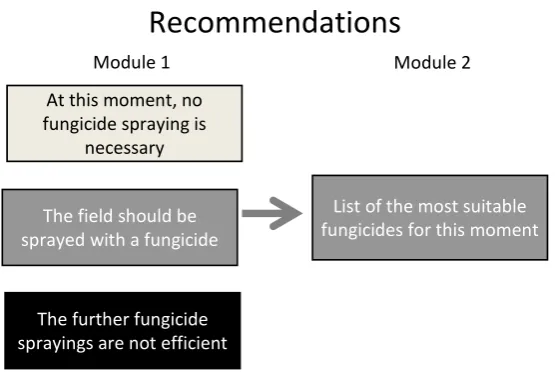
The VNIIFBlight system is based on the analysis of factors shown in Figs. 1-2 and proposes a user one of three possible recommendations: 1) “No fungicide spraying is required now”; 2) “Fungicide spraying should be done” (with the indication of the list of fungicides which are the most suitable at this moment); and 3) “The further fungicide spraying will be inefficient” (Fig. 3).
Module 1 When apply?
Last fungicide application date
Cultivar resistance to late blight Sprinkling irrigation Late blight in the neighboring fields Climatic zone
Expected weather
Late blight severity in the field
Early blight severity in the field Plant growth
stage
Application of certain in-furrow fungicides Module 1 When apply? Last fungicide application date Cultivar resistance to late blight Sprinkling irrigation Late blight in the neighboring fields Climatic zone
Expected weather
Late blight severity in the field
Early blight severity in the field Plant growth
stage
Application of certain in-furrow fungicides
Module 2 What fungicide?
Risk of a fungicide resistance development
in a pathogen
Sanitary limitations on the number of fungicidal sprayings
Sprinkling irrigation Plant growth
stage
Early blight severity in the field List of fungicides
registered in Russia Fungicide mobility
in plant tissues
Fungicide resistance to rain
Module 2 What fungicide?
Risk of a fungicide resistance development
in a pathogen
Sanitary limitations on the number of fungicidal sprayings
Sprinkling irrigation Plant growth
stage
Early blight severity in the field List of fungicides
registered in Russia Fungicide mobility
in plant tissues
Figure 3. Recommendations on the use of fungicides against the late blight/early blight
RESULTS OF STUDY
A new version of the VNIIFBlight DSS has been jointly developed and marketed by the All-Russian Research Institute of Phytopathology and the Agrodozor Ltd. The DSS is offered online for farmers and consultants (www.agropatrol.com). After authorization and a dialogue with the DSS, a user receives the following information:
1. The map of the region with the monitored potato fields (Fig. 4). Fields are identified by spots of different colors. The red color informs about the necessity of a fungicide application.
2. Map of the region with the meteorological forecast for the late blight development in the monitored areas (Fig. 5; red color means favorable conditions, green color means unfavorable conditions).
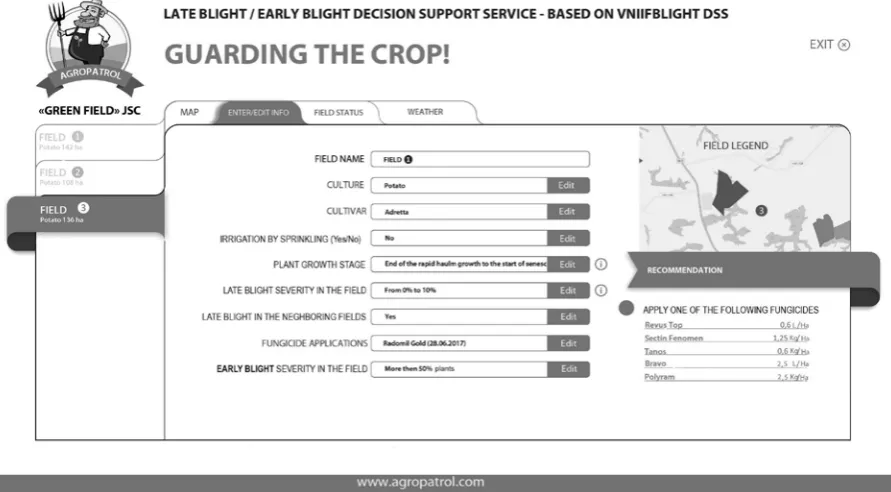
3. “Input/edit data” inset (Fig. 6).
A user may input data concerning the situation at the monitored field and then receive the corresponding recommendations about the necessity to apply fungicide treatment, as well as the list of fungicides, which are the most appropriate at this moment.
CONCLUSION
A new version of the VNIIFBlight DSS has been developed to control both late and early blights of potato by a fungicide application. In the season of 2017, the field trials of a commercial online service to control the late and early blight of potato using this DSS version started at six potato farms located in the Moscow, Bryansk, Lipetsk, Belgorod, and Samara regions of Russia; the results of these trials will be available
Recommendations
At this moment, no fungicide spraying is
necessary
The field should be sprayed with a fungicide
The further fungicide sprayings are not efficient
List of the most suitable fungicides for this moment
Figure 4. Map of the region with the monitored potato fields. The color of fields (red or green) informs about the necessity of a fungicide application. Fields 1 and 3 are red, field 2 is green.
Figure 6. “Input/edit data” inset providing recommended actions to control the late and early blights.
REFERENCES
1. Bødker, L., B.J. Nielsen, 2001. Preventive and curative affect of fungicides against late blight under field conditions. PPO-Special Report, 7: 261-265.
2. Schepers, H.T.A.M., B. Evenhuis and H.G. Spits, 2009. Strategies to control late blight in potatoes in Europe. Acta Horticulturae, 834: 79-82.
3. Kessel, G.S.T., J. Spruijt, B. Evenhuis, P.J. van Bekkum and H.T.A.M. Schepers, 2010. Experimental control strategies reducing the fungicide input at practical scale. PPO-Special Report, 14: 199-203.
4. Nielsen, B.S., L. Bǿdker and J.G. Hansen, 2010. Control of potato late blight using a dose model to adjust fungicide input. PPO-Special Report, 14: 187-192.
5. Hansen, J.G., B. Andersson, L. Sjöholm, E. Litjeroth, E. Edin, R. Bain, A. Lees, F. Ritchie, S. Kildea, L. Cooke, G. Young, A. Filippov, A. Hannukkala, E. Hausladen, A. Hermansen, R. Nærstad, J. Kapsa, E. Runno-Paurson, M. Koppel, T. Musa, G. Gulbis, A. Ronis, K. Vogelaar, J. Spoelder and B. Evenhuis, 2015. Epidemics and control of early and late blight, 2013 and 2014 in Europe. PPO-Special report, 17: 11-30.
6. Fry, W.E., A.E. Apple and J.A. Bruhn, 1983. Evaluation of potato late blight forecasts modified to incorporate host resistance and fungicide weathering. Phytopathology, 73: 1045-1059.
7. Schepers, H.T.A.M., 2004. Decision support systems for integrated control of late blight. Plant Breeding and Seed Science, 50: 57-61.
8. Wander, I.G.N., H.G. Spits and G.S.T. Kessel, 2006. Exploiting potato late blight cultivar resistance using DSS’s: four years of field experiments. PPO-Special Report, 11: 113-121.
9. Small. I.M., L. Joseph and W.E. Fry, 2013. Evaluation of the blight decision support system for the integrated management of potato and tomato late blight. Phytopathology, 103: 134–135
10. Hu, T., Z. Zhao, D. Zhou, J. Zhu and K. Cao, 2014. Chemical control strategy of potato late blight based on the DSS “China-blight”. PPO-Special Report, 16: 139-145.