I
NTERNATIONAL
J
OURNAL OF
E
NGINEERING
S
CIENCES &
M
ANAGEMENT
COMMUNICATION AND FEEDBACK FLOW: A STRATEGIC FUNCTION OF
STAKEHOLDER MANAGEMENT FOR EFFECTIVE SOFTWARE ENGINEERING
PROJECTS IN NIGERIA
Eberendu-Ogu, Adanma Cecilia
*1, Akpan, Edem Okon Peter
2, Ubani, E.C.
3& Okorocha,
Kelvin A.
4*1
Department of Computer Science, Madonna University Nigeria
2Faculty of Engineering, Akwa Ibom State University, Ikot-Akpaden, Nigeria
3&4
Department of Project Management Technology, Federal University of Technology Owerri, Nigeria
ABSTRACT
This research examined whether communication and feedback flow among stakeholders contribute significantly to project success. Communication and feedback flow is one of the most needed areas of project management of which attention of many researchers had been drawn to it. To ensure the project success, information such as requirements, expectations, resources, budgets, expenditures, and progress reports need to be communicated to all stakeholders on regular basis. Most software engineering projects in Nigeria have failed due to irregular communication among stakeholders in the project. To achieve the objective, questionnaire method was used to gather data from the respondents and analyzed using Pearson product moment correlation coefficient. It was concluded that communication and feedback among stakeholders contribute to effective software engineering projects in Nigeria. It is important that the project managers encourage useful contributions from the stakeholders without losing control of the project.
Keywords: Stakeholder management, software engineering project, communication and feedback, project success,
project stakeholders.
I.
INTRODUCTION
The main objective in communication is dissemination of information to the audience of which Project Managers must be cognizant of the preferences of the project’s stakeholders (Nguyen, Skitmore & Wong 2009). In most project management literatures, communication has been addressed as a vital skill for project managers in order to be able to write, listen well, speak, lead meetings effectively, and resolve conflicts constructively. Keeping stakeholders informed is the beginning and end of stakeholder management. Čulo and Skendrović (2010) went further to say that communication in stakeholder management involves asking stakeholders for input, but mechanisms are put in place to record both inputs and the responses of the project team.
In Nigeria most software engineering project has gulped several billions of naira but has remained largely in limbo for decades, for example National Identity Database of National Identity Management Commission (NIMC). It took the executives of NIMC three years to sign the concession agreement, a document that will tell the project team what is expected from the project (Premium Times, October 26, 2016). The report revealed that meetings were convened irregularly and this resulted in non-participation of other partners, late submission of design, and extinction of progress report. National Identity card project is not the only project that has failed due to irregular communication among stakeholders. Others are Independent National Electoral Commission (INEC) Electronic Voters Card Reader (PVC), National University Commission (NUC) National Universities Commission Data Base (NUCDB), National Population Commission (NPC) Bio-metric data project, Federal Ministry of Health and Social Services e-Health (NHIS). These projects failed due to irregular communication and feedback flow from stakeholders despite gulping billions of oil revenue. Project stakeholders were left out of the planning, execution, and deployment; consequently they either reject the finished product or fail to utilize it properly.
Most research (Eskerod & Vaagaasar, 2014; Yang, Shen, & Ho, 2009) on stakeholder management concentrate on building tools and frameworks more than establishing communication plan between project organizations and their stakeholders. In order to bridge the gap in literature, this work studied the mode of communication as a strategy of stakeholder management in software engineering projects and investigated the extent to which communication flow and feedback among project stakeholders contributes to effective Software Engineering Projects in Nigeria. Communication and feedback flow, though an integral part of stakeholder management, insignificant research work exists on stakeholder communication in projects thus, this study research question is formulated as:
To what extent does communication and feedback among stakeholders contribute to effective Software Engineering Projects in Nigeria?
In order to answer this research question, an empirical study was carried out on software engineering projects undertaken in public sectors in Nigeria. These projects are cost-intensive and involved many stakeholders such as customers, functional departments, media, suppliers, end-users, society, government, and sponsors. The data collected through questionnaire method was analyzed using Pearson moment correlation coefficient and regression analysis. The study proved that communication and feedback among stakeholders contributes to effective software engineering projects in Nigeria.
II. RELATED LITERATURES
Communication is not just exchanging information, rather understanding the emotion and intentions associated with the information is also important. For communication to be effective a two-way dialogue should exist. It does not matter the way the message is conveyed rather how the receiver receives and interprets the information. According to Nguyen, et al. (2009), the project manager should communicate the intended message to the understanding of the stakeholders. Effective communication comprises some other skills including nonverbal communication, active listening, managing stress in the moment, the ability to communicate assertively, and the capacity to recognize and understand emotions. These skills help project stakeholders to strengthen connections to others and improve teamwork, decision making, problem solving, and even communicate negative or difficult messages without initiating conflict or destroying trust (Čulo & Skendrović, 2010)
groups with key messages about the project, its objectives and benefits. Project organizations need to monitor stakeholders and take corrective measures when needed to ensure stakeholders stay involved with the project. Communication method can be in form of meetings, sending emails, telephone calls or wikis to find out why participation has dropped. Decker, Ras, Rech, Jaubert, and Rieth (2006) saw wikis as a more powerful method than email or any other office tools but less expensive and easier to use than full-fledged collaboration or requirements management tools. Cadle and Yeates (2008) opined that having regular roundtable discussion with different stakeholders at different time should be encouraged.
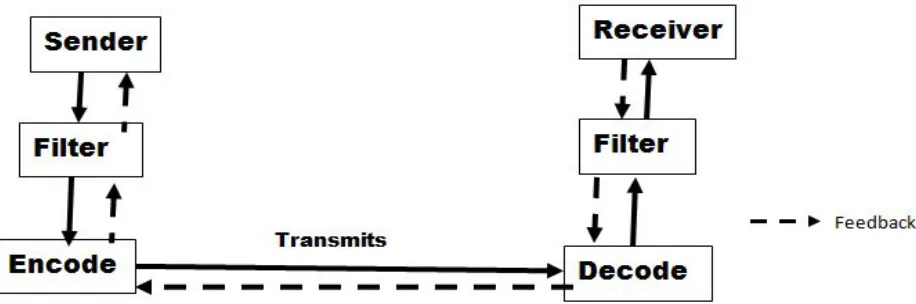
Figure 1: Communication and Feedback Model (modified from Cadle & Yeates, 2008)
Figure 1 shows that feedback is best thing to do in order to test idea against reality. Appropriate and relevant feedback helps drive real-time course-corrections (Milis & Vanhoof 2007). Feedbacks from different stakeholders help project manager to take better decision and create continuous improvement about the project. Sometimes, what should be communicated gets distorted in transmission in spite of the purposes of communication. When the receiver misunderstands what the sender said, misunderstandings, frustration, and conflicts may ensue. Caroll and Buchholtz (2008) identified candor, fidelity, and confidentiality as three key principles associated with communication. With candor, project stakeholders are required to be forthright, sincere, and honest, fair, and free from prejudice and malice in the communication. Fidelity requires the project stakeholders to be faithful to detail, accurate, and avoid deception or exaggeration. Confidentiality means that project stakeholders must exercise care in deciding what information to disclose to others. A project stakeholder might lose trust if confidentiality in communication is breached. Stakeholder’s participations can be influenced and addressed by using effective communication (Lim, Ahn,& Lee, 2005). Various stakeholders require different styles of communication at various circumstances. Finding out the stakeholder’s preferred style of communication is important as such project teams need to select communication style according to the role and position of the stakeholder. The project manager might inquire from stakeholders their preferred style of communication because Chen and Chen (2007) said that stakeholders preferred style is personal. Some prefer emails, while others prefer telephone conversation. Finally the project manager should summarize the discussion to ensure that every stakeholder agrees with the conclusions. Adopting a proactive communication with both internal and external stakeholders in a project establishes clear understanding and awareness of the role each key stakeholder plays in the project. Effective communication also helps in developing a clear and consistent SEP and ensures honest and accurate information is delivered in an effective and timely manner. Irrespective of the type of project, researchers (Achterkamp & Vos, 2008; Chen & Chen, 2007) have agreed that project failure is not only caused by ineffective project management practices, but of inappropriate communication among the project stakeholders.
III. METHODOLOGY
research questions, and questions in the questionnaire. Questionnaire method was the technique used for the primary data collection due to its obscurity, and detailed information was released without reservation (Easterby-Smith et al., 2012). The questionnaire used 10-point scale instead of 5-point or 7-point because we are evaluating what the project organizations had done in the past. If we were seeking the opinion of the respondents, then 5-point or 7-point scale would have been appropriate.
IV. RESULTS AND DISCUSSIONS
Demographic Analysis
This section is mainly designed to provide general information about the respondents in terms of the type of institutions, position and experience of the respondent.
Table 1: Nature of the Organization versus Position
Position
Total No. Returned
Total No. Sent
% Returned ICT
Manager
Project Manager
Software Engineer
N
at
ur
e
of
th
e
O
rg
an
iz
at
io
n Tertiary Institution
9 7 9 25 60 41.70%
Government Agency
19 15 16 50 60 83.30%
Government
Ministry 17 20 18 55 60 91.70%
Total 45 42 43 130 180
In table 1, also show the percentage number of questionnaire returned from each group which is depicted in Figure 3. Government ministries recorded the highest response rate of 91.7 % while tertiary institutions had the least with 41.7%. Government parastatals recorded 83.3%. The pie chart in Figure 3 depicted the results graphically.
Analysis Of Research Questions
Pearson’s correlation coefficient. Generally, the Pearson’s correlation coefficient (R) measures the extent of linear relationship between two variables. The value of R ranges from −1.00 to +1.00. A value of −1.00 indicates a perfect negative linear relationship between the two variables while a value of +1.00 indicates a perfect positive linear relationship. There is no linear relationship between the two variables when the value of R is zero. For the purpose of analyzing the research question, we shall apply the following interpretation of various ranges of values of the correlation coefficient, R.
0.00 < R < 0.25 very weak positive linear relationship 0.25 ≤ R < 0.50 weak positive linear relationship 0.50 ≤ R < 0.75 strong positive linear relationship 0.75 ≤ R < 1.00 very strong positive linear relationship
Similar interpretation holds for the associated negative linear relationships.
Research Question:To what extent does communication and feedback among stakeholders contribute to effective
Software Engineering Projects in Nigeria?
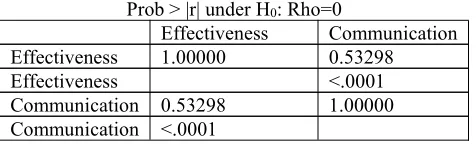
Table 2: The Correlation Procedure for Communication and Feedback among Stakeholders and Effectiveness of Software Engineering Projects in Nigeria
The CORR Procedure
2 Variables: Effectiveness and Communication & Feedback
Simple Statistics
Variable N Mean Std Dev Sum Minimum Maximum Label
Effectiveness 130 63.30769 14.64243 8230 27.00000 97.00000 Effectiveness
Communication 130 30.86923 11.52375 4013 8.00000 115.00000 Communication
Pearson Correlation Coefficients, N = 130
Prob > |r| under H0: Rho=0
Effectiveness Communication Effectiveness 1.00000 0.53298
Effectiveness <.0001
Communication 0.53298 1.00000 Communication <.0001
Table 2 indicates that the Pearson’s correlation coefficient (R) between Communication and Feedback among Stakeholders and Software Engineering Projects effectiveness is obtained as 0.53. This indicates a strong positive linear relationship between communication and feedback among stakeholders and effective Software Engineering Projects in the organizations under study. It shows that over the years, organizations with high communication and feedback among stakeholders also experienced high Software Engineering Projects effectiveness. We therefore conclude that communication and feedback among stakeholders contributes to effective Software Engineering Projects in Nigeria to a relatively high extent.
V. TEST OF HYPOTHESIS
Null hypothesis: Communication and feedback among stakeholders does not significantly contribute to effective
Software Engineering Projects in Nigeria
Alternative hypothesis: Communication and feedback among stakeholders significantly contributes to effective
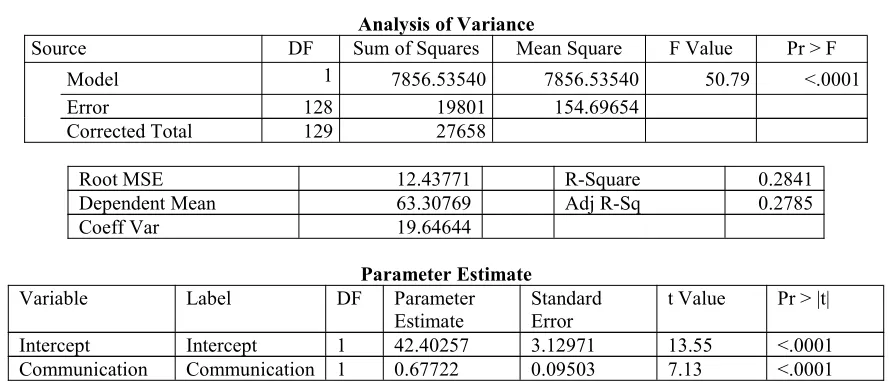
Table 3: The Regression Procedure for Communication and Feedback among Stakeholders and Effectiveness of Software Engineering Projects in Nigeria
The REG Procedure
Model: MODEL 1
Dependent Variable: EFFECTIVENESS Number of Observations Read 130 Number of Observations Used 130
Analysis of Variance
Source DF Sum of Squares Mean Square F Value Pr > F
Model 1 7856.53540 7856.53540 50.79 <.0001
Error 128 19801 154.69654
Corrected Total 129 27658
Root MSE 12.43771 R-Square 0.2841
Dependent Mean 63.30769 Adj R-Sq 0.2785
Coeff Var 19.64644
Parameter Estimate
Variable Label DF Parameter
Estimate StandardError t Value Pr > |t|
Intercept Intercept 1 42.40257 3.12971 13.55 <.0001
Communication Communication 1 0.67722 0.09503 7.13 <.0001
Table 3 shows that the regression model for the effect of Communication and Feedback among Stakeholders on Software Engineering Projects effectiveness is obtained as:
Model 1: Y = 42.40257 + 0.67722 X2 (Equation 1)
Where
Y = Effectiveness of Software Engineering Projects in Nigeria X2= Communication and Feedback among Stakeholders
Regression analysis was conducted to empirically determine whether communication and feedback flow was a significant determinant of effective Software Engineering Projects in Nigeria. Regression results in table 3 indicate the goodness of fit for the regression between communication and feedback flow and effective Software Engineering Projects was satisfactory.
Model 1 and figure4 both confirm that there is a positive linear relationship between Communication and Feedback among Stakeholders and Effectiveness of Software Engineering Projects in Nigeria. Table 4 also shows that the computed F-value for Model 1 is 50.79 with a significance probability of <0.0001, which is less than 0.05. Thus, the test is significant (P < 0.05) at 5% level of significance. We therefore reject the null hypothesis and accept the alternative hypothesis. Consequently, we conclude that communication and feedback among stakeholders significantly contributes to effective Software Engineering Projects in Nigeria. However, the R-square value of 0.2841 shows that Model 1 explains only about 28.4% of the variations in Effectiveness of Software Engineering Projects in Nigeria. Thus the model is not suitable for prediction purposes since it does not account for up to 75% of the variations in Effectiveness of Software Engineering Projects in Nigeria.
increase in communication and feedback by 1 unit leads to an increase in effective Software Engineering Projects by 0.67722.
Fig.4: Scatter plot of Communication and Feedback among Stakeholders and Effectiveness of Software Engineering Projects in Nigeria
A graphical illustration of the relationship between communication and feedback and effective Software Engineering Projects was presented in figure 4. The findings agree with those of Nguyen et al. (2009), Rozanski and Woods (2005), and Savage et al. (1991) who found a positive relationship between communication and feedback and effective project. The figure 4.6 revealed that there is a positive relationship between communication and feedback and effective Software Engineering Projects in Nigeria. An increase in communication and feedback leads to an increase in effective Software Engineering Projects in Nigeria.
VI. CONCLUSION
The study found out that there is a positive correlation between communication and feedback flow among stakeholders and effective Software Engineering Projects in Nigeria. The obtained results agreed with the findings of Fowler and Walsh (1999) and Smolander and Päivärinta (2002) who asserted that communication and feedback flow among project stakeholders averts cost overrun. It proved that the more the communication among project stakeholders, the higher the participation of the stakeholders and the more efficient software. Regression model also confirmed that there is a positive linear relationship between communication and feedback flow among stakeholders and effective Software Engineering Projects in Nigeria. The computed F-value of 50.79 with a significance probability of <0.0001, shows that the test is significant (P < 0.05) at 5% level of significance. This concludes that communication and feedback among stakeholders significantly contributes to effective SEPs in Nigeria. This agrees with the view of Milis and Vanhoof (2007), Čulo and Skendrović (2010), and El-Gohary et al (2006) that project organizations should incorporate communication and feedback among stakeholders during project development.
REFERENCES
[1] Abd-Karim, S. B., Rahman, H. A., Berawi, M. A., & Jaapar, A. (2007). A review of issues and strategies of stakeholder management in construction industry. Management in Construction and Researchers Association Meetings and Conferences (pp. 28-29). Shar Alam Selangor, Malaysia: Academia.edu.
[2] Achterkamp, M. C., & Vos, J. F. (2008). Investigating the use of the stakeholder notion in project management literature, a meta-analysis. International Journal of Project Management , 26 (7), 749-757. [3] Cadle, J., & Yeates, D. (2008). Project management for information systems (5th ed.). Harlow, England:
Prentice Hall.
[4] Carroll, A. B., & Buchholtz, A. (2008). Business and society: Ethics and stakeholder management (7th ed.). Cincinnati, OH: South-Western Cengage Learning.
[5] Chen, W. T., & Chen, T. T. (2007). Critical success factors for construction partnering in Taiwan. International Journal of Project Management , 25 (5), 475–484.
[6] Čulo, K., & Skendrović, V. (2010). Communication management is critical for project success. Informatologia , 43 (3), 228-235.
[7] Decker, B., Ras, E., Rech, J., Pascal, J., & Rieth, M. (2006). Wiki-based stakeholder participation in requirements engineering. In M. Glinz, & R. Lutz (Ed.), Proc. 14th IEEE Int’l Requirements Eng. Conf. (RE 06). 24, pp. 28-35. IEEE CS Press.
[8] Easterby-Smith, M., Thorpe, R., & Jackson, P. (2012). Management research (4th ed.). London: Sage. [9] El-Gohary, N. M., Osman, H., & Ei-Diraby, T. (2006). Stakeholder management for public/private
partnerships. International Journal of Project Management , 24 (7), 595-604.
[10]Eskerod, P., & Vaagaasar, A. (2012). Stakeholder management strategies and practices during a project course. 28th European Group for Organizational Studies Colloquium. Helsinki, Finland: EGOS.
[11]Fowler, A., & Walsh, M. (1999). Conflicting perceptions of success in an information systems project. International Journal of Project Management , 17 (1), 1-10.
[12]Fricker, S., Gorschek, T., & Myllyperkiö, P. (2007). Handshaking between software projects and stakeholders using implementation proposals. Proc. of the 13th International Working Conference on Requirements Engineering: Foundation for Software Quality (pp. 144 – 159). Springer.
[13]Lim, G., Ahn, H., & Lee, H. (2005). Formulating strategies for stakeholder management: A case-based reasoning approach. Expert Systems with Applications , 28, 831-840.
[14]Milis, K., & Vanhoof, K. (2007). Analysing success criteria for ICT projects . International Journal of Nuclear Knowledge Management , 2 (4), 449–455.
[15]Nguyen, N., Skitmore, M., & Wong, J. K. (2009). Stakeholder impact analysis of infrastructure project management in developing countries: a study of perception of project managers in state-owned engineering firms in Vietnam. Construction Management and Economics , 27 (11), 1129-1140.
[16]NITDA. (2012). NITDA Research Reports. Department of Corporate Research and Strategy: Abuja-Nigeria [17]PMI. (2013). Communication: the message is clears (White Paper). Project Management Institute Inc. [18]Premium Times. (2016). Premium Times Newspaper
[19]Rowlinson, S., & Cheung, Y. (2008). Stakeholder management through empowerment: Modelling project success. Construction Management And Economics , 26 (6), 611-623.
[20]Rozanski, N., & Woods, E. (2005). Software systems architecture: Working with stakeholders using viewpoints and perspectives. New York: Addison-Wesley.
[21]Savage, G. T., Nix, T. W., Whithead, C. J., & Blair, J. D. (1991). Strategies for assessing and managing organizational stakeholders. Academy of Management Executives , 5 (2), 51-75.
[22]Smolander, K., & Päivärinta, T. (2002). Describing and communicating software architecture in practice: Observations on stakeholders and rationale. Proc. of the 14th International Conference on Advanced Information Systems Engineering, (pp. 117-133).
[23]Turkulainen, V., Aaltonen, K., & Lohikoski, P. (December 2015/January 2016 ). Managing Project Stakeholder Communication: The Qstock Festival Case. Project Management Journal , 46 (6), 74 - 91. [24]Yang, J., Shen, Q., & Ho, M. (2009). An overview of previous studies in stakeholder management and its