©
Center for Promoting Education and Research
www.cpernet.org
Effect of Quality Product and Quality Service through Customer Satisfaction on Customer Loyalty in PTPegadaian ITC Cipulir Jakarta
Anisa Dwi Rianawaty Student Master of Management Universitas Krisnadwipayana Jakarta PO BOX 7774 / Jat CM Jakarta 13077
Email: [email protected]
Indonesia Suharto Associate Professor
Universitas Krisnadwipayana Jakarta PO BOX 7774 / Jat CM Jakarta 13077
Email: [email protected]
Indonesia Ismail Razak
Lecturer Faculty of Economics Universitas Krisnadwipayana Jakarta PO BOX 7774 / Jat CM Jakarta 13077
Email: [email protected]
Indonesia Abstract
This study aimed to analyze the effect of product quality and service quality on customer loyalty through customer satisfaction at PT Pegadaian (Persero). Data analysis using path analysis with samples are 215 respondents and technique sampling with purposive sampling. The results showed that the quality of product and service quality through customer satisfaction indirectly no significant effect on customer loyalty.
Keywords: Quality Products, Quality Service, Satisfaction and Loyalty
INTRODUCTION
PT. Pegadaian (Persero) is one of the non-bank financial institutions that are managed by the Government to carry out its main activities the distribution of money or credit on the basis of the law of pledge. The history of PT. Pegadaian (Persero) has been started since 1901 in Sukabumi, West Java with the name of the Government Pawnshop (Dutch East Indies). During his trip this institution experiencing some fundamental changes that change the legal status which would affect the structure of the company's work Pawnshop.
As one of the companies that today has developed quite rapidly, PT. Pegadaian (Persero) is required to find and build a management system capable of professional attention to customers.Two things become the company's main consideration in providing services to customers is due to the increasingly high cost of acquisition of new
customers in a climate of such tight competition, and the fact that the level of the company's ability to generate profits is directly proportional to the growth of the relationship between companies and customers.
The importance of the role of the customer for the company's survival is often expressed by the business in the form of praise and pride to customers. The word customer is a term that is very familiar with the business world in Indonesia starting from small traders to large traders, from domestic industry to industry international scale, from companies engaged in the production of goods to companies engaged in the field of services is to understand what the word customer that. In companies engaged in services, customers are people who use services. Many terms are used to the mention of the customer. In the world of banking and financial institutions, customers are called by customers.
makers to consider one or more alternative brands from a number of similar brands. But it is different from the behavior of repeat purchases, loyalty customers include the aspect of feeling in it.
Customer satisfaction regarding what is disclosed about the perceptions and hopes for service received. While loyalty is related to what customers do after interacting in a service process. Customer satisfaction should be complemented with customer loyalty because customers' satisfaction is not enough. The attitude of loyal customers will arise after the customer feel satisfied or dissatisfied with the service received. Customer loyalty is a greater benefit for the company as compared to new customers.
Quality products and services that play an important role in shaping customer satisfaction and loyalty, which is closely linked to creating profits for the company. The more quality products and services provided by the company that satisfied your customers will also be higher. Their customer satisfaction will be able to establish a harmonious relationship between the company and the customer. Create a good foundation for repeat purchases and the creation of customer loyalty and form a word of mouth recommendation would benefit the firm.
In its business growth is so rapid and so tight competition, also participated in developing the marketing concept. Event marketing is now more oriented to the customer and start focusing on the satisfaction of customer needs. Customer loyalty begins their customer satisfaction is determined by the quality of products and services so that the quality assurance it is essential that a financial institution.
The attention to products and services become very important in the service industry financial institutions, which seriously implement service functions into one moto and corporate culture as represented by PT. Pegadaian (Persero) which has adopted the system of services into work culture and ethos of attitude for all elements of the organization ranging from government officers (front office) to the management level.
LITERATURE REVIEW Customer Loyalty
The mention consumers can vary although the same meaning, such as customers and clients. As with banks, customers at PT Pegadaian (Persero) also called
the customer. In this case, the consumer/customer is the most important and is needed by the company. With its customers, a company can sell to sell the products they offer and ultimately profit. Having loyal customers is the ultimate goal of a company. But most companies do not know that customer loyalty is formed through several stages. The creation of satisfaction can provide multiple benefits for the company.
Loyalty according to Dharmesta (2002: 62), "a condition in which consumers have a positive attitude toward a brand, has a commitment to the brand, and intends to continue purchasing in the future." Customer loyalty above gives the same sense of brand loyalty and customer loyalty. Customer loyalty is not formed within a short time, but through the learning process and based on the experience of the consumer itself of purchase is consistent over time. It can be said that it has raised customer loyalty.
Dimensions or indicators of customer loyalty according to Kotler and Keller (2006; 57) consisting of:
1.Repeat purchase of fidelity customers in making a purchase transaction or continue in a certain product, in addition to customers do not just buy services and primary products but customers also bought product lines and services from the same company.
2.Retention is resistance to the negative influence of the company so that customers refuse to use alternative products or services offered by competitors.
3.Referrals namely customer to refer willingness in total over the existence of the company where the customer makes a voluntary sale of mouth to friends or relatives with respect to products or services of a company.
Customer Satisfaction
According to Kotler and Keller (2012), customer satisfaction is feeling happy or disappointed
someone who emerged after comparing the performance
©
Center for Promoting Education and Research
www.cpernet.org
the products or services offered, this will buildcustomer loyalty.
In the concept of customer satisfaction are two elements influencing that expectation and performance? Performance is consumer perceptions of what is received after consuming products, while consumer expectations are estimates of what will be accepted if he consumes the product (goods or services).
According to Kotler (2013;104), "there are several methods that can be used in measuring customer satisfaction, including:
1. The system of complaints and suggestions, the customer-centered organization that provides ample opportunity to its customers to suggestions and complaints. This information can provide ideas for the company and allow it to react fast and responsive manner to overcome the problems that arise.
2. Ghost shopping, one way to get a picture of the customer satisfaction is to hire some people to act or behave as potential buyers, then report its findings of the strengths and weaknesses of competitors company and products based on their experience in the purchase of these products. besides the ghost shopper can also observe how each complaint.
3. Lost customer analysis, companies should contact those customers who have stopped buying or who has moved the supplier to be able to understand why it happened. Monitoring customer loss rate (the rate of lost customers) is also important, increased customer loss rate shows the failure of the company to satisfy its customers.
4. Customer satisfaction surveys, general research on customer satisfaction survey conducted by research, either by telephone or direct interviews. The company will obtain responses and feedback directly from customers and also give a sign is positive that the company pay attention to customers.
Dimensions of customer satisfaction according to Lupiyoadi (2001; 127) can be described as follows:
1. The quality of products that consumers will be satisfied if the assessment showed that the products
they use quality
2. Quality of service is mainly for the service industry, consumers will feel satisfied when they get good services or as expected.
3. Emotional customers would feel proud and gain confidence that other people would be amazed to him when using products with certain brands that tend to have a higher level of satisfaction. The satisfaction derived not because of the quality of the product but the social values that make consumers be satisfied with a particular brand. 4. Price is a product that has the same quality but set a
relatively cheap price would give a higher value to their customers.
5. Cost is the consumer who does not need to incur additional costs or do not need to waste time to get a product or service tend to be satisfied with the product or services.
Product Quality
According to Rampersad (2001), "the product is anything that can be offered by manufacturers to note, asked, sought, bought, used or consumed by the market as fulfilling the needs or desires the relevant market". Products offered include physical goods (eg books,cars), services (recreation, restaurants, transportations), people (Jennifer Lopez, Stallone, Elvis Presley), place (Ancol, Hawaii, Bali), organization (PDI, the United Nations, Forkot) and the idea or ideas (Family Planning). So, the product can be tangible or intangible which can satisfy the customer.
Marketing experts like Tjiptono (2003; 51) stated, "The quality can be considered as a measure of the relative goodness of a product or service which consist of quality of design and quality of conformance". The design quality is a function of product specifications, while the quality of conformity is a measure of how much a product is able to meet the requirements or specifications of a predetermined quality. Greater emphasis expressed in the concept of TQM and also in Goetsh and Davis (1994), "Quality is a dynamic condition associated with products, services, people, processes, and environments that meet or exceed expectations".
Dimensional quality of the product according to Umar (2000), can be described as follows:
1. Performance is related to the functional aspects of goods (services) and is considered the main characteristics of customers in buying the goods. 2. Durability is a reflection of the economic life in the
form of the size of the durability or lifetime of a product.
3. Features that aspect of performance that is useful to add to the basic functions associated with the choice - the product selection and development. 4. Reliability namely matters related to the probability
of a product is successfully carrying out its functions whenever used within a certain time period.
5. Conformance ie matters relating to the level of conformity with the specifications set in advance based on the customer's wishes. This dimension reflects the degree of precision of the design of products with the qualification standards has been set.
With the quality of the product is getting better, the products produced by a company must be increasingly favored by customers that will increase the sense of satisfaction in the purchase and usage. Conversely, if the product quality is getting worse it will lower customer satisfaction.
Quality of Service
According to Sunyoto (2013), the quality of services, "One serving of the product or service according to the size that applies to where the product is held and delivery at least equal to the desired and expected by consumers".
In this globalization era, companies should always be aware of the importance of the quality factor. Therefore, measuring the level of quality is necessary. In the management of services, we have to know how the development of the quality of our services in the eyes of consumers. Quality as the nature of the appearance of the product or service is a major part of our corporate strategy to achieve sustainable excellence, both as a market leader or as a strategy to continue to grow and develop. If a product or service has good quality, then it will affect the level of customer satisfaction.
This means that the traits and characteristics of a product or service also determine the quality that has the ability to meet the needs and expectations of consumers. Manufacturers said to have been delivered if the quality of the products or services offered in accordance with the needs and expectations of consumers. If a product or service has to meet certain standards, then the goods or services deemed to have had the quality, in terms of both quality and quantity.
Kotler (2012), "There are five (5)
dimensions/determinants of the quality of services that
affect customer satisfaction". These five factors are: 1. Reliability ie the dimensions that measure the
reliability and capability of the company in providing services to its customers, to carry out the services which served reliably and accurately. 2. Responsiveness ie the responsiveness of the
company in understanding the development of customer needs and wants, alacrity and sincerity in answering the customer's question or request. 3. Conviction namely in the form of the company's
ability and behavior of employees in instilling confidence and trust to its customers. This dimension includes aspects of competence, the company's reputation, securities, as well as courtesy and hospitality employees.
4. Empathy namely the individual attention given by the company to customers, the specific needs and understand the wants and needs of its customers. 5. Tangible namely in the form of appearance of
©
Center for Promoting Education and Research
www.cpernet.org
RESEARCH METHODSResearch Design
A study requires their research methods for the research method will provide steps in conducting a study. According to Sugiyono (2007:1), "research method is basically a scientific way to get data with a specific purpose and usefulness". The scientific way of meaningful research activities based on the characteristics of science, that is, rational, empirical and systematic.
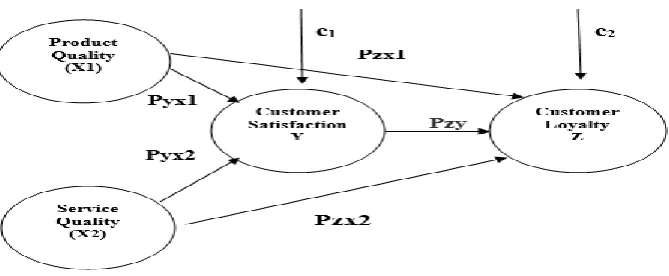
The design research model of this is that simultaneous variable product quality, service quality and customer satisfaction effect on customer loyalty PT Pegadaian (Persero) ITC Cipulir Jakarta, as well as the relationship of each independent variable on the dependent variable (customer loyalty). Explanatory
analysis research approach. This means that each of the variables presented in hypothesis testing will be observed through a causal relationship between independent variables (exogenous) to the dependent variable. In this case study the relationship between two or more variables, which in this study examines the relationship and influence between the factors of product quality, service quality and customer satisfaction on customer loyalty PT Pegadaian (Persero) ITC Cipulir Jakarta.
Framework
In this frame, work can be obtained a description that, the role of product quality, service quality, and customer satisfaction is considered very important in influencing customer loyalty. The framework can be seen in Figure 1:
Figure 1. Framework
Population and Sample
According to Hazar (1999), "Population is a large group of individuals who have the same general characteristics". In this regard, Sugiyono (2007) defines "population as a generalization region consisting of objects that have a certain quantity and characteristics defined by the researchers to be learned and then drawn conclusions". While Levina (2002) states, "a total population of an item or something that is of considerable concern".
The population in this study are all customers of PT. Pegadaian (Persero) Unit ITC Cipulir Jakarta with one-month study period, namely in March 2017 with customer sampling criteria as follows:
1. Preferred Customers are customers who have been a
customer for at least 2 years at PT. Pegadaian (Persero) Unit ITC Cipulir Jakarta.
2. Preferred Customers are active customers of PT. Pegadaian (Persero) Unit the transaction at least 1 time in 2017 at PT. Pegadaian (Persero) Unit ITC Cipulir Jakarta.
The samples are 215 respondents with a purposive sampling technique.
Data Collection Technique
with the understanding the questionnaire by Sugiyono (2007;135), "the questionnaire is a technique of data collection is done by providing a set of questions or a written statement to the respondent to answer.
This study used a Likert scale because of Likert scale associated with a statement about one's attitude toward something. Where alternative questions/answers provided in the form of a range of selection agree to disagree.
RESULTS AND DISCUSSION Testing Path Analysis
Step Testing the path analysis is divided into two, namely the testing of the Sub-Structure 1 between X1 (quality products), X2 (quality of service) and Y (customer satisfaction) and testing of sub-structure 2 between X1 (quality products), X2 (quality of service ), Y (customer satisfaction) and Z (customer loyalty). The test is performed through data processing using SPSS 17.0
Tests of Sub-Structure 1
Structural equation for the sub-structure 1, namely: Y = Pyx1 Pyx2 + e1 +
Based on the results of the regression in the quality of the product can sig 0.000 < 0.05, which means that the variable quality of products significantly affects customer satisfaction variables. Similarly, the quality of service that is sig 0.000 < 0.05, which means that the variable quality of service significantly affects customer satisfaction variables. While simultaneously, it can be interpreted that the X1 (product quality) and X2 (quality of service) have a significant effect on Y (customer satisfaction). The value of R2 or R square contained in the model table is a summary of 0.824, this shows that the contributions or donations influence X1 (product quality) and X2 (quality of service) to Y (customer satisfaction) amounted to 82.4% while the remaining 17.6% is a contribution from other variables not included in the study.
Based on the results of standardized regression coefficients beta is equal to 0.573, while the Pyx2 value that is equal to 0.361. Meanwhile, the value can be searched by the formula e1 e1 = √ (1-R2) = √ (1-.824) = 0So,2. So the equation is Y = 0,573X1 + 0,361X2 + 0,42e1.
Tests of Sub-Structure 2
Structural equation for the sub-structure 2, namely: Y = Pzx1 + Pzx2 + Pzy + e2
Based on the regression results showed that the product quality sig 0.000 < 0.05, which means that the variable quality of products significantly affects customer loyalty variable. Sig value the quality of service that is 0.008 <0.05, which means that the variable quality of service significantly affects customer loyalty variable. Similarly, the value of customer satisfaction ie sig 0.000 < 0.05, which means that the customer satisfaction variables significantly affect customer loyalty variable. While simultaneously, it can be interpreted that the X1 (product quality) and X2 (quality of service) and Y (customer satisfaction) have a significant influence on the Z (customer loyalty). The value of R2 or R square contained in the model table below is a summary of 0.962, this shows that the contribution or contribution of the influence of X1 (product quality), X2 (service quality) and Y (customer satisfaction) on Z (customer loyalty) is 96.2% while the remaining 3.8% is a contribution from variables others not included in the study.
To determine the value of Pzx1, the results of standardized regression coefficients beta is equal to 0.516, Pzx2 value that is equal to 0.122, while the Pyz value that is equal to 0.378. Meanwhile, the value can be searched by the formula e1, e2 = √ R2) = √ (1-.962) = 0.2. So the equation is Y = 0,516X1 + 0,122X2 + 0,378Y + 0,2e2.
Hypothesis Testing
The results of hypothesis testing are as follows: 1) Analysis of the effect of X1 on Y is the significance
value of X1 of 0,000 < 0,05 so that Ho is rejected and Ha is accepted which means that the quality of the product has a significant effect on the variable customer satisfaction.
2) Analysis of the effect of X2 on Y is the significance value of X2 of 0,000 < 0,05 so that Ho is rejected and Ha is accepted which means that the quality of service has a significant effect on the variable customer satisfaction.
©
Center for Promoting Education and Research
www.cpernet.org
significance value of X1 of 0,000 < 0,05 so that Hois rejected and Ha is accepted which means that the product quality has a significant effect on the variable customer loyalty.
5) Analysis of the effect of X2 on Z is the significance value of X2 of 0.008 < 0.05 so that Ho is rejected and Ha is accepted which means that the quality of service has a significant effect on the variable customer loyalty.
Testing the Effect of Direct and Indirect
The study describes the path analysis model of direct and indirect influence of exogenous variables, namely product quality, service quality and customer satisfaction against an endogenous variable that is customer loyalty.
1) Influence of product quality to customer loyalty. Direct Impact (Pzx1) = 0.516
The indirect effect through customer satisfaction (Pyx1) (Pzy) = 0.573 x 0.378 = 0.217
Effect of total = 0.516 + 0.217 = 0.733
Based on the calculation above, it is known that the direct effect (0.516) > the value of the indirect effect (0.217), the results indicate that the quality of the product does not have a significant effect indirectly on customer loyalty.
2) The influence of service quality on customer loyalty.
Direct Impact (Pzx2) = 0.122
The indirect effect through customer satisfaction (Pyx2) (Pzy) = 0.361 x 0.378 = 0.136
Effect of total = 0.122 + 0.136 = 0.258
Based on the calculation above, it is known that the direct effect (0.122) < value of the indirect effect (0.136), the results indicate that the quality of service is a significant indirect effect on customer loyalty.
Based on the analysis calculations have been described above, it can be concluded that satisfaction does not become an intervening variable between product quality and service quality on customer loyalty in PT. Pegadaian (Persero) ITC Cipulir Jakarta.
CONCLUSIONS AND RECOMMENDATIONS Conclusion
Based on the results of research and discussion in this study, it can be concluded as follows:
1. Product quality and significant positive direct effect on customer satisfaction by 0.573.
2. Quality of service is a positive and significant direct impact on customer satisfaction by 0.361.
3. Quality products and quality service and significant positive direct effect on customer satisfaction by 0.824.
4. Product quality and significant positive direct effect on customer loyalty by 0.516.
5. Quality of service is a positive and significant direct effect on customer loyalty by 0.122.
6. Customer satisfaction and significant positive direct effect on customer loyalty by 0.378.
7. Product quality and service quality through customer satisfaction indirectly no significant effect on customer loyalty.
Recommendations
From the analysis and conclusions, and based on the comments and suggestions of customers, the authors sought to propose some feedback or suggestions for companies or agencies concerned to create a suitable strategy in order to increase customer loyalty PT. Pegadaian (Persero) ITC Cipulir Jakarta, the authors suggest the following:
1. All variables have a positive effect on customer loyalty to PT. Pegadaian (Persero), particularly in the ITC Cipulir need special attention over the variable quality product and service quality the as well as looking for a breakthrough that could increase the quality of service for example by continuing to innovate in a variety of mortgage products.
2. Companies must maintain a pawnshop existing products so that customers remain loyal and do not transfer to another financial institution. As for measures to improve product pawnshop is to always keep the hallmark of seed and continue to innovate in product mortgages or other loans.
3. A need to increase the ability of the officer or employee in the service of customer transactions, such as the willingness to help the difficulties of customers, resolve customer complaints appropriately,
giving clear information according to their needs.
Besides improving the quality of service, management
(physical appearance) to pay attention to cleanliness, comfort with an attractive interior, complementing the supporting facilities (parking and air conditioning) and most notably is the safety and security of customers.
4. PT Pegadaian (Persero), especially in ITC Cipulir Jakarta must always maintain and improve the satisfaction and trust of customers. If the customer's satisfaction and trust are not maintained and
improved, the chances PT Pegadaian (Persero), will lose loyal customers in the future. To maintain the trust of our customers can now be done by enhancing the positive image of the PT Pegadaian (Persero),for example by improving services related to all aspects such as service improvement front office, service improvement customer service and so on, which will certainly enhance the reputation / image PT Pegadaian (Persero).
References
Danang, Sunyoto. (2013). Metodologi Penelitian Akuntansi. Bandung: PT Refika Aditama Anggota Ikapi. Dharmesta B.S dan Irawan. (2002). Manajemen Pemasaran Modern. Yogyakarta: Liberty.
Fandy Tjiptono, (2002), Manajemen Jasa. Penerbit Andi Yogyakarta.
Goetsch, D.L & Davis, S, (1994). Introduction to Total Quality, Quality, Productivity, Competitiveness, Englewood Cliffs, NJ, Prentice Hall International Inc.
H. Rampersad, (2001), Personal Balanced Scorecard. PPM Manajemen.
Hadjar, Ibnu. (1999). Dasar-dasar Metodologi Penelitian Kuantitatif Dalam Pendidikan. Jakarta : Raja Grafindo Persada.
Husein, Umar. (2000). Riset Pemasaran Dan Penilaian Konsumen. Jakarta: PT Gramedia Pustaka.
Kotler, Philip (2006). Manajemen Pemasaran, Edisi Pertama. Indonesia: PT. Indeks Kelompok Gramedia.
Kotler, Philip and Kevin Lane Keller, (2012). Marketing Management, Edisi 14, New Jersey: Prentice-Hall Published.
Kotler, Philip, Keller, Kevin L. (2013). Manajemen Pemasaran. Jilid Kedua, Jakarta: Erlangga. Levina (2002). Statistic for Manager. Four Edition, Pearson Prentise Hall.
Lupiyoadi (2001) Manajemen Pemasaran Jasa Teori dan Praktek, Salemba Empat, Jakarta.
Stanton, William, J (1996). Fundamental of Marketing. Thenth ed. Mc, Graw Hill Inc; Singapore. Sugiyono, (2007), Metodologi Penelitian Bisnis, PT. Gramedia, Jakarta.