DOI:10.21276/ijprhs.2016. 06.14
G Pratapet al. CODEN (USA)-IJPRUR, e-ISSN: 2348-6465
Original Article
RP-HPLC Method Development and Validation for
Estimation of Triamcinolone Acetonide in Injectable
Suspension using USP-Type-IV Dissolution Apparatus
G Pratap Kumar
*, Nemali Tirupathirao, T Murali Krishna
MRR College of Pharmacy, Nandigama, Krishna District, Andhra Pradesh.
A R T I C L E I N F O A B S T R A C T
________
1. INTRODUCTION
Dissolution and drug release tests are in-vitro tests that measure the rate and extent of dissolution or release of the drug substance from a drug product, usually aq.medium under specified conditions. It is an important QC procedure for the drug product and linked to product performance in-vivo. HPLC continues to be very biological samples. Detection of a drug or related substance in biological samples is usually complicated by the matrix. Therefore clean up procedures are employed to effectively separate drugs from endogenous materials. The ultimate sensitivity of an assay may be limited by efficiency of cleanup methods.
International Journal of Pharma Research and Health Sciences
Available online at
www.pharmahealthsciences.net
Received: 16 Nov 2016 Accepted: 20 Dec 2016
A new simple, precise, accurate and selective RP-HPLC method has been developed and validated for stability indicating RP-HPLC method for estimation of Triamcinolone acetonide injectable suspension Pharmaceutical dosage form.In this method to optimize the mobile phase, various combinations of buffer, acetonitrile and water were studied on Inertsil ODS 3V, 150x4.6mm, 5 µm with a flow rate of 1.0 ml/min .The detection was carried out at 254nm.The retention time for Triamcinolone acetonide were found to 2.72 min respectively. The method was validated according to the ICH guidelines for specificity, precision, accuracy, linearity and robustness. The method showed good reproducibility and recovery with %RSD less than 2. So the proposed method was found to be simple, specific, precise, accurate and linear. Hence it can be applied for routine analysis of Triamcinolone acetonide in bulk and pharmaceutical preparations.
Keywords:Triamcinolone acetonide, acetonitrile, linearity and robustness.
Corresponding author *
Dr. G Pratap Kumar
Pharmaceutical formulation and in biological material is primarily by the LC techniques the interest of chiral separation has developed along with the increased axis of useful separation methods in particular owing to new chiral stationary phases. The new awareness combined with increased axis of tools for selective separation by HPLC has generated most rapidly growing application field in bio analytical chemistry. In the modern pharmaceutical industry, HPLC is the major and integral analytical tool applied in all stages of drug discovery and drug development and production. HPLC coupled with MS to support target selection (proteomics), biological screening and assay development, high throughput compound analysis and characterization, UV and mass directed fractionation for un attended, automated compound purification and high throughput in vitro ADME screening. The number of drugs introduced into the market is increasing every year. These Drugs may be either new entities or partial structural modification of the existing one. Very often there is a time lag from the date of introduction of a drug into the market to the date of its inclusion in pharmacopeias. This happens due to the possible uncertainties in the continuous and wider usage of these drugs, reports of new toxicities (Resulting in their withdrawal from the market), development of Patient resistance and introduction of better drugs by competitors. Under these conditions, standards and analytical procedures for these drugs may not be available in the Pharmacopeia. Therefore it becomes necessary to develop newer analytical methods for such drugs.
2. MATERIAL AND METHODOLOGY In the present investigation, we have developed a simple and sensitive RP-HPLC method for quantitative estimation of Triamcinolone acetonide inbulk drug Pharmaceutical injectable suspension dosage forms.These are trails performed for HPLC method development ofTriamcinolone acetonide injectable suspension.
Selection of wavelength:
The detection of wavelength was selected by dissolving triamcinolone acetonidein acetonitrile to get concentration of the 10 g/ml. The resulting solution was scanned in U.V range from 200-400nmAfter thorough examination of the spectra, the wave length 254 nm was selected for further analysis.
Method development trails TRIAL: 1
Mobile phase :( 90:10% Water: Methanol
Column :ZORBAX ECLIPSE XDB C8 150x4.6mm, 5 µm
Flow rate : 1.4ml/min Column temp :25C Sample temp : Ambient Injection volume: 20 µl Run time : 20 min Wavelength : 254 nm
Mode of elution: Isocratic Rt : 11.2 min
Fig 1: chromatogram of triamcinolone acetonide for trail-1
Trial: 2: Mobile phase :( 70:20:10% Water:Methanol: ACN)
Mix water, methanol and acetonitrile in the ratio of70:20:10 %v/v and sonicate to degas.
Column : ACE C18 (250×4.6×mm, 5µ m) Flow rate : 1.2ml/min
Column temp : 25ºC Sample temp : Ambient Injection volume : 10 µl Run time : 20 min Wavelength : 254 nm Mode of elution : Isocratic Rt : 4.24 min
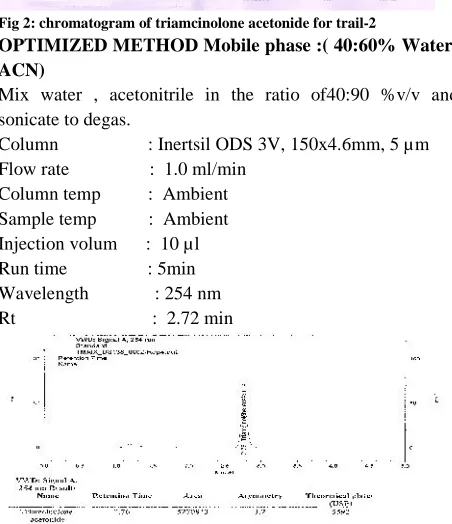
Fig 2: chromatogram of triamcinolone acetonide for trail-2
OPTIMIZED METHOD Mobile phase :( 40:60% Water: ACN)
Mix water , acetonitrile in the ratio of40:90 %v/v and sonicate to degas.
Column : Inertsil ODS 3V, 150x4.6mm, 5 µ m Flow rate : 1.0 ml/min
Column temp : Ambient Sample temp : Ambient Injection volum : 10 µl Run time : 5min Wavelength : 254 nm Rt : 2.72 min
METHOD VALIDATION
1. SYSTEM SUITABILITY: The HPLC system was stabilized for thirty min. by following the chromatographic conditions to get a stable base line. One blank followed by six replicates of a standard solution was injected to check the system suitability. The system suitability parameters were evaluated from standard Chromatograms obtained, by calculating the retention times, tailing factor, theoretical plates and %RSD peak areas from six replicate injections. The results are shown in the below table
Procedure:The blank and standard were prepared like as sample method and injected into HPLC system. The results of standard solution were summarized in below table. Table 1: System suitability data Triamcinolone Acetonide
System suitability parameters Results Acceptance criteria
% RSD for analyte peak areas of five
replicate standard injections 0.26 NMT 2.0
Theoretical plates 6123 NLT 2000
Tailing factor 1.24 NMT 2.0
0.95to
Observation:
From the system suitability studies it is observed that all parameters are within limits. Hence it is concluded that the instrument, reagents and column are suitable to perform the assay.
SPECIFICITY
The effect of wide range of excipients and other additives usually present in the Triamcinolone Acetonide the determinations under optimum conditions were investigated.
Placebo solution, sample and standard solutions were analysed individually as per the method to examine interference. Chromatograms of placebo, standard and sample were shown in below Figures.
Blank interference:
Blank solution injected. It was observed that, no blank peaks were interfering with analyte peak.
Fig 4: Typical chromatogram of standard
Fig 5: Peak purity of standard
Observation:
There was no interference due to blank at the retention time of the analyte. Hence the method is specific.
Placebo interference:
Placebo of Triamcinolone Acetonide is 1 mL of placebo sample prepared and injected. It was observed that, no placebo peaks were interfering with analyte peak.
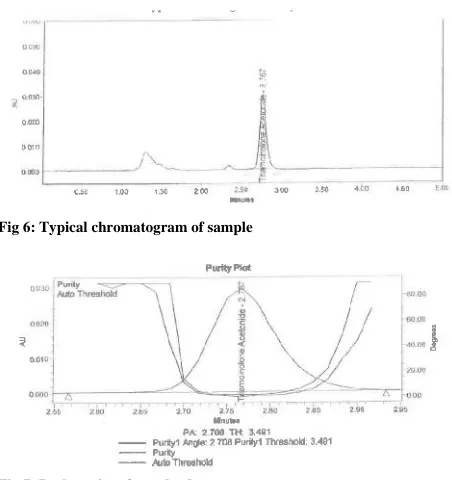
Fig 6: Typical chromatogram of sample
Fig 7: Peak purity of standard Observation:
The chromatograms of the standard and sample were identical.
ACCURACY: The accuracy of the developed method was determined by assay and recovery studies. Recovery studies were carried out at three different levels. The pre-analysedsamples were spiked with 10%, 100%, and 120% of mixed standard solution. The mixtures were analysed by the proposed method.
Procedure
A series of sample solutions were prepared in triplicate by spiking the Triamcinolone Acetonide with placebo in the range of 10% to 120% and injected into HPLC system and analyzed .
Individual % recovery, mean % recovery and % RSD were calculated and the results were found to be within the acceptable limits.
Table 2: Accuracy results of Triamcinolone Acetonide
S. No.
% Spike level
Amount added(mg/ml)
Amount recovered(mg/ml)
% Recovery
Mean
%recovery%RSD
1.
10%
0.0045 0.00445 98.9
100.4 1.5
2. 0.0045 0.00453 100.7
3. 0.0045 0.00458 101.8
1. 100%
0.0453 0.0444 98.0
99.3 1.6
2. 0.0453 0.0458 101.1
1. 120%
0.0542 0.0555 102.4
100.8 1.4
2. 0.0542 0.0543 100.2
3. 0.0542 0.0541 99.8
Observation:
The recovery results indicating that the test method has an acceptable level of accuracy. The results were found to be within the limits.
Linearity:
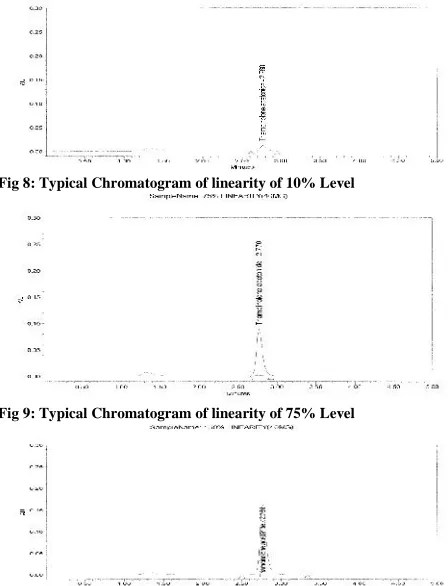
A series of solutions of Triamcinolone Acetonide, with concentrations of ranging from about 10% to 125% of specification level were prepared and injected into the HPLC system.
Linearity of detector response was established by plotting a graph of concentration and responses of Triamcinolone Acetonide. The detector response was found to be linear from about 10 to 150% of specification level. The squared correlation coefficient, slope and intercept were calculated by least square fit method for Triamcinolone Acetonide. The linearity results and graphs are summarized in below.
Fig 8: Typical Chromatogram of linearity of 10% Level
Fig 9: Typical Chromatogram of linearity of 75% Level
Fig 10: Typical Chromatogram of linearity of 150% Level
PRECISION:
The precision of the analytical method was studied by analysis of multiple sampling of homogeneous sample. The precision expressed as standard deviation or relative standard deviation. According to the ICH, precision should be performed at three different levels:
System precision (Repeatability) Method precision (Reproducibility)
Intermediate precision
Method precision for 40 mg: USP-IV (Flow through cell): To evaluate the method precision for dissolution method, six samples were prepared and analyzed.
% RSD of each time intervals were calculated and results summarized in below table.
Table 3: Method precision results of Triamcinolone Acetonide Sample % Drug dissolved
5 Min
10 Min
15 Min
20 Min
30 Min
40 Min
50 Min
60 Min
70 Min
80 Min
90 Min
120 Min
1 22 42 53 59 67 73 78 81 83 85 87 89
2 24 43 53 59 67 73 78 81 84 86 87 90
3 23 42 52 58 66 72 76 80 83 85 87 90
4 24 42 52 59 67 73 77 81 84 85 87 90
5 24 42 53 59 67 73 77 80 83 84 86 88
6 23 43 54 61 70 76 81 85 88 90 92 95
Mean 23 42 53 59 67 73 78 85 84 86 88 90 % RSD 3.5 1.2 1.4 1.7 2 1.9 2.2 2.3 2.3 2.5 2.5 2.7 Observation:
From the method precisions studies it is observed that all the parameters like %RSD of retention time and peak areas are within limits.
SOLUTION STABILITY:
The stability of solutions was evaluated by injecting the standard and samples from method precision at initial, 3rd day and 5thday at room temperature. The areas of standard and sample injections were compared.
Fig 11: A Representative chromatogram of stabiliy day3
Table 4: Stability data ofTriamcinolone Acetonide
Area response
% Difference
Initial 3930435 N/A
Day-3 3936484 0.1
Day-5 3938072 0.1
Observation: All the samples were found to be stable up to 5days.
Robustness:
For demonstrating the robustness of the developed method, experimental conditions were purposely altered and evaluated. The method must be robust enough to withstand such slight changes and allow routine analysis of the sample. Following optimized conditions were slightly varied. To evaluate the Robustness for dissolution method,
A study was conducted to determine the effect of variation in flow rate. Standard solution was prepared and injected into the HPLC system by keeping flow rates (± 0.2 ml/min) i.e., 0.8 ml/min and 1.2 ml/min. The effect of variation of flow rate was evaluated. The observations of variation of flow rate were given in below tables.
Table 5: System suitability data for Column oven temperature variation System suitability parameters Results As such (25°C) -Column oven temperature (20°C) +Column oven temperature (30°C) Acceptance criteria
% RSD for analyte peak areas of five replicate
standard injections
0.09 0.15 0.44 NMT 2.0
Theoretical plates 5035 4766 4776 NLT 2000
Tailing factor 1.1 1.1 1.1 NMT 2.0
0.95to
3. RESULTS AND OBSERVATIONS
Out In the present work reports a new RP-HPLC method for estimation of Triamcinolone acetonide injectable suspension Pharmaceutical dosage form.In this method to optimize the mobile phase, various combinations of buffer, acetonitrile and water were studied on Inertsil ODS 3V, 150x4.6mm, 5 µm Initially. Then combination of the solvents were modified by using of the compounds were not satisfactory. Then the mobile phase containing a mixture of water and acetonitrile was carried out and found that the ratio 60:40 technique resulted in peaks with good shape and resolution. A flow rate of 1.0 ml/min was found to be optimum in the range of 0.8-1.2 ml/min resulting in short retention time, baseline stability and minimum noise and the retention times of Triamcinolone acetonide were found to be, 2.72min. The developed method is validated in accordance with the ICH guidelines with all of the results within the limits. Quantitative linearity was obeyed in the concentration range of Triamcinolone acetonide 40 μg/ml of the regression equations of concentration over their peak areas were found to be Y = (R2=0.9999) for Triamcinolone acetonide where Y is the peak area and x is concentration of drugs(μg/ml). Precision of the method was studied by making the replicate injections of the standard solutions and standard deviation was determined. The % RSD value (below 2) indicates that the method was Précised.
The high percentage recovery indicates that the proposed method is highly accurate. The % Recovery of were found to be 100.4 for 10% concentration; 99.3, for 100% concentration and 100.8 for 150% concentration.Robustness of the method was performed by varying the flow rate of mobile phase and column temperature. Ruggedness of the method was determined by performing the experiment by different analysts.
Finally the developed HPLC method was applied for estimation of Triamcinolone acetonide in Pharmaceutical dosage forms. No interfering peaks were found in the
chromatogram indicating that excipients used in tablet formulations didn’t interfere with the estimation of the drugs by the proposed HPLC method.
Thus, a simple, sensitive, precise and accurate RP-HPLC method was developed and validated for the estimation of Triamcinolone acetonide injectable suspension pharmaceutical dosage form.
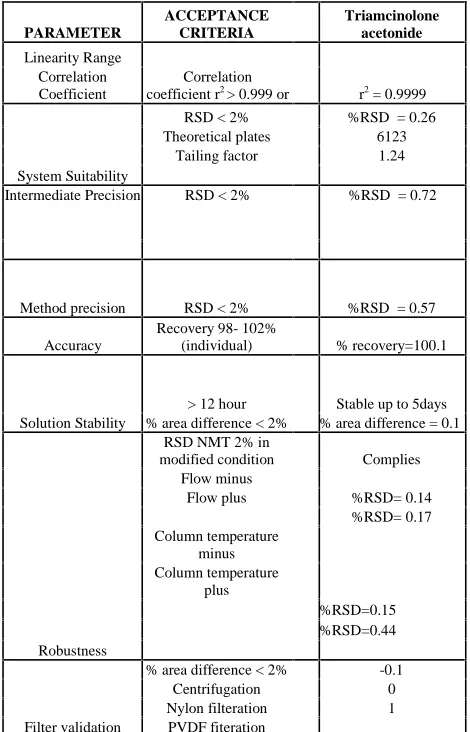
Table 6: Validation parametersTriamcinolone acetonide by HPLC
PARAMETER ACCEPTANCE CRITERIA Triamcinolone acetonide Linearity Range Correlation coefficient r2
> 0.999 or r2 = 0.9999 Correlation
Coefficient
System Suitability
RSD < 2% %RSD = 0.26 Theoretical plates 6123
Tailing factor 1.24
Intermediate Precision RSD < 2% %RSD = 0.72
Method precision RSD < 2% %RSD = 0.57
Accuracy
Recovery 98- 102%
(individual) % recovery=100.1
Solution Stability
> 12 hour Stable up to 5days % area difference < 2% % area difference = 0.1
Robustness
RSD NMT 2% in
modified condition Complies Flow minus
Flow plus %RSD= 0.14
%RSD= 0.17 Column temperature minus Column temperature plus %RSD=0.15 %RSD=0.44 Filter validation
% area difference < 2% -0.1
Centrifugation 0
Nylon filteration 1
PVDF fiteration
4. CONCLUSION
Development of new analytical methods for the determination of drugs in Pharmaceutical dosage forms is of great importance in quality control, pharmacokinetic, toxicological and biological studies. The commonly used tests of Pharmaceutical analysis generally entail compendia testing method development, setting specifications and limits, and method validation. New methods are now being developed, so that, new products can be assured to have comparable quality and can be brought to international markets faster.
sound analytical methods with greater sensitivity and reproducibility. Therefore, the complexity of problems encountered in pharmaceutical analysis with the importance of achieving is the selectivity, speed, low cost, simplicity, sensitivity, specificity, precision and accuracy in estimation of drugs.
6. REFERENCES
1. B.K Sharma. Instrumental methods of chemical analysis. Chapterb1, Introduction to analytical chemistry M3-M5. 23 Meerat; Goel publishers: 2004.
2. B.K Sharma. Instrumental methods of chemical analysis. Chapterb1, Chromatgraphy.C8-C10. 23 Meerat; Goel publishers: 2004.
3. Gurdeep R. Chatwal, sham K. Anand. Instrumental methods of chemical analysis. 5thediton. Delhi; Himalaya publishing house: 2007.
4. HPLC introduction available from web site: http://www.waters.com/waters accessed 2013.
5. G.Vidyasagar. Instrumental methods of drug analysis. Chapter 7 HPLC. Hyderabad; pharmaMedpress 2009: 107.
6. David G.Watson. Pharmaceutical Analysis. a text book for Pharmacy students and Pharmaceutical chemists. 2ndedition; Harcourt Publishers limited.
7. B.K Sharma. Instrumental methods of chemical analysis. Chapter 5 Adsorption chromatography. 23 Meerat; Goel publishers: 2004:96.
8. B.K Sharma. Instrumental methods of chemical analysis. Chapter 6 Partition chromatography. 23 Meerat; Goel publishers: 2004:113-123.
9. B.K Sharma. Instrumental methods of chemical analysis. Chapter 9 Ion pair chromatography. 23 Meerat; Goel publishers: 86.
10. Douglas A. Skoog, F. James Hallor, Stanley R.Crouch. Liquid chromatography Instrumental analysis. Chapter 26 chromatography. Delhi; Cengage learning India Pvt ltd 2011.
11. Douglas A. Skoog, F. James Hallor, Stanley R.Crouch. Liquid chromatography Instrumental analysis. Chapter 28 HPLC Delhi; Cengage learning India Pvt ltd 2011: 923.
12. Connors KA. A textbook of pharmaceutical Analysis. 3rdedition. Delhi; Wiley intersciences Inc :1994. 13. Gurdeep R. Chatwal, sham K. Anand. Instrumental
methods of chemical analysis. chapter 34 HPLC. 5thedition. Delhi; Himalaya publishing house: 2007. 14. David G. Watson. Pharmaceutical Analysis- a text book
for Pharmacy students and Pharmaceutical chemists. 2ndedition. Harcourt Publishers limited: 267-311. 15. Douglas A. Skoog, F. James Hallor, Stanley R.Crouch.
Liquid chromatography. Instrumental Analysis. Delhi. Cengage learning India Pvt ltd: 2011.
16. B.K Sharma. Instrumental methods of chemical analysis. chapter 14 HPLC. 23 Meerat. Goel publishers: 2004:113-123.
17. Elena katz. Handbook of HPLC- Chromatographic science series: 273-483.
18. Frank settle, Phyllis Brown, Kathryn DeAntonios, Prentice Hall. Handbook of Instrumental Techniques for Analytical Chemistry: 1997.
19. L.R. Snyder, J.J. Kirkland, J.L. Glajch. Practical HPLC. Method Development. chapter 1. 2ndedition. Delhi. Wiley Pvt Ltd., 1988:402-438.
Conflict of Interest: None