Multi-channel Diffusion Tensor Image
Registration via Adaptive Chaotic PSO
Yudong Zhang, Shuihua Wang, Lenan Wu, Yuankai Huo
School of Information Science and Engineering, Southeast University, Nanjing, China [email protected]
Abstract— Registration or spatial normalization of diffusion tensor images plays an important role in many areas of human brain white matter research, such as analysis of Fraction Anisotropy (FA) or whiter matter tracts. More difficult than registration of scalar images, spatial normalization of tensor images requires two important parts: one is tensor interpolation, and the other is tensor reorientation. Current tensor reorientation strategy possessed many defects during tensor registration. To overcome the shortcomings, we first presented a multi-channel model with one FA and six log-Euclidean tensors, and then proposed an adaptive chaotic particle swarm optimization to find the global minima of the objective function of the multi-channel model. The results on 42 slices inter-subject registration indicate that our proposed method can produce accurate and optimized parameters of tensor registration with fastest speed relative to Genetic Algorithm and Particle Swarm Optimization
Index Terms— multi-channel registration; genetic algorithm; particle swarm optimization
I. INTRODUCTION
Diffusion MRI is a magnetic resonance imaging (MRI) method that produces in vivo images of biological tissues weighted with the local micro-structural characteristics of water diffusion, especially in brain [1]. An important diffusion MRI modeling and analysis method is diffusion tensor imaging (DTI), which is a MRI technique that enables the measurement of the restricted diffusion of water in tissue in order to produce neural tract images [2].
With diffusion tensor image, the motion of water molecules in human brain can be well formulated by a Brownian motion in each voxel of the image as 3×3 symmetric positive-definite matrices. Diffusion tensor can be reconstructed from a sequence of diffusion weighted imaging (DWI) dataset. The processing and analysis of DTI data are much more difficult than the processing and analysis of DWI. To make DTI data more computationally tractable, investigators have developed a family of so-called diffusion anisotropy indices (DAIs). Most analysis of DTI is constrained on DAIs, which are scalar images. For population study of specific diseases, it's important to do statistical analysis directly on tensor itself. Therefore, registration of different tensor images from different subjects is a fundamental procedure.
Registration is a key step in many areas of white matter research, such as analysis of Fraction Anisotropy (FA) [3] or mapping white matter tracts in different applications, including white matter disorders, demyelination and dysmyelination, brain tumor, and
surgical interventions. Image registration can be formulated as a general optimization problem including four major parts: a metric that defines the difference measure between images; a transformation that defines the spatial transformation applied to the moving image, (e. g., affine transform, B-Spline deformable transform, demon deformable transform); an optimized function (e.g, Powell method) that searches the parameter space of the transformation; and an interpolation method that interpolates image intensities in the transformed moving image. Unlike scalar images, spatial normalization of tensor images requires two important parts, one is tensor interpolation, and the other is tensor reorientation. Current tensor reorientation strategy possessed many defects during tensor registration without consideration of full tensor information.
To overcome the weakness, we proposed a novel model and a new optimization method to solve our model. The structure of this paper is organized as follows. Section II introduces in the background of DWI, DTI, and diffusion tensor. Section III gives our proposed multi-channel model. Section IV presents an improved adaptive chaotic particle swarm optimization (ACPSO) to solve the proposed model. Experiments in section V compared the ACPSO with the standard genetic algorithm and particle swarm optimization. Final section VI is devoted to discussion.
II. BACKGROUND A. DWI and DTI
B. Diffusion Tensor
The tensor can sufficiently describe the molecular mobility along each direction and correlation between these directions. A typical tensor is described as follows
xx xy xz yz yy yz zx zy zz
D D D
D D D D
D D D
(1)
The tensor is symmetric, viz.,Dij=Djiwithi,j=x,y,z.
III. MODEL A. Log-Euclidean Vectorization of tensors
Tensors are always analyzed on Euclidean metrics, which has many defects, such as swelling effects. Recently, some researchers have introduced Log-Euclidean metrics based on affine-invariant Riemannian metrics for tensor analysis. Log-Euclidean metrics have excellent theoretical properties and provide powerful processing tools, also with simpler and faster computations. Under the matrix logarithm and exponentiation operation which are the theoretical basics of Log-Euclidean, one can combine tensor space and vector space together smoothly [5]. The Log-Euclidean vectorization is calculated in following three steps:
Step 1 Perform a diagonalization of D=RTER, which
provides a eigenvector matrixR and a eigenvalue matrix E;
Step 2 Transform each eigenvalue ofEinto its natural logarithm in order to obtain a new diagonal matrix log(E);
Step 3 Recompose log(D)=RTlog(E)R to obtain the
logarithm ofD;
Step 4 Since log(D) has only 6 degrees of freedom, it can be represented by 6D vectors in the following way
log( ) [log( ) ,log( ) ,log( ) , 2 log( ) , 2 log( ) , 2 log( ) ]
xx yy zz
T
xy xz yz
D D D D
D D D
(2)
Here log(D)i,j denote the ith row and jth column of the
matrix log(D).
B. Tensor reorientation
During scalar image registration, the intensity of each voxel is transferred, via the spatial transformation, to the reference image with an interpolation method. Spatial normalization of tensor images which requires two important parts, one is tensor interpolation, and the other is tensor reorientation, is more complex than scale images. In the case of registration of scalar images, transformation T only change the position of voxel i, while keep the value of intensity. In the case of registration of tensor images, the transformation T can’t correct the wrong topology of whiter matters after registration. Reorientation needs to be procedured after tensor registration to keep the topology of whiter matter [6]. Given moving imageMov and reference imageRef, the spatial transformationTare composed of local affine transformations. In order to test our method in a simple way, we only considered a global affine transformation in this paper.
According to Polar Decomposition Theorem, the
affine transformation can be represented by Jacobian matrix Jaco and translation Trans:
T Jaco Trans (3)
*
Jaco Rot Def (4)
here Rot denotes the orthogonal rotation matrix, Def denotes the deformation matrix. The final affine transformation can be represented by:
*
T Rot Def Trans (5)
Therefore, each tensor S is reoriented by Finite Strain strategy as follows
Reo[ ( )]T S Rot T S RotT ( ) (6) C. Multi Channel Mutual Information
Mutual information is an effective method for multimodality image registration. Mutual information is derived from Shannon’s entropy, which is a quantity that measures the mutual dependence of the two variables [7]. Mutual information is an intensity-based image registration method. Given a reference image and a moving image, image registration involves spatially transforming the moving image to align with the reference image. Intensity-based methods compare intensity patterns in images via correlation metrics, such as mutual information. Knowing the correspondence between a number of points between moving image and the reference image, a transformation, rigid, affine or no-rigid, is then determined to map the moving image to the reference images, thereby establishing point-by-point correspondence between the reference and target images. For single-channel images, the final spatial transformation of registration is determined by maxim value of MI between the reference image Ref and the moving imageMov:
* arg max {Reo[ ( )], } T
T MI T Mov Ref (7)
whereTdenotes the spatial transformation. Here, we used multi-channel to increase the registration accuracy, where the first 6 channels represent the 6 components of log tensor mentioned in section A, and the last channel represents the FA value. Fig. 1 gave a detailed example.
Afterwards, we intend to find the best affine parameters of each channel
* arg max Reo ( ) ,
k T k k
T MI T Mov Ref (8)
The final transformationT was calculated as a weighted function of the transformations Tk* with the
corresponding MI values as weighting factors, 7
* *
1
1
k k k
T T
(9)where [ (* ), ]
k MI T Mov Refk k k
, and 7
1 k k
.IV. ALGORITHM
Fig. 1 An example of seven channel registration
A. Particle Swarm Optimization
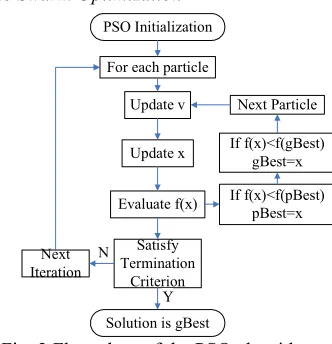
PSO Initialization
For each particle
Update v
Update x
Evaluate f(x) If f(x)<f(pBest)pBest=x If f(x)<f(gBest)
gBest=x Next Particle
Satisfy Termination
Criterion
Solution is gBest Next
Iteration
Y N
Fig. 2 Flow chart of the PSO algorithm
PSO is a population based stochastic optimization technique, which simulates the social behavior of a swarm of bird, flocking bees, and fish schooling. By randomly initializing the algorithm with candidate solutions, the PSO successfully leads to a global optimum. This is achieved by an iterative procedure based on the processes of movement and intelligence in an evolutionary system. Fig. 2 shows the flow chart of a PSO algorithm.
In PSO, each potential solution is represented as a particle. Two properties (position x and velocity v) are associated with each particle. Supposexandvof theith particle are given as
1 2
( , , ,i i iN)
x x x x (10)
1 2 ( , , , )i i iN
v v v v (11)
where N stands for the dimensions of the problem. In each iteration, a fitness function is evaluated for all the particles in the swarm. The velocity of each particle is updated by keeping track of the two best positions. One is the best position a particle has traversed so far and called “pBest”. The other is the best position that any neighbor of a particle has traversed so far. It is a neighborhood best called “nBest”. When a particle takes the whole population as its neighborhood, the neighborhood best becomes the global best and is accordingly called “gBest”. Hence, a particle’s velocity and position are updated as follows
1 1( ) 2 2( )
v v c r pBest x c r nBest x (12)
x x v t (13)
whereωis called the “inertia weight” that controls the impact of the previous velocity of the particle on its
current one. The parameters c1 and c2 are positive
constants, called “acceleration coefficients”. The parameters r1 and r2 are random numbers that are
uniformly distributed in the interval [0, 1]. These random numbers are updated every time when they occur. The parameter ∆tstands for the given time-step.
The population of particles is then moved according to (12) and (13), and tends to cluster together from different directions. However, a maximum velocityvmax,
should not be exceeded by any particle to keep the search within a meaningful solution space. The PSO algorithm runs through these processes iteratively until the termination criterion is satisfied.
B. Improved ACPSO
The PSO algorithm has proven to be very effective for solving global optimization. It is a recently invented high-performance optimizer that is very easy to understand and implement, and it also requires little computational bookkeeping and only a few lines of code.
The parameters (r1, r2) were generated by
pseudo-random number generators (RNG) in classical PSO. The RNG cannot ensure the optimization’s ergodicity in solution space because they are absolutely random; therefore, a chaotic operator was employed to generate parameters (r1,r2) by the following formula:
( 1) 4.0* ( )*[1 ( )] 1,2
i i i
r t r t r t i (14)
Another improvement lies in changing the parameters (ω, c1, c2) adaptively. In the search process of PSO, the
search space will gradually reduce as the generation increases. Therefore, we hope to search an expansive area with low precision at the prophase stage while search a restricted area with high precision at the anaphase stage as listed inTab.1.
Tab.1 Parameters variation
Prophase Anaphase
Ω Larger Smaller
c1 Larger Smaller
c2 Smaller Larger
Performance PSO Searches for global optimal in an expansive area with low precision
PSO Searches for local optimal in a limited area with high precision
The detailed formulas of those adaptive parameters are as follows:
= - i f * ( )
i MaxGeneration Generation i f
1 1
1= -1i i f * (1i 1f) c c
c c Generation c c
MaxGeneration
(16)
2 2
2= -2i i f * ( 2i 2f) c c
c c Generation c c
MaxGeneration
(17)
Here, the indexes i and f denotes “initial” and “final”, respectively.
Fig. 3 42 slices images of subject I
V. EXPERIMENTS
In this study, images were acquired on a 1.5 T MRI signal scanner. The parameters of DWIs are: TR=2.4s, TEs are around 65ms,b=1000s/mm2, FOV=24cm×24cm,
slice thickness=2mm, voxel size=2mm×2mm×2mm, diffusion directions=15. For all subjects, a high-resolution T1-weighted structural image contains 128 axial slices (acquisition matrix: 256×256) was also acquired for other usages. The experiment computer has Intel Core2 CPU with 2GHz and 1GB memory.
We used our proposed algorithm to register two adult subjects. Subject I is determined as the reference image while subject II is determined as the moving image. The 42 slices of subject I are shown in Fig. 3, and those of Subject II are omitted.
A. Algorithm Comparison
0 20 40 60 80 100 120 140 160 0
1 2 3 4 5 6 7
Epoch
M
ut
ua
lI
nf
or
m
at
io
n
GA PSO ACPSO
Fig. 4 Comparison of different algorithms
We compared our algorithm with the standard GA method and canonical PSO method. A typical convergence curve is shown in Fig. 4, indicating that GA and PSO are trapped into local minima, however, our proposed method resist from being misled and converges into global minima.
B. Time Comparison
GA PSO ACPSO 0
1 2 3 4 5 6 7 8 9
A
ve
ra
ge
T
im
e/
s
Fig. 5 Time comparison
C. Registration Evaluation
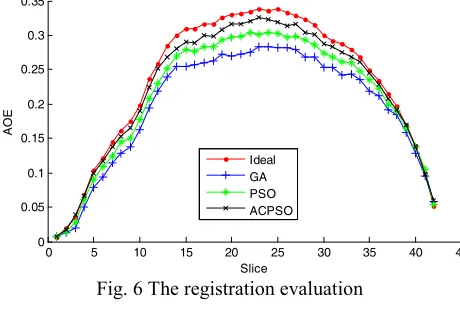
In order to evaluate the registration results, we calculated the average overlap of eigenvalue-eigenvector pairs (AOE) [9] of the resulting images. The AOE measures, on average, the extent to which two tensors at each voxel are aligned, are defined as:
23 ' '
1 3 ' 1
1 1 N ij ji ij ji
j
i i
i j j j
N
(18)Whereλji,εjiandλ’jiε’jiare thejth eigenvalue-eigenvector
pair at theith voxel location in the pair of images, andN is the total number of voxel locations for comparison. Fig. 6 shows the AOEs from different algorithms, demonstrating that our proposed algorithm has the highest AOE on every slice and is the most approximate to the ideal line.
0 5 10 15 20 25 30 35 40 45
0 0.05 0.1 0.15 0.2 0.25 0.3 0.35
Slice
A
O
E
Ideal GA PSO ACPSO
Fig. 6 The registration evaluation
VI. DISCUSSION
A new registration method for DTI was presented in this study. We first proposed a seven-channel (FA plus 6 Log-Euclidean tensor vectors) model based on maximum mutation information, afterwards, we proposed an ACPSO to solve the problem. The experiments on 42 slices of intra-subject brain images of demonstrate that our proposed method performs satisfying, takes the least convergence steps, consumes the least time, and gets the highest AOE value. The future work focuses on the application of this method to other fields such as fiber clustering.
Reference:
[1] J. M. K. Mislow, et al., "Origins of Intraoperative MRI,"Magnetic Resonance Imaging Clinics of North America,vol. 18, pp. 1-10, 2010.
[2] C. Lenglet, et al., "Mathematical methods for diffusion MRI processing,"NeuroImage,vol. 45, pp. S111-S122, 2009.
[3] L. T. Grinberg, et al., "Improved detection of incipient vascular changes by a biotechnological platform combining post mortem MRI in situ with neuropathology,"J Neurol Sci,vol. 283, pp. 2-8, Aug 15 2009.
[4] K. H. Karlsgodt, et al., "White matter integrity and prediction of social and role functioning in subjects at ultra-high risk for psychosis,"Biol Psychiatry,vol. 66, pp. 562-9, Sep 15 2009.
[5] C. Frindel, et al., "Comparison of regularization methods for human cardiac diffusion tensor MRI," Medical Image Analysis,vol. 13, pp. 405-418, 2009. [6] H. Li, et al., "Simultaneous consideration of spatial
deformation and tensor orientation in diffusion tensor image registration using local fast marching patterns," Inf Process Med Imaging,vol. 21, pp. 63-75, 2009. [7] V. E. Markaki, et al., "An iterative point
correspondence algorithm for automatic image registration: An application to dental subtraction radiography," Computer Methods and Programs in Biomedicine,vol. 93, pp. 61-72, 2009.
[8] N. Krejic, et al., "Gauss-Newton-based BFGS method with filter for unconstrained minimization," Applied Mathematics and Computation,vol. 211, pp. 354-362, 2009.
[9] G. Ball, et al., "An optimised tract-based spatial statistics protocol for neonates: Applications to prematurity and chronic lung disease," NeuroImage, May 24 2010.
Yudong Zhang was born in Suzhou, China. He received a B.S. degree in 2004 and M.S. in 2007 in electronic engineering from Nanjing University of Aeronautics and Astronautics, Nanjing. He received a Ph.D. degree in 2010 in communication and signal processing from Southeast University, Nanjing.
Now he researches as a postdoctor in Columbia University and a research fellow in New York State Psychology Institute. His research interests in computer science are in the areas of data mining for artificial neural network, decision tree, expert system, artificial intelligence, genetic algorithm, and particle swarm optimization. He is the first-author of over 10 papers published on SCI-index journals and is an active consultant for industry in these areas.
Mr Zhang is the editor of “International Journal of Intelligent Information Processing”, “Journal of Convergence Information Technology”. He is a member of IEEE, New York Academy of Science, Chinese Computer Federation (CCF), and China Institute of Electronics (CIE). Besides, he is a Council Member of Audio/Video Technician Association and Multimedia Institute in Nanjing.
Lenan Wu was born in Fujian, China, in July 1952. He received the B.S. degree in radar engineering and M.S. degree in communication & electronic systems in 1982 and 1987, respectively, both from the Nanjing Aeronautical Institute, China, and the Ph.D. degree in signal & information processing in 1997 from the Southeast University, Nanjing, China. In 1987 he joined the Department of Radio Engineering (now, the Institute of Information Scien & Engineering), Southeast University, where he is presently a Professor of Signal & Information Processing.
He has been the Deputy Chairman of the Department during 1992 to 2000 and the Director of the Multimedia Technical Research Institute (MTRI) since 1992. He is presently a Fellow of China Institute of Electronics (CIE), a Senior Member both of China Institute of Communications (CIC) and of China Computer Federation (CCF), a Vice Chairman of the Microcomputer Application Association of China Institute of Instruments, and a Council Member of the Multimedia Technology Committee of National Standardization Commission of Information..