ISSN (Online): 2320-9364, ISSN (Print): 2320-9356
www.ijres.org Volume 5 Issue 8 ǁ August. 2017 ǁ PP. 23-31
Design and Implementation Decision Support System using
MADM Methode for Bank Loans
*
Irfan Fauzi
1, Hadi Suyono
2, Rini Nur Hasanah
3 1(Faculty of Engineering, University of Brawijaya, Malang, Indonesia)*Corresponding author**Irfan Fauzi
ABSTRACT:
The function of banking process can be broadly defined as an institution functioning as a capital receiver and lender, as well as support for trading and payment transactions. In order to maintain the stability of the economy through lending, Bank Indonesia issued a form letter on March 15, 2012 on the application of risk management for the bank conducting credit. In an effort to minimize these problems, Bank Indonesia recommends the precautionary principle in arranging the loan terms and choose the prospective customer in the credit granting institutions, both banks and cooperatives to take into account the risk on lending. A method is needed to select bank for credit applications to the public, i.e. the customer. This research uses the comparison of MADM (Multiple Attribute Decision Making) between TOPSIS (Technique for Order Preference by Similarity to Ideal Solution) method and ELECTRE (ELimination Et Choix TRaduisant la realitE) method for the loan provisions to the customers. With the hope of getting the quickest and the most accurate solutions, the hesitancy in determining customers for lending can then be minimized.Keywords:
MADM, TOPSIS, ELECTRE, Loans, Bank.I.
INTRODUCTION
Economic growth of a region can not be separated from the role of financial institutions or banks in an effort to provide services to the community. According to Indonesian Banking Law number 10 of 1998, the bank is a business entity that collects funds from the community and channeled back to the community in the form of credit in order to improve the living standard. Thus, the function of the broader banking can be defined as a functioning institution of the recipient and the lender, as well as the launching of trade and payment transactions.In an effort to maintain the stability of the economy through this policy, Bank Indonesia issued a circular on March 15, 2012 regarding the implementation of risk management at the bank conducting the credit. Many institutions of both commercial bank and non-bank institutions issued credit policy to the public either in the form of cash loans or credit cards. These cash loans are usually reserved for working capital, investment, and consumption. As for credit card users, they are usually charged at the end of the usage period. With such a crediting system, the problem of non-performing loans and unfavorable payments affecting the collectivity of banks can not be avoided.
As an effort to minimize the problem, Bank Indonesia recommends prudential principles in regulating credit requirements and selecting prospective customers in credit institutions, both banks and cooperatives by taking into account the risks in lending. Based on information collected from banks, the current level of non-performing loans has generally declined, but is still relatively as high as 2.15% from the previous year. This does not include the effort of coercion of credit against SMEs (small and medium-sized enterprises) that greatly trigger the occurrence of NPL (non perfoming loan) or bad debts in the banking, thus requiring careful selection of SME credit to the community. In this case, marketings and surveyors play a very important role, since they know the real situation of prospective customers down to the field. Marketings are employees assigned to offer credit services to prospective customers, while surveyors are officers who conduct surveys on potential customers, and both of them understand the real customers’ situation.
Suhud Wahyudi and his colleagues conducted research on DSS for customer selection using TOPSIS method. However, the final result of this study shows only ranking of customer priorities, whereas credit criteria and customer alternatives can not be determined [2].Setyawan and Teguh also conducted research on the DSS to determine the creditworthiness of cooperatives using the ELECTRE method. The result of this study, however, can not perform weighting of the processed multicriteria. Therefore it must be continued with other methods or preprocessing for the calculation of the criterion weight [3].Based on some of the above research it is necessary to conduct research and development of a DSS to overcome problem with many criteria and be able to give weighting criteria. Therefore, it is necessary to implement MADM by giving comparison between TOPSIS and ELECTRE and take some advantages of both methods.
II.
THEORETICAL
BASIS
A. Decision Support System
According to Daihani, decision is an alternative of action strategy [4]. While Kusrini said that the decision is an activity to choose a strategy or action in solving a problem where the action aims to achieve a certain target [5]. In the other word, the two experts above were formulating that decision-making is an action in choosing a strategy that is believed will provide the best solution to something.Turban defines the DSS as a system that serves to support decision makers (i.e. managers) in semi-structured decision situations, but not to replace a manager's position in providing an assessment of the decision [6]. Meanwhile, according to Alter, DSS is an interactive information system that provides information, modeling, and manipulation of data used to assist decision making in semi-structured situations or unstructured situations (not replacing decision-making functions in making decisions), when no one knows exactly how the decision should be made [7].
The main difference between the DSS and the MIS (Management Information System) is that the MIS produces more routine and programmed information, while the DSS has been linked to a specific decision-making process. One example of a DSS is a production scheduling system in a company which operates based on orders. The purpose of DSS is to help managers make informed decisions to solve semi-structured problems, and improve the effectiveness of managerial decision-making rather than efficiency.
B. Method of Software Engineering
Businesses which are related with software engineering can be categorized into three general phases disregard the application area, project size, and complexity. These phases are as follows: the definition phase focusing on "what", the development phase focuses on "how", and the maintenance phase focuses on "change" [8].
C. Multiple Attribute Decision Making
MADM (Multiple Attribute Decision Making) is a model of MCDM (Multiple Criteria Decision Making). MCDM is a method of decision making to establish the best alternative based on certain criteria. Criteria are usually the sizes, rules, or standards used in decision making.
D. TOPSIS
TOPSIS stands for Technique for Order of Preference by Similarity to Ideal Solution. TOPSIS is one of the MADM methods first introduced by Yoon and Hwang [9]. It uses the principle that the chosen alternative must have the closest distance from the positive-ideal solution and furthest from the negative-ideal solution utilizing a geometric point of view by using the Euclidean distance to determine the relative proximity of an alternative with the optimal solution. The positive-ideal solution is defined as the sum of all the best attainable values for each attribute, while the negative-ideal solution consists of all the worst values achieved for each attribute, and TOPSIS considers both solutions.
The distance to the positive-ideal solution and the distance to the ideal solution is negative by taking the proximity relative to the positive ideal solution. Based on a comparison of the relative distance, alternative set of priorities can be achieved. This method is widely used to solve practical decision making. This is because the concept is simple and easy to understand, computation-efficient, and has the ability to measure the relative performance of decision alternatives in a simple mathematical form.
E. ELECTRE
An alternative is said to dominate the other alternatives if one or more of the criteria exceeds (compared to the criteria of the other alternatives) and equals the other remaining criteria [11].
F. MySQL 5.0
One of today popular RDBMS (Relational Database Management System) is MySQL. Its high speed, ease of installation, as well as its licence under GNU General Public Licence, give rise to make MySQL an option, especially if database publication over internet is needed. This research uses MySQL 5.0 as RDBMS located in the cloud for accessibility. The cloud server in used is www.freemysqlhosting.net, which is a free MySQL database hosting with certain limitations.
G. Borland Delphi 7.0
Borland Delphi 7 is a compiler using Object Pascal Language. It is event-driven and visual programming based compiler designed for Microsoft Windows platform. Borland Delphi 7 was chosen because it is the most stable version of Delphi but has a relatively small installation size, and is capable of running on Microsoft Windows XP, Vista, 7, 8, and 10 operating systems.
III.
METHOD
OF
RESEARCH
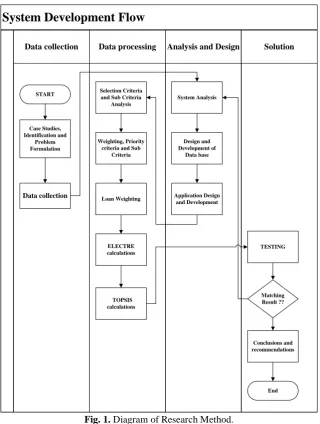
The type of this research is software engineering, with SDLC (System Development Life Cycle) is used for development. The stages performed are as follows: design, analysis, design, testing, and implementation.
System Development Flow
Data processing Analysis and Design Solution
Data collection
START
Case Studies, Identification and
Problem Formulation
Data collection
Selection Criteria and Sub Criteria
Analysis
Weighting, Priority criteria and Sub
Criteria
ELECTRE calculations Loan Weighting
TOPSIS calculations
Design and Development of
Data base System Analysis
Application Design and Development
Conclusions and recommendations
TESTING
Matching Result ??
End
Fig. 1. Diagram of Research Method.
A. Case Study
As the first stage in this research, case study dictated the author conducted a field study by entering field of study directly to Bank BNA Ngunut Arta Tulungagung. Direct observation and interviews are used with the purpose of knowing the initial information about the criteria of a customer in taking loan procedure and paying in installments to the bank.
B. Problem Identification and Formulation
After conducting preliminary research, the problems customers’ experienced can be then identified, tracing back the root of the problem. All problems identified are then feed as input to be solved using both TOPSIS and ELECTRE method.
C. Data Collection
The data needed in this research is the feasibility of a customer in applying for loan to the bank. These data include customer identity, income, assurance, character, type of business, and the ability of banks in providing loans. The data were obtained based on survey results or direct observation at Bank BNA Ngunut Arta Tulungagung.
D. Data Processing
The data will be used in data processing which includes some activities as follows: Analysis and Selection of Criteria and Sub Criteria; Weighing Priority Criteria; Weighing Criteria; And TOPSIS and ELECTRE calculations.
E. System Analysis and Design
The purpose of this stage is to analyze the system to be developed in accordance with the needs of the customers. Next will be known the specification of user needs and who will users of the system.
Start
Criteria
Using TOPSIS
Methode Using ELECTRE Methode
The chosen alternative is the
greatest value
END
Make a normalized decision matrix
Define a positive ideal matrix and a negative ideal matrix
Create a normalized weighted decision matrix Make a normalized decision
matrix
Weighting in a normalized Matrix
Define corcodance and discordance
Determine the distance between the values of each
alternative
Create a normalized weighted decision matrix
Rank alternatives
Calculate corcodance and discordance
matrix
Specifies the preference value
Determines the dominant matrix
Determines Agregate Dominance Matrix
Elimination of less favorable alternatives
F. Database Design and Development
Database is used as data storage of DSS. The database in this application uses MySQL which is an open source RDBMS. The database structure is then uploaded to cloud server and tested for connection and accessibility.
G. Application Design and Development
Applications developed will be Windows desktop-based. This application is expected to accommodate lending process to customers by using TOPSIS and ELECTRE method. The application will be developed with Borland Delphi 7 compiler.
H. Application Testing
Testing of the program would be made during the developing process and after the software development. This test aims to find errors in the application that is there to then be done improvements after analyzing the error.
II.
CONCLUSIONS
AND
RECOMMENDATIONS
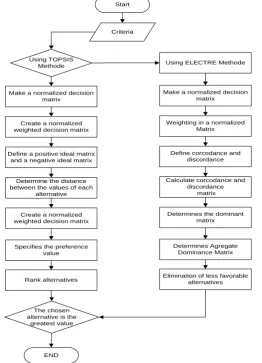
After completion of data processing and system design to minimize or overcome the existing problems, the final step is to make a conclusion of the whole thesis done and suggestions or input from the managers and stockholders of Bank BNA Ngunut Artha Tulungagung. The initial process undertaken in this software design is TOPSIS process. It starts from making a normalized decision matrix based on the criteria of the prospective customer. Then the matrix of tenorized decisions is given weight according to the criteria required by the bank. From a matrix of normalized weighing decisions sought minimum and maximum values so that positive-ideal solutions and ideal solutions can be searched. After that, the positive-ideal solution and the negative-ideal solution is obtained from the value of preference according to the equation. Finally, the system performs the ranking based on the preference value of each prospective customer.
While the process undertaken by ELECTRE is initially determine the normalization of decision matrix based on the criteria of the prospective customer. The system then performs the appropriate weighting required by the bank. Next step was to determine the corcodance and discordance of the alternatives offered by the bank. Subsequently corcodance and discordance are calculated to generate domain matrices which will ultimately result in the elimination of alternatives based on ranking on the preferences of each potential customer, as briefly seen in Figure 2.
IV.
RESULTS
AND
DISCUSSIONS
The result of the research is about the concept of calculation step which is applied to DSS software development, accompanied by the result of DSS software execution and test in case of data validation, determination of validity of prospective customer, and result of DSS credit disbursement to all candidates to be distributed in accordance with quota.
A.
Determination of Criteria
From the variables in previous chapter, some criteria are specified in each of the global sections and customer sections to match the characteristics of built software. The criteria of global section are the Conditions of the Bank, which in the development of this software is defined as the quota of funds distributed to the customers for loans. This quota of funds is planned every month to be distributed to prospective customers. When the total funds are insufficient or failed to distribute to all prospective customers, it is in this section that the established DSS plays an important role, selecting all potential customers who are eligible to find which one is selected and which are not selected according to the criteria of each prospective customer. This criterion is not a weighted criterion.
On the other side, criteria placed on the part of the customer include: Character, Lending Parameter, Capacity, Capital, and Collateral. Character (sub-criteria in the form of: history, reputation, and business legality) is a criterion that becomes one of the basic calculation of DSS. In this case there are still sub-criteria in the form of: history; reputation; and business legality. Each is a sub-criteria of a boolean type (QUALIFIED or UNQUALIFIED). Because there are 3 sub-criteria, then the QUALIFIED value for each sub-criterion is 1/3. This criterion is the criterion which is one of the basic calculations of DSS, and the weight according to its importance is 0.1.
Capacity is a criterion that holds two roles at once, i.e. as a direct criterion used to determine whether a prospective customer takes credit or not, by comparing it to the total monthly installment, which must be equal to or greater than the total monthly installment (otherwise the prospective customer can not take a loan); And as the basic criterion of the calculation of DSS with the value of monthly excess capacity to the installment load. Inside the software, this criterion is automatically detected as an excess of monthly capability to the installment load, and has a zero or more value to act as the basis of decision support, while negative value will cause the prospective customer can not take the credit. The value of 0.4 is chosen as the weight of this excess capacity in accordance with the highest degree of importance (whether each month the prospective customer is able to set aside more outside the installment).Capital is a criterion that contains estimates of assets owned by prospective customers outside of collateral. This criterion is one of the basic calculations of the DSS, which gives the meaning of the bank's confidence about the condition of the prospective customer's wealth. The weight given according to the scale of importance is 0.2.Finally, Collateral is a criterion that also has two roles at once. As a direct criterion used determine the prospective customer can take credit or not, that is when 75% of its value (as the value of collateral valuation) at least equal to the value of the ceiling or loan principal. Meanwhile, as the criterion which is the basis of DSS calculation, is calculated as the excess of the principal amount of the loan. The weighting of 0.3 indicates that the DSS relies heavily on this criterion (second order after excess capability) which shows the value of secured collateral in the event of bad debt.
Table I. Weighting of each Criteria.
No. Criteria Description Weight
1 Character Holds 3 sub-criteria, i.e. history,
reputation, and business legality. Each of them weights 1/3.
0.1
2 Capacity Based on capacity excess according to
monthly installment.
0.4
3 Capital Based on total asset possessed by
potential customer except his/her collateral.
0.2
4 Collateral Based on excessive value of 75% of
collateral appraisal against loan principal.
0.3
Total of Weight 1.0
Table I shows the description and weight of each criterion. Each criterion, like the weighted sum, must have a normalized value. Normalized values are required so that each criterion is consistent with each other by its weighting. The value that appears will range from 0 to 1. In this case, the polarity value of each criterion is already a benefit value, i.e. the greater the better, so there is no need to reverse the polarity of the value.
B.
Normalization of Character Criterion
The assessment for this criterion is a combination of the three sub-criteria that compose it, namely history, reputation, and business legality. Each of the sub-criterion is of type boolean, that is, only the value of either TRUE or FALSE is permitted. Equation 1 shows the assessment of historical sub-criterion.
(1)
Whereas equation 2 shows the appraisal of reputation sub-criteria, and equation 3 shows the assessment of the sub-criteria of business legality.
(2)
(3)
From all sub-criteria assessments, the three above are combined to produce an assessment of character criterion, as shown in equation 4, in the form of normalized values.
(4)
C.
Normalization of Capacity Criterion
for the normalization significance to have an effect in accordance with current currency value conditions, the nominal value is made in million rupiah.
(5)
Equation 5 shows the formula for normalized value of capacity excess.
D. Normalization of Capital Criterion
Assessment of these criterion is a wealth or assets owned by a prospective customer in addition to wealth or assets that are mortgaged (collateral).
(6)
Equation 6 above shows the formula for normalized value of customer’s capital.
E. Normalization of Collateral Criterion
Assessment for this criterion is actually an excess of 75% of asset appraisal value by a prospective customer against the loan principal. The minimum value is zero, where there is no advantage at all. If the value is negative, it is certain that the prospective customer is considered unfit to take this credit, so before entering the process of calculating the DSS is considered he/she would not be accepted as a candidate.
(7)
Equation 7 shows the formula for normalized value of 75 % collateral appraisal excess.
F. Calculation of The Weighted Value
The weighted value to be competed should be calculated based on the value of each normalized criterion multiplied by each weight, as shown in Equation 8 through 11, and finally summed up.
(8)
(9)
(10)
(11)
Once all weigthed values of each criterion have been obtained, every result is then summed up as shown in Equation 12.
(12)
G. Candidates Sorting based on their Weighted Value
After all candidates get the result of weighted value, then the next step is to sort based on the result of weighted value in descending order. This sorting is done using the bubble sorting method, with the consideration of the resulting performance unnecessarily high because of the limited number of candidates under 1000 rows.
H. Distribution of Credit Quotas by Rank
After the list of candidates have been sequenced, system performs a looping to subtract the credit quota by each candidate. This distribution is done by looping from the first position (from the candidate with the greatest weighted result) to the next smaller position. Each time the existing quota loop is reduced by the loan principal (ceiling) until the quota is running out or insufficient to be given to the candidate. Once the distribution is complete there are two possibilities, i.e. the quota runs out or there will be quota remaining.
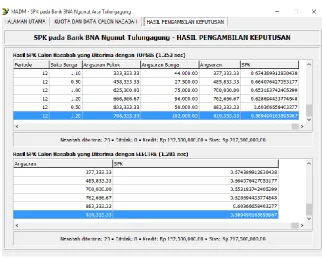
Fig. 3. Display Comparison Result of Decision Support System Using MADM Methode
Figure 3. has included comparison MADM Methode TOPSIS and ELECTRE where it was Consider using between two MADMs is not much different when applied to relatively few data, with calculations using ELECTRE slightly faster (1.281 second) Compared using TOPSIS (1.353 second).
V.
CONCLUSION
Based on the test results it can be concluded as follows:
1. MADM by using TOPSIS and ELECTRE has been able to produce decision of credit distribution with certain quota on candidates of customer.
2. By utilizing Borland Delphi 7 Compiler and MySQL 5.1 RDBMS, software can be developed which apply TOPSIS and ELECTRE and produce DSS only with simple operation.
REFERENCES
[1]. Kusrini, 2007. Konsep Dan Aplikasi Sistem Pendukung Keputusan. Yogyakarta: Penerbit Andi. [2]. Kusumadewi, S. & Purnomo, H., 2006. Fuzzy Multi-Attribute Decision Making. Graha Ilmu:
Yogyakarta.
[3]. Malayu, S.P,H, 2013. Dasar-dasar Perbankann, PT.Bumi Aksara: Jakarta
[4]. Kahraman, C., 2001. Fuzzy Multi-Criteria Decision-Making. Turkey : Istanbul Technical University: Springer Optimization and Its Applications, Volume 16, ISSN: 1931-6828.
[5]. Turban, E., 1995. Decision support and expert systems : management support systems. New Jersey: Prentice Hall.
[6]. Turban, E. & Aronson, J. E., 1998. Decision Support System and Intelligent System (5th Edition). New Orleans: Prentice Hall.
[7]. Turban, E., Aronson, J. E. & Liang, T.-P., 2005. Decision support systems and intelligent system (7th Edition). New Jersey: Prentice Hall.
[8]. Djumhana. 2006, Perkreditan pada bank, Andi Yogyakarta.
[9]. Haifang, C & WenWen, L., 2008. The Economic Benefit Analysis of Private Technological Enterprises in Wenzhou Based on TOPSIS. IEEE. Institute of Electrical and Electronics Engineers 978-1-4244-2108-4. www. Ieee.org
[11]. Hu, Y., Wu, S., dan Cai, L., 2009, Fuzzy Multi Criteria Decision Making TOPSIS for Distribution Center Location Selection, International Conference on Network Security, Wireless Communications and Trusted Computing.
[12]. Salehi, M., dan Moghaddam, R.T., 2008, Project Selection by Using a Fuzzy TOPSIS Technique, International Journal of Computer Information, and System Science, and Engineering 2.
[13]. Fulop, J. 2005. Introduction to decision Making Methods, Hungarian Academy of Science
[14]. Grover, M.P., 2008. Automation Production Systems and Computer Integrated Manufacturing, Prentice- Hall.
[15]. Roy, B. 1978, "ELECTRE III: Un algorithme de classements fonde sur une representation flue des preferences en presence de ctriteres multiples", Cahiers du CERO.
[16]. Allen, L., and Rai, A, 1996. "Operational efficiency in banking: An international comparison“, Journal of Banking and Finance.
[17]. Pardalos, P., Siskos, Y., and Zopounidis, K., (eds.), 1995. "Advances in multicriteria analysis", Kluwer Academic Publ.,Dordrecht,.
[18]. Thanassoulis, E. 1999, “Data Envelopement Analysis and its use in banking”, Interfaces,29.
[19]. Himaah,F and Ciptomulyono, U. 2007. Implementasi Metode AHP TOPSIS dalam Perangkingan Prioritas Pengerjaan Order dan Penentuan Lintasan Kritis dengan Fuzzy PERT. Surabaya. ITS. [20]. Saaty, T,L. 1988. Decision Making For Leaders and The Analytical Hierarchy Process For Decisions in
Complex World. Pittsburg.