25 | P a g e
PROGRESSIVE COLLAPSE ANALYSIS OF EXISTING RC FRAMED
STRUCTURE WITH DESIGN OF EXTERNALLY BONDED FRP SYSTEM
MS. VIDYA V MHASKE
PG Student, Department of Civil Engineering,
PDVVPCOE, Ahmednagar [email protected]
PROF. KAWADE U. R.
Head of Department, Department of Civil Engineering,
PDVVPCOE, Ahmednagar [email protected]
ABSTRACT:
when a building gets too old or exposed to any natural hazards say Tsunami or Earthquake or due to manmade hazards such as fire, explosion of gases, impact of vehicles, etc, it effects the behavior of structure and causes collapse of all or a large part of a structure precipitated by failure or damage of a relatively small part of it. A building undergoes progressive collapse when a primary structural element fails, resulting in the failure of adjoining structural elements, which in turn causes further structural failure. In this present study the behavior of existing RC framed building with 3 stories to progressive collapse located in seismic zone iii is investigated. A linear static analysis is worked out using ETABS software respectively. The demand capacity ratio is assessed in the critical region of the RC portion associated with the column removed, as per provisions of GSA guidelines. The paper concluded that the design of Externally bonded fiber reinforced polymer (FRP) composite laminates have been successfully applied to reinforced concrete (RC) beams and other structural elements there is less susceptibility of progressive collapse with ACI 440 2R-08 and ISIS CANADA as per the provision of guidelines KEYWORDS— progressive collapse, DCR ratio, GSA, ETABS, FRP laminates, strengthening
INTRODUCTION:
Progressive collapse is the collapse of all or a large part of a structure precipitated by a damage or a failure of a small part of it .It is sometimes also called as a disproportionate collapse, which is defined as a structural collapse disproportionate to the cause of the collapse. As the small structural element fails, it initiates a chain reaction that causes other structural elements to fail in a domino effect, creating a larger and more destructive collapse of the structure. A good example of progressive collapse is a house of cards; if one card fails near the top ,it causes multiple cards to fall below it due to the impact of the first card, resulting in a full.
The concept of progressive collapse comes to image after the collapse of the 22 story Ronan Point Apartment Towerin1968[1].The gas explosion occurred on the 18th floor that vigorously rapped out the exterior load bearing panels of the kitchen near the corner of the building. This results in loss of support at that story (i.e., 18th floor) & triggered above floors to collapse. The potential of this collapsing floor causes, impact load on lower stories & set up a progressive collapse. The entire exterior corner of the building collapsed from top to bottom.
GSA GUIDELINES:
The aim of GSA guidelines is to help in evaluating the risk of progressive collapse in new and existing Federal office Buildings; this document offers compact and direct guidelines. For the determination of analysis we have taken existing building with 3 numbers of stories and analyses for seismic zone iii. The following analysis case should be considered.
CASE 1.Analyze for the sudden loss of a column for one floor above ground level situated at the corner of the building.
CASE 2.Analyze for the sudden loss of a column for one floor above ground level situated at or near the middle of the shorter directions side (X- direction in this case) of the building.
CASE3.Interior column removal analysis at any suitable location should be carried out for the buildings that have underground parking and /or uncontrolled public gatherings at ground floor areas.
ANALYSIS PROCEDURE AND PERMISSIBLE CRITERION FOR PROGRESSIVE COLLAPSE:
per Indian Standard Codes, the linear elastic static analysis is carried out using ETABS.
LINEAR STATIC ANALYSIS:
This analysis is the most fundamental and the easiest type for progressive collapse analysis. It involves statically removal of major structural elements. Since this method is most basic & almost accurate, most conventional load conditions are applied with highly moderate assessment conditions.
STEP1. First, the building is analyzed with gravity load (Dead Load+ Live Load)…Eq 1, and obtain the output results for moment and shear without removing any column.
STEP2. Now remove a vertical support (column) from the position under consideration and carry out a linear static analysis to the altered structure and Load this model with 2
{Dead Load + 0.25(Live Load)}…Eq 2.
STEP3. The Static load combinations were entered into the ETABS 2015 V15.0 program and a model of the structure was generated. An ETABS 2015 computer simulation was executed for each case of different Column removal location on the model and the results are reviewed.
STEP4. Further, from the analysis results obtained, if the DCR for any member end connection or along the span itself is exceeded the allowable limit based upon moment and shear force, the member is expected as a failed member.
STEP5. If DCR value surpass its criteria then it will leads to progressive collapse.
PERMISSIBLE CRITERION FOR PROGRESSIVE COLLAPSE:
The GSA guidelines advice the use of the Demand– Capacity Ratio (DCR) which is defined as the ratio of the structural member force after the sudden removal of a column to the member strength (capacity) ,as a benchmark to determine the failure of major structural members by the linear static analysis procedure (GSA 2003).
DCR= Qud / Que …Eq 3 Where,
Qud = Acting force (demand) observed in member or connection
(shear, axial force, bending moment, and possible combined forces)
Que = Expected ultimate, unfactored capacity of the member or connection (axial force, moment, shear and possible
Combined forces)
The permissible DCR values for primary and secondary structural elements are:
• Demand capacity ratio (DCR) < 2.0 for typical structural configurations.
• Demand capacity ratio (DCR) < 1.50 for atypical structural configurations.
METHODOLOGY:
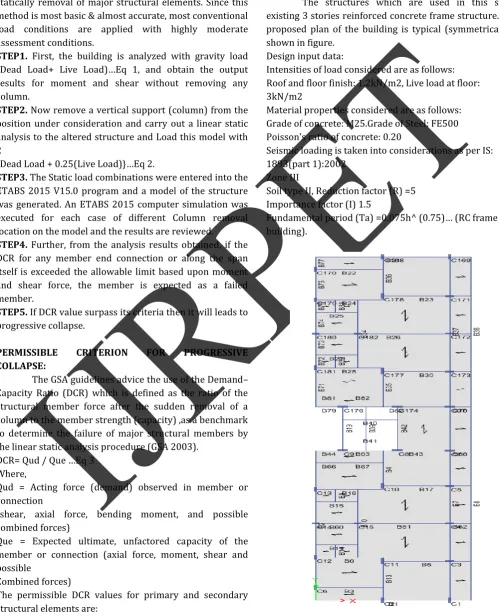
The structures which are used in this study existing 3 stories reinforced concrete frame structure. The proposed plan of the building is typical (symmetrical) as shown in figure.
Design input data:
Intensities of load considered are as follows: Roof and floor finish: 1.2kN/m2, Live load at floor: 3kN/m2
Material properties considered are as follows: Grade of concrete: M25.Grade of Steel: FE500 Poisson’s ratio of concrete: 0.20
Seismic loading is taken into considerations as per IS: 1893(part 1):2002
Zone III
Soil type II, Reduction factor (R) =5 Importance factor (I) 1.5
Fundamental period (Ta) =0.075h^ (0.75)… (RC frame building).
27 | P a g e
PROGRESSIVE COLLAPSE ANALYSIS:
In this analysis method, structural bearing element (column) removed are C1 (corner), C15 (middle along Direction),C9 (interior nearer to first bay) & linear static analysis is executed with gravity loads given by Equation 2
Forced upon the structure. Now, from the analysis results demand at critical section is worked out, also capacity of section is evaluated from the originally seismically designed section. If Demand Capacity Ratio (DCR) of a section (member) go past the acceptable limit in flexure and shear, then the member is treated as failed. The DCR computed from this procedure (linear static) assists to figure out the potential for Progressive Collapse of Structure.
CALCULATION OF DEMAND CAPACITY RATIO:
Capacity of the member at any section is evaluated as per IS 456:2000[4] from the obtained flexure and shear after Analysis and design. The member shear and moment after removal of column loaded with the load combination as per GSA code of practice, Demand of the member is found out. Demand Capacity ratio for each section is found using above data. Member shear and flexure are obtained by analysis results carried out in ETABS 15.0
Figure 2 Bending moment diagram for capacity building
RESULT AND DISCUSSION:
Employing the linear elastic static analysis using ETABS 2015 bending moment diagram is obtained, the DCR values for member under consideration loaded with GSA code of practice is worked out to know the behavior of columns and beams in the structure. The removal of column C 11caused moment reversal in the beam B6, B13,B5 intersecting at the column removed location shown in fig .fig shows the moment distribution in elevation before the removal of the column. Fig shows the moment distribution in different elevation after the column is removed. Graphical representation of DCR After getting all the DCR values for building models ,for all cases of column removal and for zones ii and v ,a graph of DCR Vs Storey’s is plotted
Figure 3 Bending moment for demand building when C11 is removed (case 2)
CASE 1:
Graph 1 DCR for B3-corner Column removed
0 2 4
1 2 3
DCR values
Z
O
NE
I
II DCR for
flexure
Graph 2 DCR for B2-corner Column removed
CASE 2:
Graph 3 DCR for B1-middle Column removed
Graph 4 DCR for B13-middle Column removed
CASE 3:
Graph 5 DCR for B5-Interior Column removed
Graph 6 DCR for B6-Interior Column removed
CONCLUSION:
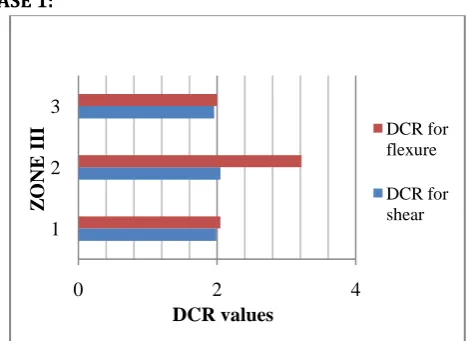
1. Case 1: For zone III, initially for two of the cases there was progressive collapse i.e. all floors were falling, before strengthening and also they did cross the DCR limits for flexure (DCR>2)
2. Case 2: For zone III, the beam in X direction for all the stories, the DCR limits exceeds; which results into no resistance to progressive collapse.
3. Case 3: For zone III, the beam in X and Y directions satisfy the DCR limits (DCR<2), resulting into resistance against progressive collapse hence strengthening not required.
REFERENCES:
1) R. Shankar Nair, Ph.D., P. E., S. E. (2004)."Progressive
Collapse Basics" NASCC Proceedings.
2) General Services Administration (GSA). (2003). Progressive collapse analysis and design guidelines for New federal office buildings and major modernization
projects, GSA.
3) ETABS 2015. Version 15, Extended 3-D Analysis of
Building Systems, Computers and Structures, Inc.,
Berkeley
4) IS 456:2000, “Code of practice for plain and reinforced concrete”( Fourth Revision )
5) IS 1893(Part-1):2002,"Criteria for Earthquake Resistant Design of Structures"(Fifth Edition).
6) Rakshith K G, Radhakrishna (2013)." Progressive Collapse Analysis Of Reinforced Concrete Framed Structure"IJRET eISSN: 2319-1163 | pISSN: 2321-7308 pp.36-40.
7) Meng-Hao Tsai, Tsuei-Chiang Huang (2011)." Progressive Collapse Analysis of an RC Building with Exterior Non-Structural Walls" . Procedia Engineering 14 (2011) 377
8) B. A. Izzuddin, A. G. Vlassis, A. Y. Elghazouli, D. A. Nethercot, ‘Progressive collapse of multi-storey buildings due to sudden column loss – Part II:
Application’, ‘Engineering Structures’ (2008), Elsevier
science publishers, Page 1424-1438.
0 2 4
1 2 3 DCR values Z o ne II
I DCR for
flexure DCR for shear
0 2 4
1 2 3 DCR values Z O NE I II DCR for flexure DCR for shear
0 2 4
1 2 3 DCR values Z O NE I II DCR for flexure DCR for shear
0 2 4
1 2 3 DCR values Z O NE I
II DCR for
flexure
DCR for shear
0 2 4
1 2 3 DCR values Z O NE I
II DCR for
flexure
29 | P a g e
9) Bhavik R. Patel (Sept 2014)." Progressive Collapse Analysis of RC Buildings Using Non-Linear Static and
Non-Linear Dynamic Method". International Journal of
Emerging Technology and Advanced Engineering. Volume 4, Issue 9, September 2014 pp.503-507. 10) S.M. Al Hafian and I.M. May [8] (2012)." Seismic
Progressive Collapse of Reinforced Concrete Framed
Structures” Ayush Singhania, Vikas Khatuja, Vikram
Singh Thakur, Dr. C.B.K. Rao [9](May2013)
11) Abhay A. Kulkarni, Rajendra R. Joshi (2011)." Progressive Collapse Assessment of Structure".
International Journal of Earth Sciences and
Engineering ISSN 0974- 5904, Volume 04, No 06 SPL, October 2011, pp. 652-655
12) B. Gururaja, R. Sridhar [14](2014) Progressive Collapse Potential of Irregular Concrete Building " IOSR Journal of Mechanical and Civil Engineering (IOSRJMCE) e-ISSN: 2278-1684, p-ISSN: 2320-334X PP 67-70
13) Azlam Bin Adnan,Liew Yong Seong (Mar 2014). "Investigation of Progressive Collapse Resistance for a
Seismically Designed RC Building".Research Journal of
Applied Sciences, Engineering and Technology 7(10): 2154-2161, 2014.pp.2154-2161
14) Miss. Preeti K. Morey, Prof S.R.Satone[13] (june 2012)." Progressive Collapse Analysis Of
Building".(IJERA) Vol. 2, Issue 4, June-July 2012,