ISSN (Online): 2320-9364, ISSN (Print): 2320-9356
www.ijres.org Volume 5 Issue 6 ǁ June. 2017 ǁ PP. 46-55
Provably Secure Authenticated Key Management Protocol
Against De-Synchronization Attacks in the Intra-MME Handover
1
Khaled Khairy,
2Mainak Chatterjee
Department of Computer Science, University of Central Florida, USA
ABSTRACT:
This paper presents an authenticated key management protocol for Intra-MME handover over LTE networks. The proposed protocol is formalized using Multi-Set Rewriting approach with existential quantification. The rules specifying the Dolev-Yao intruder model for the proposed protocol is presented, and the immunity of the proposed protocol against the de-synchronization attack, which is the most dangerous attack against the standard protocol, is proved formally.Keywords:
LTE, Handover, Formalization, Multi-Set Rewriting (MSR).I.
INTRODUCTION
Intra-MME handover in long-term evolution (LTE) networks takes place between the source evolved node (eNB) and target eNB under the same mobile management entity (MME). The terms handover refers to the process of transferring an ongoing call or data session from one channel connected to the core network to another channel. In the standard intra-MME handover key management, the session keys for ciphering and integrity protection are derived from the subscriber specific root key (KASME), permanently stored in the
universal subscriber identity module (USIM) and also in the core network authentication center (AUC). The MME derives three keys from KASME: two transient keys KNASenc and KNASint, and a third key KeNB specific for
encrypting the traffic between the nodes and the users [1]. The KeNB is transformed to a new key KeNB* by a one
way key derivation function (KDF) using fresh parameters, i.e., Next Hop (NH) key and the NH Chaining Counter (NCC) to ensure one-hop forward and backward key separation [2].
Before the local root key KASME is updated, an intruder using a rogue base station [6] may apply the
de-synchronization attack to break the forward key separation. Therefore, the new session keys are compromised. Thus, two-hop forward key separation was introduced [3]. This loophole in the standard handover key management protocol has been presented in some recent works [4-6] which suggested some solutions to overcome the de-synchronization attack [7-10], but those could not completly prevent this attack. Therefore, keeping these keys away from the intruders, during the handover process, by enhancing the current intra-MME handover key management protocol is still needed to prevent the de-synchronization attack and to maintain the one-hop forward security. The security protocol analysis aims to prove that a protocol is correct and tries to find any attack scenarios that may result in the failure of any secrecy properties. The Dolev–Yao abstraction [11] considers the protocols as a form of multi-set rewriting (MSR) with existential quantification [12]. In MSR approach, the protocol execution could be carried out symbolically and the interaction of a well-founded protocol theory with an intruder theory can be considerd by analyzing the tracesof the protocol. MSR has so far been applied to many protocols such as Needham-Schroeder and Neumann-Stubblebine [15], Kerberos authentication [16, 17] and Diffie-Hellman protocols [18].
This paper proposes an authenticated key management protocol, provably secure against the desynchronization attack during the intra-MME handover in LTE networks. The proposed protocol can overcome this attack by keeping out the source eNB from the handover process and using the MME as a third trusted party. The traces of the standard protocol showed that the intruder impersonating the source eNB can carry out the handover process and learn the new session key. On the other side, we prove in a formal manner that the proposed protocol can detect the intruder and aborts the handover process. The rest of this paper is structured as follows: section 2 gives an overview of the MSR formalization approach and the rules specifying the Dolev-Yao intruder model. The intra-MME handover key management protocol is presented in section 3. The proposed protocol is presented in section 4. Finally, the conclusions are drawn in section 5.
multi-set of facts. The existential quantification, symbolically model the generation of fresh data (e.g., nonce or session keys). The memory predicates are used to encode systems consisting of a collection of coordinated sub-protocols. Also the constraints are used for testing objects belonging to complex interpretation domains, e.g., time stamps, in an abstract and modular way [13, 14].
In the third stage, the rules comprising sub-protocols or sub-theories are joined in a protocol role theory parameterized by the principal executing it. Rules in a role are threaded using role state predicates declared inside the role which record the information accessed by a rule. The roleis given as the association between a role owner and a collection of rules. Some roles, such as those implementing a server or an intruder, are intrinsically bound to a few specific principals, often just one. We call them anchored rolesand denote them as ρA. Other roles can be executed by any variable principal. In this case, principal A must be kept as a parameter
bound to the role. These generic rolesare denoted as ρ∀A.
2.1 Signature
The signature fragment shown in Table 1 sets up the typing infrastructure used in this paper, with the ‘Types’ column summarizing the types used. The ‘Sub-typing’ column expresses the sub-typing relations satisfied with these types: (A<: B) means that A is a sub-sort of B, with indentation used as a visual aid to track dependencies. Table 2 shows the function symbols used in this paper. In any signature, each function symbol must have a fixed set of parameter sorts (one for each function argument) and a result sort. Finally, Table 3 shows the types of predicates that can enter a state or a rewrite rule used in this paper.
Table 1. MSR Sorts Used in this Paper
Sorts Types Subtyping Name
Messages msg: type. m
Principals principal: type.
tcs: type ts: type. User: type. eNodeB: type.
Server: type.
principal <: msg. tcs <: principal.
ts <: tcs. User <: tcs. eNodeB<: ts.
Server <: ts.
UE eNB1, eNB2
MME
Encryption types etype: type. etype <: msg. e
Keys key: etype → type.
dbK: etype → tcs → type.
shK: etype → client→ ts → type. ∀e: etype, A: tcs. dbK
e A <: keye.
∀e: etype, A: tcs, A: ts. shKe C A <: keye.
k_ dbK_ shK_ _
Nonce nonce: type. nonce <: msg. n_
Timestamps time: type. time <: msg. t_,_
cipher cipher: type. cipher <: msg X, Y
Table 2. Function Symbols for the Proposed Protocol
Function Modeling Arguments
Encryption enc ( _, <_>) e_key × msg → cipher
Hash H (<_>) msg → msg
Pairing < _, _ >: msg × msg → msg
Table 3. Predicate Symbols for the Proposed Protocol
Type Modeling
Public Network Predicate N(_,_,…,_ )
State Predicates L(_,_,…,_)
Private Memory Predicates M (_,_,…,_).
2.2 Dolev-Yao intruder model
The rules specifying the Dolev-Yao intruder model [11] for the proposed protocol can be divided into three categories as follows:
2.2.1 Network, pairing and encryption rules
The Dolev-Yao intruder can work with data on the network or in his possession; the rules in each pair (e.g., encryption and decryption) are symmetric operations.
The intruder may intercept network messages (INT), remove them from the network, transmit messages he knows (TRN), decompose (DMC) and compose (CMP) compound messages.
The intruder may duplicate (DPM and DPD) and delete (DLM and DLD) messages or database keys he knows.
The intruder may introduce a function for pairing, which is abbreviated as: < _, _ >: msg × msg → msg.
If the intruder knows a database key, he may decrypt (DDC') and encrypt (DEC') messages using this key as follows:III.
INTRA-MME
HANDOVER
KEY
MANAGEMENT
PROTOCOL
When an UE detects the need to hand over to another node, it sends a measurement report to the source eNB that includes all the candidate eNBs for handover (i.e., message (S1)). Upon receiving the measurement report, source node eNB1 will choose the target eNB (eNB2). The eNB1 will then generate the new KeNB* using
the fresh NHNCC key received from the MME and (α1) target physical cell identity and frequency of eNB1 (i.e.,
Equation (1)).
KeNB*= KDF (NHNCC, α1) (1)
Then eNB1 forwards KeNB* with the NCC value to eNB2, (i.e., message (S2)). The subsequent session key
(KeNB**) between UE and eNB2 is derived directly from the new KeNB* and α2.
Also, eNB2 sends the NCC value to UE, (i.e., message (S3)). The UE compares the received NCC with the value associated with the current security association (i.e., NCC-1). If they are the same, UE uses the NCC value to update the NHNCC key, (i.e., Equation (3)). And then derive the new key using Equations (2) and (3) and
sends the handoverconfirmation to eNB2, (i.e., message (S4)).
NHNCC = KDF (KASME, NHNCC-1) (3)
When eNB2 completes the handover signaling with UE, it sends the S1 path switch request, (i.e., message (S5)) to the MME to increment the NCC value by 1, and computes a new NH (i.e., NHNCC+1) from the KASME and
current NH key. Then, the MME forwards the fresh NHNCC+1 and NCC+1 to the eNB2 to be used in the next
handover, (i.e., message (S6)). The sequence of messages is summarized below. msg (S1) UE → eNB1 : Measurement Report
msg (S2) eNB1→ eNB2 : KeNB*, NCC
msg (S3) eNB2→ UE : eNB2, NCC
msg (S4) UE → eNB2 : Handover Confirmation
msg (S5) eNB2→ MME :{eNB2, UE, NHNCC, NCC} KIP2 //S1 path switch request
msg (S6) MME → eNB2 :{NHNCC+1, NCC+1}KIP2 //S1 path switch ACK
3.1 Roles generation theory
Figures 1, 2, and 3 show the user, source eNB, and target eNB generic roles. Figure 4 shows the anchored role of the MME server in the intra-MME handover key management standard protocol formalization.
∀ eNB1, eNB2: eNodeB. ∀KeNB: shK UE eNB1. ∀KeNB**: shK UE eNB2. ∀ NCC: msg.
N3.1 (eNB2, NCC)
M1.0 (UE, eNB1, KeNB, NCC) β 1,1 →
Ǝ KeNB**: shK UE eNB2.
N1.1 (HO OK)
L1.1 (UE, eNB2, KeNB**)
IF ValidUE (NCC)
Figure 1. User’s Role in the Standard Protocol
Figure 2. Source Node’s Role in the Standard Protocol
∀UE: User. ∀ eNB1: eNodeB. ∀ KIP2: dbK eNB2. ∀ KeNB**: shK UE eNB2.
∀ NHNCC, NCC, NHNCC+1, NCC+1: msg
N2.1(KeNB*, NCC)
L3.0()
β 3,1
→
Ǝ KeNB**: shK UE eNB2.
N3.1 (eNB2, NCC)
L3.1 (eNB2, UE,KeNB**)
N1.1 (HO OK)
L3.1 (eNB2, UE,KeNB**)
β 3,2
→
N3.2 ({eNB2, UE, NHNCC, NCC} KIP2)
L3.2 (eNB2, UE,KeNB**)
N4.1(NHNCC+1, NCC+1)
L3.2 (eNB2, UE,KeNB**)
β 3,3
→
.
L3.3 (eNB2, UE,KeNB**, NHNCC+1, NCC+1)
Figure 3. Target Node’s Role in the Standard Protocol
∀UE: User. ∀ eNB1, eNB2: eNodeB. ∀ KIP2: dbK eNB2.
∀ NHNCC, NCC, NHNCC+1, NCC+1: msg.
N3.2 ({eNB2, UE, NHNCC, NCC} KIP2) β 4,1
→
Ǝ NHNCC+1, NCC+1: msg.
N4.1(NHNCC+1, NCC+1)
Figure 4. MME Server’s Role in the Standard Protocol
∀UE: User. ∀ eNB2: eNodeB. ∀KeNB: shK UE eNB1. ∀KeNB*: shK UE eNB2.
L2.0(eNB1, UE, eNB2, KeNB) β2,1 →
Ǝ KeNB*: shK UE eNB2.
N2.1(KeNB*, NCC)
L2.1(eNB1, UE, eNB2, KeNB, KeNB*)
∀ UE: User
∀ eNB1: eNodeB
∀ eNB2: eNodeB
3.1 The Protocol Theory
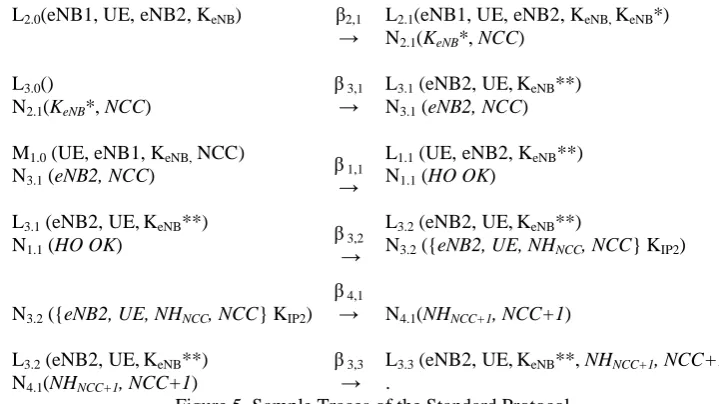
The sample traces of the intra-MME handover key management standard protocol is depicted in Fig. 5. The UE, eNB1, eNB2 and MME are the bounded role theories, where L2.0, L3.0 and L4.0 are the initial role states, and L1.1,
L2.1 and L3.1 are the role states.
L2.0(eNB1, UE, eNB2, KeNB) β2,1
→
L2.1(eNB1, UE, eNB2, KeNB, KeNB*)
N2.1(KeNB*, NCC)
L3.0()
N2.1(KeNB*, NCC)
β 3,1
→
L3.1 (eNB2, UE,KeNB**)
N3.1 (eNB2, NCC)
M1.0 (UE, eNB1, KeNB, NCC)
N3.1 (eNB2, NCC)
β 1,1
→
L1.1 (UE, eNB2, KeNB**)
N1.1 (HO OK)
L3.1 (eNB2, UE,KeNB**)
N1.1 (HO OK)
β 3,2
→
L3.2 (eNB2, UE,KeNB**)
N3.2 ({eNB2, UE, NHNCC, NCC} KIP2)
N3.2 ({eNB2, UE, NHNCC, NCC} KIP2)
β 4,1
→ N4.1(NHNCC+1, NCC+1)
L3.2 (eNB2, UE,KeNB**)
N4.1(NHNCC+1, NCC+1)
β 3,3
→
L3.3 (eNB2, UE,KeNB**, NHNCC+1, NCC+1)
.
Figure 5. Sample Traces of the Standard Protocol
3.2The De-Synchronization Attack
An intruder can control a rogue base station which is a mobile device and impersonates a legitimate base station, either by compromising a commercial station or by deploying a personal station through physical, host, or network protocol vulnerabilities [6]. The goal of the rogue base station attack is to disrupt the updating of the NCC value. Either by manipulating the message between eNBs or by manipulating the S1 path switch ACK, leaving the target eNB desynchronized and the future sessions keys vulnerable. The effect of the de-synchronization attack lasts until KASME is revoked through the Evolved Packet System Authentication and Key
Agreement (EPS-AKA) procedure between MME and UE. In this process, the new session key and subsequent security contexts are freshly created. Figure 6 presents the intruder rule of the standard protocol traces in case of de-synchronization attack.
I0(eNB1, UE, eNB2, KeNB, NCC, NHNCC)
β I,1 →
Ǝ NCC’: msg. Ǝ KeNB*: shK UE eNB2. I1(eNB1, UE, eNB2, KeNB,KeNB*) N2.1 ( KeNB*, NCC’ )
L3.0()
N2.1( KeNB*, NCC’ )
β 3,1 → L3.1 (eNB2, UE,KeNB**) N3.1 ( eNB2, NCC’ )
M1.0 (UE, eNB1, KeNB, NCC) N3.1 ( eNB2, NCC’ )
β 1,1
→ LN1.11.1 (UE, eNB2, K (HO OK) eNB**)
L3.1 (eNB2, UE,KeNB**) N1.1 (HO OK)
β 3,2 → L3.2 (eNB2, UE,KeNB**)
N3.2 ({eNB2, UE, NHNCC, NCC’} KIP2)
N3.2 ({eNB2, UE, NHNCC, NCC’} KIP2) β 4,1 → N4.1(NHNCC+1, NCC’+1)
L3.2 (eNB2, UE,KeNB**) N4.1(NHNCC+1, NCC’+1)
β 3,3 → L3.3 (eNB2, UE,KeNB**, NHNCC+1, NCC’+1) .
Figure 6. Intruder Rules in the Standard Protocol Traces
As shown in Figure 6, using an initial knowledge I0 (eNB1, UE, eNB2, KeNB, NCC, NHNCC), the
intruder impersonating the genuine eNB may launch rule β I,1. The intruder may apply the data generation rules
presented in section 2.2.2 to generate NCC’ (much higher than the value of NCC) of type msg, and use equation (4) to generate the new session key KeNB* from the previous session key KeNB.Also the intruder may update his
knowledge by adding the new session key to I1 (eNB1, UE, eNB2, KeNB,KeNB*). Then the intruder may use the
pairing rules presented in 2.2.1 to compose a new message {KeNB*, NCC’} and forward it to the target eNB.
As a result, the target eNB will derive the new key KeNB** using equation (2), in which the key KeNB* is derived
from the previous key KeNB. In addition, the target eNB will forward NCC’ to the UE, which will be
de-synchronized because the NCC and NCC’ are not the same. That enforces the UE to derive the next session key KeNB** based on the current KeNB* (derived from KeNB) instead of using the NHNCC+1 Key. Consequently, the
intruder will learn the new session key KeNB** and use it for further attacks. The intruder may then intercept
network messages between the user and the target eNB, and can decrypt the messages and compromise the data.
IV.
THE
PROPOSED
PROTOCOL
The main idea of the proposed protocol is to keep the source eNB out, and involve the MME as a third trusted party (TTP) during the handover process. MME prepares the challenges needed to authentication the UE and the target eNB. In addition, MME generates the fresh materials needed to drive the new session key, and sends these materials to UE protected by the local root key KASME and to the target eNB physically protected or
encrypted with the pre-shared IP-Sec association keys KIP between the core network and the eNBs.
As in the standard protocol, when an UE detects the need to hand over to another node, it sends a measurement report to the eNB1 that includes all the candidate eNBs for handover (i.e., message (P1)). Upon receiving the measurement report, eNB1 will choose the target eNB (eNB2). In the proposed protocol, eNB1 will not generate the new session key KeNB* but it will send a handover request to the MME server including the
UE and the eNB2 names and also a freshly generated time stamp t, all encrypted under KIP1, (i.e., message (P2)).
MME will then send back the handover response to eNB1 including an authenticator to authenticate the UE, (i.e., message (P3)). The authenticator contains the received time stamp t, a freshly generated nonce n, and the UE name, all encrypted under KASME known only to the UE and the MME server. Also MME will send the
contents of the authenticator to eNB2, encrypted under KIP2, (i.e., message (P5)). Upon receiving this message,
eNB2 will decrypt the message to retrieve its contents and generate the new session key KeNB*using Equation
(5), then wait for the user request.
KeNB*= KDF (n, α2) (5)
Upon receiving the handover response, (i.e., message (P3)), eNB1 will decrypt the message and forward the authenticator to the UE with the eNB2 name, (i.e., message (P4)), all encrypted under KeNB. UE will
then decrypt the message and learn the target eNB2 and decrypt the authenticator to retrieve the parameters needed to generate the new session key KeNB* using Equation (4). Then, UE will send an authentication request
to eNB2 that includes its name and the hash of the nonce n, all encrypted under the new session key KeNB*, (i.e.,
message (P6)).
The eNB2 will authenticate the UE by comparing the received hash with the calculated one. If they are not the same, eNB2 will abort the process. But if they are the same, eNB2 will compose a message containing the nonce n and the time stamp t, and send it to the UE encrypted under the new session key KeNB* (i.e.,
message (P7)) to authenticate itself to the UE. Upon receiving message (P7), UE will decrypt the message and check the nonce n and the time stamp t. If they are not the same, UE will abort the process. But if they are the same, UE will authenticate eNB2 and sends back a handover confirmation message, (i.e., message (P8)). The eNB2 will forward the handover confirmation message to acknowledge the MME server that the handover process is successfully accomplished (i.e., message (P9)). The sequence of messages is summarized below. msg (P1) UE → eNB1 : Measurement Report
msg (P2) eNB1 → MME : {UE,eNB2, t}KIP1 // handover request
msg (P3) MME → eNB1 : {UE, eNB2, Authenticator}KIP1 // handover response
msg (P4) eNB1→ UE : {eNB2, Authenticator}KeNB
msg (P5) MME → eNB2 : {UE, n, t }KIP2
msg (P6) UE → eNB2 :{ UE, h(n)}KeNB*
msg (P7) eNB2→ UE :{n, t}KeNB*
msg (P8) UE → eNB2 : Handover Confirmation msg (P9) eNB2→ MME : Handover Acknowledgement
4.1 Roles generation theory
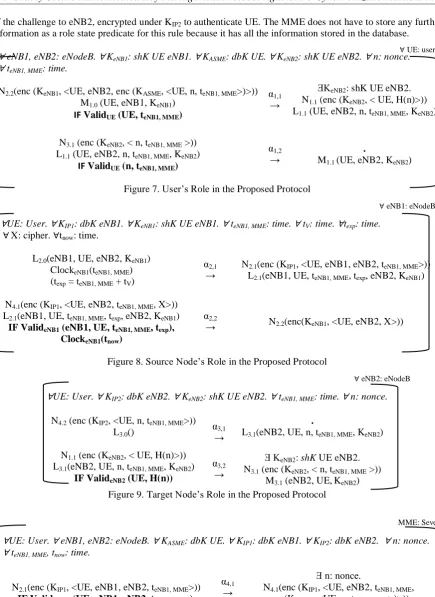
Figure 7, 8, and 9 show the UE, source eNB, and target eNB generic roles. Figure 10 shows the anchored role of MME server in our formalization. The protocol initiator eNB1, may use rule α2,1 shown in
Figure (9), to send an encrypted message under KIP1, to the MME server requesting the handover. In addition,
eNB1 stores the information from the request in a role state predicate L2.1. Upon receiving the handover request
N2.1, MME checks UE, eNBs names and the timestamp using the validation check ValidMME. Then MME may
use rule α4,1 shown in Figure (10) to send the handover response N4.1 to eNB1, encrypted under KIP1, including a
challenge to UE. The challenge is encrypted under KASME, contains UE, a fresh generated nonce n, and teNB1,
of the challenge to eNB2, encrypted under KIP2 to authenticate UE. The MME does not have to store any further
information as a role state predicate for this rule because it has all the information stored in the database.
∀ eNB1, eNB2: eNodeB. ∀KeNB1: shK UE eNB1. ∀KASME: dbK UE. ∀KeNB2: shK UE eNB2. ∀ n: nonce.
∀ teNB1, MME: time.
N2.2(enc (KeNB1, <UE, eNB2, enc (KASME, <UE, n, teNB1, MME>)>))
M1.0 (UE, eNB1, KeNB1)
IF ValidUE (UE, teNB1, MME)
α1,1
→
ƎKeNB2: shK UE eNB2.
N1.1 (enc (KeNB2, < UE, H(n)>))
L1.1 (UE, eNB2, n, teNB1, MME, KeNB2)
N3.1 (enc (KeNB2, < n, teNB1, MME >))
L1.1 (UE, eNB2, n, teNB1, MME, KeNB2)
IF ValidUE (n, teNB1, MME)
α1,2
→
.
M1.1 (UE, eNB2, KeNB2)
Figure 7. User’s Role in the Proposed Protocol
∀UE: User. ∀KIP1: dbK eNB1. ∀KeNB1: shK UE eNB1. ∀ teNB1, MME: time. ∀ tV: time. ∀texp: time. ∀X: cipher. ∀tnow: time.
L2.0(eNB1, UE, eNB2, KeNB1)
ClockeNB1(teNB1, MME)
(texp = teNB1, MME + tV)
α2,1
→
N2.1(enc (KIP1, <UE, eNB1, eNB2, teNB1, MME>))
L2.1(eNB1, UE, teNB1, MME, texp, eNB2, KeNB1)
N4.1(enc (KIP1, <UE, eNB2, teNB1, MME, X>))
L2.1(eNB1, UE, teNB1, MME, texp, eNB2, KeNB1)
IF ValideNB1 (eNB1, UE, teNB1, MME, texp), ClockeNB1(tnow)
α2,2
→ N2.2(enc(KeNB1, <UE, eNB2, X>))
Figure 8. Source Node’s Role in the Proposed Protocol
∀UE: User. ∀ KIP2: dbK eNB2. ∀ KeNB2: shK UE eNB2. ∀ teNB1, MME: time. ∀ n: nonce.
N4.2 (enc (KIP2, <UE, n, teNB1, MME>))
L3.0()
α3,1
→
.
L3.1(eNB2, UE, n, teNB1, MME, KeNB2)
N1.1 (enc (KeNB2, < UE, H(n)>))
L3.1(eNB2, UE, n, teNB1, MME, KeNB2)
IF ValideNB2 (UE, H(n))
α3,2
→
Ǝ KeNB2: shK UE eNB2.
N3.1 (enc (KeNB2, < n, teNB1, MME >))
M3.1 (eNB2, UE,KeNB2)
Figure 9. Target Node’s Role in the Proposed Protocol
∀UE: User. ∀ eNB1, eNB2: eNodeB. ∀ KASME: dbK UE. ∀ KIP1: dbK eNB1. ∀ KIP2: dbK eNB2. ∀ n: nonce.
∀ teNB1, MME, tnow: time.
N2.1(enc (KIP1, <UE, eNB1, eNB2, teNB1, MME>))
IF ValidMME (UE, eNB1, eNB2, teNB1, MME), ClockMME (tnow)
α4,1
→
Ǝ n: nonce.
N4.1(enc (KIP1, <UE, eNB2, teNB1, MME,
enc (KASME, <UE, n, teNB1, MME>)>))
α4,2
→ N4.2 (enc (KIP2, <UE, n, teNB1, MME>))
Figure 10. MME Server’s Role in the Proposed Protocol
The eNB1 expects the response N4.1 from MME within a certain time, encrypted under one of its
database keys KIP1, including a challenge (an opaque message). If a message of this form appears on the
network, eNB1 uses the role state predicate L2.1 and the validity check ValideNB1 to ensure that eNB1, UE, and
teNB1,MME in this message match those in its original request. If they are the same, eNB1 may read this message
∀ UE: user
∀ eNB1: eNodeB
∀ eNB2: eNodeB
from the network and save the relevant information using rule α2,2 shown in Figure (8), which replaces the facts
N4.1 and L2.1 with the fact N2.2 (contains, UE, eNB2, and challenge X, encrypted under KeNB1) to be sent to UE.
The UE expects the response N2.2 from eNB1, including a challenge encrypted under KASME. If a
message of this form appears on the network, UE uses the memory predicate M1.0 and the validation check
ValidUE to check UE’s name, and the time stamp teNB1,MME. Then UE may read this message from the network
and save the relevant information, using rule α1,1 shown in Figure (7), to generate KeNB2 and replaces the facts
N2.2 and M1.0 with the fact N1.1 and L1.1. UE will send N1.1 to eNB2 to authenticate herself.
If a message of the form, N4.2 from the MME server appears on the network, encrypted under KIP2,
eNB2 will read this message from the network and store the relevant information, in a role state predicate L3.1
after generating KeNB2 using n and teNB1, MME. At this time, eNB2 expects a request message N1.1 from UE,
contains UE, and the hash of n. If a message of this form appears on the network, eNB2 uses the role state predicate L3.1 and validation check ValideNB2 to authenticate UE by computing the hash of n and comparing it
with the received one. If they are the same, eNB2 will read the message from the network and save the relevant information, using rule α3,1 shown in Figure (9), which replaces the facts N1.1 and L3.1 with the fact N3.1 and
memory predicate M3.1. the eNB2 will then send N3.1 to UE to authenticate itself. The UE expects a response
N3.1 from eNB2. If a message of this form appears on the network, UE uses the role state predicate L1.1 and
validation check ValidUE to authenticate eNB2 by checking n and teNB1, MME. If they are the same, UE may read
this message from the network and save the relevant information in the memory predicate M1.1 using rule α1,2
shown in Figure (7), which sends an acknowledge to eNB2 that the handover is done successfully.
4.3 The Protocol Theory
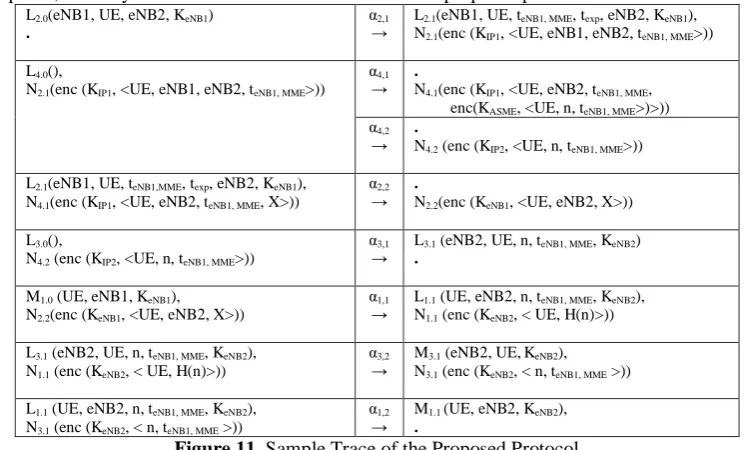
The Sample trace of the proposed protocol in Figure (11) shows that UE, eNB1, eNB2 and MME are the bounded role theories, where L2.0, L3.0 and L4.0 are the initial role states, while the L1.1, L2.1 and L3.1 are the role states. From the formalization, we can deduce that the protocol is formed as a well-founded protocol theory, such that: the knowledge of one participant is separated from the knowledge of another. Also the private knowledge is separated from public knowledge, and the state of a participant from a network message. Also the initialization theory was separated from the key distribution and role-assignment phase and the protocol execution phase, in a way that reflects the bounded nature of the proposed protocol.
L2.0(eNB1, UE, eNB2, KeNB1) .
α2,1
→ LN2.12.1(eNB1, UE, t(enc (KIP1, <UE, eNB1, eNB2, teNB1, MME, texp, eNB2, KeNB1, MMEeNB1), >))
L4.0(),
N2.1(enc (KIP1, <UE, eNB1, eNB2, teNB1, MME>)) α4,1
→ . N4.1(enc (KIP1, <UE, eNB2, teNB1, MME, enc(KASME, <UE, n, teNB1, MME>)>)) α4,2
→ .
N4.2 (enc (KIP2, <UE, n, teNB1, MME>))
L2.1(eNB1, UE, teNB1,MME, texp, eNB2, KeNB1), N4.1(enc (KIP1, <UE, eNB2, teNB1, MME, X>))
α2,2 →
.
N2.2(enc (KeNB1, <UE, eNB2, X>))
L3.0(),
N4.2 (enc (KIP2, <UE, n, teNB1, MME>))
α3,1
→ L. 3.1 (eNB2, UE, n, teNB1, MME, KeNB2)
M1.0 (UE, eNB1, KeNB1), N2.2(enc (KeNB1, <UE, eNB2, X>))
α1,1
→ LN1.11.1 (UE, eNB2, n, t (enc (KeNB2, < UE, H(n)>)) eNB1, MME, KeNB2),
L3.1 (eNB2, UE, n, teNB1, MME, KeNB2), N1.1 (enc (KeNB2, < UE, H(n)>))
α3,2 →
M3.1 (eNB2, UE,KeNB2), N3.1 (enc (KeNB2, < n, teNB1, MME >))
L1.1 (UE, eNB2, n, teNB1, MME, KeNB2), N3.1 (enc (KeNB2, < n, teNB1, MME >))
α1,2 →
M1.1 (UE, eNB2, KeNB2), .
Figure 11. Sample Trace of the Proposed Protocol
4.5 Previnting The De-Synchronization Attack
Initially, the intruder impersonating the genuine eNB may use the data access rules presented in 2.2.3 to access the name of any principal (UE, eNB1, eNB2, or MME), and also lookup the session key KeNB1 and the
long-term (database) key KIP1 to have an initial knowledge I0 (eNB1, UE, eNB2, KeNB1, KIP1). The intruder can
also access the defined time stamps {teNB1,MME, texp}, and compose any message using the rules presented in
section 2.2.1.
As shown in Figure 12, with the initial knowledge I0, intruder could lunch the rule αI,1, compose the
message N2.1{UE, eNB1, eNB2, teNB1,MME} and encrypt it using KIP1, then forward it to the MME as a handover
request. Also the intruder may store these data in the intruder predicate I1(eNB1, UE, teNB1, MME, texp, eNB2,
intruder may launch another rule αI,2. The intruder may decrypt the message N4.1 using KeNB1, and decompose its
contents. Then the intruder will try to delete the challenge X (cipher) and generate a generic message Z, which is not the encryption of any other message. Then the intruder may send message N2.2(enc (KeNB1, <UE, eNB2, Z
>)) to the UE, and update his knowledge I1 by adding the two values X and Z to I2(eNB1, UE, teNB1,MME, texp,
eNB2, KeNB1, X, Z).
In this case, upon receiving the message N2.2, the UE will first decrypt the message using KeNB1 then
decrypt the message Z using KASME and perform the validation test ValidUE (UE, teNB1, MME). The UE will detect
the attack because the validation test ValidUE will fail and then abort the handover process in rule α1,1.
Otherwise, the intruder may forward the challenge X as received from the server MME to the UE. In this case, the handover process will take place and the new session key will be derived and shared between the UE and the target eNB2 away from the intruder. Consequently, the intruder will not learn the new session key.
I0(eNB1, UE, eNB2, KeNB1, KIP1) .
αI,1
→ IN1(eNB1, UE, t2.1(enc (KIP1, <UE, eNB1, eNB2, teNB1, MME, texp, eNB2, KeNB1, MMEeNB1), >)) L4.0(),
N2.1(enc (KIP1, <UE, eNB1, eNB2, teNB1, MME>))
α4,1 → .
N4.1(enc (KIP1, <UE, eNB2, teNB1, MME, enc(KASME, <UE, n, teNB1, MME>)>)) α4,2 → .
N4.2 (enc (KIP2, <UE, n, teNB1, MME>)) I1(eNB1, UE, teNB1,MME, texp, eNB2, KeNB1),
N4.1(enc (KIP1, <UE, eNB2, teNB1, MME, X>))
αI,2
→ IN2(eNB1, UE, t2.2(enc (KeNB1, <UE, eNB2, Z >)) eNB1,MME, texp, eNB2, KeNB1, X, Z), L3.0(),
N4.2 (enc (KIP2, <UE, n, teNB1, MME>))
α3,1 → L3.1 (eNB2, UE, n, teNB1, MME, K-eNB2) .
M1.0 (UE, eNB1, KeNB1), N2.2(enc (KeNB1, <UE, eNB2, Z >))
IF ValidUE (UE, teNB1, MME)
α1,1 → ABORT
Figure 12. Intruder Rules in the Proposed Protocol Traces
According to the formal analysis results, we can conclude that the standard protocol could not detect the de-synchronization attack since the intruder impersonating the genuine base station could launch the handover process and learn the new session key, as shown in the intruder rules traces in section (3.3). As a result, the standard protocol could not maintain the one-hop forward security and the new session key is compromised. On the other side, though the intruder can initiate the handover process, he cannot complete the handover process because the proposed protocol detects the attack and aborts the process at the UE side, as shown in the trace of the intruder rules in section (4.3). As a result, the proposed protocol maintains the one-hop forward security and protects the new session key from being compromised.
V.
CONCLUSIONS
This paper proposes a provably secure authenticated key management protocol against the desynchronization attack in the LTE intra-MME handover. The proposed protocol keeps out the source eNB from the key management process, and uses the MME as a third trusted party. The MME sends the fresh materials needed to drive the new session key for both the user and the target eNB (away from the source eNB) protected by the pre-shared local root key KASME and the pre-shared IPsec association key KIP2, respectively. An
overview of the Multi-Set Rewriting (MSR) formalism with existential quantification technique is presented. Also the signature fragment that sets up the typing infrastructure used in this paper and the rules specifying the Dolev-Yao intruder model are conducted. Formalizations of the LTE intra-MME handover standard protocol and the proposed protocol are conducted using MSR formalism under the Dolev–Yao intruder model, in a way that reflects their bounded nature.
The traces of the intra-MME handover key management protocol and the effect of the de-Synchronization attack showed that the protocol could not detect the attack. As a result, the intruder impersonating the genuine base station could carry out the handover process and learn the new session key after the handover takes place. On the other side; we illustrated in a formal manner that the proposed protocol can prevent the de-Synchronization attack. The intruder can initiate the handover process, but he cannot learn the new session key, since the proposed protocol detects the attack at the user side, and aborts the handover process.
REFERENCES
[1]. Dahlman, E., S. Parkvall, and J. Skold, 4G: LTE/LTE-advanced for mobile broadband. 2013: Academic press.
[2]. 3GPP, 3GPP System Architecture Evolution (SAE); Security architecture, in TS 33.401 Version 11.2.0. 2012: 3rd Generation Partnership Project.
[4]. Han, C.-K. and H.-K. Choi, Security analysis of handover key management in 4G LTE/SAE networks. IEEE Transactions on Mobile Computing, 2014. 13(2): p. 457-468.
[5]. Zhang, M. and Y. Fang, Security analysis and enhancements of 3GPP authentication and key agreement protocol. IEEE Transactions on wireless communications, 2005. 4(2): p. 734-742.
[6]. Park, Y. and T. Park. A survey of security threats on 4G networks. in IEEE Globecom Workshops, 2007.
[7]. Sridevi, B., D. Mohan, and R. Neelaveni. Secured Handover Key Management among LTE Entities Using Device Certification. in IEEE Eco-friendly Computing and Communication Systems (ICECCS), 2014.
[8]. Forsberg, D., LTE key management analysis with session keys context. Computer Communications, 2010. 33(16): p. 1907-1915.
[9]. Xiao, Q., B. Cui, and L. Li. An Enhancement for Key Management in LTE/SAE X2 Handover Based on Ciphering Key Parameters. in IEEE P2P, Parallel, Grid, Cloud and Internet Computing (3PGCIC), 2014.
[10]. Chandavarkar, B. Mitigation of desynchronization attack during inter-eNodeB handover key management in LTE. in IEEE Contemporary Computing (IC3), 2015.
[11]. Mao, W. A structured operational modelling of the dolev-yao threat model. in International Workshop on Security Protocols. 2002. Springer.
[12]. Cervesato, I., et al. A meta-notation for protocol analysis. in Computer Security Foundations Workshop. Proceedings of the 12th IEEE. 1999.
[13]. Cervesato, I., A specification language for crypto-protocols based on multiset rewriting, dependent types and subsorting. Computer Science Department, 2001: p. 38.
[14]. Cervesato, I. Typed MSR: Syntax and examples. in International Workshop on Mathematical Methods, Models, and Architectures for Network Security. 2001. Springer.
[15]. Mitchell, J., et al. Undecidability of bounded security protocols. in Workshop on Formal Methods and Security Protocols. 1999.
[16]. Butler, F., et al., Formal analysis of Kerberos 5. Theoretical Computer Science, 2006. 367(1-2): p. 57-87.
[17]. Butler, F., et al., A formal analysis of some properties of Kerberos 5 using MSR. 2004.
[18]. Schmidt, B., et al. Automated analysis of Diffie-Hellman protocols and advanced security properties. in IEEE Computer Security Foundations Symposium (CSF), 2012.
Authers
Khaled Khairy received the BSc degree and the MSc degree in electrical engineering from the Military Technical College (MTC), Department of Communication at Cairo Egypt. He is a PhD candidate and in a visiting scholar in the Department of Computer Science at the University of Central Florida, in Orlando, Florida. He has nearly ten years’ experience in security systems design and implementation. His research interests include security issues in LTE mobile networks, Modeling and Simulation.