Study of Compressive Strength of Concrete by
using E-Waste
Harshvardhan Shukla Himanshu Rajput
BE Student BE Student
Department of Civil Engineering Department of Civil Engineering
SVITS, Indore SVITS, Indore
Anshul Jain Devashish Gurjar
BE Student BE Student
Department of Civil Engineering Department of Civil Engineering
SVITS, Indore SVITS, Indore
Gaurav Awasthi Assistant Professor Department of Civil Engineering
SVITS, Indore
Abstract
E-Waste material is causing hazardous effect to the environment and human health. So, it is necessary to use it in those areas which can minimize its dangerous effect and can bring some positive result. Endeavors are made to use such type of waste material into concrete as a coarse aggregate or fine aggregate. This research paper is presenting an investigation on study of compressive strength of concrete by using E-waste as a part of coarse aggregate. Conventional Mix M-25 is designed as per the new guidelines of IS 10262:2009. The E- waste is broken into specific size and shape. Total 90 specimens were casted with and without using E-waste (1%, 1.5% & 2%) along with fly-ash and Poly Carboxylic Ether (Plasticizer). Compressive strength test was conducted on both type of specimen after 7 days, 14 days and 28 days of curing. The utilization of E-waste in the concrete is quite effective and compressive strength is increasing up to 2% replacement. This ensure that the use of E- waste in the concrete results into benefits, mainly the better waste management of such non-recyclable waste material, making the project economical and increasing the compressive strength of concrete.
Keywords: Compressive Strength, E-waste, Fly-ash, PCE, PPC
________________________________________________________________________________________________________
I. INTRODUCTION
Electronic waste, popularly known as E-waste, can be defined as electronic and electrical equipment products (including the connecting power plug, batteries, motherboards, printed circuit board) which have become obsolete due to change in fashion, style and status and nearing the end of life. Rapid technology change, low cost have resulted in a fast growing surplus of electronic waste around the globe, several tones of E-waste need to be disposed per year. Traditional landfills or stockpiles method is not an environment friendly solution and disposal process is also very difficult to meet EPA (Environmental Protection Agency) regulation – “How to reuse the non- disposal E- waste become an important research topic”. E- Plastic waste is one of the fastest growing waste streams in the world.
In developing countries, it ranges 0.01% to 1% of the total municipal solid waste generation. Maharashtra ranks first followed by Tamilnadu, Andhra Pradesh, Uttar Pradesh, West Bengal, Delhi, Karnataka, Gujarat, and Madhya Pradesh & Punjab in the list of E-waste generating state in India. Among top ten cities Generating E-waste Mumbai ranks first followed by Delhi, Bangalore, Chennai, Kolkata, Ahmedabad, Hyderabad, Pune, Surat and Nagpur.
II. ADVERSE HEALTH & ENVIRONMENT IMPACTS OF E-WASTE
Electrical & Electronic equipment are made up of the several components many which contain toxic substance like lead ,chromium , mercury, beryllium ,cadmium, acids & plastic etc .These toxic substance can have highly adverse impacts on human health and environment, if not handled properly.
III. DISPOSAL OF E-WASTE
of leachatewhich often contains heavy water resources, even state of the art landfills which are sealed to the long term are not fully safe. Older landfills sites and uncontrolled dumps, however pose a much greater danger of releasing hazardous emission. Mercury, Cadmiumand lead are among the most toxic leachates. Mercury, For example will leach certain electronic devices such as circuit breakers. Lead has been found to leach from broken lead containing glass of cathode ray tubes from TV and Monitors.
IV. OBJECTIVE OF THE STUDY
- To analyze the effect on compressive strength of concrete by replacing coarse aggregate with E- waste. - To minimize the effect of E-waste on environment and human health.
V. METHODOLOGY
Mix were design after conducting the various tests on material like specific gravity, fineness, consistency and initial setting time for cement. Sieve analysis. Mix proportion was 1:1.96:3.7.
Two type of specimen were prepared first one is conventional concrete and other one was concrete with various proportions of E-waste along with incorporation of fly ash and admixture. Compressive strength test was conducted on specimens prepared using E-waste and the results were compared with the conventional mix.
VI. EXPERIMENTAL INVESTIGATIONS
Materials Used:
- Cement – PPC as per IS 1489 : 1991
- Fine aggregate – Natural sand as per IS 383- 1970
- Coarse aggregate – Crushed 20 mm maximum size –as per IS 383-1970 - E-waste material (PCBs and motherboards)
- Fly-ash
- Plasticizer-PCE ( poly carboxylic ether)
Tests on Material:
Tests are conducted on cement, fine aggregate and coarse aggregate which are shown in following tables. Table – 1
Test on Cement Test Results Specific Gravity 2.91
Consistency 33% Table – 2 Test on Fine Aggregate
Test Results Specific Gravity 2.70 Free Surface Moisture 2.1% Gradation Zone 2
Table – 3 Test on Coarse Aggregate
Test Results Specific Gravity 2.78 Aggregate impact value 31.33% Aggregate crushing value 17.30%
Total 10 composition of concrete mix were casted with different proportion of E-waste (1%, 1.5%, and 2%) and experimental investigation is carried out in the table shown below
Table – 4 Mix Proportion
MIX PROPORTION
MIX Z
MIX Z1 PPC + FA + CA + 1% E-WASTE+10% FLY ASH + PCE MIX Z2 PPC + FA + CA + 1.5% E WASTE + 10% FLY ASH + PCE MIX Z3 PPC + FA + CA + 2% E-WASTE+ 10% FLY ASH + PCE Abbreviations
PPC: - Portland Pozzolana Cement, FA: Fine Aggregate, CA: Coarse aggregate, PCE: Poly Carboxylic Ether Test on Hardened Concrete
Compressive strength test
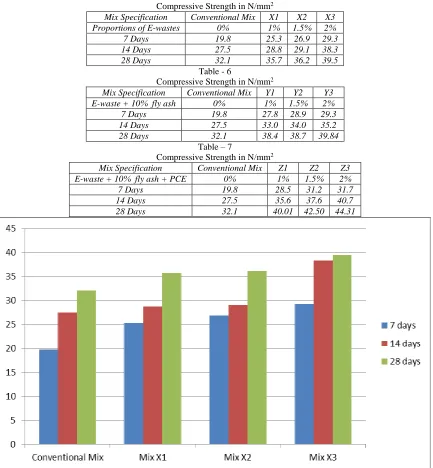
Compressive strength test was conducted to evaluate the strength development of concrete containing various E-Waste contents at the age of 7, 14 & 28 days
Table – 5
Compressive Strength in N/mm2
Mix Specification Conventional Mix X1 X2 X3 Proportions of E-wastes 0% 1% 1.5% 2% 7 Days 19.8 25.3 26.9 29.3 14 Days 27.5 28.8 29.1 38.3 28 Days 32.1 35.7 36.2 39.5
Table - 6
Compressive Strength in N/mm2
Mix Specification Conventional Mix Y1 Y2 Y3 E-waste + 10% fly ash 0% 1% 1.5% 2%
7 Days 19.8 27.8 28.9 29.3
14 Days 27.5 33.0 34.0 35.2 28 Days 32.1 38.4 38.7 39.84
Table – 7
Compressive Strength in N/mm2
Mix Specification Conventional Mix Z1 Z2 Z3 E-waste + 10% fly ash + PCE 0% 1% 1.5% 2%
7 Days 19.8 28.5 31.2 31.7
14 Days 27.5 35.6 37.6 40.7
28 Days 32.1 40.01 42.50 44.31
Chart 2: Comparison between Conventional Mix and Y series
Chart 3: Comparison between Conventional Mix and Z series
VII. DISCUSSION
- This work can be implemented in construction industry especially in road projects which will make it more safe, eco-friendly and economical.
REFERENCES
[1] P.Gomathi Nagajothi, Dr.T. Felixkla (2014, June) “Compressive strength of concrete incorporated with e-fiber waste,” IJETAE International Journal Of Emerging Technology And Advanced Engineering, Vol. 4.
[2] P.Krishna Prasanna, M.Kanta Rao, “Strength variation in concrete by using E-waste as coarse aggregate”, IJETAE International Journal of Emerging Technology and Advanced Engineering, Vol. 4.
[3] Iftekar Gull, Mr. M. Balasubramanian, (2014, April) “A new paradigm on experimental investigation of concrete for e-plastic waste management”, IJETT International Journal of Engineering Trends and Technology, Vol. 4
[4] T.R. Nayak, G.Morikoni, “Environmental friendly durable concrete made with recycled materials for sustainable concrete construction”,
[5] Chirag Garg, Aakash Jain, (2014, Feb.) “Green concrete: Efficient and eco-friendly construction materials”, IJRET International Journal of Research in Engineering and Technology, Vol. 2.
[6] Lakhmi. R, Nagan.s, (2010, Nov.) “Study on concrete containing e-plastic waste”, IJES International Journal of Environmental Science, Vol. 1
[7] R. N. Nibudeyet. al. (Jun, 2013), “Strength and fracture properties of post consumed waste plastic fiber reinforced concrete” IJCSEIERD International Journal of Civil, Structural, Environmental and Infrastructure Engineering Research and Development ISSN 2249-6866, Vol. 3, Issue 2, Pages 9-16.
[8] R.Lakshmi, S. Nagan (2011) , “Investigations On Durability Characteristics Of E-plastic Waste Incorporated Concrete” AJCE Asian Journal of Civil Engineering (Building And Housing) Vol. 12, No. 6 (2011) Pages773-787