Robert McNabb, Christopher Nuth, Andreas Kääb, and Luc Girod
Department of Geosciences, University of Oslo, Postboks 1047 Blindern, 0316 Oslo, Norway Correspondence:Robert McNabb ([email protected])
Received: 24 August 2018 – Discussion started: 1 October 2018
Revised: 26 February 2019 – Accepted: 27 February 2019 – Published: 15 March 2019
Abstract. Glacier mass balance has been estimated on in-dividual glacier and regional scales using repeat digital ele-vation models (DEMs). DEMs often have gaps in coverage (“voids”), the properties of which depend on the nature of the sensor used and the surface being measured. The way that these voids are accounted for has a direct impact on the es-timate of geodetic glacier mass balance, though a systematic comparison of different proposed methods has been hereto-fore lacking. In this study, we determine the impact and sen-sitivity of void interpolation methods on estimates of volume change. Using two spatially complete, high-resolution DEMs over southeast Alaska, USA, we artificially generate voids in one of the DEMs using correlation values derived from photogrammetric processing of Advanced Spaceborne Ther-mal Emission and Reflection Radiometer (ASTER) scenes. We then compare 11 different void interpolation methods on a glacier-by-glacier and regional basis. We find that a few methods introduce biases of up to 20 % in the regional re-sults, while other methods give results very close (<1 % dif-ference) to the true, non-voided volume change estimates. By comparing results from a few of the best-performing meth-ods, an estimate of the uncertainty introduced by interpolat-ing voids can be obtained. Finally, by increasinterpolat-ing the number of voids, we show that with these best-performing methods, reliable estimates of glacier-wide volume change can be ob-tained, even with sparse DEM coverage.
1 Introduction
Glacier mass balance responds directly to climatic influ-ences, and therefore long-term records of glacier mass bal-ance reflect changes in climate. Traditional estimates of
glacier mass balance have involved in situ seasonal or annual measurements of accumulation and ablation at select loca-tions and the extrapolation of these sparse measurements to the entire glacier (the glaciological method; see, e.g., Cog-ley, 2009). This can provide a temporally dense time series for an individual glacier, but for very large glaciers or at regional scales, it is neither practical nor even possible. As of January 2019, the World Glacier Monitoring Service has glaciological-method mass balance measurements for only 450 of the more then 200 000 glaciers worldwide (WGMS, 2019; RGI Consortium, 2017), the majority of which are per-formed on smaller glaciers, with mass balances that tend to be more negative than the regional average (e.g., Gardner et al., 2013).
of glacier mass balance using the geodetic method are and will be more prevalent, providing proper spatial accounting of the scale of glacier changes worldwide.
In this study, we focus on the estimation of geodetic mass balance from DEMs. In general, wide-coverage DEMs are created from sensors on aerial or satellite platforms falling into two categories, optical and radar. DEMs derived from optical sensors have the advantage of measuring the snow and ice surface directly, but data availability is subject to weather and light conditions, which can often be cloudy or dark in most glaciated regions around the globe. In addition, low-contrast areas on glacier surfaces, such as in the accu-mulation area, can often result in missing data or data voids, though this problem has been reduced with the improved radiometric resolution of more modern sensors. DEMs de-rived from radar sensors are weather- and illumination-independent, as the active sensor acquires data even through cloud cover and polar night. However, glaciers tend to oc-cur in areas with steep and/or rough topography, and layover and shadow can confound efforts to unwrap elevations on glaciers (e.g., Rignot et al., 2001; Shugar et al., 2010). In addition, radar signals penetrate snow and ice differently, de-pending on the properties of the surface, as well as the fre-quency of the signal; this penetration results in a spatiotem-poral systematic bias in surface measurement that is still poorly understood and constrained (e.g., Rignot et al., 2001; Dall et al., 2001; Gardelle et al., 2012; Dehecq et al., 2016). DEMs derived from airborne laser scanning (e.g., Geist et al., 2005; Abermann et al., 2010; Andreassen et al., 2016) are highly accurate, spatially complete, and mostly avoid the penetration issues associated with radar-derived DEMs. Such DEMs are expensive to produce, however, and have similar requirements as optical sensors and aerial photography, i.e., clear sky or high clouds, conditions that can be difficult to find over glaciers.
In the most ideal scenarios to calculate geodetic mass balances from repeat DEM differencing, the entire glacier would be sampled systematically and with similar accuracy. In the most commonly used DEMs for glacier mass bal-ance described above, zones of missing data (hereafter called “voids”) are rather common and may severely bias estimates depending upon how these regions are accounted for (e.g., Kääb, 2008; Berthier et al., 2018). Several different methods have been applied in the literature, and we briefly summarize them here. They include bilinear interpolation of elevation or elevation differences (e.g., Kääb, 2008), filling with an aver-age value from a surrounding neighborhood (e.g., Melkonian et al., 2013, 2014), multiplying the average elevation change by the total glacier-covered area (e.g., Surazakov and Aizen, 2006; Paul and Haeberli, 2008; Fischer et al., 2015), and es-timating elevation change as a function of elevation, integrat-ing this curve with the glacier hypsometry (e.g., Arendt et al., 2002, 2006; Kohler et al., 2007; Berthier et al., 2010; Kro-nenberg et al., 2016). In addition, we can classify these meth-ods into “global” (here meaning encompassing the whole
of the dataset as opposed to worldwide) and “local” types, whereby global methods use data from an entire region or group of glaciers, while local methods fill voids using only information from an individual glacier or from data closely surrounding the voids.
While various methods are used in individual studies, the sensitivity of geodetic mass balance estimates to various in-terpolation methods is not clear. An overarching comparison of the numerous methods, and their subsequent effects on volume change estimates at both local and regional scales, is lacking. Using correlation values derived from photogram-metric processing of optical stereo imagery, we artificially introduce voids into a high-quality, spatially complete DEM and difference this DEM to another spatially complete DEM. We then apply 11 different methods to fill these artificially produced voids and compare the resulting estimates of vol-ume change both glacier by glacier and regionally to de-termine the potential impact on and sensitivity to volume change estimates. This study aims to quantify the effects of different handling approaches and to suggest the void-handling methods best suited for accurate volume change es-timation. As a final note, in this paper, we use two radar-derived DEMs: one radar-derived from C-band radar and another derived from X- and P-band radar. Biases in the derived vol-ume change estimates exist due to differences in seasonal timing and radar penetration; as such, the estimates presented here should not be interpreted as mass balance estimates for these glaciers without additional corrections.
2 Data 2.1 Study area
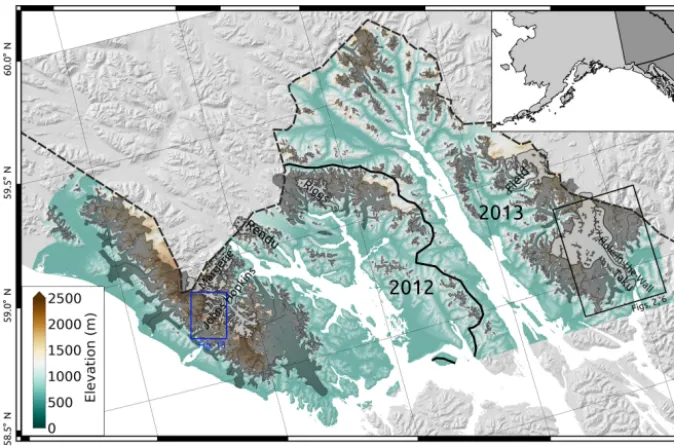
To test the impact of void interpolation methods on estimates of volume change, we chose the area surrounding Glacier Bay and Lynn Canal, Alaska, USA (Fig. 1). This area con-tains over 700 individual glaciers (Randolph Glacier Inven-tory (RGI) v6.0; Pfeffer et al., 2014; RGI Consortium, 2017), with glaciers ranging from sea level to over 4000 m a.s.l., covering an area of approximately 5900 km2. Additionally, the region is home to a wide range of glacier types, includ-ing surge-type glaciers, retreatinclud-ing (and advancinclud-ing) tidewater glaciers, and both large and small valley glaciers. As such, it is an ideal region to estimate the effects of using spatially incomplete DEMs to estimate glacier volume changes, as it provides a diverse sample of glacier types, sizes, and altitude ranges, with a high variability of intra- and inter-glacier ele-vation changes.
2.2 DEMs 2.2.1 SRTM
Figure 1.Study area in southeast Alaska, USA. IfSAR DEMs are displayed on top of SRTM hillshade. The solid black line indicates the boundary between 2012 and 2013 IfSAR acquisitions. The dashed black line indicates the US–Canada border. Dark gray outlines show glacier extents; named glaciers (light gray outlines) are discussed further in the following sections. The black outline indicates the extents of Figs. 2 and 6; the blue outline indicates the extent of Fig. 13.
study. The SRTM was acquired in February 2000 aboard the Space Shuttle Endeavour, flying both C-band and X-band in-struments (Van Zyl, 2001). This nearly global DEM is tem-porally consistent and therefore ideal and commonly used for geodetic mass balance estimation (e.g., Surazakov and Aizen, 2006; Larsen et al., 2007; Melkonian et al., 2013, 2014), though typically over longer time periods (>10-year separation between DEMs). We have selected this dataset, and not the US National Elevation Dataset (NED) as other studies have used in the region (e.g., Arendt et al., 2002, 2006; Larsen et al., 2007; Berthier et al., 2010), as the NED DEM was produced by digitizing 1948 USGS contour maps (Larsen et al., 2007) that contained large biases at higher el-evations on glaciers (e.g., Arendt et al., 2002).
Owing to the nature of the instrument, the acquisition, and the topography in the region, there are voids in the SRTM data on steep slopes due to shadowing and layover effects (e.g., Rignot et al., 2001). Filled SRTM products, such as the one distributed by the CGIAR Consortium for Spatial Infor-mation (Jarvis et al., 2008), typically use the NED dataset to fill these voids, which can introduce significant anomalies and discontinuities into the on-glacier elevations. As these voids are typically small and confined to the glacier mar-gins in steep-sloped areas, we used the non-void-filled SRTM dataset and update glacier areas in our calculations (when necessary) to ignore these no-data regions, essentially assum-ing they do not belong to the glacier; these voids correspond to<2.5 % of the on-glacier area for our glacier outlines and study region. These original SRTM voids will thus not affect our sensitivity analysis for estimates of volume change.
2.2.2 IfSAR
As part of the Statewide Digital Mapping Initiative, the state of Alaska is producing an interferometric synthetic-aperture radar (IfSAR) DEM of the entire state. The data are acquired from airborne radar operating in the X band and P band, and they are provided in a native resolution of 5 m mosaics. In our study area, flights were flown in summer 2012 and 2013. These data are available from the U.S. Geological Survey (USGS, 2019). The DEMs have a reported accuracy of 3 m, though on low-angle slopes the provided metadata indicate an accuracy closer to∼1 m when compared to lidar swaths.
2.2.3 Glacier outlines
We use the Randolph Glacier Inventory v6.0 data as a base to mask glaciers (RGI Consortium, 2017). The outlines in this region are mostly based on imagery from the mid-2000s, so we have manually updated the outlines using mostly cloud-free Landsat scenes acquired in late summer in 1999 and 2001 in order to ensure our glacier outlines correspond to the SRTM date as close as possible.
to work with, and for our purposes it is better to have a large sample of on-glacier pixels, we also remove any glaciers with an area smaller than 1 km2. Finally, we remove any glaciers for which we did not have a result for all methods (i.e., the glacier is completely voided). This results in a total of 415 individual glacier outlines used for the analysis.
3 Methods
We first calculate the “true” volume change by directly dif-ferencing the IfSAR and SRTM DEMs after co-registration, following Nuth and Kääb (2011), and summing the eleva-tion differences multiplied by pixel area within each glacier outline. We then calculate the regional volume change as the sum of these individual glacier volume changes and estimate the uncertainty in the true volume change using the original (non-voided) IfSAR and SRTM DEMs. We introduce voids into the IfSAR DEM and interpolate those voids using each of the interpolation methods described in Sect. 3.2. To assess the performance of each method, we compare the interpo-lated estimates to the true volume changes and the uncer-tainties derived from the non-voided DEMs. The code used to generate and interpolate the DEM voids, as well as the results for each glacier, can be found at https://github.com/ iamdonovan/dem_voids (last access: 8 March 2019).
Ordinarily, using DEMs derived from radar of differ-ent bands, especially those acquired in differdiffer-ent seasons such as the SRTM (February) and IfSAR (typically August– September), would require a consideration of the effects of differential radar penetration in snow and ice, as well as a temporal correction accounting for the difference in season, before converting elevation changes to a mass balance value (Haug et al., 2009; Kronenberg et al., 2016). In this region, the SRTM is known to have particularly high levels of pen-etration that cause significant biases when used in geodetic mass balance calculations (Berthier et al., 2018). As our in-terest in this study is in isolating the effect of void interpola-tion methods on estimates of volume change, we ignore the differential penetration and temporal mismatch between our DEMs. We therefore highlight the fact that biases will exist in the numbers provided in this study and stress that these estimates should not be interpreted as mass balances without significant additional corrections.
3.1 Artificial void generation
In order to investigate the effects of interpolating voids, we first simulate voids in the (arbitrarily chosen) IfSAR DEM to reflect the distribution and size of voids that might be ex-pected in DEMs derived from optical stereo sensors. Corre-lation masks from 99 MicMac ASTER (MMASTER) pro-cessed stereo scenes (Girod et al., 2017) provide the basis for void simulation as low correlation areas represent failure of the stereographic reconstruction and elevation determination.
We thus use areas of low correlation in the ASTER scenes to mimic voids, providing a way to ensure that our artificial voids are similar to what would normally be seen in DEMs derived from spaceborne optical stereo sensors.
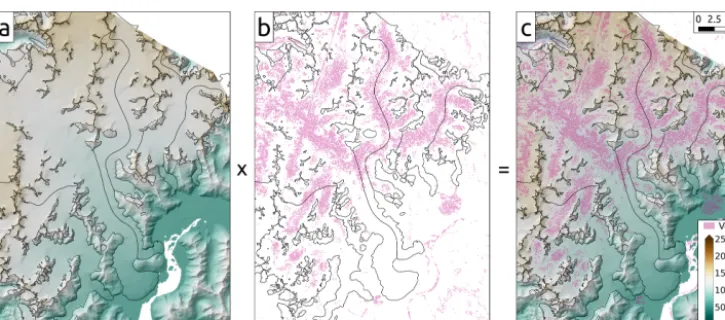
We average and mosaic the 99 ASTER correlation masks together and select a correlation threshold of 50 % to serve as the lower bound for acceptable data. This choice of thresh-old is based on a visual inspection of the mask produced and the desire to mimic the ASTER data as much as possible. To further investigate the effects of the interpolation method on the estimates of volume change, we also decrease the thresh-old to 35 % and increase it to 70 %, 80 %, 90 %, and 95 %, comparing the differences for the best-performing interpola-tion methods. For each threshold value, we apply the result-ing mask to the IfSAR DEMs, producresult-ing voids as shown in Fig. 2.
3.2 Void interpolation
The following is a summary of the different methods used to fill the artificially generated voids in the DEM and DEM difference (dDEM) products. We have split the methods into three general categories: “constant” interpolation, “spatial” interpolation, and “hypsometric” interpolation.
3.2.1 Constant methods
For the so-called constant interpolation methods, we calcu-late the mean (or median) elevation differences of the non-void pixels for each glacier, then multiply this value by the glacier area, thereby obtaining an average volume change for the glacier. Examples of this method in the literature include Surazakov and Aizen (2006), Paul and Haeberli (2008), and Fischer et al. (2015).
3.2.2 Spatial methods
1. Interpolation of elevation. This method interpolates raw elevation values of the surrounding pixels to fill voids. The resulting interpolated DEM is differenced from the second DEM, followed by a calculation of the volume changes. Though Pieczonka and Bolch (2015) use or-dinary kriging to fill voids in the original DEMs, we choose to use bilinear interpolation for further compar-ison with the results of Kääb (2008). Examples of this approach can be found in Kääb (2008), Pieczonka et al. (2013), and Pieczonka and Bolch (2015).
2. Interpolation of elevation differences. Two original, un-filled DEMs are differenced to create a dDEM. Then, the voids in the dDEM are filled using bilinear inter-polation. An example of this approach can be found in Kääb (2008) and Zheng et al. (2018).
Figure 2.Example of masking procedure over Taku Glacier, with RGI outlines shown in black. The IfSAR DEM(a)is masked using the composite correlation mask from the ASTER products with a correlation threshold (here 50 %)(b)to produce a DEM(c)with voids (in purple) similar to expected voids in an optical DEM. In panel(b), purple represents areas where the ASTER correlation is below the chosen threshold.
based on on-glacier pixels within a 1 km radius of the void pixel. Examples of this approach can be found in Melkonian et al. (2013, 2014).
3.2.3 Hypsometric methods
The so-called hypsometric methods are based on the assump-tion that there is a relaassump-tionship between elevaassump-tion change and elevation. They can be further subdivided into global and local approaches, depending on whether the mean is calcu-lated using data from the entire dataset or area of interest (i.e., global) or for an individual glacier only (i.e., local). We have chosen this terminology to be consistent with the terms used for other forms of interpolation. The global approach is usually used to extrapolate measurements from only a few glaciers to a regional scale (e.g., Arendt et al., 2002; Berthier et al., 2010; Kääb et al., 2012; Johnson et al., 2013; Nilsson et al., 2015), rather than to estimate an individual glacier’s mass balance. Here, we use these methods to evaluate both individual and regional volume changes in order to see the effects on individual glacier changes.
1. Mean (or median) elevation difference by elevation bin. Here, the original, unfilled DEMs are differenced, and the entire dDEM is binned according to the elevation in the earliest DEM for each pixel within the glacier outlines. The mean (or median) elevation difference for each bin is then calculated and multiplied by the area of each elevation bin to get a volume change. The sum of the volume change of each individual bin then gives the volume change for the glacier. This method is used by, e.g., Kääb (2008), Berthier et al. (2010), Gardelle et al. (2013), Papasodoro et al. (2015), Kronenberg et al. (2016), Brun et al. (2017), and Dussaillant et al. (2018). If a glacier has an elevation range of 500 m or more, we use 50 m wide bins; otherwise we choose elevation bins
that are 10 % of the glacier elevation range. Addition-ally, where elevation bins are completely voided, we fill these bins using a third-order polynomial fit to the avail-able data, so long as there are data over two-thirds of the glacier elevation range.
2. Polynomial fit to elevation difference by elevation bin. The original, unfilled DEMs are differenced, and a poly-nomial is fit to the elevation differences as a function of the original elevation. This elevation curve is then inte-grated over the glacier hypsometry in order to calculate a volume change. Based on examples from the litera-ture, such as Kääb (2008), we have chosen a third-order polynomial.
3.3 Uncertainties
To estimate the uncertainties in the true volume changes, we first co-register each DEM (SRTM, 2012 and 2013 IfSAR campaigns) to ICESat using the method described by Nuth and Kääb (2011). We can then use the triangulation proce-dure described in Paul et al. (2017) to estimate the residual biasεbiasafter co-registering the DEMs to each other, i.e., the uncertainty in correcting the mean bias between the DEMs. We also estimate the combined random error in elevation, εrand, by calculating the root mean square (RMS) difference of the population of dDEM pixels on stable ground. For each glacier, the error in volume changeε1V can be estimated as
ε1V2 =(ε1hA)2+(εA1h)2, (1)
(εbiasandεrand),ε1hcan be written
ε1h= s
ε2rand p
n/(L/r)2
+εbias2 , (2)
wherenis the number of pixels (i.e., measurements) that fall within the glacier outline,L is the autocorrelation distance (here assumed to be 500 m; Brun et al., 2017; Magnússon et al., 2016; Rolstad et al., 2009), and r is the pixel size (30 m). Finally, we can combine Eqs. (1) and (2) to obtain
ε1V = v u u
t A
s
ε2rand p
n/(L/r)2+ε 2 bias
!2
+ εA1h 2
. (3)
4 Results and discussion 4.1 Void distribution
Figure 3 shows the void and area frequency distributions per normalized glacier elevation bin. For the 50 % thresh-old case, most glaciers (64.4 %, 268 glaciers) have a to-tal void percentage below 20 %, with only a small number (6.7 %, 28 glaciers) having more than 40 % voids. Voids are distributed similarly to glacier area with respect to normal-ized glacier elevation (i.e., the elevation divided by the ele-vation range), and most of the voids, as well as most of the glacier area, are found in the middle third of the glacier el-evation range. This portion of the range corresponds to the flatter, mostly featureless portions of the accumulation area, which leads to lower correlation in the ASTER scenes. These void and area distributions, along with the range of elevation changes, suggest that the middle third of the glacier elevation range is the most important to ensure correct estimation; that is, uncertainties introduced by interpolating over voids in the upper and lower thirds of the elevation range will be muted owing to the typically smaller areas and percentage of voids in these ranges.
4.2 Variability of elevation change
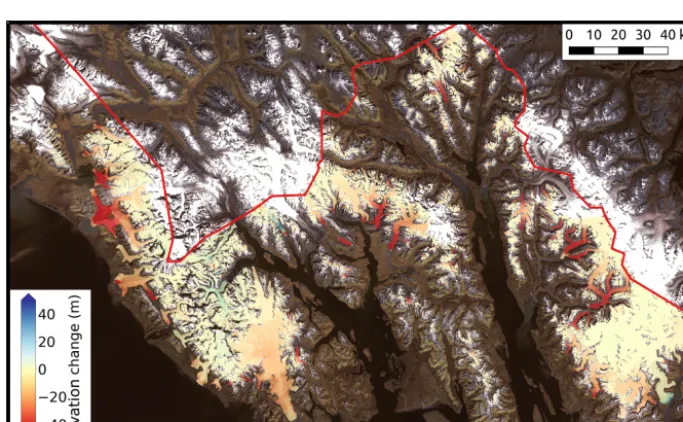
Figure 3 also shows the mean and median elevation changes per normalized elevation bin, and the standard deviation of elevation changes. The highest elevation change variabil-ity on-glacier is in the lower portion of the glacier, where most of the dynamic change is occurring. Higher up in the accumulation area, the variability is much lower, and the mean differences are close to zero. These general pat-terns can be observed in the spatial distribution of eleva-tion changes shown in Fig. 4. In general, elevaeleva-tion changes in the region are negative, especially at lower elevations, as noted in other studies (e.g., Larsen et al., 2007; John-son et al., 2013; Melkonian et al., 2014; Berthier et al., 2018). Some exceptions include Margerie (RGI ID: RGI60-01.20891), Johns Hopkins (RGI60-01.20734), and Rendu
Glacier (RGI60-01.21013) in the 2012 acquisition area and Taku Glacier (RGI60-01.01390) in the 2013 acquisition area (see Fig. 1 for glacier locations). Margerie, Johns Hopkins, and Taku Glacier are some of the few currently advancing tidewater glaciers in Alaska (e.g., Motyka and Echelmeyer, 2003; Truffer et al., 2009; McNabb and Hock, 2014), while Rendu Glacier has been previously identified as a surge-type glacier (Field, 1969). The pattern of elevation change shown on Rendu Glacier in Fig. 4, with thinning at higher eleva-tions and pronounced thickening at lower elevaeleva-tions, is sug-gestive of a surge sometime between February 2000 and Au-gust 2012 (e.g., Raymond, 1987; Björnsson et al., 2003); a tributary of Margerie Glacier also appears to have surged dur-ing this time period.
The variability of elevation changes in the region is quite high, with a standard deviation of on-glacier eleva-tion changes of 0.65 m a−1 for all glaciers in the region. This level of variability is significantly smaller than other parts of Alaska (1.14 m a−1 for glaciers in western Alaska; Le Bris and Paul, 2015), but significantly higher than re-gions in high-mountain Asia, where Brun et al. (2017) found intra-regional standard deviations in mass balance of ∼0.2 m w.e. a−1 (∼0.24 m a−1 given their assumed den-sity of 850±60 kg m3). Compared to values estimated from ICESat (Nilsson et al., 2015), this region is in line with Svalbard (0.7 m a−1), higher than the Canadian Arctic (0.34 and 0.42 m a−1for north and south, respectively), and much lower than Iceland (1.14 m a−1).
4.3 Impact of void interpolation on individual glacier estimates
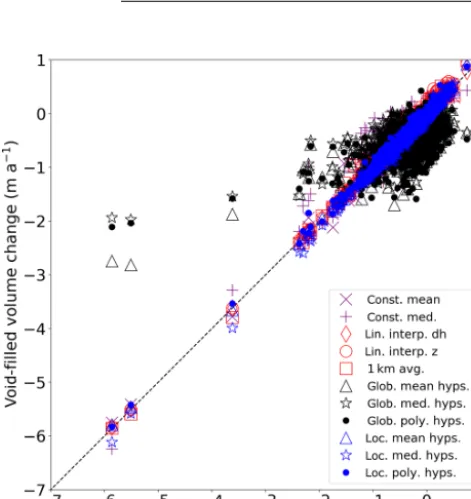
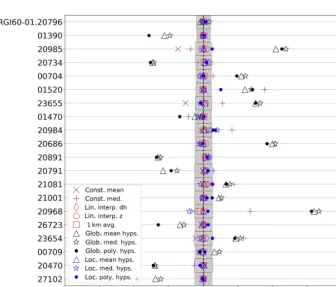
The variability of elevation gain and elevation loss shown in Fig. 4 informs some of the patterns shown in Fig. 5. Gen-erally, the global hypsometric methods are furthest from the true values, which is perhaps not surprising in a region with a high variability of glacier elevation changes. Glaciers that are far from the mean of the glacier-wide average elevation changes (−0.36 m a−1) will tend to be far from the true vol-ume change when the volvol-ume change is estimated using re-gional values, as the data used for the interpolation do not reflect conditions at that particular glacier. Thus, interpo-lated estimates for glaciers losing much more than the re-gional average tend to be overestimated (i.e., less negative change), while interpolated estimates at glaciers that are los-ing less than the average, or even increaslos-ing in volume, tend to be underestimated (i.e., more negative and/or less positive change). Methods that use data from an individual glacier, or in a small area close to the particular glacier outline, tend to do a much better job of reproducing volume changes over each of these glaciers than the global methods.
val-Figure 3.Distribution of glacier area and voids by normalized elevation (0 – lowest elevation, 1 – highest elevation), and mean and median elevation changes by normalized elevation, binned using bin widths of 0.02. The shaded area around the mean elevation changes indicates the mean±1 standard deviation.
Figure 4.Non-voided, true elevation changes over the study area. Note the contrasting patterns of thinning and thickening at lower elevations over glaciers labeled in Fig. 1 compared to the region in general. The background image is a mosaic of Landsat 7 scenes from 1999 and 2001; the red line indicates the location of the US–Canada border.
ues (typically <0.2 m a−1 with the exception of the global hypsometric methods). The percentage of estimates that fall within the uncertainty range of the true volume change esti-mates for most of the methods is quite high, above 95 %. One notable exception is the constant median method described in Sect. 3.2.1, which, aside from the global hypsometric meth-ods, shows the fewest glaciers for which the interpolated value falls within the uncertainty (84 %), the largest individ-ual overestimation at 1.22 m a−1, the largest mean and stan-dard deviation (0.07±0.19 m a−1), the largest RMS
differ-ence (0.20 m a−1), and the worst agreement with the regional volume change estimate (0.69 km3a−1overestimation).
Table 1.Summary statistics for difference to true volume change for each method for the 415 glaciers sampled. Here, SD refers to standard deviation, and “diff” refers to the difference to true volume change (i.e., interpolated–true). All units in m a−1, except for “total diff”, which is in units of km3a−1, and “pct. uncert.”, which indicates the percentage of glaciers for which the interpolated dV was within the uncertainty of the true volume change.
Method Mean±SD Median Max Min RMS diff Total diff Pct. uncert.
const. mean −0.01±0.07 0.00 0.61 −0.37 0.07 −0.18 97.36
const. med. 0.07±0.19 0.03 1.22 −0.53 0.20 0.69 83.89
lin. interp. dh 0.00±0.03 0.00 0.13 −0.16 0.03 0.01 100.00
lin. interp.z 0.03±0.06 0.01 0.34 −0.20 0.07 0.16 99.52
1 km avg. 0.00±0.08 0.00 0.39 −0.44 0.08 −0.01 99.28
glob. mean hyps. −0.08±0.45 −0.13 3.12 −1.10 0.46 0.03 52.64 glob. med. hyps. −0.04±0.49 −0.08 3.92 −1.09 0.49 0.52 51.92 glob. poly. hyps. −0.25±0.51 −0.32 3.75 −1.39 0.57 −0.39 37.02
loc. mean hyps. 0.00±0.03 0.00 0.20 −0.20 0.03 0.00 100.00
loc. med. hyps. −0.01±0.06 −0.01 0.39 −0.37 0.07 −0.09 98.80
loc. poly. hyps. 0.01±0.06 0.00 0.35 −0.24 0.06 0.26 97.84
Figure 5.Void-filled volume change estimate for individual glaciers vs. true volume change.
patterns within elevation bands. Near the dividing lines be-tween glaciers, discontinuities can be seen in the local hyp-sometric maps compared to the more gradual changes across dividing lines seen in the original elevation changes and the spatially interpolated maps. This suggests that the choice of glacier outlines can have an impact on the resulting volume change estimates. Finally, the global hypsometric methods (Fig. 6e–g), taking data from the region, do not faithfully re-produce the anomalous elevation change patterns for Taku Glacier.
For the largest 20 glaciers in the dataset (all>100 km2), which represent 61 % of the total glacier area for the glaciers
studied, as well as 68.8 % of the volume change in the region (a total of−49.9 km3), we see a number of patterns related to each of the methods. Figure 7 shows that for these largest glaciers, most of the methods fall within ∼ ±0.3 m a−1 of the true value, with significant outliers for some methods on some glaciers. For example, each of the methods for Hole-in-the-Wall Glacier (RGI60-01.27102) are clustered quite close to the true value, with the exception of the global methods. Hole-in-the-Wall Glacier is directly adjacent to Taku Glacier and is also slightly gaining mass, thus leading to the discrep-ancy with the regional averages. In general, the global meth-ods underestimate or overestimate volume change, with only a few cases in which the results are within the uncertainty of the true value. For another glacier, Riggs Glacier (RGI60-01.21001), the non-global methods give a value within∼ 0.05 m a−1 of the true value, while the global methods are still within ∼0.25 m a−1; the number of voids induced on this glacier is relatively small (19 % of the glacier area), and the elevation changes on this glacier are also similar to the re-gional ones (strong elevation loss at lower elevations, small gain at higher elevations).
Figure 8 shows a box plot of the distribution of differ-ences to truth for each method using both the largest glaciers (Fig. 8a) and all glaciers (Fig. 8b). Based on the size of the interquartile range and the mean difference of each interpo-lated estimate, the best-performing methods are the spatial interpolation methods, the local hypsometric method, and the constant mean method for both sets of glaciers. For all glaciers, the outlier range is also the smallest for the lo-cal hypsometric methods, linear interpolation of elevation change, constant mean, and the 1 km average approach.
Figure 6.Elevation change maps for Juneau Icefield and Taku Glacier.(a)Initial, non-voided elevation change;(b)linear interpolation of elevation change;(c)linear interpolation of elevation;(d)1 km average;(e)global mean hypsometric;(f)global median hypsometric;
(g)global polynomial hypsometric;(h)local mean hypsometric;(i)local median hypsometric;(j)local polynomial hypsometric. Note that the global interpolation schemes in panels(e)–(g)show primarily surface lowering, in contrast to the actual signal of no change or surface increase, as well as increased notability of individual glacier outlines in panels(h)–(j).
Figure 8.Difference to true volume change for each method tested for(a)glaciers larger than 100 km2;(b)all glaciers.
Figure 9. Distribution of elevation change values for voided and non-voided datasets over Field Glacier, binned using 1 m bins. Ver-tical lines indicate mean and median values for the voided dataset.
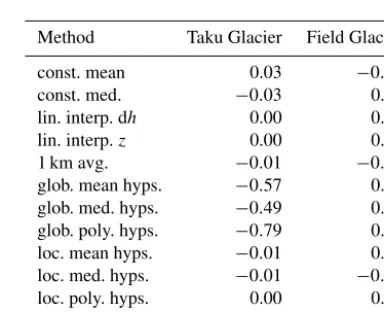
above: the data being used to interpolate voids for Taku Glacier are far more negative than reality. The constant me-dian estimate for Field Glacier (RGI60-01.01520) has the largest overall change from the true value for the non-global methods, at 0.92 m a−1. For this glacier, only the constant median method and the global methods perform particularly poorly; the rest are all within ±0.15 m a−1 of the true es-timate of −1.15 m a−1 (∼13 %). As shown in Fig. 9, this is most likely because of the heavy slant towards very neg-ative elevation changes in the elevation change distribution for Field Glacier. While representing significantly more of the glacier area, the values near 0 m elevation change found on the glacier are small compared to the extremely negative values, so the median is pulled heavily towards zero, which greatly underestimates the volume change.
4.4 Impact of void interpolation on regional total
While the differences to the true values, when averaged over all glaciers, tends to be close to zero, the differences in the regional estimates can vary substantially, as shown in Table 1. The methods that came closest to the “true” vol-ume change for the region were the local mean hypsomet-ric method, linear interpolation of elevation differences, and
Table 2.Difference to true volume change for two of the glaciers with the largest individual differences (Taku Glacier: 0.11 m a−1; Field Glacier:−1.15 m a−1). All units in m a−1, except for pct. void.
Method Taku Glacier Field Glacier
const. mean 0.03 −0.01
const. med. −0.03 0.89
lin. interp. dh 0.00 0.00
lin. interp.z 0.00 0.00
1 km avg. −0.01 −0.01
glob. mean hyps. −0.57 0.60
glob. med. hyps. −0.49 0.69
glob. poly. hyps. −0.79 0.71
loc. mean hyps. −0.01 0.01
loc. med. hyps. −0.01 −0.01
loc. poly. hyps. 0.00 0.25
pct. void 39.27 18.97
the global mean hypsometric method, which all yielded esti-mates within 0.03 km3a−1(0.8 %) of the regional total. The global mean hypsometric method is often used in altimetry-based studies to extrapolate measurements to unsurveyed glaciers, either using absolute or normalized elevation (e.g., Arendt et al., 2002; Kääb et al., 2012; Johnson et al., 2013; Larsen et al., 2015), and our results indicate that relatively little bias is introduced to the regional estimate through this form of extrapolation, at least for this example. In this study, we have used absolute elevations, rather than normalized el-evations, for the global methods. In other regions, it may be worth comparing the differences between using absolute and normalized elevations.
el-tainty of 0.4 km3a−1. The constant median had the worst agreement with the regional total, at 0.69 km3a−1 (18 %). In contrast to this, estimating volume changes using the global median hypsometric method underestimated the re-gional total volume change by 0.37 km3a−1. While for an en-tire glacier, the median elevation change skews very heavily towards zero due to the asymmetry in positive and negative values of elevation change, this is not necessarily the case for an elevation bin. As noted by Kääb (2008) and borne out by the elevation change interpolation method, elevation changes tend to be rather self-similar on small spatial scales, and the median change for an elevation bin tends to be a more accu-rate reflection of the actual elevation change. That said, for both the local and global methods, using the mean rather than the median yields a better result on both an individual and re-gional basis, suggesting that the mean is more representative as a rule.
4.5 Increasing void area
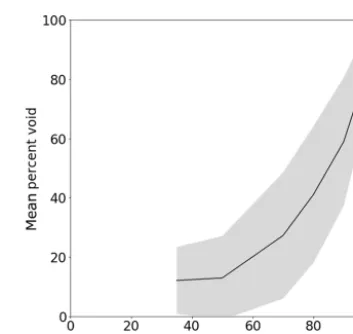
To estimate the sensitivity of the different methods to the amount of voids in the DEMs, we varied the correlation threshold from 35 % to 95 %. The effect of using each thresh-old on the mean percent void for all glaciers is shown in Fig. 10. Above a threshold of 70 %, the mean void per-centage per glacier increases dramatically, up to 75 % voids when using a threshold of 95 %. In the following analysis, we compare the total set of interpolated volume changes for all glaciers over all threshold scenarios. We have limited the number of methods discussed to those that performed the best in the 50 % threshold case (described in Sect. 4.3 and 4.4): the constant mean method, linear interpolation of ele-vation changes, the 1 km average method, the global mean hypsometric method, and the local mean and median hypso-metric methods.
Figure 11 shows that the local hypsometric and spatial interpolation methods can tolerate a high void percentage (>50 %) before more than 10 % of the estimates fall outside of the uncertainty range; beyond 70 % voids, this percentage increases dramatically. The constant mean method does not perform as well for lower void percentages, but it does not drop as quickly at higher void percentages as the other
meth-Figure 10.Mean (±standard deviation) percent void over glacier area for each of the correlation thresholds investigated.
Figure 11.Percent of estimates that fall within the uncertainty esti-mates as a function of the void percent.
ods. As expected, the global mean hypsometric method has low values throughout the range of void percentages, though there is not as much dependence on the void percentage as with the other methods. Even at the highest void percentages, the spatial interpolation methods perform remarkably well, with upwards of 75 % of estimates falling below the uncer-tainty range for both linear interpolation of elevation change and the 1 km average; this may not be true for other datasets, which we discuss more in Sect. 4.6.
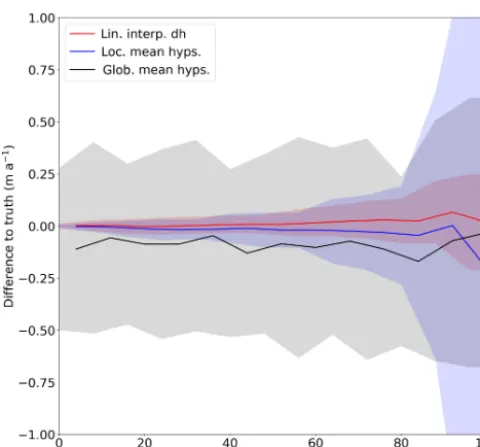
Figure 12.Difference to true mass balance as a function of void percentage for the three best-performing methods on both an indi-vidual glacier and regional basis. Shaded region around each line indicates±standard deviation.
in Fig. 11, linear interpolation of elevation change and the local mean hypsometric method remain close to the true val-ues of volume change up to around 50 %–60 % voids, before the standard deviation increases dramatically, though less so for linear interpolation of elevation change. As the local hyp-sometric method requires data in a given elevation bin for interpolation, it makes sense that with a higher void percent-age, the interpolated estimates are further and further from the true values of volume change, while linear interpolation requires fewer data to provide an estimate; as long as the missing values are similar enough to the non-voided values, the interpolated estimates of volume change do not deviate significantly from the true volume changes.
4.6 ASTER differences
While linear interpolation of elevation differences performs very well with these DEMs and voids, it should be noted that these DEMs are very smooth, without significant noise in el-evation values over glacier surfaces. When using DEMs that are noisier, this method may actually perform worse, as it may amplify this noise. To illustrate this, we used ASTER DEMs acquired on 13 August 2015 over a portion of the 2012 IfSAR acquisition area and differenced these DEMs to the SRTM. The ASTER DEMs were processed using MMAS-TER, and along-track and cross-track biases were corrected using the 2012 IfSAR DEM (see Girod et al., 2017, for more details on these corrections).
Compared to the IfSAR DEM, the ASTER DEMs are quite noisy in the accumulation areas of glaciers owing to the
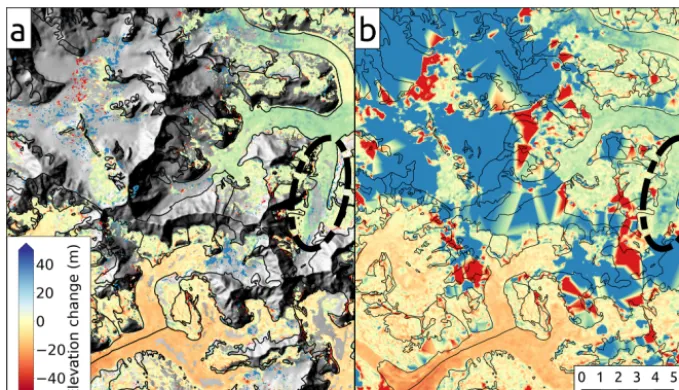
low contrast, and hence low correlation, between the original images in the ASTER scenes. As such, even after correla-tion masking, there is significant noise in the DEM differ-ence map (Fig. 13a). When these values are linearly interpo-lated, the resulting dDEM shows clear interpolation artifacts and elevation changes that differ greatly from the original IfSAR–SRTM differences (Fig. 13b), biasing the estimated volume changes.
For the 91 glaciers covered by these ASTER DEMs, the other best estimates named above (local mean hypsometric and global mean hypsometric) yield a total volume change estimate of∼0 m a−1, whereas linear interpolation of ele-vation differences yields a volume change of +0.2 m a−1. Looking further at this, this discrepancy is almost entirely due to one glacier, Johns Hopkins Glacier. Linear interpola-tion of elevainterpola-tion changes yields a volume change estimate of∼1 m a−1for this glacier, while the other estimates yield values of∼0.6 m a−1.
Thus, we caution against using a direct linear interpola-tion of elevainterpola-tion differences to fill voids without first filter-ing or otherwise removfilter-ing potential outliers, which are often located near voids; this increases their influence in a linear interpolation. We also caution against using this approach when the distances between known values are quite large in relation to the glacier width. The local mean hypsomet-ric approach used by many studies performs just as well as linear interpolation of elevation differences in the idealized case analyzed here; it therefore appears to be more robust against this kind of noise and is easily implemented in place of linear interpolation.
A question then arises: when using noisy, “real-world” data such as ASTER DEMs, is it better to keep only the most reliable values for a given DEM, potentially producing large voids that must be interpolated, or is it better to have a more complete DEM? Given the results presented in this section, and the results shown in Sect. 4.5, we suggest that on-glacier areas with relatively low correlation (i.e., reliability) can still have usable data. As the local hypsometric methods tend to be more robust against noise and can tolerate a rather high percentage of data voids (up to∼60 %; Fig. 12), a strategy of using lower correlation thresholds (∼50 %–60 %) in com-bination with the local hypsometric approach seems well-suited to making the most of the available data.
5 Conclusions
hypsomet-Figure 13. Elevation changes over the upper portion of Johns Hopkins Glacier, estimated by differencing an ASTER DEM acquired on 13 August 2015 and the SRTM(a)with correlation-masked values left as no data;(b)with voids filled using linear interpolation. Clear interpolation-related artifacts are seen in the sparsely sampled accumulation area. Ellipses highlight an area over the glacier where linear interpolation performs well, with no obvious artifacts in the interpolated surface.
ric method, also performed quite well in estimating the re-gional total volume change, differing from the true estimate by less than 1 %. For the low-noise-level DEMs we have used, linearly interpolating elevation differences tends to pro-duce elevation change maps that look the most similar to the original maps. This may not hold, however, for voids that take up a larger portion of the glacier area, whereby the as-sumption that elevation changes are similar over small dis-tances may be violated, and interpolation artifacts would in-troduce larger uncertainties. Additionally, this may not hold for DEMs that are noisier, especially in low-contrast areas such as the accumulation zones of glaciers; as such, we cau-tion against adopting this method without first considering the characteristics of the DEMs being used. In terms of indi-vidual glacier estimates, the local mean hypsometric method performs quite well and appears more robust in the face of noisy DEMs, which perhaps explains its widespread use in studies of glacier volume change and geodetic mass balance. On average, most of the methods perform well, with low mean, median, and RMS differences for all methods, though large outliers skew the differences in the regional totals. The constant median method, however, tends to work quite poorly owing to the asymmetrical distribution of positive and neg-ative elevation change values; i.e., the glaciers in the region tend to have significantly more negative values of elevation change than positive values. Unless there is good reason to think the distribution of elevation changes for a particular glacier or region is more symmetrical, this method should be avoided. The same can be said for using a median hyp-sometric approach, which does not perform as well as the mean hypsometric approaches. As might be expected, using regional data to estimate the volume change of an individual
glacier quite often performs poorly, though the regional total volume change can be well-approximated in this way.
The bias introduced by a given method is also dependent on the size of the data voids. For the two most accurate meth-ods on both an individual glacier and regional basis, interpo-lating voids of up to 50 % tends to introduce small differ-ences in the estimated volume change; most of the change is happening in the lower parts of the glacier where the void percentage is smaller. Above 60 %–70 % voids, however, the errors grow substantially and are usually significantly higher than the uncertainty in the original datasets. This is not the case for the global interpolation methods, however, which have large errors for individual glaciers that are mostly in-dependent of the void percentage. Thus, the void percentage does not have as pronounced an effect on the regional total estimated using the global mean hypsometric method, im-plying that its use in regional-scale altimetry studies is well-founded.
significant noise or have large voids, however, linear interpo-lation may not be suitable. If attempting to estimate geodetic mass balance for unsurveyed glaciers, as is needed in many altimetry-based studies, only a global method will suffice, though the mass balance estimate for a given unsurveyed glacier should not be taken at face value. Additionally, the regional estimate for such a case may be strongly biased. As each of these different methods is relatively easily im-plemented, however, a comparison of the different methods should be attempted in order to provide a measure of the un-certainty introduced by interpolating voids in the data.
Code availability. The code used to generate and fill voids, as well as the resulting data for each glacier, can be found in a Git repository at https://github.com/iamdonovan/dem_voids (last access: 8 March 2019).
Author contributions. RM and CN designed the study; RM devel-oped the code for interpolating DEM voids; LG assisted in MMAS-TER development; all authors contributed to analyzing the results and writing the paper.
Competing interests. The authors declare that they have no conflict of interest.
Acknowledgements. This study was funded in part by the ESA project Glaciers_cci (4000109873/14/I-NB) and the European Research Council under the European Union’s Seventh Framework Programme (FP 2007–2013)/ERC grant agreement no. 320816. Alaska IfSAR DEM data are provided through the state of Alaska’s Statewide Digital Mapping Initiative and the US Geological Survey’s Alaska Mapping Initiative. Both the IfSAR and the SRTM DEM are distributed through the USGS Earth Resources Observation Center. Acquisition of ASTER images was guided by NASA JPL through the ASTER science team and the Global Land Ice Measurements from Space (GLIMS) initiative. The authors wish to thank Frank Paul and Stephen Plummer for their helpful comments on early versions of the paper. Nick Barrand and two anonymous reviewers provided many insightful comments that helped improve the quality of the paper.
Edited by: Daniel Farinotti
Reviewed by: Nicholas Barrand and two anonymous referees
References
Abermann, J., Fischer, A., Lambrecht, A., and Geist, T.: On the potential of very high-resolution repeat DEMs in glacial and periglacial environments, The Cryosphere, 4, 53–65, https://doi.org/10.5194/tc-4-53-2010, 2010.
Andreassen, L. M., Elvehøy, H., Kjøllmoen, B., and Engeset, R. V.: Reanalysis of long-term series of glaciological and geodetic
mass balance for 10 Norwegian glaciers, The Cryosphere, 10, 535–552, https://doi.org/10.5194/tc-10-535-2016, 2016. Arendt, A. A., Echelmeyer, K. A., Harrison, W. D., Lingle, C. S.,
and Valentine, V. B.: Rapid Wastage of Alaska Glaciers and Their Contribution to Rising Sea Level, Science, 297, 382–386, https://doi.org/10.1126/science.1072497, 2002.
Arendt, A. A., Echelmeyer, K. A., Harrison, W. D., Lingle, C. S., Zirnheld, S. L., Valentine, V. B., Ritchie, J. B., and Drucken-miller, M.: Updated estimates of glacier volume changes in the western Chugach Mountains, Alaska, and a comparison of re-gional extrapolation methods, J. Geophys. Res., 111, F03019, https://doi.org/10.1029/2005JF000436, 2006.
Bamber, J. L. and Rivera, A.: A review of remote sensing methods for glacier mass balance determination, Global Planet. Change, 59, 138–148, https://doi.org/10.1016/j.gloplacha.2006.11.031, 2007.
Berthier, E., Schiefer, E., Clarke, G. K. C., Menounos, B., and Rémy, F.: Contribution of Alaskan glaciers to sea-level rise derived from satellite imagery, Nat. Geosci., 3, 92–95, https://doi.org/10.1038/ngeo737, 2010.
Berthier, E., Larsen, C., Durkin, W. J., Willis, M. J., and Pritchard, M. E.: Brief communication: Unabated wastage of the Juneau and Stikine icefields (southeast Alaska) in the early 21st century, The Cryosphere, 12, 1523–1530, https://doi.org/10.5194/tc-12-1523-2018, 2018.
Björnsson, H., Pálsson, F., Sigurðsson, O., and Flowers, G. E.: Surges of glaciers in Iceland, Ann. Glaciol., 36, 82–90, https://doi.org/10.3189/172756403781816365, 2003.
Brun, F., Berthier, E., Wagnon, P., Kääb, A., and Treichler, D.: A spatially resolved estimate of High Mountain Asia glacier mass balances from 2000 to 2016, Nat. Geosci., 10, 668–673, https://doi.org/10.1038/ngeo2999, 2017.
Cogley, J. G.: Geodetic and direct mass-balance measurements: comparison and joint analysis, Ann. Glaciol., 50, 96–100, https://doi.org/10.3189/172756409787769744, 2009.
Dall, J., Madsen, S. N., Keller, K., and Forsberg, R.: Topography and Penetration of the Greeland Ice Sheet Measured with Air-borne SAR Interferometry, Geophys. Res. Lett., 28, 1703–1706, 2001.
Dehecq, A., Millan, R., Berthier, E., Gourmelen, N., Trouvé, E., and Vionnet, V.: Elevation changes inferred from TanDEM-X data over the Mont-Blanc area: Impact of the X-band interferometric bias, IEEE J. Sel. Top. Appl., 9, 3870–3882, 2016.
Dussaillant, I., Berthier, E., and Brun, F.: Geodetic Mass Bal-ance of the Northern Patagonian Icefield from 2000 to 2012 Using Two Independent Methods, Front. Earth Sci., 6, 8, https://doi.org/10.3389/feart.2018.00008, 2018.
Elsberg, D. H., Harrison, W. D., Echelmeyer, K. A., and Krim-mel, R. M.: Quantifying the effects of climate and surface change on glacier mass balance, J. Glaciol., 47, 649–658, https://doi.org/10.3189/172756501781831783, 2001.
Field, W. O.: Current observations on three surges in Glacier Bay, Alaska, 1965–1968, Can. J. Earth Sci., 6, 831–839, 1969. Fischer, M., Huss, M., and Hoelzle, M.: Surface elevation and mass
changes of all Swiss glaciers 1980–2010, The Cryosphere, 9, 525–540, https://doi.org/10.5194/tc-9-525-2015, 2015.
com-borne laser scanning data: case study Engabreen, Norway, Ann. Glaciol., 42, 195–201, 2005.
Girod, L., Nuth, C., Kääb, A., McNabb, R. W., and Gal-land, O.: MMASTER: improved ASTER DEMs for el-evation change monitoring, Remote Sens., 7, 704–729, https://doi.org/10.3390/rs9070704, 2017.
Haug, T., Rolstad, C., Elvehøy, H., Jackson, M., and Maalen-Johansen, I.: Geodetic mass balance of the western Svartisen ice cap, Norway, in the periods 1968–1985 and 1985–2002, Ann. Glaciol., 50, 119–125, 2009.
Huss, M.: Density assumptions for converting geodetic glacier volume change to mass change, The Cryosphere, 7, 877–887, https://doi.org/10.5194/tc-7-877-2013, 2013.
Jarvis, A., Reuter, H. I., Nelson, A., and Guevara, E.: Hole-filled seamless SRTM data v4, Tech. rep., International Centre for Tropical Agriculture (CIAT), available at: http://srtm.csi.cgiar. org (last access: 8 March 2019), 2008.
Johnson, A. J., Larsen, C. F., Murphy, N., Arendt, A. A., and Zirnheld, S. L.: Mass balance in the Glacier Bay area of Alaska, USA, and British Columbia, Canada, 1995– 2011, using airborne laser altimetry, J. Glaciol., 59, 632–648, https://doi.org/10.3189/2013JoG12J101, 2013.
Kääb, A.: Glacier Volume Changes Using ASTER Satellite Stereo and ICESat GLAS Laser Altimetry. A Test Study on Edgeøya, Eastern Svalbard, IEEE T. Geosci. Remote Sens., 46, 2823– 2830, 2008.
Kääb, A., Berthier, E., Nuth, C., Gardelle, J., and Arnaud, Y.: Contrasting patterns of early twenty-first-century glacier mass change in the Himalayas, Nature, 488, 495–498, https://doi.org/10.1038/nature11324, 2012.
Kohler, J., James, T. D., Murray, T., Nuth, C., Brandt, O., Barrand, N. E., Aas, H. F., and Luckman, A. J.: Acceleration in thinning rate on western Svalbard glaciers, Geophys. Res. Lett., 34, 1–5, https://doi.org/10.1029/2007GL030681, 2007.
Kronenberg, M., Barandun, M., Hoelzle, M., Huss, M., Farinotti, D., Azisov, E., Usubaliev, R., Gafurov, A., Petrakov, D., and Kääb, A.: Mass-balance reconstruction for Glacier No. 354, Tien Shan, from 2003 to 2014, Ann. Glaciol., 57, 92–102, https://doi.org/10.3189/2016AoG71A032, 2016.
Larsen, C. F., Motyka, R. J., Arendt, A. A., Echelmeyer, K. A., and Geissler, P. E.: Glacier changes in southeast Alaska and north-west British Columbia and contribution to sea level rise, J. Geo-phys. Res., 112, F01007, https://doi.org/10.1029/2006JF000586, 2007.
nus positions, 1948–2012, J. Geophys. Res., 119, 153–167, https://doi.org/10.1002/2013JF002915, 2014.
Melkonian, A. K., Willis, M. J., Pritchard, M. E., Rivera, A., Bown, F., and Bernstein, S. A.: Satellite-derived volume loss rates and glacier speeds for the Cordillera Darwin Icefield, Chile, The Cryosphere, 7, 823–839, https://doi.org/10.5194/tc-7-823-2013, 2013.
Melkonian, A. K., Willis, M. J., and Pritchard, M. E.: Satellite-derived volume loss rates and glacier speeds for the Juneau Icefield, Alaska, J. Glaciol., 60, 743–760, https://doi.org/10.3189/2014JoG13J181, 2014.
Motyka, R. J. and Echelmeyer, K. A.: Taku Glacier (Alaska, USA) on the move again: active deformation of proglacial sediments, J. Glaciol., 49, 50–58, 2003.
Nilsson, J., Sandberg Sørensen, L., Barletta, V. R., and Forsberg, R.: Mass changes in Arctic ice caps and glaciers: implications of regionalizing elevation changes, The Cryosphere, 9, 139–150, https://doi.org/10.5194/tc-9-139-2015, 2015.
Nuth, C. and Kääb, A.: Co-registration and bias corrections of satel-lite elevation data sets for quantifying glacier thickness change, The Cryosphere, 5, 271–290, https://doi.org/10.5194/tc-5-271-2011, 2011.
Papasodoro, C., Berthier, E., Royer, A., Zdanowicz, C., and Langlois, A.: Area, elevation and mass changes of the two southernmost ice caps of the Canadian Arctic Archipelago between 1952 and 2014, The Cryosphere, 9, 1535–1550, https://doi.org/10.5194/tc-9-1535-2015, 2015.
Paul, F. and Haeberli, W. O.: Spatial variability of glacier elevation changes in the Swiss Alps obtained from two digital elevation models, Geophys. Res. Lett., 35, 1–5, https://doi.org/10.1029/2008GL034718, 2008.
Paul, F., Bolch, T., Briggs, K., Kääb, A., McMillan, M., McNabb, R., Nagler, T., Nuth, C., Rastner, P., Strozzi, T., and Wuite, J.: Error sources and guidelines for quality assessment of glacier area, elevation change, and velocity products derived from satel-lite data in the Glaciers_cci project, Remote Sens. Environ., 203, 256–275, 2017.
Glasser, N. F., Gurney, S. D., Hagg, W., Hall, D. K., Hari-tashya, U. K., Hartmann, G., Herreid, S. J., Howat, I. M., Jiskoot, H., Khromova, T. E., Klein, A., Kohler, J., König, M., Kriegel, D., Kutuzov, S., Lavrentiev, I., Le Bris, R., Li, X., Manley, W. F., Mayer, C., Menounos, B., Mercer, A., Mool, P., Ne-grete, A., Nosenko, G., Nuth, C., Osmonov, A., Pettersson, R., Racoviteanu, A. E., Ranzi, R., Sarikaya, M. A., Schneider, C., Sigurðsson, O., Sirguey, P., Stokes, C. R., Wheate, R., Wolken, G. J., Wu, L. Z., and Wyatt, F. R.: The randolph glacier inven-tory: A globally complete inventory of glaciers, J. Glaciol., 60, 537–552, https://doi.org/10.3189/2014JoG13J176, 2014. Pieczonka, T. and Bolch, T.: Region-wide glacier mass budgets and
area changes for the Central Tien Shan between∼1975 and 1999 using Hexagon KH-9 imagery, Global Planet. Change, 128, 1– 13, https://doi.org/10.1016/j.gloplacha.2014.11.014, 2015. Pieczonka, T., Bolch, T., Junfeng, W., and Shiyin, L.:
Heteroge-neous mass loss of glaciers in the Aksu-Tarim Catchment (Cen-tral Tien Shan) revealed by 1976 KH-9 Hexagon and 2009 SPOT-5 stereo imagery, Remote Sens. Environ., 130, 233–244, https://doi.org/10.1016/j.rse.2012.11.020, 2013.
Raymond, C. F.: How do glaciers surge? A review, J. Geophys. Res., 92, 9121–9134, https://doi.org/10.1029/JB092iB09p09121, 1987.
RGI Consortium: Randolph Glacier Inventory – A Dataset of Global Glacier Outlines: Version 6.0: Technical Report, https://doi.org/10.7265/N5-RGI-60, Global Land Ice Measure-ments from Space, Colorado, USA, Digital Media, 2017. Rignot, E. J., Echelmeyer, K. A., and Krabill, W. B.:
Pene-tration depth of interferometric synthetic-aperture radar sig-nals in snow and ice, Geophys. Res. Lett., 28, 3501–3504, https://doi.org/10.1029/2000GL012484, 2001.
Rolstad, C., Haug, T., and Denby, B.: Spatially integrated geodetic glacier mass balance and its uncertainty based on geostatistical analysis: Application to the western Svartisen ice cap, Norway, J. Glaciol., 55, 666–680, https://doi.org/10.3189/002214309789470950, 2009.
Shugar, D. H., Rabus, B. T., and Clague, J. J.: Elevation changes (1949–1995) of Black Rapids Glacier, Alaska, derived from a multi-baseline InSAR DEM and historical maps, J. Glaciol., 56, 625–634, 2010.
Surazakov, A. B. and Aizen, V. B.: Estimating volume change of mountain glaciers using SRTM and map-based topo-graphic data, IEEE T. Geosci. Remote Sens., 44, 2991–2995, https://doi.org/10.1109/TGRS.2006.875357, 2006.
Truffer, M., Motyka, R. J., Hekkers, M., Howat, I. M., and King, M. A.: Terminus dynamics at an advancing glacier: Taku Glacier, Alaska, J. Glaciol., 55, 1052–1060, https://doi.org/10.3189/002214309790794887, 2009.
USGS: USGS EROS Archive – Digital Elevation – Interferometric Synthetic Aperture Radar (IFSAR) – Alaska, available at: https://www.usgs.gov/centers/eros/science/usgs-eros-archive-digital-elevation-interferometric-synthetic-aperture-radar, last access: 17 January 2019.
Van Zyl, J. J.: The shuttle radar topography mission (SRTM): A breakthrough in remote sensing of topography, Acta Astronaut., 48, 559–565, https://doi.org/10.1016/S0094-5765(01)00020-0, 2001.
WGMS: USGS EROS Archive – Digital Elevation – Interferometric Synthetic Aperture Radar (IFSAR) – Alaska, available at: https: //wgms.ch/data_databasestats/, last access: 17 January 2019. Zemp, M., Jansson, P., Holmlund, P., Gärtner-Roer, I., Koblet,
T., Thee, P., and Haeberli, W.: Reanalysis of multi-temporal aerial images of Storglaciären, Sweden (1959–99) – Part 2: Comparison of glaciological and volumetric mass balances, The Cryosphere, 4, 345–357, https://doi.org/10.5194/tc-4-345-2010, 2010.
Zemp, M., Thibert, E., Huss, M., Stumm, D., Rolstad Denby, C., Nuth, C., Nussbaumer, S. U., Moholdt, G., Mercer, A., Mayer, C., Joerg, P. C., Jansson, P., Hynek, B., Fischer, A., Escher-Vetter, H., Elvehøy, H., and Andreassen, L. M.: Reanalysing glacier mass balance measurement series, The Cryosphere, 7, 1227– 1245, https://doi.org/10.5194/tc-7-1227-2013, 2013.