COLLABORATIVE LEARNING ENVIRONMENT USING A CLOUD-BASED SYSTEM PLATFORM FOR SCIENCE EXPERIMENTS IN HIGHER EDUCATION
Hao-Chang Lo
Department of Digital Content and Technology, National Taichung University of Education, 140 Min-Shen Road, Taichung 40306, Taiwan
Abstract
This study investigated a collaborative learning environment employing a cloud-based system platform for science experiments in higher education, developed on the basis of ubiquitous learning. The cloud-based system platform was completed according to a systematic design process, ADDIE, which involves analysis, design, development, implementation, and evaluation. Four sophomore undergraduate students pursuing science-related degrees in the midlands of Taiwan participated in this study. A qualitative research design was adopted, and triangulation was used to establish the validity of this qualitative study. Data were collected from a questionnaire and focus interviews to investigate students’ perceptions on using the cloud-based system platform for physics experiments in science laboratories. The data analysis results revealed empirical evidence of positive interdependence, face-to-face interaction, individual accountability, social skills, and group processing, indicating that college students learned collaboratively when they used the cloud-based system platform to perform science experiments.
Key words: collaborative learning, cloud-based system platform, experiments, science laboratory, ubiquitous learning
1. INTRODUCTION
1.1 Experiments in science education
Science must be accompanied by experimentation and laboratory work (Trowbridge & Bybee 1990). Typically, practical science laboratory activities merely confirm or demonstrate concepts that have already been presented to students. However, science education reform approaches focus on active learning by students. Students are expected to ask questions, acquire knowledge, construct and test explanations, and communicate their ideas with others (National Research Council 1996), as well as develop thinking skills, values, and attitudes that will be useful throughout their lives regardless of their career choices (American Association for the Advancement of Science 1993). Writing laboratory reports, an integral part of conducting science experiments, requires writing the laboratory procedures, recording quantitative and qualitative observations, and deducing conclusions after results have been gathered. In the process of writing laboratory reports, students have opportunities to think critically and reason about the meaning of their laboratory data (Keys 1999), construct their conceptions of science individually and with others, and develop their scientific literacy (Keys et al. 1999). Most learning activities in laboratories occur in groups, and students can acquire additional opportunities to understand phenomena and engage in conceptual changes with peers who have diverse opinions and ideas through group learning. Light and Glachan (1985) showed that working in groups can be highly efficient, particularly for work requiring complex problem-solving processes.
1.2 Collaborative learning
Collaborative learning, an instructional strategy based on the premise of active learning in which students become engaged and are responsible for the learning process, is widely adopted when students learn in groups. The possible benefits of collaborative learning include fostering understanding (Dillenbourg 1999; Siraj-Blatchford 2007; Terenzini et al. 2001), promoting deep learning (Visschers-Pleijers et al. 2006), and knowledge retention (Ramsden 2003). Collaborative learning is closely associated with social constructivism that presumes that knowledge is
nonfoundational or intersubjective. Johnson, Johnson, and Smith (1991) stated that positive interdependence, face-to-face interaction, individual accountability, social skills, and group processing are five essential elements of collaborative learning. The terms collaborative and
cooperative have generally been interchangeable in the past; however, some scholars insist on a few
differences. Brufee (1999) recommended that collaborative learning is more appropriate for college-level students, whereas cooperative learning is more suitable for Grades K–12 when the learning objectives and different roles of the instructor are considered. In brief, collaborative learning helps students construct knowledge through consensus building among individual group members; however, implementing group learning activities at university is challenging (Blumenfeld, Marx, & Soloway 1996). In addition, an increasing number of universities are expected to ensure that students develop skills for independent problem solving, critical thinking, teamwork, and lifelong learning as part of their undergraduate studies (Biggs & Tang 2007).
1.3 Technology-enhanced learning
Considerable research on how technology enhances student learning has been conducted (Chen et al., 2010). Furthermore, some studies (e.g., Manlove, Lazonder, & Jong 2009; Zacharia, Olympiou, & Papaevripidou 2008) have effectively incorporated group learning strategies to facilitate student learning in a technology-enhanced laboratory. The increase in information and communication technology (ICT) proliferates computer-supported collaborative learning (CSCL), and both the education and information engineering domains have contributed to CSCL. Over the recent decades, substantial research has been completed to develop theories and technologies that enrich collaborative environments (Alharbi, Athauda, & Chiong 2014). CSCL still presents challenges even though literature reports considerable advantages of CSCL. For example, only forming groups of students and providing them with group and ICT tools does not guarantee that a collaborative learning process will occur as expected. Students often do not meet pedagogical objectives or achieve learning goals because they fail to perform collaborative tasks appropriately. To solve this problem, researchers have suggested using a learning strategy to promote student engagement and help them acquire knowledge and social skills through a predefined structured collaborative methodology (Dillenbourg & Hong 2008).
Currently, the trend in technology-enhanced instruction is ubiquitous learning (Doolittle & Mariano 2008). Ubiquitous learning incorporates wireless technologies and mobile devices flexibly to enable learning through devices such as smart phones, laptops, tablets, iPods, palm pilots, and other devices that are typically lightweight, portable, and enable Internet connectivity. Moreover, cloud computing, which enables centralized data storage and online access to computer services or resources, makes ubiquitous learning increasingly effective.
1.4 Research purpose
This study examined a collaborative learning environment employing a cloud-based system platform that was developed on the basis of ubiquitous learning for science experiments in higher education. To achieve collaborative learning, an online collaborative scenario was predefined, and some essential elements of collaborative learning were investigated in this study.
2. METHODS
2.1 Cloud-based system platform
ADDIE, a systematic design involving a five-phase process including analysis, design, development, implementation, and evaluation, was adopted to develop the cloud-based system platform.
2.1.1 Analysis phase
An analysis document was completed on the basis of comparing existing science laboratory learning with ideal learning. Sequentially, a requirement analysis of the cloud-based system platform based on the analysis document was conducted.
2.1.2 Design phase
According to the requirement analysis, we began designing the required system platform, which included visual planning, Web design, and an online database. In addition, the design had to meet standards of ubiquitous learning to enable users to use a personal computer (PC), notebook, tablet, or smart phone during the entire process. Another task in this phase was to predefine an online collaborative scenario for science experiments. Figure 1 shows a simplified illustration of an online collaborative scenario, and a brief description is stated as follows:
Before a laboratory experiment, instructors begin a new experiment course and post prelaboratory documents to a Web platform. Students must enroll in the online course when they use the system platform for the first time. The instructor can group students allowed to participate in the experiment course. Group members then communicate, exchange information, and co-write the prelaboratory report online. Informing students that instructors can monitor all procedures and participate in learning activities by using the Internet as well as score students according to their online performance is crucial.
Working in a laboratory, students perform practical experiments, interact face-to-face, and upload all experiment records (images, video recordings, and data). In addition, they can search related online information to support their laboratory work if necessary.
After completing laboratory work, students review records by using a platform, manage data, discuss with group members, exchange ideas and information, and write their postlaboratory reports collaboratively. Instructors evaluate students’ reports after they are submitted, and students subsequently receive comments and feedback.
Figure 1. Online collaborative scenario for a science experiment
2.1.3 Development phase
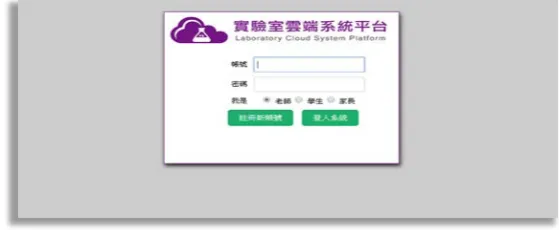
A prototype was developed and debugged on the basis of the previous phase. Figure 2 shows the login homepage interface. Each user obtains a new account after completing an account creation form. There are three types of authority including teacher, student, and parents. Instructors may establish their own online laboratory and commence experiment courses in the laboratory. Students start online learning activities after logging in and selecting the experiment they wish to participate in. Parents have the right to view only group activities in which their children engage.
Figure 2. Login homepage interface
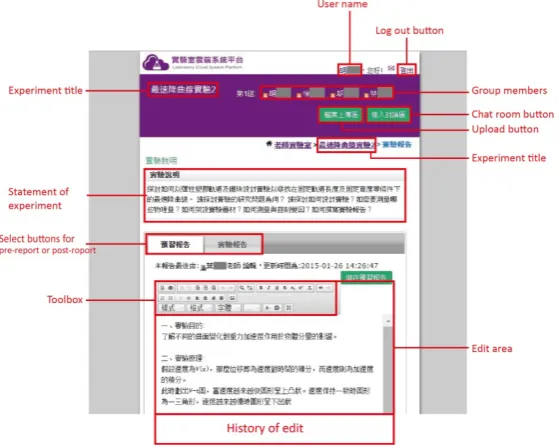
Figure 3 illustrates the main homepage interface. The experiment title is displayed in the upper left-hand corner. The username and names of group members are displayed in the upper right-hand corner. A pop-up browser window appears and enables students to communicate with group members when they click the chat room button. In the same manner, users upload files by clicking the upload button. A statement of the experiment that instructors post to explain the experiment is displayed in the center. The edit area with a toolbox is located below the select button for pre- or postreports, and a user edits a report after selecting the report he or she wants to write. Each version of the edited report is displayed when the user clicks the edit history button at the bottom of the homepage.
Figure 3. Main homepage interface
2.1.4 Implementation phase
Participants were invited to use the cloud-based system platform for a physics experiment in a science laboratory.
2.1.5 Evaluation phase
To evaluate this cloud-based system platform, a qualitative research design was adopted. The qualitative research design investigated students’ perceptions on using the cloud-based system platform for a physics experiment in a science laboratory. The design is described in the following subsections.
2.2 Research design
A qualitative research design was adopted in this study. Participants were invited to attend two physics experiments including a cookbook experiment to measure instantaneous velocity and an inquiry experiment for brachistochrone. Each experiment lasted a week and included prelaboratory, in-laboratory, and postlaboratory tasks. The participants were assigned to small groups and completed group tasks. A questionnaire that examined the perceptions of the students by comparing a traditional experiment environment with the cloud-based experiment environment was completed after the 2 weeks of experiments. According to the results of the questionnaire, a 60-min focus interview was designed to obtain abundant data to investigate students’ perceptions of using the cloud-based system platform for physics experiments in a science laboratory. The interviewer compared the perceptions of students between a traditional experiment environment and the cloud-based experiment environment. When we integrated the data collected from the questionnaire and focus interviews, triangulation was used to establish the validity of this qualitative study.
2.3 Participants
Four sophomore undergraduate students (two men and two women) with science-related majors from the midlands of Taiwan participated in this study. They have successfully completed college courses including general physics laboratory, general chemistry laboratory, and general biology laboratory courses.
2.4 Analytic procedures
Transcripts of the focus interviews were first produced before the data was analyzed. A two-stage analysis strategy was used for the data analysis. The raw data collected from the focus interviews and questionnaires were coded separately at the first stage. At the second stage of analysis, data were integrated and triangulated by reading integrated data repeatedly. During the analytic procedure, a coding schema, namely category coding, was developed to organize data and obtain data reduction. The major code was collaboration, and subcodes were the essential elements of collaborative learning (Table 1).
Positive interdependence, face-to-face interaction, individual accountability, social skills, and group processing are five essential elements of collaborative learning (Johnson, Johnson & Smith 1991).
Positive interdependence asserts that students must believe that their performance and success is
based on that of the group and that their individual contribution is essential. Face-to-face interaction originally involved students receiving peer feedback and presenting or exchanging information, but we sought to investigate how students interact online when using a cloud-based system platform. Hence, we substituted online interaction for face-to-face interaction and defined online interaction as students receiving peer feedback, presenting information, and exchanging information through the Internet. Individual accountability asserts that students as individuals are held accountable for their contribution to the group. Social skills assert that students must develop and use appropriate interpersonal skills in the learning process. Group processing asserts that students must have the opportunity to reflect on how they are performing individually within the group as well as how their group is performing as a whole.
A seven-digit number code was produced for each coding data. For example, “QSHGH15” means data collected from ‘Questionnaire’ and completed by ‘Student’ ‘HGH’ with serial number ’15.’ Another example, “ISSJC21” means data collected from ‘Interview’ and completed by ‘Student’ ‘SJC’ with serial number ’21.’
Table 1. Framework for category coding (coding schema) Major code: collaboration
Subcodes: Positive
interdependence
Students must believe that their performance and success is based on that of the group and that their individual contribution is essential.
Online interaction Students receiving peer feedback and present or exchange information through the Internet.
Individual accountability
Students as individuals are held accountable for their contribution to the group.
Social skills Students must develop and use appropriate interpersonal skills in the learning process.
Group processing Students must have the opportunity to reflect on how they are performing individually within the group as well as how their group is performing as a whole.
3. RESULTS AND DISCUSSION 3.1 Positive interdependence
The results of the questionnaire revealed that students were accustomed to working alone in the traditional science experiment environment:
“We will assign a group task first. We work on a group task individually then put them together….” (QSHGH15)
The interview results showed the following:
“We are used to writing pre-lab post-reports and reports individually.” (ISWCR05)
“We will assign group tasks when we finish the experiment and then perform the tasks individually. Sometimes we may interact on Facebook if necessary.” (ISWCR09)
Collaborative learning does not involve students working on a group assignment individually and then collaborating in a perfunctory manner to collate individual research findings (Dillenbourg et al. 1996). Summers and Volet (2010) also mentioned that merely grouping students together and assigning them group tasks does not necessarily lead to collaborative learning. Members of a group who share common goals must perceive that working together is individually and collectively beneficial, and success depends on the participation of all the members (Johnson, Johnson, & Holubec 1998). In this study, students were clearly informed that the instructor would allocate scores according to both individual and collective performance. All interaction records were stored in the system platform database, and the contribution of each student was displayed on the homepages.
“The teacher asked that everyone participate in writing reports and he will monitor the whole process through the Internet.” (QSHGH05)
“I think it is to urge us to participate. We always lack motivation to discuss with group members when we work individually, but this time it is different. The teacher can observe the process of writing and score according to the contribution of each student through the cloud-based system platform.” (ISHGH24)
The mechanism seemed to result in group members actively encouraging and helping one another to achieve the group’s goals as opposed to simply dividing the work individually. The mechanism is critical for students because past research has found that students demonstrate low participation in a CSCL environment (Lipponen et al. 2003).
“We wrote reports individually and disregarded our mistakes because other members did not know or did not care about them in the past. However, we will find and correct them because the reports are ours when we work collaboratively by using the cloud-based system platform.” (ISSJC18) 3.2 Online interaction
The increase in ICT accompanies the change in lifestyle. People living in the era of the Internet are accustomed to communicating with others by using all types of communication tools. In the group process, students exchanged information, read information, communicated with group members, explained data, co-wrote reports, and received feedback through the cloud-based system platform by using a PC, notebook, tablet, or smart phone without the limitation of time and space.
“We can directly share and discuss information by hyperlinking to the URL that other group members have searched on the platform. It is convenient for us to recall and rethink because the information and discussion will be recorded.” (QSTPF04)
“We can exchange ideas and information immediately by using the platform.” (QSWCR04)
“It is convenient because we can do our work on a PC, notebook, tablet, or smart phone anytime and anywhere.” (QSTPF11)
“We communicate with group members more than we did before when writing reports. I think that it
is because of the ease of use, just like we do on Facebook.” (QSWCR12)
The advantage of ubiquitous learning and the usability of the cloud-based system platform helped the students to interact with others more often than they did in the traditional learning environment in the laboratory. Empirical evidence shows that increasing interactions can lead to collaborative learning because genuine collaborative learning is achieved through interpretive and elaborative talk, instead of collaboration (Teasley 1995).
3.3 Individual accountability
Individual accountability is the measurement of whether each group member achieved the groups’ goal. The quality and quantity of each member’s contributions are assessed, and the results are presented to all group members (Johnson et al. 1998). Johnson et al. (1991) claimed that the most common challenge, namely free-riding or social loafing, occurs when members avoid performing their fair share of the workload and assume that others will complete the work for them. One of the participants realized the same predicament when he talked about experiences of group learning. “It always happens that one will pick up the part that was not originally assigned to him or her because someone else did not finish his or her fair share of the workload.” (ISSJC21)
We adopted a learning strategy in which each group member’s contribution to writing the reports is recorded ona cloud-based system platform and in which an instructor scores students on the basis of individual accountability. System recordings include every edited version of the report and all interactions such as communication, exchanging information, discussions, and negotiation. Students are aware of how they are performing individually within the group and how their group is performing as a whole. Therefore, students are motivated to participate in the collaborative process. “…The teacher can observe the process of writing and score according to the contribution of each student through the cloud-based system platform.” (ISHGH24)
“…We must participate in group tasks positively; otherwise, the teacher will notice.” (ISHGH34) “I am able to see what I have done for the task on the cloud-based system platform and recognize my contribution and performance.” (ISHGH39)
“Although we do the assigned task individually, we will also see the performance of the group work on the cloud-based system platform.” (QSHGH20)
“There are obvious distinctions between finishing a report collaboratively and doing it alone.” (QSTPF19)
Students demonstrated a positive attitude and were responsible for their fair share of the workload when instructors structured individual accountability by observing each group member and keeping track of students’ contribution to the group work. Comparatively, students in CSCL environments participate more equally in the learning process (Fjermestad 2004; Janssen et al. 2007).
3.4 Social skills
Social skills that people require to join online communities differ from those in traditional face-to-face environments. Ibia and Ekott (2013) conceptualized social skills as the ability of people to interact freely and meaningfully with others both within and outside their environment without considerable inhibitions or hindrances when using the Internet. The participants in this current study were accustomed to interacting with others and managing social communities by using ICT in their daily life.
“We are used to interacting with friends on the Internet by using community software such as Facebook, Skype, and other communication software.” (ISSJC32)
The students were comfortable when they used the cloud-based system platform to learn, and numerous interpersonal skills were used appropriately.
“…We will keep discussing on the cloud-based system platform just like we do on Facebook.”
(QSHGH18)
“Communicating with group members by using the cloud-based system platform can help us reach agreements on experiments. We can also solve problems through discussions.” (QSHGH01)
“It is easier for us to communicate on the Internet. Online interactions prevent embarrassment or shame that we are used to experiencing during face-to-face discussions, specifically student-to-teacher discussions.” (QSSJC05)
“We share links for information, ideas, and others’ criticisms during group interaction by using the cloud-based system platform.” (QSWCR23)
3.5 Group processing
Group processing is an identifiable sequence of actions or events that occur over time and are aimed at achieving a particular goal (Johnson, Johnson & Holubec 1998). In other words, group processing involves members reflecting on the group’s work and their interactions with one another to clarify and improve efforts to achieve the goals of the group as well as to maintain effective working relationships. At the beginning of the course, the students were informed that the process is monitored by instructors.
“…The teacher can observe the process of writing and score according to the contribution of each student through the cloud-based system platform.” (ISHGH24)
The students attempted to alert group members to continue working and achieve group goals because instructors continually monitored their work.
“To do a good job, we will remind group members who do something wrong in real time.” (ISSJC33)
Instructors assist students in improving the quality of the group’s task continually. “Teachers can help us when we have trouble during our discussion.” (QSTPF05)
“It is good for us that teachers will provide feedback according to the monitoring process.” (ISSJC35)
4. CONCLUSIONS
A cloud-based system platform was developed for college students’ laboratory work to enhance collaborative learning on the basis of the importance of experimentation in science learning, and ubiquitous learning was also considered. According to the systematic design process of ADDIE, the cloud-based system platform was developed using analysis, design, development, implementation, and evaluation. Students cannot be placed in a group and be expected to function effectively without useful guidance, particularly in an online environment. In this study, an online collaborative scenario that predefines collaborative processes with a learning strategy was developed to ensure that students work effectively in a CSCL environment.
A qualitative research design was adopted to investigate students’ perceptions on using the cloud-based system platform for physics experiments in a science laboratory. Blending learning was adopted that learning activities were performed both in a laboratory, such as practical and face-to-face social interactions, and outside of school, including online report writing. According to the research purpose, the main investigation focused on the process of writing reports as collaborative learning in this study. A conclusion was deduced by reviewing the empirical findings. In addition, further research is suggested.
The students seemed to develop positive interdependence because their work was scored according to individual and collective performance and their performance was directly displayed on the homepages. The advantage of ubiquitous learning and using the cloud-based system platform is that students are encouraged to interact with others more often than they would in a traditional learning
environment in the laboratory. In addition, the empirical evidence shows that increasing interactions can lead to collaborative learning. The students demonstrated a positive attitude and were responsible for their fair share of the workload because the instructors could structure individual accountability by observing each group member and by keeping track of each student’s contribution to the group work. Individual accountability was scored according to the records onthecloud-based system platform. The students were comfortable when they used the cloud-based system platform to learn, and several interpersonal skills were used appropriately. The students attempted to alert their group members to continue working and achieve group goals because instructors continually monitored their work. Furthermore, instructors could assist students in improving the quality of the group’s task continually.
As mentioned, the empirical evidence indicates that the benefit of using technology is the provision of a convenient and flexible environment in which students can learn collaboratively when writing scientific experiment reports, specifically for students who are limited by time and space in traditional classrooms. ICT as learning tools and an instructional design with an online collaborative scenario are critical elements for successful CSCL. The empirical evidence suggests that an online collaborative scenario for science experiments may guide students in an experiment course and encourage them to engage in online group tasks.
We determined that the daily practice of using ICT, such as communicating with others on the Internet and performing tasks by using computer-based or mobile devices, motivates students to participate in CSCL environments. In other words, the technologies that students are accustomed to using in their daily lives are effective options when considering the tools that should be used in CSCL.
Despite the encouraging results of this study regarding the positive effect of collaborative learning by using the cloud-based system platform for science experiments in higher education, future research is required in several directions. First, the students experienced online learning for only 2 weeks in this study. Continually encouraging students to engage in online group tasks is challenging when online learning is a routine course. Second, collaborative learning in a group consisting of four students was only qualitatively investigated. Collaborative learning among groups is more complex than that in this study. Finally, Järvelä (2013) indicated that regulatory processes contribute to successful collaboration and self-regulated learning (SRL) in a CSCL environment. Additional studies should focus on SRL in CSCL environments by using a cloud-based system platform for science experiments.
ACKNOWLEDGEMENTS
This work is supported by the Ministry of Science and Technology, Taiwan, Republic of China under contract NSC 102-2511-S-142 -010 -MY3.
REFERENCES
American Association for the Advancement of Science 1993, Benchmarks for science literacy, New York: Oxford University Press.
Alharbi, N, Athauda, R & Chiong, R 2014, ‘An integrated framework for collaboration in online learning using CSCL scripts’, paper presented to the 9th International Conference on Information Technology and Application (ICITA 2014), Sydney, Australia.
Biggs, J & Tang, C 2007, Teaching for quality learning at university, Maidenhead: Open University Press.
Blumenfeld, PC, Marx, RW, Soloway, E & Krajcik, J 1996, ‘From small group cooperation to collaborative communities’, Educational Researcher, vol. 25, no. 8, pp.37–40.
Brufee, K 1999, Collaborative Learning: Higher Education, Interdependence and the Authority of
Knowledge, Baltimore: Johns Hopkins University Press.
Chen, S, Lo, H-C, Lin, J-W, Liang, J-C, Chang, H-Y, Huang, F-K, Chiou, G-L, Wu, Y-T, Lee, W-Y, Wu, H-K, Wang, C-Y & Tsai, C-C 2012, Development and implications of technology in reform-based physics laboratories. Physical Review Special Topics-Physics Education Research, vol. 8, 020113. DOI: 0.1103/PhysRevSTPER.8.020113.
Dillenbourg, P (ed.) 1999, Collaborative learning: Cognitive and computational approaches, Oxford, UK: Pergamon/Elsevier Science.
Dillenbourg, P, Blaye, M, Baker, A & O'Malley 1996, ‘The evolution of research on collaborative learning’, in E Spada & P Reiman (Eds.), Learning in humans and machines: Towards an
interdisciplinary learning science, Oxford, Elsevier, pp. 189-211.
Doolittle, PE & Mariano, GJ 2008, ‘Working memory, capacity and mobile multimedia learning environments: individual differences in learning while mobile’, Journal of Educational Multimedia
and Hypermedia, vol. 17, no. 4, pp. 511-530.
Dillenbourg, P & Hong, F 2008, ‘The mechanics of CSCL macro scripts’, International Journal of
Computer-Supported Collaborative Learning, vol. 3, pp. 5-23.
Fjermestad, J 2004, ‘An analysis of communication mode in group support systems research’,
Decision Support Systems, vol. 37, pp. 239–263.
Ibia, IE & Ekott, IB 2013, ‘Internet Usage and the Development of Social Skills among Youths in Akwa Ibom State’, Nigeria. Sociology and Anthropology, vol. 1, no. 2, pp. 65-71.
Janssen, J, Erkens, G, Kanselaar, G & Jaspers, J 2007, ‘Visualization of articipation: Does it contribute to successful computer-supported collaborative learning’, Computers & Education, vol. 49, pp. 1037–1065.
Järvelä, S 2013, ‘New frontiers: regulated learning in CSCL’, Educational Psychologist, vol. 48, no. 1, pp. 25-39.
Johnson, DW, Johnson, RT & Smith, KA 1991, Cooperative Learning: Increasing College Faculty
Instructional Productivity, ASHE-FRIC Higher Education Report No. 4. Washington, DC.
Johnson, RT, Johnson, DW, Holubec, EJ 1998, Cooperation in the Classroom, Boston: Allyn and Bacon.
Keys, CW 1999, ‘Revitalizing instruction in scientific genres: Connecting knowledge production with writing to learn in science’, Science Education, vol. 83, pp. 115-130.
Keys, CW, Hand, B, Prain, V & Collins, S 1999, ‘Using the science writing heuristic as a tool for learning from laboratory investigations in secondary science’, Journal of Research in Science
Teaching, vol. 36, no. 10, pp. 1065-1084.
Light, P & Glachan, M 1985, ‘Facilitation of individual problem solving through peer interaction,
Education Psychology’, vol. 5, pp. 217.
Lipponen, L, Rahikainen, M, Lallimo, J & Hakkarainen, K 2003, ‘Patterns of participation and discoursein elementary students’ computer-supported collaborative learning’, Learning and
Instruction, vol. 13, pp. 487–509.
Manlove, S, Lazonder, AW & Jong, T 2009, ‘Collaborative versus individual use of regulative software scaffolds during scientific inquiry learning’, Interaction Learning Environ, vol. 17, pp. 105.
National Research Council 1996, National science education standards, Washington, D. C: National Academy Press.
Ramsden, P 2003, Learning to Teach in Higher Education, London: Routledge Falmer.
Siraj-Blatchford, I 2007, ‘Creativity, communication and collaboration: The identification of
pedagogic progression in sustained shared thinking’, Asia-Pacific Journal of Research in Early
Childhood Education, vol. 1, no. 2, pp. 323.
Summers, M & Volet, S 2010, ‘Group work does not necessarily equal collaborative learning: Evidence from observations and self-reports’, European Journal of Psychology of Education, vol. 25, pp. 473–92.
Teasley, SD 1995, ‘Communication and collaboration: The role of talk in children’s peer interactions’, Developmental Psychology, vol. 31, no. 2, pp. 207-220.
Trowbridge, LW & Bybee, RW 1990, Becoming a secondary Science teacher, Columbus, OH: Merrill.
Visschers-Pleijers, AJ, Dolmans, DH, de Leng, BA, Wolfhagen, IH & Van der Vleuten, CP 2006, ‘Analysis of verbal interactions in tutorial groups: A process study’, Medical Education, vol.40, no. 2, pp. 129-137.
Zacharia, ZC, Olympiou, G & Papaevripidou, M 2008, ‘Effects of experimenting with physical and virtual manipulatives on students’ conceptual understanding in heat and temperature’, Journal
Research Science Teaching, vol. 45, pp. 1021.