AN INVESTIGATION INTO COMPREHENSION COMPETENCE AND GRAMMAR ACHIEVEMENTS OF LEARNERS OF TURKISH AS A FOREIGN LANGUAGE IN
TURKEY Kübra Şengül1
, Ali Murat Sünbül2
1Nevşehir Hacı Bektaş Veli Üniversitesi Eğitim Fakültesi Türkçe Eğitimi Bölümü, Turkey
2Necmettin Erbakan Üniversitesi Eğitim Fakültesi Eğitim Bilimleri Bölümü Eğitim Programları ve Öğretim Ana Bilim Dalı, Turkey
Abstract
This research study used a relational model in order to both determine comprehension competence and grammar achievements of those who learn Turkish as a foreign language in Turkey and to find out the relations between them. B2 level learners of Turkish as a foreign language from the universities of Marmara, Gazi, Mersin, Fırat, Uşak, and Nevşehir participated in this research study. Reading and listening comprehension and grammar achievement tests, developed by the researchers, were used as data collection tools. KR20 reliability coefficients of the grammar, listening and reading comprehension tests were found as 0,88, 0,94, 0,91. These data indicate that achievement tests are highly reliable. According to the acquired data, it was found that the students were generally successful; there was a moderate level of positive correlation between listening-reading comprehension achievements and grammar-listening comprehension achievements; there was a high level of positive correlation between grammar- reading comprehension achievements.
Key words: teaching, turkish, foreign, language, comprehension skills, grammar
INTRODUCTION
Foreign language learning has become a topic of interest as there has been an increase in communication, cooperation and educational opportunities between countries and societies. This has led to a desire to learn foreign languages and to the search and development of new approaches, methods and techniques. There is an overlap between a desire and need to learn a language as a foreign language, and political, military, commercial, and cultural effects of the target language societies. Teaching Turkish as a foreign language in terms of written sources goes back to 11th century and this, without doubt, parallels with the fact that the areas where Turks lived were developed in political, social, military terms. In today’s conditions, the rapid development of science has paved the way for progress in technology and this has made it possible for people and societies to communicate regardless of race, religion and geographic distance. Facility of communication in which Turkey also takes part, when combined with other reasons, has led to an increase in the importance of teaching Turkish as foreign language day by day. “As a result of this, 31170 foreign students have come to our country for higher education since 2012 (www.osym.gov.tr, cited from Tok and Yıgın, 2013).”
The fact that learning foreign languages has become an important need throughout the world led to the topic to be handled from a universal perspective. This case, by reflecting on the training policy of the European Council, contributed to the preparation of Common European Framework of Reference for Languages.
“The Common European Framework provides a common basis for the elaboration of language syllabuses, curriculum guidelines, examinations, textbooks, etc. across Europe. It describes in a comprehensive way what language learners have to learn to do in order to use a language for communication and what knowledge and skills they have to develop so as to be able to act effectively.” (Telc-Meb, 2013: 11)
As is the case in European countries, teaching foreign languages in Turkey is handled by considering this framework as guidelines and education is planned according to certain language levels. This
framework of reference, composed of six main language levels: A1 (Breakthrough), A2 (Waystage), B1 (Threshold), B2 (Vantage), C1 (Effective Operational Proficiency-, C2 (Mastery), state that foreign language learning needs to be handled with an action–oriented approach. The action-oriented approach takes learners’ communicative competence to the forefront. That is why, the action-oriented approach suggests that language learners need to gain competence in language in order to use it in the street, at school, at the cinema –in short, situations they might encounter in their daily lives. Being able to perform effectively in a foreign language is tied to learners’ proficiency in listening, speaking and grammar.
As having comprehension competence helps foreign language learners to use other aspects of language (i.e. listening and writing) more accurately, competence in comprehension skills has a prominent place in teaching a foreign language. Rubin and Thompson (1994) state that people spend 60% of their time on listening. That being the case, developing listening skill in foreign language learning is seen as a significant initial step. This also applies to the rules of grammar. As each language has different rules, learners need to be aware of the grammar rules of the target language. However, while considering foreign language skills, it is necessary to take into account some issues dissimilar to teaching mother tongue. These are mother tongue competence of a person and the differences between the mother tongue and second language (Singhal, 2006). Another issue, which affects the development of reading skills in a foreign language, is the differences between the alphabets of native and target language. This fact can be exemplified by an individual who learns mother tongue through Cyrillic alphabet, and therefore has difficulty in reading Arabic texts. This is the case for listening and speaking skills when sound dimension of a language is considered. Languages, as it is known, have different articulations. For instance, Russian doesn’t have the “c, ğ, ö and ü” sounds (Köksal and Pestil, 2012). The differences between the articulations of two languages will make it difficult for an individual to articulate, and comprehend the sounds. For that reason, similarities and differences between the native language of an individual and the target language need to be taken into account while designing foreign language education.
The maintenance of good education is related to the determination of problems in the learning process and finding solutions to them. For that reason, it is of great importance to identify the success and problems of language learners in the area of reading, writing, listening, and grammar. Communicative language competence, put forward by the action-oriented approach, highlights that it is essential for an individual to understand what s/he hears and reads, and conveys what s/he wants to communicate through writing and speaking. Therefore, it is of great importance to observe language competence of those who learn Turkish as a foreign language and take reasonable precautions during the learning process.
As there is a need for qualification in listening, reading and grammar in order to use foreign language effectively, investigation of this topic has great significance in the field. Comprehension abilities of foreign language learners and their competencies in grammar direct the organization of learning process. Considering this fact, this research study was an attempt to determine not only the comprehension competence of learners who learn Turkish as a foreign language in Turkey and their grammar achievements but also the relation between them.
When the literature is analyzed, it has been observed that the studies on comprehension competence are mostly based on the analysis of course books in terms of the activities related to comprehension abilities (Ak, 2011; Eken, 2011). Köse (2005) searched for the effect of teaching Turkish based on Common European framework by the Council of Europe on the student’s success and attitude and found that students were more successful in the courses that were compatible with this framework. There are research studies related to teaching of grammar by Aydın (1999) and Düzenli (2008). In her Master of Arts Thesis, titled as “Ability of Foreigners to Learn Turkish”, Sevindi (2012), via semi-structured interview form, searched for the foreign instructors’ ability of Turkish learning, their interest in Turkish and Turkish culture and evaluated their mistakes in the usage of Turkish. The lack of studies not only on the comprehension competence of learners who learn Turkish as a foreign language in Turkey and their grammar achievements but also the relation between these aspects has undoubtedly been effective in the selection of this research.
METHODOLOGY
This part includes research model, participants, data collection tools, and data analysis.
Research Model
“In a correlational research model, detailed descriptions are made according to common or comparable criteria to determine whether variables regarding the same factor (whole, object situation) covary (Karasar, 2002: 25).” Correlational survey model which is a quantitative study has been conducted in this research to determine students’ comprehension skills in Turkish as a foreign language and grammar achievement and to investigate the relationship between comprehension skills in Turkish as a foreign language and grammar achievement.
Participants
Participants of the study were determined based on the convenience sampling technique. In convenience sampling, the researcher selects the participants starting with with the ones that are most conveniently available until the needed number of participants is achieved or prefers to choose the most accessible and economical sample or situation (Büyüköztürk et al., 2010).
A total of 156 students learning Turkish at B2 level at Marmara, Gazi, Mersin, Fırat, Uşak ve Nevşehir Universities constitute the sample of the study. These students who came to Turkey for university education have been residing in Turkey since October, 2014. Descriptive data concerning participants’ alma mater, age, gender, and reason of residence in Turkey is provided in Table 1.
Table 1. Descriptive Data Concerning Participants’ Alma Mater, Age, Gender, and Reason of Residence in Turkey
Gender N % Age N %
Reason of Residence in Turkey
N % University N %
Male 103 66
17-20 86 55
Undergraduate
Study 107 68,6 Marmara 22 14,1
Female 53 34
21-25 47 30 Higher education 35 22,4 Gazi 28 17,9
26-30 15 11 Family Matters 8 5,1 Mersin 24 15,4
31-35 6 3 Labor Relations 3 1,9 Fırat 12 7,7
36-40 2 1 Other Reasons 3 1,9 Uşak 50 32,1 Nevşehir 20 12,8
Total 156
100 Total 156 100 Total 156 100 Total 156 100
As shown in Table 1, % 66 of the participants were male and %34 of them were female; most of them were between 17-20 (% 55,2) and 21-25 (% 30,1) years old; while % 68,4 of the participants reside in Turkey because of their undergraduate education, % 22,4 of them reside in Turkey because of higher education. Thus, it appears that most of the people learning Turkish as a foreign language were between 17-25 years old and most of these people come to Turkey to receive their undergraduate education.
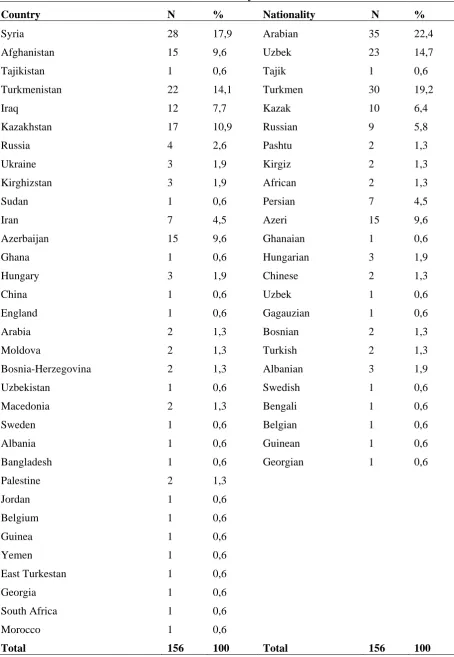
Table 2 shows the descriptive data regarding the countries participants have come from and their nationality.
Table 2. Descriptive Data Regarding Countries Participants Have Come From and Their Nationality
Country N % Nationality N %
Syria 28 17,9 Arabian 35 22,4
Afghanistan 15 9,6 Uzbek 23 14,7
Tajikistan 1 0,6 Tajik 1 0,6
Turkmenistan 22 14,1 Turkmen 30 19,2
Iraq 12 7,7 Kazak 10 6,4
Kazakhstan 17 10,9 Russian 9 5,8
Russia 4 2,6 Pashtu 2 1,3
Ukraine 3 1,9 Kirgiz 2 1,3
Kirghizstan 3 1,9 African 2 1,3
Sudan 1 0,6 Persian 7 4,5
Iran 7 4,5 Azeri 15 9,6
Azerbaijan 15 9,6 Ghanaian 1 0,6
Ghana 1 0,6 Hungarian 3 1,9
Hungary 3 1,9 Chinese 2 1,3
China 1 0,6 Uzbek 1 0,6
England 1 0,6 Gagauzian 1 0,6
Arabia 2 1,3 Bosnian 2 1,3
Moldova 2 1,3 Turkish 2 1,3
Bosnia-Herzegovina 2 1,3 Albanian 3 1,9
Uzbekistan 1 0,6 Swedish 1 0,6
Macedonia 2 1,3 Bengali 1 0,6
Sweden 1 0,6 Belgian 1 0,6
Albania 1 0,6 Guinean 1 0,6
Bangladesh 1 0,6 Georgian 1 0,6
Palestine 2 1,3
Jordan 1 0,6
Belgium 1 0,6
Guinea 1 0,6
Yemen 1 0,6
East Turkestan 1 0,6
Georgia 1 0,6
South Africa 1 0,6
Morocco 1 0,6
Total 156 100 Total 156 100
It is seen in Table 2 that % 17,9 of the participants learning Turkish as a foreign language at the universities mentioned above come from Syria, % 14,1 of them come from Turkmenistan, % 10,9 of them come from Kazakhstan; and of all the participants who have been learning Turkish as a foreign language % 22,4 were Arabian, % 19,2 were Turkmen, % 14,7 were Uzbek, % 9,6 were Azeri and % 6,4 were Kazak.
Data Collection Tools
To test students’ comprehension achievement in Turkish as a foreign language and their grammar achievement, achievement tests were developed in this study; and their achievement in these fields and the relationship between their achievements in these fields were examined. Following steps were followed in the development of achievement tests:
Learning outcomes in the mentioned fields were determined in parallel with B2 level specified in the Common European Framework of Reference for Languages. So the pilot form consisting 41 questions concerning reading comprehension, 31 questions concerning listening comprehension, and 52 questions concerning grammar was developed. Field experts' opinions were taken into consideration for the pilot form and the final forms were constructed in accordance with the experts’ suggestions.
Pilot form of the reading comprehension achievement test was administered to 140 students at B2 level learning Turkish at different universities, pilot form of the listening comprehension achievement test was administered to 151 students, and the pilot form of the grammar achievement test was administered to 134 students. After the pilot administration, Kuder Richardson (KR-20) reliability coefficient was calculated; items which had item discrimination index under 0,20 were removed from the test and the final form was constructed. Kuder-Richardson (KR-20) reliability coefficient was found to be 0,88 for the grammar achievement test; 0,94 for the listening comprehension achievement test; and 0,91 for the reading comprehension achievement test. Then achievement tests were administered to a total of 156 students learning Turkish as a foreign language at Marmara, Gazi, Mersin, Fırat, Uşak and Nevşehir Universities. Their comprehension achievement and grammar achievement and the relationship among them were examined.
FINDINGS
1. Findings Regarding Students’ Reading Comprehension, Listening Comprehension, and Grammar Achievements
Students’ reading comprehension, listening comprehension, and grammar achievements were shown in Table 4 who have been learning Turkish as a foreign language.
Table 3. Arithmetic Mean, Standard Deviation, and Variance Analyses Regarding Achievement Tests
Skill N 𝑥̅ Variance Sd.
Reading Test 32 22,53 43,85 6,62
Listening Test 27 20,10 52,86 7,27
Grammar 45 28,92 70,55 8,39
According to Table 3, % 60 of the students were successful at the reading comprehension test, % 70 were successful at the listening comprehension test, and % 60 were successful at the grammar test. This shows that the students learning Turkish as a foreign language succeeded at comprehension skills and grammar generally.
2. Findings Regarding the Relationship between Students’ Listening Comprehension Achievement and Reading Comprehension Achievement
Table 4. Relationship between Listening Comprehension and Reading Comprehension
Listening Reading
Listening 1 ,387**
Reading 1
p<0,01
Table 4 shows that there is a significant medium positive correlation between listening comprehension achievement and reading comprehension achievement, r=0,387, p<0,01. So it can be said that as listening comprehension achievement increases, the reading comprehension achievement increases accordingly. When determination coefficient r2=0,15 is taken into account, it can be said that % 15 of the total variance in reading skill originates from the listening skill.
3. Findings Regarding the Relationship between Students’ Grammar and Reading Comprehension Achievement
Table 5. The Relationship between Grammar and Reading Comprehension
Grammar Reading
Grammar 1 ,768**
Reading 1
p<0,01
Table 5 shows that there is a significant strong positive correlation between grammar and reading comprehension achievement, r=,768, p<0,01. So it can be said that as grammar achievement increases, the reading comprehension achievement increases accordingly. When determination coefficient r2=0,58 is taken into account, it can be said that % 58 of the total variance in reading skill originates from grammar. This finding asserts the argument of Audio-Lingual Method that there is a positive correlation between reading and grammar.
4. Findings Regarding the Relationship between Students’ Grammar Achievement and Listening Comprehension Achievement
Table 6. The Relationship between Grammar and Listening Comprehension
Grammar Listening
Grammar 1 ,409**
Listening 1
p<0,01
Table 6 shows that there is a significant medium positive correlation between grammar achievement and listening comprehension achievement, r=,409, p<0,01. So it can be said that as grammar achievement increases, listening comprehension achievement increases accordingly. When determination coefficient r2=0,16 is taken into account, it can be said that % 16 of the total variance in listening skill originates from grammar.
DISCUSSION AND CONCLUSION
Results of the study show that students learning Turkish as a foreign language are generally successful at comprehension skills and grammar. The medium positive correlation between listening and reading skills indicates that these skills support each other. Anderson ve Lynch’s (1988: 18) expression that good listeners are generally good readers supports this result. So paying attention to developing activities both for listening and reading skills can ensure students use Turkish better as a foreign language.
Also the result regarding the strong correlation between students’ grammar achievement and reading comprehension achievement presents an opposing evidence to the argument (Eken, 2011: 36; Tosun 2005: 26) concerning pushing grammar instruction out of the picture when compared to four language skills. This finding reveals the significance of grammar instruction in terms of its relationship with reading comprehension skill. The same situation occurs in terms of the relationship between grammar and listening comprehension achievement. The result regarding the significant medium positive correlation between grammar and listening comprehension indicates that both dimensions of the language support each other. Therefore, the necessity of not considering comprehension skills and grammar instruction apart and the importance of teaching comprehension skills and grammar instruction together and in a meaningful order was demonstrated in this study.
REFERENCES
AK, D. (2011). İkinci Dil Öğretim Kaynaklarında Yer Alan Anlama Etkinliklerinin Karşılaştırılması (Yeni Hitit ve New Headway Örneklemi). Unpublished Master Thesis, İstanbul: Marmara University, Institute of Educational Sciences.
ANDERSON, A. and LYNCH T. (1988). Listening, Language Teaching: A Scheme For Teacher Education. Oxford University Press.
BÜYÜKÖZTÜRK, Ş. vd., (2010). Bilimsel Araştırma Yöntemleri. Ankara: Pegem Akademi.
EKEN, D., T. (2011). Yabancı Dil Olarak Türkçe ve İngilizce Öğretiminde Temel Düzey Dinleme-Anlama Etkinliklerinin Karşılaştırılması. Unpublished Master Thesis, İstanbul: İstanbul University, Social Sciences Institute.
GRİFFİTHS, C. (2008). Lessons From Good Language Learners. Cambridge University Press. KARASAR, N. (2002). Bilimsel Araştırma Yöntemi. Nobel: Ankara.
KÖKSAL, D., and PESTİL, A., D. (2012). Yabancı Dil olarak Türkçe Konuşma Öğretimi. İçinde: Aziz Kılınç and Abdullah Şahin (Editors), Yabancı Dil Olarak Türkçe Öğretimi (YDTÖ). (Page: 213-234), Ankara: Pegem Akademi.
KÖSE, D. (2005). Avrupa Konseyi Yabancı Diller Ortak Başvuru Metni’ne Uygun Türkçe Öğretiminin Başarıya ve Tutuma Etkisi. Unpublished Doctoral Thesis, Ankara: Ankara University, Social Sciences Institute.
RUBIN, J. and THOMPSON, I. (1994). How To Be A More Successful Language Learner. Heinle &Heinle Publishers.
SEVİNDİ Z., E. (2012). Yabancıların Türkçe Öğrenme Yeterlilikleri. Unpublished Master Thesis, İzmir: Dokuz Eylül University, Institute of Educational Sciences.
SINGHAL, M. (2006). Teaching Reading to Adult Second Language Learners: Theoretical Foundations, Pedagogical Applications, and Current Issues. The Reading Matrix Inc.
TELC-MEB (2013). Diller için Avrupa Ortak Öneriler Çerçevesi – Öğrenim, Öğretim ve Değerlendirme. Frankfurt / Main, Germany: telc GmbH.
TOK, M. and YIGIN, M. (2013). Yabancı Uyruklu Öğrencilerin Türkçe Öğrenme Nedenlerine İlişkin Bir Durum Çalışması.Dil ve Edebiyat Eğitimi Dergisi, 8, 132-147.
TOSUN, C. (2005). Türkçenin Yabancı Dil Olarak Öğretilmesi, Journal of Language and Linguistic Studies, 2(1), 22.
AYDIN, Ö. (1999). İkinci Dil Olarak Türkçe Öğretiminde Türkçe Dilbilgisi Betimlemelerinin Görünümü. Çağdaş Türk Dili, 137, 33-41.
DÜZENLİ, S. (2008). Türkçede Ortaçlaştırma Belirticilerinin Öğretimine Yönelik Ders Malzemesi Hazırlama. Unpublished Master Thesis, İzmir: Dokuz Eylül University Institute of Educational Sciences.