Baghdad Science Journal
Vol.16 (Special Issue) 2019
DOI:http://dx.doi.org/10.21123/bsj.2019.16.2(SI).0485
Teen-Computer Interaction: Building a Conceptual Model with Thoughts-
Emotion-Behaviour
Mohd Rosidi Omar
1*Husniza Husni
2**Received 15/9/2018, Accepted 10/11/2018, Published 20/6/2019
This work is licensed under a Creative Commons Attribution 4.0 International License.
Abstract:
Teen-Computer Interaction (TeenCI) stands in an infant phase and emerging in positive path. Compared to Human-Computer Interaction (generally dedicated to adult) and Child-Computer Interaction, TeenCI gets less interest in terms of research efforts and publications. This has revealed extensive prospects for researchers to explore and contribute in the region of computer design and evaluation for teen, in specific. As a subclass of HCI and a complementary for CCI, TeenCI that tolerates teen group, should be taken significant concern in the sense of its context, nature, development, characteristics and architecture. This paper tends to discover teen’s emotion contribution as the first attempt towards building a conceptual model for TeenCI. Informal and in-person interview were conducted with two experts and a series of focus group discussion with 30 teens have also been conducted to gain their valuable insights. Interestingly, the findings suggest and lead us to considering the theory of psychosocial development towards a holistic model of TeenCI that considers not only emotion but three identifying keys – thoughts-emotion-behaviour. We justify that there is a strong connection between cognition and emotion that influences teen’s behaviour, which would be an important input to be included in TeenCI-related design and development.
Key words: Emotion In Adolescent, Interaction Design, Teen-Computer Interaction, Theory Of Psychosocial Development.
Introduction:
Emotions can be easily defined as states of feeling. Emotion may comprise feelings, thoughts, behaviours, cognitive responses and physically changes (1). (2) gave a definition to the term of emotion as a complex condition that aids several functions in human affairs and behaviour. After years of study, the number of basic emotions is lessen from eight by Robert Plutchik in 1997 into six in 1999 by Paul Ekman and the latest, as in 2014, where a group of Glasgow University researchers discovered that surprise and fear shared the same indication of eyes widely open, while disgust and anger shared a wrinkled nose. They proposed only four basic emotions comprises the noticeably distinct of gladness and grief, the grouped emotions of frighten and surprise and the grouped emotion of rage and disgust (3).
1 Kolej Poly-Tech MARA, Malaysia.
2 Universiti Utara Malaysia, Malaysia.
Corresponding authors: *[email protected] **[email protected]
In our recent study, we have identified that emotions are one of the critical identifying keys as decisive attributes of human’s growth. For that reason, we include emotion as one of the identifying keys into our Teen-Computer Interaction (TeenCI) model since teen’s emotions are poorly differentiated and hardly regulated, which means they are able to experience many emotions at the same time (4). This makes teen’s emotions a fascinating research subject.In this TeenCI study, we define the identifying keys as factors that enable the functionality of TeenCI.
evaluation when authorizing a blend of the children’s creative minds with the adults’ expressiveness. Thus, teen also has formed an enormous lucrative technology market share established on their population and their rising strength of expenditure (6). Having almost world’s one-fifth population, teen segmentation has shaped a massive and profitable marketplace (7).
The Teen-Computer Interaction term is fabricated in 2013 to value the contribution of teens in outlining and supporting the design and evaluation of technology for adult to-be generation. TeenCI remains in its newborn stage and develops in an optimistic, encouraging direction. Compared to HCI (meant for adult) and CCI (specifically meant for children), TeenCI obtains less attraction in terms of fundamental researches and publications (5,8,9). Towards a better understanding of teens for TeenCI modelling, this paper is thus attempt to discover teen’s emotion contribution to designing a TeenCI model as an identifying key factor that basically informs us on how emotion could help enlighten the design of a TeenCI model, guided by the theory of psychosocial development originally by Erik Erikson in 1968 as cited in Munley (10) and therefore suggests a conceptual model for TeenCI.
Emotion Recognition and Teen’s Emotion:
Recently, emotion recognition has turned into a significant preparatory study to distinguish human emotions by exploiting numerous forms of methodology. The exploration of emotion recognition has drawn much concern from various knowledge fields such as psychology, engineering, neuroscience, medical (11), and computer science. It is also an interdisciplinary research by attaining much knowledge in cognitive science, psychology, and also computer science (12). Somehow, only little knows that the research of emotion has started before 19th century by having Charles Darwin as the
leading recorded scientist to systematically study emotional expressions in 1872.
Recognizing emotions are analytically conflicting between fields of marketing, sociology, psychology, e-learning and information technology (13). On that cause, researchers have initiated their self-made tools to recognize emotions (14). According to (15) the main methods, which are widely used to measure emotions, are facial expressions, questionnaires, physiological inputs, speech inputs, and preference data. While, as affirmed by (16), (17) and (18) validate that teenager’s transitional developments need an interrelated reform of the person and the condition affecting cognition, emotion, behaviour, and relationship. In this matter, cognition, emotion, and
behaviour were utilized to measure person’s growth from childhood to adolescent and towards adulthood.
Amongst all emotion recognition techniques, classification has been created to categorize all these pioneered and accomplished techniques into four main channels, which are:
• Facial: Emotion recognition is measured by observing facial muscles changes such as smiling lips signifying joyfulness.
• Speech: Various emotion states are detected, possibly via various tone expressions of somebody’s voice by figuring the voice pitch or the strength of the speech signals.
• Physiological Signal of Autonomous Nervous System (ANS): Human organs resided on the face for example eyes and mouth are manipulated to feel or convey someone’s feeling.
• Body Gesture: Some exact emotions are expressed through certain body parts’ posture patterns and movements.
Teen inclines to present complexity in behavior and owns different personalities reflecting to situations. They have become to be risk-taker, sexually matured, and independent (19). Apart from that, (20) report teen has ability to exhibit high knowledge and skills of technology based on current rate of computer literacy. In contrast, teen is tremendously influenced by social modernization in teaching and learning activity, ethnic interval, mass media exposure, occupation, socioeconomic standing, family constitutions, geographical location, and nationality (7). Concluding all these indications, those are the characteristics that shape the identity, form the features and build up teen’s growth. For the sake of benefiting the HCI research, teen group have to be specifically concerned by viewing into all the characteristics, not only as an early adopter or appropriator but also as an essential contributor in technology design.
(21) comprehensively discusses in a specific section about thinking pattern changes, which significantly attributed to cognitive development of teen that may give an essential implication for TeenCI researchers along the whole process of teen’s application research and development. Changes in thinking pattern during adolescent also have improved emotional significance. Adolescent develop their abilities in:
hypothetical reasoning and deductive reasoning abilities.
• Abstract thinking: Adolescent builds their capability to think and argue concerning abstract conceptions including religion and issues of politic, moral, and social.
• Complex ways thinking: Thinking ability in multi-dimensional directions or multiple meanings and ability of complex thought such as sarcasm.
• Meta-thinking: Also known as metacognition; that is an ability of thinking about their own thinking. Adolescent are likely to believe that because of their own thinking process, other people are also thinking about themselves too. Being able to improve emotional significance through the changes occurred in thinking pattern makes teenagers interesting to work with for modelling a TeenCI as they can provide priceless insights into their behaviours, opinions, values, and attitudes (22). The changes that happen for teens at this age are the ones that set them apart from children and adults. As mentioned earlier, teen’s emotions are difficult to be differentiated and regulated because of the tendency to simultaneously feel many emotions. This finding of emotions differentiation tells that teen’s emotions are likely a rollercoaster, which goes up and down, shifting feelings in a very short time (4). It is agreed by (21) that teen’s cognitive capacity is still not sophisticated yet far distinct from children. Teen improves their ability of thinking in complex ways, abstract and logical over time, which also improve emotion’s self-regulation skill by managing distress and practicing mindfulness.
Teen-Computer Interaction:
TeenCI-concerned study explicitly includes a group of people within the age of 13–19 in the segment specification. This segment of youths is identified as teen because of their number of age ends with the expression "teen". They are purely distinctive, full of adrenaline, thrilling, and technology-equipped which prospectively to be exploited in collecting valuable insights and perceptions to craft future technology (22). This also pushes TeenCI research grows into challenging, rewarding (23) and worthwhile. Working with teen, initially we have to describe this group’s age scope and its characteristics. It is hard to classify and decide the age range of teen, since there are lots of justifications from many scholars. (19) specify the teen’s age is between 13 to 19 years old. In the meantime, (7) categorized teen into early teen and late teen, which are 10–14 years and 15–19 years respectively. (21) satisfies the ages of teen at
the range of 13 to 19 years old. But by some means, (24) limit teen’s age to be between of 12-17. Eventhough, among researchers have not commonly agreed and arguable from various perspectives towards the range of ages for teen but in this exact research purposes, the teen is termed as a community of young individuals at the age of 13 to 19 years old as mutually agreed by the majority says in CCI society.
TeenCI is refreshingly new subject to be learned. (23) has handed researchers with a remarkable prospect to expose new insights that may benefit HCI field, in general. The benefit can come in the kind of literature, as well as published items and research efforts, which would bring advantages to the entire community of HCI as replicating activities of researches in describing the TeenCI term itself, constructing new conceptual frameworks and methodologies to work with teens, and setting up computer requirement to satisfy all the teen’s needs. (23) also resolutely urge for novel solutions over stressing problems in teen’s worlds, as they are imaginative and innovative in the matter of adopting technology in their daily life. This demand has stimulated our interest to join existing HCI community to share thinking on approaches and research design as an action to appreciate the specific TeenCI’s body of knowledge as shown in Figure.1. This meaningful start-up is supposed to pool more researchers to work with TeenCI as many as the precedence of adult’s HCI and children’s CCI.
Figure 1. The position of TeenCI with respect to HCI and CCI (19).
Teen’s contribution in interaction design requires a specialized, unique work and classification, contrasts from CCI and HCI. Teen is a group of consumers that comes under a less-highlighted area because of least attention and little quantity of research in this arising (5,6). Teen is capable of offering richer and broader dimension designing technology and evaluating the technologies too as this age can be regarded to have a balanced mixture of children’s creative minds and adults’ expressiveness. As suggested by (19), a different method of interaction design specifically for teen, when they be certain of the existing HCI and CCI might not be suitable or wholly effectual to convey teen’s requirements. Also, teen is known for their complexity and diversity, which requires a cautious consideration in HCI study context (21). In addition, teens later will grow to become adults and thus constructive interactive insights can be collected for the purpose of designing future technology innovations.
Consequently, TeenCI is realized as the prospective area to be studied and improved further to realize such companion between the nation's generation of digital natives and machines, for a succeeding execution of the agenda. All these challenges hopefully could position TeenCI to be as high as HCI and CCI. Since TeenCI is still new in research area, we have not yet discovered any newly developed models or frameworks that visualize TeenCI as an agenda that also contribute for the development of application and computer system. Based on literature, we thus suggest five identifying keys that significantly have positive impact to build a firm foundation of TeenCI. Those keys are thoughts, emotions, behaviours, abilities, and needs. The identification and justification of the keys are thoroughly examined based on literature reviews and from expert’s suggestions throughout long discussions. The factors are carefully selected and ordered according to their importance and connectivity. But in this paper, we only discuss the first three keys in respect to their relationship in
activating cognition and emotion, which suits with this paper’s main objective.
Initially, we identified only four items in our early version of TeenCI model after we revealed the practicality of behaviour, emotion, needs, and abilities becoming as the identifying keys and the sequencing of items was as mentioned. This concept of identifying keys was originated from (25), which were utilized under CCI boundary. We were pleased to extend the proposed idea of ABC of CCI in that paper which comprises Activities, Behaviours and Concerns by improvising the keys to be applied in our TeenCI model with more appropriate determinants. This was where all our works started; as the aspiration and motivation for the development of our owned TeenCI model.
Methods and Materials:
Interview with experts
Table 1. A snippet of the fundamental questions asked during the interview with experts.
Basic Questions Probing Questions
1. What is your definition of adolescent or teenager? 1. Can you please elaborate more?
2. Do you think there is much difference between children and teenagers?
2. If yes, why and what would be the significant difference? If no, why?
3. Do you think there will be much difference also between teenager and adult?
3. If yes, why and what would be the significant difference? If no, why?
4. Do you think there is a need for a specific computer interaction for teenager?
4. Why do you say so?
5. What is your comment, if I say “Behaviours, Emotions, Needs, and Abilities” are able to influence adult, teenager, and children. In what sense can they give influence to these groups of people?
5. Can you explain further? Why is that [based on the answer given]?
The two sessions were recorded and notes were also taken during the sessions to probe deeper. The content analysis approach was used for analysing the interview data where it involves examination of the transcript of the interviews for triggering elements that could be of significant to the concept of TeenCI, such as emotion and cognition that could lead to serious consideration when designing a digital archetype with teens as its main users. Transcripts are produced and read carefully while performing coding. The coding leads to very interesting findings as discussed quite significantly in the next section.
Interview with focus group
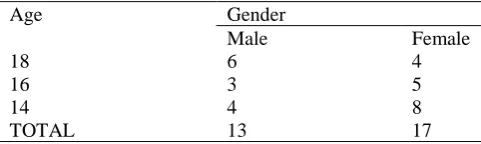
To probe deeper, we also conducted six interview sessions with teenagers to acquire thick and rich insights and saturated views from this under-study subject. There were 30 interviewees chosen within the range of 13 – 19 years old school and college students. The summary of age distribution and gender is shown in Table 2. As suggested by (27), we applied these eight principles taken from (28) to prepare an effective qualitative interview and maintained participants focus so that, greatest possible benefits could be gained which include these elements: 1) select a space and adequate time with minimal interruption; 2) brief the participants on objectives and aims of the interview; 3) explain that the interview is confidential and the interviewer keep the secrecy of interview’s content; 4) inform the interview’s format to the participants; 5) specify the duration of the interview session; 6) share with the participants our contact numbers and mediums if they want to communicate in future; 7) give chance to the participants to ask questions before the interview starts; 8) record the session either audio or video and take notes all the answers from our participants. Six groups of 3 to 6 participants were questioned in three different days. Our participants from secondary school were interviewed at two different
locations; 4 groups in preparatory room at a computer laboratory and a group in discussion room at the school’s library. The interview sessions were managed to be completed in two days. While, the only group from college was interviewed at the college’s library lobby.
Table 2. The age distribution and gender.
Age Gender
Male Female
18 6 4
16 3 5
14 4 8
TOTAL 13 17
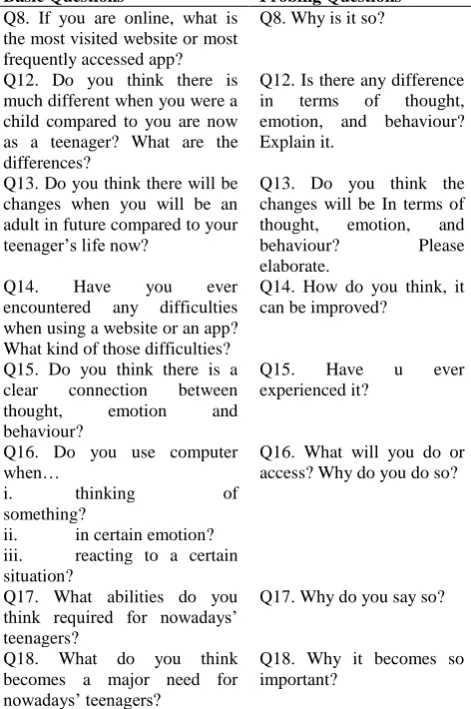
Table 3. A snippet of the questions from focus group.
Basic Questions Probing Questions
Q8. If you are online, what is the most visited website or most frequently accessed app?
Q8. Why is it so?
Q12. Do you think there is much different when you were a child compared to you are now as a teenager? What are the differences?
Q12. Is there any difference in terms of thought, emotion, and behaviour? Explain it.
Q13. Do you think there will be changes when you will be an adult in future compared to your teenager’s life now?
Q13. Do you think the changes will be In terms of thought, emotion, and behaviour? Please elaborate.
Q14. Have you ever encountered any difficulties when using a website or an app? What kind of those difficulties?
Q14. How do you think, it can be improved?
Q15. Do you think there is a clear connection between thought, emotion and behaviour?
Q15. Have u ever experienced it?
Q16. Do you use computer when…
i. thinking of
something?
ii. in certain emotion? iii. reacting to a certain situation?
Q16. What will you do or access? Why do you do so?
Q17. What abilities do you think required for nowadays’ teenagers?
Q17. Why do you say so?
Q18. What do you think becomes a major need for nowadays’ teenagers?
Q18. Why it becomes so important?
Finding and Discussion:
During an educational brainstorm session from an in-person informal interview with a local psychiatrist, Expert A, the whole idea is connecting thoughts, emotions, and behaviours. He proposed the theory of psychosocial development by Erik Erikson in 1959 to be referred to (see Table 4), where he said the teenagers according to earlier definition and age range will be facing Stage 5: Identity vs. Role Confusion and Stage 6: Intimacy vs. Isolation crises. He also added, a failure in one stage will be prolonged to the next stage as an incomplete task in the previous stage. This unsuccessful task will end up with depression, anxiousness, aggression, irritable, and other negative feelings. But a successful journey through every single stage will possess among others self-confident, high self-esteem, leading characteristics, and happiness. Towards the end of the conversation during the interview session, the expert asserted that on top of biology process should come the thoughts because according to him, thoughts will transpire emotion and that is followed by or translated to
behaviour. He believes that the brain is the most precious organ in human anatomy that controls human’s physical and mental.
Table 4. Stages in Psychosocial Development Theory by Erik Erikson
adapted from McLeod (34).
Stage Crisis Basic Virtue Age
1 Trust vs. Mistrust Hope 0 - 1½ 2 Autonomy vs. Shame Will 1½ - 3 3 Initiative vs. Guilt Purpose 3 – 5 4 Industry vs. Inferiority Competency 5 – 12 5 Identity vs. Role
Confusion
Fidelity 12 – 18
6 Intimacy vs. Isolation Love 18 – 40 7 Generativity vs.
Stagnation
Care 40 – 65
8 Ego Integrity vs. Despair
Wisdom 65+
Expert B then supports this theory with the introductory explanation to the concept of cognition and motivation. He preferred to include cognition as the initial process of brain generating ideas and thoughts where McClelland’s 1960s theory of needs (also popular by the name of Three Needs Theory) has been used as a reference. He urged the importance of human’s need to be fulfilled according to these classes of achievement, affiliation, and power. Expert B also suggested the method to measure the brain’s efficiency by analyzing brain’s thinking tendency, creativity or intelligent quotient (IQ). For this purpose, an example of tool recommended is NASA’s Task Load Index questionnaire.
Figure 2. Thoughts-emotions-behaviours as related identifying keys for TeenCI.
To show how cognition triggers thoughts to influence other factors, we should return to the basic of cognition itself where it starts. Cognition is the outcome of mind’s or mental’s inactivity or processes connecting to the entry and keeping information by getting knowledge and comprehending through thought, past experience, and the feels (35,36). Since 1980s, cognition and emotion have been extensively researched, huge literature grew more significantly, separately, and exploding (37,38). (39) clarify that using emotion in computer field has become progressively significant especially in HCI because of emotion recognition offers effective interaction with computers in these three ways: 1) computers can potentially take appropriate courses of action if the computers are able to understand users’ emotions; 2) HCI is generally social; and 3) as an improvement to effectiveness of communication by adding gestures or use of speech. (40) rediscovers that psychologists viewed emotions as the products of cognitive processes. The response of emotion is stimulated by human’s evaluative intuition by a complex cognitive judgment of the importance of events to a human. The maximum experience of emotion in normal situation comprises of these three compound components – thoughts, impulses of action, and somatic disruptions. This means, emotions are derived from a thought, which is resided at the top of the biological process.
To further analyse the initial yet interesting findings from the two experts, our focus group sessions with some selected teenagers discover that their thoughts and emotions did reflected in the discussion. They are keen to socialize by spending their online time with apps such as WhatsApp, Instagram, and WeChat. 22 out of 30 participants use WhatsApp most frequently to communicate with friends and families and disseminate information. This is consistent with what teenagers need and their required abilities, where more than half of the participants said they need technology to get connected and practicing social abilities by engaging communication and public relationship
with friends and close relatives. It seems to fit the stage 6: Intimacy vs. Isolation of psychosocial development theory where teenagers start to build an intimate relationship with opposite gender. Besides that, we managed to recognize elements of thought, emotion, and behaviour in both Q12 and Q13 (refer Table 3). For Q14, we identified that these teenagers had problems with some websites and apps such in Twitter, Waze, Instagram, WhatsApp and School Examination Analysis System website (Ministry of Education Malaysia application’s for school examination results viewing) in terms of user interface, usability, and computer physical issues such as network and hardware specifications. Focusing on thought, emotion, and behaviour, we did ask about Q15 to see if there was a significant connection by example between thought, emotion and behaviour and found that 2/3 of the participants agreed and some provided with their own experiences. Being related to Q15 and Q16 extends the finding to the computer usage. Nineteen participants had transpired their thought, emotion, and behaviour to the computer usage by accessing Youtube, posting status on social media, listening music on iTunes, playing online game and share it with friends via WhatsApp. Specifically Q17 questioned about what required abilities for them. Surprisingly, they listed social and communication skills on top, then followed by technology skills, self-organization and time management. While, for Q18 the participants listed smartphone and computer as the most needed, then came money, knowledge, and lastly self-discipline.
Fascinatingly, we also found out that teenagers spend lot of their time online at the average of 9 hours a day. One in many reasons why teenagers are online is to get connected. By getting connected, teenagers meet their friends virtually to do activities together such as chatting or playing online games. The more time teenagers spend time together, the more they get to know each other and establish closeness. This can possibly bring to a serious relationship as mentioned in stage 6 of psychosocial development theory. That is the importance of time management skill to be taught at these ages so that they will not waste their time doing unbeneficial activities. Despite, undoubtedly, they do understand their roles in society as the next generation to lead the country in future and thus they do realize what they need to equip themselves with the quality to become future leaders. From this we can conclude that being teens they do think of their future and trying to fulfil their roles in society. Whether or not thoughts (cognition) or emotions are being
Behaviours Emotions
primarily used in their daily lives remain a mystery as these two keys are very much unconsciously used when it comes to making daily decisions or just filling their roles in society. Restating agreement on Q15, teenagers obviously could possibly link up what they have in their mind with the emotion that they may portray.
The argument of which one comes first between cognition and emotion has been unresolved since no mutual agreement whether cognitive conditions precede emotion or whether we think first, then we feel and vice versa (37). But earlier, according to (40) thought and feelings are simultaneous, as he believes thought is an essential state of emotion. Emotion also said to have influence on human’s decision making, where discrepancies in human’s behaviors and form of senseless behaviors are
explained when emotions are involved (41,42). Cognition, as emphasized by (43) signifies to controlled processes such as memory, language, problem solving, attention and planning. He states that in the domain of emotion, amygdala is popularly exampled, while in the cognition case is lateral prefrontal cortex. Both of these cognitive-emotional are interacted at high point connectivity brain regions, known as hubs, which are crucial for controlling the information’s stream and assimilation between areas. This shows that cognition and emotion system interact in important manner and (43) proposed that this strong interaction is not only in brain, but also often integrated as both of cognition and emotion jointly be a factor to behavior.
Figure 3. Theory of psychosocial development leading to Emotional Design in the perspective of Teen CI.
Based from the above finding and discussion, a justification can be disclosed to show the relationship between these three key factors of thought, emotion, and behaviour in our model of TeenCI (see Figure. 3). This finding has shed the light onto the path to embrace emotional design (44) when designing digital archetypes targeted for teens, for a better design, more beneficial, and maximum positive experience. Taking into consideration the three identifying keys for teens, the technology design for teens should be based on the visceral, behavioral, and reflective levels. For example, if we are to design an online learning site for teens to cater for the 21st century learning, the
affect behavior. With the teens’ complex emotion roller coaster, the visceral aspect seems very important as it can set good thought (first impression) that will later trigger the other two identifying keys – emotion and behaviour. And thus, we propose to have the three identifying keys as interrelated elements in our TeenCI conceptual model, apart from teen’s needs and abilities, and using stage 5 and part of stage 6 of the psychosocial development theory as foundation for the identifying keys.
Conclusion:
For the past 30 years, HCI field has concentrated only on requirements and specifications drawn from adult community only. Recent development of research and design in software and application suggests the need of segmentation to detail out the specifications into certain age groups, hence the already known segment, CCI and now TeenCI started to emerge from the field. TeenCI is a newly emerging area of study that offers great opportunities to be explored and new challenges to be discovered. Teen community is fascinating to study since they are interesting subjects, technologically-literate, multi-dimension, and fast-learning entities. They have become a popular classification of ages to segment the product in the gigantic marketplace as they share almost 20% of the world’s population.
As suggested by the experts, emotion and thought are decided to be included as the key factor in constructing TeenCI model, along with behaviour (as the output of thoughts-emotions), ability, and need. Emotion is a compulsory characteristic of a human. No human identifies to have no emotion because of the automatic function of the brain as same as respiratory system. Emotion is closely related to brain’s activities. Both emotion and cognition has significant effect on human’s behaviour. Transition of growth from children span to adult has to pass through this period of teen’s boundary. Teen’s emotion is growing to prepare them to leave childhood, which is full with fun and playing before they arrive to adulthood, which is filled with responsibility and commitment. More research and publication are anticipated to be delivered in appreciating this part of UX field. Such contributions expect TeenCI researchers to consider these few suggestions (21): 1) examining the teenager’s autonomy; 2) examining researchers’ own position; and 3) seeking to be clear.
In addition, Norman (44)’s emotional design has already emphasized the three distinctive levels of brain involves visceral, behavioural and
reflective parts which explain how human’s brain sees things differently as far as design is concerned. This is comprehended that we are now giving a novel description of human’s brain processing by stating these: behavioural levels are referred to behaviours, visceral levels are referred to thoughts and reflective levels are referred to emotions. We believe by adding these interesting points, we are able to attract more future works to jointly appreciate the emergence of TeenCI field.
Conflicts of Interest: None.
References:
1. Agrafioti F, Hatzinakos D, Anderson AK. ECG pattern analysis for emotion detection. IEEE Transactions on affective computing. 2011 Aug 25;3(1):102-15.
2. Hockenbury DH, Hockenbury SE. Discovering psychology. Macmillan; 2010 Jan 27.
3. BBC. All human behaviour can be reduced to 'four basic emotions'. BBC News [Internet]. 2014 Feb 3 [cited 2018 Mar 7]. Available from:
http://www.bbc.com/news/uk-scotland-glasgow-west-26019586.
4. McConchie, J. What Do Teens’ Emotions Fee Like?: Greater Good Magazine [Internet] 2018 July 24 [Cited 2018 Sep 13]. Available from: https://greatergood.berkeley.edu/article/item/what_d o_teens_emotions_feel_like
5. Fitton, D., Bell, B., Read, J. C., Iversen, O., Little, L., & Horton, M. Understanding Teen UX : Building a Bridge to the Future. CHI 2014. 2014 (pp. 79-82). ACM.
6. Fitton D, Bell B. Working with teenagers within HCI research: understanding teen-computer interaction. In Proceedings of the 28th International BCS Human Computer Interaction Conference on HCI 2014-Sand, Sea and Sky-Holiday HCI 2014 Sep 9 (pp. 201-206). BCS.
7. Poole ES, Peyton T. Interaction design research with adolescents: methodological challenges and best practices. In Proceedings of the 12th International Conference on Interaction Design and Children 2013 Jun 24 (pp. 211-217). ACM.
8. Bailey CM, Seals CD. Evaluation of Web Usability Guidelines for Teens. In Proceedings of the SouthEast Conference 2017 Apr 13 (pp. 50-54). ACM.
9. Bonsignore E, Hansen D, Pellicone A, Ahn J, Kraus
11. Cohen I, Garg A, Huang TS. Emotion recognition from facial expressions using multilevel HMM. InNeural information processing systems, 2000 Nov (Vol. 2).
12. Mikhail M, El-Ayat K, El Kaliouby R, Coan J, Allen
JJ. Emotion detection using noisy EEG data. InProceedings of the 1st Augmented Human International Conference 2010 Apr 2 (p. 7). ACM. 13. Terzis V, Moridis CN, Economides AA. Measuring
instant emotions based on facial expressions during computer-based assessment. Personal and ubiquitous computing. 2013 Jan 1;17(1):43-52.
14. Zaman B, Shrimpton-Smith T. The FaceReader:
Measuring instant fun of use. InProceedings of the
4th Nordic conference on Human-computer
interaction: changing roles 2006 Oct 14 (pp. 457-460). ACM.
15. Moridis CN, Economides AA. Toward
computer-aided affective learning systems: a literature review. Journal of Educational Computing Research. 2008 Dec;39(4):313-37..
16. Curtis AC. Defining adolescence. Journal of
Adolescent and Family Health. 2015;7(2):2. 17. Graber JA, Brooks-Gunn J. Transitions and turning
points: Navigating the passage from childhood through adolescence. Developmental psychology. 1996 Jul;32(4):768.
18. Lerner RM, Castellino DR. Contemporary
developmental theory and adolescence:
Developmental systems and applied developmental science. Journal of adolescent health. 2002 Dec 1;31(6):122-35.
19. Fitton D, Read JC, Horton M. The challenge of working with teens as participants in interaction design. InCHI'13 Extended Abstracts on Human Factors in Computing Systems 2013 Apr 27 (pp. 205-210). ACM.
20. Agosto DE, Magee RM, Dickard M, Forte A. Teens,
technology, and libraries: An uncertain relationship. The Library Quarterly. 2016 Jul 1;86(3):248-69. 21. Bell, B. T. Understanding Adolescents. In L. Little,
D. Fitton, B. T. Bell, & N. Toth, Perspective on HCI Research with Teenagers. 2015 (pp. 11-27). York: Springer International Publishing.
22. Fitton D, Little L, Bell BT. Introduction: HCI Reaches Adolescence. In Perspectives on HCI Research with Teenagers 2016 (pp. 1-9). Springer, 23. Cham.Read, J. C., & Horton, M. Future Direction for
Quality TeenCI Research. In L. Little, D. Fitton, B. T. Bell, N. Toth, D. Tan, & J. Vanderdonckt (Eds.), Perspective on HCI Research with Teenagers, 2016 (pp. 269-278). Switzerland: Springer International Publishing.
24. Manago AM, Vaughn L. Social media, friendship, and happiness in the millennial generation. InFriendship and happiness 2015 (pp. 187-206). Springer,
25. Dordrecht. Dordrecht.Read, J. The ABC of CCI
(Child Computer Interaction). Interfaces, 2005 (62) , 8-9. (L. Cowen, Ed.) UK: British HCI Group.
26. Rowley J. Conducting research interviews.
Management Research Review. 2012 Mar
23;35(3/4):260-71.
27. Carter M. General guidelines for conducting
interviews. Retrieved March. 1999;20:2013. from
http://managementhelp.org/evaluatn/intrview.html
28. Turner III DW. Qualitative interview design: A practical guide for novice investigators. The qualitative report. 2010;15(3):754-60.
29. Gill P, Stewart K, Treasure E, Chadwick B. Methods of data collection in qualitative research: interviews and focus groups. British dental journal. 2008 Mar;204(6):291.
30. Boddy CR. Sample size for qualitative research. Qualitative Market Research: An International Journal. 2016 Sep 12;19(4):426-32.
31. Marshall B, Cardon P, Poddar A, Fontenot R. Does sample size matter in qualitative research?: A review of qualitative interviews in IS research. Journal of
Computer Information Systems. 2013 Sep
1;54(1):11-22.
32. Mason M. Sample size and saturation in PhD studies
using qualitative interviews. InForum qualitative Sozialforschung/Forum: qualitative social research 2010 Aug 24 (Vol. 11, No. 3).=.
33. Anderson M, Jiang J. Teens, social media & technology 2018 [Internet]. Retrieved from Pew Research Center website: http://www. pewinternet. org/2018/05/31/teens-social-media-technology-2018. 2018 May.
34. McLeod, S. Erik Erikson's Stages of Psychosocial Development. [Internet] [Cited at 2018 Nov. 12]
Available from: Simply Psychology:
https://www.simplypsychology.org/Erik-Erikson.html;
35. Cambridge Cognition Ltd. What is Cognition.
[Internet] 2015 Aug 19[Cited at 2018 Aug 29]
Available from :
http://www.cambridgecognition.com/blog/entry/wha t-is-cognition
36. Rasekhi A. The Study of Factors Affecting the Creation of Cognition Based on Power-Knowledge Point of View. Open Journal of Philosophy. 2016 Jan 20;6(01):36.
37. De Houwer J, Hermans D. Do feelings have a mind
of their own?. InCognition and Emotion 2010 May 9 (pp. 48-75). Psychology Press
38. Lin IY. Evaluating a servicescape: the effect of cognition and emotion. International Journal of Hospitality Management. 2004 Jun 1;23(2):163-78.
39. Haag A, Goronzy S, Schaich P, Williams J. Emotion
recognition using bio-sensors: First steps towards an automatic system. InTutorial and research workshop on affective dialogue systems 2004 Jun 14 (pp. 36-48). Springer, Berlin, Heidelberg.
40. Lazarus RS. Thoughts on the relations between
emotion and cognition. American psychologist. 1982 Sep;37(9): pp. 1019-1024.
Cognition and Emotion. Journal of Economic Perspectives. 2005 Dec 19(4), 3-24.
42. Schwarz N. Emotion, cognition, and decision
making. Cognition & Emotion. 2000 Jul
1;14(4):433-40.
43. Pessoa L. On the relationship between emotion and cognition. Nature reviews neuroscience. 2008 Feb;9(2):148.
44. Norman DA. Emotional design: Why we love (or
hate) everyday things. Basic Civitas Books; 2004.
راكفلأا عم يميهافم جذومن ءانب :رتويبمكلاو نيقهارملا نيب لعافتلا
-يفطاعلا كولسلا
رمع يديزور دمحم
1ينسح ازينسح
21
ايزيلام , ارام كت يلوب ةيلك
2
ايزيلام , اراتوا ةعماج
:ةصلاخلا
لعافتلا لثمي( رتويبموكلاو قهارملا نيب
(TeenCI
بوساحلاو ناسنلاا نيب لعافتلاب ةنراقم بجوم راسمب رهظيو ةركبم ةلحرم
نإف ، بوساحلاو لافطلأا نيب لعافتلاو )نيغلابلل ماع لكشب سركم(
TeenCI
دقو .تاروشنملاو ثحبلا دوهجب قلعتي اميف لقأ مامتهاب ىظحت
ف اهرابتعاب .ديدحتلا هجو ىلع ، نيقهارملا مييقتو رتويبمكلا ميمصت لاجم يف ةمهاسملاو فاشكتسلا نيثحابلل ةعساو تلاامتحا نع اذه فشك ةئ
نم ةيعرف
HCI
ـل ةيليمكتو
CCI
ذخؤت نأ بجي ،
TeenCI
ةعومجم عم حماستت يتلا اهتعيبطو اهقايس ىنعمب ريبك مامتهاب ، نيقهارملا
ذومن ءانب وحن ىلولأا ةلواحملا اهرابتعاب نيقهارملا ةفطاع ةمهاسم فاشتكا ىلإ ثحبلا اذه ليمي .ةيرامعملا اهتسدنهو اهصئاصخو اهروطتو ج
ـل يميهافم
TeenCI
.
تيرجأ امك ، ءاربخلا نم نينثا عم ةيصخشو ةيمسر ريغ ةلباقم تيرجأ عم زيكرتلا ةعومجم تاشقانم نم ةلسلس
30 نيقهارملا نم
يسفنلا روطتلا ةيرظن يف رظنلا ىلإ اندوقتو ريشت جئاتنلا نأ مامتهلال ريثملا نمو .ةميقلا مهراكفأ باستكلا
ـل يلك جذومن وحن يعامتجلاا
TeenCI
يوهلا ديدحتل حيتافم ةثلاث اًضيأ لب ، بسحف ةفطاعلا رابتعلاا يف ذخأي لاة -.كولسلاو ةفطاعلاو راكفلأا
يف اهنيمضت بجي ةمهم تلاخدم ةباثمب نوكتس يتلاو ، نيقهارملا كولس ىلع رثؤت يتلا ةفطاعلاو كاردلإا نيب ةيوق ةقلاع دوجو رربن نحن ريوطتو ميمصت
TeenCI
.
:ةيحاتفملا تاملكلا
روطتلا ةيرظن ، لعافتلا ميمصت ، بوساحلاو نيقهارملا نيب لعافتلا يسفنلا