Page 38
SYSTEMATIZATION OF THE METHOD OF PROJECT MANAGEMENT FOR EDUCATION IN UNIVERSITY
Masahisa Shinoda, Keita Nishioka, Akiomi Mishima
Mathematics and Science Education Research Center, Kanazawa Institute of Technology, 7-1, Ohgigaoka, Nonoichi, Ishikawa 921-8501 Japan
Abstract
Improvement and investigation about a quality of both product and process of each project in university is introduced. Project subjects are proposed and proceeded by students. The progress of each project is checked and managed regularly by teaching staff. The method of project management well known as PMBOK (Project Management Body of Knowledge), that is widely used in business world, is tried to apply into the projects to improve these quality of both product and process. From these activities, the attempt to construct and systematize the method of project management that is optimum for education in university is described.
Key words: project management, coaching, project activities, design, manufacturing, PMBOK
1. INTRODUCTION
Kanazawa Institute of Technology (KIT) has a wide variety of facilities and unique environment to support project activities which are performed by students. Total number of project activities that are recognized officially at KIT is over 80. Manufacturing a robot and a hand aircraft aiming at contests are the typical examples. Professors and lecturers belonging to KIT are making various efforts to improve these project activities (Kamata et al. 2017, Sentoku et al. 2015 & 2016, Tarumi, Marui, & Mika 2015). Similar projects and these analysis are also performed in other universities (Kubo 2014, Pan & Kubo 2014).
The project based on fundamental science and engineering, which is one of the officially recognized projects at KIT is managed by the authors. In this project, the students propose project subjects individually. Next, the students and teaching staff verify the principle of the proposed subjects from the standpoints of mathematics, physics, engineering, electronics, software programing, production, and so on. After that, the students start to manufacture their products of project subjects. Here, the teaching staff means the authors of this paper.
We, the authors, are studying how to improve the quality of both a process and a product through each project activity. The first author of this paper, Shinoda, moved to KIT from the electric company in 2015. He has a wide variety of experiences about designing and manufacturing electric appliances, for examples, DVD player/recorder, Blu-ray player/recorder, and liquid crystal displays. He has been also certified as the PMP (Project Management Professional) by the Project Management Institute (PMI) since 2007. With these points as backgrounds, we are tackling with the projects based on fundamental science and engineering to improve the quality of both the product and the process of each project by applying the well-known method of project management (Shinoda 2017). This method was established and published as “A guide to the project management body of knowledge”, so called as “PMBOK GUIDE” (Project Management Institute 2013).
Our final goal is to systematize the method of the project management that is optimum for education in university by 2019.
Page 39
2. BRIEF INTRODUCTION ABOUT PROJECT MANAGEMENT BODY OF KNOWLEDGE (PMBOK GUIDE)
PMBOK GUIDE describes the method how to proceed with projects to success, and is recognized practically as the world standard for a wide variety of projects in the business world. The first edition was published in 1996 and the current version is the fifth edition published in 2013. PMBOK GUIDE defines 47 processes of the project, here, the process means a procedure or a treatment which is a necessary action in the project activities. All processes are divided into five process groups and ten knowledge areas.
Five process groups are as follows: • Initiating process group, • Planning process group, • Executing process group,
• Monitoring and Controlling process group, and • Closing process group.
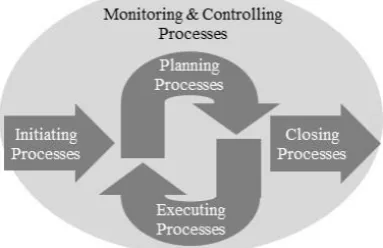
The relationship among the five process groups is schematically shown in Fig. 1. The project starts according to the initiating processes, then, is planned according to the planning processes and is executed according to the executing processes. When a final product is completed or cancelled, the project is finalized according to the closing processes. The monitoring and controlling processes affect the other processes to investigate and improve the quality of both the process and the product.
Fig. 1. Schematic diagram of the relationship among five process groups. (This figure is re-drawn by the authors according to PMBOK GUIDE.)
The knowledge areas including essential processes to achieve the project management are classified into to ten management groups as follows:
• Project integration management, • Project scope management, • Project time management, • Project cost management, • Project quality management,
Page 40 • Project procurement management, and
• Project stakeholder management.
Using these five process groups and ten knowledge areas, 47 processes are defined at cells somewhere on the two-dimensional map, in which the process groups are placed on the horizontal columns and the knowledge areas are placed on the vertical ones. In this paper, we do not mention the contents of 47 processes.
In order to construct and systematize the method of the project management for education, our policy is that 47 processes defined by PMBOK GUIDE will not be always necessary from an educational standpoint. The reasons of this policy are the followings.
(1) The students involved in the project are beginners.
(2) The students should be conscious of necessary processes, because they cannot be involved the whole project activities within the limited project term. This means that some processes should be treated by only teaching staff instead of the students.
3. PROJECT ACTIVITIES
3.1. Brief introduction of the project activities
We are organizing the project based on fundamental science, engineering, and manufacturing. The students, who are interested in mathematics, physics, mechanics, electric engineering, electronics, production, and so on, join this project. This project is not applied the university’s credit.
3.2. Management method of projects
Page 41
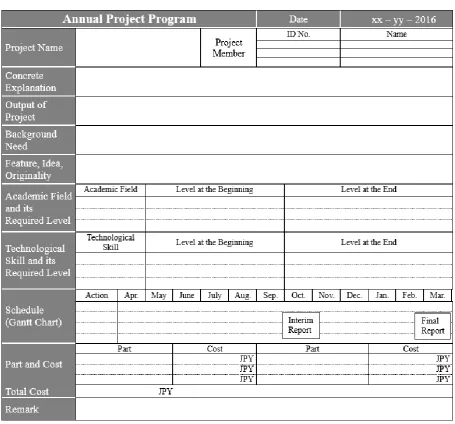
Fig. 2. Example of the annual project program sheet.
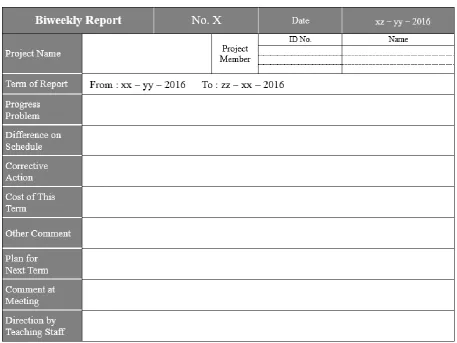
After starting the projects, the students have to report biweekly their progress and problems if happened using the sheet as shown in Fig. 3. In this sheet, items such as “time”, ”cost”, ”risk”, ”procurement” of ten knowledge areas, and a column for teachers’ direction or advise are implicated.
Page 42
Fig. 3. Example of the biweekly report sheet.
3.3. Analysis of project activities in 2016
Eleven project activities were performed by sixteen project students in 2016. The classification of the subjects were the followings.
• To solve problems around students’ life : 4 projects • To pursue hobbies or skills deeply : 6 projects
• To prepare future special study : 1 project
Most of the students chose and performed the subject of the project individually.
At the end of the project term, the results of all projects were presented by students at the public hearing as the final report meeting. Regrettably, seven projects had not completed their products. The reason of incompletion is analyzed in the next section.
3.4. Relationship between the two-dimensional map by PMBOK GUIDE and project members’ actions
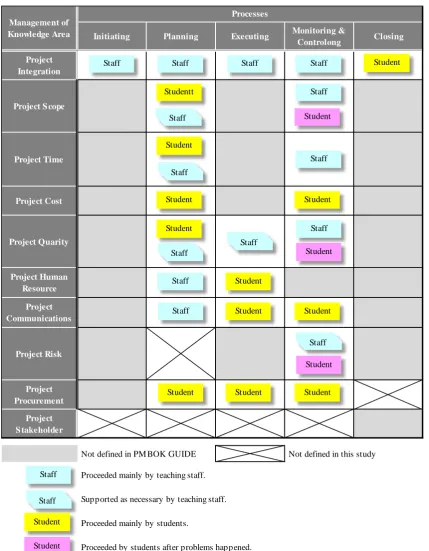
The two-dimensional map, in which the process groups are placed on the horizontal columns and the knowledge areas are placed on the vertical ones, is defined by PMBOK GUIDE. All of 47 processes are located at appropriate cells on this map. Here, we tried to specify project members’ actions instead of 47 process items on this map. The project members’ actions were classified into four types as follows: (1) actions proceeded mainly by teaching staff,
Page 43 (3) actions proceeded mainly by students, and
(4) actions proceeded by students after problems happened.
Figure 4 shows the two-dimensional map on which the above four actions are specified into appropriate cells. We would like to extract the essential points from Fig. 4.
Fig. 4. Relationship between the two-dimensional map and project members’ actions.
Initiating Planning Executing Monitoring &
Controlong Closing
Project Integration
Project S cope
Project Time Project Cost Project Quarity Project Human Resource Project Communications Project Risk Project Procurement Project S takeholder
Not defined in PM BOK GUIDE Not defined in this study
Proceeded mainly by teaching staff.
Supported as necessary by teaching staff.
Proceeded mainly by students.
Page 44
Regarding the process groups, the project activities were performed as follows.
• The initiating process was conducted by only teaching staff, because this process was very important so that the purpose and significance of the project were officially declared. After this process, each project was started by the project students.
• As for the planning and executing processes, the project students proceeded with each management items mainly by themselves.
• As for the monitoring and controlling processes, teaching staff basically proceeded with these processes. Since all project students were beginners for projects, teaching staff should propose corrective actions if there was anxiety that the quality of both the product and the process was getting worse than those were originally planned.
• As for the closing process, all students reported the results of their activities and products at the final report meeting.
In the same manner, the project activities were performed regarding the management of knowledge areas as follows.
• The project integration was proceeded by only teaching staff in all process groups except the closing process.
• As for the project scope and project quality, the project students proceeded mainly with their subjects first and teaching staff supported as necessary in the planning process. In the monitoring and controlling processes, once problem happened, students modified their activities by themselves or according to ideas of teaching staff or other students.
• As for the project time, this means the schedule. The project students planed their projects in the planning process and performed according to their plans. In the monitoring and controlling processes, teaching staff monitored whether the projects were on schedule. If not, teaching staff managed to keep the schedule or to advise corrective actions.
• As for the project cost, teaching staff did not manage this area, because unfortunately, our projects is organized without an official budget.
• As for the project human resource and project communications, teaching staff managed these areas in planning process, however, the project students managed in other processes.
• As for the project risk, teaching staff and the students jointly managed if any serious problems happened.
There were some cells which were not defined in the project activities by the students or teaching staff to simplify the management intentionally.
Page 45
4. RESULTS OF THE QUESTIONNAIRE BY STUDENTS
We conducted a questionnaire on the project students at the end of the project term. Here, six questions as follows and these answers are introduced.
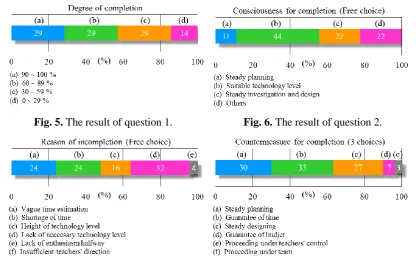
1) How degree of completion was your product? 2) What was your consciousness for completion? 3) Why was your product incomplete?
4) What was your countermeasure for completion?
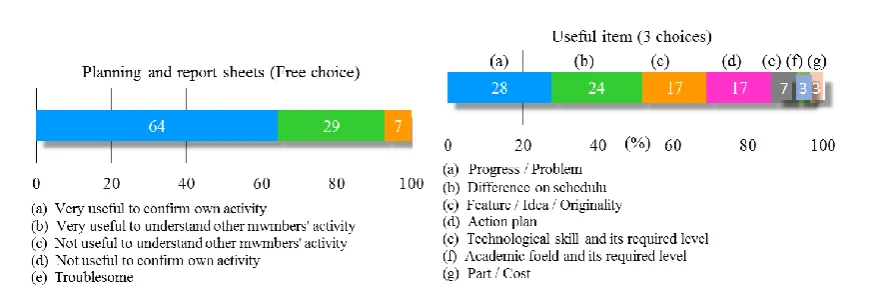
5) How did you think of the sheets for the annual project program and the biweekly report? 6) What were useful items in these sheets?
Figures 5-8 show the results of the above questions 1-4. Summarizing the results from these figures, most of the projects had not completed during the project term (Fig. 5). The most important point to succeed the project was that students could manufacture products within their own skills already acquired (Fig. 6). In other words, some of them had not make great efforts to reach their goals by acquiring higher skills or knowledge. From Fig. 7, academic or technology level was one of big factors for the students to complete their products, and the other big factor was time. This means that most of the students could not manage their own schedule properly. From Fig. 8, the students were conscious of steady planning, guarantee of time, and steady designing to complete their project activities. The first two points are related to “project time management”, and the last point is related to both “project scope management” and “project quality management” in the knowledge areas of PMBOK. In addition, all items of (a)-(f) in Fig. 8 are related to “project risk management”.
Fig. 5. The result of question 1. Fig. 6. The result of question 2.
Fig. 7. The result of question 3. Fig. 8. The result of question 4.
Page 46
Fig. 9. The result of question 5. Fig. 10. The result of question 6.
5. CONCLUSION
We directed and observed the project activities performed by the project students for one year. Most of the project students were beginners for such activities on designing and manufacturing. In order to make the students conscious for completing their products, we prepared two sheets, “Annual project program” and “Biweekly report”, and proceeded with the projects according to these sheets. From the results of the questionnaire, most of the project students understood these sheets to be meaningful.
We analyzed the process and the product of each project, and investigated the relationship between the two-dimensional map and the project members’ actions. As the results, it became clear that the most of the cells on the map were filled up completely with actions by the project students or teaching staff. Therefore, it is supposed that this map described by PMBOK GUIDE is very suitable and applicable for education in university as well as business in company.
There are two characteristic points through the project activities. One is that most of the projects were performed by an individual student. The other is that most of the projects were not completed by the end of the project term. As for incompletion, we suppose two reasons. One reason is that the project students could not manage their own schedule properly because of beginners. The other is their academic and technical levels. The quality level of the product was restricted by the student’s ability.
Thinking of the future project such as a large scale, higher technology level, complicated, or diversified subjects, a project activity by a team or collaboration with specialists of different fields will be strongly required. We hope that the students will recognize the importance of collaboration and will proceed by making a team to overcome difficult subjects. In addition, the deeper direction by teaching staff must be more important than it was. Assessment by a third party will be one of an effective method to improve the project quality of both the product and the process.
We have studied this research for one year. In future work, we will continue to systematize of the method of project management for education in university. We will also investigate the relationship between 47 processes defined by PMBOK and actual processes which will be performed by the students and the teaching staff.
ACKNOWLEDGEMENTS
Page 47 REFERENCES
Kamata, H, Nagayama, K, Takechi, S, Nakazawa, K & Takago, D 2017, ‘The collaboration project designing IT applications’, KIT Progress, no. 25, pp. 1-10. [in Japanese]
Kubo, H 2014, ‘A Proposal of International Manufacturing Management Strategy in Photovoltaic Industry in Asia’, International Journal of the Japan Society for Production Management, vol.2, no.1, pp. 37-42.
Pan, Z & Kubo, H 2014, ‘Product and Process Architecture in White LED Industry’, International Journal of the Japan Society for Production Management, vol.2, no.1, pp. 43-48.
Project Management Institute 2013, A Guide to the Project Management Body of Knowledge (PMBOK GUIDE) 5th edn, PMI, Pennsylvania.
Sentoku, E, Iwata, S, Sakamoto, M, Matsushita, O, Ito, M, Shin, M, Teraoka, N, Omote, H, Shimbo, E & Furuya, S 2016, ‘Educational impact and learning effectiveness of eco-house design proposal project’, KIT Progress, no. 24, pp. 183-192. [in Japanese]
Sentoku, E, Shin, M, Sakamoto, M & Iwata, S 2015, ‘”Project design” program for strengthening student’s skills of creativity and innovation’, KIT Progress, no. 22, pp. 105-116. [in Japanese]
Shinoda, M 2017, ‘Improvement of Project Activities Based on Method of Project Management through Manufacturing Educational Material in University’, Journal of Economics, Business and Management, vol. 5, no. 2, pp. 108-111.