Microbial Enhanced Oil Recovery, Wettability
Alteration and Interfacial Tension Reduction by
an Efficient Bacterial Consortium, ERCPPI-2
Parviz Darvishi 1,*, Shahab Ayatollahi 2, Ali Reza Roostaei 3
1. Department of Chemical Engineering, School of Engineering, Yasouj University, Yasouj, Iran 2. School of Chemical and Petroleum Engineering, Sharif University of Technology, Tehran, Iran
3. School of Chemical and Petroleum Engineering, Shiraz University, Shiraz, Iran
ARTICLE INFO ABSTRACT
Article history:
Received: February 7, 2014 Accepted: January 22, 2015
Keywords:
Microbial enhanced oil recovery Bacterial consortium
MEOR mechanisms Extreme conditions
* Corresponding author: Email: [email protected]
Tel.: +98 74 32221711 Fax: +98 74 32221711
In the present study, the potential of a bacterial consortium of Enterobacter cloacae and
1. Introduction
The current global dependence on petroleum as the major source of energy and lack of short-term substitutes for this form of energy necessitates maximum recovery from active reserves and reactivation of those regarded as depleted oil reservoirs. The challenge to increase the oil recovery from depleted oil reservoirs is a driving force behind the efforts to come up with alternative, cost-efficient and environmentally compatible recovery processes [1]. EOR technologies are of utmost importance as they permit further recovery from depleted or declining oil reserves. A considerable amount of research works go into laboratory investigation, field pilot trials and also large-scale implementation of different EOR methods annually [2-5]. Various EOR methods are being evaluated, including the use of microbial processes in the reservoirs. Basically, microbial enhanced oil recovery (MEOR) is a collection of techniques that utilizes microorganisms and their metabolic products to improve the recovery of crude oil from reservoir rock [6-8]. Besides, MEOR is one of the environmentally compatible technologies that can potentially be implemented with an exceptionally low operating cost. Research and field testing during the last two decades have demonstrated the industrial potential for the exploitation of microorganisms in EOR [9].
There are several scenarios in which MEOR can be implemented in oil
fields. The simplest form of MEOR is ex-situ application which uses microbial
products rather than living microorganisms themselves to enhance oil recovery
[8]. In in-situ methods, microorganisms are used to grow and produce
bio-products inside the oil reservoir [9-10]. The benefit of this method is that it eliminates the need of complex upstream facilities for bio-product production and purification. It can also be ensured that a reservoir naturally-occurring microorganism is already adapted to the harsh conditions of temperature and salinity. However, it might be difficult to activate these microbes in sufficient amounts using relatively cheap nutrients.
There are a number of mechanisms through which microorganisms are believed to result in enhanced oil recovery. As one of the most basic mechanisms, profile modification and the subsequently improved sweep efficiency occurs, when the biomass produced by the reproduction of cells blocks certain high permeability flow channels forcing the flow to sweep low permeability zones. Blocking of pores can also be done by biopolymers
produced in-situ or introduced by injection [9]. Biosurfactants and
bio-emulsifiers produced by microorganisms reduce the IFT between oil and brine, resulting in the displacement of trapped oil blobs or easier movement of it in the pores [11-12].
These, along with several other mechanisms can take place individually or simultaneously depending on the type of microorganism. Among the mentioned mechanisms, the production of biosurfactants is specifically attractive as it is able to recover a substantial amount of trapped oil and also result in lower residual oil saturation.
However, many oil reservoirs are anaerobic and have high temperature, salinity and pressure which are often cited as some of the limitations for MEOR process [17]. As a result, this technology requires the microorganisms that are able to withstand difficult reservoir conditions. Few researches have been done with microbial enhanced oil recovery under extreme environmental conditions [18-19]. In our previous work [20], the potential of ERCPPI-2 for the production of a boisurfactant mixture with excessive oil spreading and emulsification properties under extreme environmental conditions had been studied. Besides, it was shown that ERCPPI-2 is able to recover the trapped oil in reservoir rocks. In this study, various mechanisms of MEOR will be investigated to increase our understanding of those factors that can enhance the performance of ERCPPI-2 in the area of MEOR. These factors include: Investigation of microbial fluid effect on rock properties, Identification of good nutrient for the microbes for quick stimulation under reservoir conditions and the investigation of oil releasing mechanisms during MEOR.
2. Research Method 2.1. Chemicals
Olive oil was purchased from Vital Oil Company in Spain. Gachsaran crude oil (API=32.1) was selected from one of the main oil fields in south of Iran to represent the crude oil sample. All other chemicals were also of analytical grade and purchased from Merck Company.
2.2. Bacteria
Bacterial consortium of Enterobacter cloacae and Pseudomonas sp.
which was isolated in Shiraz University Institute of Biotechnology of [20] was employed in this work
2.3. Growth conditions
Nutrient rich agar medium containing 1% yeast extract, 1.5% nutrient
broth, 1% ammonium sulfate and 2% agar and Luria-Bertani (LB) medium,
consisting of 1% Bacto tryptose, 0.5% Bacto yeast extract, and l% NaCl were used to culture the consortium. A minimal salt medium (MS) containing the
following basal components (per liter): KH2PO4, 2.7 g, K2HPO4, 13.9 g, NaNO3,
1.0 g, NaCl, 1.0 g, yeast extract, 0.5 g was used throughout the study. The basal minimal medium was supplemented with 10 ml of a stock solution of
0.25% (w/v) MgSO4.7H2O, along with 10 ml of 1% (w/v) (NH4)2SO4 sterilized by
filtration through 0.2 µm membrane filters (Millipore Corp., Bedford, MA, USA). A trace element solution (10 ml) consisting of the following composition (per
1000 ml): EDTA 0.5 g, MnSO4.H2O, 3.0g, NaCl, 1.0 g, ZnSO4.7H2O, 0.10 g.
CuSO4.5H2O, 0.01 g, FeSO4.7H2O, 0.10 g, AlK(SO4)2, 0.01g, CaCl2.2H2O, 0.10
g, Na2MoO4.2H2O, 0.01 g, NiCI2.6H20, 0.003 g, H3BO3, 0.01 g was sterilized by
0.5% (w/v) was added to the final culture. The initial pH of the medium was adjusted to 7.0.
2.4. Potential of ERCPPI-2 for biosurfactant production under in situ
conditions
The success of microbial enhanced oil recovery process depends mostly on the growth of microbes and biosurfactant production under reservoir conditions. In our previous work, the potential of ERCPPI-2 for biosurfactant production under simulated reservoir conditions was studied [20]. The effects of various carbon and nitrogen sources, temperature, pressure, pH and salinity on the microorganism growth, biosurfactant production, surface activity and stability of produced biosurfactants by ERCPPI-2 were investigated and it was demonstrated that this consortium had a good ability for the reduction of IFT under extreme conditions.
2.5. Potential of ERCPPI-2 for wettability alteration under in situ conditions
The effect of ERCPPI-2 on wettability alteration of the core under in situ
conditions was studied using Amott cell tests and contact angle measurements. The Amott-Harvey method was used here, as described by Anderson [21]. The method utilizes a sequence of imbibition and forced displacement tests and based on these measurements the Amott-Harvey wetting index was calculated according to the following equation:
f w, sp w,
sp w,
f o, sp o,
sp o, h
a
V V
V
V V
V I
(1)
Where, Ia-h is the Amott-Harvey wetting index, Vo, sp is the volume of oil
displaced by spontaneous imbibition of brine, Vo, f is the volume of oil displaced
by forced imbibition of brine, Vw, sp is the volume of brine displaced by
spontaneous imbibition of oil and Vw, f is the volume of brine displaced by forced
imbibition of oil.
A wetting index of 1 corresponds to a strongly water-wet system, while a
wetting index of –1 corresponds to a strongly oil-wet system. Wetting index
equal to zero represents a neutral-wet or mixed-wet system [22].
Contact angle measurements involved a water drop coming in contact with rock surface and surrounded by kerosene. The fluids were allowed to come to equilibrium and the contact angle between the water drop and the rock surface was measured (Krüss, DSA 100, Germany). The magnitude of contact angle gives a direct indication of the rock’s wettability [21].
2.6. Fluid and rock properties
Formation brine was prepared from a solution of 1.26 g Na2SO4, 0.051 g
NaHCO3, 75 g NaCl, 0.61 g KCl, 9.2 g CaCl2 and 7.6 g MgCl2 per liter. The
brine was sterilized by autoclaving at 121 °C and its initia l pH was adjusted to 7.0. Gachsaran crude oil under sterlie conditions was used as the oleic phase in the tests.
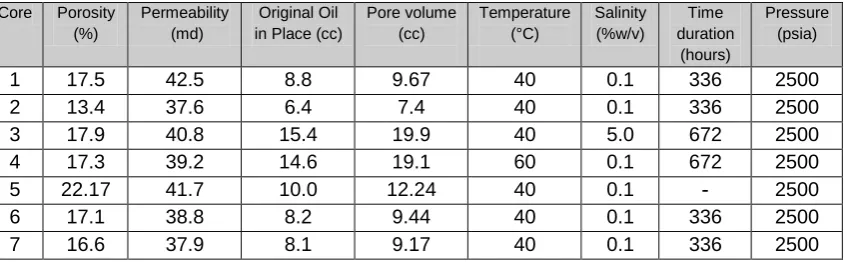
oil recovery (under optimal conditions) in rocks with high and low residual oil saturations, respectively. Core 3 investigated the effect of salinity with a concentration of 5% (w/v) and core 4 studied the effect of temperature at 60 °C. Core 5 had been considered for free cell-biosurfactant solution injection. In order to investigate the influence of crude oil and MS medium on wettability alteration, cores 6 and 7 were flooded with crude oil and MS medium without any bacterium injection, respectively. The results obtained from cores 6 and 7 were compared with other cores.
Table 1. Core properties and different environmental conditions in oil recovery tests.
2.7. Core holder flooding system
To investigate the potential of ERCPPI-2 for MEOR, the tests were performed in core holder flooding system that is shown in Figure 1. The set-up was designed so that it could simulate an oil reservoir under extreme environmental conditions. For the evaluation of oil displacement, core flooding tests were performed as described by Darvishi et al. [20].
3. Results and Analysis
3.1. Potential of ERCPPI-2 for biosurfactant production
The effect of various carbon sources (all in 0.5% w/v) on the growth, biosurfactant production and surface activity of ERCPPI-2 is shown in Figure 2. The best biosurfactant production of 1.67 g/l, interfacial tension of 0.65 mN/m and surface tension of 31.7 mN/m was obtained when the cells were grown in the presence of olive oil as the carbon source. In contact with Gachsaran crude oil, the results were 0.42 g/l, 5.75 mN/m and 41.2 mN/m, respectively.
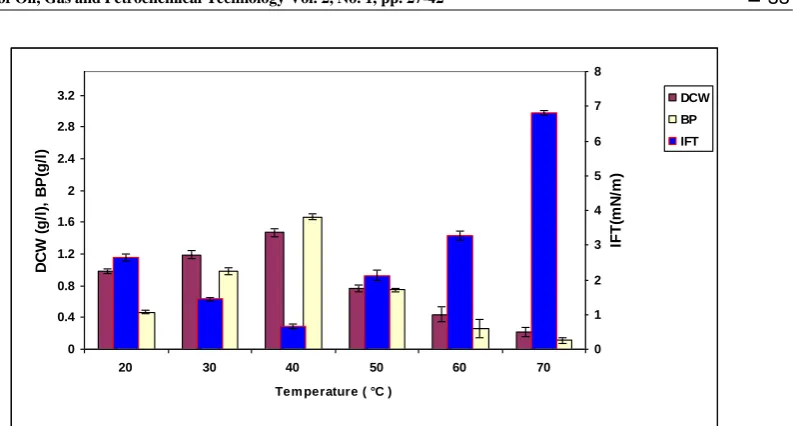
The influence of temperature, pressure, pH and salinity on the growth, biosurfactant production, surface activity and stability of the produced biosurfactant mixture by ERCPPI-2 in contact with olive oil have been presented in Figures 3, 4, 5 and 6, respectively.
The obtained results in Figures 2-7 show that ERCPPI-2 is able to produce a biosurfactant mixture with excessive oil spreading and emulsification properties in contact with several carbon sources and a wide range of environmental conditions. Among the carbon sources that were examined, olive oil had the highest biosurfactant yield. As a result, in core flooding tests, olive oil at a concentration of 0.5% (w/v) was added to MS medium as a co-substrate of Gachsaran crude oil for the stimulation of biosurfactant production and more reduction of IFT between oil/water interfaces.
Pressure (psia) Time duration (hours) Salinity (%w/v) Temperature (°C) Pore volume (cc) Original Oil
Figure 1. Core holder flooding system. 0 0.4 0.8 1.2 1.6 2 2.4 2.8 3.2 G lu c o s e F ru c to s e S u c ro s e G ly c e ro l T o lu e n e B e n z e n e X y le n e E th y l B e n z e n e S o ro o s h c ru d e o il G a c h s a ra n c ru d e o il P h e n o l O li v e o il M T B E C o n tr o l Carbon source D C W ( g /l ), B P (g /l ), I F T (m N /m ) 0 2.5 5 7.5 10 12.5 15 17.5 20 22.5 DCW BP IFT
Figure 2. The effect of various carbon sources on the growth, biosurfactant production and surface activity of consortium ERCPPI-2 [20].
0 0.4 0.8 1.2 1.6 2 2.4 2.8 3.2
20 30 40 50 60 70
Tem perature ( °C )
D
C
W
(
g/
l)
,
B
P
(g/
l)
0 1 2 3 4 5 6 7 8
IFT
(m
N
/m
)
DCW BP IFT
Figure 3. The effect of temperature on the growth, biosurfactant production and surface activity of consortium ERCPPI-2 [20].
Figure 4. The effect of pressure on the growth, biosurfactant production and surface activity of consortium ERCPPI-2.
3.2. The potential of ERCPPI-2 for wettability alteration under in situ conditions
The Amott-Harvey wetting index and contact angle of core surfaces are presented in Table 2. In contact with pure outcrop, these results were 0.855 and
24.5°, respectively. It is also shown in Table 2 that cell-free biosurfactant
injection had changed the wettability of core towards more oil-wet conditions.
3.3. The potential of ERCPPI-2 for enhanced oil recovery
0 0.4 0.8 1.2 1.6 2 2.4 2.8 3.2 3.6
4 5 6 7 8 9 10 pH D C W ( g /l ), B P (g /l ) 0 0.5 1 1.5 2 2.5 3 3.5 4 IF T ( m N /m ) DCW BP IFT
Figure 5. The effect of pH on the growth, biosurfactant production and surface activity of consortium ERCPPI-2 [20].
0 0.4 0.8 1.2 1.6 2 2.4 2.8 3.2
0 2.5 5 7.5 10 12.5 15 Salinity (%w/v) D C W ( g /l ), B P (g /l ) 0 1 2 3 4 5 6 7 8 9 IF T (m N /m ) DCW BP IFT
Figure 6. The effect of salinity on the growth, biosurfactant production and surface activity of consortium ERCPPI-2 [20].
Table 2. The Amott-Harvey indiex and contact angle of core surfaces.
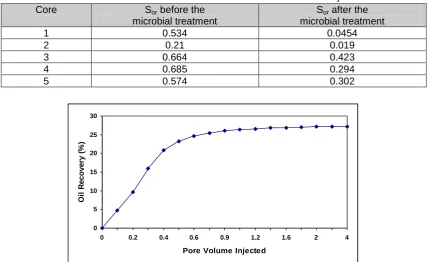
As shown in Figure 7, the injection of cell-free biosurfactant solution through the core at a temperature of 40 °C and pressure of 2500 psia resulted in an oil recovery of 27.2%. On the other hand, the injection of the bacterial consortium into the core at a temperature of 40 °C, pressure of 2500 psia, salinity of 0.1% (w/v) and initial oil saturations of 51.6 and 21% (two different tests at high and low residual oil saturations) resulted in an oil recovery of 48.8
and 19.1%, respectively (Figures 8 and 9). In both cases, the final residual oil saturations were reduced below 3%.
Table 3. Residual oil saturation of cores before and after the microbial injection of cores.
0 5 10 15 20 25 30
0 0.2 0.4 0.6 0.9 1.2 1.6 2 4
Pore Volume Injected
O
il
R
e
c
o
v
e
ry
(
%
)
Figure 7. Oil recovery efficiency by injection of free-cell biosurfactant solution into core 5.
0 10 20 30 40 50 60
0 0.2 0.4 0.6 0.9 1.2 1.6 3 4
Pore Volume Injected
O
il
R
e
c
o
v
e
ry
(
%
)
Figure 8. Microbial oil recovery efficiency for core 1 with high residual oil saturation. Sor after the microbial treatment Sor before the
microbial treatment Core
0.0454 0.534
1
0.019 0.21
2
0.423 0.664
3
0.294 0.685
4
0.302 0.574
0 2 4 6 8 10 12 14 16 18 20 22
0 0.2 0.4 0.6 0.9 1.2 1.6 3 4
Pore Volume Injected
O
il
R
e
c
o
v
e
ry
(
%
)
Figure 9. Microbial oil recovery efficiency for core 2 with low residual oil saturation.
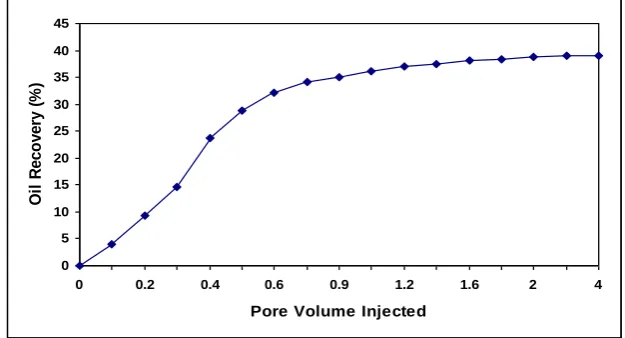
In the same conditions, the test was repeated for a core with the residual oil saturation of 66.4% and salinity of 5% (w/v). As indicated in Figure 10, the oil recovery was measured to be 24.1% for this case. In the next experiment (Fig. 11) with a residual oil saturation of 68.5%, the temperature was increased to 60 °C and salinity returned to 0.1% (w/v), which resulted in an oil recovery of 39.1%.
0 5 10 15 20 25 30
0 0.2 0.4 0.6 0.9 1.2 1.6 2 4
Pore Volume Injected
O
il
R
e
c
o
v
e
ry
(
%
)
Figure 10. Microbial oil recovery efficiency for core 3 at salinity of 5% (w/v).
Under optimal conditions, ERCPPI-2 was able to reduce the residual oil saturation of cores below 3%. In more severe conditions of salinity and temperature, the oil recovery was decreased, but the adverse effect of salinity was more than the temperature. As temperature increases, viscosity reduction among the other oil recovery mechanisms plays a more effective role.
3.4. Extending the results to the Iranian reservoir field conditions
steps are taken to find the right microorganism that will proliferate under these conditions. One of the available options is the pre-adaptation of bacteria to reservoir conditions. Proper adaptation of microbes before injection will not only improve the ability of bacteria cells to withstand any physiological and environmental stress but also ensure the production of desired metabolites that can be controlled and monitored. Adaptation time is a critical factor in the overall process recovery efficiency, and should be determined in the laboratory for every proposed microbial flooding system [23-25]. The results of present work reinforced the statement that adaptation of consortium to extreme reservoir conditions of high temperature is possible to a certain extent. However, for the adaptation to be successful, it has to be through a gradual acclimation. The pure strains of ERCPPI-2 were able to tolerate higher level of temperature. Engineering of new strains of bacteria by proper adaptation to high temperatures to meet reservoir conditions in some of the Iranian oilfields is in progress. The highest adaptation temperature ever achieved in our tests was 83 °C compared to the temperature of 60 °C performed in MEOR tests using laboratory scale experiments. The obtained data clearly demonstrated the strains adapted to higher temperatures from that of pure cultures and thus improved their abilities for metabolic production at high temperature levels. It is expected that the knowledge obtained from this study can give useful information in the successful implementation of MEOR technology for the enhanced oil recovery under some of Iranian reservoir conditions.
0 5 10 15 20 25 30 35 40 45
0 0.2 0.4 0.6 0.9 1.2 1.6 2 4
Pore Volume Injected
O
il
R
e
c
o
v
e
ry
(
%
)
Figure 11. Microbial oil recovery efficiency for core 4 at temperature of 60 °C.
The results of present study indicated that ERCPPI-2 is a halothermotoleran consortium which is able to produce bio-products in a wide range of environmental conditions.The produced bio-products are very efficient leading to high percentage of oil recovery under reservoir conditions. Combining multiple microbial mechanisms by ERCPPI-2 has a significant effect on improving the oil
recovery efficiency. Enterobacter sp. was capable of producing a high amount
sweeping efficiency of waterflood by selective plugging of high permeability zones or water-invaded zones [28]. In addition, it increases the viscosity of aqueous phase and reduces the viscosity of oil phase [20]. The simultaneous effects of increasing viscosity of the aqueous phase and decreasing viscosity of the oil phase will result in favorable mobility ratios. On the other hand,
Psedomonas sp. produces rhamnolipid biosurfactcnt which has a substantial effect on the reduction of oil/water interfacial tension and recovering the trapped oil [20]. IFT reduction is responsible for the major part of oil recovery from very small pores and throats of the reservoir rocks under MEOR process [9].
The measurement of Amott-Harvey wetting index and contact angle of the cores injected by ERCPPI-2 demonstrated that bacterial growth could change the wettability of core towards more water-wet conditions which led to high oil recovery efficiencies. It was shown that wettability of minerals could be altered by the adsorption of different organic matter from crude oil and during the bacterial growth creating various types and degrees of wettability [14]. Effects of bacteria on wettability have been studied in a few publications. They reported that the change in wetting properties is dependent on the initial wetting conditions of cores. Bacterial growth in an initially oil-wet system can result in more water-wet conditions [13], while a water-wet system can change towards less water-wet conditions [14]. According to capillary pressure measurements in sand packs between glass plates, residual oil saturation decreased and a change towards more water-wet conditions was observed when bacteria were present. The mechanisms for the improvement of sweep efficiency were assumed to be the emulsification of oil, wettability alteration and gas pressurization [1, 26].
Findings of the present study indicate that properties of ERCPPI-2 in the area of
MEOR are comparable to other strains introduced by similar works. Bacillus
licheniformis JF-2 and Clostridium acetobutylicum were used successfully at simulated subsurface reservoir conditions, yielding an additional 17-19% oil recovery [29]. Raiders et al. [30] showed the ability of microorganisms in Berea sandstone to improve the volumetric sweep efficiency and increase oil recovery
by 10-38% of the original oil in place by in situ growth and metabolism following
the injection of nutrients. Yakimov et al. [18] studied the potential of several
strains of Bacillus licheniformis in enhanced oil recovery and reported that this
strain produces significant amount of a surfactant similar to surfactin at moderately elevated temperatures of 55 °C and salinities up to 12% NaCl.
Qingxin, et al. [31] reported that Pseudomonas aeruginosa and its metabolic
products could enhance the oil recovery in the model reservoir by 11.2%. In
another work by Enas, et al. [32], Thermoanaerobacter brockii subsp.
4. Conclusion
The bacterial consortium of Enterobacter cloacae and Pseudomonas sp.
were investigated as a suitable candidate for the possible utilization in microbial enhanced oil recovery. The main aspects covered during the investigation were adaptation to extreme reservoir conditions, metabolites production, microbial fluid rock interactions and oil recovery mechanisms. These are based on the ability of consortium to grow in relatively harsh conditions and produce metabolites that can efficiently mobilize the trapped oil. It is evident that this consortium offer useful metabolic products such as biosurfactant, biopolymer, biogas, in addition to biomass for enhancing the oil recovery. The produced bio-products can contribute to multiple microbial mechanisms which can tackle specific problems of oil recovery. Through this, it will be possible to effectively control, monitor and utilize microbial activities in the recovery and utilization of oil resources. The findings also indicate that the range of temperature at which this consortium could grow is low compared to conditions of many Iranian oil wells. However, the results are comparable to other microbial injection tests that have been presented in other reports and they can provide an opportunity for further research in terms of its applications in microbial enhanced oil recovery. Engineering the new strains of ERCPPI-2 by proper adaptation to meet reservoir conditions in the Iranian oilfields is in progress.
References
[1] S. A. Kianipey and E. C. Donaldson. "Mechanisms of Oil Displacement by
Microorganisms." presented at the 61st Annual Technical Conference and
Exhibition, New Orleans, SPE paper 15601, 1986.
[2] M. Bao, X. Kong, G. Jiang, X. Wang, and X. Li. "Laboratory study on activating indigenous microorganisms to enhance oil recovery in Shengli
Oilfield." Journal of Petroleum Science and Engineering, vol. 66, pp. 42-46,
2009.
[3] J. F. Liu, L. J. Ma, B. Z. Mu, R. L. Liu, F. T. Ni, and J. X. Zhou. "The field pilot of microbial enhanced oil recovery in a high temperature petroleum
reservoir." Journal of Petroleum Science and Engineering, vol. 48, pp. 265–
271, 2005.
[4] Q. X. Li, C. B. Kang, H. Wang, C. D. Liu, and C. K. Zhang. "Application of
microbial enhanced oil recovery technique to Daqing Oilfield." Biochemical
Engineering Journal, vol. 11, pp. 197-199, 2002.
[5] G. Plaza, I. Zjawiony, and I. Banat. "Use of different methods for detection of
thermophilic biosurfactant producing bacteria from
hydrocarbon-contaminated and bioremediated soils." Journal of Petroleum Science and
Engineering, vol. 50, pp. 71–77, 2006.
[6] R. S. Bryant. "Potential uses of microorganisms in petroleum recovery
technology." in Proceedings of the Oklahoma Academy of Science, vol. 67,
pp. 97–104, 1987.
[8] M. Banat. "Biosurfactants production and possible uses in microbial
enhanced oil recovery and oil pollution remediation: a review." Bioresource
Technology, vol. 51, pp. 1–12, 1995.
[9] Soudmand-asli, S. S. Ayatollahi, H. Mohabatkar, M. Zareie, and S. F.
Shariatpanahi. "The in situ microbial enhanced oil recovery in fractured
porous media." Journal of Petroleum Science and Engineering, vol. 58, pp.
161–172, 2007.
[10] M. Abu El Ela, S. El-Tayeb, M. H. Sayyouh, M. Abdel Dayem, and S. Desouky. "Effects of stimulating indigenous bacteria in oil reservoirs on relative permeability curves." presented at the SPE/DOE Improved Oil Recovery Symposium, Tulsa, SPE paper 75240, 2002.
[11] E. Kowalewski, I. Rueslåtten, K. H. Steen, G. Bødtker, and O. Torsæter. "Microbial improved oil recovery—bacterial induced wettability and
interfacial tension effects on oil production." Journal of Petroleum Science
and Engineering, vol. 52, pp. 275–286, 2006.
[12] J. L. Chisholm, S. V. Kashikar, R. M. Knapp, M. J. Mclnerney, and D. E. Menzie. "Microbial enhanced oil recovery: interfacial tension and
gas-induced relative permeability effects." presented at the 65th Annual
Technical Conference and Exhibition, New Orleans, SPE paper 20481, 1990.
[13] M. Karimi, M. Mahmoodi, A. Niazi, Y. Al-Wahaibi, and S. Ayatollahi S. "Investigating wettability alteration during MEOR process, a micro/macro
scale analysis." Journal of colloids and surfaces B: Biointerfaces, vol. 95,
pp. 129-136, 2012.
[14] W. G. Anderson. "Wettability Literature Survey- Part 1: Rock/Oil/Brine
Interactions and the Effects of Core Handling on Wettability." Journal of
Petroleum Technology, vol. 38(10), pp. 1125-1144, 1986a.
[15] B. Mu, Z. Wu, Z. Chen, X. Wang, F. Ni, and J. Zhou. "Wetting Behavior on Quartz Surfaces by the Microbial Metabolism and Metabolic Products."
presented at the 7th International Symposium on Wettability and its Effect
on Oil Recovery, Tasmania, 2002.
[16] E. J. Polson, J. O. Buckman, D. Bowen, A. C. Todd, M. M. Gow, and S. J. Cuthbert. "An ESEM investigation into the effect of microbial biofilms on the
wettability of quartz." presented at the 7th International Symposium on
Wettability and its Effect on Oil Recovery, Tasmania, 2002.
[17] R. S. Makkar RS and S. S. Cameotra. "Production of biosurfactant at
mesophilic and thermophilic conditions by a strain of Bacillus subtilis."
Journal of Industrial Microbiol Biotechnology, vol. 20, pp. 48-52, 1998. [18] M. M. Yakimov, M. M. Amro, M. Bock, K. Boseker, H. L. Fredrickson, D. G.
Kessel, and K. N. Timmis. "The potential of Bacillus licheniformis strains for
in situ enhanced oil recovery." Journal of Petroleum Science and Engineering, vol. 18, pp. 147–160, 1997.
[20] P. Darvishi, Sh. Ayatollahi, D. Mowla D, and A. Niazi. "Biosurfactant production under extreme environmental conditions by an efficient microbial
consortium, ERCPPI-2." Colloids and Surfaces B: Biointerfaces, vol. 84, pp.
292–300, 2011.
[21] W. G. Anderson. "Wettability Literature Survey- Part 2: Wettability
Measurement." Journal of Petroleum Technology, vol. 38(11), pp.
1246-1262, 1986b.
[22] L. Cuiec. "Evaluation of reservoir wettability and its effect on oil recovery" in
Interfacial Phenomena in Oil Recovery, N. R. Morrow, New York, Marcel Decker, pp. 375–391, 1991.
[23] N. J. Russell. "Mechanisms of thermal adaptation in bacteria: blueprints for
survival." Trends in Biochemical Sciences, vol. 9(3), pp. 108-112, 1984.
[24] J. L. C. M. Van de Vossenberg, A. J. M. Driessen, M. S. da Costa, and W. N. Konings. "Homeostasis of the membrane proton permeability in Bacillus
subtilis grown at different temperatures." Biochimica et Biophysica Acta,
vol. 1419, pp. 97-104, 1999.
[25] D. A. Ratkowsky, J. Olley, and T. Ross. "Unifying temperature effects on
the growth rate of bacteria and the stability of globular proteins." Journal of
Theoretical Biology, vol. 233, pp. 351-362, 2005.
[26] R. T. Armstrong and D. Wildenschild. "Investigating the pore-scale
mechanisms of microbial enhanced oil recovery." Journal of Petroleum
Science and Engineering, vol. 94–95, pp. 155–163, 2012.
[27] T. R. Jack, B. G. Thompson, and E. Diblasio. "The potential for use of
microbes in the production of heavy oil." in Proceedings of the International
Conference on Microbial Enhancement of Oil Recovery, Bartellesville, pp. 88–93, 1983.
[28] I. Lazar, I. Petrisor, and T. Yen. "Microbial enhanced oil recovery (MEOR)."
Petroleum Science and Technology, vol. 25 (11), pp. 1353–1366, 2007.
[29] E. C. Donaldson and T. Obeida. "Enhanced oil recovery at simulated
reservoir conditions." Developments in Petroleum Science, vol. 31, pp.
227-245, 1991.
[30] R. A. Raiders, R. M. Knapp, and M. J. McInerney. "Microbial selective
plugging and enhanced oil recovery." Journal of Industrial Microbiology, vol.
4, pp. 215-230, 1989.
[31] L. Qingxin, K. Congbao, W. Hao, L. Chunde, and Z. Changkai. "Application
of microbial enhanced oil recovery technique to Daqing Oilfield."
Biochemical Engineering Journal, vol. 11, pp. 197–199, 2002.
[32] J. T. Enas, I. A. Jimoh, E. G. Søgaard, and S. N. Rudyk. "Laboratory
investigation of Thermoanaerobacter brockii subsp. lactiethylicus strain
9801T for possible utilization in microbial enhanced oil recovery." Journal of
نیب ششک شهاک و یگذنوشرت رییغت ،تفن یبورکیم تشادرب دایدزا
زا هدافتسا اب یحطس
طولخم
یاراک یرتکاب
ERCPPI-2
یشیورد سیورپ 1 *،یهللا تیآ باهش ،
2
ییاتسور اضریلع ،
3
1 . ٍُزگ ىازیا ،جَسای ،جَسای ُاگطًاد ،یسذٌْه ُذکطًاد ،یویض یسذٌْه
2 . ىازیا ،ىازْت ،فیزض یتعٌص ُاگطًاد ،تفً ٍ یویض یسذٌْه ُذکطًاد
3 . ىازیا ،سازیض ،سازیض ُاگطًاد ،تفً ٍ یویض یسذٌْه ُذکطًاد
م تاصخشم هلاق هديكچ :هلاقم هچخیرات تفایرد : 18 يوْت 1392 ییاًْ شزیذپ : 2 يوْت 1393 یزتکات طَلخه تیلتال ،زضاح كیمحت رد
Enterobacter cloacae ٍ
Pseudomonas sp.
( ERCPPI-2 )
تفً یتٍزکیه تضادزت دایدسا رد
یتٍزکیه تضادزت دایدسا فلتخه یاّ مشیًاکه ٍ ِتفزگ رازل یتایسرا درَه ً سا ُدافتسا ِجیتً رد تف
یزتکات طَلخه يیا
ذیلَت یتسیس تلاَصحه ٍ
ُذهآ تسذت جیاتً .تسا ِتفزگ رازل كیلد یسرزت درَه ىآ طسَت ُذض يیت صطک صّاک ،ىشخه ُذض یساس ِیثض طیازض تحت ِک ذًداد ىاطً ار تفً ذیلَت یلصا یاّ مشیًاکه یگذًَضزت زییغت ٍ ساگ ذیلَت ،یحطس یلاعف ِجیتً رد یتٍزکیه ت
ERCPPI-2
ُذض یًشتلایس یاّ ُشغه رد
.ذٌّد یه لیکطت زت ییاشست زیثات تًاتکفرَسَیت ذیلَت ،ىایه يیا رد
ِت زجٌه زها يیا ِک ِتضاد بآ ٍ تفً یاّساف یحطس يیت صطک صّاک یاّ ُداد .ذیدزگ ُذض سثح تفً سا یا ِظحلاه لتال راذمه تفایسات ِک ذًداد ىاطً ُشغه ُذًراذْگً یاّ نتسیس سا ُذهآ تسذت یّاگطیاهسآ د یزتکات طَلخه لحه رد ذضر طیازض توس ِت ار یگذًَضزت ،ُشغه ىٍر
،یزتکات یاّ لَلس ذلاف تًاتکفرَسَیت لَلحه كیرشت ٍ زتطیت یتسٍذتآ ِجَت ات .ذّد یه قَس زتطیت یتسٍد تفً طیازض توس ِت ار یگذًَضزت یزتکات طَلخه ِکٌیا ِت
ERCPPI-2
ِت مشیًاکه ذٌچ لاوعا ِت ردال
راذمه سا زظٌفزص ،ذضات یه ىاهشوّ ترَص عٍزض رد ُشغه تفً تیعاثضا
زیس ِت ار تیعاثضا يیا راذمه تسا ردال یزتکات طَلخه ،یتٍزکیه ذٌیآزف 3 یرَض زتداح طیازض تحت .ذّد صّاک % 5
یاهد ٍ )یًسٍ/یًسٍ( %
°C
60 ات زتازت ةیتزت ِت تفً تفایسات ذصرد ، 1 / 24 ٍ 1 / 39 .ذهآ تسذت %
:یذیلک تاملک
تفً یتٍزکیه تضادزت دایدسا خه یزتکات طَل
یاّ مشیًاکه MEOR
یطیحه داح طیازض
![Figure 2. The effect of various carbon sources on the growth, biosurfactant production and surface activity of consortium ERCPPI-2 [20]](https://thumb-us.123doks.com/thumbv2/123dok_us/518637.2051520/6.595.89.511.76.552/figure-various-sources-biosurfactant-production-surface-activity-consortium.webp)
![Figure 6. The effect of salinity on the growth, biosurfactant production and surface activity of consortium ERCPPI-2 [20]](https://thumb-us.123doks.com/thumbv2/123dok_us/518637.2051520/8.595.112.513.87.448/figure-salinity-biosurfactant-production-surface-activity-consortium-ercppi.webp)