A Node Identification based IDS Security against Sybil Attack in MANET
Shalini Tiwari
Dept. of Computer Science
IES College of Technology, Ratibad, Bhopal, MP [email protected]
Aishwarya Mishra
Dept. of Computer Science
IES College of technology, Ratibad, Bhopal, MP, [email protected]
Abstract— Security is one of the major anxieties in
MANET due to the absence of centralized administration. The nodes in network is moves with random mobility and these nodes are frequently changes their location in network. The attacker nodes are easily entered in network without information to other nodes and this attacker is drops the useful data packets of sender. Sybil attacker is one of the packets dropping attacker that drop the data packets of sender. It generate the multiple identities and these identities are different or identities of other nodes. In this dissertation we proposed the reliable identity based IDS security scheme to measure the network performance in presence of Sybil attacker. The proposed IDS is identified the attacker by the identity that is generated fake in network. The route section is the hop by hop interconnection of mobile nodes and the sender is sending the data to destination through that route the attacker is drop the number of data packets in network. The attacker identity is identified by number of IDS nodes in network that cover the whole network. If attacker is moves in ant section of network then the IDS is exist in network to identify the malicious activities of attacker. The attacker is always grasping the node identification (ID) number of normal nodes that are in range of attacker and uses that node ID for communication. The proposed IDS are finding malicious nodes that are drop data packets and having multiple ID's are found by attacker in network. The particular security scheme are check the profile of each node in network and only the attacker is one that performing malicious activities. The proposed security scheme is removes the attacker existence and provides secure communication in MANET.
Keywords— MANET, Sybil attack, Routing, Security, IDS, ID's, packet dropping.
INTRODUCTION
Mobile Ad hoc Network (MANET) is the collection of nodes or processing elements that communicate to nearby nodes to form link in between sender to receiver [1]. The MANET is the dynamic network which forms the connection in absence of centralized administration or any supervised unit. That kind of network is also called open network and nodes in network are also behaves as host as well as router. The routing decision is based on the basis of shortest path and this path is used for sending data by sender to destination. The Ad hoc is the network used to provide the communication in short range and for long distance like as city to city or country to country, internet is the only convenient option for sending and receiving data. The attackers are with no trouble agitate normal performance of network and this kind of malicious activities are degrades the network performance. The malicious nodes are dropping the valuable data packets or block the data packets sending
by sender. The role of intermediate nodes is to only forward or receive the packets from sender or any other intermediate node to forward other node/s till destination is not found. The Ad hoc Network is established at anywhere and anyplace without any obstacle of proper signal of internet or other any other medium. The MANET is established at small area and nodes are incessantly moves in a limited area. If the nodes are far from each other it is not possible to communicate with other nodes. It is necessary that nodes are maintain the proper distance to other nodes by that they communicate with other and performing successful communication [2,3]. The radio range of mobile nodes is limited and the nodes that out of radio range is not possible to communicate with each other.
Fig.1 Example of MANET
protocols should self-configure to regulate to atmosphere, traffic, and mission changes. What emerges from these characteristics if the visions of an especially versatile, malleable and nonetheless strong and formidable special design which will be accustomed monitor the habits of birds in their natural environment, and which, in alternative circumstances, is structured to launch deadly attacks onto unsuspecting enemies.
Because of its mobile, non-infrastructure nature, the unexpected network poses new style necessities. The primary is self-configuration (of addresses and routing) within the face of quality. At the applying level, unexpected network users usually communicate and collaborate as groups (for example, police, fire-fighters, medical personnel groups in an exceedingly search and rescue mission).These applications so need economical cluster communications (multicasting) for each knowledge and real time traffic. Moreover, quality stimulates a number of location primarily based services nonexistent within the wired net.
The quality of mobile unexpected network styles has challenged generations of researchers since the 70’s, recognition partly to the advances in radio technology, major success are rumored in military still as civilian applications on this front (e.g., battlefield, disaster recovery, motherland defence, etc) [3]. Initially look, these applications are reciprocally exclusive with the notion of “infrastructure networks and also the Internet” on that most industrial applications trust. This can be partially the rationale why the unexpected network technology has a tough time transitioning to industrial eventualities and touching people’s in daily life.
TYPESOFATTACKSINMANET
The attacks in MANETS are classified into two major categories [4, 5], namely
Ppassive Aattacks
Passive attacks are those, launched by the adversaries solely to snoop the data exchanged in the network. These adversaries in any way don’t disturb the operation of the network. Such attacks identification becomes very difficult since network itself does not affected and they can reduced by using powerful encryption techniques.
Active Attacks,
The active attack tries to alter or destroy the information that is being exchanged, thereby disturbing the normal functionality of the network. In MANET malicious and undesirable nodes to disrupted the normal functioning in the network. Some of the common attacks [3, 4] in MANET are as follows:-
Black Hole Attack
The purpose of this attack is to increase the congestion in network. In this attack the malicious node does not forward any packets forwarded to it, instead drops them all. Due to this attack the packets forwarded by the nodes do not reach their intended destination and the congestion in the network escalates due to retransmissions.
Wormhole Attack
The main aim of the wormhole attack is to replay the packet on the other side of the network. This attack is executed by two nodes colluding to form a wormhole. The attacker on one side make the nodes believe that distance to the destination is just one hop, when it is greater than one hop.
Denial of Service (DoS) Attack and Flooding
The aim of this attack is to cripple the smooth functioning of the network. This attack is accomplished by continually sending packets into the network causing the targeted node in the network to process them and keep them occupied resulting in the crashing of that node. This attack can cause the network infrastructure to collapse.
Sybil Attack
In the Sybil attack [6, 7], an attacker pretends to have multiple identities. A malicious node can behaves as if it were a larger number of nodes either by impersonating other nodes or simply by claiming false identities. A malicious device multiple identities are referred to as Sybil identities or Sybil nodes. Sybil attacks are classified into three categories like direct or indirect communication, fabricated or stolen identity, and simultaneity. In the direct communication, Sybil nodes communicate directly with legitimate nodes, whereas in the indirect communication messages sent to Sybil nodes are routed through malicious nodes. An attacker can fabricate a new identity or it can simply steal it after destroying or temporarily disabling the impersonated node. All Sybil identities can participate simultaneously in the network or they may be cycled through.
ROUTING PROTOCOL OVERVIEW
Mobile Ad-hoc networks are organizing and self-configuring multihop wireless networks, where the structure of the network changes dynamically. This is mainly due to the mobility of the nodes [8]. Nodes in these networks utilize the same random access wireless channel, cooperating in an intimate manner to engaging themselves in multihop forwarding. The node in the network not only acts as hosts but also as routers that route data to/from other nodes in network [2].
A.Proactive Routing Protocols:
Proactive protocols like Destination Sequenced Distance Vector (DSDV) continuously learn the topology of the network by exchanging topological information among the network nodes. Thus, when there is a need for a route to a destination, such route information is available immediately. If the network topology changes too frequently, the cost of maintaining the network might be very high. If the network activity is low, the information about actual topology might even not be used.
B. Reactive Routing Protocols:
route(s) to the destination only when the need arises. They do not need periodic transmission of topological information of the network.
C. Hybrid Routing Protocols:
Often reactive or proactive feature of a particular routing protocol might not be enough instead a mixture might yield better solution. Hence, in the recent days, several hybrid protocols are also proposed like ZRP [10].
RELATEDWORK
This section presents related work about existing work done in the field of MANET routing protocol, congestion control.
In this paper [11], proposed a new Sybil identity and whitewash identity (WID) interchangeably. In this proposal they considered both types of Sybil attacks. The strategy of our detection mechanism is to detect every new identity created by a Sybil attacker [6]. Here assume that the attacker joins the network with its single identity, and that malicious nodes do not collude with one another. We also assume that nodes do not increase or decrease their transmit power. The attackers can get identities by two ways. First, they can fabricate identities (for example, creating an arbitrary identifier). Second, they can use stolen identities, i.e., spoof the identities of legitimate nodes (masquerading) in the network.
In this paper [12], the proposed system works considering the Certification Authority mutually parameter and RSSI because the alternative parameter. The RSSI is used to make the cluster and to elect the cluster head. The CA’s responsibility is given to the CH. Whenever massive variations occur in RSSI on neighbor's entry and exit behavior, the Certification Authority comes into play. The CA checks the certification of a node. If it's not valid, its certificate is revoked otherwise it's absolve to communicate within the network. RSSI (Received signal strength Indicator) as a parameter to discover the Sybil node owing to its light-weight however it's didn't discover the fast-paced Sybil nodes.
In this paper [13] we tend to increase the light-weight Sybil attack detection technique. This technique tend to use three additional parameters i.e. energy, frequency and latency. In increased Sybil Attack Detection Technique, turnout of network is increased; range of Sybil nodes and bit error rate is decreased as compared to light-weight Sybil Attack Detection technique. In this, initial network is made consisting of nodes and their parameters worth i.e. Speed, Energy, Frequency and Latency are initialized. Then Id’s of every node, address per Id and informatics address per id is generated. Set threshold worth of every parameter i.e. for speed its set to 10m/s and for energy, frequency and latency parameters it's set to average energy of network, average frequency of network and average latency of network severally. Once new node enters in network, initial its address is checked with address of nodes gift within the network. If the address of latest node doesn't match with any node’s address within the network, then it’s all parameters are checked i.e. Speed, energy, frequency and latency.
Athichart Tangpong, george Kesidis, Hung-yuan Hsu, and Ali Hurson [14] sturdy Sybil Detection for MANETs we tend to propose a sturdy Sybil attack detection framework for MANETs supported reputation-based system, observance of network activities. The scheme tends to don't need selected and honest monitors to perform the Sybil attack detection. Every mobile node within the network observes packets passing through it associated sporadically exchange its observations so as to work out the presence of an attack. Malicious nodes fabricating false observations are going to be detected and rendered ineffective.
Sohail Abbas, Madjid Merabti, and David Llewellyn-Jones [15] “Deterring Whitewashing Attacks in Reputation based Schemes for Mobile ad hoc Networks” during this title we tend to describe a reputation based theme for MANETs that acts as a deterrent for whitewashing attacks. Instead of attempting to discover whitewashing attacks, we tend to approach the matter in a very novel method by removing the benefits that whitewashing will offer. In our planned theme, every node should pay associate entry fee to consume network services. As monetary fees don't seem to be appropriate for MANETs thanks to fee management complications, rather than a monetary fee we tend to use a fee within the kind of cooperation.
PROPOSED WORK
In this section describe the Sybil detection and protection algorithm that separated into three sections i.e. input parameters, output and routine execution. Sybil attack node behaviour stolen the id of destination in same time or different time, So that the source node not identifies the actual destination node and sends the data to the Sybil attacker node, those data are not receives by the genuine destination and all the data capture by the attacker node. Through this algorithm we efficiently detect the Sybil attacker node and protect them. Formal description of the algorithm executes step by step and guaranteed that proposed approach is more secure against the Sybil behaviour.
Algorithm: A New Attack and Prevention Scheme against
Sybil Attack in Mobile Ad hoc Network
Input Parameters:
The some symbols are used to denote the number of different communication resources like mobiles, source node destination node etc.
The number of mobile nodes is represents from M Source nodes are represents from Si // Si ɛ M Destination nodes are represents from Si ɛ M Intermediate node= Im
Sybil attacker ID = Sai
Security System=IDS (Intrusion Detection System) Nodes communication RC=550m
Output: PDR, Infection percentage, Sybil node
identification,NRL.
Routine:
AODV Broadcast Route Request from Si to Di
Step2:if (Next-Node! =Dn && Rc) then
{
Sequence _number++
Im, Im+1… for ward packets ti Di is not found Hop_count++ }
Step3:ElseIf (Im = = Di) then
{
Di sends confirmation through Im, Im+1… to Si // Si is directly in range of Di then Im, Im+1 = 0
Si Established route and sending data to Di
Si sends Acknowledgement of successful data delivery to Di }
Else
Node out of range
End if End do
Step4: IDS watch communication between the nodes
If (Packets_Routing! = True) then // Im = Sai {
Data packets drop by Im or Sai not reach at destination
Si sends packets drop by Sai not reach to Di
If (Im _ID = Sai && Sai_ID = New_ID ) then {
Sai capture the Im id for communication Drop all the packets sending by Si
Set fake node_ID of Sai do same step again }
End if End if
Step5: The IDS node is watch the all activities of nodes
If (Next_node _Ri && Pack_Fwd! = true && Sai_ID = New_ID) then
Block the Sai node
Else If (Next_node _Ri && Pack_Fwd! = true && Sai_ID = New_ID) then
Block the Sai+1 node
…… …… …….
…….. ….. ………
Block the Sai+n node
End if
Re-establish route in between Source and Destination Abolish all the Sybil attackers Sai, Sai+1, ...Sai+n Establish route having no Sybil attacker existence Start communication and for security maintenance go to step 4
Stop
In our proposed work IDS (Intrusion Detection System) identifies the node behaviour in real time and if IDS node identifies more identity at same and different time and attacker capture the packet from any sender, than IDS node execute prevention module in this module preventer node block the attacker node and broadcast the behaviour information of Sybil attacker to all nodes so that every node aware about attack behaviour and sender check the route table, if attacker id belong in the table than certainly disable the existing path and re-broadcast the route packet with message of blocked node id’s, so fresh route discover without participation of attacker node and reliable path identifies and send data to receiver nodes.
SIMULATION TOOL OVERVIEW
The network simulator (ns-2) is a discrete network simulator targeted at network researching. Ns-2 originated in 1989 as a variant of the REAL network simulator. As a part of the Virtual Internetworks Test bed (VINT) project at the University of California in Berkley. The project was supported by Defense Advanced Research Projects Agency (DARPA) in 1995 [16]. Ns-2 is an object-oriented simulator with substantial support available for simulation of TCP, routing, and multicast protocols, initially intended for wired networks, but the Monarch Group at Carnegie Mellon University (CMU) have extended ns-2 to support wireless networks. The core of the simulator, including the network protocols is implemented in C++, while object oriented TCL is used as an interface to describe, and set up the simulations. The implementation of ns-2 closely follows the OSI model. In ns- 2, an agent is used as a representation of an endpoint where network traffic are constructed, processed and terminated.
Simulation Parameters
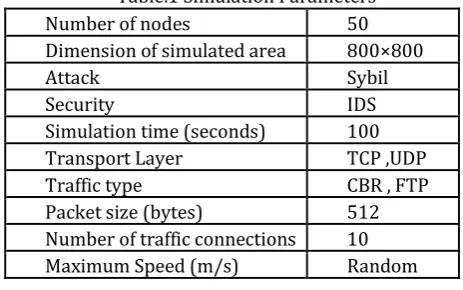
Parameters are completely decided on the basis of protocols used in simulation. The parameters are considered in this simulation are mentioned in table 1. According to these parameters the simulation of attacker and prevention scheme is simulated and measures the performance of dynamic network.
Table.1 Simulation Parameters Number of nodes 50 Dimension of simulated area 800×800
Attack Sybil
attacker
Security IDS
Simulation time (seconds) 100 Transport Layer TCP ,UDP Traffic type CBR , FTP Packet size (bytes) 512 Number of traffic connections 10 Maximum Speed (m/s) Random
RESULT DISCUSSION
In this section we compare the performance of normal routing, Sybil attacker and IDS and proposed security scheme is really effective to provide reliable communication in between sender and receiver.
TPR Performance Analysis
node density scenarios. The 20, 40 and 60 nodes density scenarios are taken to simulate the performance of network in different 2, 4, 8, 12 and 16 node density scenario in network.
Fig.2 TPR Analysis of 20 Nodes
.
Fig.3 TPR Analysis of 40 Nodes
Fig.4 TPR Analysis of 60 Nodes
Fig.5 FPR Analysis of 20 Nodes
FPR Performance Analysis
The nodes that are correctly detected is identified by TPR but true nodes but detected as a malicious is called
as FPR in network. The packet dropping in network is not possible to control fully but in any without one way to one way communication it is not possible to remove the dropping of packets. The fewer packets dropping id showing the better routing performance of proposed security scheme in dynamic network. The same performance is also evaluated is sane scenarios but here also the performance of proposed scheme is better than the previous security scheme.
Fig.6 FPR Analysis of 40 Nodes
Fig.7 FPR Analysis of 60 Nodes
CONCLUSION
The attackers are dropping the all data packets that are the reason of routing misbehavior in MANET. But the flexibility of decentralized administration in mobile nodes communication provides the results in a dynamic topology, that makes it very difficult in developing secure ad-hoc routing protocols. Data transmitted by a node is received by all the nodes within its direct transmission range. So attackers can easily affect the data being transmitted in the network. The proposed multiple ID's detection scheme is identified the existence of Sybil attacker by identified the actual behavior of particular node. If the nodes are in earlier not drop data continuously but after some time IDS watch that the attacker node has generate that ID in network because in routing procedure the fake ID is generated by Sybil attacker and the node which is drop packets is not exist in routing procedure currently. The particular Sybil attacker is change their ID's according to change the location in network because it also moves in network and same fake ID's is not possible to always maintain the connectivity with attacker. The proposed IDS is detect and also gives the attacker multiple ID's with the possible information of data dropping in network. The performance of UDP packets are showing the degradation in performance means packet dropping is more and if the packet dropping is more than in that case PDR 75
80 85 90 95 100
2 4 8 12 16
P
er
ce
na
tg
e
%
Node Velocity
TPR Analysis
20 Old
20 Proposed
90 92 94 96
2 4 8 12 16
P
er
ce
n
at
ge
%
Node Velocity
TPR Percenatge
40 Old
40 Proposed
90 95 100
2 4 8 12 16
P
er
ce
n
at
ge
%
Node Velocity
TPR Analysis
60 Old
60 Proposed
0 10 20
2 4 8 12 16
P
er
ce
n
tage
%
Nodes Velocity
FPR Analysis
20 Old
0 5 10
2 4 8 12 16
P
er
ce
n
tage
%
Nodes Velocity
FPR Analysis
40 Old
40
Proposed
0
5
10
2 4 8 12 16
P
er
ce
n
at
ge
%
Nodes Velocity
FPR Nodes Analysis
60 Old
performance is also showing the reduction in performance. The summarized performance provides the exact value of performance up to end of simulation time. the proposed IDS is no doubt improves the performance and also this performance is better than normal due to better availability of route and data receiving in network. The attacker multiple ID's detection is by watching the nodes activity continuously in network. If the multiple attackers are present in network than it is not easy to detect it easily in dynamic network. In future we proposed the security scheme to detect the multiple attackers in network and also evaluate the performance in static as well as dynamic network.
REFERENCES
[1]. Chlamtac, I., Conti, M., and Liu, J. J.-N. Mobile ad hoc networking: imperatives and challenges. Ad Hoc Networks, 1(1), pp. 13–6, 2003.
[2]. M. Conti, S. Giordano "Multihop ad hoc networking: The Theory", IEEE Communication Magine, 45(4):78-86, 2007
[3]. Adnan Nadeem and Michael P. Howarth, "A Survey of MANET Intrusion Detection & Prevention Approaches for Network Layer Attacks", IEEE Communications Surveys & Tutorials, Vol. 15, No. 4, Fourth Quarter, pp.2027-2045, 2013
[4]. Satyam Shrivastava, Sonali Jain, A Brief Introduction of Different type of Security Attacks found in Mobile Ad-hoc Network” International Journal of Computer Science & Engineering Technology Vol. 4 No. 03 March 2013.
[5]. S. Yi and R. Kravets, "Composite Key Management for Ad Hoc Networks", Proceeding of the 1st Annual International Conference on Mobile and Ubiquitous Systems: Networking and Services (MobiQuitous’04), pp. 52-61, 2004.
[6]. Abu Taha Zamani, Javed Ahmad, "A Novel Approach to Security in Mobile Ad Hoc Networks (MANETs)", International Journal of Computer Science and Information Technology Research, Vol. 2, Issue 1, pp. 8-17, January-March 2014.
[7]. J. Newsome, E. Shi, D. Song, and A. Perrig, “The Sybil Attack in Sensor Networks: Analysis and Defences,” presented at the 3rd Int. Symposium Information Processing in Sensor Networks (IPSN), pp. 259–268, 2004.
[8]. Laura Marie Feeney, “A Taxonomy For Routing Protocols in Mobile Ad Hoc Networks, Technical report, Swedish Institute of Computer Science, Sweden, 1999.
[9]. C. E. Perkins, E. M. Royer and S.R. Das, “Ad hoc On-Demand Distance Vector Routing,” Internet Draft: draft-ietf-manet-aodv-09.txt, November 2001. [10].Z. Hass, and M. Pearlman, “The performance of query
control scheme for the zone routing protocol”, in Proceeding of ACM SIGCOMM, August 1998.
[11].Rupali Bhumkar, Dr. D. l. Pete "Reduction of Error Rate in Sybil Attack Detection for MANET", IEEE Sponsored 9th International Conference on Intelligent Systems and Control (ISCO), 2015
[12].R. Vintoh kumar, Mr. P. Ramesh, Dr. H. Abdul Rauf, "Cluster Based Enhanced Sybil Attack Detection in
MANET through Integration of RSSI and CRL", IEEE International Conference on Recent Trends in Information Technology, pp. 1-7, 10-12 April 2014. [13].Himika Sharma and Roopali Garg, “Enhanced
Lightweight Sybil Attack Detection Technique”, IEEE 2014 5th International Conference on The Next Generation Information Technology Summit (Confluence), 476 – 481, 25-26 September 2014. [14].Athichart Tangpong, George Kesidis, Hung-yuan Hsu,
Ali Hurson, “Robust Sybil Detection for MANETs”, IEEE Proceedings of 18th International Conference on Computer Communications and Networks (ICCCN), pp. 1-6, 3-6 August 2009.
[15].Sohail Abbas, Madjid Merabti, and David Llewellyn-Jones “Deterring Whitewashing Attacks in Reputation Based Schemes for Mobile Ad hoc Networks”, IEEE Conference Wireless Days (WD), 2010 IFIP, pp. 1 – 6, 20-22 October 2010.
[16].K. Fall and K. Varadhan. (2011, November) The ns manual (formerly known as ns notes and documentation). [Online]. Available: