182
The drug discovery and development process has undergone dramatic changes particularly in the last decade. Progress in drug discovery has been fuelled by improvements in methodologies and technologies including automated high performance liquid chromatography (HPLC), fast HPLC, automated method development, LC-MS and high-throughput purification methods. During the drug discovery and development process, rugged analytical methods are highly desirable to evaluate early drug targets, drug metabolism, pharmacokinetics, process research, preformulation and formulations. In view of the continuous demand for stability indicating methods for maintaining the quality and safety of drugs and bioanalytical methods in clinical and pre-clinical studies during drug discovery, the present work has been proposed.
The present thesis entitled “DEVELOPMENT OF LIQUID
CHROMATOGRAPHY-MASS SPECTROMETRIC METHODS FOR
ANALYTICAL AND BIOANALYTICAL APPLICATIONS” has been divided into six chapters.
Chapter 1 deals with a brief introduction on role of liquid chromatography and mass spectrometry in drug discovery & development.
Chapter 2 deals with LC-ESI-MS/MS studies on forced degradation of abacavir sulphate an anti HIV drug.
Chapter 3 deals with LC-ESI-MS/MS studies on forced degradation of indinavir suphate an anti HIV drug.
Chapter 4 deals with development of an on-line two dimensional liquid chromatography combined with tandem mass spectrometric method for the determination of an antibiotic drug rifaximin in rat serum.
183
Chapter 6 describes the development of an ionic liquid based dispersive liquid-liquid micro extraction procedure for the extraction and determination of rifaximin in rat serum by HPLC.
Chapter 1: Role of liquid chromatography and mass spectrometry in drug discovery & development.
This chapter gives a brief introduction to various roles of liquid chromatography in pharmaceutical analysis and bioanalysis. In modern pharmaceutical industry, high-performance liquid chromatography (HPLC) is the major and integral analytical tool applied at all stages of drug discovery, development, and production. At each phase analyses of various samples are performed to adequately control and monitor the quality of the prospective drug candidates, excipients, and final products, which require bioanalytical as well as stability indicating methods.
Effective, eco-friendly and rapid method development is of paramount importance throughout the drug development life cycle. This requires a thorough understanding of HPLC principles and theory which lay a solid foundation for appreciating the many variables that are optimized during fast and effective HPLC method development and optimization. HPLC basics, types of chromatography, detectors, method development and validation are discussed briefly in this chapter. Hyphenated techniques such as LC-MS and LC-MS/MS were also discussed.
184
Part A: Development of stability indicating methods
i. LC-MS/MS studies on forced degradation of abacavir sulphate. ii. LC-MS/MS studies on forced degradation of indinavir sulphate. Part B: Development of Bioanalytical methods
iii. On-line 2D-LC-ESI-MS/MS determination of rifaximin in rat serum iv. LC-ESI-MS determination of rifaximin on dried blood spots
v. Ionic liquid based dispersive liquid-liquid microextraction and determination of rifaximin in rat serum
Part A: Development of stability indicating methods
Chapter 2: LC–MS/MS studies on forced degradation of abacavir sulphate.
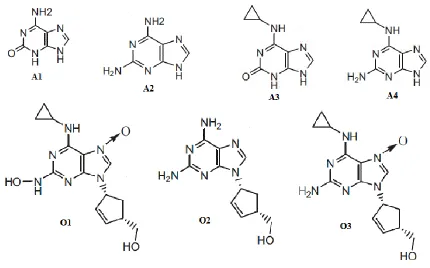
Abacavir sulphate (ABC) was subjected to forced degradation under the conditions of hydrolysis (acid, alkali and neutral), oxidation, photolysis and thermal stress. It resulted to eight degradation products. In case of acid hydrolysis drug was degraded completely. Hence its kinetic behaviour at temperatures 50 and 65 oC was also studied. Rate constant, half-life and t90 of
the drug were also calculated. The rate constant was increased from 0.0474 to 0.0064 h-1 as temperature increase from 50 to 65 oC. Abacavir sulphate and its
degradation products separation was accomplished on Waters XTerra C18 (250
185
Fig. 1 The chemical structures of proposed degradation products of ABC.
Chapter 3: LC–MS/MS studies on forced degradation of indinavir sulphate.
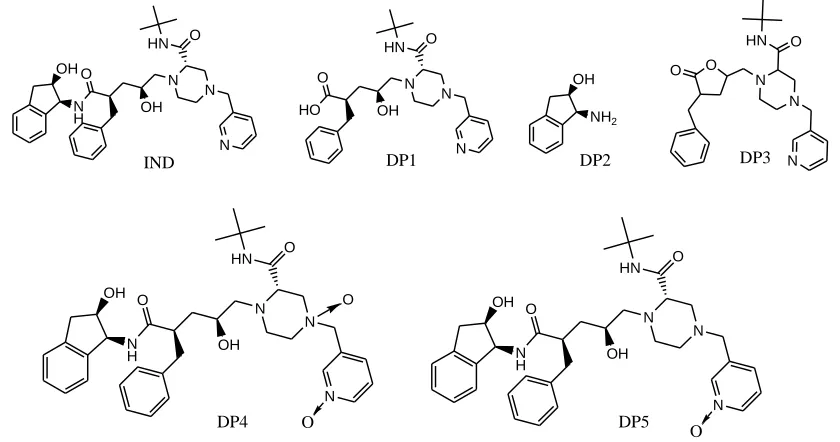
Indinavir sulphate (IDV) was subjected to acid hydrolysis, base hydrolysis, neutral hydrolysis, oxidation in presence of hydrogen peroxide and AIBN, thermal degradation and photo degradation. Total six degradation products were formed. Among the six degradation products three were from acid hydrolysis, two from oxidation and one of the degradation products obtained from neutral hydrolysis also. Indinavir sulphate and its degradation products were well separated on Waters XTerra C18 column. Based on the
186 N N O HN N O O N N O HN N N H O OH OH NH2 OH N N O HN N HO O OH DP1
IND DP2 DP3
N N O HN N N H O OH OH O O N N O HN N N H O OH OH O DP4 DP5
Fig. 2 The chemical structures of proposed degradation products of IDV.
Part B: Development of Bioanalytical methods
Chapter 4: On-line 2D-LC-ESI-MS/MS determination of rifaximin in rat serum.
This chapter describes the development of a direct injection method for the determination of rifaximin in rat serum. To facilitate this method two dimensional liquid chromatography was employed. The 2D-LC-ESI/MS/MS system consisted of a restricted access media column for trapping proteins as the first dimension and a Waters C18 column as second dimension using 0.1%
187
Chapter 5: LC-ESI-MS determination of rifaximin on dried blood spots.
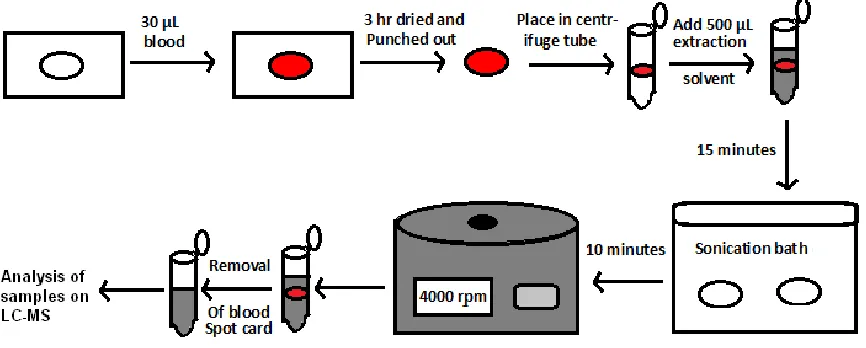
This chapter describes the suitability of dried blood spot (DBS) technique was evaluated for sample collection. A patient can collect blood samples from finger prick on a blood spot card without much special training to a clinic for analysis. A high-throughput liquid chromatography–electrospray ionization mass spectrometric (LC–ESI-MS) method for screening of rifaximin on DBS was developed and validated. It involves solvent extraction of a punch of DBS (Fig. 3) followed by reversed-phase LC on a relatively new monolithic column consisting of a silica rod with bimodal pore structure and detection by ESI-MS.
Fig. 3 Optimized method for processing and extraction of rifaximin from DBS.
Chapter 6: Ionic liquid based dispersive liquid-liquid microextraction and determination of rifaximin in rat serum.
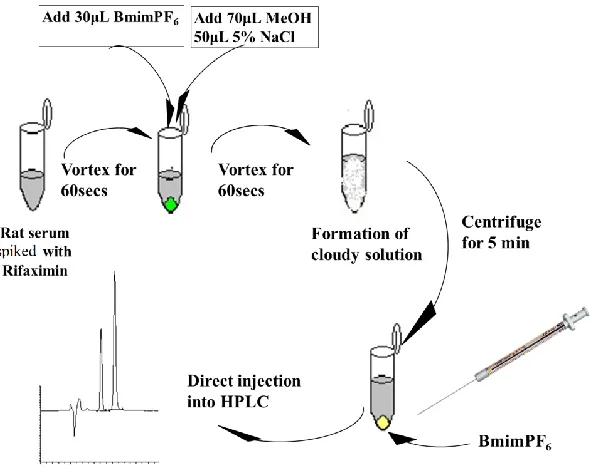
An efficient and environmental friendly ionic liquid based dispersive liquid-liquid micro extraction followed by RP-HPLC method for determination of rifaximin in rat serum was developed (Fig. 4). A water immiscible 1-butyl-3-methylimidazolium hexafluorophosphate (BmimPF6), was found to be an
188
investigation. The effects of ionic liquid, dispersive solvent, extractant/disperser ratio and salt concentration on sample recovery and enrichment were studied. Using BmimPF6 and methanol as extraction and
dispersive solvents, the recovery was found to be more than 98% at an extractant/disperser ratio of 0.43. The recovery was further enhanced to 99.5% by the addition of 5.0% NaCl solution. Rifaximin extracted in to BmimPF6 was
spiked with rifampicin used as an internal standard and directly injected on to a Waters XTerra® C18 (5 μm, 250 x 4.6 mm) column, using 0.1% aqueous acetic
acid: acetonitrile (45:55, v/v) as a mobile phase in an isocratic mode of elution and detected at 239 nm using photo diode array detector by reverse phase high performance liquid chromatography. A 3-fold enhancement in detection limit was achieved compared to the previously reported extraction method using protein precipitation.