Original Article
Journal of Advances in Medical Education & Professionalism
A half-day stroke workshop based on the Kirkpatrick model to
improve new clinical staff behavior
MIYAKO SHINOHARA1,2, RN; TAKEHIRO NAKAMURA3*, MD, PhD; NORICHIKA
KUNIKATA1, EMT; HIROSHI OKUDERA4, MD, PhD; YASUHIRO KURODA1, MD, PhD
1Department of Emergency and Disaster Medicine, Kagawa University Faculty of Medicine, Miki, Japan; 2Mitoyo General Hospital,
Kanonji, Japan; 3Department of Medical Technology, Kagawa Prefectural University of Health Sciences, Takamatsu, Japan; 4Department
of Crisis Medicine, Graduate School of Medicine and Pharmaceutical Science, University of Toyama, Toyama, Japan
Introduction: The present study aimed to determine the validity and usefulness of scales and training programs for clinical staff to evaluate nerve signs as an initial response to stroke. We developed a stroke workshop, using the analysis, design, development, implementation, and evaluation (ADDIE) model method based on instructional systems design theory.
Methods: The workshop aimed to improve the basic first aid skills of clinical staff for stroke. The participants (n=46) were randomly assigned to conventional Cincinnati Pre-hospital Stroke Scale (CPSS) or modified CPSS groups (simple randomization). Short-term case simulation was conducted immediately after the training as well as 6 months later to evaluate the nurses’ skills. We conducted evaluations, using an instructional framework throughout the ADDIE process. We used the Kirkpatrick model to evaluate the educational effect of up to level 3 in this study. The Wilcoxon signed-rank test was used to analyze differences between the pre-test and post-test groups.
Results: The evaluation of the new clinical staff stroke emergency training program, either using the conventional CPSS or the modified CPSS, showed that the participants were highly satisfied and exhibited improved knowledge and skills (conventional CPSS: 3.05±0.73 vs 3.64±0.59, P=0.012 and modified CPSS: 2.95±0.97 vs 3.61±0.49, P=0.111, before training vs after training, respectively). On the other hand, it was difficult for the participants to evaluate neurologic conditions using the modified CPSS compared with the conventional CPSS.
Conclusion: These results demonstrated that stroke care training is effective in reaction, learning, and behavior. The modified CPSS could be useful as with the conventional CPSS. In future, evaluation of neurological conditions should be improved.
*Corresponding author: Takehiro Nakamura, MD, PhD;
Department of Medical Technology,
Kagawa Prefectural University of Health Sciences,
Takamatsu, Japan
Tel: +81-87-870-1212
Email: tanakamu@kms. ac.jp
Please cite this paper as:
Shinohara M, Nakamura T, Kunikata N, Okudera H, Kuroda Y. A half-day stroke workshop based on the Kirkpatrick model to improve new clinical staff behavior. J Adv Med Educ Prof. 2020;8(1):10-17. DOI: 10.30476/jamp.2019.74874.0.
Received: 7 September 2018
Accepted: 23 September 2019
Keywords: Workshop; Stroke; Clinical staff; Behavior
A
bs
tr
ac
t
Introduction
T
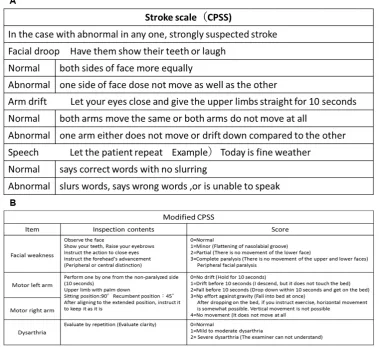
he present study aimed to determine the validity and usefulness of scales and training programs developed for new clinical staff members to evaluate nerve signs as anpresent workshop design mainly included the adoption of applying the Cincinnati Pre-hospital Stroke Scale (CPSS) (4) to simulated patients. Netz, et al. reported that CPSS could be also useful in hospital for stroke with acute onset (5). The CPSS is a validated pre-hospital stroke screening tool that has been easily and widely adopted by emergency medical services. The CPSS is scored from 0 to 3, with one point given for each of the following physical exam findings: facial droop, arm drift, and slurred speech (4, 5).
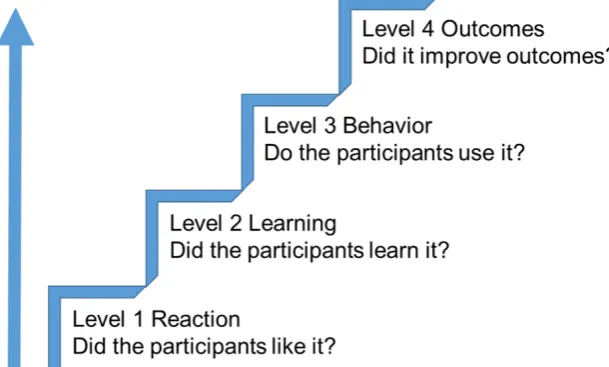
The Kirkpatrick model of evaluation is used to evaluate whether a training program is likely to meet the needs (6-8). It distinguishes among four outcome levels following educational guidlines (Figure 1). Many studies on faculty development have focused on Kirkpatrick level 2 outcomes (changes in knowledge). Some studies that investigated level 3 or 4 outcomes (changes in behavior or outcomes) following an educational intervention failed to find any important effects (9, 10). Especially, it is difficult to evaluate effects by level 4 (11).
We conducted a preliminary survey on the degree of understanding for clinical staff in our hospital (12). Neurological findings of consciousness level, pupil, and paralysis evaluation are essential for the early detection and response of cerebral signs (13, 14). Among these, findings of paralysis can rule out symptoms other than those of cranial nerve disorder, such as hypoglycemia and peripheral symptoms, and a simple scale is required for evaluation. Some studies have reported the training for stroke care (13-15).
The present study aimed to determine the impact of a stroke workshop on clinical faculty knowledge and behaviors. This workshop is targeted for all clinical staff.
Methods
We conducted a study on 46 new clinical staff members (medical doctor: 0, nurse: 46, other staff: 0) in Mitoyo General Hospital, Kagawa, Japan, from 2015 to 2017. The participants took a stroke workshop aiming to improve their basic first aid skills for stroke.
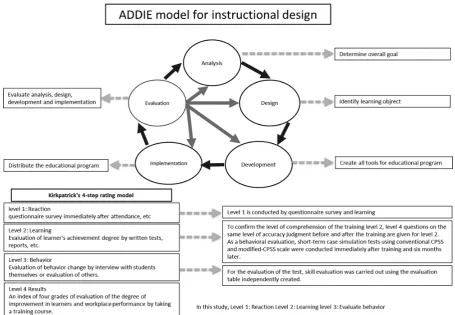
Pedagogical approach, using ADDIE model (Figure 2)
In the analysis phase, the instructional problems were clarified, the instructional goal was established and the participants’ knowledge and skills were identified. We conducted a preliminary survey on the degree of comprehension for the clinical staff in our hospital. Our survey revealed the degree of comprehension of 50% for airway problems, 49% for breathing problems, 40% for circulation problems, and 29% for disability (12). The goal is to get knowledge and skills to find stroke early. Our training objectives were to 1) understand the contents of CPSS and 2) evaluate neurological conditions, using the CPSS scale. Forty-six new nurses were randomly assigned to the traditional CPSS or modified CPSS. Training took place in 2015 and August 2016. Short-term case simulation was performed shortly after training in 2016 and 2017, wherein the skills and quality were evaluated.
The design phase established learning content, lesson planning and media selection. We gathered feedback from the analysis phase and resources on the topic provided by information with evidence. The contents of this workshop were designed to augment the Basic Life Support (BLS) resuscitation paradigms through the addition of a structured approach to early stroke assessment based on the Immediate Stroke Life Support
(ISLS) course. To allow the participants to practice smoothly, we recruited three qualified, clinically experienced and ISLS certified facilitators. The facilitators explained the objectives and goals of the training (15). Stroke scale practice was first observed and then practiced.
By applying the CPSS used in pre-hospital settings, we developed a scale that can detect the severity and abnormality of nerve signs at an early stage and can lead to the early response to and treatment of stroke. Measurement items were the same as those of the CPSS, namely facial paralysis, upper limb paralysis, and language impairment. The evaluation scale was used in pre-hospital settings without modifications. Each item was measured using the NIHSS measurement method: facial paralysis, 0–3; upper limb paralysis, 0–4; language disorder [1]; aphasia 0–3 [2]; and articulation disorder 0-2. We modified the scale to a constant of 12 points and refer to the modified scale as modified CPSS.
During the development phase, we received the reviewed design document. We developed modified CPSS based on conventional CPSS. The conventional CPSS is presented in Figure 3A. The modified CPSS evaluated the neurological condition of the simulated patients, using Figure 3B. We revised case simulations to introduce the modified CPSS. After practical training,
the subjects were explained the importance of comprehensively judging diseases and symptoms other than stroke, and the intention of index of scale evaluation in evaluating stroke scale as a whole. We developed a training DVD (digital versatile disc) of normal cases during the training sessions and distributed it as a self-learning teaching material. We expected the learning effect by video (16).
examination would not come in contact.
One staff member worked with two to four students. The students worked in pairs and alternated between the role of a patient and clinical staff. In the scenario, after performing the evaluation alternately in normal cases, we evaluated one stroke case, and set a time for debriefing for each case in the group. Three cases of stroke, facial nerve paralysis, cervical spine injury, and hypoglycemia were prepared in the case simulation test immediately after training and again 6 months later. For the case simulation test, a room separate from the training venue was set up. Each case took 2 min; feedback and movement after the simulation took a total of 5 min per person. The conventional CPSS is presented in Figure 3A. The modified CPSS evaluated the neurological condition of the simulated patients, using Figure 3B. We also prepared a waiting room so that the participants who completed the simulation test and those waiting to complete the examination would not come in contact.
Educational evaluation is important for
was performed using the independently created evaluation table. Level 3 was assessed, using a questionnaire with four Yes/No questions about actions and changes in consciousness after training.
The conventional CPSS is reliable and widely prevalent as a hospital scale. Mackey, et al. reported that the conventional CPSS could be useful even on bedside use (class II evidence study) (18). Although we modified the reliable conventional CPSS, we kept the basic principle of the conventional CPSS. We have developed it as a modified CPSS that can evaluate neurological findings level.
All data were reported as mean±SD. The Wilcoxon signed-rank test was used to analyze differences between the pre-test and post-test groups. The χ² independent test was used to compare the conventional CPSS group and the modified CPSS group. A statistically significant difference was defined as a P value less than 0.05. All statistical analyses were performed, using StatMate V (ATMS Co., Ltd., Tokyo, Japan).
Ethical consideration
This study was conducted at the Mitoyo General Hospital after being approved by the hospital’s ethics committee. The purpose of the research study was explained to all subjects, and all subjects gave their consent to participate. The test results and consciousness survey results were carefully managed to maintain anonymity. Results
The average age of the participants was 24.3±6.8 years. Two were teenagers, 34 were in their 20s, nine were in their 30s, and one was in 40s. Out of 46 new clinical staff, 43 participated in the training course. Four participants from the
conventional CPSS group and one participant from the modified CPSS group were absent during the simulation test due to poor business and physical condition. Therefore, we evaluated the skills of the remaining 17 participants of the conventional CPSS group and 21 of the modified CPSS group.
Evaluation of pedagogical approach by ADDIE model
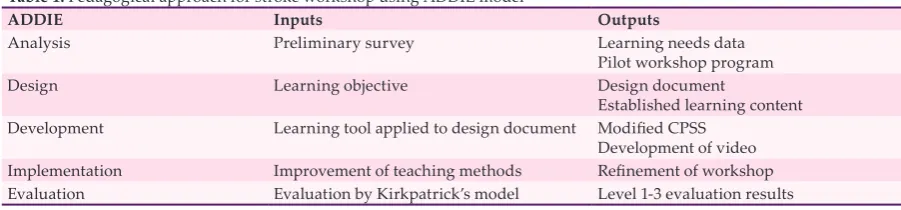
We describe the inputs and outputs during each phase of stroke workshop development, using ADDIE model (Table 1).
Kirkpatrick level 1: Reaction
The level of satisfaction with the training contents in the conventional and modified CPSS groups is shown in Table 2. No significant difference was observed in scale understanding, scale evaluation, or training satisfaction scores between the conventional and modified CPSS groups. In response to the question of whether the outcome of training can be utilized in future nursing, the conventional CPSS group scored 4.12±0.49 and the modified CPSS group scored 4.14±0.64, indicating no significant difference (Table 3).
Kirkpatrick level 2: Learning
Evaluation of understanding was conducted before (pre) and after (post) training (Figure 3). In the conventional CPSS group, the average points were 3.05±0.73 before and 3.64±0.59 after the course (P=0.012, Figure 4, left). In the modified CPSS group, the average points were 2.95±0.97 before and 3.61±0.49 after the course (P=0.011, Figure 4, right).
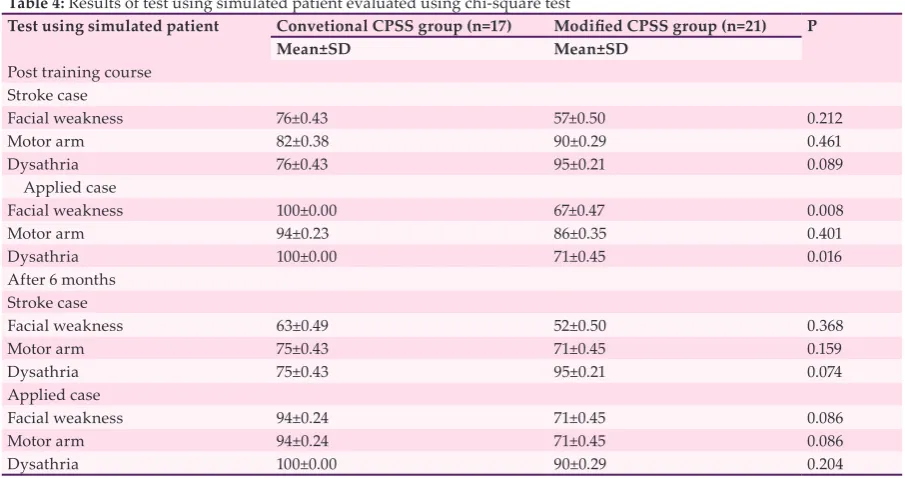
Results of the test using simulated patient evaluation are shown in Table 4. In post-training
Table 1: Pedagogical approach for stroke workshop using ADDIE model
ADDIE Inputs Outputs
Analysis Preliminary survey Learning needs data
Pilot workshop program
Design Learning objective Design document
Established learning content
Development Learning tool applied to design document Modified CPSS
Development of video
Implementation Improvement of teaching methods Refinement of workshop
Evaluation Evaluation by Kirkpatrick’s model Level 1-3 evaluation results
Table 2: The visual analog scale scores of satisfactions with the training contents
Question items Conventional CPSS group (n=17) Modified CPSS group (n=21) P
Mean±SD Mean±SD
Understanding of scale 79.4±10.7 75.7±16.4 0.88
Evaluation using scale 79.4±10.7 75.7±16.4 0.94
difficult cases except for stroke, facial weakness evaluation was at 100% for the conventional CPSS group and 67% for the modified CPSS group (P=0.008). Dysarthria evaluation was at 100% for the conventional CPSS group and 71% for the modified CPSS group (P=0.016). However, no significant difference was observed between the scores immediately and 6 months after training.
Kirkpatrick level 3: Behavior
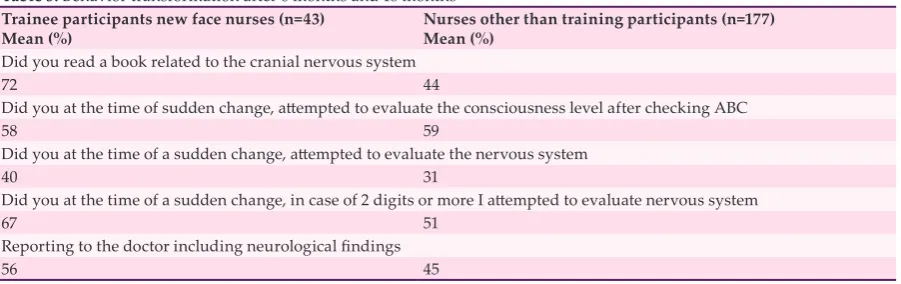
We investigated behavior change of 43 new nurses participating in the training after 6 months and 18 months. We also investigated 177 staff members in the training participation department as a control. In the behavior change survey, the results for four of the five items were high (P=0.039, Table 5).
Table 3: Responses to whether this training can be used for future nursing based on a 5-point Likert scale Conventional CPSS group (n=17) Modified CPSS group (n=21) P
Mean±SD Mean±SD
4.12±0.49 4.14±0.64 0.89
Figure 4: Comparison of knowledge before (pre) and after (post) the training course. Evaluation of the degree of comprehension of the training in the conventional CPSS group (left) and the modified CPSS group (right).
Table 4: Results of test using simulated patient evaluated using chi-square test
Test using simulated patient Convetional CPSS group (n=17) Modified CPSS group (n=21) P
Mean±SD Mean±SD
Post training course
Stroke case
Facial weakness 76±0.43 57±0.50 0.212
Motor arm 82±0.38 90±0.29 0.461
Dysathria 76±0.43 95±0.21 0.089
Applied case
Facial weakness 100±0.00 67±0.47 0.008
Motor arm 94±0.23 86±0.35 0.401
Dysathria 100±0.00 71±0.45 0.016
After 6 months
Stroke case
Facial weakness 63±0.49 52±0.50 0.368
Motor arm 75±0.43 71±0.45 0.159
Dysathria 75±0.43 95±0.21 0.074
Applied case
Facial weakness 94±0.24 71±0.45 0.086
Motor arm 94±0.24 71±0.45 0.086
Discussion
The present stroke workshop was a half-day program designed to augment the BLS resuscitation paradigms through the addition of a structured approach to early stroke assessment. The training course developed for the new clinical staff members is based on valid guidelines and provides the ability to diagnose patients in a hospital (15). An optimal instructor-to-learner ratio should be approximately 1:4. The hands-on and simulatihands-on activities should be mentored and facilitated by experienced instructors who provide formative assessments and feedback throughout each exercise. The participants alternately role-played patients with specific neurologic deficits and clinical staff member to practice and self-assess the skills learned and apply the neurologic rating scales. Role-playing serves to engage and activate thinking about the disease process and course content and influences the healthcare awareness of the participants acting as simulated patients.
According to the questionnaire survey, many participants thought that the present program was useful to learn about the initial management of stroke patients. The evaluation of the stroke first aid training program for new clinical staff members showed high participant satisfaction and improved the participants’ knowledge and skills. The results of the present study demonstrated that training of stroke care could improve nurses’ reaction, learning, and behavior.
The evaluation of the new clinical staff stroke emergency training program, either using the conventional CPSS or the modified CPSS, showed that the participants were highly satisfied and exhibited improved knowledge and skills. On the other hand, it was difficult for the participants to evaluate neurologic conditions, using the modified CPSS compared with the conventional CPSS. As a future task, we have to improve the training method of neurological evaluation. A
blended learning, which incorporates video-assisted resources, might be a useful tool to teach clinical skills to students (19).
Most studies based on the Kirkpatrick model have evaluated only levels 1 and 2 of this model (9, 10). In the present study, the participants’ comfort levels with practicing skills for stroke improved, indicating changes in Kirkpatrick level 1 (reaction) and 2 (learning). Most of this improvement was maintained 6 months after the training, indicating a change in Kirkpatrick level 3 (behavior). In order to maintain skills in the long term, continuous learning using videos could be effective (20). Video-based learning has shown to improve participants’ learning output in various disciplines (21-23). On the other hand, three factors present challenges at the behavior level. First, the participants could find an opportunity to change behaviors. Second, the time for change in behavior could not be predicted. Finally, the atmosphere could have an impact on changing behavior (17, 24).
A limitation of the present study was the lack of evaluation of Kirkpatrick level 4, which should be addressed in future studies. No study has assessed the effectiveness of training of clinical staff members for stroke care based on all four levels of the Kirkpatrick model.
Conclusion
Comfort among new clinical staff members in practicing stroke management could be improved with a half-day workshop, and most results of the training could be maintained 6 months later. Although the modified CPSS is more complicated than the conventional CPSS, there was no significant difference in the test. The modified CPSS could be useful as with the conventional CPSS. In future, it is necessary to improve training, using the modified CPSS.
Conflicts of Interest: None declared.
Table 5: Behavior transformation after 6 months and 18 months Trainee participants new face nurses (n=43)
Mean (%) Nurses other than training participants (n=177)Mean (%)
Did you read a book related to the cranial nervous system
72 44
Did you at the time of sudden change, attempted to evaluate the consciousness level after checking ABC
58 59
Did you at the time of a sudden change, attempted to evaluate the nervous system
40 31
Did you at the time of a sudden change, in case of 2 digits or more I attempted to evaluate nervous system
67 51
Reporting to the doctor including neurological findings
References
1. Hsu TC, Lee-Hsieh J, Turton MA, Cheng SF. Using the ADDIE model to develop online continuing education courses on caring for nurses in Taiwan. J Contin Educ Nurs. 2014;45:124-31.
2. Lu SC, Cheng YC, Chan PT. Using ADDIE Model to Develop a Nursing Information System Training Program for New Graduate Nurse. Stud Health Technol Inform. 2016;225:969-70.
3. Tobase L, Peres HHC, Almeida DM, Tomazini EAS,
Ramos MB, Polastri TF. Instructional design in the development of an online course on Basic Life Support. Rev Esc Enferm USP. 2018;51:e03288.
4. Kothari RU, Pancioli A, Liu T, Brott T, Broderick J. Cincinnati Prehospital Stroke Scale: reproducibility and validity. Ann Emerg Med. 1999;33:373-8. 5. Netz U, Perry Z, Horev A, Mizrachi S. Recognition
and primary treatment of acute stroke occurring in hospital. Harefuah. 2011;150:318-21. In Hebrew. 6. Bates R. A critical analysis of evaluation practice: The
Kirkpatrick model and principle of beneficence. Eval
Program Plan. 2004;27:341-7.
7. Rajeev P, Madan MS, Jayarajan K. Revisiting Kirkpatrick’s model –An evaluation of an academic training course. Curr Sci. 2009;96:272-6.
8. Smidt A, Balandin S, Sigafoos J, Reed VA. The Kirkpatrick model: A useful tool for evaluating training outcomes. J Intellect Dev Disabil. 2009;34:266-74. 9. Dorri S, Akbari M, Dorri Sedeh M. Kirkpatrick
evaluation model for in-service training on cardiopulmonary resuscitation. Iran J Nurs Midwifery Res. 2016;21:493-7.
10. Koohestani HR, Soltani Arabshahi SK, Fata L, Ahmadi F. The educational effects of mobile learning on students of medical sciences: A systematic review in experimental studies. J Adv Med Educ Prof. 2018;6:58-69.
11. Shelton S, Alliger G. Who’s afraid of level 4 evaluation? A practical approach. Training Dev. 1993;47(6):43-7. 12. Shinohara M, Kii N, Shinomiya A, Kuroda Y,
Nakamura T, Tamiya T, et al. Training of coma scale using ISLS content for the new face nurses. J Jap Cong Neurol Emerg. 2015;27:12-6. In Japanese.
13. Nakamura T, Ajimi Y, Okudera H, Yamada M,
Imizu S, Hirayama T, et al. The modules for ISLS/
PNLS combined course as international version: Report of workshop in 9th International Conference of Cerebrovascular Surgery. Asian J Neurosurg. 2010;5:95-100.
14. Nakamura T, Ajimi Y, Okudera H, Yamada M, Toyoda I, Itoh K, et al. Report on the international Primary Neurosurgical Life Support course in the eighth Asian Congress of Neurological Surgeons in Kuala Lumpur, Malaysia. Asian J Neurosurg. 2011;6:2-5.
15. Okudera H, Wakasugi M, Hashimoto M, Berg BW, Ajimi Y, Nakamura T, et al. Integrated multimodality simulation curriculum: International Immediate Stroke Life Support. Journal of Clinical Simulation Research. 2013; 2(3):35-53.
16. Kirkpatrick DL. Training and development handbook: A guide to human resourse development. New York: McGraw-Hill; 1976.
17. Curran VR. Tele-education. J Telemed Telecare. 2006;12:57-63.
18. Mackay MT, Churilov L, Donnan GA, Babl FE, Monagle P. Performance of bedside stroke recognition tools in discriminating childhood stroke from mimics. Neurology. 2016; 86:2154-61.
19. Coyne E, Rands H, Frommolt V, Kain V, Plugge M, Mitchell M. Investigation of blended learning video resources to teach health students clinical skills: An integrative review. Nurse Educ Today. 2018;63:101-7. 20. Ebn Ahmady A, Barker M, Fahim M, Dragonetti
R, Selby P. Evaluation of Web-Based Continuing Professional Development Courses: Aggregate Mixed-Methods Model. JMIR Med Educ. 2017;3:e19. 21. Copley J. Audio and video podcasts of lectures for
campus-based students: production and evaluation of student use. Innovations in Education and Teaching international. 2007;44:387-99.
22. Cardall S, Krupat E, Ulrich M. Live lecture versus video-recorded lecture: are students voting with their feet? Acad Med. 2008;83:1174-8.
23. Murthykumar K, Veeraiyan DN, Prasad P. Impact of Video Based Learning on the Perfomance of Post Graduate Students in Biostatistics: A Retrospective
Study. J Clin Diagn Res. 2015;9:ZC51-3.