3(3), Fall 2011, Ser. 64/4
(Previously Journal of Social Sciences & Humanities)
Variations in EFL Teachers’ Pedagogical Knowledge Base as a Function of Their Teaching License Status
M. N. Karimi (Allvar ) Assistant Professor
Tarbiat Moallem University, Tehran email: [email protected]
Abstract
The study of teachers’ pedagogical knowledge base (PKB) to discover how teachers think and work is attracting increasing attention in ELT. Against this background, the present study aimed at probing the likely variations in EFL teachers’ pedagogical knowledge base as a function of their teaching license status. To this aim, six teachers (two standard-licensed, two alternatively-licensed, and two non-licensed teachers) were selected as the participants. Stimulated Recall Technique was used for the data collection purpose. Identification of the dominant thought categories of the three clusters of teachers was carried out by segmenting, coding and categorizing them. The analyses of the data revealed significant differences in the number and list of dominant pedagogical thought categories (PTC) across the three groups of teachers. Language Management, Procedure Check, Affective, Self-Reflection, Progress Review, and Beliefs formed the dominant list of PTCs by Standard Licensed (SL) teachers. Language Management, Procedure Check, Affective, and Progress Review comprised the dominant categories of Alternatively Licensed (AL) teachers, while Non-Licensed (NL) teachers' dominant PTCs included Language Management, Procedure Check, Progress Review, and Note Behaviour. Self-reflection and Beliefs were the thought categories absent in the AL and NL teachers’ list of dominant PTCs.
Keywords: license status, PKB, EFL teachers, pedagogical thought units ––––––––––––––––––––––––––––––––––––––––
1. Introduction
Over the last decade or so, there has been an acknowledgement of the fact that in the field of teaching English as a foreign language, teachers’ PKB, defined as "accumulated knowledge about the act of teaching, including the goals, procedures, and strategies that form the basis for what teachers do in the classroom" (Mullock, 2006, p. 48), is an area which has been neglected in the literature (Freeman, 2002; Freeman & Johnson, 1998; Gatbonton, 2000). During this time, the need to delineate the EFL teachers’ PKB and to establish new standards for the content specification of language teacher education programs has been recognized in the field (Guntermann, 1993). There have, accordingly, been some attempts to develop a coherent research agenda for discovering how teachers think and work (e.g. Akbari & Dadvand, 2011; Akbari & Tajik, 2009; Borg, 2003; Freeman, 1996; Gatbonton, 2000; 2008; Golombek, 1998; Johnston & Goettsch, 2000; Mullock, 2006; Richards & Lockhart, 1994; Watzke, 2007).
Some of this research has been purely theoretical in nature and has focused on defining, conceptualizing, formulating and developing a PKB for EFL teachers, but others are comparative empirical accounts of the PKB of teachers done with reference to a number of teaching and teacher-related variables such as teacher experience, teacher training, pedagogical context, and teachers' reflective practices or personality (Akbari & Tajik, 2009; Cabaroglu & Roberts, 2000; Crooks & Arakaki, 1999; Gatbonton, 2000; 2008; Golombek, 1998; Mullock, 2006; Richards & Pennington, 1998).
Despite this surging interest in the topic, there has not yet been enough exploration of the variables which can account for the ways teachers vary in terms of knowledge base. The demand for further research into the EFL teachers’ PKB is best reflected in Akbari and Tajik’s (2009) words:
teachers make the decisions they make and what forces are influential in the formation of their professional identity is yet to be completed" (p. 53).
Thus, to take a small step forward in better understanding the nature of EFL teachers’ PKB and attempting at bridging the gap in research in this area, the present study aimed at exploring EFL teachers’ pedagogical knowledge base.
2. Pedagogical Knowledge Base in the Literature
explained a greater proportion of the variation in evaluations than did content knowledge as measured by standardized test scores. Indeed, education coursework explained 16% of the variance in the evaluations.
Rather than taking a myopic view of teacher PKB in terms of such criteria as pedagogic coursework or the number of courses passed on the way of teaching, the present study investigates pedagogical knowledge as rooted in teacher cognition, defined as "the unobservable cognitive dimension of teaching – what teachers know, believe and think" (Borg, 2003, p.81). It moves in the direction of those research orientations which conceptualize teacher pedagogical knowledge as "accumulated knowledge about the act of teaching, including goals, procedures, and strategies that form the basis for what teachers do in classroom" (Mullock, 2006, p. 48). The study of this type of knowledge based on the above conceptualization has its roots in the belief that all the practices carried out by teachers in the classroom are accompanied by some form of background thinking (Mullock, 2006). "It is based on the assumption that what teachers do in the classroom has its origins in thoughts or mental acts which have been shaped by attitudes, values, knowledge and beliefs gathered through years of being a student and being (or becoming) a teacher (Mullock, 2006, p. 48).
precision of her elicited categories in terms of definition and limits their applicability to similar contexts (Mullock, 2006).
The first defect is mentioned to be the dubious ecological validity of the study, that is, the classes were created for research purposes and were not natural intact classes. Another problem with the study was the "lack of information about the ranking and frequency of the six domains of pedagogical knowledge consulted by the teachers" (Mullock, 2006, p.50). The third problem raised with regard to the study was related to the reliability and validity of the data collection procedure employed, i.e., the stimulated-recall protocol (Mullock, 2006).
Improving on Gotbonton's (2000) study, while maintaining the overall design of her study, Mullock (2006) examined the PKB of four ESL teachers. The study aimed at examining whether the patterns of pedagogical knowledge found in Gatbonton's study would be found in the teaching situations used in her study. The participants of her study were three female and one male teachers, aged between 30 to 45, with an experience range of 3 months to 12 years, and all having undertaken the Cambridge Certificate In English Language Teaching to Adults (CELTA). The results arrived at through this study were to a large extent akin to those found in Gatbonton's study, with minimal differences. Language Management (25%), Knowledge of Students (21%), Procedure Check (10%), Progress Review (7%), and Noting Students' Reactions and Behaviour (6%) were the main categories which attracted the highest frequency of occurrence.
An intersecting point about her study is the comparison between experienced and inexperienced teachers' pedagogical thought units. In terms of varieties of the thoughts produced, no significant difference was found between the two groups. However, some differences were observed between the two with reference to some particular categories.
what pedagogical knowledge these teachers have internalized after having completed a teacher training program and how this knowledge compares to that of teachers who have had more experience than they have had" (p. 161).
The results of her study showed that the pedagogical knowledge of novice teachers is comparable to the PKB of experienced ones in terms of major categories but not in terms of the details within the categories. The two types of teachers were shown to be similar in terms of the number and type of pedagogical knowledge categories. However, the rank orderings of the teachers' dominant PK category list were not the same. Language Management (20%), Knowledge of Students (9%), Procedure Check (8%), Progress Review (8%), Beliefs (7%), Noting Students' Reactions and Behaviour (6%), and Decisions (6%) were the experienced teachers' dominant list of PK categories. In contrast, Noting Students' Behaviour and Reactions (13%), Language Management (12%), Procedure Check (11%), Knowledge of Students (10%), Affective Issues (8%), Progress Review and Beliefs (each at 7%), and Decisions and Self-Critique (each at 6%) were the dominant PK categories of the novice teachers.
In an approximate replicate of Gatbonton’s and Mullock’s studies, Akbari and Tajik (2009) conducted a study to investigate the probable differences in the pedagogical knowledge base of Iranian experienced and less EFL experienced teachers. Maintaining an almost similar design to that in the previous studies, they found differences both in the number and the order of the pedagogical thought units their teacher participants produced in the course of their teaching. Experienced teachers were reported to produce an average of five pedagogical thought units in a single minute, whereas the less experienced teachers were reported to produce 3 thought units. Language Management was the dominant thought category for the less experienced teachers, while Self- Reflection ranked first for the experienced teachers.
in the BA vs. MA degree of the participants. Maintaining the overall design of earlier studies and using the same data collection procedure and coding scheme, they concluded that MA teachers produced significantly more thought units while teaching compared with BA teachers and that the highest frequency difference was found in the Affective thought category. They attributed this to the fact that "graduate training—due to its academic depth and breadth—might have helped broaden the M.A. teachers’ view on a range of affective issues and heightened their awareness of the complexity of classroom processes with consequences for their classroom decisions" (p. 51).
As revealed by the review reported here, all these studies have focused on experience and only one on formal education as variables likely to influence the number and order of pedagogical thought categories of EFL or ESL teachers and they are replicates of the previous studies. However, the present study was not intended to be a replicate of the earlier studies and therefore investigated EFL teachers’ PKB with reference to a variable which is quite pertinent but ignored in the literature on ELT in general and EFL teachers’ PKB in particular: Teacher Licensure (Certification). Much to the surprise of the researchers in ELT, this variable has received a real currency in research on other areas of education and is thought to be the "major quality control mechanism for the [teaching] profession" (Blanton, Sindelar & Correa, 2006, p. 116). The variable has been investigated with reference to student achievement gains in many areas of education other than second language pedagogy (Fetler, 1999; Ferguson, 1991; Goldhaber & Brewer, 2000; Hanushek, 1992; Hanushek, & Kain, 2001; Hanushek & Pace, 1995; Rivkin, Miller, McKenna, & McKenna, 1998; Rowan, Correnti, & Miller, 2002).
is felt to do comparative studies of teachers with varying license status. Thus, the study intends to find out how teachers with varying license status vary in their PKB.
Specifically, thus, the study probes the following research questions: 1. Does the number of pedagogical thought units produced by EFL
teachers in the course of their teaching vary as a function of their teaching license status?
2. Does the dominance of the pedagogical thought categories of EFL teachers vary as a function of their teaching license status?
To investigate these questions, three types of teachers, teaching in Iranian EFL contexts, were identified based on their teaching licensure status.
Standard Licensed (SL): These are teachers who hold standard certification in Teaching English as a Foreign Language. The teaching licenses of these teachers have been delivered by institutes of higher education. These teachers have passed a reasonable number of courses on EFL pedagogy.
Alternatively Licensed (AL): These are teachers who have majored in English-related fields other than Language Teaching (English Translation in this study) but have received some institutional Teacher Training courses. The teaching licenses of these teachers have been delivered by agencies not affiliated with an institute of higher education. Most of the courses these teachers have passed during their studies have been subject matter rather than pedagogical courses. They have, however, had a minimal number of courses on EFL instruction.
3. Methodology 3.1 Participants
Participants of the study included six teachers, each two of whom representing one of the three types of teachers distinguished above – SL, AL, and NL. They were teaching in private language institutes in Ilam (A western province of Iran) and were selected through purposive sampling. The participant teachers were matched in terms of academic degree (all BAs), the level of class, the coursework taught, and experience (ranging from 2 to 4 years). There was one male and one female teacher for every teacher type.
The students of these teachers were also six single-sex classes (numbered 8 to 13) studying at level two (Interchange Intro) in private institutes of Ilam. The age range of the students was from 12 to 27. The mother tongue of the students was mostly Kurdish, with a minimum of L1-Farsi students. It should be pointed out that due to the reluctance and disagreement of some of the students, they were not filmed and the focus of the videotape was wholly on the teachers' practices. The duration of the analyzed videotaped sessions was kept to be 75 minutes, although some of the recordings were longer than 75 minutes.
3.2 Data collection and procedure
Following Gatbonton (2000; 2008), Mullock (2006), Akbari and Tajik (2009), and Akbari and Dadvand (2011), Stimulated Recall Technique
research protocol is developed and (c) an independent third party rater trained in the coding procedure is used. Thus, after filming the six teachers’ classes, each of them was immediately interviewed as to the instructional moves he/she had in the class and for the pedagogical thought unit underlying the move. The way the researchers went about doing this was that they stopped the film for every move the teachers made to let them talk about the thought underlying it while they were being tape-recorded. After transcribing the verbal recollections, they were segmented into pedagogical thought units which were, in turn, classified into super-ordinate categories called pedagogical thought categories already available from earlier studies (See Appendix B for a definition of these thought categories). The time gap between the thinking and the reporting was kept as small as we could (from a quarter to one hour and a half after the recording). This is believed to enhance the reliability of the procedure by making teachers more capable of retrieving the thoughts they produced while teaching. Also, following Akbari and Dadvand (2011), the teachers were made aware of the purpose behind their recalled interviews " to diminish the likely effects of teachers' undue reading into their pedagogic behaviors" (p. 49). Also, in order to reduce the probable effects of the researcher's presence on the teachers' performance (over-reporting or under-reporting their true ability), filming was carried out with the camera placed on a tripod at the end of the class focusing on the teachers' practices.
3.3 Data analysis
2008; Mullock, 2006). What follows is an example of the segmentation and labeling process:
Teacher 1: (recollecting her thoughts when talking to one of her
students, Mojgan), She attends all the classes with interest (1), but when she speaks, I can see signs of anxiety on her face (2).
Teacher 4: I really didn’t understand what she said (3), so I told her to
switch into Farsi (4).
As mentioned earlier, after initial segmentation, identification and coding, the chunks were classified into pedagogical thought categories. For example, the first and second units were classified as belonging to a thought category named "Knowledge of the Students", while the third and the fourth ones were classified as belonging to "Comprehension Check"
and "Language Management" respectively. It should be noted that some comments which were not related to the teachers' thought processes during the class were not included in any of the thought categories and therefore in the analysis. For example:
Teacher 3: Actually, that's because I come form a rustic background.
Teacher 1: My friends always tell me I look serious when speaking
English.
Following Gass and Mackey (2000), we used an independent third party rater trained in the coding procedure in the segmentation, labeling and categorizing processes. To check this, a third party (a Ph.D student of TEFL), trained in this respect, was asked to examine one of the teachers' recorded recollections which yielded a consistency of 93%.
4. Results and Discussion
As mentioned earlier, the main aim of the study was to probe the PKB of the EFL teachers as a function of their license status and to find the differences and the similarities among the three groups of Standard Licensed, Alternatively Licensed and Non-licensed teachers with reference to pedagogical thought categories underlying their teaching process. The frequency and the percentage of the PTCs of the three groups of teachers are presented in the appendix.
4.1 Dominant pedagogical thought categories of the three teacher types
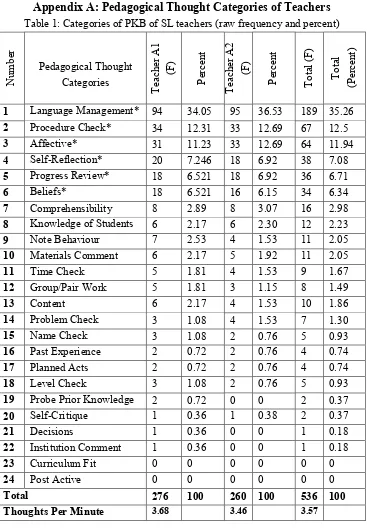
The first aspect in probing the PKB of the teachers focused on identifying the dominant thought categories the three groups of teachers produced. Following the lead of other studies carried out on PKB of ELT teachers (Gatbonton, 2000; 2008; Mullock, 2006; Akbari &Tajik, 2009), the pedagogical thought categories with the frequency of at least 6% of the total number of PTCs were considered dominant, as shown by asterisks in the tables of PTCs (See the Appendix). The analyses showed that Language Management (35.26), Procedure Check (12.5), Affective (11.94), Self-Reflection (7.08), Progress Review (6.71) and Beliefs (6.34) comprised the dominant categories of Standard Licensed teachers. Language Management (39.91), Procedure Check (12.23), Affective (11.58), and Progress Review (6.86) formed the dominant thought categories of Alternatively Licensed teachers. Non-licensed teachers' dominant PTCs included Language Management (41.17), Procedure Check (10.78), Progress Review (6.86), and Note Behaviour (6.37). Self-Reflection, which forms the fourth dominant pedagogical thought category of SL teachers and Beliefs which formed the sixth thought category of their dominant PTCs are excluded from AL and NL teachers' lists of dominant PTCs.
teachers, although their frequency rankings differ across the groups of teachers. Besides these three categories, "Affective" is the common category between SL and AL teachers, and the rankings are the same (3 for both). This category does not appear in NL teachers' list of dominant categories and is relegated to the fifth category for this group. Note Behaviour, on the other hand, is the category which finds dominance only with reference to NL teachers but not the other two groups of teachers. That language management is the most dominant category of PTUs can be put down to the effects of the context of instruction. Since the present study was conducted in an Iranian EFL context, teachers viewed themselves "as the primary agents in charge of facilitating the students’ language input/output, [and] might have made sense of their teaching commitment, either consciously or unconsciously, as that of a language coordinator" (Akbari & Dadvand, 2011, p. 14). That the categories of Procedure Check and Progress Review are the common PTCs across the three groups of teachers can also be interpreted with reference to the institutional pressures on the teachers to make sure that the lessons proceed smoothly from start to finish and that the learners are involved in the lesson, are on task and are successfully carrying out the task. The existence of Affective category as one of the dominant categories of SL and AL teachers and the existence of Self-reflection and Beliefs as two dominant categories among SL teachers can be interpreted with reference the pedagogical expertise of these teachers gained mostly through the teaching preparation courses they have received.
4.2 Comparing teachers' total number of PTUs
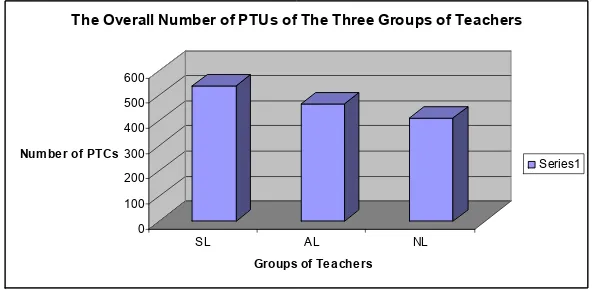
produced the second highest number of PTUs and NL teachers produced the lowest number of PTUs. This is, however, at the descriptive level. But, to still add rigor to the findings and to test the significance of the differences among the three groups of teachers, Chi-square tests were carried out. Chi-square test is the most appropriate procedure to test the relationship between two variables for frequency data (Hatch & Lazaraton, 1991).
The results of the Chi-square tests, run for this purpose, revealed a significant difference among the three groups when compared together. The results are reported in the following table:
Table 1: Chi-square test for the total number of PTCs of the three groups of teachers
Group N Observed N Expected N Chi-Square Asymp. Sig. SL Teachers 2 536 470.0 17.48 .000 AL Teachers 2 466 470.0
NL Teachers 2 408 470.0
The following bar graph also displays the total number of PTUs the three groups of teachers produced.
Figure 1: Graphic representation of the total number of PTCs of the three groups of teachers
0 100 200 300 400 500 600
Number of PTCs
SL AL NL
Groups of Teachers
The Overall Number of PTUs of The Three Groups of Teachers
As shown in the Table above, (M2= 14.09, df = 2, p<.05), there is a significant difference among the three groups of teachers in terms of the number of PTCs they produce while teaching. The greatest difference was, however, found between SL and NL teachers, as the following Chi-square tables indicate:
Table 2: Chi-square test for the total number of PTCs of SL and NL teachers Group N Observed N Expected N Chi-Square Asymp. Sig.
SL Teachers 2 536 472.0 17.35 .000 NL Teachers 2 408 472.0
As the Table shows, (M2= 14.11, df = 2, p<.05), a significant difference is found between SL and NL teachers in terms of the frequency with which they produce PTUs during the process of teaching. It supports the fact that probably the number of pedagogical preparation courses passed can give rise to a much higher number of PTUs. These two types of teachers are the furthest away from each other in the number of pedagogical preparation courses passed. Here too, the greatest difference is found between these two teachers. The results of Chi-square tests also revealed a statistically significant difference between AL and NL teachers, as shown below:
Table 3: Chi-Square test for the total number of PTCs of AL and NL teachers Group N Observed N Expected N Chi-Square Asymp. Sig.
AL Teachers 2 466 437.0 3.84 .050 NL Teachers 2 408 437.0
Table 4: Chi-Square test for the total number of PTCs of SL and AL teachers Group N Observed N Expected N Chi-Square Asymp. Sig.
SL Teachers 2 536 501.0 4.89 .027 AL Teachers 2 466 501.0
The results, (M2= 3.03, df = 2, p<.05), as mentioned earlier, gave rise to a statistically significant difference. This could be interpreted with reference to the fact that although the alternate emergency pedagogical preparation programs the AL teachers have received and have the potential to make their instruction more thoughtful, they cannot be a distinguishing factor in significantly enhancing the number of PTUs feeding the process of a teacher's instruction.
4.3 Comparing dominant PTCs across the types of teachers
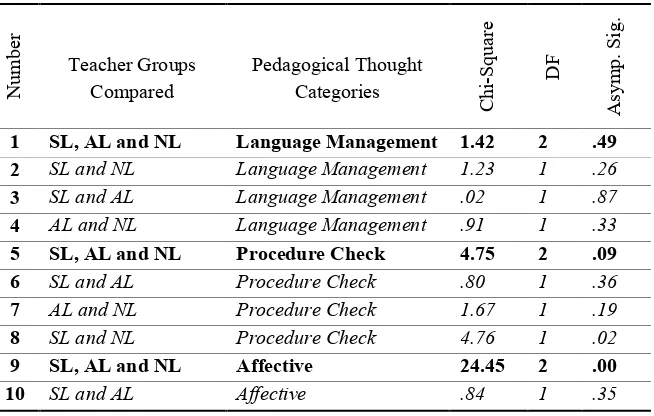
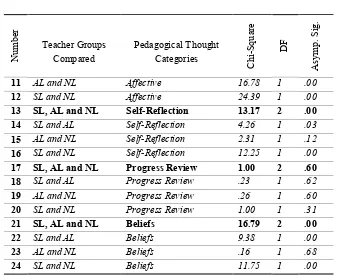
Besides investigating the total number of PTUs across the three groups of teachers, Chi-square tests were run to probe the differences in the dominant PTCs among the three groups of teachers. As the number of chi-square Tables reporting the results would be a bit high, all the results were presented in the following edited Table.
Table 5: The edited table of Chi-square results
A sy m p. S ig . D F C hi -S qu ar e Pedagogical Thought Categories Teacher Groups Compared N um be r .49 2 1.42 Language Management SL, AL and NL
1
.26 1
1.23 Language Management
SL and NL 2
.87 1
.02 Language Management SL and AL
3
.33 1
.91 Language Management AL and NL
4
.09 2
4.75 Procedure Check
SL, AL and NL 5
.36 1
.80 Procedure Check
SL and AL 6
.19 1
1.67 Procedure Check
AL and NL 7
.02 1
4.76 Procedure Check
SL and NL 8
.00 2
24.45 Affective
SL, AL and NL 9
.35 1
.84 Affective
A sy m p. S ig . D F C hi -S qu ar e Pedagogical Thought Categories Teacher Groups Compared N um be r .00 1 16.78 Affective
AL and NL 11
.00 1
24.39 Affective
SL and NL 12
.00 2
13.17 Self-Reflection
SL, AL and NL 13
.03 1
4.26 Self-Reflection
SL and AL 14
.12 1
2.31 Self-Reflection
AL and NL 15
.00 1
12.25 Self-Reflection
SL and NL 16
.60 2
1.00 Progress Review
SL, AL and NL 17
.62 1
.23 Progress Review
SL and AL 18
.60 1
.26 Progress Review
AL and NL 19
.31 1
1.00 Progress Review
SL and NL 20
.00 2
16.79 Beliefs
SL, AL and NL 21
.00 1
9.38 Beliefs
SL and AL 22
.68 1
.16 Beliefs
AL and NL 23
.00 1
11.75 Beliefs
SL and NL 24
Given the fact that Language Management attracted the highest percentage of the total number of PTCs for the three groups of teachers, The first analysis focused on this category. As it can be observed in the table of results, (M2= 1.42, df = 2, p>.05), there is no significant difference among the three groups of teachers in the total number of PTUs related to Language Management. This homogeneity prevailed even when the teachers were compared two by two, as shown in the Table. The results, (M2= 1.23, df = 2, p>.05), (M2= .02, df = 2, p>.05) and (M2= .91, df = 2, p>.05), indicate no significant difference between SL and NL teachers, SL and AL teachers, and AL and NL teachers respectively.
This was also the case when the PTUs related to this category belonging to SL and AL teachers, and AL and NL teachers were compared.
As it can be observed by a look at the results, (M2= .80, df = 2, p>.05) and (M2= 1.67, df = 2, p>.05), no significant difference can be found between SL and AL teachers and also between AL and NL teachers. However, when SL and NL teachers were compared, the analysis revealed the existence of a statistically significant difference between the two Groups. As it can be observed, the results, (M2= .4.76, df = 2, p<.05), attest to the existence of a significant difference between the two groups of teachers, which might be attributable to the greater gap in number of pedagogical preparation courses these two groups of teachers have received. SL teachers tend to manifest greater levels of planning and organization in their classes and show persistence when things do not go smoothly. They seem to be more concerned about classroom organization and they know where they are going in their classes.
The third PTC which was compared across the groups of teachers was The Affective Thoughts category. The results of the Chi-square test run for the purpose of comparing the three groups' number of PTUs related to this category, (M2= .24.45, df = 2, p<.05), reveals the existence of a significant difference among the three groups of teachers with reference to this category. However, this difference does not seem significant between SL and AL teachers. In fact, the results, (M2= .84, df = 2, p>.05), do not support the existence of a statistically significant difference between these two groups of teachers. But the results of chi-square tests run for the purpose of comparing AL and NL, and SL and NL teachers proved the existence of a significant difference. As it can be seen, the results, (M2= 16.78, df = 2, p<.05) and (M2= 24.39, df = 2, p<.05), attest to the existence of a significant difference between these groups of teachers in terms of Affective Thoughts category.
to acknowledge the feelings of their students. They have learnt to be receptive to students’ preferences, likes and dislikes. They have learned, mostly from the courses they have received, to create positive educational atmospheres so that an intimate relationship is established through which students are encouraged to take risks. These features are, of course, found in the AL teachers as well, but to a far lesser extent. These are much in line with the features associated with Affective Thoughts Category of PTUs.
The next category of pedagogical thoughts which was compared was Self-Reflection. This PTC refers to teachers' revelations about themselves, preferences, likes, dislikes, styles of teaching and strategies for dealing with the students. The results of the chi-square tests run for this purpose, (M2= 13.17, df = 2, p<.05), confirm the existence of a statistically significant difference between the three groups of teachers when compared together. This was also the case when SL and AL teachers were compared. Here, again, as the results show, (M2= .4.26, df = 2, p<.05), there is a significance difference between SL and AL teachers. This was not, however, supported between AL and NL teachers. Here, the results, (M2= 2.31, df = 2, p>.05), show that there is not a significant difference between these two groups of teachers although a look at the number of thoughts produced by AL teachers is relatively higher than those produced by NL teachers. The results also attested to the existence of a significant difference between SL and NL teachers when compared together. As shown in the Table of results, (M2= 12.25, df = 2, p<.05), a significant difference has been found between SL and NL teachers. In fact, SL teachers have been put at the upper end of the continuum for Self-Reflection as compared with the other two groups of teachers.
The number of PTUs related to Progress Review for the three groups of teachers was also compared using Chi-square tests. The results of the Chi-square test run for the purpose of comparing PTUs of Progress Review, (M2= 1.00, df = 2, p>.05), proved no significant difference between the three groups of teachers. This was also, more or less, the case when the teachers were compared two by two. As it can be observed, the results, (M2= .23, df = 2, p>.05), (M2= .26, df = 2, p>.05), (M2= 1.00, df = 2, p>.05), proved no significant difference between SL and AL, AL and NL and SL and AL teachers. As mentioned before, the institutional pressures require the teachers to pay enough attention to ensuring that students are involved in the lesson, are successful enough in doing the task and pay adequate attention. This, I assume, masks the investigation of real differences between the three groups of teachers with reference to this category of PTUs.
The last PTC which we compared across the three groups of teachers was Beliefs, which was only among SL teachers' dominant pedagogical category list. This category deals with issues like teachers’ beliefs and knowledge about language, language learning and language teaching, The results of the Chi-square test run for the purpose of investigating this PTC among the three groups of teachers, (M2= 16.79, df = 2, p<.05), proved a significant difference among the three groups of teachers. This difference, however, did not hold for AL and NL teachers. The results, (M2= .16, df = 2, p>.05) proved no significant difference between these two groups of teachers, meaning that a solid pedagogical preparation is needed to make a significant change in teachers’ beliefs about language and language teaching and learning. The more cogent reason for this can be the fact that this category did not appear in the AL and NL teachers’ lists of dominant thought categories.
5. Conclusion
two participants per cluster of teachers due mainly to feasibility concerns in collecting and transcribing the data. As proved by the results, SL teachers, who have received more pedagogical preparation courses, produced the highest number of PTUs (with an average of 3.57 thoughts per minute), and the NL teachers produced the lowest number of PTUs (with an average of 2.72 thoughts per minute); the AL teachers fell in between the two categories (with an average of 3.10 thoughts per minute). This supports the fact that pedagogical preparation courses may have some sort of relationship with the more reflective and thoughtful teaching of the practitioners. SL teachers also produced a more varied spectrum of PTUs. Self-reflection and Beliefs as two of the very important thought units feeding the process of instruction were only found in the SL teachers’ list of dominant pedagogical thought categories and were absent in the other two groups’ PTCs and significant differences were found among the teachers with reference to these thought categories.
knowledge, refers to orientation towards teaching, knowledge of curriculum, student difficulties, effective instructional strategies for a particular concept, assessment methods, etc.
As in other educational domains, in second language pedagogy, Richards (1998) finds Shulman’s conceptualization of knowledge base a suitable frame of reference by which to examine the core knowledge base of second language teachers. He proposes six dimensions for this: ( 1) theories of teaching, (2) teaching skills, (3) communication skills and language proficiency, (4) subject matter knowledge, (5) pedagogical reasoning skills and decision making, and (6) contextual knowledge.
But much to our chagrin, in practice, the perceived distinction between teachers’ subject matter knowledge and teachers’ knowledge of general pedagogical principles and practices seems clouded in second language pedagogy. Many still believe that commonly held knowledge, beliefs, and assumptions about pedagogy are sufficient for a successful accomplishment of the grave aim of second language teaching.
Thus, the results of the study could highlight an immediate need for changes in the views of ELT professionals and practitioners about language pedagogy. Literature in other areas of education other than second language teaching (Davies & Ferugson, 1997; Feiman-Nemser, 2001) stresses the importance of teacher pedagogical preparation in making the greatest impact on the learning process of the students.
Although, more recently in second language pedagogy, a handful of researchers have begun criticizing traditional perspectives of language teacher education and have called for a reconceptualization of the field (Freeman & Johnson, 1998; Freeman & Richards, 1996; Richards & Nunan, 1990, Schulz, 2000; Tsui, 2003); in practice, there has not been any discernible shift.
amalgamation of what has been previously conceived as distinctively identifiable knowledge domains including knowledge of subject matter, the learner, the curriculum, the context and, of course, pedagogy.
Another important implication of this study is the need to reconceptualize policies of licensing. Licensing should be rigid and strict to make sure that highly qualified teachers are hired and should not allow teachers to enter the classroom via alternate routes (Goldhaber & Brewer, 2000). Given the importance of accountability in education today, this issue finds urgency. Knowledge about language teaching, "while not as complex and highly specialized as the professional knowledge required in medicine or law, is sufficiently specialized to warrant professional status" (Mullock, 2006: p. 48). This professional status, she believes, "may result in increasing importance being placed on the preparation and certification of TESOL practitioners" (Mullock, 2006: p. 48)
References
Akbari, R., & Dadvand, B., (2011). Does formal education make a difference? A comparison of pedagogical thought units of BA vs. MA teachers. Modern Language Journal, 95(1), 44-60.
Akbari, R., & Tajik, L. (2009). L2 Teachers’ pedagogic knowledge base: A comparison between experienced and less experienced practitioners. Australian Journal of Teacher Education, 34(6), 52-73.
Alexander, C. D., & Fuller, E. (2005). Effects of teacher qualifications on student achievement in middle school mathematics in Texas, Presented at the American Educational Research Association Annual Meeting.
Blanton, L. P., Sindelar, P. T., & Correa, V. I. (2006). Models and measures of beginning teacher quality. The Journal of Special Education, 40(2), 115-127.
Borg, S. (2003). Teacher cognition in language teaching: A review of research on what language teachers think, know, believe and do.
Cabaroglu, N., & Roberts, J. (2000). Development in student teachers’ pre-existing beliefs during a 1-Year PGCE program. System, 28, 387-402.
Crookes, G., & Arakaki, L. (1999). Teaching idea sources and work conditions in an ESL program. TESOL Journal, 8, 15-19.
Davies, R., & Ferugson, J. (1997). Teachers’ views of the role of initial teacher education in developing their professionalism. Journal of Education for Teaching: International Research and Pedagogy, 23(1),39-56.
Feiman-Nemser, S. (2001). From preparation to practice: Designing a continuum to strengthen and sustain teaching. Teachers College Record, 103(6), 1013-1055.
Fetler, M. (1999). High school characteristics and mathematics test results. Education Policy Analysis Archives, 7(9), 1-20.
Ferguson, R. (1991). Paying for public education: New evidence on how and why money matters. Harvard Journal on Legislation, 28, 465-498.
Ferguson, R. F., & Womack, S. T. (1993). The impact of subject matter and education coursework on teaching performance. Journal of Teacher Education. 44(1), 55-63.
Freeman, D. (2002). The hidden side of the work: Teacher knowledge and learning to teach. LanguageTeaching, 35, 1–13.
Freeman, D., & Johnson, K. E. (1998). Reconceptualizing the knowledge base of language teacher education. TESOL Quarterly, 32, 397–416. Freeman, D., & Richards, J. (Eds.) (1996). Teacher learning in language
teaching. New York: Cambridge University Press.
Gass, S. M., & Mackey, A. (2000). Stimulated recall methodology in second language acquisition. Mahwah, NJ:Erlbaum.
Gatbonton, E. (2000). Investigating experienced ESL teachers’ pedagogical knowledge. Canadian Modern Language Review, 56,
Gatbonton, E. (2008). Looking beyond teachers’ classroom behavior: Novice and experienced ESL teachers’ pedagogical knowledge.
Language Teaching Research, 12, 161-182.
Goldhaber, D., & Brewer, D. (2000) Does teacher certification matter? High school certification status and student achievement.
Educational Evaluation and Policy Analysis,22,129-145.
Golombek, P. R. (1998). A study of language teachers’ personal practical knowledge. TESOL Quarterly, 32, 447- 464.
Guntermann, G. (Ed.) (1993). Developing language teachers for a changing world. Lincolnwood, IL: National Textbook Company. Hanushek, E. A. (1992). "The trade-off between child quantity and
quality." Journal of Political Economy, 100(1), 84–117.
Hanushek, E., & Pace, R. (1995). Who chooses to teach (and why).
Economics of Education Review,14(2), 101-117.
Hatch, E., & Lazaraton, N. (1991). The research manual: Design and Statistics for applied Linguistics, Heinle and Heinle Publishers, USA Johnston, B., & Goettsch, K. (2000). In search of the knowledge base of language teaching: explanations by experienced teachers. Canadian Modern Language Review, 56(3), 437-468.
Miller, J.W., McKenna, B.A., & McKenna, M.C. (1998). A comparison of alternatively and traditionally prepared teachers. Journal of Teacher Education, 49(3), 165-176.
Monk, D. H. (1994). Subject area preparation of secondary mathematics and science teachers and student achievement. Economics of
Education Review,13(2), 125-45.
Mullock, B. (2006). The pedagogical knowledge base of four TESOL teachers. The Modern Language Journal, 90, 48-66.
Richards, J. (1998). The scope of second language teacher education in Beyond training. Cambridge, UK: Cambridge University Press.
Richards, J.C., & D. Nunan (eds) (1990). Second language teacher education. New York: Cambridge University Press.
Richards, J. C., & Pennington, M. (1998). The first year of teaching. In Richards, J.C. (ed.). Beyond Training. Cambridge: Cambridge University Press (pp. 173-90).
Rivkin, S. G., Hanushek, E. A., & Kain, J. F. (1998). Teachers, schools, and academic achievement. NBER Working Paper No. W6691. Rowan, B., Correnti, R., & Miller, R. (2002). What large-scale survey
research tells us about teacher effects on student achievement: Insights from the prospects study of elementary schools. Teachers College Record, 104, 1525–1567.
Schulz, R. A. (2000). Foreign language teacher development: MLJ Perspectives 1916-1999. Modern Language Journal, 84, 496-522. Shulman, L.S. (1986a). Paradigms and research programs in the study of
teaching: A contemporary perspective. In M.C. Wittrock (Ed.),
Handbook of research on teaching (3rd ed.) (pp.3 –36). NewYork: Macmillan.
Shulman, L. (1986b). Those who understand knowledge growth in teaching. Educational Researcher,15(2), 4-14.
Shulman, L. (1987). Knowledge and teaching: Foundations of the new reform. Harvard Educational Review, 57 (1), 1-22.
Tsui, A.B.M., (2003) Understanding expertise in teaching. Cambridge: Cambridge University Press.
Appendix A: Pedagogical Thought Categories of Teachers Table 1: Categories of PKB of SL teachers (raw frequency and percent)
T ot al (P er ce nt ) T ot al (F ) P er ce nt T ea ch er A 2 (F ) P er ce nt T ea ch er A 1 (F ) Pedagogical Thought Categories N um be r 35.26 189 36.53 95 34.05 94 Language Management* 1 12.5 67 12.69 33 12.31 34 Procedure Check* 2 11.94 64 12.69 33 11.23 31 Affective* 3 7.08 38 6.92 18 7.246 20 Self-Reflection* 4 6.71 36 6.92 18 6.521 18 Progress Review* 5 6.34 34 6.15 16 6.521 18 Beliefs* 6 2.98 16 3.07 8 2.89 8 Comprehensibility 7 2.23 12 2.30 6 2.17 6
Knowledge of Students 8 2.05 11 1.53 4 2.53 7 Note Behaviour 9 2.05 11 1.92 5 2.17 6 Materials Comment 10 1.67 9 1.53 4 1.81 5 Time Check 11 1.49 8 1.15 3 1.81 5 Group/Pair Work 12 1.86 10 1.53 4 2.17 6 Content 13 1.30 7 1.53 4 1.08 3 Problem Check 14 0.93 5 0.76 2 1.08 3 Name Check 15 0.74 4 0.76 2 0.72 2 Past Experience 16 0.74 4 0.76 2 0.72 2 Planned Acts 17 0.93 5 0.76 2 1.08 3 Level Check 18 0.37 2 0 0 0.72 2
Table 2: Categories of PKB of AL teachers (raw frequency and percent) T ot al (P er ce nt ) T ot al (F ) P er ce nt T ea ch er A 2 (F ) P er ce nt T ea ch er A 1 (F ) Pedagogical Thought Categories N um be r 39.91 186 40.52 92 39.33 94 Language Management* 1 12.23 57 12.33 28 12.13 29 Procedure Check* 2 11.58 54 11.01 25 12.13 29 Affective* 3 6.86 32 7.04 16 6.69 16 Progress Review* 4 4.72 22 4.40 10 5.02 12 Self-Reflection 5 4.29 20 4.84 11 3.76 9 Note Behaviour 6 3.64 17 3.08 7 4.18 10 Comprehensibility 7 3.00 14 3.08 7 2.92 7
Knowledge of Students 8 2.78 13 2.64 6 2.92 7 Beliefs 9 2.57 12 2.64 6 2.51 6 Materials Comment 10 1.93 9 1.32 3 2.51 6 Time Check 11 1.28 6 1.32 3 1.25 3 Group/Pair Work 12 1.07 5 1.32 3 0.83 2 Problem Check 13 0.85 4 0.88 2 0.83 2 Content 14 0.64 3 0.44 1 0.83 2 Name Check 15 0.64 3 0.44 1 0.83 2 Past Experience 16 0.42 2 0.44 1 0.41 1 Planned Acts 17 0.42 2 0.44 1 0.41 1 Level Check 18 0.42 2 0.44 1 0.41 1
Table 3: Categories of PKB of NL teachers (raw frequency and percent) T ot al (P er ce nt ) T ot al (F ) P er ce nt T ea ch er A 2 (F ) P er ce nt T ea ch er A 1 (F ) Pedagogical Thought Categories N um be r 41.17 168 41.5 83 40.86 85 Language Management* 1 10.78 44 11 22 10.57 22 Procedure Check* 2 6.86 28 6.5 13 7.21 15
Progress Review * 3 6.37 26 6 12 6.73 14 Note Behaviour* 4 4.65 19 4.5 9 4.80 10 Affective 5 4.41 18 4.5 9 4.32 9 Time Check 6 4.16 17 4 8 4.32 9 Comprehensibility 7 3.92 16 4 8 3.84 8
Knowledge of Students 8 3.18 13 3 6 3.36 7 Self-Reflection 9 2.94 12 3 6 2.88 6 Self-Critique 10 2.69 11 3 6 2.40 5 Beliefs 11 2.45 10 2.5 5 2.40 5 Content 12 1.71 7 2 4 1.44 3 Group/Pair Work 13 1.71 7 2 4 1.44 3 Decisions 14 0.98 4 1 2 0.96 2 Past Experience 15 0.49 2 0.5 1 0.48 1 Materials Comment 16 0.49 2 0.5 1 0.48 1 Problem Check 17 0.24 1 0 0 0.48 1 Planned Acts 18 0.24 1 0.5 1 0 0
Appendix B: Definitions of the pedagogical knowledge categories
Pedagogical Thought Categories
Definition Sample Utterances
Language Management
Has to do with the management of language input and students’ output. e.g., provide language, model utterances, elicit language from students.
I’m asking question so that she explains more and more using adjectives.
Procedure Check
Things to do with ensuring that the lesson proceeds smoothly from start to finish, e.g., starting the lesson, giving, explaining and demonstrating procedures.
This is a quick
review for remembering [the
previous
grammatical point].
Noting Student Behavior
The teachers’ comments on what they observe students do and how they react, e.g. they move around or do not want to work with someone.
I am checking their attention at the same time.
Affective
Remarks on teachers’ feelings and reactions about the students, establishing and maintaining rapport, e.g., the teacher wanted students to feel relaxed.
Again this [a joke by the teacher] may help to light up the atmosphere.
Progress Check
Ensuring that the students are involved in the lesson, are doing the things they are supposed to do, and are on task, e.g., check if students are on task, note success in doing the task.
Everyone is engaged in the activity…
Knowledge of Students
Everything that has to do with comments on what teachers know about the students, e.g., I know students’ abilities, personalities, attitudes, interests and feeling.
She [a student who has just read the text] is very sensitive to my comments.
Self Reflect
The teacher’s revelations about her or himself, e.g., likes, preferences, attitudes, hobbies, style of teaching, and strategies in dealing with the students.
Pedagogical Thought Categories
Definition Sample Utterances
Time Check
Remarks on anything to do with timing of activities or tasks, e.g., wanted to give the students enough time, or did not have enough time.
I look down at my watch to see if we still have time [for a role play].
Comprehensibility
Comments on whether students understood lessons, ideas, tasks, whether teacher understood the students’ output, e.g., students did not understand, had trouble understanding.
She couldn’t understand what I was trying to say…
Group Work
Anything to do with group/pair work, e.g. organizing students into groups, teacher intervention in groups.
I want to pair him [a weak student] with someone more active.
Content Check
Knowledge of what the lesson is or should be about, e.g. check what must be covered.
I’m trying to finish the unit…
Self Critique
Teachers’ admission of their mistakes, failings, lapses of judgment, e.g., should have corrected, and did not do the right thing- mostly negative.
I shouldn’t have asked them for a summary at the start …
Beliefs
(Self Explanatory) Teachers’ beliefs and knowledge about language, language learning and language teaching, e.g., I believe students should not be disturbed while on task.
I’d never interrupt students while they talk, even when they
make serious mistakes.
Decisions
Teachers’ choices made while teaching, e.g., decide if the task is appropriate, choosing one task instead of another.
I skip another exercise…
Planning Acts
Thoughts about how teacher planned lesson and how it is carried out in the classroom, e.g., I planned this well, forgot my plan, or the plan did not work.
Pedagogical Thought Categories
Definition Sample Utterances
Problem Check
Has to do with the problems impeding the lesson flow and student difficulties with the lesson, e.g., noting and anticipating student difficulties.
I’m checking to see if there’s any problem [with students’
pronunciation]…
Probe Knowledge
The teachers’ efforts to find out what the students know. e.g., brainstormed, and asked students what they knew about the topic.
I’m digging deeper [asking further questions] to see what they already know.
Past Experience
The teachers’ revelation of what s/he used to do or what s/he did in the past, e.g. I used to make students work harder.
Before, I wouldn’t give them this much of freedom…
Level Check
Comments on the level of the students and lesson, e.g., check whether task matches students’ level, note the student level and adjusting the task.
I was careful not to given them a difficult task given their English [level].
Name Check
Remarks about names, e.g., I suddenly forgot the student’s name, and students’ names are difficult to remember.
Just can’t remember his name!
Materials Com.
The teachers’ reflections on the material to be covered, e.g., the suitability of the material for its intended purpose.
The unit is full of culturally inapt materials …