R E S E A R C H
Open Access
Global exponential stability and existence of
periodic solutions for delayed
reaction-diffusion BAM neural networks with
Dirichlet boundary conditions
Weiyuan Zhang
1*, Junmin Li
2and Minglai Chen
2*Correspondence: [email protected] 1Institute of Mathematics and
Applied Mathematics, Xianyang Normal University, Xianyang, 712000, China
Full list of author information is available at the end of the article
Abstract
In this paper, both global exponential stability and periodic solutions are investigated for a class of delayed reaction-diffusion BAM neural networks with Dirichlet boundary conditions. By employing suitable Lyapunov functionals, sufficient conditions of the global exponential stability and the existence of periodic solutions are established for reaction-diffusion BAM neural networks with mixed time delays and Dirichlet boundary conditions. The derived criteria extend and improve previous results in the literature. A numerical example is given to show the effectiveness of the obtained results.
Keywords: neural networks; reaction-diffusion; mixed time delays; global exponential stability; Poincaré mapping; Lyapunov functional
1 Introduction
Neural networks (NNs) have been extensively studied in the past few years and have found many applications in different areas such as pattern recognition, associative memory, com-binatorial optimization,etc. Delayed versions of NNs were also proved to be important for solving certain classes of motion-related optimization problems. Various results concern-ing the dynamical behavior of NNs with delays have been reported durconcern-ing the last decade (see,e.g., [–]). Recently, the authors in [] and [] considered the problem of exponential passivity analysis for uncertain NNs with time-varying delays and passivity-based con-troller design for Hopfield NNs, respectively.
Since NNs related to bidirectional associative memory (BAM) were proposed by Kosko [], the BAM NNs have been one of the most interesting research topics and have attracted the attention of researchers. In the design and applications of networks, the stability of the designed BAM NNs is one of the most important issues (see,e.g., [–]). Many important results concerning mainly the existence and stability of equilibrium of BAM NNs have been obtained (see,e.g., [–]).
However, strictly speaking, diffusion effects cannot be avoided in the NNs when elec-trons are moving in asymmetric electromagnetic fields. So, we must consider that the ac-tivations vary in space as well as in time. In [–], the authors considered the stability of NNs with diffusion terms which were expressed by partial differential equations. In
ticular, the existence and attractivity of periodic solutions for non-autonomous reaction-diffusion Cohen-Grossberg NNs with discrete time delays were investigated in []. The authors derived sufficient conditions on the stability and periodic solutions of delayed reaction-diffusion NNs (RDNNs) with Neumann boundary conditions in [–]. In these works, due to the divergence theorem employed, a negative integral term with gradient was removed in their deduction. Therefore, the stability criteria acquired by them do not contain diffusion terms; that is to say, the diffusion terms do not have any effect on their deduction and results. Meanwhile, some conditions dependent on the diffusion coeffi-cients were given in [, –] to ensure the global exponential stability and periodicity of RDNNs with Dirichlet boundary conditions based on -norm.
To the best of our knowledge, there are few reports about global exponential stability and periodicity of RDNNs with mixed time delays and Dirichlet boundary conditions, which are very important in theories and applications and also are a very challenging problem. In this paper, by employing suitable Lyapunov functionals, we shall apply inequality tech-niques to establish global exponential stability criteria of the equilibrium and periodic solutions for RDNNs with mixed time delays and Dirichlet boundary conditions. The de-rived criteria extend and improve previous results in the literature [, ].
Throughout this paper, we need the following notations.Rndenotes then-dimensional
Euclidean space. We denote
u(t,x) –u∗=
m
i=
ui–u∗i r
dx,
ϕu(s,x) –u∗= sup
–∞≤s≤
m
i=
ϕui(s,x) –u∗i r
dx
and
v(t,x) –v∗=
n
j=
vj–v∗jrdx,ϕv(s,x) –v∗= sup
–∞≤s≤
n
j=
ϕvj(s,x) –v∗j r
dx
,
r≥.
Letui=ui(t,x),vj=vj(t,x).
The remainder of this paper is organized as follows. In Section , the basic notations, model description and assumptions are introduced. In Sections and , criteria are pro-posed to determine global exponential stability, and periodic solutions are considered for reaction-diffusion recurrent neural networks with mixed time delays, respectively. An il-lustrative example is given to illustrate the effectiveness of the obtained results in Sec-tion . We also conclude this paper in SecSec-tion .
2 Model description and preliminaries
In this paper, the RDNNs with mixed time delays are described as follows:
∂ui
∂t =
l
k= ∂ ∂xk
Dik
∂ui
∂xk
–pi
ui(t,x)
+
n
j=
bjifj
vj(t,x)
+
n
j= ˜
bji˜fj
vj
t–θji(t),x
+
n
j=
¯ bji
t
–∞kji(t–s)
¯ fj
vj(s,x)
ds+Ii(t),
∂vj
∂t =
l
k= ∂ ∂xk
D∗jk∂vj
∂xk
–qj
vj(t,x)
()
+
m
i=
dijgi
ui(t,x)
+
m
i= ˜
dijg˜i
ui
t–τij(t),x
+
m
i=
¯ dij
t
–∞
¯
kij(t–s)g¯i
ui(s,x)
ds+Jj(t).
The RDNNs model given in () can be regarded as RDNNs with two layers, wheremis
the number of neurons in the first layer andnis the number of neurons in the second layer. x= (x,x, . . . ,xl)T∈⊂Rl,is a compact set with smooth boundary∂andmes>
in the spaceRl;u= (u
,u, . . . ,um)T∈Rm,v= (v,v, . . . ,vn)T∈Rn.ui(t,x) andvj(t,x)
rep-resent the state of theith neuron in the first layer and thejth neuron in the second layer at timetand in the spacex, respectively.bji,b˜ji,b¯ji,dij,d¯ijandd˜ijare known constants
denot-ing the synaptic connection strengths between the neurons in the two layers, respectively; fj,f˜j,f¯j,gi,g˜iandg¯idenote the activation functions of the neurons and the signal
propaga-tion funcpropaga-tions, respectively.IiandJjdenote the external inputs on theith neuron andjth
neuron, respectively;piandqjare differentiable real functions with positive derivatives
defining the neuron charging time;τij(t) andθji(t) represent continuous time-varying
de-lay and discrete dede-lay, respectively;Dik≥ andD∗jk≥,i= , , . . . ,m,k= , , . . . ,land
j= , , . . . ,n, stand for the transmission diffusion coefficient along theith neuron andjth neuron, respectively.
System () is supplemented with the following boundary conditions and initial values:
ui(t,x) = , vj(t,x) = , t≥,x∈∂, ()
ui(s,x) =ϕui(s,x), vj(s,x) =ϕvj(s,x), (s,x)∈(–∞, ]× ()
for anyi= , , . . . ,mandj= , , . . . ,n, wheren¯is the outer normal vector of∂,ϕ=ϕu
ϕv
= (ϕu, . . . ,ϕum,ϕv, . . . ,ϕvn)T ∈C are bounded and continuous, whereC=
ϕ|ϕ=ϕu
ϕv
,ϕ :
(–∞,]×Rm (–∞,]×Rn
→Rm+n. It is the Banach space of continuous functions which maps(–∞,]
(–∞,]
intoRm+nwith the topology of uniform convergence for the norm
ϕ =
ϕu
ϕv
= sup
–∞≤s≤
m
i=
|ϕui|rdx
+ sup
–∞≤s≤
n
j=
|ϕvj|rdx
.
Remark Some famous NN models became a special case of system (). For example, when Dik= andD∗jk = (i= , , . . . ,m,k= , , . . . ,l), the special case of model () is
the model which has been studied in [–]. Whenb˜ji= andd˜ij= ,i= , , . . . ,m,j=
, , . . . ,n, system () became NNs with distributed delays and reaction-diffusion terms [, , ].
(A) The functionsτij(t), θji(t) are piecewise-continuous of classCon the closure of
each continuity subinterval and satisfy
≤τij(t)≤τij, ≤θji(t)≤θji, τ˙ij(t)≤μτ< , θ˙ji(t)≤μθ< ,
τ= max
≤i≤m,≤j≤n{τij}, θ=≤i≤maxm,≤j≤n{θji}
with some constantsτij≥,θji≥,τ> ,θ> for allt≥.
(A) The functionspi(·) andqj(·) are piecewise-continuous of classCon the closure of
each continuity subinterval and satisfy
ai=inf
ζ∈Rp
i(ζ) > , pi() = ,
cj=inf
ζ∈Rq
j(ζ) > , qj() = .
(A) The activation functions and the signal propagation functions are bounded and Lipschitz continuous,i.e., there exist positive constantsLfj,L˜fj,Lfj¯,Lgi,Lgi˜andL¯gi such that for allη,η∈R,
fj(η) –fj(η)≤Lfj|η–η|, f˜j(η) –f˜j(η)≤L ˜
f
j|η–η|, f¯j(η) –f¯j(η)≤L
¯
f
j|η–η|, gi(η) –gi(η)≤Lig|η–η|, g˜i(η) –g˜i(η)≤L˜
g
i|η–η|, g¯i(η) –g¯i(η)≤L¯ g
i|η–η|.
(A) The delay kernelsKji(s),K¯ij(s) : [,∞)→[,∞) (i= , , . . . ,m,j= , , . . . ,n) are
real-valued non-negative continuous functions that satisfy the following conditions:
(i) +∞Kji(s)ds= ,
+∞
K¯ji(s)ds= ;
(ii) +∞sKji(s)ds<∞,
+∞
sK¯ij(s)ds<∞;
(iii) There exist a positiveμsuch that
+∞
seμsKji(s)ds<∞,
+∞
seμsK¯ij(s)ds<∞.
Let (u∗,v∗) = (u∗,u∗, . . . ,u∗n,v∗,v∗, . . . ,v∗n) be the equilibrium point of system (). Definition The equilibrium point of system () is said to be globally exponentially stable if we can findr≥ such that there exist constantsα> andβ≥ such that
u(t,x) –u∗+v(t,x) –v∗ ≤βe–αtϕ
u(s,x) –u∗+ϕv(s,x) –v∗ ()
for allt≥.
Lemma [] Letbe a cube|xl|<dl(l= , . . . ,m),and let h(x)be a real-valued function
belonging to C()which vanishes on the boundary∂of,i.e.,h(x)|∂
=.Then
h(x)dx≤dl
∂∂xhldx. ()
3 Global exponential stability
Now we are in a position to investigate the global exponential stability of system (). By constructing a suitable Lyapunov functional, we arrive at the following conclusion.
Theorem Let(A)-(A)be in force.If there exist wi> (i= , , . . . ,n+m),r≥,γij> ,
βji> such that
wi
–rnari–Dil–rnari+ (r– ) n
j=
ari+ (r– )
n
j=
ariβ– r r–
ji
+
n
j=
wm+jmr
|dij|r
Lgir+|˜dij|r
eτ –μτ
Lgi˜r+|¯dij|rγijr
Lgi¯r <
and
wm+j
–rmcrj–D∗jl–rmcrj+ (r– )
m
i=
crj+ (r– )
m
i=
crjγ– r r–
ij
+
m
i=
winr
|bji|r
Lfjr+|˜bji|r
eθ –μθ
Lfj˜r+|¯bji|rβjir
L¯fjr < , ()
in which i= , , . . . ,m,j= , , . . . ,n,Lfj,Lfj˜,Ljf¯,Lgi,Lig˜ and Lgi¯ are Lipschitz constants,Di=
min≤k≤l{Dik/dk},D∗j =min≤k≤l{D∗jk/dk},then the equilibrium point(u∗,v∗)of system()is
unique and globally exponentially stable.
Proof If () holds, we can always choose a positive numberδ> (may be very small) such that
wi
–rnari–Dil–rnari+ (r– ) n
j=
ari+ (r– )
n
j=
ariβ– r r–
ji
+
n
j=
wm+jmr
|dij|r
Lgir+|˜dij|r
eτ –μτ
Lgi˜r+|¯dij|rγijr
Lg¯i
i
r
+δ<
and
wm+j
–rmcrj–D∗jl–rmcrj+ (r– )
m
i=
crj+ (r– )
m
i=
crjγ– r r–
ij
+
m
i=
winr
|bji|r
Lfjr+|˜bji|r
eθ –μθ
Lfj˜r+|¯bji|rβjir
L¯fjr +δ< , ()
Let us consider the functions
Fi
x∗i=wi
–rnari–Dil–rnari+ (r– ) n
j=
ari
+ (r– )
n
j=
ariβ– r r–
ji
+∞
kji(s)ds+ x∗inari–
+
n
j=
wm+jmr
|dij|r
Lgir+|˜dij|r
eτ –μτ
Lgi˜r
+|¯dij|rγijr
Lg¯i
i
r +∞
ex∗isk¯
ij(s)ds
and
Gj
y∗j=wm+j
–rmcrj–D∗jl–rmcrj+ (r– )
m
i=
crj+ (r– )
m
i=
crjγ– r r–
ij
+∞
¯ kij(s)ds
+ y∗jmcrj–
+
m
i=
winr
|bji|r
Lfjr
+|˜bji|r
eθ –μθ
Lfj˜r+|¯bji|rβjir
Lfj¯r
+∞
ey∗jsk
ji(s)ds , ()
wherex∗i,y∗j ∈[, +∞),i= , , . . . ,m,j= , , . . . ,n.
From () and (A), we deriveFi() < –δ< ,Gj() < –δ< ;Fi(x∗i) andGj(y∗j) are
con-tinuous forx∗i,y∗j ∈[, +∞). Moreover,Fi(x∗i)→+∞asx∗i →+∞andGj(y∗j)→+∞as
y∗j →+∞. Thus there exist constantsεi,σj∈[, +∞) such that
Fi(εi) =wi
–rnari–Dil–rnari+ (r– ) n
j=
ari
+ (r– )
n
j=
ariβ– r r–
ji
+∞
kji(s)ds+ εinari–
+
n
j=
wm+jmr
|dij|r
Lgir
+|˜dij|r
eτ –μτ
Lgi˜r+|¯dij|rγijr
Lg¯i
i
r +∞
eεisk¯
ij(s)ds =
and
Gj(σj) =wm+j
–rmcrj–D∗jl–rmcrj+ (r– )
m
i=
crj
+ (r– )
m
i=
crjγ– r r–
ij
+∞
¯
kij(s)ds+ σjmcrj–
+
m
i=
winr
|bji|r
Lfjr
+|˜bji|r
eθ –μθ
Lfj˜r+|¯bji|rβjir
L¯fjr
+∞
eσjsk
ji(s)ds = , ()
By usingα=min≤i≤m,≤j≤n{εi,σj}, obviously, we get
Fi(α) =wi
–rnari–Dil–rnari+ (r– ) n
j=
ari
+ (r– )
n
j=
ariβ– r r–
ji
+∞
kji(s)ds+ αnari–
+
n
j=
wm+jmr
|dij|r
Lgir
+|˜dij|r
eτ –μτ
Lgi˜r+|¯dij|rγijr
Lg¯i
i
r +∞
eαsk¯ij(s)ds ≤
and
Gj(α) =wm+j
–rmcrj–D∗jl–rmcrj+ (r– )
m
i=
crj
+ (r– )
m
i=
crjγ– r r– ij +∞ ¯
kij(s)ds+ αmcrj–
+
m
i=
winr
|bji|r
Lfjr
+|˜bji|r
eθ –μθ
Lfj˜r+|¯bji|rβjir
Lfj¯r
+∞
eαskji(s)ds ≤, ()
wherei= , , . . . ,m,j= , , . . . ,n.
Suppose (u,v) = (u,u, . . . ,un,v,v, . . . ,vn)Tis any solution of model (). Rewrite model
() as
∂(ui–u∗i)
∂t =
l
k= ∂ ∂xk
Dik
∂(ui–u∗i)
∂xk
–pi
ui(t,x)
–pi
u∗i
+ n j= bji fj
vj(t,x)
–fj
v∗j+
n j= ˜ bji ˜ fj vj
t–θji(t),x
–f˜j
v∗j
+ n j= ¯ bji t
–∞kji(t–s) ¯
fj
vj(s,x)
–f¯j
v∗jds, ()
∂(vj–v∗j)
∂t =
l
k= ∂ ∂xk
D∗jk∂(vj–v
∗
j)
∂xk
–qj
vj(t,x)
–qj
v∗j
+ m i= dij gi
ui(t,x)
–gi
u∗i+
m i= ˜ dij ˜ gi ui
t–τij(t),x
–g˜i
u∗i
+ m i= ¯ dij t –∞ ¯ kij(t–s)
¯ gi
ui(s,x)
–g¯i
u∗ids. ()
Multiplying () byui–u∗i and integrating overyield
d dt
ui–u∗i
dx = l k=
ui–u∗i
∂ ∂xk
Dik
∂(ui–u∗i)
∂xk
–pi(ξi)
ui–u∗i
dx+ n j= bji
ui–u∗i
fj(vj) –fj
v∗jdx
+ n j= ˜ bji
ui–u∗i
˜
fj
vj
t–θji(t),x
–f˜j
v∗jdx
+ n j= ¯ bji
ui–u∗i t
–∞kji(t–s) ¯
fj
vj(s,x)
–¯fj
v∗j ds
dx. ()
According to Green’s formula and the Dirichlet boundary condition, we get
l k=
ui–u∗i
∂ ∂xk
Dik
∂(ui–u∗i)
∂xk
dx= –
l k= Dik
∂(ui–u∗i)
∂xk
dx. ()
Moreover from Lemma , we have
– l k= Dik
∂(ui–u∗i)
∂xk
dx≤–
l k= Dik
dk
ui–u∗i
dx≤–Dilui–u∗i
. ()
From ()-(), (A), (A) and the Holder integral inequality, we obtain that
d dt
ui–u∗i
dx
≤–Dil
ui–u∗i
dx– ai
ui–u∗i
dx + n j=
|bji|ui–u∗iL f
jvj–v∗jdx
+ n j=
|˜bji|ui–u∗if˜
vj
t–θji(t),x
–f˜v∗jdx
+ n j=
|¯bji|
t
–∞kji(t–s)
ui–u∗if¯j
vj(s,x)
–f¯j
v∗j ds
dx. ()
Multiplying both sides of () byvj–v∗j, similarly, we also have
d dt
vj–v∗j
dx
≤–D∗jl
vj–v∗jdx– cj
vj–v∗jdx
+ m i=
|dij|Lgiui–u∗ivj–v∗jdx
+ m i=
|˜dij|g˜
ui
t–τij(t),x
–g˜u∗ivj–v∗jdx
+ m i=
|¯dij|
t
–∞
¯
kij(t–s)g¯i
ui(s,x)
–g¯i
u∗ivj–v∗jds
Choose a Lyapunov functional as follows:
V(t) =
m i= wi
nari–ui–u∗i r
eαt
+
n
j=
|˜bji|rnr
eθ –μθ
t t–θji(t)
eαξf˜
j
vj(ξ,x)
–f˜j
v∗jrdξ
+
n
j=
|¯bji|rnrβjir
+∞
kji(s)
t t–s
eα(s+ξ)¯fj
vj(ξ,x)
–f¯j
v∗jrdξds
dx + n j=
wm+j
mcrj–vj–v∗j r
eαt
+
m
i=
|˜dij|rmr
eτ –μτ
t t–τij(t)
eαξg˜i
ui(ξ,x)
–g˜i
u∗irdξ
+
m
i=
|¯dij|rmrγijr
+∞
¯ kij(s)
t t–s
eα(s+ξ)g¯i
ui(ξ,x)
–g¯i
u∗irdξds
dx.
Its upper Dini-derivative along the solution to system () can be calculated as follows:
D+V(t)≤
m i= wi
rnari–ui–u∗i
r–∂|ui–u∗i|
∂t e
αt+ αeαtnar–
i ui–u∗i r
+eαt
n
j=
|˜bji|rnr
eθ –μθ
f˜j
vj(t,x)
–f˜j
v∗jr
–
n
j=
|˜bji|rnr
eθ –μθ
–θ˙ji(t)
eα(t–θji(t))f˜
j
vj
t–θji(t),x
–f˜j
v∗jr
+eαt
n
j=
|¯bji|rnrβjir
+∞
eαskji(s)f¯j
vj(t,x)
–f¯j
v∗jrds
–eαt
n
j=
|¯bji|rnrβjir
+∞
kji(s)f¯j
vj(t–s,x)
–f¯j
v∗jrds
dx + n j=
wm+j
rmcrj–vj–v∗j
r–∂|vj–v∗j|
∂t e
αt+ αeαtmcr–
j vj–v∗j r
+eαt
m
i=
|˜dij|rmr
eτ –μτ
g˜i
ui(t,x)
–g˜i
u∗ir
–
m
i=
|˜dij|rmr
eτ –μτ
eα(t–τij(t))( –τ˙
ij)g˜i
ui
t–τij(t),x
–g˜i
u∗ir
+eαt
m
i=
|¯dij|rmrγijr
+∞
eαsk¯ij(s)g¯i
ui(t,x)
–g¯i
u∗irds
–eαt
m
i=
|¯dij|rmrγijr
+∞
¯ kij(s)g¯i
ui(t–s,x)
–g¯i
u∗irds
≤ m i= wi
rnari–ui–u∗i r–
eαt
–Dilui–u∗i
–aiui–u∗i
+ n j=
|bji|ui–u∗iL f
jvj–v∗j
+
n
j=
|˜bji|ui–u∗if˜
vj
t–θji(t),x
–f˜v∗j
+
n
j=
|¯bji|
t
–∞kji(t–s)
ui–u∗if¯j
vj(s,x)
–f¯j
v∗j ds
+ αeαtnar–
i ui–u∗i r
+eαt n
j=
|˜bji|rnr
eθ –μθ
f˜j
vj(t,x)
–f˜j
v∗jr
–eαt n
j=
|˜bji|rnrf˜j
vj(t–θji,x)
–f˜j
v∗jr
+eαt
n
j=
|¯bji|rnrβjir
+∞
eαskji(s)f¯j
vj(t,x)
–f¯j
v∗jrds
–eαt
n
j=
|¯bji|rnrβjir
+∞
kji(s)f¯j
vj(t–s,x)
–f¯j
v∗jrds
dx + n j=
wm+j
rmcrj–vj–v∗j r–
eαt
–D∗jlvj–v∗j
–cjvj–v∗j
+ m i=
|dij|L g
iui–u∗ivj–v∗j+ m
i=
|˜dij|g˜
ui(t–τij,x)
–g˜u∗ivj–v∗j
+
m
i=
|¯dij|
t
–∞
¯
kij(t–s)g¯i
ui(s,x)
–g¯i
u∗ivj–v∗j ds
+ αeαtmcjr–vj–v∗j r
+eαt
m
i=
|˜dij|rmr
eτ –μτ
g˜i
ui(t,x)
–g˜i
u∗ir
–eαt
m
i=
|˜dij|rmrg˜i
ui(t–τij,x)
–g˜i
u∗ir
+eαt
m
i=
|¯dij|rmrγijr
+∞
eαsk¯ji(s)g¯i
ui(t,x)
–g¯i
u∗irds
–eαt m
i=
|¯dij|rmrγijr
+∞
¯ kij(s)g¯i
ui(t–s,x)
–g¯i
u∗irds
dx. ()
From () and the Young inequality, we can conclude
D+V(t)≤
eαt
m
i=
wi
–rnari–Dilui–u∗i r
–rnariui–u∗i r
+ (r– )
n
j=
+
n
j=
nr|bji|r
Lfjrvj–v∗j r
+ (r– )
n
j=
ariui–u∗i r
+
n
j=
|˜bji|rnrf˜j
vj
t–θji(t),x
–f˜j
v∗jr
+ (r– )
n
j=
ariβ– r r–
ji
t
–∞kji(t–s)
ui–u∗irds
+
n
j=
|¯bji|rnrβjir
t
–∞kji(t–s) f¯j
vj(s,x)
–f¯j
vj∗rds + αnair–ui–u∗i r
+
n
j=
|˜bji|rnr
eθ –μθ
f˜j
vj(t,x)
–f˜j
v∗jr
–
n
j=
|˜bji|rnrf˜j
vj
t–θji(t),x
–f˜j
v∗jr
+
n
j=
|¯bji|rnrβjir
+∞
eαskji(s)f¯j
vj(t,x)
–f¯j
v∗jrds
–
n
j=
|¯bji|rnrβjir
+∞
kji(s)f¯j
vj(t–s,x)
–f¯j
v∗jrds
dx
+
eαt
n
j=
wm+j
–rmcrj–D∗jlvj–v∗j r
–rmcrjvj–v∗j r
+ (r– )
m
i=
crjvj–v∗j r + m i=
|dij|rmr
Lgirui–u∗i r
+ (r– )
m
i=
crjvj–v∗j r
+
m
i=
|˜dij|rmrg˜i
ui
t–τij(t),x
–g˜i
u∗ir
+ (r– )
m
i=
crjγ– r r– ij t –∞ ¯
kij(t–s)vj–v∗j r ds + m i=
|¯dij|rmrγijr
t
–∞
¯
kij(t–s)g¯i
ui(s,x)
–g¯i
u∗irds
+ αmcrj–vj–v∗j r
+
m
i=
|˜dij|rmr
eτ –μτ
g˜i
ui(t,x)
–g˜i
u∗ir
–
m
i=
|˜dij|rmrg˜i
ui
t–τij(t),x
–g˜i
u∗ir
+
m
i=
|¯dij|rmrγijr
+∞
eαsk¯ij(s)g¯i
ui(t,x)
–g¯i
u∗irds
–
m
i=
|¯dij|rmrγijr
+∞
¯ kij(s)g¯i
ui(t–s,x)
–g¯i
u∗irds
≤
eαt
m i= wi
–rnari–Dil–rnari+ (r– ) n
j=
ari+ αnari–
+ (r– )
n
j=
ariβ– r r–
ji
t
–∞kji(t–s)ds +
n
j=
wm+jmr
|dij|r
Lgir
+|˜dij|r
eτ –μτ
Lgi˜r+|¯dij|rγijr
+∞
eαsk¯ij(s)
Lg¯i
i
r
ds ui–u∗i r
dx
+
eαt
n
j=
wm+j
–rmcrj–D∗jl–rmcrj+ (r– )
m
i=
crj
+ (r– )
m
i=
crjγ– r r– ij t –∞ ¯
kij(t–s)ds + αmcrj–
+
m
i=
winr
|bji|r
Lfjr
+|˜bji|r
eθ –μθ
L˜fjr+|¯bji|rβjir
Lfj¯r
+∞
eαskji(s)ds vj–v∗j r
dx. ()
From (), we can conclude
D+V(t)≤ and so V(t)≤V(), t≥. ()
Since
V() =
m i= wi
nari–ui(,x) –u∗i r
+
n
j=
|˜bji|rnr
eθ –μθ
–θji(t) f˜j
vj(ξ,x)
–f˜j
v∗jrdξ
+
n
j=
|¯bji|rnrβjir
+∞
kji(s)
–s
eα(s+ξ)f¯
j
vj(ξ,x)
–f¯j
v∗jrdξds
dx + n j=
wm+j
mcrj–vj(,x) –v∗j r
+
m
i=
|˜dij|rmr
eτ –μτ
–τij(t) g˜i
ui(ξ,x)
–g˜i
u∗irdξ
+
m
i=
|¯dij|rmrγijr
+∞
¯ kij(s)
–s
eα(s+ξ)g¯
i
ui(ξ,x)
–g¯i
u∗irdξds
dx ≤ m i= max ≤i≤m{wi}
nari–ui(,x) –u∗i r
+
n
j=
|˜bji|rnr
eθ –μθ
L˜fjr
–θji
vj(ξ,x) –v∗j r dξ + n j=
|¯bji|rnr
Lfj¯rβjir +∞
kji(s)
–s
eα(s+ξ)vj(ξ,x) –v∗j r
dξds
+
n
j= max ≤j≤n{wm+j}
mcrj–vj(,x) –v∗j r
+
m
i=
|˜dij|r
L˜girmr e τ
–μτ
–τij
ui(ξ,x) –u∗i r
dξ
+
n
j=
|¯dij|rmr
Lgi¯rγijr +∞
¯ kji(s)
–s
eα(s+ξ)ui(ξ,x) –u∗i r
dξds
dx
≤
max
≤i≤m{wi}+≤maxj≤n{wm+j}≤maxj≤n
m
i=
|¯dij|rmr
L¯girγijr +∞
¯
kij(s)seαsds
+max
≤j≤n{wm+j}≤maxj≤n
m
i=
|˜dij|r
L˜girmr e ττ
–μτ
ϕu(s,x) –u∗ r
+
max
≤j≤n{wm+j}+≤maxi≤m{wi}≤maxi≤m
n
j=
|¯bji|rnr
Lfj¯rβjir +∞
seαskji(s)ds
+max
≤i≤m{wi}≤maxi≤m
n
j=
|˜bji|rnr
Lgj˜r e θθ
–μθ
ϕv(s,x) –v∗ r
. ()
Noting that
eαt
min ≤i≤m+nwi
u(t,x) –u∗+v(t,x) –v∗≤V(t), t≥. ()
Let
β=max
max
≤i≤m{wi}+≤maxj≤n{wm+j}≤maxj≤n
m
i=
|¯dij|rmr
Lgi¯rγijr +∞
¯
kij(s)seαsds
+max
≤j≤n{wm+j}≤maxj≤n
m
i=
|˜dij|r
Lgi˜rmr e ττ
–μτ
,
max
≤j≤n{wm+j}+≤maxi≤m{wi}≤maxi≤m
n
j=
|¯bji|rnr
L¯fjrβjir +∞
seαskji(s)ds
+max
≤i≤m{wi}≤maxi≤m
n
j=
|˜bji|rnr
Lgj˜r e θθ
–μθ
min ≤i≤m+n{wi}.
Clearly,β≥. It follows that
u(t,x) –u∗+v(t,x) –v∗≤βe–αtϕu(s,x) –u∗+ϕv(s,x) –v∗,
for anyt≥, whereβ≥ is a constant. This implies that the solution of () is globally
exponentially stable. This completes the proof of Theorem .
diffusion term. Obviously, Lyapunov functional to construct is more general and our re-sults expand the model in [, ].
Whenb˜ji= andd˜ij= (i= , , . . . ,m,j= , , . . . ,n), system () becomes the following
BAM NNs with distributed delays and reaction-diffusion terms:
∂ui
∂t =
l
k= ∂ ∂xk
Dik
∂ui
∂xk
–pi
ui(t,x)
+
n
j=
bjifj
vj(t,x)
+
n
j=
¯ bji
t
–∞kji(t–s)
¯ fj
vj(s,x)
ds+Ii(t),
∂vj
∂t =
l
k= ∂ ∂xk
D∗jk∂vj
∂xk
–qj
vj(t,x)
+
m
i=
dijgi
ui(t,x)
+
m
i=
¯ dij
t
–∞
¯
kij(t–s)g¯i
ui(s,x)
ds+Jj(t).
()
For (), we get the following result.
Corollary Let(A)-(A)be in force.If there exist wi> (i= , , . . . ,n+m),r≥,γij> ,
βji> such that
wi
–rnari–Dil–rnari+ (r– ) n
j=
ari+ (r– )
n
j=
ariβ– r r–
ji
+
n
j=
wm+jmr
|dij|r
Lgir+|¯dij|rγijr
L¯gir<
and
wm+j
–rmcrj–D∗jl–rmcrj+ (r– )
m
i=
crj+ (r– )
m
i=
crjγ– r r–
ij
+
m
i=
winr
|bji|r
Lfjr+|¯bji|rβjir
Lfj¯r< , ()
where i= , , . . . ,m,j= , , . . . ,n,Lfj,Lfj˜,Ljf¯,Lgi,Lgi˜and L¯gi are Lipschitz constants.Then the equilibrium point(u∗,v∗)of system()is unique and globally exponentially stable.
4 Periodic solutions
In this section, we consider the stability criterion for periodic oscillatory solutions of sys-tem (), in which external inputIi:R+→R,i= , , . . . ,m, andJj:R+→R,j= , , . . . ,n,
are continuously periodic functions with periodω, that is,
Ii(t+ω) =Ii(t), Jj(t+ω) =Jj(t), i= , , . . . ,m,j= , , . . . ,n.
Theorem Let (A)-(A)be in force. There exists only oneω-periodic solution of sys-tem(),and all other solutions converge exponentially to it as t→+∞if there exist con-stants wi> (i= , , . . . ,n+m),r≥,γij> ,βji> (i= , , . . . ,m, j= , , . . . ,n)such
that
wi
–rnari–Dil–rnari+ (r– ) n
j=
ari+ (r– )
n
j=
ariβ– r r–
ji
+
n
j=
wm+jmr
|dij|r
Lgir+|˜dij|r
eτ –μτ
Lgi˜r+|¯dij|rγijr
Lgi¯r <
and
wm+j
–rmcrj–D∗jl–rmcrj+ (r– )
m
i=
crj+ (r– )
m
i=
crjγ– r r–
ij
+
m
i=
winr
|bji|r
Lfjr+|˜bji|r
eθ –μθ
Lfj˜r+|¯bji|rβjir
L¯fjr < , ()
where i= , , . . . ,m and j= , , . . . ,n,Lfj,L˜fj,Ljf¯,Lgi,L˜gi and Lgi¯ are Lipschitz constants in (A).
Proof For anyϕu
ϕv
,ψu
ψv
∈C, we denote the solutions of system () through,ϕu
ϕv
and,ψu
ψv
as
u(t,ϕu,x) =
u(t,ϕu,x), . . . ,um(t,ϕu,x)
T
, v(t,ϕv,x) =
v(t,ϕv,x), . . . ,vn(t,ϕv,x)
T
and
u(t,ψu,x) =
u(t,ψu,x), . . . ,um(t,ψu,x)
T
, v(t,ψv,x) =
v(t,ψv,x), . . . ,vn(t,ψv,x)
T
,
respectively. Define
ut(ϕu,x) =u(t+θ,ϕu,x), θ∈(–∞, ],t≥,
vt(ϕv,x) =v(t+θ,ϕv,x), θ∈(–∞, ],t≥.
Clearly, for anyt≥,ut(ϕu)
vt(ϕv)
∈C. Now, we define
yi=ui(t,ϕu,x) –ui(t,ψu,x), zj=vj(t,ϕv,x) –vj(t,ψv,x).
Thus, we can obtain from system () that
∂yi
∂t =
l
k= ∂ ∂xk
Dik
∂yi
∂xk
–pi
ui(t,ϕu,x)
–pi
ui(t,ψu,x)
+
n
j=
bji
fj
vj(t,ϕv,x)
–fj
vj(t,ψv,x)
+
n
j= ˜
bji
˜
fj
vj
t–θji(t),ϕv,x
–f˜j
vj
t–θji(t),ψv,x
+
n
j=
¯ bji
t
–∞kji(t–s) ¯
fj
vj(s,ϕv,x)
–¯fj
vj(s,ψv,x) ds,
∂zj
∂t =
l
k= ∂ ∂xk
D∗jk∂zj
∂xk
–qj
vj(t,ϕv,x)
–qj
vj(t,ψv,x)
+
m
i=
dij
gi
ui(t,ϕu,x)
–gi
ui(t,ψu,x)
+
m
i= ˜
dij
˜ gi
ui
t–τij(t),ϕu,x
–g˜i
ui
t–τij(t),ψu,x
+
m
i=
¯ dij
t
–∞
¯ kij(t–s)
¯ gi
ui(s,ϕu,x)
–g¯i
ui(s,ψu,x)
ds .
We consider the following Lyapunov functional:
V(t) =
m
i=
wi
nari–|yi|reαt
+
n
j=
|˜bji|rnr( –μθ)
t t–θji(t)
f˜j
vj(ξ,ϕv,x)
–f˜j
vj(ξ,ψv,x) r
dξ
+
n
j=
|¯bji|rnrβjir
+∞
kji(s)
t t–s
eα(s+ξ)
ׯfj
vj(ξ,ϕv,x)
–f¯j
vj(ξ,ψv,x)rdξds
dx
+
n
j=
wm+j
mcrj–|zj|reαt
+
m
i=
|˜dij|rmr( –μτ)
t t–τij(t)
g˜i
ui(ξ,ϕu,x)
–g˜i
ui(ξ,ψu,x) r
dξds
+
m
i=
|¯dij|rmrγijr
+∞
¯ kij(s)
t t–s
eα(s+ξ)
×g¯i
ui(ξ,ϕu,x)
–g¯i
ui(ξ,ψu,x)rdξds
dx.
By a minor modification of the proof of Theorem , we can easily get
u(t,ϕu,x) –u(t,ψu,x)+v(t,ϕv,x) –v(t,ψv,x)
≤βe–αt ϕu–ψu + ϕv–ψv
fort≥,in whichβ≥ is a constant. Now, we can choose a positive integerNsuch that
βe–αNω≤
, βe
–αNω≤
. ()
Defining a Poincaré mappingP:C→Cby
P ϕu ϕv =
uω(ϕu)
vω(ϕv)
, ()
due to the periodicity of system, we have
PN ϕu ϕv =
uNω(ϕu)
vNω(ϕv)
. ()
Lett=Nω, then from ()-() we can derive that
PN
ϕu
ϕv
–PN
ψu ψv ≤ ϕu ϕv – ψu ψv ,
which shows thatPNis a contraction mapping. Therefore, there exists a unique fixed point
ϕu∗
ϕv∗
∈C, namely,PNϕu∗
ϕv∗
=ϕu∗
ϕv∗
.
SincePNPϕu∗ ϕv∗
=PPNϕu∗ ϕv∗
=Pϕu∗
ϕv∗
, thenPϕ∗u
ϕ∗v
is also a fixed point ofPN. Because of
the uniqueness of a fixed point ofPN, thenPϕu∗
ϕv∗
=ϕu∗
ϕv∗
.
Let (u(t,ϕu∗,x),v(t,ϕ∗v,x)) be the solution of system () through,ϕu∗
ϕv∗
, then (u(t+
ω,ϕu∗,x),v(t+ω,ϕ∗v,x)) is also a solution of system (). Clearly,
ut+ω
ϕu∗,x vt+ω
ϕv∗,x =
ut
uω
ϕu∗
vt
vω
ϕ∗v =
ut
ϕu∗,x vt
ϕv∗,x fort≥. Hence (u(t+ω,ϕ∗u,x),v(t+ω,ϕ∗v,x))T= (u(t,ϕ∗
u,x),v(t,ϕv∗,x))Tfort≥.
This shows that (u(t,ϕu∗,x),v(t,ϕv∗,x))Tis exactly oneω-periodic solution of system (), and it is easy to see that all other solutions of system () converge exponentially to it as
t→+∞. The proof is completed.
5 Illustration example
In this section, a numerical example is given to illustrate the effectiveness of the obtained results.
Example Consider the following system on={(x,x)T| <xk<
√
.π,k= , } ⊂R:
∂ui
∂t =
l
k= ∂ ∂xk
Dik
∂ui
∂xk
–pi
ui(t,x)
+ n j=
bjifj
vj(t,x)
+ n j= ˜
bjif˜j
vj
t–θji(t),x
+ n j= ¯ bji t
–∞kji(t–s)
¯ fj
vj(s,x)
ds+Ii(t),
∂vj
∂t =
l
k= ∂ ∂xk
D∗jk∂vj
∂xk
–qj
vj(t,x)
+ m i=
dijgi
ui(t,x)
+ m i= ˜
dijg˜i
ui
t–τij(t),x
+ m i= ¯ dij t –∞ ¯
kij(t–s)g¯i
ui(s,x)
ds+Jj(t),
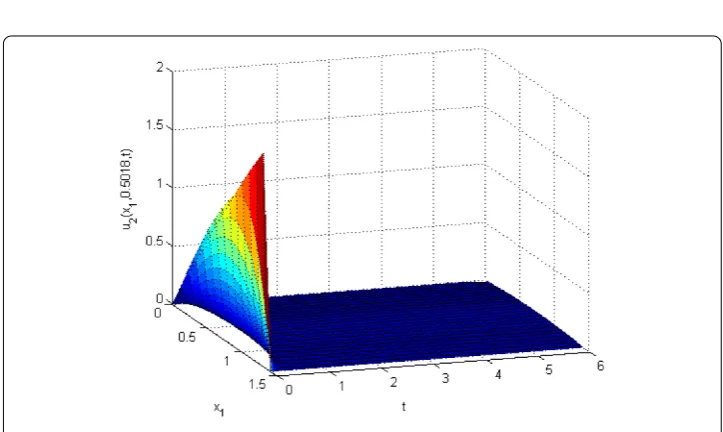
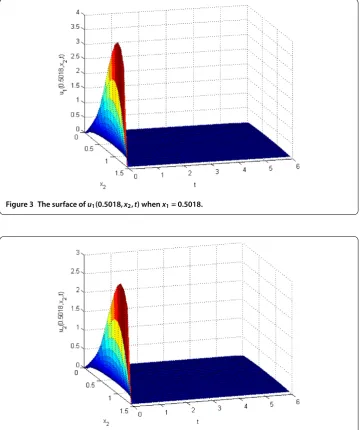
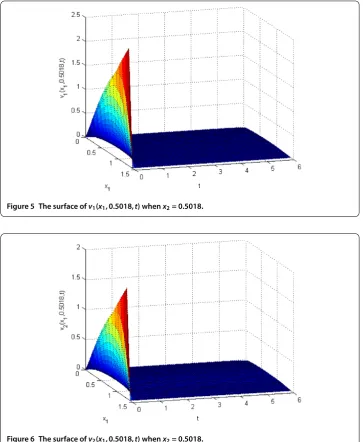
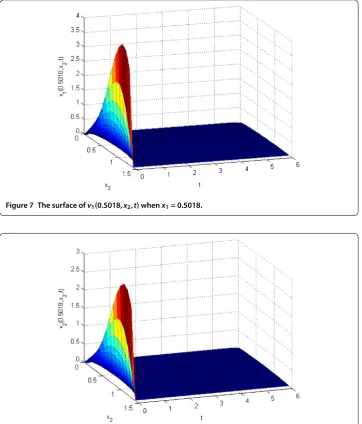
Figure 1 The surface ofu1(x1, 0.5018,t) whenx2= 0.5018.
Figure 2 The surface ofu2(x1, 0.5018,t) whenx2= 0.5018.
ui= , vj= , t≥, x∈∂,
ui(s,x) =ϕui(s,x), vj(s,x) =ϕvj(s,x), (s,x)∈(–∞, ]×,
where kji(t) =k¯ij(t) =te–t,i,j,l= , .f(η) =f(η) =f˜(η) =f˜(η) =f¯(η) =¯f(η) =g(η) =
g(η) =g˜(η) =g˜(η) =g¯(η) =g¯(η) =tanh(η),n=m=l= ,λ= .,θji(t) =τij(t) = . –
.sin(πt),Lfj =Ljf˜ =Lfj¯ =Lgi =Lig˜ =L¯gi = ,i,j= , . pi(ui(t,x)) =ui(t,x),qj(vj(t,x)) =
vj(t,x),D=D= ,D∗ =D∗= ,a=a= ,c=c= ,r= ,μτ =μθ= .,d= .,
d= ,d= .,d= .,d˜= –.,d˜= .,d˜= .,d˜= .,d¯= .,d¯= .,
¯
d= .,d¯= .,b= .,b= .,b= –.,b= –.,b˜= –,b˜= .,b˜= .,
˜