ARTICLE
Event-specific multiplex PCR method for four
genetically modified cotton varieties, and its
application
Soon‑Jae Eum, Il Ryong Kim, Hye Song Lim, Jung Ro Lee and Wonkyun Choi
*Abstract
Multiplex polymerase chain reaction (PCR) methods have been developed and validated for screening, tracing, and regulating genetically modified (GM) crops in quarantine and environmental monitoring. In this study, we aimed to develop a method to simultaneously detect four GM cotton varieties in order to establish a screening system for cot‑ ton volunteers. Based on the sequence of DNA in the junction between introduced gene and flanking genomic DNA of four GM cotton events, herbicide‑tolerant MON88701 and DAS‑81910‑7 and insect‑resistant COT102 and T304‑40, event‑specific primers were designed and a multiplex detection method was developed. The simplex PCR results supported the multiplex PCR results; the amplification efficiency of the novel multiplex PCR method was increased compared with that of the Joint Research Centre (JRC) method. Based on the accuracy and efficiency, the method can be applied to detect and identify randomly mixed reference materials and suspected cotton volunteers. To apply this multiplex PCR method to living modified (LM) environmental monitoring samples, we performed additional PCR analysis to identify whether the volunteers were the four LM cotton varieties. As a result, 66 cotton volunteers were identified with stack event, comprising one or two of the four LM cotton events, and all stacks have been approved in South Korea for food, feed, and processing. These results indicated that our novel multiplex method is suitable for LMO identification.
Keywords: Cotton, Living modified organism, LMO detection, Multiplex PCR
© The Author(s) 2019. This article is distributed under the terms of the Creative Commons Attribution 4.0 International License (http://creat iveco mmons .org/licen ses/by/4.0/), which permits unrestricted use, distribution, and reproduction in any medium, provided you give appropriate credit to the original author(s) and the source, provide a link to the Creative Commons license, and indicate if changes were made.
Introduction
Innovations in modern biotechnology have led to the development of genetically modified (GM) crops with herbicide tolerance (HT), insect resistance (IR), and qual-ity and production improvements. In 2017, over 67 coun-tries adopted GM crops and 25 councoun-tries cultivated GM crops on 189.8 million hectares—an increase of 3% from 2016—for food, feed, and processing [1]. These GM crops have been expanded beyond maize, soybean, canola, and cotton, which are commercial crops, to include alfalfa, sugar beet, papaya, potato, and apple.
Cotton (Gossypium hirsutum L.) is a primary natural fiber and major oilseed crop with a global planting area of approximately 30.2 million hectares. In 2017, GM cotton
varieties accounted for 24.1 million hectares (18 million hectares with IR varieties, 0.82 million hectares with HT varieties, and 5.2 million hectares with IR/HT varieties) of cultivation area, and they were planted in 14 countries [1]. COT102 is an insect-resistant variety, developed by Syngenta (Basel, Switzerland), in which the Vip3A(a) protein is expressed to confer resistance to feeding dam-age by lepidopteran pests. MON88701 has two bacterial genes, namely bar and dmo, to provide resistance against the herbicides glufosinate and dicamba; it was devel-oped by Monsanto (St. Louis, MO, USA). T304-40 was developed by BASF (Ludwigshafen, Germany). It has the
Cry1Ab and bar genes, conferring IR/HT. DAS-81910-7, which was developed by Dow AgroSciences LLC (Indian-apolis, IN, USA), has the aad-12 and pat genes, confer-ring resistance against 2,4-dichlorophenoxyacetic acid (2,4-D) and glufosinate. The IR/HT genes introduced in
Open Access
*Correspondence: [email protected]
these crops are from bacteria such as Bacillus thuring-iensis (vip3a and cry1ab), Streptomyces hygroscopicus
(bar), Stenotrophomonas maltophilia (dmo), Delftia aci-dovorans (aad-12), and Streptomyces viridochromogenes
(pat).
Although GM plants have been cultivated for food and feed in several countries, numerous issues still persist, such as human health effects, biosafety, environmental risk, and ethical concerns [2]. Therefore, high-accuracy and high-throughput standardized detection methods of GM crops are in demand to regulate the use of GM crops to their purpose and to control unintentional environ-mental release. Nucleic acid- and protein-based methods are commonly used for detection of genetically modi-fied organisms (GMOs). Among the nucleic acid-based methods, PCR detection methods including simplex and multiplex PCRs are widely applied owing to their high sensitivity and accuracy [3]. They have been applied in GM crop detection for screening and quantifying GM crop-derived DNA. There has been a demand for multi-plex methods for the simultaneous detection of GMOs due to the increase in single and stack events. These simultaneous detection methods are especially useful for detecting GMOs in mixed samples or stack events that contain multiple exogenous genes. The detection meth-ods for GM cotton have been developed using frequently present genetic elements such as p35S, T-nos, T-35 s,
cp4 epsps, pat, bar, and cry1Ab/Ac [4, 5]. The develop-ment of new techniques such as real time PCR has led to advances in GM cotton detection [3, 6, 7]. However, the application of these real-time PCR detection methods is limited as they require expensive laboratory equipment [8]; hence, there is a need to develop conventional multi-plex PCR detection methods for GMO identification.
In this study, we aimed to develop a method to simulta-neously detect four GM cotton varieties in order to estab-lish a screening system for cotton volunteers. To validate the developed multiplex PCR method, we applied the limit of detection, randomly mixed reference materials (RMs), and living modified organism (LMO) monitoring sample analysis. This method can help efficiently monitor four GM cotton events in a single reaction and will ben-efit GMO testing in food or processed products.
Materials and methods
Reference materials and plant samples
Reference materials of GM cotton (COT102, T304-40, MON88701, and DAS-81910-7) were obtained from the Institute for Reference Materials and Measurements (IRMM, Geel, Belgium) and the Oil Chemists’ Society (AOCS, Urbana, IL, USA). Cotton volunteers were col-lected from the LMO environmental monitoring pro-ject of the National Institute of Ecology (Korea) in 2018,
dried with SiO2 (DUKSAN, Ansan, Korea), and stored at − 80 °C until DNA extraction.
DNA extraction
Genomic DNA was extracted from cotton RMs and leaf tissue of cotton volunteers using the DNeasy Plant Mini Kit (Qaigen, Hilden, Germany), following the manufacturer’s recommendations. The amount of total genomic DNA was measured using the spectrophotom-eter ND-2000 (Thermo Fisher Scientific, Wilmington, DE, USA), and then the final concentration was adjusted to 50 ng/µL for analysis. The quantity of the DNA was confirmed by 1.0% agarose gel electrophoresis (data not shown). The extracted DNA samples were stored at
− 20 °C until further use.
PCR analysis
The information about LM cotton events was obtained from the Joint Research Centre of the European Com-mission (JRC-EC) and the Center for Environmental Risk Assessment (CERA). Event-specific primers were designed and applied to establish the multiplex PCR method; alcohol dehydrogenase C (ADH1) was used as the PCR control. The primers were purchased from Mac-rogen Inc. (Seoul, Korea) and were diluted in nuclease-free water (Qiagen, Germany). For simplex and multiplex PCRs, we used the 2× EF-Taq PCR Pre-Mix (Solgent, Daejeon, Korea) in a reaction mixture of 30 µL total vol-ume, containing 50 ng of genomic DNA, from RMs or volunteer samples, and event-specific primers. The reac-tion mixture was amplified using the Proplex PCR system (Applied Biosystems, Waltham, MA, USA) under the fol-lowing conditions: initial denaturation at 95 °C for 5 min; 35 cycles of denaturation at 95 °C for 0.5 min, annealing at 58 °C for 0.5 min, and extension at 72 °C for 0.5 min; and one cycle of final extension at 72 °C for 5 min. The PCR products (10 µL) were resolved on 2.5% (w/v) aga-rose gel by electrophoresis and gel images were obtained using Chemi-Doc™ XRS+ (Bio-Rad, Hercules, CA, USA).
Sensitivity and practical application of the developed multiplex PCR method
DNA samples and one or four randomly mixed RMs. To confirm the practical application of the multiplex PCR for LMO monitoring, volunteer cotton leaf samples from LMO environmental monitoring were analyzed.
Results
Establishment of a multiplex PCR method
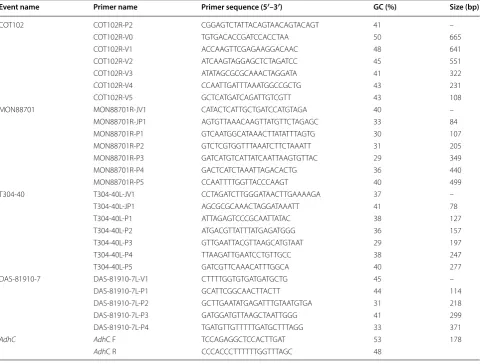
To develop a multiplex PCR method for cotton, we col-lected basic information about the four LM cotton events (Fig. 1) and designed event-specific simplex PCR primers (Table 1). These event-specific primers for the flanking
Fig. 1 Schematic diagrams of gene structure and event‑specific primers for living modified (LM) cotton varieties. The arrows indicate the binding sites of the primers (F: forward primer, R: reverse primer). The flanking sequence of cotton genomes is represented by bold lines (LB, left border; RB, right border; , promoter; , coding gene; , terminator)
Table 1 List of primers used for cotton multiplex PCR method
Event name Primer name Primer sequence (5′–3′) GC (%) Size (bp)
COT102 COT102R‑P2 CGG AGT CTA TTA CAG TAA CAG TAC AGT 41 –
COT102R‑V0 TGT GAC ACC GAT CCA CCT AA 50 665
COT102R‑V1 ACC AAG TTC GAG AAG GAC AAC 48 641
COT102R‑V2 ATC AAG TAG GAG CTC TAG ATCC 45 551
COT102R‑V3 ATA TAG CGC GCA AAC TAG GATA 41 322
COT102R‑V4 CCA ATT GAT TTA AAT GGC CGCTG 43 231
COT102R‑V5 GCT CAT GAT CAG ATT GTC GTT 43 108
MON88701 MON88701R‑JV1 CAT ACT CAT TGC TGA TCC ATG TAG A 40 –
MON88701R‑JP1 AGT GTT AAA CAA GTT ATG TTC TAG AGC 33 84
MON88701R‑P1 GTC AAT GGC ATA AAC TTA TAT TTA GTG 30 107
MON88701R‑P2 GTC TCG TGG TTT AAA TCT TCT AAA TT 31 205
MON88701R‑P3 GAT CAT GTC ATT ATC AAT TAA GTG TTAC 29 349
MON88701R‑P4 GAC TCA TCT AAA TTA GAC ACTG 36 440
MON88701R‑P5 CCA ATT TTG GTT ACC CAA GT 40 499
T304‑40 T304‑40L‑JV1 CCT AGA TCT TGG GAT AAC TTG AAA AGA 37 –
T304‑40L‑JP1 AGC GCG CAA ACT AGG ATA AATT 41 78
T304‑40L‑P1 ATT AGA GTC CCG CAA TTA TAC 38 127
T304‑40L‑P2 ATG ACG TTA TTT ATG AGA TGGG 36 157
T304‑40L‑P3 GTT GAA TTA CGT TAA GCA TGT AAT 29 197
T304‑40L‑P4 TTA AGA TTG AAT CCT GTT GCC 38 247
T304‑40L‑P5 GAT CGT TCA AAC ATT TGG CA 40 277
DAS‑81910‑7 DAS‑81910‑7L‑V1 CTT TTG GTG TGA TGA TGC TG 45 –
DAS‑81910‑7L‑P1 GCA TTC GGC AAC TTA CTT 44 114
DAS‑81910‑7L‑P2 GCT TGA ATA TGA GAT TTG TAA TGT GA 31 218
DAS‑81910‑7L‑P3 GAT GGA TGT TAA GCT AAT TGGG 41 299
DAS‑81910‑7L‑P4 TGA TGT TGT TTT TGA TGC TTT AGG 33 371
AdhC AdhC F TCC AGA GGC TCC ACT TGA T 53 178
cotton genome sequence and the introduced LM gene were tested and the primers with high efficiency were selected. All simplex PCR primers showed event-specific amplification without any non-specific bands. These simplex PCR results indicated that the newly developed simplex PCR primers (Fig. 2b–d, lanes 3–7) showed increased PCR band intensity than the JRC method primer set (Fig. 2b–d, lane 2).
Based on the simplex PCR results, we developed a novel multiplex PCR method for the four LM cot-ton varieties (Fig. 3). To increase the amplification intensity of small PCR fragments, we used 4 pmol of primers for COT102 and 2 pmol for the other three LM cotton events (viz., MON88701, T304-40, and DAS81910-7) in the multiplex PCR analysis; the ampli-fication intensity was sufficient in the multiplex PCR. The PCR product size of the four LM cotton events was 108 (COT102), 205 (MON88701), 277 (T304-40), and
371 bp (DAS-81910-7), as expected. These results indi-cated that the newly developed event-specific multiplex PCR could detect each event without any non-specific reaction.
Limit of detection
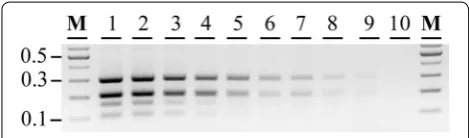
In many cases, the quality and quantity of genomic DNA from LMO monitoring samples might not be sufficient to identify event information. Therefore, the minimum concentration of genomic DNA that could be detected using the multiplex PCR is crucial [9]. The LOD was estimated using a dilution series of the four mixed RM DNA mixtures (Fig. 4). The results indi-cated that each event-specific PCR band was amplified at a genomic DNA concentration of 12.5 ng/µL. Thus, our multiplex PCR method assured efficient detection at a low concentration of DNA and therefore could be applied to verify cotton varieties in LM monitoring.
Fig. 2 Confirmation of the simplex PCR primer set for the four living modified (LM) cotton varieties. a–d PCR product of the four LM cotton events: a COT102; b MON88701; c T304‑40; d DAS‑81419‑7. The PCR products were electrophoresed on a 2.5% agarose gel. Lane 1, AdhC (endogenous gene) primer; lane 2, JRC method primer; lanes 3–7, event‑specific primer sets. M represents 100 bp marker
Fig. 3 Establishment of multiplex PCR. The multiplex PCR with each genomic DNA template [lane 1, COT102; lane 2, MON88701; lane 3, T304‑40; lane 4, DAS81419‑7; lane 5, non‑LM cotton; lane 6, mixed four living modified organism reference materials (LMO RMs)] was performed. M represents 100 bp marker
Verification of the efficiency of multiplex PCR
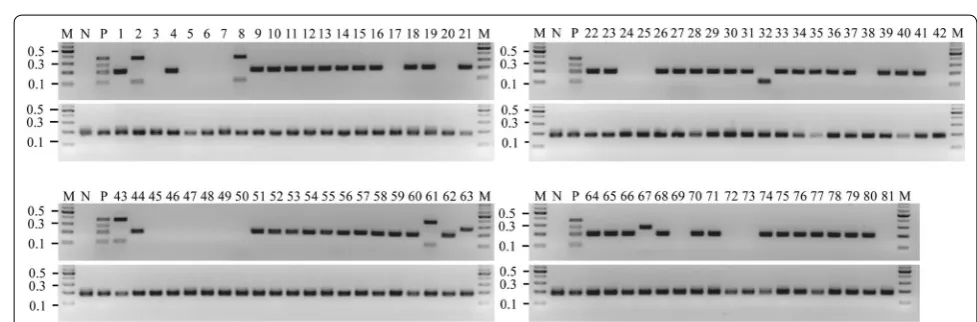
Randomly mixed RM DNA mixtures with non-LM DNA was used to confirm the sensitivity and efficiency of the multiplex PCR method for cotton. The results revealed that the multiplex PCR method can effectively detect all randomly mixed cotton RM DNA samples (Fig. 5). The multiplex PCR results with randomly mixed RM mix-tures suggested that this method can identify all LMO stacks, including the four LM cotton varieties that will be approved in the future. The multiplex PCR method was applied to identify LM samples, which were collected from environmental monitoring [9–11]. To verify the application of multiplex PCR method in LMO monitor-ing, we used LM cotton samples collected from an LMO monitoring project in the Republic of Korea in 2018. Eighty-one cotton volunteer samples were further ana-lyzed to identify and confirm the efficiency of the multi-plex PCR method developed in this study (Fig. 6). Among
the 81 LM cotton volunteers, 66 LM cotton varieties were further identified using the multiplex PCR method (Additional file 1: Table S1). These results indicated that the established multiplex PCR method can be used to detect and identify volunteers in LMO environmental monitoring.
Discussion
After more than 20 year of development of GMOs, there are more than 300 GM crops in research or global devel-opment pipelines and more than 100 GMOs (10 crops) have entered the market or were released into the envi-ronment [1]. LMOs have been controversial owing to their adverse effects on the conservation and sustainable use of biological diversity, besides the risks to human health [12].
Several methods based on nucleic acid or proteins have been employed to detect and identify LMOs.
Fig. 5 Efficiency of multiplex PCR using a random living material organism (LMO) reference material (RM) mixture. Random mixtures of LM cotton genomic DNA were used as multiplex PCR templates. Total DNA amount was 50 ng in each reaction. Lane 1, non‑LM; lanes 2–16, random mixtures of LM cotton RMs. M represents 100 bp marker
Developing reliable detection methods is crucial for the detection of LM materials in food and identification of unauthorized LMOs. Moreover, rapid and cost-effec-tive detection methods, such as multiplex PCR, can be adopted to identify LMOs in transboundary movement or the environment [13, 14]. In this study, we developed an event-specific multiplex PCR method to detect four LM cotton varieties and applied the novel method to identify unintentionally released LMOs into the envi-ronment. Compared with those of the conventional PCR detection method, new techniques such as real-time PCR are highly sensitive and convenient owing to their short reaction time; moreover, they do not require post-PCR manipulations [15]. However, developing a multiplex PCR method using real-time PCR system is difficult due to the interference between pairs of prim-ers and limitation of probe combinations, reducing the sensitivity and efficiency [3]. Currently, some multiplex real-time PCR methods have been reported to simulta-neously detect a few targets using universal target genes [16]. Several factors can affect the sensitivity and speci-ficity of multiplex PCR. Among them, the ratio between primer and template is especially important [14]. In our previous study, we developed a multiplex PCR method for four GM soybeans and applied the same concentra-tion of primers [9]. However, the concentration of some primers was too low for multiplex PCR, and the small-est target product could not be amplified exponentially [9]. In the present study, to improve the efficiency of multiplex PCR, we doubled the amount of COT102 primers, and the results showed that all multiplex PCR products were amplified effectively. This equal amplifi-cation can reduce false negative results in GMO detec-tion. Furthermore, the simplex PCR results indicated that the efficiency of the newly developed simplex PCR was considerably higher than that reported for the JRC method.
Among the multiplex detection methods for major GM crops, those for cotton have not been well studied because cotton is not a food crop. Multiplex PCR meth-ods have been developed for MON15985, MON531, GHB614, MON88913, LLCOTTON25, and MON1445-2 [10], GHB119 and 281/3006 [17], and GHB119 and T304-40 [3]. In this study, a conventional multiplex PCR method for COT102, MON88701, T304-40, and DAS-81910-7 was newly developed to identify approved GM cotton varieties in Korea. Currently, 14 GM cotton events have been approved for food, feed, and process-ing in Korea, and the multiplex PCR method included in this study has been developed by the National Institute of Ecology. MON757 and COT67B event-specific detection methods are under development, and simplex method can be applied for GM cotton identification.
The successful establishment and validation of GMO detection methods depend on the supplement of food and feed RMs and certified RMs [18]. The reference materials are required for qualitative and quantitative PCRs to screen and identify GMOs as the positive con-trols to monitor whether the established PCR method works properly and to quantify GM DNA in the total DNA [19]. Recently, issues related to unintentional transboundary movements and capacity building were discussed at the CBD held in 2018 to provide appro-priate RMs that will enable laboratory work on the detection and identification of LMOs. In the future, the operator, the concept of which has not been well defined, might require providing information or access to RMs for regulatory purposes. The LOD of GMO detection methods has been evaluated based on the tar-get DNA’s copy number [20], and it depends on DNA quality, DNA extraction method, PCR primer speci-ficity, and PCR premix type [21]. For high-sensitive detection, large amount of DNA as template is used; however, environmental sample of LMO cannot ensure DNA quality and quantity. Several testing methods released by developers or regulators and several previ-ously reported GMO detection methods recommend that the minimum amount of purified DNA required is 40–100 ng in total reaction volume [6, 10, 11]. In this study, we detected LMOs using the newly developed multiplex PCR method, which required only 12.5 ng of purified DNA.
Since 2009, the Ministry of Environment and National Institute of Ecology in the Republic of Korea has been performing LMO environmental monitoring to imple-ment the post-manageimple-ment strategies of LMO unin-tentional release into natural environment [22]. Whole cottonseed and cottonseed meals are sources of edible fat for dairy cattle [23]. Therefore, the total imported LM cotton seeds increased from 92 thousand tons in 2008 to 151 thousand tons in 2017 in Korea [24]. With the increasing use of whole cottonseed for feed in Korea, the number of unintentionally released LM cotton varie-ties has consistently increased [22]. Thus, there is a need to develop multiplex PCR methods to identify suspected LM samples during LMO monitoring.
Supplementary information
Supplementary information accompanies this paper at https ://doi. org/10.1186/s1376 5‑019‑0459‑8.
Additional file 1: Table S1. Information of event analysis obtained using the newly developed multiplex PCR.
Abbreviations
LOD: limit of detection; PCR: polymerase chain reaction; RM: reference material.
Acknowledgements Not applicable.
Authors’ contributions
JRL and WC conceived and designed of the study. SJE, IRK, and HSL performed all experiments and collected plant samples. SJE and WC wrote the paper. All authors read and approved the final manuscript.
Funding
This study was supported by a grant from the National Institute of Ecology (NIE), funded by the Ministry of Environment (MOE) of the Republic of Korea (NIE‑A‑2019‑06, NIE‑A‑2019‑07).
Availability of data and materials Not applicable.
Competing interests
The authors declare that they have no competing interests.
Received: 6 August 2019 Accepted: 16 September 2019
References
1. ISAAA (2017) Global Status of Commercialized Biotech/GM Crops in 2017. Biotech crop adoption surges as economic benefits accumulate in 22 years. ISAAA Brief No. 53. http://www.isaaa .org/resou rces/publi catio ns/brief s/53/defau lt.asp. Accessed 01 Aug 2019
2. Yang L, Pan A, Zhang K, Yin C, Qian B, Chen J et al (2005) Qualitative and quantitative PCR methods for event specific detection of genetically modified cotton Mon1445 and Mon531. Transgenic Res 14:817–831 3. Li X, Wang X, Yang J, Liu Y, He Y, Pan L (2014) A novel quadruplex real‑time
PCR method for simultaneous detection of Cry2Ae and two genetically modified cotton events (GHB119 and T304‑40). BMC Biotechnol 14:43 4. Singh M, Bhoge RK, Randhawa G (2016) Crop‑specific GMO matrix‑
multiplex PCR: a cost‑efficient screening strategy for genetically modified maize and cotton events approved globally. Food Control 70:271–280 5. Rosa SF, Gatto F, Angers‑Loustau A, Petrillo M, Kreysa J, Querci M (2016)
Development and applicability of a ready‑to‑use PCR system for GMO screening. Food Chem 201:110–119
6. Sawazaki HE, Duarte AP, Fuzatto MG, Sawazaki E, Grandi SHR, de Ponte JF et al (2015) Identification and quantification of corn, soybean and cotton genetically modified by real time PCR. Am J Mol Biol. 5:84–93
7. Liang C, van Dijk JP, Scholtens IM, Staats M, Prins TW, Voorhuijzen MM et al (2014) Detecting authorized and unauthorized genetically modi‑ fied organisms containing vip3A by real‑time PCR and next‑generation sequencing. Anal Bioanal Chem 406:2603–2611
8. Holst‑Jensen A, Rønning SB, Løvseth A, Berdal KG (2003) PCR technol‑ ogy for screening and quantification of genetically modified organisms (GMOs). Anal Bioanal Chem 375:985–993
9. Choi W, Seol MA, Jo BH, Kim IR, Lee JR (2018) Development and applica‑ tion of a novel multiplex PCR method for four living modified soybeans. Appl Biol Chem. 61:635–641
10. Jo BH, Seol MA, Shin SY, Kim IR, Choi W, Eum SJ et al (2016) Multiplex PCR method for environmental monitoring of approved LM cotton events in Korea. J Plant Biotechnol. 43:91–98
11. Shin SY, Lim HS, Seol MA, Jung YJ, Kim IR, Song HR et al (2016) Four multiplex PCR sets of 11 LM maize for LMO environmental monitoring in Korea. J Plant Biotechnol. 43:473–478
12. Prakash D, Verma S, Bhatia R, Tiwary BN (2011) Risks and precau‑ tions of genetically modified organisms. ISRN Ecol. https ://doi. org/10.5402/2011/36957 3
13. Morisset D, Demšar T, Gruden K, Vojvoda J, Štebih D, Žel J (2009) Detec‑ tion of genetically modified organisms‑closing the gaps. Nat Biotechnol. 27:700–701
14. Shrestha HK, Hwu KK, Chang MC (2010) Advances in detection of geneti‑ cally engineered crops by multiplex polymerase chain reaction methods. Trends Food Sci Technol 21:442–454
15. Cottenet G, Blancpain C, Sonnard V, Chuah PF (2013) Development and validation of a multiplex real‑time PCR method to simultaneously detect 47 targets for the identification of genetically modified organisms. Anal Bioanal Chem 405:6831–6844
16. Pansiot J, Chaouachi M, Cavellini L, Romaniuk M, Ayadi M, Berthear Y et al (2011) Development of two screening duplex PCR assays for genetically modified organism quantification using multiplex real‑time PCR master mixes. Eur Food Res Technol 232:327–334
17. National Institute of Ecology (2015) Development of multiplex‑PCR for simultaneous detection of LMOs. NIE, Seocheon (in Korean)
18. Wu Y, Li J, Li X, Zhai S, Gao H, Li Y et al (2019) Development and strategy of reference materials for the DNA‑based detection of genetically modi‑ fied organisms. Anal Bioanal Chem 411:1729–1744
19. Lauwaars M, Anklam E (2004) Method validation and reference materials. Accred Qual Assur 9:253–258
20. Mano J, Hatano S, Nagatomi Y, Futo S, Takabatake R, Kitta K (2018) Highly sensitive GMO detection using real‑time PCR with a large amount of DNA template: single laboratory validation. J AOAC Int 101:507–514
21. Gryson N (2010) Effect of food processing on plant DNA degradation and PCR‑based GMO analysis: a review. Anal Bioanal Chem 396:2003–2022 22. National Institute of Ecology (2018) Study on environmental monitoring
and post‑management of LMO. NIE, Seocheon (in Korean)
23. Arieli A (1998) Whole cottonseed in dairy cattle feeding: a review. Anim Feed Sci Technol 72:97–110
24. KBCH: Korea Biosafety Clearing House (2018) Status of risk assessment of GMO in Korea. http://www.biosa fety.or.kr. Accessed 01 Aug 2019
Publisher’s Note