International Journal of Agriculture, Environment and Biotechnology Citation: IJAEB: 11(3): 557-561, June 2018
DOI: 10.30954/0974-1712.06.2018.19
©2018New Delhi Publishers. All rights reserved
ENTOMOLOGY
Extending the Storage and Post-storage Life of Dragon Fruit
Using a Cold Room (Ecofrost)
Parag Babaji Jadhav
Ecofrost Technologies Pvt. Ltd., Survey No 134/1, 134/2,130/3, Jeevan Nagar, Tathawade, Pune, Maharashtra, India Corresponding author: [email protected](ORCID ID:0000-0001-9818-1193)
Paper No. 715 Received: 09-04-2018 Accepted: 29-05-2018
ABSTRACT
Storage at 10°C with 93% RH was evaluated as the best condition to maintain the post-harvest quality of the Dragon fruit. These fruit retained the lowest weight loss i.e. around 0.3% per day inside the cold room. While an average weight loss of 2.6% per day was measured during post-storage period. Fruit stored inside cold room of Ecofrost retained a maximum storage life upto 15 to 17 days and the post-storage life was recorded as 3 to 4 days. Shelf-life was recorded as 2.5 days in ordinary room conditions. Fruit stored at 10°C had 100% decay incidence after five days in ordinary room conditions.
Highlights
mThe fruit stored at 10°C (50°F) with 93% RH conditions retained higher storage life upto 15 to 17 days.
mThe average weight loss was recorded minimum per day inside cold room. Keywords: Dragon, Post-storage, Weight, Cold, Temperature, Ecofrost, Fruit, Storage
Dragon fruit (Strawberry pear, and Thang), Hylocereus have been introduced as exotic fruit crop. This fruit is popular in Southeast Asia; belongs to the climbing cacti (Cactaceae) family. Vietnam is the main commercial producer of dragon fruits in the Southeast Asian region. It is grown commercially, as is the red- or purple-fleshed (H. costaricensis and H. polyrihizus). The fruit is a fleshy berry with thick peel enclosing delicately flavoured and seedy red pulp. It is a non-climacteric fruit that reaches the best eating quality when harvested at ripe conditions (Chien et al. 2007). The flesh is sweet and white with numerous tiny black seeds, and is consumed fresh or used for juice, jellies, marmalades, jams, wine, and beverages (Wybraniec et al. 2002; Chuah et al. 2008).
D r a g o n f r u i t a r e h i g h i n a n t i o x i d a n t s (phytoalbumins), which help to fight carcinogenic free-radicals against forming in the body. It is rich in Vitamin-C and minerals, especially calcium and phosphorus. They are also low in calories and high in fiber, while the seeds are having high
polyunsaturated fatty acids. The seeds of the fruit are said to help in controlling blood glucose levels in people with non-insulin-dependent hyperglycaemic conditions (a kind of diabetes). It is also used to treat stomach and endocrine problems. Dragon fruit also improves eyesight and prevents hypertension. The rapid shrivelling of the pitaya fruit after harvest reduces visual quality, storage life, and marketability. The main postharvest problems of the pitaya fruit are mechanical injury, chilling injury, decay, and water loss (Wall & Khan 2008; Chandan 2010).
The objective of our study was to determine weight-loss (%) and storage life (days) in Dragon-fruit (white flesh) inside cold room conditions of 10°C and 93% RH) and at ordinary room conditions.
MATERIALS AND METHODS
Experimental Site and Environment
Pune, Maharashtra, India during Rabbi season of 2017.
Experimental Material and Observations
The fruit (white flesh) were harvested at full ripe stage in the early morning of 30th August 2016.
Fruit were handled carefully to reduce abrasion and compression injury during transit. Such freshly harvested and selected fruit were placed under shady conditions for thirty minutes and stored inside the cold room of Ecofrost at 10°C with 93%
RH conditions. Sixteen fruit were stored in cold room, out of which two fruit were taken out on day 1 (just after start of experiment) and at the end of day 1, 3, 6, 8, 12, 15 and 17 and then transported by motorcycle to the Agricultural Research Laboratory of Ecofrost Technologies Pvt. Ltd., Tathawade, Pune and placed in room conditions for 4 days to study the weight loss (%) at the end of the following second and the fourth day.
RESULTS AND DISCUSSION
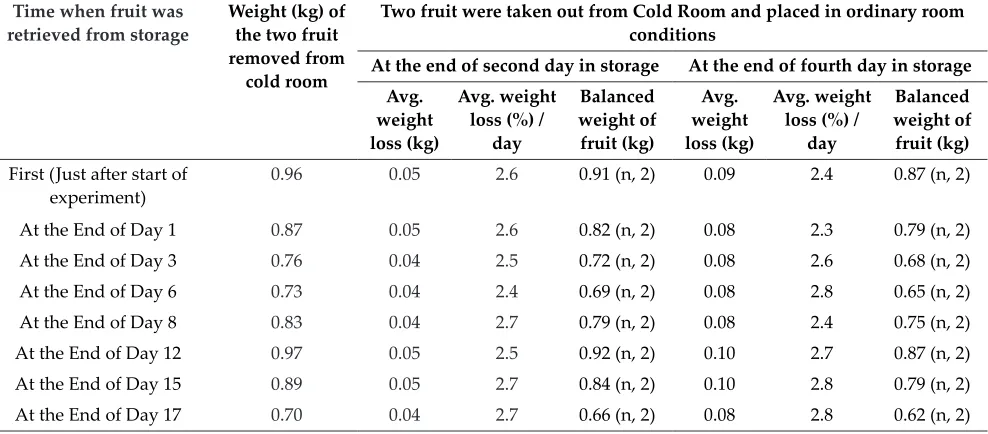
Parameters of importance at delivery to consumer like storage life (days) and weight loss (%) inside cold room and at ordinary room conditions were recorded. Out of sixteen fruit, the weight loss was higher during four days of post-storage-life at room conditions than during the lengthiest of all seventeen days of storage at 10°C (Table 2 and 3). The weight-loss (kg) as measured, increased from 0.00kg (just after start of experiment) with the number of days in the cold storage to 0.09 kg till the end of the day 12 but reduced after that to 0.04 kg by the end of day 17 while kept inside cold storage (Fig. 1). The weight loss (%) in ordinary room conditions at the end of day two and day four were measured after two fruit were taken out from cold room on the day just after the start of experiment and at the end of day 1, 3, 6, 8, 12, 15 and 17; it was observed that varying losses from 2.3% to 2.8% were present at each of these instances except after day 15 when
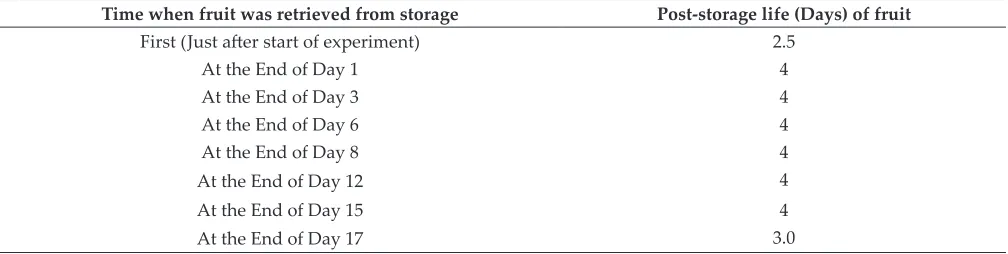
Table 1: Post-storage life (Days) of Dragon fruit
Time when fruit was retrieved from storage Post-storage life (Days) of fruit
First (Just after start of experiment) 2.5
At the End of Day 1 4
At the End of Day 3 4
At the End of Day 6 4
At the End of Day 8 4
At the End of Day 12 4
At the End of Day 15 4
At the End of Day 17 3.0
Table 2: Weight loss of Dragon fruit inside cold room of Ecofrost at 10°C and 93 % RH
Time when fruit was retrieved from
storage Total weight (kg) of fruit before removing from cold
room
Weight loss (kg) Total weight (kg)
balanced after two
fruit removed out from cold room
Two fruit removed weight
(kg) from cold room At cold room (10°C and 93 % RH)
First (Just after start of experiment) 6.77 0.00 (n, 16) 5.81 (n, 14) 0.96
At the End of Day 1 5.79 0.02 (n, 14) 4.92 (n, 12) 0.87
At the End of Day 3 4.88 0.04 (n, 12) 4.14 (n, 10) 0.76
At the End of Day 6 4.07 0.07 (n, 10) 3.37 (n, 08) 0.73
At the End of Day 8 3.29 0.08 (n, 08) 2.53 (n, 06) 0.83
At the End of Day 12 2.44 0.09 (n, 06) 1.55 (n, 04) 0.97
At the End of Day 15 1.48 0.07 (n, 04) 0.74 (n, 02) 0.89
At the End of Day 17 0.70 0.04 (n, 02) 0.00 (n, 00) 0.70
Table 3: Weight loss (kg) of Dragon fruit during post-storage at room conditions
Time when fruit was
retrieved from storage Weight (kg) of the two fruit removed from
cold room
Two fruit were taken out from Cold Room and placed in ordinary room conditions
At the end of second day in storage At the end of fourth day in storage Avg.
weight loss (kg)
Avg. weight loss (%) /
day
Balanced weight of fruit (kg)
Avg. weight loss (kg)
Avg. weight loss (%) /
day
Balanced weight of fruit (kg)
First (Just after start of
experiment) 0.96 0.05 2.6 0.91 (n, 2) 0.09 2.4 0.87 (n, 2)
At the End of Day 1 0.87 0.05 2.6 0.82 (n, 2) 0.08 2.3 0.79 (n, 2)
At the End of Day 3 0.76 0.04 2.5 0.72 (n, 2) 0.08 2.6 0.68 (n, 2)
At the End of Day 6 0.73 0.04 2.4 0.69 (n, 2) 0.08 2.8 0.65 (n, 2)
At the End of Day 8 0.83 0.04 2.7 0.79 (n, 2) 0.08 2.4 0.75 (n, 2)
At the End of Day 12 0.97 0.05 2.5 0.92 (n, 2) 0.10 2.7 0.87 (n, 2)
At the End of Day 15 0.89 0.05 2.7 0.84 (n, 2) 0.10 2.8 0.79 (n, 2)
At the End of Day 17 0.70 0.04 2.7 0.66 (n, 2) 0.08 2.8 0.62 (n, 2)
Note: Initial weight of 6.77 kg (16 Fruits), n- Indicates number of fruit.
1A: General view of Dragon-fruit storage
on day 1 (Just after start of experiment) 1B:inside cold room General view of Dragon fruit on day 4 1C:inside cold room General view of Dragon fruit on day 8
1D: General view of Dragon fruit on day 4 in ordinary room conditions, when fruit were taken out on day 17 from cold room
1E: General view of Dragon fruit on day
12 inside cold room 1F:15 inside cold room General view of Dragon fruit on day
the losses were consistently above 2.7%. Similarly, post-storage life was recorded as 3.0 to 4.0 days in room conditions (Table 1 and Fig. 2). Fruit stored at 10°C with 93% RH had the average weight-loss of 0.3% per day during the 17 days of storage period. At room conditions, average weight-loss was recorded as 2.6% per day for 4 days storage. The average weight loss was measured as 2.58% per day for first two days and 2.6% per day for next two days at room conditions during 4 days of post-storage, when fruits were taken out from cold room. The deterioration of the physical appearance and damages due to disease attacks on the fruit at room conditions could increase losses in value and spoilage (photo 1 D). These losses are costlier to retailers for such a high-valued fruit. Abrasion of the skin makes the rate of water-loss higher resulting in shrivelling and reduces weight. Water-loss results in Water-loss of saleable weight and physical appearance. Fruit stored in the cold conditions had a greener colour on the bracts, no chilling injury symptoms in the outer flesh tissue, reduced decay incidence (%) and severity (%) as compared with fruit stored in ordinary room conditions. Storage at low temperatures reduces fruit metabolism, delay
senescence, delay softening during storage of H. undatus and H. polyrhizus fruit (Punita et al. 2009).
CONCLUSION
In conclusion, the fruits which were stored at 10°C (50°F) with 93% RH conditions retained higher storage life upto 15 to 17 days. Post-storage-life was recorded as 3 to 4 days in ordinary room conditions. The average weight loss was recorded as 0.3% per day inside cold room for 17 days storage and 2.6% per day during 4 days of post storage life in ordinary room conditions. Fruits stored in ordinary room conditions had 100% decay incidence and severity after 3.5 days.Fruit stored at 10°C had 100% decay incidence after five days in ordinary room conditions. Also, the visual quality of the fruit is evident from the images collected at various stages of this experiment. This activity establishes that the selected storage conditions have high impact in terms of shelf life and retainment of quality of Dragon fruit and can help reduce the losses in the supply chain.
ACKNOWLEDGEMENTS
The authors are grateful to the Directors of Ecofrost
0 0.02 0.04 0.07 0.08 0.09 0.07 0.04 0 0.02 0.04 0.06 0.08 0.1
First (Just after start of experiment)
End of Day 1 End of Day 3 End of Day 6 End of Day 8 End of Day 12 End of Day 15 End of Day 17
W eight lo ss (kg) i nsi de Col d R oom
Fig. 1: Average Weight Loss (kg) inside Cold Room
2.5
4 4 4 4 4 4
3 0 1 2 3 4 5
First (Just after start of experiment)
End of Day 1 End of Day 3 End of Day 6 End of Day 8 End of Day 12 End of Day 15 End of Day 17
Post Storage Li fe, Da y s
Fruit taken out on day from cold room
Figure 2 Post-storage life (Days) of Dragon fruit at ordinary room conditions
Technologies Pvt. Ltd., Jeevan Nagar, Tathawade, Pune, Maharashtra- 411 033 for providing excellent facilities for conducting this research.
REFERENCES
Chandran, S. 2010. Effect of film packing in extending shelf-life of dragon fruit, Hylocereus undatus and Hylocereus polyrhizus. Acta Horti., 875: 389-394.
Chien, P.J., Sheu, F. and Lin, H.R. 2007. Quality assessment of low molecular weight chitosan coating on sliced red pitayas. J Food Eng., 79: 736-740.
Chuah, T.G., Ling, H.L., Chin, N.L., Choong, T.S.Y., Fakhru’l-Razi, A. 2008. Effects of temperatures on rheological behaviour of dragon fruit (Hylocereus sp.) juice. Int. J. Food Eng., 4: 1-28.
Punitha, V., Boyce, A.N. and Chandran, S. 2009. Activity of cell wall degrading enzymes in Hylocereus polyrhizus. Indian Journal of Agricultural Research, 43(4): 235-242.
Wall, M.M. and Khan, S.A. 2008. Post-harvest quality of dragon fruit (Hylocereus spp.) after X-ray irradiation quarantine treatment. Hort. Sci., 43: 2115-2119.