R E S E A R C H
Open Access
Grapevine rootstocks shape underground
bacterial microbiome and networking but
not potential functionality
Ramona Marasco
1*†, Eleonora Rolli
2†, Marco Fusi
1, Grégoire Michoud
1and Daniele Daffonchio
1,2*Abstract
Background:The plant compartments ofVitis vinifera, including the rhizosphere, rhizoplane, root endosphere, phyllosphere and carposphere, provide unique niches that drive specific bacterial microbiome associations. The majority of phyllosphere endophytes originate from the soil and migrate up to the aerial compartments through the root endosphere. Thus, the soil and root endosphere partially define the aerial endosphere in the leaves and berries, contributing to theterroirof the fruit. However,V. viniferacultivars are invariably grafted onto the rootstocks of otherVitisspecies and hybrids. It has been hypothesized that the plant species determines the microbiome of the root endosphere and, as a consequence, the aerial endosphere. In this work, we test the first part of this hypothesis. We investigate whether different rootstocks influence the bacteria selected from the surrounding soil, affecting the bacterial diversity and potential functionality of the rhizosphere and root endosphere.
Methods:Bacterial microbiomes from both the root tissues and the rhizosphere of Barbera cultivars, both ungrafted and grafted on four different rootstocks, cultivated in the same soil from the same vineyard, were characterized by 16S rRNA high-throughput sequencing. To assess the influence of the root genotype on the bacterial communities’recruitment in the root system, (i) the phylogenetic diversity coupled with the predicted functional profiles and (ii) the co-occurrence bacterial networks were determined. Cultivation-dependent approaches were used to reveal the plant-growth promoting (PGP) potential associated with the grafted and ungrafted root systems.
Results:Richness, diversity and bacterial community networking in the root compartments were significantly influenced by the rootstocks. Complementary to a shared bacterial microbiome, different subsets of soil bacteria, including those endowed with PGP traits, were selected by the root system compartments of different rootstocks. The interaction between the root compartments and the rootstock exerted a unique selective pressure that enhanced niche differentiation, but rootstock-specific bacterial communities were still recruited with conserved PGP traits.
Conclusion: While the rootstock significantly influences the taxonomy, structure and network properties of the bacterial community in grapevine roots, a homeostatic effect on the distribution of the predicted and potential functional PGP traits was found.
Keywords: Grapevine, Bacterial recruitment, Rootstock selection, Microbial ecology, Co-occurrence network, Plant growth-promoting bacteria, Microbiome, Rhizosphere, Endosphere
* Correspondence:[email protected]; [email protected]
†Equal contributors
1King Abdullah University of Science and Technology (KAUST), Biological and
Environmental Sciences and Engineering Division (BESE), Thuwal 23955-6900, Saudi Arabia
Full list of author information is available at the end of the article
Background
Plant-specific microbiomes play an indisputable role in supporting plant health and adaptation to changing envir-onmental conditions. These microbial communities act as a highly diversified, external secondary genome for the host plant and supply key ecological functionalities that contribute to increased plant fitness [1]. The final quality of plant products, such as fruit and other derived products, is dependent not only on the plant cultivar and cultivation practices but also on an ensemble of poorly characterized factors, grouped under the broad term ter-roir[2, 3]. In grapevines, the microbiomes associated with the phyllosphere and the fruits (carposphere) in particular were recently shown to present biogeographic-specific traits that further define the terroir properties [2–4]. High-throughput sequencing analysis demonstrated that the non-random‘microbialterroir’was a determining fac-tor in regional grape must characteristics, showing that microbial vineyard inhabitants play a critical role in deter-mining fruit quality [2, 5, 6].
Interestingly, the majority of the microbial taxa found in the aboveground grapevine tissues originated in the soil, indicating that the roots act as the primary reservoir of bacterial grapevine colonizers [7, 8]. In particular, the phyllosphere endophytes migrate to the aerial tissue from the root endosphere after they are recruited by the root tissues from the soil, which has a determinant role as a microbial supplier for the aerial endosphere [7–9]. It can be argued that the plant species and genotype also play important roles in selecting the plant-specific endo-phytes from soil [8].
Since the nineteenth century, Vitis vinifera varieties have been cultivated as scions and grafted onto the root-stocks of otherVitisspecies and hybrids to prevent vine-yards from succumbing to Phylloxera pests. Grafting Phylloxera-immune rootstock is a global practice, and the development of new rootstock genotypes is an im-portant aspect of modern viticulture [10]. The rootstock affects scion development by influencing the reproduct-ive performance, vigour, biomass accumulation and dis-tribution in the plant, phenology and fruit yield [11–13]. Moreover, the rootstock influences plant resistance to soil-borne pests [14], climate, or adverse environmental and soil conditions, such as drought [15], salinity [16], limestone content [17] and poor mineral nutrition [18]. Different rootstocks often co-occur in the same vineyard to maximize plant resilience to adverse growth conditions. Although it is widely known that the rootstock geno-type and the grape-associated microbiota affect the grapevine physiology, studies unveiling the structure of the bacterial assemblages associated with different graft combinations are lacking [13]. Here, we hypothesize that the rootstock genotype plays a fundamental role in influ-encing the recruitment and structure of the bacterial
microbiome associated with the rhizosphere and root endosphere. Considering that the root endosphere medi-ates the passage of endophytes to the aerial endosphere and carposphere [7–9], understanding the effect of the rootstock type on the microbiomes in the root endo-sphere is a necessary step towards understanding the factors that determine the microbial terroir of grape-vines. To address effects of the rootstock type on the selective recruitment of bacterial communities in the rhizosphere and root endosphere, we compared ungrafted and grafted plants of the cultivar Barbera, all cultivated in the same soil at a single vineyard. We investigated the bacterial diversity in five different root systems with 16S rRNA gene high-throughput sequen-cing and inferred the predicted functionality and interac-tions in the root tissues and rhizosphere. Furthermore, we used a cultivation-dependent approach to test the plant growth-promoting (PGP) functionality of the cul-tivable bacterial strains detected by high-throughput sequencing.
Results
Richness and diversity of bacterial communities
associated with the root systems of ungrafted grapevine or grapevine grafted on different rootstocks
Table S4 and Additional file 1: Table S5A), explaining 11.6% of the observed variation (Additional file 1: Table S5B), in addition to the one explained by Fraction factor (46.4% of total variance) and the Rootstock factor (10% of the total variance, Additional file 1: Table S5B). The remaining part (32%) of the observed variance remain unresolved and cannot be explained considering only these two factors (Additional file 1: Table S5B). A fraction/ rootstock-specific bacterial community was identified (Additional file 1: Figure S2A and B). Bacterial assem-blage in the root tissues showed rootstock-specific endophytic bacterial communities (Additional file 1: Table S3B). Similarly in the rhizosphere, the rootstock influenced the bacterial assemblage, with only one pair of rootstocks (420A, SO4) that not differentiate significantly (Additional file 1: Table S3C).
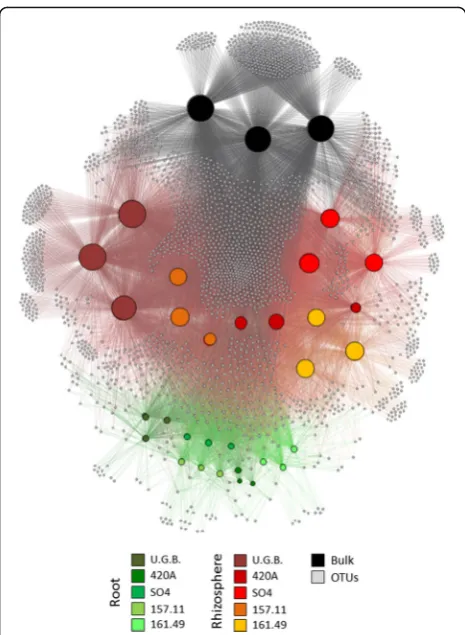
The edge distribution and density in the bipartite net-work indicated the different distributions of OTUs
among the factors ‘Fraction’ and ‘Rootstock Type’. Specific OTUs were connected to the five different rhizosphere samples, especially in the case of ungrafted plants (U.G.B., Additional file 1: Table S6). A similar trend, accounting for significantly less OTUs per sample, was found in the root tissues. A significant difference in the alpha diversity was found between the‘Fraction’and ‘Rootstock Type’ factors, with higher Shannon indices and OTU-Richness values in the bulk soil and rhizosphere than in the root tissues (Additional file 1: Table S2). The alpha diversity of the bacterial micro-biomes associated with the different rootstocks was vari-able, with 420A showing significantly less diversity than the other rootstocks, both in the root and in the rhizo-sphere (Additional file 1: Table S2 and Additional file 1: Figure S3).
Bacterial taxa distribution in the grape root system is significantly influenced by the fraction and the rootstock types
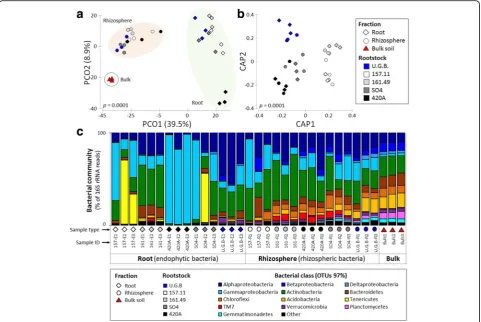
According to the taxonomic affiliations of the OTUs, the grapevine root system hosted 35 bacterial phyla (Additional file 1: Table S7A), 105 classes (99.7% se-quences classified; Additional file 1: Table S7B), 149 orders (94.7% classified; Additional file 1: Table S7C), 184 families (83.9% sequences classified; Additional file 1: Table S7D) and 182 genera (44.2% sequences classified; Additional file 1: Table S7E). Both ungrafted and grafted Barbera grape root systems were dominated by Proteobac-teria (53%: Gammaproteobacteria and Alphaproteobac-teria 31 and 17%, respectively), Actinobacteria (24%), Bacteroidetes (5%), Chloroflexi (4%) and Acidobacteria (4%) phyla (Fig. 2c). WhileProteobacteria,Actinobacteria andBacteroidetesrelative abundance did not show signifi-cant changes among root and rhizosphere fractions (false discovery rate, FDR: p> 0.05), Chloroflexi and Acidobac-teriawere significantly more abundant in the rhizosphere (FDR: t= 7.39, p= 0.003;t= 3.49, p= 0.003; respectively). Despite the distribution of Proteobacteriadid not signifi-cantly differ among the two fractions, classes belonging to this phylum presented different trends. For instance, Betaproteobacteria(FDR:t= 3.83,p= 0.003) and Gamma-proteobacteria (FDR: t= 2.39, p= 0.048) were differently distributed among the two fractions, while Alphaproteo-bacteria presented a similar (FDR: t= 0.245, p= 0.8) relative abundance across the grape root system.
Among the sequences identified at the genus level (Additional file 1: Table S7E and Additional file 1: Figure S4), the main genera in the root tissues were ‘Candidatus Phytoplasma’(FDR:t= 1.85,p= 0.006) and Pseudonocardia (FDR: t= 2.78, p= 0.003), while Pseudomonas dominated both in the root and the rhizosphere fractions (FDR:t= 1.54, p= 0.26).
Bacterial taxa distributions at phylum (Fig. 2c) were significantly influenced by the rootstock type in the root tissues (F4,10 = 5.5586; p= 0.001), but not in the rhizo-sphere (F4,10= 1.9591). On the contrary, genera distribu-tion (Addidistribu-tional file 1: Figure S4 and Addidistribu-tional file 1: Table S7E) revealed a rootstock effect in both root com-partments (root: F4,10= 3.6952, p= 0.014; rhizosphere: F4,10= 2.6123, p= 0.105). The linear discriminant ana-lysis effect size (LEfSe) detected 59 bacterial clades in the roots and 55 in the rhizospheres, which discrimi-nated the bacterial communities between the different root genotypes (Fig. 3a, b, Additional file 1: Table S8). Highly specific distributions of the bacterial clades were observed in the root endosphere of the different root systems, with the dominance of Actinobacteria (83% of clades) in rootstock 157.11,Proteobacteriain both 420A (100%) and U.G.B. (53%), Planctomycetes (38%) in SO4 and Bacteroidetes (35%) in 161.49 (Fig. 3a and Additional file 1: Table S8A). In the rhizosphere, both
rootstock 157.11 and U.G.B. showed higher numbers of differentially abundant clades (24 and 21, respectively) than the other three rootstocks (9, 1 and 1 in SO4, 420A and 161.49, respectively). In this compartment, new phyla were detected with increasing clade diversity asso-ciated with 157.11, SO4 and U.G.B.; 420A and 161.49 were dominated by one taxon each, TM7 and an Actino-bacteriaclade, respectively (Fig. 3b and Additional file 1: Table S8B).
The rootstock-pairs dissimilarity, due to phyla and genera contribution in root and rhizosphere fractions, was calculated by SIMPER (similarity percentages) ana-lysis (Additional file 1: Table S9 and S10). Higher micro-biome dissimilarity among rootstocks was revealed in the root tissues compared to the rhizosphere, both con-sidering phyla (Additional file 1: Table S9A) and genera (Additional file 1: Table S9B) distribution.Acidobacteria, Bacteroidetesand Chloroflexiwere the major phyla that contribute to differentiate the endophyte communities
Fig. 2Comparison of microbial communities in samples from different rootstock root-system compartments (root tissues and rhizospheres).a
Principal coordinates analysis (PCoA) for root, rhizosphere and bulk samples.bConstrained analysis of principal coordinates (CAP) was generated from the same OTU table by selecting only those samples influenced by their location within the root system (root tissue or rhizosphere) and constrained to the rootstock grouping factor. Pairwise comparisons using permutational MANOVAs on a distance matrix are shown in
associated with the different rootstock types. In the rhizosphere, Gammaproteobacteria, Betaproteobacteria and Actinobacteria further contributed to the relative low dissimilarity (Additional file 1: Table S9A and Additional file 1: Table S10 A and B). Several genera determined the dissimilarities among rootstocks in both endosphere and rhizosphere fractions and some genera appeared to be root genotype biomarkers, such as NovosphingobiumandStreptomyces in the rhizospheres of U.G.B. and SO4, respectively, and Serratia and ‘C. Phytoplasma’in the root tissues of 157.11 and 161.49, re-spectively (Additional file 1: Table S9B and Additional file 1: Table S10 C and D).
Rootstock-specific and shared bacterial assemblages
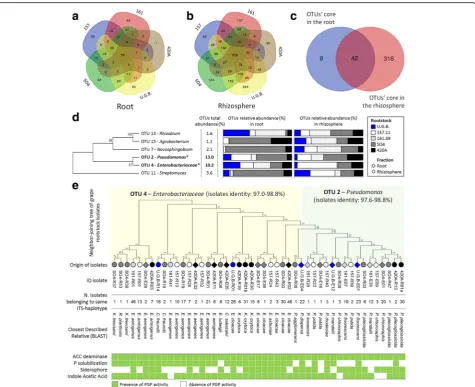
The root endosphere and rhizosphere compartments of grafted and ungrafted plants showed specific OTUs for each rootstock and a cluster of shared OTUs (Fig. 4a, b and Additional file 1: Table S6 A and B). The root tissues
and the rhizosphere had cores with 50-shared (76% of the total root-tissue OTUs; Additional file 1: Table S11A) and 358-shared OTUs (74% of the total rhizosphere OTUs; Additional file 1: Table S11B), respectively. The shared root-tissue bacteria were primarily dominated by two OTUs phylogenetically affiliated with Pseudomonas(OTU 2, 29%) andEnterobacteriaceae(OTU 4, 24%), followed by OTUs belonging to Actinomycetales (9%) andRhizobiaceae (4%; Additional file 1: Table S10A). The shared rhizosphere bacteria were Actinomycetales (23%), Sphingomonadales (7%) and Rhizobiales (7%), followed by Pseudomonas, Enterobacteriaceaeand Chloro-flexi, which together account for 15% of the bacterial com-munity in the rhizosphere (Additional file 1: Table S11B). Specific OTUs associated with the rootstocks 420A, 157.11 and SO4 endospheres represented less than 2% of their bacterial communities, while those associated with 161.49 and U.G.B. represented 6.5 and 7.6% of their bacterial communities, respectively (Fig. 4a and Additional file 1:
Table S12A). A similar trend was observed in the rhizo-sphere, where the U.G.B.-specific OTUs enriched 5% of the relative abundance (Additional file 1: Table S12B). A com-parison between the shared rhizosphere OTUs (50) and the shared endosphere OTUs (358) revealed a total of 42 shared OTUs (mainly affiliated to Gammaproteobacteria, AlphaproteobacteriaandActinobacteria), counting for 42% of the sequenced relative abundance in the root system (Fig. 4c and Additional file 1: Table S11C). The top six shared OTUs represented 32% of the overall bacterial community and were taxonomically affiliated with Rhizo-bium, Agrobacterium, Novosphingobium, Pseudomonas, Enterobacteriaceae and Streptomyces,with a variable dis-tribution in the root compartments of the different root-stocks (Fig. 4d).
Co-occurrence networks in the bacterial communities of ungrafted and grafted Barbera root systems
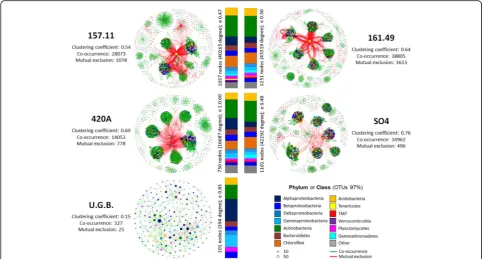
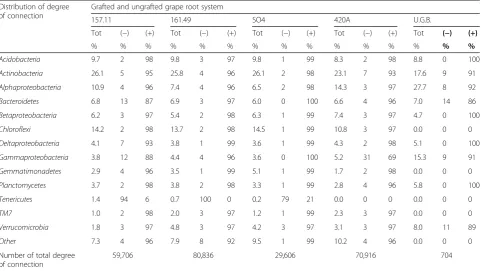
An analysis of the co-occurrence bacterial networks within the root systems (root and rhizosphere) of grafted and ungrafted Barbera plants showed different connect-ivity patterns directly and differently influenced by the rootstock type (Fig. 5 and Additional file 1: Table S13). We recorded a significantly higher number of co-occur-rence interactions than mutual exclusions in all of the networks. We recorded significantly more nodes, net-work clustering, interactions and netnet-work density in the grafted plants than in U.G.B. (Additional file 1: Table S13). These findings indicate a higher complexity of the bacter-ial networks in the root systems of the grafted grapes than in U.G.B. All of the grafted root systems featured
Fig. 4Grape rootstock shared microbiome and correlation with cultivable bacteria.a,bVenn diagrams showing the common and exclusive bacterial OTUs of the roots and compartments the selected rootstock.cOverlaps between the shared rhizosphere and root OTUs of all selected rootstocks.d
compartmentalized bacterial modules, several of which (up to 66) were connected, and presented high numbers of connections (up to 179 per node; Add-itional file 1: Figure S5 and AddAdd-itional file 1: Table S14). In contrast, the bacterial networks in the U.G.B. root systems presented only 16 modules and the con-nected taxa showed a similar degree of interactions (Additional file 1: Figure S5 and S6).
The taxonomy of the most connected nodes signifi-cantly differed between the grafted and ungrafted root systems (p= 0.008, Fig. 5, Table 1 and Additional file 1: Table S14). Actinobacteria mainly shaped the topology of the bacterial network in the grafted root system (up to 26% of the total degree of connection; Table 1), followed byChloroflexi(up to 15%),Alphaproteobacteria (up to 14%) and Acidobacteria (up to 10%). In the U.G.B. root system, connectivity among the bacterial community was primarily driven byAlphaproteobacteria(28% of the total degree of connection; Table 1), followed by Actinobacteria(17%) and Gammaproteobacteria (15%). Sev-eral of the highly connected taxa, such as Acidobacteria (Ellin6075 and Solibacteraceae), Actinobacteria (Gaiellaceae, Nocardiaceae and Microbacteriaceae), Alphaproteobacteria (SphingomonadaceaeandRhodospirillaceae) and Gammapro-teobacteria (Sinobacteraceae and Xanthomonadaceae),
appeared to be the key species driving the bacterial occurrence within the plant microbiome [19]. The most connected taxa established positive interactions (from 69 to 100% of the total interaction), whileTenericutes (representing 2.2% of the se-quences in the dataset) established mainly negatives (from 79 to 100% of the total interaction), indicating exclusion-based in-teractions with many of the other community components (Tables 1, 2 and Additional file 1: Table S15). Phylogenetic analysis identified theTenericutes OTU as closely related to ‘CandidatusPhytoplasma solani’(Additional file 1: Figure S7), the causal agent responsible for bois noir disease [20]. Al-though the grafted Barbera roots (157.11, 161.49 and SO4 rootstocks) hosted relatively high numbers of Tenericutesin the root tissues (Fig. 2c and Table 2), the plants did not present any obvious symptoms of grapevine yellows disease.
Predicting bacterial functional profiles in the root tissues and rhizospheres of grafted and ungrafted Barbera plants
According to the analysis of the bacterial 16S rRNA gene dataset with the Tax4fun software package, a total of 61 ± 14% of OTUs can be mapped to KEGG organisms (Additional file 1: Table S16). The rootstock genotype did not affect the predicted metabolism of the root- and rhizosphere-associated bacterial communities (root: F4,10 = 2.6439, p= 0.065; rhizosphere: F4,10= 1.3637, p= 0.251;
Additional file 1: Figure S2 C and D), but it affected the beta-diversity of both the root and rhizosphere fractions (root: F4,10= 6.9945,p= 0.001; rhizosphere: F4,10= 4.4515, p= 0.001; Additional file 1: Figure S2 A and B). Also considering only the PGP key enzyme-encoding genes for biofertilization (nitrogen metabolism, phosphate solubilization and siderophore synthesis [21]) and biostimulation (indole acetic acid (IAA) production, 1-aminocyclopropane-1-carboxylate (ACC) deaminase activity and general PGP traits like VOCs production [22]), no rootstock effect was identified (root: F4,10= 1.9637, p= 0.1004; rhizosphere: F4,10= 1.2341, p= 0.3248;
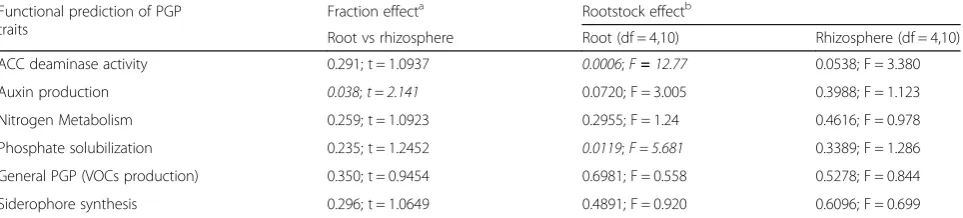
Additional file 1: Table S17 and Additional file 1: Figure S2 E and F). However, an analysis of the indi-vidual PGP traits showed that the enzyme-encoding genes for siderophore production, nitrogen metabol-ism and auxin (IAA) production were mostly spread throughout the bacterial communities associated with the root system, both in the root tissues and rhizo-sphere (Additional file 1: Figure S8). Except for IAA production, which had a 1.2-fold higher abundance in the estimated functional profile of the rhizosphere communities, the enzyme-encoding PGP genes were equally distributed between the bacterial communities associated with the root endosphere and the rhizo-sphere (Table 3). Looking inside each fraction, a significant rootstock effect was observed for only two of the PGP traits from the endophytic communities: ACC deaminase activity and phosphate solubilization pathways (Table 3 and Additional file 1: Figure S8B). The overall data show that the different rootstocks selected distinct bacterial populations, but not specific PGP func-tional traits within their bacterial communities.
Plant growth-promoting (PGP) potential of cultivable bacteria associated with grafted and ungrafted root systems
Cultivable bacteria associated with the root systems of the four different rootstocks and U.G.B. ranged from 106to 107 CFUs/g in the root tissues and from 109to 1010CFUs/g in
Table 1Degree of connection for each phylum/class in bacterial community networks of grapevine roots Distribution of degree
of connection
Grafted and ungrafted grape root system
157.11 161.49 SO4 420A U.G.B.
Tot (−) (+) Tot (−) (+) Tot (−) (+) Tot (−) (+) Tot (−) (+)
% % % % % % % % % % % % % % %
Acidobacteria 9.7 2 98 9.8 3 97 9.8 1 99 8.3 2 98 8.8 0 100
Actinobacteria 26.1 5 95 25.8 4 96 26.1 2 98 23.1 7 93 17.6 9 91
Alphaproteobacteria 10.9 4 96 7.4 4 96 6.5 2 98 14.3 3 97 27.7 8 92
Bacteroidetes 6.8 13 87 6.9 3 97 6.0 0 100 6.6 4 96 7.0 14 86
Betaproteobacteria 6.2 3 97 5.4 2 98 6.3 1 99 7.4 3 97 4.7 0 100
Chloroflexi 14.2 2 98 13.7 2 98 14.5 1 99 10.8 3 97 0.0 0 0
Deltaproteobacteria 4.1 7 93 3.8 1 99 3.6 1 99 4.3 2 98 5.1 0 100
Gammaproteobacteria 3.8 12 88 4.4 4 96 3.6 0 100 5.2 31 69 15.3 9 91
Gemmatimonadetes 2.9 4 96 3.5 1 99 5.1 1 99 1.7 2 98 0.0 0 0
Planctomycetes 3.7 2 98 3.8 2 98 3.3 1 99 2.8 4 96 5.8 0 100
Tenericutes 1.4 94 6 0.7 100 0 0.2 79 21 0.0 0 0 0.0 0 0
TM7 1.0 2 98 2.0 3 97 1.2 1 99 2.3 3 97 0.0 0 0
Verrucomicrobia 1.8 3 97 4.8 3 97 4.2 3 97 3.1 3 97 8.0 11 89
Other 7.3 4 96 7.9 8 92 9.5 1 99 10.2 4 96 0.0 0 0
Number of total degree of connection
59,706 80,836 29,606 70,916 704
Quantitative report of taxa connection as a percentage (%) of the total degree (Tot), specifying the percentage of co-occurrence (+) and mutual exclusion (−) inter-action observed for each taxon
Table 2Evaluation ofCandidatus Phytoplasmasp. OTU network interactions in grape root systems. Qualitative and quantitative comparison ofCandidatus Phytoplasmasp. OTU interactions in grape root bacterial community networks
Tenericutesnetwork interaction 157.11 161.49 420A SO4 U.G.B. Relative abundance (%) 5.6 0.3 0.00 6.1 0.0
Number of nodes 6 6 0 10 0
Node degree Positive 54 0 0 24 0
Negative 808 585 0 91 0
Edge target Co-occurrence 23 0 0 0 0
Mutual exclusion 329 245 0 30 0
Edge source Co-occurrence 22 0 0 0 0
the rhizosphere soil (Additional file 1: Table S18). Following a dereplication according to their ITS-PCR genotype, 68 of the initial 636 bacterial isolates were selected for PGP trait screening. The 68 isolates shared more than 98% 16S rRNA gene identity with their closest described relatives in the databases (Additional file 1: Table S19) and were ascribed to 17 genera in ten different families and five classes (Additional file 12: Table S20). Enterobacteriaceae dominated the whole collection (68% of the total isolates, with 52 and 83% of the isolates in the root endosphere and the rhizosphere, respectively), followed by Pseudomonada-ceae (20% of the total isolates, with 26% and 14% in the root endosphere and the rhizosphere, respectively) and Bacillaceae(7% of the total isolates, but retrieved only from the root tissues). Interestingly, these families were repre-sented by specific genera in the two root compartments. For instance, even though the most represented genus, Enterobacter, was found both in the rhizosphere and the root endosphere (56 and 21% of the total Enterobacteria-ceae, respectively), specific genera for each of the two fractions were isolated from the collection.Klebsiella(16% of the total Enterobacteriaceae) was isolated from the rhizosphere only, whilePantoea (7%),Rhanella(11%) and Serratia (7%) were isolated from the root endosphere. Pseudomonadaceae, the second most abundant family, accounted only for 5% the isolates in the rhizosphere, but represented 29% of the isolates in the root endosphere. The distribution and abundance of the isolate type varied ac-cording to the rootstock type, with the rhizosphere having a more taxonomically homogenous cultivable community than the root endosphere (Additional file 1: Table S20).
Apart from ACC deaminase, which was used as a select-ive trait in the isolation process, the most common trait in the collection was IAA production, found in 85% of the iso-lates. The ‘biofertilization traits, phosphate solubilization’ and siderophore production, were expressed in 62 and 53% of the isolates, respectively (Additional file 1: Table S21).
While the distributions of the‘biostimulation traits’among rhizosphere and the root isolates were similar, the biofertili-zation traits were more represented among the rhizosphere isolates.
To assess the differences detected by cultivation dependent and independent approaches, the 16S rRNA gene sequences of the 68 bacterial isolates were compared with the 42 OTUs shared by the grafted and ungrafted grapevine root systems. Interestingly, 47 strains sequences (representing the 77% of the isolate collection) showed more than 97% identity with the two most abundant OTUs related to Pseudomonas (13%) and Enterobacteriaceae (10.2%). While the Pseudo-monas OTU 2 matched (97% similarity) with isolates affili-ated with thePseudomonasgenus in the cultivable fraction, several genera such asKlebsiella,Citrobacterand Enterobac-terwere affiliated (97% similarity) to OTU 4 of Enterobacteri-aceae. The isolates corresponding to the two main OTUs presented potential PGP traits (Fig. 4e). All of the strains showed the potential to affect plant hormone balances, since they were capable of synthetizing ACC deaminase and producing IAA (100 and 91% of the isolates, respect-ively). Moreover, several isolates were capable of pro-ducing siderophores (64%) and enzymes involved in the solubilization of inorganic phosphate (72%), sup-porting their potential capacity to enhance iron and phosphate availability in the soil.
Discussion
The root systems of the Barbera plants examined in this study, whether ungrafted or grafted on different rootstocks, recruited complex bacterial microbiomes that were largely composed of Proteobacteria, Actinobacteria,Bacteroidetes, Cloroflexi and Acidobacteria. Generally, diversification of the root microbiota begins in the rhizosphere fraction, where the root exudates recruit bacteria inhabiting the surrounding soil [6, 22–25]. Then, factors driven by the host-plant genotype generate a more distinct endophytic
Table 3Functional predictions of grafted and ungrafted grape bacterial community plant growth-promoting (PGP) traits. Statistical results (pvalue) have been reported for each of the six PGP functional trait carried by grape bacterial communities to evaluate the effect of‘Fraction’(comparing root vs rhizosphere,ttest) and the effect of‘Rootstock’(comparing rootstocks in both root and rhizosphere fractions, ANOVA). Significant values are reported in italics
Functional prediction of PGP traits
Fraction effecta Rootstock effectb
Root vs rhizosphere Root (df = 4,10) Rhizosphere (df = 4,10)
ACC deaminase activity 0.291; t = 1.0937 0.0006;F=12.77 0.0538; F = 3.380
Auxin production 0.038;t=2.141 0.0720; F = 3.005 0.3988; F = 1.123
Nitrogen Metabolism 0.259; t = 1.0923 0.2955; F = 1.24 0.4616; F = 0.978
Phosphate solubilization 0.235; t = 1.2452 0.0119;F = 5.681 0.3389; F = 1.286
General PGP (VOCs production) 0.350; t = 0.9454 0.6981; F = 0.558 0.5278; F = 0.844
Siderophore synthesis 0.296; t = 1.0649 0.4891; F = 0.920 0.6096; F = 0.699
a
Ttest statistical analysis was performed to compare the functional prediction of PGP traits in the two fractions. Thepandtvalues have been reported to evaluate statistical significance
b
microbial community composed only of those microorgan-isms able to pass through the endodermis and pericycle to stably colonize the root tissues [23, 24, 26, 27].
We observed that the bacterial communities associ-ated with each root type substantially differed in richness and diversity. Such a variability in the structure of the bacterial communities, especially in the endosphere, can be ascribed to (i) non-uniform colonization of the root system, (ii) slight variations in the plant physiology and growth stage, (iii) root exudation and even (iv) random events [26, 28]. Soil physicochemical properties, local bio-geographical factors and vineyard management pro-cedures have been shown to affect the composition of root-associated communities throughout the grapevine lifespan [8, 25, 29–31]. The plant genotype is a known driver of the plant-associated microbiota structures, in-cluding those in the aerial endosphere and carposphere [32]. We demonstrated that the type of rootstock, inde-pendently of the scion cultivar and the soil type, is also a factor determining the specificity of the bacterial com-munity in the grape root system compartments.
As grapevines are generally cultivated as scions (Barbera cultivar in our study) to be grafted on a root-stock, a large variety of scion-rootstock combinations are possible; this affects the productivity and quality of the grapes [18]. Plant genotype modulates the root me-tabolism, immune response and exudate composition, all of which in turn influence the activity and structure of the root microbiome [33]. Even small differences in the host genotype may alter the underground microbiome structure, impacting plant health [34]. Notably, the V. vinifera root systems in our study were endowed with complex microbiome structures tuned by the types of rootstock (different hybrids of V. ripariae × V. berlan-dieri) and plant species (V. viniferavs. V. ripariae× V. berlandieri). Since grapevine rootstocks and their hybrids have been selected by breeders over the last century for their ability to provide ecological services to grape scions, such as tolerance to environmental factors (e.g. drought, soil limestone content and salin-ity) [13, 15, 35], the differences among the bacterial microbiome structures of grafted plants may be re-lated to the rootstock species domestication, as has been observed in crop plant species such as wild plants and cultivars of rice [36]. In our study, the root system type determines the differential distribu-tion of a subset of common community members be-tween the rhizosphere and the root tissues and, at the same time, selects specific bacterial OTUs as bio-markers for the different root genotypes. The bacter-ial microbiomes of the different rootstocks were largely composed of Alpha- and Gamma- Proteobac-teria and Actinobacteria that accounted for 42% of the relative abundance. The major phyla detected in
our study do not differ considerably from those found in previous studies examining the bacterial microbiomes of grapevines (previous studies examined the root micro-biome of different rootstocks, but not of ungrafted V. viniferaplants) in other geographical locations, suggesting that part of the bacterial microbiome associated with dif-ferent rootstocks is conserved [8, 25, 29, 37, 38]. The ungrafted V. vinifera plants of the Barbera cultivar pre-sented a root bacterial microbiome that was different from the rootstocks, especially in the root endosphere, support-ing that diversity was driven by the plant species. An examination of other ungraftedV. viniferacultivars would help to further disentangle such differences among species in the genusVitisand among cultivars withinV. vinifera.
The plant host and its associated microorganisms interact dynamically, defining a stable holobiont in which the partners cooperate to increase the fitness of the whole [1]. The functional capacity of micro-biome is not equal to the sum of its individual components, since microbial species interact with each other and form a complex networks that signifi-cantly influence ecological processes and host adapta-tions [39]. The root genotype exerted a remarkable effect on the size and complexity of the grape root system networks, with the most extensive differences being between the grafted and ungrafted grape roots. We interpret the increased network size and complexity of the grafted grape root as an enhanced community organization with many bacterial interac-tions among the rhizosphere-root continuity. The higher number of positive interactions in grafted grape roots compared to ungrafted suggests that the enhanced cooperation is possibly driven by the in-creased metabolic exchanges. In contrast, the bacterial community networks of ungrafted roots were rela-tively simple, indicating a baseline level of interaction. The lack of complex root system networks in ungrafted plants might reflect an inactive or dormant state of many root-associated bacteria [40], without implicating a reduction of bacterial diversity [41]. In-deed, although ungrafted plants exhibited the lowest network complexity among the examined root sys-tems, they showed high levels of diversity statistically comparable to those of the grafted plants.
phytoplasma by insect vectors normally occurs in the stems and leaves. However, phytoplasmas are capable of colonizing all of the plant organs, including the roots, as shown in garland chrysanthemums and Vicia faba [43, 44]. In the phytoplasma-inhabited rootstock, the surrounding bacterial communities developed negative interactions through a high number of mutual exclu-sions (Table 2), suggesting an active biocontrol that may prevent the disease from spreading, analogously to what may occur in the human gut [45]. It has been postulated that when threatened by an invading pathogen, the multi-trophic interactions among the plant, microbes, and environment are disrupted, and the native microbial community must be recon-structed [46]. During infection, phytoplasmas impact the composition of the endophytic microbial commu-nities of diseased grapevines [47, 48], decreasing the overall bacterial diversity and increasing the abun-dance of bacteria affiliated with Sphingobacterium sp. [47]. Interestingly, we did not detect phytoplasma sequences in U.G.B., even though the origin was sym-patric with the other plants included in the study, suggesting that the rootstocks may influence the ecology of the phytoplasma by becoming potential reservoirs of these cell-wall-less grape pathogens. An analysis of the microbial network interactions may help to clarify the host-pathogen interactions and pro-vide new insights into the pathogen colonization process [49, 50].
Bacterial taxa that develop many interactions play relevant key roles within a microbiome [51]. Such taxa have large direct or indirect regulatory effects on other members of their community. All of the highly connected taxa in the grapevine root systems except Tenericutes were found in nodes that established positive interactions with the other components of the bacterial community. The Actinobacteria and Alphaproteobacteria showed the highest levels of connectivity, both in grafted and ungrafted roots, sug-gesting that they act as positive-interaction promoting hubs. Other highly connected taxa (i.e. Chloroflexi, Gammaproteobacteria and Verrucomicrobia) had different levels of connectivity in the grafted and ungrafted grape roots, indicating that they serve dif-ferent functions in the bacterial communities of the different root systems. These bacteria have been observed in the root systems of other crops and were often associated with PGP activities such as protec-tion and promoprotec-tion of host growth under abiotic and biotic stresses [52, 53].
Considering the ability of bacteria to influence many aspects of plant health, the factors that shape the assem-bly and persistence of microbiota are of great interest to crop breeders and microbiologists [54]. Even though a
significant proportion of bacterial diversity is driven by the root genotype, we observed that the predicted me-tabolisms are similar among the different root systems. This indicates that the potential functionalities and services of the bacterial microbiomes recruited by the different root systems are redundant and evenly spread among the root genotypes. We previously found that the PGP potential of cultivable bacteria in grape root sys-tems was equally represented in root-associated bacterial communities, independent of the environmental factors such as the grape cultivar, country of the vineyard, cli-mate, latitude, soil type and vineyard management [29]. Here, we further specify that functional redundancy is preserved in the variable bacterial microbiomes recruited by different root genotypes in the same soil, indicating that it is an intrinsic property of the studied vineyard soil. Indeed, functional redundancy, achieved through high diversity and vicariance, is crucial for maintaining a functioning ecosystem in agricultural systems [55].
For a selected core of the predicted PGP functional genes, the selection pressure of the different root geno-types was not mirrored by a different predicted function-ality in the examined root compartments, suggesting that the potential ecological services were conserved both in the rhizosphere and the root endosphere. The conservation of PGP functional redundancy was con-firmed in the cultivable bacterial fractions of the differ-ent grape root systems. Remarkably, the cultivable fraction we obtained mainly consisted of the Enterobac-teriaceae and Pseudomonadaceae families, which were widely represented in the whole bacterial community of grape root as measured by the Illumina deep sequencing. These results are consistent with surveys on other grape root systems [8, 29, 56] that described these bacterial taxa as prominent members of the grape root holo-biome. Despite the rhizosphere having higher bacterial density and diversity than the endosphere [57], we observed similar frequencies of PGP traits in both fractions of all of the root genotypes. All of the isolated bacteria presented at least two PGP traits potentially involved in the biofertilization or biostimulation of grapevine growth. Among the PGP features investigated, the abilities to produce auxin and ACC deaminase play an important role in microbe-interaction and plant adaptation. By inducing modification of the root system architecture [58], these morphological changes enhance the nutrient and water uptake of plants, resulting in a higher resistance to stresses [59, 60].
Conclusion
bacterial components that may successively colonize the aboveground plant organs (i.e. stem, leaves, flower and fruit), influencing the quality of the fruit. As the root system is a key player in determining the plant-associated bacterial community, it contributes to the mi-crobial terroir of the grapevine fruit and products. We proved that the bacterial communities in the root system of grape plants cultivated in the same soil and vineyard are significantly associated with the host genotype (root-stock type) and have different compositions and interac-tions. Despite selecting different bacterial components, grape root genotypes vicariate similar PGP traits carried by different bacteria that provide fundamental ecological services. Understanding the relationship between the bacterial community in the root system and its selection by the rootstock will provide helpful information for vineyard management and productivity, as well as ele-ments to be considered in the comprehension of the mi-crobialterroirof grapes.
Methods
Root system sampling and processing
The root systems of ungrafted Barbera grapevine plants (V. viniferaL., cv. Barbera) and Barbera grapevine root-stocks named 402A, 157.11, SO4 and 161.49 (V. riparia × V. berlandieri) were sampled in a vineyard at ‘Le Fracce’ farm (Oltrepo’ Pavese, Italy; latitude 45° 00′ 38.88′′ N and longitude 9° 08′ 25.44″ E), following the sampling design reported in Additional file 1: Figure S1. Features of the selected rootstock are reported in Additional file 1: Table S1 and Additional file Rootstock characterization. All of the selected grapes were culti-vated in the same vineyard field, which was character-ized by a clay-rich soil, and subjected to the same soil management practices for fertilization, irrigation and disease control [59]. The sampling was authorized by the owner, who is fully acknowledged in this paper, and no specific permissions were required for this activity. Grapevine roots were collected at 30–50 cm depth, where the root system was denser. Soil and root samples were collected under sterile conditions using sterile tools. The recovered samples were brought to the laboratory for further processing within 24 h from the time of sampling. The sampled roots with rhizosphere soil particles attached were placed in sterile tubes containing 9 mL of physiological solution (9 g/L NaCl). The tubes were vortexed for 5 min to detach the soil particles and then centrifuged at 4000 rpm for 5 min. The supernatant was discarded and the remaining soil fraction was used to represent the rhizosphere fraction. The clean roots were moved to a new tube and surface sterilized, as described in Cherif et al. [61]. Several washes with sterile water were performed to remove any trace of contaminants. The wash solution from the last rinse was
cultured on PAF medium plates (10 g/L proteose peptone, 10 g/L hydrolyzed casein, 3 g/L MgSO4, 1.5 g/L K2HPO4, 10 mL/L glycerol and 15 g/L agar for solid medium) to de-termine the efficiency of sterilization.
Metagenomic DNA extraction and metaphylogenomic analysis of 16S rRNA gene
Bacterial diversity, taxonomic distribution and statistical analyses
OTUs present in less than two thirds of the replicates were discarded. A bipartite network analysis [68] of the bacterial community associated with the grape root sys-tem (root tissues and rhizosphere) and the bulk soil was performed using the QIIME script make_bipartite_net-work.py and was visualized in Cytoscape [69]. Nodes in the network corresponded to hosts and bacterial OTUs, with links indicating the presence of an OTU in the host. Bray-Curtis dissimilarity distance matrices were used to perform a principal coordinates analysis (PCoA), a canonical analysis of principal coordinates (CAP), and permutational analyses of variance (PERMANOVA) as described in Ramette [70] and Buttigieg and Ramette [71]. Statistical analyses were conducted in PRIMER v. 6.1, PERMANOVA+ for PRIMER routines [72] to test differences in the interaction, abundance and compos-ition of the bacterial communities among the fixed and orthogonal explanatory variables, ‘Fraction’ (3 levels: root/rhizosphere/bulk) and ‘Rootstock Type’ (5 levels: U.G.B., 157.11, 161.49, SO4 and 420A). Prior to running PERMANOVA, we tested the homogeneity of the dispersions among the categorical variables using PERMDISP (F11,33= 4.63; p= 0.23). Variance explained by the explanatory variable and their interaction has been calculated according with Nuccio et al. [73].
Non parametric statistical tests have been run to evaluate the taxonomical difference observed between root and rhizosphere (Wilcoxon rank test) and among rootstocks in the two fractions (Kruskal Wallis test) at phylum and genus level using the QIIME function group_significance.py [64]. For non-parametric multiple comparison test, a false discovery rate (FDR) has been applied [71]. Alpha diversity indices were calculated using the PAST software [74].
A linear discriminant analysis effect size (LEfSe) was applied to the OTU table (Wilcoxon p-value: 0.05, LDA > 2; http://huttenhower.sph.harvard.edu/gal-axy/) to identify the discriminant bacterial clade of rootstock in both the root and rhizosphere fractions, according to the method described elsewhere [75]. A Similarity Percentages (SIMPER) analysis was per-formed with PRIMER 6 to explore the dissimilarities between the Fraction and Rootstock Type factors. Summarized taxa tables at the phylum and genera levels were used to investigate the phylogenetic groups that contribute to the dissimilarity. Unclassi-fied OTUs amounting to less than 3% of the relative abundance in the root system were discarded from the analysis, following a previous study [76].
The OTUs shared among different rootstocks and frac-tions were defined by a Venn-diagram analysis using the software available at http://bioinformatics.psb.ugent.be.
The OTU table was also used to predict the functional potential of bacterial communities using Tax4Fun [77]. Since Tax4Fun only recognized taxonomical data from the SILVA database, the OTUs previously obtained (as described in the paragraph ‘Metagenomic DNA extrac-tion and metaphylogenomic analysis of 16S rRNA gene’) were taxonomically reassigned using the command assign_taxonomy.py in the QIIME pipeline and the SILVA 119 database [78]. Once obtained SILVA119-based OTUs table, Tax4Fun generated a relative abundance of KEGG orthology (KO) groups associated with each sample depending on matches between the representative sequences from each SILVA119-based OTUs and the KEGG organisms [79, 80]. The taxonomic profile of KEGG organisms obtained by the SILVA-based OTUs was normalized by the 16S rRNA copy number (obtained from NCBI genome annotations).
The fraction of OTUs that could not be mapped to KEGG organisms is reported in supplementary material and ranging from 18 to 67% (Additional file 1: Table S15).
KEGG orthologs (KO) involved in the PGP mechanisms (auxin production, nitrogen metabolism, phosphate solubilization, siderophore synthesis, ACC deaminase ac-tivity and general PGP acac-tivity) were extracted using the KEGG database and several reviews [81–83].
Co-occurrence network analysis
was used for the count data [90]. To visualize the tax-onomy of the most connected nodes (Fig. 5), we selected the nodes with a connection frequency of more than 75%.
Isolation, cultivation and molecular identification of bacteria isolates
Either 1 g of the rhizosphere soil or 1 g of the sterilized root obtained as described above was used as inoculum for the ACC-deaminase enrichment culture, as described by Penrose and Glick [91]. A total of 636 colonies were ran-domly picked from the isolation plates, and the bacteria were propagated three times on a PAF medium. The puri-fied strains were frozen in 25% glycerol at−80 °C for later use. The redundancy of the microbial collection was re-duced by a dereplication procedure, based on the hetero-geneity of the 16S-23S rRNA Internal Transcribed Spacers (ITS) measured by ITS-PCR fingerprinting [92]. A total of 68 ITS haplotypes were identified by 16S rRNA sequencing. The gene was amplified using universal 27F and 1492R primers in a PCR reaction under previously reported condi-tions [93]. The sequencing was performed by Macrogen Inc. (South Korea). The sequences were edited in Chromas lite 2.01 (http://technelysium.com.au/wp/) and subjected to BLAST (http://blast.ncbi.nlm.nih.gov/Blast.cgi). The OTU/ isolate sequences were aligned using the SILVA Incremental Aligner (SINA, [94]), where the conserved blocks were se-lected with the Gbloks software [95]. The phylogenetic ana-lysis was performed using Molecular Evolutionary Genetic Analysis MEGA7 [96] to apply the neighbor-joining method [97] to 1000 replicates as a bootstrap test.
To evaluate and quantify the presence of bacterial iso-lates in the total community, 16S rRNA sequences of the isolates were blasted against the most abundant OTU sequences (OTU2, OTU4, OTU7 and OTU11). When the percent identity was above 97% with coverage over 95% of the OTU sequence, the isolate sequences were aligned and a phylogenetic analysis was performed using the method described above.
In vitro characterization of the PGP potential of ACC deaminase cultivable bacteria
The 68 selected isolates (showing different ITS haplo-types) were screened in vitro to evaluate their plant growth-promoting (PGP) activity score. The protocol de-scribed by Bric et al. [98] was followed to determine the indole acetic acid (IAA) production. The presence of IAA in the culture supernatant was determined spectro-photometrically at 530 nm. Pure IAA (Sigma-Aldrich Co., Italy) was used as the standard and uninoculated media served as the control. The mineral P-solubilizing ability of the strains was determined on Pikovskaya’s li-quid medium amended with 0.5% tricalcium phosphate [Ca3(PO4)2] as inorganic P [99]. Siderophore release was
detected by the formation of orange halos on Chrome Azural S (CAS) agar plates after incubating for 7 days at 30 °C, as described elsewhere [100].
Nucleotide sequence accession numbers
The sequences of the partial 16S rRNA genes for isolates were deposited in the GeneBank database under the accession numbers KY810694–KY810761 and HF562860– HF562905. The sequence reads were deposited in the NCBI SRA database under the BioProject ID: PRJNA378357 (ac-cession numbers SRR5318246–SRR5318255).
Additional file
Additional file 1: Table S1.Information about rootstocks and ungrafted grape,Table S2. Number of sequences, total OTUs and diversity indices,Table S3. Pair-wise post hoc test comparison of root-stock bacterial communities associated to grape root system,Table S4. Main test comparison of bacterial’beta-diversityTable S5. (A) Cross Valid-ation of‘Fraction’בRootstock’groups. (B) Estimation of beta-diversity variation’components,Table S6. Rootstock’specific and shared OTUs,
Table S7. Phylogenetic affiliation of OTUs,Table S8. Linear discriminant analysis Effect Size of bacterial OTUs in root and rhizosphere,Table S9. Main phyla and genera contributing to the dissimilarity among root-stocks,Table S10. Phyla and genera contribution to rootstocks dissimilar-ity,Table S11. Relative abundance and phylogenetic affiliation of OTUs’ core,Table S12. Number of sequence and relative abundance of root-stock specific OTUs,Table S13. Topological property of co-occurring bac-terial networks,Table S14. Nodes tables of co-occurring bacterial networks,Table S15. Edge tables of co-occurring bacterial network,
Table S16. Quality statistical analysis of Tax4Fun results,Table S17. KEGG enzyme-encoding gene for PGP traits and their abundances in the pre-dicting functional profiles of rootstock bacterial communities,Table S18. Number of cultivable bacteria expressed as colony-forming unit per gram of sample,Table S19. Phylogenetic identification of one representative bacterial isolates for each ITS-haplotype,Table S20. Phylogenetic identifi-cation of bacteria isolates for each rootstock,Table S21. Screening of bacterial isolates for PGP activities,Figure S1. Sampling scheme,Figure S2. Beta-diversity and functional prediction,Figure S3. Alpha-diversity,
Figure S4. Relative abundance of genera belonging toActinobacteria,
AlphaproteobacteriaandGammaproteobacteria,Figure S5. Nodes degree distribution,Figure S6. Degree distribution of node in the third percent-ile,Figure S7. Phylogenetic tree of‘Candidatus Phytoplasma’,Figure S8. Relative abundances of predicted PGP traits,Figure S9. Rarefaction curve and Good’s coverage values. (DOCX 1603 kb)
Abbreviations
157.11:Barbera grape (V. viniferasp.) grafted on 157.11 rootstock (V. riparia×
V. berlandieri); 161.49: Barbera grape (V. viniferasp.) grafted on 161.49 rootstock (V. riparia×V. berlandieri); 420A: Barbera grape (V. viniferasp.) grafted on 420A rootstock (V. riparia×V. berlandieri); SO4: Barbera grape (V. viniferasp.) grafted on SO4 rootstock (V. riparia×V. berlandieri); ACC: 1-Aminocyclopropane-1-carboxylate; CAP: Canonical analysis of principal coordinates; CFU: Colony-forming unit; IAA: Indole acetic acid; ITS-PCR: 16S-23S rRNA gene internal transcribed spacer polymerase chain reaction; KEGG: Kyoto encyclopaedia of genes and genomes; LEfSe: Linear discriminant analysis effect size; OTU: Operational taxonomic unit; PCoA: Principal coordinate analysis; PCR: Polymerase chain reaction; PERMANOVA: Permutational multivariate analysis of variance;
Acknowledgements
The authors thank Roberto Gerbino (Le Fracce Farm, Fondazione Bussolera Branca, Casteggio, Italy) for the support in grapevine sampling. The authors are particularly grateful to Karoline Faust for essential help in network analysis and to Dr. Luigimaria Borruso for his useful advice.
Funding
This research was financially supported by the University of Milan and by the King Abdullah University of Science and Technology (KAUST). ER
acknowledges support by Università degli Studi di Milano, DeFENS, the European Social Fund (FSE) and Regione Lombardia (contract‘Dote Ricerca’).
Availability of data and materials
The datasets generated or analysed during the current study are available in the NCBI SRA repository under the BioProject ID: PRJNA378357 (accession numbers SRR5318246–SRR5318255).
Authors’contributions
The study was conceived by DD, RM, ER and MF. All authors contributed to the data collection. Data interpretation and manuscript preparation were performed by RM, ER, MF and DD. RM and ER performed the experiments. MF, RM and GM contributed to bioinformatics data analysis. All authors critically reviewed and edited the manuscript, and approved its publication.
Ethics approval and consent to participate
Not applicable.
Consent for publication
Not applicable.
Competing interests
The authors declare that they have no competing interests.
Publisher’s Note
Springer Nature remains neutral with regard to jurisdictional claims in published maps and institutional affiliations.
Author details
1King Abdullah University of Science and Technology (KAUST), Biological and
Environmental Sciences and Engineering Division (BESE), Thuwal 23955-6900, Saudi Arabia.2Department of Food Environmental and Nutritional Sciences, Università degli Studi di Milano, 20133 Milano, Italy.
Received: 11 October 2017 Accepted: 18 December 2017
References
1. Rosenberg E, Zilber-Rosenberg I. Microbes drive evolution of animals and plants: the hologenome concept. MBio. 2016;7:e01395–15.
2. Gilbert J A, van der Lelie D, Zarraonaindia I. Microbial terroir for wine grapes. Proc Natl Acad Sci U S A. 2014;111:5–6.
3. Bokulich N, Collins T, Masarweh C, Allen G, Heymann H, Ebeler S, et al. Fermentation behavior suggest microbial contribution to regional wine characteristics. MBio. 2016;7:1–12.
4. Knight S, Klaere S, Fedrizzi B, Goddard MR. Regional microbial signatures positively correlate with differential wine phenotypes: evidence for a microbial aspect to terroir. Sci Rep. 2015;5:14233. Nature Publishing Group 5. Bokulich NA, Thorngate JH, Richardson PM, Mills DA. Microbial
biogeography of wine grapes is conditioned by cultivar, vintage, and climate. Proc Natl Acad Sci U S A. 2014;111:139–48.
6. Burns KN, Kluepfel DA, Strauss SL, Bokulich NA, Cantu D, Steenwerth KL. Vineyard soil bacterial diversity and composition revealed by 16S rRNA genes: differentiation by geographic features. Soil Biol Biochem Elsevier Ltd. 2015;91:232–47.
7. Martins G, Lauga B, Miot-Sertier C, Mercier A, Lonvaud A, Soulas ML, et al. Characterization of epiphytic bacterial communities from grapes, leaves, bark and soil of grapevine plants grown, and their relations. PLoS One. 2013;8:e73013.
8. Zarraonaindia I, Owens SSM, Weisenhorn P, West K, Hampton-Marcell J, Lax S, et al. The soil microbiome influences grapevine-associated microbiota. MBio. 2015;6:e02527–14.
9. Compant S, Kaplan H, Sessitsch A, Nowak J, Ait Barka E, Clement C. Endophytic colonization of Vitis vinifera L. by Burkholderia phytofirmans strain PsJN: from the rhizosphere to inflorescence tissues. FEMS Microbiol. Ecol. 2008;63:84–93.
10. Whiting J. Selection of grapevine rootstocks and clones: Dept. of Primary Industries; 2003.
11. Bonghi C, Corso M, Vannozzi A, Ziliotto F, Zouine M, Maza E, et al. Grapevine rootstocks differentially affect the rate of ripening and modulate auxin-related genes in Cabernet Sauvignon berries. Front Plant Sci. 2016;7:1–14. 12. Jin Z-X, Sun T-Y, Sun H, Yue Q-Y, Yao Y-X. Modifications of“Summer
Black”grape berry quality as affected by the different rootstocks. Sci Hortic. 2016;210:130–7.
13. Warschefsky EJ, Klein LL, Frank MH, Chitwood DH, Londo JP, Von Wettberg EJB, et al. Rootstocks: diversity, domestication, and impacts on shoot phenotypes. Trends Plant Sci. 2016;21:418–37.
14. Wallis CM, Wallingford AK, Chen J. Grapevine rootstock effects on scion sap phenolic levels, resistance to Xylella fastidiosa infection, and progression of Pierce’s disease. Front Plant Sci. 2013;4:1–9.
15. Berdeja M, Nicolas P, Kappel C, Dai ZW, Hilbert G, Peccoux A, et al. Water limitation and rootstock genotype interact to alter grape berry metabolism through transcriptome reprogramming. Hortic Res. 2015;2:15012. 16. Hamrouni LHM, Abdelly CHK. Influence of the rootstock/scion
combination on the Grapevine’s behavior under salt stress. J Plant Biochem Physiol. 2015;3:154.
17. Bert P-F, Bordenave L, Donnart M, Hévin C, Ollat N, Decroocq S. Mapping genetic loci for tolerance to lime-induced iron deficiency chlorosis in grapevine rootstocks (Vitis sp.). Theor Appl Genet. 2013;126:451–73. 18. Habran A, Commisso M, Helwi P, Hilbert G, Negri S. Roostocks/scion/
nitrogen interactions affect secondary metabolism in the grape berry. Front Plant Sci. 2016;7:1134.
19. Van der Heijden MGA, Hartmann M. Networking in the plant microbiome. PLoS Biol. 2016;14:e1002378.
20. Aryan A, Brader G, Mörtel J, Pastar M, Riedle-Bauer M. An abundant
“Candidatus Phytoplasma solani”tuf b strain is associated with grapevine, stinging nettle and Hyalesthes obsoletus. Eur J Plant Pathol. 2014;140:213–27. 21. Mapelli F, Marasco R, Balloi A, Rolli E, Cappitelli F, Daffonchio D, et al.
Mineral–microbe interactions: biotechnological potential of bioweathering. J Biotechnol. 2012;157:473–81.
22. Hayat R, Ali S, Amara U, Khalid R, Ahmed I. Soil beneficial bacteria and their role in plant growth promotion: a review. Ann Microbiol. 2010;60:579–98. 23. Bulgarelli D, Schlaeppi K, Spaepen S, van Themaat EVL, Schulze-Lefert P, Ver
Loren van Themaat E, et al. Structure and functions of the bacterial microbiota of plants. Annu Rev Plant Biol 2013;64:807–838.
24. Compant S, Clément C, Sessitsch A. Plant growth-promoting bacteria in the rhizo- and endosphere of plants: their role, colonization, mechanisms involved and prospects for utilization. Soil Biol Biochem. 2010;42:669–78. 25. Samad A, Trognitz F, Compant S, Antonielli L, Sessitsch A. Shared and
host-specific microbiome diversity and functioning of grapevine and accompanying weed plants. Environ Microbiol. 2017;19:1407–24. 26. Hardoim PR, van Overbeek LS, van Elsas JD. Properties of bacterial endophytes
and their proposed role in plant growth. Trends Microbiol. 2008;16:463–71. 27. Martín-Moldes Z, Zamarro MT, del Cerro C, Valencia A, Gómez MJ, Arcas A,
et al. Whole-genome analysis of Azoarcus sp. strain CIB provides genetic insights to its different lifestyles and predicts novel metabolic features. Syst Appl Microbiol. 2015;38:462–71.
28. DeAngelis KM, Brodie EL, DeSantis TZ, Andersen GL, Lindow SE, Firestone MK. Selective progressive response of soil microbial community to wild oat roots. ISME J. 2009;3:168–78.
29. Marasco R, Rolli E, Fusi M, Cherif A, Abou-Hadid A, El-Bahairy U, et al. Plant growth promotion potential is equally represented in diverse grapevine root-associated bacterial communities from different biopedoclimatic environments. Biomed Res Int. 2013;2013:1–17.
30. Castañeda LE, Godoy K, Manzano M, Marquet PA, Barbosa O. Comparison of soil microbial communities inhabiting vineyards and native sclerophyllous forests in central Chile. Ecol Evol. 2015;5:3857–68.
31. Campisano A, Antonielli L, Pancher M, Yousaf S, Pindo M, Pertot I. Bacterial endophytic communities in the grapevine depend on pest management. van Overbeek LS, editor. PLoS One. 2014;9:e112763.
33. Wagner MR, Lundberg DS, del Rio TG, Tringe SG, Dangl JL, Mitchell-Olds T. Host genotype and age shape the leaf and root microbiomes of a wild perennial plant. Nat Commun. 2016;7:12151.
34. Haney CH, Samuel BS, Bush J, Ausubel FM. Associations with rhizosphere bacteria can confer an adaptive advantage to plants. Nat Plants. 2015;1:15051.
35. Pagliarani C, Vitali M, Ferrero M, Vitulo N, Incarbone M, Lovisolo C, et al. The accumulation of miRNAs differentially modulated by drought stress is affected by grafting in grapevine. Plant Physiol. 2017;173:2180–95. 36. Shenton M, Iwamoto C, Kurata N, Ikeo K. Effect of wild and cultivated rice
genotypes on rhizosphere bacterial community composition. Rice. 2016;9:42. 37. Pinto C, Pinho D, Sousa S, Pinheiro M, Egas C, Gomes AC. Unravelling the
diversity of grapevine microbiome. PLoS One. 2014;9:e85622.
38. Vega-Avila AD, Gumiere T, Andrade PAM, Lima-Perim JE, Durrer A, Baigori M, et al. Bacterial communities in the rhizosphere ofVitis viniferaL. cultivated under distinct agricultural practices in Argentina. Antonie Van
Leeuwenhoek. 2015;107:575–88.
39. Layeghifard M, Hwang DM, Guttman DS. Disentangling interactions in the microbiome: a network perspective. Trends Microbiol. 2017;25:217–28. 40. Fierer N, Lennon JT. The generation and maintenance of diversity in
microbial communities. Am J Bot. 2011;98:439–48.
41. Jones SE, Lennon JT. Dormancy contributes to the maintenance of microbial diversity. Proc Natl Acad Sci. 2010;107:5881–6.
42. Connor N, Barberán A, Clauset A. Using null models to infer microbial co-occurrence networks. PLoS One. 2017;12:e0176751.
43. Wei W, Kakizawa S, Suzuki S, Jung H-Y, Nishigawa H, Miyata S, et al. In planta dynamic analysis of onion yellows Phytoplasma using localized inoculation by insect transmission. Phytopathology. 2004;94:244–50. 44. Lherminier J, Courtois M, Caudwell A. Determination of the distribution and
multiplication sites of Flavescence Dorée mycoplasma-like organisms in the host plant Vicia faba by ELISA and immunocytochemistry. Physiol Mol Plant Pathol. 1994;45:125–38.
45. Mazmanian SK, Round JL, Kasper DL. A microbial symbiosis factor prevents intestinal inflammatory disease. Nature. 2008;453:620–5.
46. Trivedi P, Duan Y, Wang N. Huanglongbing, a systemic disease, restructures the bacterial community associated with citrus roots. Appl Environ Microbiol. 2010;76:3427–36.
47. Bulgari D, Quaglino F, Bianco PA, Casati P. Preliminary results on endophytic bacterial community fluctuation during phytoplasma infection. Bull Insectology. 2011;64:213–4.
48. Bulgari D, Casati P, Quaglino F, Bianco PA. Endophytic bacterial community of grapevine leaves influenced by sampling date and phytoplasma infection process. BMC Microbiol. 2014;14:198.
49. Trivedi P, He Z, Van Nostrand JD, Albrigo G, Zhou J, Wang N. Huanglongbing alters the structure and functional diversity of microbial communities associated with citrus rhizosphere. ISME J. 2012;6:363–83. 50. Trivedi P, Wang N. Host immune responses accelerate pathogen evolution.
ISME J. 2014;8:727–31.
51. Berry D, Widder S. Deciphering microbial interactions and detecting keystone species with co-occurrence networks. Front Microbiol. 2014;5:1–14. 52. Hamedi J, Mohammadipanah F. Biotechnological application and
taxonomical distribution of plant growth promoting actinobacteria. J Ind Microbiol Biotechnol. 2015;42:157–71.
53. Finkel OM, Castrillo G, Herrera Paredes S, Salas González I, Dangl JL. Understanding and exploiting plant beneficial microbes. Curr Opin Plant Biol. 2017;38:155–63.
54. Gopal M, Gupta A. Microbiome selection could spur next-generation plant breeding. Front Microbiol. 2016;7:1971.
55. Mendes LW, Kuramae EE, Navarrete AA, van Veen JA, Tsai SM. Taxonomical and functional microbial community selection in soybean rhizosphere. ISME J. 2014;8:1577–87.
56. Biasolo GAD, Kucmanski DA, Salamoni SP, Gardin JPP, Minotto E, Baratto CM. Isolation, characterization and selection of bacteria that promote plant growth in grapevines (Vitis sp.). J Agric Sci. 2016;9:184.
57. Compant S, Mitter B, Colli-Mull JG, Gangl H, Sessitsch A. Endophytes of grapevine flowers, berries, and seeds: identification of cultivable bacteria, comparison with other plant parts, and visualization of niches of colonization. Microb Ecol. 2011;62:188–97.
58. Baldan E, Nigris S, Romualdi C, D’Alessandro S, Clocchiatti A, Zottini M, et al. Beneficial bacteria isolated from grapevine inner tissues shape Arabidopsis thaliana roots. PLoS One. 2015;10:1–18.
59. Rolli E, Marasco R, Vigani G, Ettoumi B, Mapelli F, Deangelis ML, et al. Improved plant resistance to drought is promoted by the root-associated microbiome as a water stress-dependent trait. Environ Microbiol. 2015;17:316–31.
60. Rolli E, Marasco R, Saderi S, Corretto E, Mapelli F, Cherif A, et al. Root-associated bacteria promote grapevine growth: from the laboratory to the field. Plant Soil. 2017;410:369–82.
61. Cherif H, Marasco R, Rolli E, Ferjani R, Fusi M, Soussi A, Mapelli F, Blilou I, Borin S, Boudabous A, Cherif A. Oasis desert farming selects environment-specific date palm root endophytic communities and cultivable bacteria that promote resistance to drought. Environ Microbiol Rep. 2015;7:668–78. 62. Kuczynski J, Lauber CL, Walters WA, Parfrey LW, Clemente JC, Gevers D, et al. Experimental and analytical tools for studying the human microbiome. Nat Rev Genet. 2012;13:47–58.
63. Edgar RC. UPARSE: highly accurate OTU sequences from microbial amplicon reads. Nat Methods. 2013;10:996–8.
64. Caporaso JG, Kuczynski J, Stombaugh J, Bittinger K, Bushman FD, Costello EK, et al. QIIME allows analysis of high-throughput community sequencing data. Nat Methods. 2010;7:335–6.
65. McDonald D, Price MN, Goodrich J, Nawrocki EP, DeSantis TZ, Probst A, et al. An improved Greengenes taxonomy with explicit ranks for ecological and evolutionary analyses of bacteria and archaea. ISME J. 2012;6:610–8. 66. Price MN, Dehal PS, Arkin AP. FastTree 2—approximately
maximum-likelihood trees for large alignments. PLoS One. 2010;5:e9490. 67. McMurdie PJ, Holmes S. Waste not, want not: why rarefying microbiome
data is inadmissible. PLoS Comput Biol. 2014;10:e1003531.
68. Dormann CF, Gruber B, Fründ J. Introducing the bipartite package: analysing ecological networks. R News. 2008;8:1609–3631.
69. Shannon P, Markiel A, Ozier O, Baliga NS, Wang JT, Ramage D, et al. Cytoscape: a software environment for integrated models of biomolecular interaction networks. Genome Res. 2003;13:2498–504.
70. Ramette A. Multivariate analyses in microbial ecology. FEMS Microbiol Ecol. 2007;62:142–60.
71. Buttigieg PL, Ramette A. A guide to statistical analysis in microbial ecology: a community-focused, living review of multivariate data analyses. FEMS Microbiol Ecol. 2014;90(3):543-50.
72. Anderson MMJ, Gorley RNRN, Clarke KR. PERMANOVA + for PRIMER: guide to software and statistical methods. Plymouth; 2008.
73. Nuccio EE, Anderson-Furgeson J, Estera KY, Pett-Ridge J, De Valpine P, Brodie EL, et al. Climate and edaphic controllers influence rhizosphere community assembly for a wild annual grass. Ecology. 2016;97:1307–18. 74. Horstemeyer MF, Wang P. Cradle-to-grave simulation-based design
incorporating multiscale microstructure-property modeling: reinvigorating design with science. J Comput Mater Des. 2003;10:13–34.
75. Segata N, Izard J, Waldron L, Gevers D, Miropolsky L, Garrett WS, et al. Metagenomic biomarker discovery and explanation. Genome Biol. 2011;12:R60.
76. Clarke K, Warwick R. Change in marine communities: an approach to statistical analysis and interpretation. 2nd ed. Plymouth: Prim. Ltd Plymouth; 2001. 77. Aßhauer KP, Wemheuer B, Daniel R, Meinicke P. Tax4Fun: predicting
functional profiles from metagenomic 16S rRNA data. Bioinformatics. 2015;31:2882–4.
78. Quast C, Pruesse E, Yilmaz P, Gerken J, Schweer T, Yarza P, et al. The SILVA ribosomal RNA gene database project: improved data processing and web-based tools. Nucleic Acids Res. 2012;41:D590–6.
79. Ogata H, Goto S, Sato K, Fujibuchi W, Bono H, Kanehisa M. KEGG: Kyoto encyclopedia of genes and genomes. Nucleic Acids Res. 1999;27:29–34. 80. Kanehisa M, Goto S, Sato Y, Kawashima M, Furumichi M, Tanabe M. Data,
information, knowledge and principle: back to metabolism in KEGG. Nucleic Acids Res. 2014;42:D199–205.
81. Kanehisa M, Furumichi M, Tanabe M, Sato Y, Morishima K. KEGG: new perspectives on genomes, pathways, diseases and drugs. Nucleic Acids Res. 2017;45:D353–61.
82. Kaiser K, Wemheuer B, Korolkow V, Wemheuer F, Nacke H, Schöning I, et al. Driving forces of soil bacterial community structure, diversity, and function in temperate grasslands and forests. Sci Rep. 2016;6:33696.
83. Sashidhar B, Podile AR. Mineral phosphate solubilization by rhizosphere bacteria and scope for manipulation of the direct oxidation pathway involving glucose dehydrogenase. J Appl Microbiol. 2010;109:1–12. 84. Weiss S, Van Treuren W, Lozupone C, Faust K, Friedman J, Deng Y, et al.
85. Faust K, Sathirapongsasuti JF, Izard J, Segata N, Gevers D, Raes J, et al. Microbial co-occurrence relationships in the human microbiome. Ouzounis CA, editor. PLoS Comput Biol. 2012;8:e1002606.
86. Faust K, Raes J. CoNet app: inference of biological association networks using Cytoscape. F1000 Res. 2016;5:1519.
87. Barberán A, Bates ST, Casamayor EO, Fierer N. Using network analysis to explore co-occurrence patterns in soil microbial communities. ISME J. 2012;6:343–51.
88. Blondel VD, Guillaume J-L, Lambiotte R, Lefebvre E. Fast unfolding of communities in large networks. J Stat Mech Theory Exp. 2008;2008:P10008. 89. Bastian M, Heymann S, Jacomy M. Gephi: an open source software for
exploring and manipulating networks. Third Int AAAI Conf Weblogs Soc Media. 2009;8:361–2.
90. O’Hara RB, Kotze DJ. Do not log-transform count data. Methods Ecol Evol. 2010;1:118–22.
91. Penrose DM, Glick BR. Methods for isolating and characterizing ACC deaminase-containing plant growth-promoting rhizobacteria. Physiol Plant. 2003;118:10–5.
92. Daffonchio D, Cherif A, Borin S. Homoduplex and heteroduplex polymorphisms of the amplified ribosomal 16S-23S Internal Transcribed Spacers describe genetic relationships in the“Bacillus cereus group.”. Appl Environ Microbiol. 2000;66:5460–8.
93. Marasco R, Rolli E, Ettoumi B, Vigani G, Mapelli F, Borin S, et al. A drought resistance-promoting microbiome is selected by root system under desert farming. PLoS One. 2012;7:e48479.
94. Pruesse E, Peplies J, Glöckner FO. SINA: accurate high-throughput multiple sequence alignment of ribosomal RNA genes. Bioinformatics. 2012;28:1823–9. 95. Talavera G, Castresana J, Kjer K, Page R, Sullivan J. Improvement of
phylogenies after removing divergent and ambiguously aligned blocks from protein sequence alignments. Syst Biol. 2007;56:564–77.
96. Kumar S, Stecher G, Tamura K. MEGA7: molecular evolutionary genetics analysis version 7.0 for bigger datasets. Mol Biol Evol. 2016;33:1870–4. 97. Saitou N, Nei M. The neighbor-joining method: a new method for
reconstructing phylogenetic trees. Mol Biol Evol. 1987;4:406–25. 98. Bric JM, Bostock RM, Silverstone SE, Bric JM, Bostock RM, Silverstonet SE.
Rapid in situ assay for Indoleacetic acid production by bacteria immobilized on a nitrocellulose membrane. Appl Environ Microbiol. 1991;57:535–8. 99. Nautiyal CS. An efficient microbiological growth medium for screening
phosphate solubilizing microorganisms. FEMS Microbiol Lett. 1999;170:265–70. 100. Schwyn B, Neilands J. Universal chemical assay for the detection
determination of siderophores. Anal Biochem. 1987;160:47–56.
• We accept pre-submission inquiries
• Our selector tool helps you to find the most relevant journal • We provide round the clock customer support
• Convenient online submission • Thorough peer review
• Inclusion in PubMed and all major indexing services • Maximum visibility for your research
Submit your manuscript at www.biomedcentral.com/submit