R E S E A R C H
Open Access
Private queries on encrypted genomic
data
Gizem S. Çetin
1, Hao Chen
2, Kim Laine
2*, Kristin Lauter
2, Peter Rindal
3and Yuhou Xia
4FromiDASH Privacy and Security Workshop 2016 Chicago, IL, USA. 11/11/2016
Abstract
Background: One of the tasks in the iDASH Secure Genome Analysis Competition in 2016 was to demonstrate the feasibility of privacy-preserving queries on homomorphically encrypted genomic data. More precisely, given a list of up to 100,000 mutations, the task was to encrypt the data using homomorphic encryption in a way that allows it to be stored securely in the cloud, and enables the data owner to query the dataset for the presence of specific mutations, without revealing any information about the dataset or the queries to the cloud.
Methods: We devise a novel string matching protocol to enable privacy-preserving queries on homomorphically encrypted data. Our protocol combines state-of-the-art techniques from homomorphic encryption and private set intersection protocols to minimize the computational and communication cost.
Results: We implemented our protocol using the homomorphic encryption library SEAL v2.1, and applied it to obtain an efficient solution to the iDASH competition task. For example, using 8 threads, our protocol achieves a running time of only 4 s, and a communication cost of 2 MB, when querying for the presence of 5 mutations from an encrypted dataset of 100,000 mutations.
Conclusions: We demonstrate that homomorphic encryption can be used to enable an efficient privacy-preserving mechanism for querying the presence of particular mutations in realistic size datasets. Beyond its applications to genomics, our protocol can just as well be applied to any kind of data, and is therefore of independent interest to the homomorphic encryption community.
Keywords: Cryptography, Homomorphic encryption, Genome privacy
Background
In 2015 and 2016,iDASH (integrating Data for Analysis, Anonymization, and Sharing) hosted two international contests onSecure Genome Analysis. Teams from around the world participated to test the limits of secure compu-tation on genomic data, and benchmark solutions on real data sets. Such contests serve to bring together experts in security, cryptography, and bioinformatics to quickly make progress on interdisciplinary challenges. The task for outsourced storage and computation this year was to implement a method for private queries—specifically string matching on encrypted genomic data.
*Correspondence: [email protected]
2Microsoft Research, 14820 NE 36th St, WA 98052 Redmond, USA Full list of author information is available at the end of the article
Motivation
In recent years cloud storage and services have been devel-oping rapidly. Enterprise customers in the medical and financial sectors can potentially save money and stream-line business processes by outsourcing the storage and computation of their data to public storage clouds. Instead of storing and managing a large amount of data locally, a medical center can utilize cloud storage for electronic medical records or genomic data of patients. However, using public storage clouds can potentially compromise the privacy and security of the data. One effective way of addressing these concerns is to store private data in encrypted form in the public cloud. Typical block ciphers do not allow data to be used in encrypted form, and meaningful computation on the data would either require it to be returned to the customer for decryption, or
alternatively for the storage cloud to have access to the decryption key. A new way to solve this problem is to instead encrypt it using a very special encryption scheme that is specifically designed to allow for computations to be done in encrypted form. Such an encryption scheme is called ahomomorphic encryption scheme.
In this paper we focus on tasks related tostring match-ing, which is motivated by the following scenario. A medical center wants to outsource the storage of several VCF files (The Variant Call Format Version 4.2) contain-ing patients’ genomic data to a public cloud. In order to protect the privacy of the patients, the medical cen-ter uploads the files in homomorphically encrypted form. At a later date, the medical center needs to calculate the probability of certain genetic diseases through matching a set of biomarkers to the encrypted genomes of patients. These query biomarkers also need to be passed to the cloud in homomorphically encrypted form to protect the privacy of the patients. The cloud then needs to match the biomarkers in the encrypted query to those in the encrypted VCF file using a string matching algorithm compatible with homomorphic encryption. This produces an encrypted result, which it can then send back to the medical center for decryption and analysis.
2In its most basic form, string matching on homomor-phically encrypted data can be summarized as follows. Suppose a string Q of length has been homomorphi-cally encrypted. Now consider another string X of the same length. The task is to perform a comparison oper-ation that returns a ciphertext whose decryption reveals whether Q and X are the same string. The decryption may or may not leak information about one or both of the strings Q, X. As a more complicated example, con-sider a dataset ofN homomorphically encrypted strings
Q1,. . .,QN, all of length . Now the task might be to query the entire dataset, and to return a ciphertext whose decryption reveals whether a given query string X is present in the set. Again, the decryption may or may not reveal information about one or more of the stringsQi,X. In more complicated examples, one might want to accept partial matches, or strings within a certain Hamming distance of the query string.
Summary of results
We start by discussing the basics of homomorphic encryption, and techniques for encoding and batching ciphertexts. Next, we outline various approaches for string matching on homomorphically encrypted data. We then employ hashing techniques from Private Set Intersec-tion protocols [1, 2] to obtain significant performance improvements over the basic methods. We then focus on one particular method for string matching, and describe formally a practical and efficient protocol for using it for privacy-preserving queries.
We apply our protocol to solve the homomorphic encryption challenge in the 2016 iDASH Secure Genome Analysis Competition. In this task, we are given a VCF file containing a certain number of rows (each row cor-responds to a mutation). From each row we extract 40 bits of relevant information, encrypt it using a homomor-phic encryption scheme, and upload it to a cloud server. A client queries the server for the presence of a particular mutation (single query) or several mutations (multiquery) in the file. The server performs the query matching homo-morphically, and returns the encrypted result to the client. For homomorphic encryption, our solution uses the Fan-Vercauteren scheme from [3], and the implementation in theSimple Encrypted Arithmetic Library - SEAL [4]. We evaluated our solution on two example VCF files, contain-ing 10,000 rows and 100,000 rows, respectively. Table 5 summarizes the performance of our solution.
Our solution to the iDASH competition task was selected as the winner at an associated workshop held in Chicago, IL in November 2016.
Related work
Over the last 5 years, there have been a number of papers demonstrating computation on homomorphically encrypted medical and genomic data, in a line of work starting with [5], which showed how practical statis-tical tasks can be achieved by introducing a different way of encoding data as polynomials to avoid deep cir-cuits for simple multiplication of real numbers. Other computational tasks that have been demonstrated to be viable on homomorphically encrypted data include heart attack risk prediction from encrypted health data [6], and genomic computations such as Pearson Goodness-of-Fit test, Cochran-Armitage Test for Trend, measures of linkage disequilibrium, and Estimation Maximization algorithm for haplotyping [7]. Homomorphic computa-tion of edit distance was one of the tasks for the 2015 iDASH competition, and was demonstrated to be possi-ble by a number of submissions [8]. A proceedings volume covering the submissions to the 2015 competition was published, including a paper covering one of the winning submissions: an optimized implementation of the modi-fied edit distance algorithm [9, 10]. Several other works have focused on applications of homomorphic encryp-tion on evaluating machine learning models on encrypted data [11, 12].
In Bedö et al. [13] show how to perform very advanced string matching tasks—e.g. fuzzy matching— on homomorphically encrypted data. Unfortunately, these techniques come with a large computational and commu-nication overhead, making them significantly less practi-cal than what we present here.
Methods
Homomorphic encryption
Homomorphic encryption is a powerful cryptographic primitive that allows computation to be performed on encrypted data. While the idea in principle is old [15], and many well-known public-key cryptosystems (e.g. RSA, ElGamal, Paillier) already allow either additions or mul-tiplications to be performed on the ciphertext side, only very recently Craig Gentry described the firstfully homo-morphic encryption scheme in the seminal paper [16], where the encryption scheme respects both addition and multiplication. Since then, a vast amount of both theo-retical and practical implementation work has been done to improve the efficiency of homomorphic encryption schemes [3, 17–21], and at this point researchers are start-ing to see performance results that are good enough for carefully selected realistic applications [5, 12, 22].
While many of the techniques and algorithms pre-sented in this paper are agnostic to the exact homomor-phic encryption scheme that is being used, for simplicity we will restrict toRing LWE-based cryptosystems using power-of-2 cyclotomic rings of integers [23]. In such cryp-tosystems, the plaintext space is typically the polynomial quotient ringZt[x]/(xn+1), and the ciphertext space the polynomial quotient ringZq[x]/(xn +1), wheren is a power of 2, andt qare positive integers. HereZtand Zqdenote integers modulotandq, respectively. Thus, it is customary to denoteR = Z[x]/(xn+1), so that the plaintext and ciphertext spaces becomeRt = R/tR, and
Rq = R/qR, respectively. We use this notation through-out the paper. We note that in some schemes, such as the BGV scheme described in [19], the modulus q changes throughout the homomorphic evaluation as a result of an operation called modulus switching, but this fact has no consequences for our protocol, and the reader can safely ignore it. In our experiments we use the Simple Encrypted Arithmetic Library - SEAL [4], which imple-ments the Fan-Vercauteren (FV) scheme described in [3]. Thus, our notation and terminology most closely follow [4] and [3], but the techniques apply trivially also to many other schemes.
Leveled fully homomorphic encryption
Technically speaking, fully homomorphic encryption refers to an encryption scheme which can evaluate any arithmetic circuit on encrypted inputs. In practice, this turns out to be too much to ask. Instead, by restricting the multiplicative depth of the circuits to some boundL, one can set the parameters of the encryption scheme to sup-port only circuits up to depthL, and obtain significantly better performance than what a true fully homomorphic encryption scheme would give. Such schemes are called
leveledfully homomorphic, and are typically described by the following randomized algorithms:
• Setup1κ, 1L: Given a security parameterκand a parameterL∈Z+(level), outputs a set of encryption parametersparms.
• KeyGen(parms): Outputs a secret keyskand a public keypk. Optionally outputs one or more evaluation keysevk.
• Encrypt(m,pk): Given messagem∈Rt, outputs ciphertextc∈Rq.
• Decrypt(c,sk): Given ciphertextc∈Rq, outputs messagem∈Rt.
• Evaluate(C,(c1,. . .,ck),evk): Given circuitf of depth at mostL with k input wires, and inputs c1,. . .,ckwithci→Encrypt(mi,pk), outputs a ciphertextc such that
PrDecrypt(c,sk)=f(m1,. . .,mk)
=negl(κ). Moreover, we require that the size of the output of
Evaluateis not more than polynomial inκ independent off (compactness), and independent ofL (see e.g. [24]).
We say that a leveled fully homomorphic encryption scheme is secure if it is IND-CPA secure. The reader is referred to [19] for more details.
Encoding
As we explained above, we restrict to homomorphic encryption schemes where the plaintext space is the poly-nomial quotient ring Rt. Thus, when integers are to be encrypted, and integer arithmetic performed on them in encrypted form, one needs to employ anencoding scheme
to convert integers into elements ofRt. There are many ways to do this (see e.g. [4]), but we only need the simplest method in this work. Namely, given an integerm∈Z, we encode it as the constant polynomialm ∈ Rt. Of course, this allows us to only encode integers between 0 andt−1, which gives a strict lower bound on the size oftthat we can use. The corresponding decoding function is equally trivial: interpret the constant polynomial as an integer. As Ztis a subring ofRt, as long as we ensure that the under-lying plaintext integers that are encountered during the homomorphic evaluation never get reduced modulot, we can use the homomorphic encryption scheme to perform integer arithmetic. In practice, this places a strong lower bound on the size oft, which subsequently necessitates the use of largernandqfor technical reasons [4]. Unfor-tunately, increasingnandqcan have a dramatic adverse effect on performance, which is why it is crucial to choose
t as small as possible. This typically requires a detailed analysis of the computation that is to be performed on encrypted data.
Batching
on homomorphically encrypted data. We give a very brief explanation here, and refer the reader to [4, 22, 25, 26] for more details.
The simple encoding scheme described above is extremely wasteful, as it encodes only one single integer modulot into a plaintext polynomial with enough space to store thousands of such integers. Indeed, recall that we use the ring R = Z[x]/(xn +1) to construct both the plaintext space (Rt) and the ciphertext space (Rq), and that
nis always a power of 2. Typicallynis at least 1024, and in some extreme examples as large as 65536. The size of
qdepends onn, and ranges between 30 bits forn= 1024 to thousands of bits forn= 65536. A naive way to try to improve the situation by enabling SIMD operations would be to encode one integer modulotinto each coefficient of the message polynomial. While such an encoding would indeed work when the additive homomorphism is used (addition of polynomials inRtis done coefficient-wise), it would not work for multiplications. Instead, the standard approach is to choosetsuch that the polynomial modu-lusxn+1 factors intonlinear factors modulot. This is achieved by restrictingtto be a prime such that 2n|(t−1). This causes the plaintext space Rt to split into a direct product asRt∼=Znt, where the isomorphism is an isomor-phism of rings, meaning it respects both additions and multiplications. Given a vectorm ∈ Znt representing the values in the individual slots, we denote its composition
into a plaintext polynomialm∈RtbyCompose(m). Sim-ilarly, given a plaintext polynomialm ∈Rt, we denote its
decompositioninto a vectorm ∈Znt representing the val-ues in the individual slots byDecompose(m). An explicit description of the isomorphism is given in the references mentioned above.
In computations where SIMD operations can be used, batching can provide an enormous improvement in
latency, and in other cases at least inthroughput(see e.g. [12, 22, 25, 26]), making it one of the most powerful and important concepts in homomorphic encryption.
String matching
Setup
Suppose we are given a dataset D of distinct N -bit strings Q(1),. . .,Q(N). We denote the bits in Q(i) by
Q(1i),. . .,Q(i), so the dataset can be organized into anN×
matrix of bits:
D=
⎛ ⎜ ⎜ ⎝
Q(11) · · · Q(1)
..
. . .. ...
Q(1N) · · · Q(N) ⎞ ⎟ ⎟ ⎠
We need to homomorphically encryptDto produce an encrypted datasetDEnc, and we explain below how this is done. Likewise, given an-bit query stringX, we denote
its bits byX1,. . .X, and explain below how to homomor-phically encrypt it to yield an encrypted queryXEnc. The task is then to construct a low-depth arithmetic circuit
fQuery, such that the result of the homomorphic evalua-tionfQuery(DEnc,XEnc)decrypts and decodes correctly to yield a plaintext from which one can determine whetherX
matches any of the rows ofD.
EncryptingDand X
To encrypt the dataset, we use homomorphic encryption with batching. Suppose n is a power of two, and t is a prime such that 2n|(t−1), so that every plaintext polyno-mial inRt can be considered as ann-tuple of slots, each containing an integer modulot.
Ifn N, one can always add empty rows to extend the dataset to satisfyn|N. Thus, without loss of generality, we will assume n|N. LetB = N/nbe the batch count. We form aB×matrixDof plaintext polynomials
D= ⎛ ⎜ ⎜ ⎜ ⎜ ⎜ ⎜ ⎜ ⎜ ⎜ ⎜ ⎜ ⎝ Compose ⎡ ⎢ ⎢ ⎣
Q(11)
. . .
Q(1n) ⎤ ⎥ ⎥
⎦ · · · Compose
⎡ ⎢ ⎢ ⎣
Q(1)
. . .
Q(n) ⎤ ⎥ ⎥ ⎦ . . . . .. ... Compose ⎡ ⎢ ⎢ ⎣
Q(1N−n+1)
. . .
Q(1N) ⎤ ⎥ ⎥
⎦ · · · Compose
⎡ ⎢ ⎢ ⎣
Q(N−n+1)
. . .
Q(N) ⎤ ⎥ ⎥ ⎦ ⎞ ⎟ ⎟ ⎟ ⎟ ⎟ ⎟ ⎟ ⎟ ⎟ ⎟ ⎟ ⎠ ,
which we encrypt entry-wise to form an encrypted matrixDEnc, whosei-th rowD(
i)
Encis a vector of lengthof ciphertext polynomials.
Given a query stringXwith bitsX1,. . .,X, we first form an-dimensional vector of plaintext polynomials as
X= ⎛ ⎜ ⎝Compose ⎡ ⎢ ⎣ X1 .. . X1 ⎤ ⎥
⎦ · · · Compose
⎡ ⎢ ⎣ X .. . X ⎤ ⎥ ⎦ ⎞ ⎟ ⎠
=(X1· · ·X).
Compare-add-multiply
Our first approach is particularly good for scenarios where the strings are long, and there are few batches (large, smallB). We homomorphically evaluate the function
CAM(DEnc,XEnc)= B
i=1
j=1
D(Enci)
j−
XEnc
j 2
,
(1)
where(−)jdenotes thej-th component of a vector. Due to batching, each subtraction followed by squaring in (1) comparesnbits (one bit per one row in the original datasetD) to the corresponding bit position in the query stringX. Letibe the index of one of theBbatches, and consider what happens in the sum for this particulari. If thek-th row within thei-th batch—i.e. the (n(i−1)+k)-th row inD—matches the query stringX, then the sum will have value 0. Otherwise it will have a non-zero value of at most. Finally, evaluating the product results in a cipher-text with a 0 in thek-th slot precisely when the query matched the (n(i−1)+k)-th row ofDfor at least one batch indexi.
Note that we need the parameter t in the encryption scheme to be bigger than . This is to avoid false pos-itives from appearing as a result of the sum wrapping around t. Note also that we do not need to care about
t being large enough to support multiplication over the batches, becausetbeing prime ensures that the product is 0 (modt)precisely when one of the factors is 0.
Evaluating the functionCAMrequires(2−1)Badditions or subtractions,Bsquarings, andB−1 multiplications. It has multiplicative depth 1+log2B, which is small whenNis small, and most importantly does not depend on . It is in fact possible to evaluate CAM with only a depth log2(B+1)circuit, but this is computationally less efficient, and less amenable to multithreading.
Larger base. If the strings to be compared are long, much of the running time ofCAMwill be spent performing the Bsquarings. The situation can be significantly improved by reducing the lengthof the rows ofDby not repre-senting them as strings of bits, but instead as strings of base-bdigits, whereb>2. Of course the same kind of rep-resentation has to be used for the query stringX. Nearly everything presented above still works, and in particular the functionCAM behaves analogously, i.e. it results in a ciphertext with a 0 in the k-th slot precisely when the query matches the (n(i−1)+k)-th row ofDfor at least one batch indexi. The only major difference is that we must be very careful now not to wrap aroundtduring the computation to avoid false positives. The sums of squares of differences in (1) can now be as large as b(b −1)2, wherebis the length of the string when represented in
baseb. For example, if the rows are-bit integers, we can getb=
/log2b. Once again, sincetis a prime, we do not need to worry about the product.
To give some concrete numbers, consider bits strings of length 100. In the binary representation it would suffice to taket > 100, but in base-16 we needt > 5625. Roughly estimating, this increase in t can result in the cipher-text noise growing by 6 extra bits in each multiplication, amounting to a total of 61+log2Bbits more noise in the result, potentially prompting an increase in the encryption parameters whenBis large. Nevertheless, the number of squarings is reduced by a factor of 4, so as long as the parameters do not need to be increased (at least too much), the result can be a significant improvement in performance.
Other considerations. TheCAMmethod is very efficient when the bit strings are long, andBis not too large. The possibility of using a larger base for encoding the strings can help further reduce their length, and increase the per-formance. TheCAMmethod is also fully compatible with all performance improvements described below, making it significantly more powerful than what is suggested by the above analysis.
The downside of theCAMmethod is that it only reports whether the query stringX was found inDor not. It is hard to see how it could be improved to support partial, or fuzzy queries, or made to return some function of the rows that were found to match the query.
Compare-multiply-add
Our second approach is particularly good for scenar-ios where the strings are short, and there are many of them (small, largeN). We homomorphically evaluate the function
CMA(DEnc,XEnc)= B
i=1
j=1
1−
D(Enci)
j−
XEnc
j 2
.
(2)
matches found in thek-th slot of all batches, and the sum of the values in all slots will be precisely the number of matches found.
Evaluating the function CMA requires ( + 1)B − 1 additions or subtractions,Bsquarings, and(−1)B mul-tiplications. We ignore the very cheapplainsubtractions, where we subtract from an unencrypted number 1. It has multiplicative depth 1 + log2, which is small when is small, but does not depend on N. It is possible to evaluateCMAwith only a depth log2(+1)circuit, but this is computationally less efficient, and less amenable to multithreading.
Since the expression in the square brackets in (2) has always value either 0 or 1, the only restriction ontis to taket > Bto prevent modular reduction in the summa-tion phase (compare this to the boundt > in theCAM method).
Other considerations. The CMA method can be very effective when , i.e. the length of the strings, is short. In this case the multiplicative depth does not depend on the number of rows in the dataset, which makes this method particularly suitable for situations where level 1+ log2circuits can be computed with reasonable param-eters. Unfortunately, the computational complexity and the multiplicative depth quickly become very high when grows.
Another significant advantage of theCMA approach is that the signal of success comes in a much more useful form that in theCAMapproach. For example, consider the case of only one batch. If a match is found, the result of CMAis a ciphertext with a 1 exactly in the slot(s) where the match occurred, and 0 elsewhere. Thus, the result ofCMA can be used to perform conditional computations depend-ing on whether a match was found or not. Furthermore, CMAalways shows the exact number of matches that were found, which is in general not true forCAM, although it will be when we start applying hashing techniques.
Unfortunately, the CMA method does not support the
larger base optimization to reduce the length of the dataset strings.
Compare-add
Consider the case whereDhas only one row, i.e. only one vertical batch per string bit is needed. Let
CA(DEnc,XEnc)=
j=1
D(Enc1) j−
XEnc
j
2
. (3)
The function CA has the very nice property that the
k-th slot will end up containing the Hamming distance between the query string and thek-th row of the dataset. Thus, a match can be detected as a 0 in a particular slot. For this to work correctly, it is necessary to have t >
to prevent modular reduction from taking place in the summation.
Other considerations. This method is very fast and efficient at detecting partial matches. Unfortunately, it only works when the batch countBis 1.
Message expansion
Note that in all of the methods described above the query will have size 1/B of the size of the entire encrypted dataset. The result always consists of one single cipher-text, which is(1/B)-th of the size of the entire encrypted dataset. Thus, whenBis small, the large query size can make it unreasonably inefficient to use the functionsCAM, CMA, and especiallyCA. In some cases the assumption is that several queries will be submitted to the encrypted dataset, in which case only the amortized query size might matter. Later we discuss query packing techniques that yield significantly improved amortized performance in these cases.
Hashing
In this section we show how a technique called
permutation-based cuckoo hashingcan be used in various ways to improve the performance of the string matching algorithms. First, it can be used to shorten the strings that need to be homomorphically compared, resulting in over-all better performance in the functionsCAM,CMA, andCA. Second, it allowsCAMto always return theexactnumber of matches found. Third, when usingCAMorCA, it allows us to pack several queries together into so-called mul-tiqueries, resulting in significantly improved amortized performance in both query size and running time.
Permutation-based hashing
Permutation-based hashing [27] is a technique that has been used extensively to improve the efficiency of mod-ern Private Set Intersection (PSI) protocols (see e.g. [1, 2]), where two distrusting parties both hold sets of bits strings, and want to find the intersection of their sets without revealing anything else to each other. Permutation-based hashing can be used to shorten the strings that need to be compared in these protocols, resulting in improved performance. We employ the same trick.
Let X be an -bit string, and split it into two parts asX = XLXR. LetLbe the bit-length ofXL, andRthe bit-length ofXR. LetH:{0, 1}L→ {0, 1}Rbe a hash func-tion. We define thelocationofXasLoc(X)=H(XL)⊕XR, where⊕denotes binaryXOR. Consider now a hash table withnbins, wheren= 2R, and insertX
Lin the bin with indexLoc(X).
hashing encodes a part of the string into the index of the bin (location in the hash table). If we can make bin com-parisons cheap (or free), the amount of work that needs to be done in actual string comparison operations may be significantly reduced. For this to work, we need each bin to contain at most one item, which depending on the hash functionH, the total number of strings, and the hash table sizenmay or may not be likely to happen. The stan-dard trick to make this happen is by usingcuckoo hashing, which is a hashing technique with a particularly high load factor.
Permutation-based cuckoo hashing
In the above description of permutation-based hashing we assumed that each bin will end up containing at most one value. This is not hard to achieve by taking the table to be much larger than the number of possible strings to be inserted, but this is hugely wasteful. Instead, we use a hashing technique known as cuckoo hashing [28–32], which uses several hash functions to try to find a hash-ing scheme that gives as small of a hash table as pos-sible, while ensuring that each bin ends up with at most one item.
Cuckoo hashing. Letnbe the size of the hash table, and suppose we haveN items to be inserted. LetH0andH1 be independent and random hash functions {0, 1}L →
{0, 1}R. We denoteLoc
i(X)=Hi(XL)⊕XR, whereXLand
XRare as before. TheNitems are inserted into the table as follows. Given an itemX, insertXLatLoc1(X). If this location was already occupied byXL for some other item
X withLoci(X) = Loc1(X), then popXL, and insert it atLoc1−i(X). Continue in this way until the conflict is resolved, and until all items are inserted. This method can fail due to an infinite loop of insertions occurring, but it is likely to succeed as long asn≥2N.
A subtle issue with the approach above was pointed out in [2, 33]. Namely, when using more than one hash func-tion in permutafunc-tion-based hashing, it is possible that two distinct items hash to the same value in the same bin, breaking the nice property that the location and the hash value uniquely describe the item. This problem can be fixed in a number of ways, e.g. by appending the index of the hash function to the string stored in the bin, or to the bin index. We choose to append it to the bin index. Thus, we take the size of the hash table to ben=2R+1, and set
Loci(X)=i·2R+[H
i(XL)⊕XR] .
d-cuckoo hashing. The space-efficiency of cuckoo hash-ing can be significantly improved by ushash-ing more hash functions. The generalization which we call d-cuckoo
hashingwas described and analyzed in [31, 32]. Consider
dindependent and random hash functions
H0,. . .,Hd−1:{0, 1}L→ {0, 1}R, and denote
Loci(X)=i·2R+[H
i(XL)⊕XR] .
N items are inserted into a hash table of size n =
2R+ log2d using the random-walk method of [32] as follows. To insert an item X, choose a random hash function index i, and insert XL at Loci(X). If the loca-tion was already occupied by XL for some other item
X with Locj(X) = Loci(X), then pop XL, randomly choose another hash function index j = j, and insert
XLatLocj(X). Continue in this way until the conflict is resolved, and until all items are inserted.
Success probability. The probability that the method described above will fail due to an infinite loop increases asNapproaches the hash table sizen. In practice, the ran-dom walk not will not be able to find a valid configuration, where each item is mapped to a unique location. While increasing the number of hash functionsdincreases the probability of finding a valid configuration, the underly-ing problem of too many collisionsLoci(X) = Locj(X) remains, unless the ration/Nis increased.
It is important to be able to estimate the failure probabil-ity for hashing the dataset. This is because of our securprobabil-ity model, which assumes that the dataset size is known to the adversary. If the hashed dataset is unexpectedly large (resp. small), the adversary will learn something about the dataset: it caused unusually many (resp. few) hash collisions. Thus, for the security proof to go through, it is important to determine n and d before hashing the dataset in such a way that the failure probability is at most 2−λ, where λ is the statistical security parameter. This guarantees that the adversary will not learn any extra information, except perhaps with probability at most 2−λ. Typically aλof around 30 or 40 is deemed sufficient.
take to run d-cuckoo hashing significantly more than 230times.
We provide an empirical analysis for n ∈
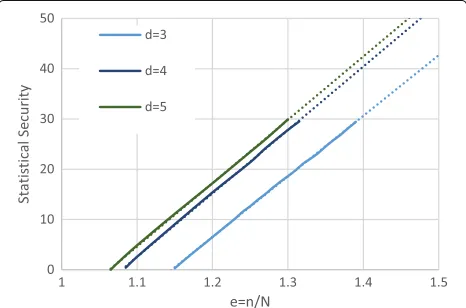
{4096, 8192, 16384}, and will see below that this is in fact sufficient to also treat huge datasets withNn. Figure 1 shows the empirical failure probability for d ∈ {3, 4, 5} andn=4096 for a variety of expansion factorse=n/N. The solid line indicates the regions where measured failure probabilities were obtained with more then 230 trials, and the dotted lines denote results obtained by extrapolation. These empirical results clearly show that ford∈ {3, 4, 5}the security parameter scales linearly with the expansion factore.
Table 1 shows the complete set of interpolated equations, which were obtained from the empirical anal-ysis with the parameters in question. In general, we find that the required e to achieve a desired security level increases asnbecomes larger. For instance, when consid-ering d = 5 hash functions,n = 4096 requires an eof approximately 0.01 smaller thann = 8192, for all mea-suredλ. However, this trend is weak, and may not hold for much largernas the asymptotic analysis suggests. In addi-tion, whiled ≥ 3 yields a linear relationship withλ, the special case ofd = 2 scales exponentially in the security parameter, as was also found by [1]. This is why we restrict to the much more efficient parameters ofd ≥ 3. More-over, because of the diminishing returns that increasing
d provides, we conclude that d = 4 provides the best trade-off for the setting that we consider.
Improved exact string matching
Single batch dataset
Suppose we are given a datasetD, and that the total num-ber of rows N < n so that the batch count B = 1. Instead of working withDdirectly, we instead hash each
Fig. 1Empirical (solid line) and extrapolated (dotted line) failure probabilities ofd-cuckoo hashing when insertingNitems into a table of sizen=4096. Graph describing cuckoo hashing failure probability
Table 1The linearly interpolated lines relating the statistical
security parameterλto thed-cuckoo hash table expansion factor
e, whereN=n/eitems are inserted to a table of size
n∈ {4096, 8192, 16384}usingd∈ {3, 4, 5}hash functions
d n=4096 n=8192 n=16384
3 λ=120.5e−138.1 λ=122.5e−141.5 λ=123.3e−143.5
4 λ=126.2e−136.3 λ=128.2e−139.6 λ=127.5e−140.0
5 λ=126.1e−134.0 λ=121.3e−129.7 λ=121.5e−130.8
row Q(1),. . .,Q(N) using permutation-based d-cuckoo hashing to produce a hashed datasetH(D). The length of the rowsQ(i)is = R+L, andn = 2R+ log2d. Sup-pose for now thatNis so much smaller thannthat hashing succeeds with overwhelming probability. LetH(D)denote the batching of the hashed dataset—analogous toD—and letH(D)Encdenote its encryption.
Given a query string X of length , we need to apply permutation-based d-cuckoo hashing to form a hashed query. In this case we hash only one item (namelyX) into a table of size n, and populate each of the d locations Loci(X) with XL. This is necessary, because we cannot know into which of the d locations X eventually ended up when the dataset was hashed. Let H(X) denote the hash table containing the hashed query string. Each row of the hash table will have lengthLbits, and we apply the Composefunction exactly as before to form the batch-ing of the hashed query H(X), and finally encrypt it to obtainH(X)Enc.
The comparison ofH(X)EncwithH(D)Enccan be done using CAM, CMA, or CA, almost exactly as before, but now the strings that need to be compared have length L bits, which is R = log2n − log2d bits fewer than the originalbits. In an optimal cased is as small as possible, and n as large as possible, but in prac-tice n is bounded by performance restrictions coming from homomorphic encryption (bigger n means worse performance).
Multiple batch dataset
In our security model the sizeN of the dataset and the lengthof the strings are public information. For secu-rity reasons (see below), we need to be able to fix a public predetermined choice forB, and say that the probability of a hashing failure occurring for at least one of theseB
batches is at most 2−λ. Building on our failure probabil-ity estimates for cuckoo hashing, it is straightforward to adjust the bounds for this setting withBbatches: instead of solving the equations of Table 1 for a givenλ, we must compensate for the fact thatBsuch hash tables are con-structed. Thus, cuckoo hashing should be expected to fail at most once in every 2λBtrials. Therefore, the left hand side of the equations of Table 1 should beλ+log2B; e.g. for
d = 3,n = 4096 the equation becomes λ+ log2B =
120.5e−138.1, when applied to the multiple batch setting. Note thate= n/N, and the total number of items in the dataset isN=BN=Bn/e.
Larger base
In the CAM method we would still want to use larger base b > 2 for more compact representation of the strings, and for better message expansion in encryption. The dataset and query are hashed just as before, but the items in the bins that earlier were expressed as bit strings of lengthLare now instead expressed as base-bstrings of lengthL,b=L/log2b
.
The problem of empty bins
There is one issue that we have ignored until now. The hash tables in the hashed dataset will typically contain some number of empty bins, and the hashed queries (which are also hash tables) will contain almost entirely empty bins. An empty bin naturally results in a value of 0 in the corresponding slot after batching. These zeros will cause false matches to occur, unless they are in some way invalidated.
This problem is easy to solve by writing animpossible
value to the slots that correspond to empty bins in the batched hashed query and dataset. Note that these impos-sible values do also need to be different for the query, and for the dataset. Note that when using a base b in decomposing the strings, after batching the values in all (non-empty) slots will be at mostb−1.
For the CAM method we populate the empty bins of the hashed dataset with the valueb, and the empty bins of the hashed query with the valueb +1. We conclude that theCAMmethod works as long as the homomorphic encryption parametert> L,b(b+1)2. It is in fact possi-ble to do slightly better by simply invalidating the unused bins for one of theLpositions, and requiretto be such that(L,b−1)(b−1)2+(b+1)2<t.
For theCMAmethod the situation is a bit trickier. Sup-pose the batch count isB. Then the party that encrypts the dataset includes with itBadditional ciphertexts that
containmasksfor the batches, invalidating (i.e. setting to zero) all locations that are empty in the hash table. Like-wise, the party that submits the query includes an extra ciphertext that encrypts a mask that invalidates all loca-tions that are empty in the query hash table. So instead of the usualCMA, we now evaluate
CMA
H(D)Enc,H(X)Enc
=Mask(H(X))
B
i=1 ⎧ ⎨
⎩Mask(H(D))i
×
j=1
1 −
H(D(i)) Enc
j−
H(X)Enc
j 2⎤
⎦ ⎫ ⎬ ⎭,
whereMask(H(D))i is a batched ciphertext that has a 1 in each slot that corresponds to a non-zero hash table bin inH(D(i)), and a 0 in the rest of the slots, andMask(H(X))
is a batched ciphertext that has a 1 in the slots that cor-respond to non-empty bins, and a 0 in other slots. The masks will now automatically invalidate all rows that are not supposed to be included in the comparison by setting them to zero.
Multiqueries
Suppose the dataset has been hashed and encrypted as described above, and instead of one queryX, consider sub-mittingkqueriesX(1),. . .,X(k). Naively, the performance and communication cost isk-fold compared to submit-ting a single query. Alternatively, we could try to use the same hash table when hashing each of thekqueries, cut-ting down the performance to (1/k)-th of that of the naive approach. This will work as long as for each of the d
location functions the locationsLoc(X(j))are distinct. In case there is overlap in the locations, we need to split the multiquery into two or more parts. More precisely, if
BX denotes the size of the largest bin after inserting allk items with alldhash functions, then we need to break the multiquery up intoBX hash tables, each of which will be batched and encrypted separately.
Success probability
We assume the number of k of concurrent queries (k -multiqueries) to be public information. For security rea-sons, we need to be able to predetermine a value forBX that is exceeded with probability at most 2−λ, where again λ is the statistical security parameter. Then we always submitBX separate queries, because otherwise someone observing the queries can tell whether hash collisions occurred more or less than expected, which leaks infor-mation.
need to first determine how likely it is that when plac-ing k balls into n/d boxes the largest box has size at mostBX:
Pr[ at least one box contains more thanBXballs] ≤n
d ·Pr[ first box contains more thanBXballs]
=n
d
k
i=BX+1
k
i d n
i 1− d
n k−i
.
To fail, this must occur in at least one of thedregions. Therefore,
Pr[ multiquery packing failure]≤n
k
i=BX+1
k
i
×
d n
i 1− d
n k−i
.
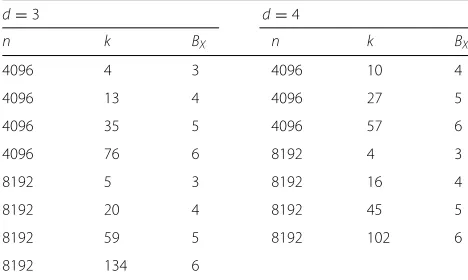
A few examples are presented in Table 2 (forλ = 30) and Table 3 (forλ=40).
Furthermore, if more than one multiquery is performed over the lifetime of the data, it might be necessary to adjust the success probability to ensure that the fail-ure probability is negligible even when performing some predetermined number M of k-multiqueries. Namely, we should select BX in such a way that on expecta-tion at most one of every 2λM k-multiqueries fails. For simplicity, we ignore this correction for now on, and assumeM=1.
It is also possible to ignore this information leak, and simply submit ak-multiquery in as few batches as possi-ble. The information leak resulting from this seems very difficult for an adversary to use, in particular if it does not know the hash functions used by the location functions. Nevertheless, our proof of security requires the number
BX to be determined beforehand, and that the multi-query size does not depend on the individual multi-query strings themselves.
Table 2Parameters with multiquery failure probability≈2−30
d=3 d=4
n k BX n k BX
4096 4 3 4096 10 4
4096 13 4 4096 27 5
4096 35 5 4096 57 6
4096 76 6 8192 4 3
8192 5 3 8192 16 4
8192 20 4 8192 45 5
8192 59 5 8192 102 6
8192 134 6
Table 3Parameters with multiquery failure probability≈2−40
d=3 d=4
n k BX n k BX
4096 5 4 4096 10 5
4096 13 5 4096 23 6
4096 30 6 8192 6 4
8192 7 4 8192 16 5
8192 21 5 8192 39 6
8192 52 6
Our protocol
In this section we describe in detail our protocol for querying an encrypted dataset using the CAM method with d-cuckoo hashing for multiqueries. Protocols for usingCMAandCAare similar, and we omit their formal descriptions.
Formal protocol description
We consider two parties:
• Theserver who stores the encrypted dataset and evaluates the string matching functionCAM.
• Theclient who owns the encrypts the dataset, submits encrypted queries to the server, owns the secret key, and obtains the results of the queries.
It is easy to extend our protocol to work instead with a dataset owner who is differentfrom the client, and uses only the client’s public key to encrypt its dataset. Indeed, the protocol would be nearly identical, except that the server would have to randomize the non-zero slots in the output of CAM to not leak extra information about the dataset to the client. We have chosen to restrict to the two-party version of the protocol to make the security model, and the description of the protocol simpler.
We assume that the sizeN of the datasetD, the length of the strings, and the number ofkof queries are public information. A formal description of our protocolCAMis given in Fig. 2.
Security
Fig. 2ProtocolCAMProtocol description
CMAandCA, and the proof of security does not depend in a significant way on which string matching method is used.
First, let us consider the setup phase where the encrypted dataset is constructed. When constructing the hashed datasetH(D), failing to construct theB cuckoo hash tables obtained within it may reveal to the server that a certain number of hash collisions occurred while hashing the dataset. As such, we must ensure that the probability of this event is negligible in the statistical secu-rity parameterλ. Our hashing failure probability estimates show how the public parametersn,d, andBcan be chosen to have this property. Such a choice is made in proto-colCAM(Fig. 2). Once the hashed datasetH(D)is con-structed, it is encrypted with homomorphic encryption as was described above, the exact details depending on whetherCAM,CMA, orCAis used. The encrypted dataset is then uploaded to the server.
Later, a query of sizekis made. The exact details depend slightly on whether CAM, CMA, or CAis used. However, in all cases the query is encrypted using homomorphic encryption. Moreover, the size of the query is a function of the public parametersk,N,, andb. A full simulation of the protocol can therefore be obtained by replacingD and the query with uniformly sampled ones of the same size. This change is computationally indistinguishable by
a straightforward reduction to the indistinguishability property of the homomorphic encryption scheme.
Results
In this section we will give an example application that was one of the problem tracks in the iDASH Secure Genome Analysis Competition in 2016. Track number 3 in the competition—Testing for Genetic Diseases on Encrypted Genomes—can be described as follows:
Problem description. Consider a setup with a client (or possibly several clients), and a server. Initially the client holds genomic data in VCF files in plaintext form. It encrypts the files using homomorphic encryption, and uploads them to the server for long-term storage. At a later point the client wishes to query the server for the presence of a particular entry (line) in the encrypted data. The query will also be encrypted using homomorphic encryption to prevent the server from learning any of the client’s private data from it. More generally, the client can issue multiqueries, in which several entries are queries at once. After the client gets an encrypted result back from the server, it decrypts and decodes it to learn a Boolean result:MATCHorNO MATCH (orkBoolean results for a
k-multiquery).
We consider two scenarios. In the first one we assume that the VCF files contain up to 104rows, and in the sec-ond one up to 105rows. We present separate parameters optimized for both scenarios.
Parsing the files. The client starts with parsing the VCF files as follows. It reads in a line, and outputs #CHROM (chromosome number), POS (position), the last entry in the string REF (one of{A,C,G,T, empty}), the last entry in the string ALT (similarly one of{A,C,G,T, empty}), and one bit representing whether SVTYPE=SNP. We encode the symbols in REF and ALT using numbers as
{A=0,C=1,G=2,T =3, empty=0}.
The empty symbol appears for example when SVTYPE=DEL. Substitutions (SVTYPE=SUB) and insertions (SVTYPE=INS) are ignored to obtain better performance, and because the competition problem description allowed it. This is why we only care about the last (and only) symbol in the REF and ALT strings. While our implementation only supports querying entries with SVTYPE=SNP, but it is possible—and easy—to generalize our solution to support more general queries at the price of only slightly reduced performance. This is because the CAM function behaves very nicely with increasing string length.
X or Y, we need 5 bits to represent it. Since POS is an integer of length at most 9 decimal digits, we need 30 bits to represent it. Since we only encrypt homomorphi-cally the last symbol of the REF and ALT strings, we need 2 bits for both. Finally we need one bit to repre-sent whether SVTYPE=SNP. In total, our encoding of each row has length= 40 bits. For each row we will encrypt homomorphically only these 40 bits.
Thus, we encode an entry of the VCF file into 40 bits (to be homomorphically encrypted) as follows:
x= x" #$ %1. . .x5
Chromosome number
x" #$ %6. . .x35 Starting position
x" #$ %36x37 Reference
x" #$ %38x39 Alternative
"#$%x40 Is SNP?
Encrypting the dataset. In order to reduce the bit length of the inputs, we use permutation-based 4-cuckoo hashing. We use n = 8192, and
N = 7700. We consider two types of situations, where in the first one N = 104 (so B = 2), and in the second oneN =105(soB=13). Now,d=4, soR=log2n− log2d =11, andL=−R=29. The location functions areLoci(x) = i·211+[Hi(xL)⊕xR] fori∈ {0,. . ., 3}. With table size this much larger than the number of items inserted in each table, 4 hash functions suffices to obtain a good probability of succeeding in the hashing process. Each data entry (also each query) is represented by 40 bits, which hashing reduces toL=29 bits. We use a block sizeb = 210 to getL,b = 3. Thus, we needt> L,b(b+1)2=3151875. In our first example with N = 104and B = 2 this results in an encrypted dataset consisting ofBL,b = 6 ciphertexts. Similarly, in our second example withN =105andB=13 we obtain an encrypted dataset consisting ofBL,b=39 ciphertexts. For the sake of performance, in our example we ignore the possibility of a (very) minor information leak due to a small but non-negligible hash failure probability. Con-sidering the case ofB=13, to instead obtain a statistical security level ofλ=30, it suffices to use the same param-eters but to restrict the VCF files with at most 78781 rows (N ≈ 6060). To obtain a statistical security level of λ = 40, the VCF files should have no more than 74483 rows (N≈5729).
Encrypting multiqueries. We restricted to multiqueries of size at most 5 due to the specifications of the compe-tition problem description. Again, we ignored potential information leaks from hash failures, in all examples pro-ducing only a single set of L,b ciphertexts (BX = 1). Indeed, forn = 213, andd = 4, packing a 5-multiquery into one succeeds with probability approximately 0.98. Thus, in our implementation, the 5-multiqueries consist of only BXL,b = 3 ciphertexts. The amortized size of
each query is therefore(3/5)/39=1/65 of the size of the encrypted dataset.
Even if a hash collision would occur, and the multi-query would have to be split up, it is very hard to see how an adversary could use this information, since typ-ically it would not even know what the hash functions are. Nevertheless, to instead obtain a statistical security level of λ = 40 would require takingBX = 4. Alterna-tively,BX = 4 allows for up to 16-multiqueries while still achieving a statistical security level ofλ=30.
Implementation and performance
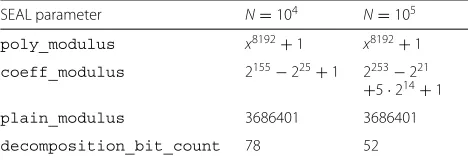
For homomorphic encryption we use the Simple Encrypted Arithmetic Library - SEAL [4], which imple-ments the Fan-Vercauteren encryption scheme [3]. Table 4 summarizes the SEAL encryption parameters that we used. In fact, we used two sets of parameters: one for our smaller example (N = 104), and another one for the larger one (N = 105). Note that both parameter sets use the same n (exponent in poly_modulus), but the smaller parameters have a much smaller q
(coeff_modulus). The larger parameters are estimated to have a computational security levelκ ≈ 100 bits [34], and the smaller parameters have a significantly higher
security level, which we did not explicitly estimate. The larger parameter set can easily be upgraded to support over 128 bits of security if needed, and this will come at a slight decrease in performance.
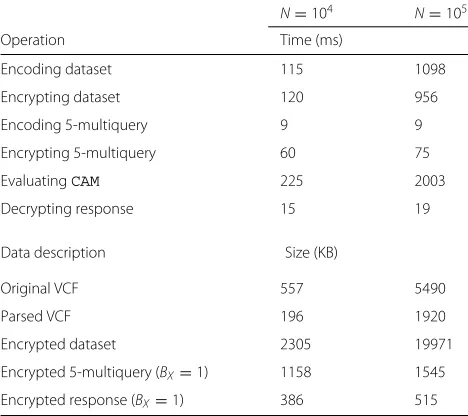
The results of our experiments are presented in Table 5. The experiments were ran on an Intel Xeon E5-1620 v3 @ 3.50 GHz, with 16 GB of RAM installed. Our implemen-tation used 8 threads to speed up the evaluation ofCAM. For homomorphic encryption we used SEAL v2.1.
Discussion
Our results in Table 5 demonstrate that homomorphic encryption can be practical for outsourcing data storage, and enabling privacy-preserving queries on the encrypted data with realistic performance. Message expansion due to homomorphic encryption is not prohibitively big (10–12x based on Table 5), and we certainly expect the situation to improve during the next few years as a result of new innovations in cryptography and encoding techniques.
Table 4SEAL encryption parameters forN=104(left) and
N=105(right)
SEAL parameter N=104 N=105
poly_modulus x8192+1 x8192+1
coeff_modulus 2155−225+1 2253−221
+5·214+1
plain_modulus 3686401 3686401
Table 55-multiquery performance results withN=104(left) andN=105(right)
N=104 N=105
Operation Time (ms)
Encoding dataset 115 1098
Encrypting dataset 120 956
Encoding 5-multiquery 9 9
Encrypting 5-multiquery 60 75
EvaluatingCAM 225 2003
Decrypting response 15 19
Data description Size (KB)
Original VCF 557 5490
Parsed VCF 196 1920
Encrypted dataset 2305 19971
Encrypted 5-multiquery (BX=1) 1158 1545
Encrypted response (BX=1) 386 515
Computational performance is already surprisingly good, and could easily be improved further by using a homo-morphic encryption library that has a stronger emphasis on performance optimizations, such as FV-NFLlib [35]. We were only concerned about simple set membership queries in this work, and it remains a challenge to cre-ate efficient protocols that allow more flexible types of queries.
We demonstrated our techniques in the context of querying SNPs in encrypted (parsed) VCF files of up to 105rows. By increasing the homomorphic encryption parameters it becomes possible to query also much larger files (millions of rows).
Our protocol relies heavily on the semi-honest security model, which is a standard assumption to make due to the often huge performance benefits it yields over pro-tocols secure under stronger security models, where the parties behavior is not necessarily restricted to follow the protocol description.
Conclusions
We have demonstrated that homomorphic encryption is indeed powerful and efficient enough to be used for stor-ing and privately querystor-ing encrypted genomic data for the presence of mutations. We also showed that the com-putational and communication cost can be dramatically reduced in the amortized setting, where the presence of several mutations is queried at once.
Extending our protocol to more complicated types of queries remains an interesting and important chal-lenge. Another possible direction for future research is to extend this work to the malicious security model, or
perhaps some slightly weaker model, but doing this with-out accruing too much performance or communication overhead seems challenging.
Funding
Publication of this article was funded by Microsoft Corporation.
Availability of data and materials
Our code is not publicly available, but we can provide explanations and details of individual parts of the implementation upon request. The homomorphic encryption library SEAL is publicly available at http://sealcrypto.codeplex.com.
Authors’ contributions
All authors contributed equally to this work. All authors have read and approved this manuscript.
Competing interests
The authors declare that they have no competing interests.
Consent for publication
Not applicable.
Ethics approval and consent to participate
Not applicable.
About this supplement
This article has been published as part of BMC Medical Genomics Volume 10 Supplement 2, 2017: Proceedings of the 5th iDASH Privacy and Security Workshop 2016. The full contents of the supplement are available online at https://bmcmedgenomics.biomedcentral.com/articles/supplements/volume-10-supplement-2.
Publisher’s Note
Springer Nature remains neutral with regard to jurisdictional claims in published maps and institutional affiliations.
Author details
1Worcester Polytechnic Institute, 100 Institute Rd, MA 01609 Worcester, USA. 2Microsoft Research, 14820 NE 36th St, WA 98052 Redmond, USA.3Oregon
State University, 2500 NW Monroe Ave, OR 97331 Corvallis, USA.4Princeton University, 304 Washington Rd, NJ 08544 Princeton, USA.
Published: 26 July 2017
References
1. Pinkas B, Schneider T, Zohner M. Scalable Private Set Intersection Based on OT Extension. 2016. http://eprint.iacr.org/2016/930, Accessed 9 May 2017. Cryptology ePrint Archive, Report 2016/930.
2. Pinkas B, Schneider T, Segev G, Zohner M. Phasing: Private set intersection using permutation-based hashing. In: 24th USENIX Security Symposium (USENIX Security 15). Washington: USENIX Association; 2015. p. 515–30.
3. Fan J, Vercauteren F. Somewhat Practical Fully Homomorphic Encryption. 2012. http://eprint.iacr.org/, Accessed: 9 May 2017, Cryptology ePrint Archive, Report 2012/144.
4. Laine K, Chen H, Player R. Simple Encrypted Arithmetic Library - SEAL (v2.1). 2016. https://www.microsoft.com/en-us/research/publication/ simple-encrypted-arithmetic-library-seal-v2-1, Accessed 9 May 2017. 5. Naehrig M, Lauter K, Vaikuntanathan V. Can homomorphic encryption
be practical? In: Proceedings of the 3rd ACM workshop on Cloud computing security workshop. Chicago: ACM; 2011, pp. 113–24. 6. Bos JW, Lauter K, Naehrig M. Private predictive analysis on encrypted
medical data. J Biomed Inform. 2014;50:234–43.
7. Lauter K, López-Alt A, Naehrig M. Private computation on encrypted genomic data. In: Progress in Cryptology-LATINCRYPT 2014. Cham: Springer; 2014. p. 3–27.
9. Kim M, Lauter K. Private genome analysis through homomorphic encryption. BMC Med Inform Decis Making. 2015;15(Suppl 5):S3. 10. Cheon JH, Kim M, Lauter K. Homomorphic computation of edit distance.
In: International Conference on Financial Cryptography and Data Security. Berlin Heidelberg: Springer; 2015. p. 194–212.
11. Graepel T, Lauter K, Naehrig M. ML confidential: Machine learning on encrypted data. In: International Conference on Information Security and Cryptology. Berlin Heidelberg: Springer; 2013. p. 1–21.
12. Gilad-Bachrach R, Dowlin N, Laine K, Lauter K, Naehrig M, Wernsing J. CryptoNets: Applying Neural Networks to Encrypted Data with High Throughput and Accuracy. In: Proceedings of The 33rd International Conference on Machine Learning. New York: PMLR; 2016. p. 201–10. 13. Bed ˝o J, Conway T, Ramchen K, Teague V. Privately Matchingk-mers.
2016. Cryptology ePrint Archive, Report 2016/781 http://eprint.iacr.org/ 2016/781. Accessed 9 May 2017.
14. Dowlin N, Gilad-Bachrach R, Laine K, Lauter K, Naehrig M, Wernsing J. Manual for Using Homomorphic Encryption for Bioinformatics. Proc IEEE. 2017;105(3):552–67.
15. Rivest RL, Adleman L, Dertouzos ML. On data banks and privacy homomorphisms. Found Secure Comput. 1978;4(11):169–80. 16. Gentry C. Fully homomorphic encryption using ideal lattices. In: STOC.
2009. p. 169–78.
17. Gentry C, Sahai A, Waters B. Homomorphic encryption from learning with errors: Conceptually-simpler, asymptotically-faster, attribute-based. In: Advances in Cryptology–CRYPTO 2013. Berlin Heidelberg: Springer; 2013. p. 75–92.
18. Brakerski Z, Vaikuntanathan V. Efficient fully homomorphic encryption from (standard) LWE. SIAM J Comput. 2014;43(2):831–71.
19. Brakerski Z, Gentry C, Vaikuntanathan V. (Leveled) fully homomorphic encryption without bootstrapping. In: Proceedings of the 3rd Innovations in Theoretical Computer Science Conference. Cambridge: ACM; 2012. p. 309–25.
20. López-Alt A, Tromer E, Vaikuntanathan V. On-the-fly multiparty computation on the cloud via multikey fully homomorphic encryption. In: Proceedings of the forty-fourth annual ACM symposium on Theory of computing. New York: ACM; 2012. p. 1219–234.
21. Bos JW, Lauter K, Loftus J, Naehrig M. Improved security for a ring-based fully homomorphic encryption scheme. In: Cryptography and Coding. Berlin Heidelberg: Springer; 2013. p. 45–64.
22. Gentry C, Halevi S, Smart NP. Homomorphic evaluation of the AES circuit. In: Advances in Cryptology–CRYPTO 2012. Berlin Heidelberg: Springer; 2012. p. 850–67.
23. Lyubashevsky V, Peikert C, Regev O. On ideal lattices and learning with errors over rings. J ACM (JACM). 2013;60(6):43.
24. Armknecht F, Boyd C, Carr C, Gjøsteen K, Jäschke A, Reuter CA, et al. A guide to fully homomorphic encryption. 2015. IACR Cryptography ePrint Archive 2015/1192. https://eprint.iacr.org/2015/1192.
25. Brakerski Z, Gentry C, Halevi S. Packed ciphertexts in LWE-based homomorphic encryption. In: Public-Key Cryptography–PKC 2013. Berlin Heidelberg: Springer; 2013. p. 1–13.
26. Smart NP, Vercauteren F. Fully homomorphic SIMD operations. Designs, Codes Cryptogr. 2014;71(1):57–81.
27. Arbitman Y, Naor M, Segev G. Backyard cuckoo hashing: Constant worst-case operations with a succinct representation. In: Foundations of Computer Science (FOCS) 2010 51st Annual IEEE Symposium on. Piscataway: IEEE; 2010. p. 787–96.
28. Pagh R, Rodler FF. Cuckoo hashing. In: European Symposium on Algorithms. New York: Springer; 2001. p. 121–33.
29. Devroye L, Morin P. Cuckoo hashing: further analysis. Inf Process Lett. 2003;86(4):215–9.
30. Kirsch A, Mitzenmacher M, Wieder U. More robust hashing: Cuckoo hashing with a stash. SIAM J Comput. 2009;39(4):1543–61.
31. Fotakis D, Pagh R, Sanders P, Spirakis P. Space efficient hash tables with worst case constant access time. In: Annual Symposium on Theoretical Aspects of Computer Science. Springer; 2003. p. 271–82.
32. Frieze A, Melsted P, Mitzenmacher M. An analysis of random-walk cuckoo hashing. In: Approximation, Randomization, and Combinatorial Optimization. Algorithms and Techniques. Springer; 2009. p. 490–503. 33. Lambæk M. Breaking and fixing private set intersection protocols. 2016.
Master’s thesis, Aarhus University https://eprint.iacr.org/2016/665. Accessed 9 May 2017.
34. Albrecht MR, Player R, Scott S. On the concrete hardness of learning with errors. J Math Cryptol. 2015;9(3):169–203.
35. Aguilar-Melchor C, Barrier J, Guelton S, Guinet A, Killijian MO, Lepoint T. NFLlib: NTT-based fast lattice library. In: Cryptographers’ Track at the RSA Conference. Springer; 2016. p. 341–56.
• We accept pre-submission inquiries
• Our selector tool helps you to find the most relevant journal
• We provide round the clock customer support
• Convenient online submission
• Thorough peer review
• Inclusion in PubMed and all major indexing services
• Maximum visibility for your research
Submit your manuscript at www.biomedcentral.com/submit