Please cite this article as: M. Jaderyan, H. Khotanlou, Automatic Hashtag Recommendation in Social Networking and Microblogging Platforms Using a Knowledge-Intensive Content-Based Approach, International Journal of Engineering (IJE), IJE TRANSACTIONS B: Applications Vol. 32, No. 8, (August 2019) 1101-1116
International Journal of Engineering
J o u r n a l H o m e p a g e : w w w . i j e . i r
Automatic Hashtag Recommendation in Social Networking and Microblogging
Platforms Using a Knowledge-Intensive Content-based Approach
M. Jaderyan, H. Khotanlou*
Department of Computer Engineering, Bu-Ali Sina University, Hamedan, Iran
P A P E R I N F O
Paper history:
Received 23 April 2019
Received in revised form 23 May 2019 Accepted 05 July 2019
Keywords:
Content Enrichment Hashtag Recommendation Knowledge-Intensive Ontology
Semantic Network Representation Structured Knowledge Base
A B S T R A C T
In social networking/microblogging environments, #tag is often used for categorizing messages and marking their key points. Also, since some social networks such as twitter apply restrictions on the number of characters in messages, #tags can serve as a useful tool for helping users express their messages. In this paper, a new knowledge-intensive content-based #tag recommendation system is introduced. The proposed system works by integrating structured knowledge in every core component. First, the relevant features, semantic structures and information-content are extracted from messages. Since little information can often be placed in a message, a content enrichment module is introduced to identify information structures that can improve the representation of message. The extracted features are represented by semantic network. Then, a hybrid and multi-layered similarity module identifies the commonalities and differences of the features, semantics and information-content in messages. At the end, #tags are recommended to users based on #tags in contextually similar messages. The system is
evaluated on Tweets2011 dataset. The results suggests that the proposed method can recommend suitable
#tags in negligible operational time and when little content is available.
doi: 10.5829/ije.2019.32.08b.06
1. INTRODUCTION
١
The microblogging environments in social networks have become the main source of preferred/favourite information and breaking news. They have also transformed into platforms for communicating with friends and celebrities for many people. These platforms are being employed to acquire and analyze information in applications such as public opinion mining [1, 2], prediction based on public opinions [3], individual reputation scoring and management [1], natural language processing [4], privacy protection [5], event detection [6] and interest and expertise mining [7]. Twitter is one of the most important and widely used social networking platforms [8]. What distinguishes twitter from other social networking platforms is the 280-character limit on the messages (tweets). This unique feature makes it difficult for users to convey their intended message by a single tweet. The adaptation of #tags for marking the key points of messages is another interesting feature of
*Corresponding Author Email: [email protected] (H. Khotanlou)
twitter. Since in most cases, the intended meaning of a tweet cannot be stated clearly by 280-character limit, using #tags will help users express their message better. Over the last couple of years, numerous approaches have been introduced for #tag recommendation in microblogging/social networking platforms. The majority of these approaches can be classified in three categories: (1) content-based [9–12], (2) collaborative filtering-based [10, 13] and (3) machine learning-based approaches [14]. The approaches in the first category calculate the similarity of a user’s message to the stored messages in a database and recommend #tags to users based on the contextual similarity between them. However, since users’ messages are usually short and they cannot convey the intended meaning clearly, it would be very difficult to find suitable #tags [10]. The approaches in the second category analyze the preferences of collaborative users and recommend #tags based on the opinion of users that share common interest with the active user. These approaches suffer from
serious drawbacks, which arise from challenges such as the cold start phenomenon, data sparsity, scalability and ambiguity (when dealing with synonyms). The approaches in the third category train a learning model using the microblogging data. The biggest drawback of these approaches is the vast amount of predefined classes in the training data, which results in heavy computational burden on the system.
The success of a #tag recommendation model depends on the generated representation of messages. Over the last decade, the vector space representation models have gone through fundamental changes. The shallow word embedding approaches can model the content of textual resources in a continuous space called word2vec [15]. In this space, the co-occurrence relation and semantic pattern between concepts are identified and modelled. These models are then used to develop semantically enhanced techniques for calculating similarity between word sequences. Methods such as skip-gram [16] and continuous bag-of-words (CBOW) [17] are among word2vec-based modelling techniques. Advanced methods such as Recurrent Neural Network and Convolutional Neural Networks are among the newly developed approaches that employ word-embedding techniques [18–20].
The main contributions of this paper are: (1) introducing a knowledge-intensive #tag recommendation system by integrating the structured knowledge of ontology, Wikipedia and WordNet in every component of the proposed method. (2) Introducing a novel content enrichment module for improving the representation of messages. (3) Introducing a novel weighting mechanism for optimized representation of content in semantic networks. (4) Using the graphical structure of semantic networks to model the semantics and information-content of messages. (5) Introducing a novel hybrid and multi-layer semantic similarity measure for identifying the shared information-content and commonalities/ differences in semantic features, structural features and semantic relations of two semantic networks.
The rest of the paper is structured as follows: in the second section, the related works are explored. In the third section, the research objectives are declared. In the fourth section, the structure of the Top-Level ontology and KBs is introduced. In the fifth section, the proposed method of #tag recommendation is introduced. In the sixth section, the evaluation results are presented and the conclusions are presented in the seventh section.
2. RELATED RESEARCHES
Many of the studies in this area analyze the information-content of the messages, extract prominent features of the content, and use the extracted features to recommend #tags [21]. Otsuka et al. [9] introduced a new ranking
method called HF-IHU, which is a variant of the well-known TF-IDF method. This method considers data sparseness and #tag relevance as the deciding factors for #tag recommendation. Gong et al. [22] proposed bag-of-phrase model for better capturing of the underlying topics of posted microblog. Then, online Twitter-User LDA [22] is used to learn Twitter users’ dynamic interests. This method uses incremental bi-term topic model (IBTM) to discover the latent topics of tweet content. These methods are then combined to generate #tag recommendations.
Most #tag recommendation approaches employ a representation schema to model the contents (tweets). The vector space models (VSMs) are among the most popular representation schemas. Zangerla et al. [23] used TF-IDF model for #tag recommendation. They used the TF-IDF vector model to find the most similar messages to user’s tweet. The continuous space models (word embedding) were formed to address the intrinsic drawbacks of VSMs. Over the last couple of years, word-embedding techniques have been used successfully for #tag recommendation [15]. Mikolov et al. [24] in google proposed two novel models for computing continuous vector representations of words from very large data sets. The designed models enable the system to learn the distributed representations of words. Weston et al. [25] introduced a convolutional neural network for #tag recommendation. The proposed method learns the feature representations of short textual resources (posts, messages, sentences, …) by using #tags as a supervised signal. Gong and Zhang [26] have used the convolutional neural networks for #tag recommendation. The authors have proposed a novel architecture with an attention mechanism to calculate embedding for each word of a given message. The collective embedding is then used to model the whole message. A novel recurrent neural network model to learn vector-based tweet representations is proposed to recommend #tags [15]. A skip-gram model is used to generate distributed word representations and a convolutional neural network to learn semantic sentence vectors. Finally, the sentence vectors are used to train a LSTM-RNN network. The tweet vectors are used as features to classify #tags.
by Tomar et al. [10]. The topic relevance of hashtags to posts are characterized based on content models. Active user’s hashtag usage preference is predicted in a collaborative filtering manner.
Graph-based modelling of microblogging messages has also been used as a representation schema for #tag recommendation. Al-Dhelean et al. [28] introduced a heterogeneous social graph model that contains information about users, tweets, and #tags. The graph is then summarized to a #tag graph that shows the similarity between different #tags. At the end, the vertices in the graph are ranked using a random walk with restart and a content-based similarity measure. The researches in this field suggest that using a graph-based approach for content representation has positive impact on overall performance. A graph-coarsening approach that aims to speed-up the execution time of graph-based tag recommenders in large-scale folksonomies is introduced by Wang et al. [11]. A community detection algorithm in multiplex networks is applied for coarsening the hyper-graph depicting a folksonomy and #tag recommendation.
Learning-based approaches can be employed to model the tweets and corresponding #tags. Tomar et al. [10] used a skip-gram model to learn distributed word representations (word2vec) of tweets. They used the learned model to train a deep feed forward neural network for #tag recommendation. Probabilistic models [28], Topic Analysis [4] and RNN-LSTM networks [29] are also used for modelling and recommending #tags in microblogging platforms [30, 31].
Inspired by the researches in this field, we have exploited the structured knowledge of KBs and Top-Level Ontology to develop a content enrichment module, to represent messages in graphical structure of semantic network and to implement a hybrid semantic similarity measure for #tag recommendation.
3. THE STRUCTURE OF KBS
The KBs play a crucial role in optimal performance of the proposed method. Understanding their structural characteristics underlines what kind of semantic information/structures are identifiable and extractable.
3. 1. OntoWordNet The OntoWordNet ontology is an integral part of the system. Each concept in ontology is organized as synonym set so that the contextually similar (or equivalent) concepts can be identified. This facilitates content enrichment [13].
3. 2. WordNet WordNet models a semantically enhanced lexicon for English language. The structure of WordNet consists of synsets. The synset organizes a set of synonym concepts. Every synset consists of several senses. The senses are simply the different meanings of a
concept. More details about WordNet is available in literature [13].
3. 3. Wikipedia Wikipedia data are available for academic use through D.I.S.C.O project [32]. Both data are structured the same way. The manner in which the data are created is described in literature [32, 33]. Wikipedia data structure consist of two sets of data: (1) first-order word vector: which contains words that occur together in Wikipedia and BNC corpus and (2) second-order word vector: which contains words that occur in similar contexts. more information is available in literature [32, 33].
4. PROPOSED METHOD
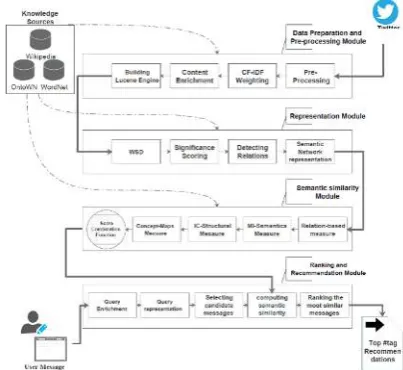
The proposed method utilizes the structured knowledge of KBs and ontology to extract the semantics and informative features from messages. The extracted features will be used for content enrichment, content representation and semantic similarity computation. The proposed system recommends #tags by analyzing the contents of user’s message and measuring its semantic and contextual similarity to the messages in a database. Figure 1 illustrates the core components of the proposed method.
The structured knowledge of ontology and KBs are integrated in every component of the proposed system. The proposed method comprises of four components: (1) Data preparation and pre-processing module: this module is tasked with extraction of relevant features, semantic structures and information-content form messages. (2) Representation module: this module uses the extracted information and features about a message to model the information-content in graphical structure of semantic networks. (3) Semantic similarity module: this module is
tasked with finding the most similar messages to an input message. (4) Ranking and recommendation module: this module ranks the messages according to their similarity to the user message and determines the most suitable #tags. As illustrated in Figure 1, the input of the proposed system is a database of social media messages. At first, the messages undergo a pre-processing operation and the semantic structures and information-content features are extracted. In the next step, the features (concepts/words) are weighted using CF-IDF weighting schema. The most challenging part of analyzing contents is the lack of sufficient content. A novel content-enrichment module is introduced to overcome this obstacle. The feature vectors are then enriched to enhance the representation of information-content. For accurate modelling of the relation between features, a Word Sense Disambiguation (WSD) technique is used to annotate features with their true (contextual) meanings. In the next step, the features and the enriched contents [34] are indexed using the Apache Lucene [35] to create a full-text indexing search engine. Since the extracted features are not equally important, a hybrid weighting mechanism is introduced to select the most important features (concepts/words) for content representation. Then, the semantic network structure is used to represent the features and the enriched contents. As the user enters a message into the system, Lucene search engine identifies and retrieves a number of similar messages. Then, a novel hybrid semantic similarity module is introduced for identifying the shared information-content and semantics between the semantic networks of the retrieved messages and semantic network representation of user input. The #tags in the contextually similar messages are marked as #tag recommendation candidates. Finally, the ranking mechanism ranks the computed #tag recommendation candidates and recommends suitable #tags to the user.
4. 1. Data Preparation and Pre-processing Recommending #tags based on users’ tweeting behavior and the content of tweets would require a database of pre-analyzed tweets, which would be the basis for #tag recommendation. We have used the “Tweets2011” dataset to generate this database. “Tweets2011” dataset contains identifiers for approximately 16 million tweets sampled between January 23rd and February 8th, 2011. The corpus is designed to be a reusable, representative sample of the twitter sphere [36]. In order to collect the tweets, tweet identifiers are retrieved from the dataset and the original tweets are fetched using third-party libraries [37]. From the nearly 16 million tweets in the dataset, 10,099,860 randomly selected tweets were retrieved and stored for further processing.
The pre-processing steps include: (1) Removing tweets with no #tags, (2) Extracting and Storing #-tags, (3) Removing All Non-English Messages, (4) Removing User IDs, (5) Removing Re-Tweets, (6) Removing All
URLs, (7) Removing Punctuations and non-alphanumerical symbols, (8) Removing Stop-Words, (9) Lower-case Transformation, (10) Lemmatization of textual entities and (11) uni-gram and Bi-gram identification. After pre-processing, 952,416 tweets out of 10,099,860 tweets were remained in the database.
Next, all the detected uni-gram and bi-gram concepts are weighted using CF-IDF weighting method (which is a variant of TF-IDF weighting method) [38].
4. 2. Enriching the Content of the Messages
4. 2. 1. Enriching the Content Using Wikipedia KB Employing structured knowledge bases for improving the representation of textual resources can help the system understand the context and semantics in textual resources [39]. Wikipedia KB contains two sets of information namely, the co-occurring and the contextually similar concepts/words. We are proposing to use the first and second-order word vectors for enriching the content of messages. The enrichment module facilitates the identification of lexical/semantic features that are essential for system understanding of the context. For each concept/word in message vector, Apache Lucene Library [40] is used to retrieve the co-occurring and contextually similar concepts/words. The retrieved concepts/words will be appended to the corresponding message vector.
4. 2. 2. Enriching the Content Using WordNet KB One of most important information structures in WordNet is the contextually similar sets. These sets determine which concepts are contextually similar/related to one another. Appending the contextually similar sets to the message vector helps system detect the messages with shared information-content. MIT’s Java WordNet interface (JWI) [41] is used to retrieve the contextually similar set for each concept/word. Each retrieved set will be appended to the corresponding message vector.
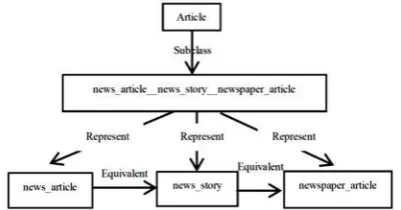
appended to the message vector. An example of concept map for “news” is illustrated in Figure 2.
The “concept maps” are used to annotate the message semantic networks and to infer new links between concepts. Incorporating the enriched content for improving the representation model and system understanding of context is a novel idea presented here.
Definition 1. Let be a message vector, then:
, , , … … , → a message vector
, , , , , … … , → enrichment vector for
∪ , ,
, , , … … , , , , , … … , → extended message vector for
, , , … … , → a message weight vector
, , *
!"#,,,$
, , % , , ∗
!"#,,,$ → enriched message weight vector (
0.6)
∪ , , → extended message
weight vector
4. 3. Word Sense Disambiguation of the Concepts Before we can model the relations between concepts, we need to clear the concepts/words of ambiguity. Therefore, a word sense disambiguation (WSD) technique, inspired by the idea presented in literature [42], has been developed. The underlying assumption is that similar senses occur in similar contexts. In other words, by comparing the collective informational and contextual features of a concept with the information-content of each possible senses, we can induce its true contextual meaning. The developed WSD technique relies heavily on the structured knowledge of Wikipedia and WordNet. The following step are performed: (1) A
7
+
, context window around the desired concepts in the message is created. In addition, the first-order word vector for each member of the context window is retrieved and appended to the context window. The window and the appending vectors create a “context vector” for each concept; (2) all possible senses of the concept, their usage
Figure 2. Representation of a generated Conceptual Map
example in a sentence and their brief definition (gloss) for each sense are extracted from WordNet. This will form a “sense vector” for each sense. The first-order word vector for each member of a sense vector is also retrieved and appended to corresponding sense vector. Finding the similarity between each sense vector and the context vector determines the contextual similarity between them; (3) a combination of cosine and Jaro-Winkler [43] measures is used to calculate the similarity score as follows.
-./0-12314 , 5261764 8
0953.21: ;0-12314 , 5261764 8 <
=>?5_ .2 A1?: ;0-12314 , 5261764 88
(1)
The sense vector with highest similarity score is selected as the correct sense vector and the corresponding sense is used to annotate the concept. The output of this module is a set of weighted concepts that are annotated by their contextual meaning.
4. 4. Building Full-Text Search Engine Apache Lucene (Solr) Java library is used to index the messages and the enriched contents in the dataset and build a search engine. The generated Lucene’s search indexes allows easy and fast access to hundreds of thousands of stored messages. When evaluating the proposed method, the indexed dataset will be split into training and testing subsets. These subsets will be used to evaluate the performance and estimate parameters.
presence of 7B. This relation was not originally a part of OntoWordNet ontology, but it has been added by aligning DBpedia ontology [44] and related datasets with OntoWordNet ontology. The aforementioned relations are used to link the concepts/words in semantic networks.
Definition 2. Let CDEFGDHIEC be an extended message vector for message , then:
J K>?6 L, -MN1? A>33, 3MO A>33, 3P252P/→ a set of relations
Q ∪ , , →an extended
message vector
R?>Nℎ R TU , 1B, U VWU ∈ Q, 1B∈ J
⋃0U , 1B, U 8 Z ,…
BZ , , ,[
R?>Nℎ BZ , , ,[Z ….,… R Z …;
TU , 1B, U V , TU , 1B, U V , … . . , TU , 1B, U V Z \;] L ^_ `
a.2 3 ∀TU , 1B, U V ∈ R ∃ A.2 WA.2 ↔ TU , 1B, U V→ relation can be expressed as a triple
R?>Nℎ R;`e 0/133>f18 TU , 1B, U V;`e% U ∈ Q, 1B∈
J BZ , , ,[Z ,… ⋃0U , 1B, U 8;`e
R?>Nℎ R\` 0M31? /133>f18 TU , 1B, U V\` % U
∈ Q, 1B∈ J
⋃TU , 1B, U V\` Z ,…
BZ , , ,[
Not all the concepts/words contribute equally to the information-content of the message. Therefore, only concepts that make greater contribution to the information-content should participate in semantic network generation process. Thus, a novel measure is introduced to identify concepts that are irrelevant to the context.
4. 5. 1. Contribution Score for Semantic Networks “Contribution scoring function” is a novel hybrid measure that calculates amount of “cohesion” each concept/word has with the “information-content” and “context” of a message. Four criteria are considered for calculating the contribution score: (1) lexical cohesion, (2) co-occurrences cohesion, (3) semantic cohesion and (4) Hierarchical path proximity.
Lexical Cohesion: calculates the lexical cohesion of each concept in a message with all the remaining concepts in the same message by measuring Jaro-Winkler [43] similarity between them. This will give us the idea of how much each lexical entity is compatible with the information-content of message.
-./gh _ 0> , O 8 B< ANT1 − BV > ≠ O (2)
B l
0 .m / 0
n|h!|; <|]!|; <;+; p 56ℎ1? .31 (3)
where B is the computed Jaro similarity score for the concepts > and O. A^ is the length of common prefix between two concepts. / is the number of matched
characters and 6 is half the number of characters displacements between two concepts.
Semantic Cohesion: calculates the semantic cohesion of each concept in the message with all the remaining concepts in the same message by measuring Lin [34] similarity between them.
-./q 0> , O 8 0rs0h∗rs0qs:0h!,]!88!8,rs0]!88 > ≠ O (4)
where, IC is the information-content and is computed as t90>8 − log N0>8 using WordNet KB [34].
Hierarchical Path Proximity: calculates the shortest hierarchical path between two concepts in OntoWordNet ontology [34, 35]:
-./ \xh_; 0> , O 8
/>7 yq e 0h∗z ^ 0qs:0h!,]!88!,]!8, ∗z ^ 0qs:0h!,]!88{ > ≠ O (5)
Co-Occurrences Cohesion: calculates the degree of shared information-content between a concept in a message and all the remaining concepts in the same message.
-./s + \ 0> , O 8 L |0h!8,L |0]!8∗L |0h!,]!8 < } ∗ ∗L |0]!,h!8
L |0h!8,L |0]!8 > ≠ O
(6)
where, } is a controlling parameter between [0, 1], m?1~0> , O 8 is the frequency of O co-occurring with > and m?1~0O , > 8 is the frequency of > co-occurring with O. Also, m?1~0> 8 is the frequency of concept >.
At the end, a weighted linear combination of these measures determines the contribution score of each concept:
526?.OM6.52_3 5?10> 8
•1 .m ∑BZ ,…. + ; ƒB` e L h _` Th!,]•V
0 „. ….
(7)
3.f2.m. >2 1_3 5?1T> , OBV ∗
-./gh _ T> , OBV < ∗ -./_ T> , OBV < ∗
-./ \xh_; T> , OBV < [∗ -./s + \ T> , OBV (8)
where, N is the number of concepts and > is the
respective concept. Also,
, , and
[areweighting parameters. They are between [0, 1] and their sum is equal to 1. These parameters are estimated using a subset of evaluation data in the evaluation stage. In the next step, top-n% of the concepts (with highest contribution score) are used to generate the message semantic network. The top-80% seems to be the optimal percentage of concepts for generating message semantic network. This number is estimated using a subset of evaluation data.
4. 5. 2. Semantic Networks Generation Process
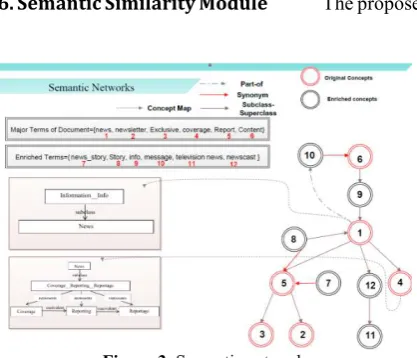
semantic relations are established between them. When only the original concepts (excluding enriched content) are projected onto the ontology, in most cases several separated clusters of concepts are formed. Two reason can explain this occurrence: (1) because of the lack of sufficient content in the messages, it is only natural that separated clusters of concepts/words are formed and (2) the concepts/words that can connect the separated clusters are left out. However, when the extended message vectors are projected onto OntoWordNet ontology, in most cases, a fully connected graphical representation of message is formed. The enriched concepts/words that can connect the separated clusters are called “liaison concepts”. Therefore, the enrichment module is one of the most important component of the proposed method and integrating this module provides two major benefits for the system: (1) identifying liaison concepts, which connects the separated clusters and (2) improving the information-content and representation of the messages. The following steps are performed to generate a message semantic network: (1) the top-n% of the concepts/words are selected according to the contribution score. (2) The selected concepts/words are projected onto the ontology and the proposed algorithm (Figure 4) identifies the relations between them one by one and links them to one another. (3) The liaison concepts connect the separated concept clusters to form a fully connected semantic network. Figure 3 illustrates how the semantic network connects the concepts and how the liaison concepts connect the separated clusters.
As shown in Figure 3, “info”, “story”, “television_news” and “newscast” act as the “liaison” concepts for connecting the separated clusters and connecting the semantic network to concepts in the deeper hierarchical structure of ontology. The semantic network will be represented as a sub-ontology using the OWL/XML schema. Therefore, the semantic network is machine-readable. The algorithm for generating Semantic network is depicted in Figure 4.
4. 6. Semantic Similarity Module The proposed
Figure 3. Semantic network
Input: a set of messages ‰ , , , … . . , , each
document , , , … … ,
Loop: for each concept in Loop: until is empty
Condition: if semantic network is empty
Append the first concept to the semantic network and Delete the first Concept from . End of Condition
Relation-Path set = a set indicating concepts with relations to and their path length; relative to in ontology
Relation={concepts with relation to }, Path={path length of each Relation}
Loop: for each that already exists in the semantic network
Loop: for each Bin the
Condition: if the relation between and ;is in Relation-location set & path-length>1 Source= , Destination= ;
Find every concept in a path from source to Destination
Disregard if the path already exist in the semantic network
Connect the Destination concept of the respective relation to Source concept in the semantic network
Add “Destination” to the semantic network and Remove the “Destination” from
Delete Relation and its Path-length from sets Relation and Path
End of Condition End of Loop End of Loop
Condition: if there are relations in set Relation with Path-Length=1
Connect and via superclass/subclass relation End of Condition
End of loop End of Loop
Output: the generated semantic network for the ’
Figure 4. Algorithm for generating Semantic network
4. 6. 1. Relation-based Measure
Explicit Measure: calculates the amount of shared information-content between two semantic networks. This measure determines which message semantic network is similar to semantic network representation of user’s message.
(9)
- 5?1Š ^_ n⋃T‹D, EŒ, ‹DV•Ž•p
∑ : ;
•‘’n‹D,EŒ,‹Dp•Ž• “”” •–— •˜!™”—•š
|h__ ^_ ` ;`e ` ;h .|
-./›œ•T‹D,EŒ,‹DV
•ž ^, .m ‹D >2 ‹Œ >?1 .2 ⋃T‹D, EŒ, ‹DVŸŽEG
1 − ž ^ 5. .
Implicit Measure: calculates the similarity between two semantic networks by measuring the commonalities in the established relations. In other words, this measure determines how much a message semantic network resembles a user message semantic network.
(10)
- 5?1;^_ n⋃T‹D, EŒ, ‹DV•Ž•p
∑ : ;
¡’n‹D,EŒ,‹Dp•Ž• “”” •–— •˜!™”—•š
|h__ ^_ ` ;`e ` ;h .|
-./›œ•T‹D,EŒ,‹DV
•ž;^, .m 0‹D, EŒ, ‹D8 ∈ ⋃T‹D, EŒ, ‹DVŸŽEG
1 − ž;^ 5. .
where, ž ^ and ž;^ are thresholds between [0, 1] and ‹Dand ‹Œare concepts in user message and a message in the database respectively. This measure generates a number between [0, 1] indicating the similarity score.
4. 6. 2. Semantics-based Measures
WordNet-based Measure: This method is based on the notion of information-content (IC) of the Least Common Subsumer (LCS) [34]. The notion of IC and the level of shared IC between concepts can be considered as a measure for calculating semantic similarity between two messages. Higher level of shared IC indicates high level of semantic similarity and higher similarity score. To this end, the normalized Jiang and Conrath measure is employed [32, 35].
(11)
…¢_3./0‹D, ‹Œ8 £& 0‹D, ‹Œ8 1 −
¥yrs$˜¦0‹D8,rs$˜¦T‹ŒV+ ∗rs$˜¦nqs:T‹D,‹ŒVp{§
where, ‹Dand ‹Œ are concepts in user message and a message in the database respectively. The IC of ‹D is t90‹D8 − log N0‹D8 and is calculated using WordNet.
Wikipedia-based Measure: The semantic similarity between two concepts can be viewed as function of similarities/differences between their respective Wikipedia’s first-order and second-order word vectors.
To this end, a measure inspired by Lin’s information theoretic measure [45, 46] has been implemented. This measure is called Collocation-Contextual similarity measure. At first, the first-order and second-order vectors corresponding to two concepts are retrieved. Then the following equations are used to calculate the similarity:
(12)
…. ._3./0U , UB8
∑•"#,«;ª"#,…$;©"#,…,¦0¬©, ˜—”• ,¬ª8 0rT¨©, _• ,∗V,rT¨ª, _• ,∗V8
∑•"#,«;ª"#,…$;©"#,…,¦0¬©, ˜—”• ,¬ª8 0rT¨©, _• ,¨ªV8,∑0¬©, ˜—”• ,¬ª8•"#,«;ª"#,…$;©"#,…,¦0rT¨ª, _• ,¨©V8
?1AB ?1A , ?1A
5
− 5 M??12 1_?A>6.52, 9526176M>A_3./.A>?.6P_-1A
tTU®, ?1AB , U V A5fL |T¨©, _• ,¨ªV∗L |T¨ª, _• ,¨©VL |T¨©, _• ,∗V∗L |T∗, _• ,¨ªV
where, ‹Dand ‹Œ are concepts in user message and a message in the database respectively. t0U®, ?1AB , U 8 is equal to the mutual information between U® and U®. The
m?1~08 function calculates the frequency of ‹¯and ‹¯in co-occurrence/contextually_similar relations based on Wikipedia KB.
4. 6. 3. IC-Semantics-Structural Measures
IC-Structural Measure: measures commonalities in structural and IC-based features of two concepts in two semantic networks:
(13) 3./_t9_-6 0U , UB8
rs0qs:0¨!,¨•88
rsnqs:T¨!,¨•Vp,¥°T¨!,¨•V∗±rs0¨!8+rsnqs:T¨!,¨•Vp²§,00 +°T¨!,¨•V8∗0rsT¨•V+rs0qs:0¨!,¨•888
³TU , UBV
´
^ 0¨!8
^ 0¨!8, ^ 0¨•8 1N6ℎ0U 8 ≤ 1N6ℎ0UB8
1 − ^ 0¨!8, ^ T¨•V^ 0¨!8 „. …
where, ‹D and ‹Œ are concepts in user message and a message in database respectively and 1N6ℎ0‹D8 calculates the depth of ‹D in hierarchical structure of ontology. IC of ‹D is t90‹D8 − log N0‹D8 and is calculated using WordNet. ³T‹D, ‹ŒV is a normalizing factor and is a function of depth of U and UB in ontology.
Semantics Measure: measures commonalities in corresponding first-order (co-occurrence) and second-order (contextually similar) vectors of two concepts in two semantic networks:
(14)
3./_31/>26.30‹D, ‹Œ8 0W +W + 0‹D8⋂ +0‹D8⋃ + 0‹Œ8W0‹Œ8W< W 0‹D8⋂ 0‹Œ8W
W 0‹D8⋃ 0‹Œ8W<
W`· `0‹D8⋂`· `0‹Œ8W W`· `0‹D8⋃`· `0‹Œ8W8
In the semantics-based and the IC-Semantics-Structural-based measures, the notion of semantic similarity between two concepts is used to compute the similarity between two semantic networks. These methods compute the semantic similarity between all the possible pairs of concepts in user message and a message in database and generate a number between [0, 1].
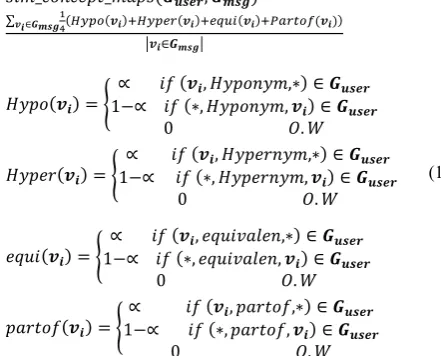
4. 6. 4. Concept Maps-based Measure This measure calculates the similarities between concepts maps of two different semantic networks. Each concept in a semantic network is annotated by a concept map, which provides useful insight about the concepts. Finding the commonalities between concept maps gives us an idea of how much two semantic networks are similar. The following equations are used to calculate the similarity:
3./_ 52 1N6_/>N30¸ŸŽEG, ¸•Ž•8
∑‹D∈¸•Ž•#¹0º·^ 0‹D8,º·^ 0‹D8, |\ 0‹D8,xh L0‹D88
W‹D∈¸•Ž•W
(15)
»PN50‹D8 l
∝ .m 0‹D, »PN52P/,∗8 ∈ ¸ŸŽEG
1−∝ .m 0∗, »PN52P/, ‹D8 ∈ ¸ŸŽEG
0 „. …
»PN1?0‹D8 l
∝ .m 0‹D, »PN1?2P/,∗8 ∈ ¸ŸŽEG
1−∝ .m 0∗, »PN1?2P/, ‹D8 ∈ ¸ŸŽEG
0 „. …
1~M.0‹D8 l
∝ .m 0‹D, 1~M.U>A12,∗8 ∈ ¸ŸŽEG
1−∝ .m 0∗, 1~M.U>A12, ‹D8 ∈ ¸ŸŽEG
0 „. …
N>?65m0‹D8 l
∝ .m 0‹D, N>?65m,∗8 ∈ ¸ŸŽEG
1−∝ .m 0∗, N>?65m, ‹D8 ∈ ¸ŸŽEG
0 „. …
where ∝ is thresholds between [0, 1]. This method generate a number between [0, 1] indicating the similarity score.
At the end, a linear weighted combination of the introduced measures is used to compute the overall semantic similarity.
5U1?>AA_3./_3 5?1T¸ŸŽEG, ¸•Ž•V ∗ ∑‹Œ∈¸•Ž•,½Œ ∈½ŒEFGDHIEC‹D∈¸ŸŽEG ½Œ∗ _` ;T‹D,‹ŒV
∑½Œ ∈½ŒEFGDHIEC½Œ < ∗
∑‹Œ∈¸•Ž•,½Œ ∈½ŒEFGDHIEC‹D∈¸ŸŽEG ½Œ∗ _` ;T‹D,‹ŒV
∑½Œ ∈½ŒEFGDHIEC½Œ <
(16) + ∗∑ ½Œ∗` ;_` ;h `T‹D,‹ŒV
‹Œ∈¸•Ž•,½Œ ∈½ŒEFGDHIEC ‹D∈¸ŸŽEG
∑½Œ ∈½ŒEFGDHIEC½Œ < [∗
∑‹Œ∈¸•Ž•,½Œ ∈½ŒEFGDHIEC‹D∈¸ŸŽEG ½Œ∗` ;_rs_: T‹D,‹ŒV
∑½Œ ∈½ŒEFGDHIEC½Œ < < ¾∗
- 5?1Š ^_ T⋃T‹D, EŒ, ‹DV ∈ ¸•Ž•V
< ¿∗ - 5?1;^_ T⋃T‹D, EŒ, ‹DV ∈ ¸•Ž•V < À∗
3./_ 52 1N6_/>N30¸ŸŽEG, ¸•Ž•8
where, , , , [, ¾, ¿ and À are the weighting parameters between [0, 1] and their sum is equal to 1. These parameters are estimated using a subset of evaluation data in evaluation stage. So far, the result is a set of ranked message and a set of #tag candidates. The next step is to rank the #tag candidates and recommend the top-N #tags to users.
4.7. #Tag Ranking and Recommendation Module In order to rank the top-N #tag candidates, a suitable ranking method needs to be introduced to rank, select and recommend the best #tags to user.
Ranking based on the similarity score: the score of similarity between messages can be used to rank the #tags for recommendation. It is logical to assume that if the user message and a message in database are contextually similar, the message in database probably contains #tags that are appropriate for recommendation to user. In circumstances where several messages may contain the same #tag, the #tags in messages with higher scores will be ranked higher. Figure 5. Illustrates the overall #tag recommendation algorithm.
5. EVALUATION
5. 1. Evaluation Setup “Tweets2011” dataset (described in section 5.1) is the basis for creating the message database, implementing the search and recommendation engine and evaluating the proposed method. The Leave-One-Out method is used to evaluate the proposed #tag recommendation system. A total of test runs are performed and the average of test results is used
Input: the sets of messaged ‰ , , , … . . , , Lucene search engine, user message, KBs
Construct the user message semantic network based on the entered user message
Loop: for the constructed user message semantic network Retrieve a number of messages comprising similar
content. End of Loop
Loop: for each retrieved message Construct the semantic network End of Loop.
Compute the semantic similarity between user message and semantic network representation of other messages in DB.
Rank most similar messages according to their similarity to user message.
Rank the #tag recommendation candidates in the most similar messages based on scores generated by hybrid measure.
Output: #tag recommendation for social network users/microblog users.
to evaluate the performance. In each test run, 95,240 input messages (nearly 10% of the indexed messages) containing maximum of eight #tags are retrieved randomly (from Lucene search index) for evaluation. From the left-out data, ten thousand messages are selected randomly for parameter optimization. These messages are different from the evaluation data. Obviously, we remove #tags for every input message. In addition, the input message is removed from the Lucene index so that it does not distort the evaluation results. Since nearly a million recommendations are computed and evaluated; therefore, the evaluation setup is comprehensive and it generates a good assessment of system performance.
5. 1. 1. Similar Methods for Comparison
I. The method introduced in literature [27] is considered to compare the system performance with similar methods. It is a straightforward method based on term frequency-inverse document frequency (tf/idf). The following equations are used to compute the similarity:
6m_. m, 6m, ∗ . m (17)
6m, 2, (18)
. m log| : ∈ ||z| (19)
This equation consists of two parts. The term_frequency
part counts the number of occurrences of term t in a given message d and inverse_document _frequency determines the significance of term t in all the messages.
II. Another method has been developed to assess the performance of proposed method. This method exploits lexical, semantics-based and structural-based features of messages to determine the similarity between two different messages. This method consists of three measures: (1) cosine similarity (2) Informationcontent -based similarity (3) Hierarchical path--based similarity.
The following equations are used to calculate the similarity between two messages:
953.210 ; , \` 8 Å —$˜!–—榗$˜!–—ÃÅ‖Ç. $Äš—˜$Äš—˜‖
∑¬•∈æ ¨!œ¨•
Äš—˜ ¬!∈æ—$˜!–—Ã
È∑ 0¨!8«
¬!∈æ—$˜!–—à œÈ∑¬•∈æĚ—˜0¨•8«
(20)
t − O>31 TU , UBV t9` 0a9-0U , UB88
(21)
t9` 0U 8 n1 −ÉÊË0 ·^ 0¨ÉÊË 0ÌÍ•Ê_ÎÊÊÏ8!8, 8p
K>6ℎ_O>31 TU , UBV ÐÑÒ∀™º h h__xh ™0¨!,¨•8 (22)
where ; represents an extended message vector, \` represents extended user message vector, ℎPN50U 8 is the number of hyponyms for U and Hypo_root is the
number of hyponyms for the root node of ontology. The final similarity score is calculated as follows:
»PO?. 03./T ; , \` V8 ∗
953.21T ; , \` V < ∗
∑‹Œ∈æ‹D∈Ã$Äš—˜—$˜!–—Ã,½Œ ∈½ŒEFGDHIEC½Œ∗r +]h` š!¦n‹D,‹Œp
∑½Œ ∈½ŒEFGDHIEC½Œ < ∗
∑‹Œ∈æ‹D∈Ã$Äš—˜—$˜!–—Ã,½Œ ∈½ŒEFGDHIEC½Œ∗xh _]h` š!¦n‹D,‹Œp
∑½Œ ∈½ŒEFGDHIEC½Œ
(23)
where , and are the weighting parameters between [0, 1] and their sum is equal to 1. Also, B represents extended message weight vector.
5. 2. Overcoming High Dimensionality of Messages Because of the huge number of messages in the dataset, it is not computationally efficient to calculate the similarity between user message and all the messages in the database. Thus, we used the embedded “more_like_this” module in the Apache Lucene library. This module allows users to query and retrieve documents in the database that are similar to an arbitrary document. For each user message, this module retrieves two hundred similar message from the dataset and their similarity to the user message is calculated. The following settings are used to evaluate the performance of the proposed method and its components.
As mentioned in section 5.6, for each input message, similar tweets are identified and the top-N #tags are recommended. In addition, the performance of the proposed method in recommending top-N #tags (where N=1, N=2... and N=10) is evaluated.
5. 3. Evaluation Metrics The Precision and
Recall metrics are used to evaluate the proposed method:
K?1 .3.520»>3ℎ6>f ;; h 8
WØ ;; Ù“š–•“Úš ∩ e h_Ù“š–•“ÚšW
WØ ;; Ù“š–•“ÚšW
(24)
-1 >AA0»>3ℎ6>f ;; h 8
WØ ;; Ù“š–•“Úš ∩ e h_Ù“š–•“ÚšW
W e h_Ù“š–•“ÚšW
(25)
where, -1 5//12 1 ºh` he` are the Top-N recommended #tags and „?.f.2>Aºh` he` are the original #tags, which were removed from the input message.
5. 4. Evaluation Results
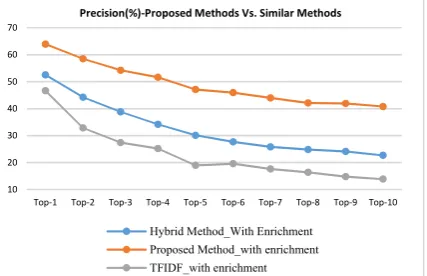
5. 4. 1. Evaluating the Performance of Proposed Method in Recommending #Tags to Users The recall and precision values for top-N recommendations are illustrated in Figures 6 and 7. The similarity_function
outperforms the tf/idf and hybrid similarity method. It also performs significantly better even when only small number of #tag recommendations are computed. The proposed method yields higher recall and precision. Two possible reasons can explain the results: (1) the representation module is comprehensive. It incorporates the lexical, semantic, syntactical, information-content and structural features in the proposed model. (2) The proposed semantic similarity module exploits the extracted features for analyzing the content, finding the commonalities/differences between messages and finally computing the similarity between them.
As depicted in Figure 7, the precision value decreases as the number of recommended #tags is increased. The proposed method is evaluated on a portion of database that contain maximum eight #tags. Therefore, even if system performs perfectly in terms of recall, the maximum performance in terms of precision will be 80%. Therefore, 2 out of 10 #tag recommendations are not admissible. In addition, two other issues contribute to the issue of low precision values: (1) the messages are shorts and the number of features in messages are low (Max. 9 features). (2) Some messages do not contain any features and contain only #tags.
Figure 6. The recall values for the proposed #tag recommendation method compared to other similar methods
Figure 7. The Precision values for the proposed #tag recommendation method compared to other similar methods
5. 4. 2. Evaluating the Enrichment Module and Its Effect on the Overall Performance of the Proposed Method and Similar Methods In this section, we are trying to determine the overall effect of this module on the performance of the proposed method. The results are illustrated in Figures 8 and 9. As depicted, coupling the proposed method with content enrichment module results in higher precision and recall values. According to results, adding a content enrichment module to the #tag recommendation systems has a positive effect on the performance and accuracy. In addition, the results indicate that coupling a semantic similarity measure with content enrichment modules will results in better understanding of the context and further improvement in the quality of generated #tags. It should be noted that even when the N (the number of recommended #tags) is small, the proposed method coupled with enrichment modules scores promising recall and precision values. Also, the proposed method is capable of recommending suitable #tags even when little content is available.
5. 4. 3. Evaluating the Semantic Similarity Module and Its Effect on Overall Performance of the Proposed Method The accuracy of the proposed method heavily depends on the representation technique and the manner in which the commonalities/difference between messages are measured.
The proposed similarity module considers all available information (lexical, semantic, syntactical, information-content-based, latent and structural features) for computing similarity. Therefore, it is essential to determine the efficacy of the module and its performance. As illustrated in Figures 10 and 11, the proposed method performs significantly better in terms of precision and recall when the proposed similarity module is applied. Also, the precision values, especially when the N is small, indicates that top recommendations by the proposed method are significantly better compared to the situation when the hybrid similarity measure is applied.
Figure 8. The Recall values for evaluating the overall effect of the enrichment module on the proposed and similar methods
20 30 40 50 60 70 80
Top-1 Top-2 Top- 3 Top-4 Top-5 Top-6 Top- 7 Top-8 Top- 9 Top-10
Recall(%)-Proposed Methods Vs. Similar Methods
Hybrid Method_with Enrichment Proposed Method _with enrichment
TFIDF _with enrichment
10 20 30 40 50 60 70
Top-1 Top-2 Top-3 Top-4 Top-5 Top-6 Top-7 Top-8 Top-9 Top-10
Precision(%)-Proposed Methods Vs. Similar Methods
Hybrid Method_With Enrichment Proposed Method_with enrichment TFIDF_with enrichment
20 30 40 50 60 70 80
Top-1 Top-2 Top- 3 Top-4 Top-5 Top-6 Top- 7 Top-8 Top- 9 Top-10
Recall(%)-Proposed Methods Vs. Similar Methods
Figure 9. The Precision values for evaluating the overall effect of the enrichment module on the proposed and similar methods
Figure 10. The Recall values when evaluating the overall effect of the semantic similarity module on the proposed method
Figure 11. The Precision values when evaluating the overall effect of the semantic similarity module on the proposed method
In addition, the recall values suggest that when the proposed similarity module recommends a small number of #tags (N is small); they are more accurate. The reason is that the similarity module considers all the available information about messages.
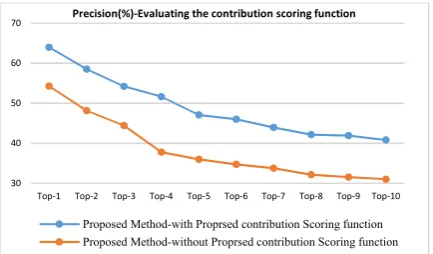
5. 4. 4. Evaluating the Contribution Scoring Function and Its Effect on Overall Performance Next step is to evaluate the effectiveness of contribution
scoring function in selecting the best concepts for semantic networks. To this end, we have replaced this scoring function with the CF-IDF weighting schema. The results are illustrated in Figures 12 and 13. The result suggest that the contribution scoring function does a better job in identifying the concepts that are essential in representing the context and information-content.
In the next step, the components of the contribution scoring function and their effect on the overall performance are evaluated. The evaluation results indicate that lexical cohesion metric performs poorly compared to semantic and Hierarchical cohesion metrics. In other words, knowledge-based metrics are better suited for features selection in representation module. In addition, the performance of lexical cohesion metric is somewhat similar to the CF-IDF weighting method. The co-occurrence cohesion metric achieves the best results among the components of the contribution scoring function. This is because it requires more semantic analysis of context compared to other metrics. The results are illustrated in Figure 14.
5. 4. 5. Evaluating the Semantic Network Representation and Its Effect on Overall Performance The optimal accuracy and performance of proposed method depends on accurate
Figure 12. The Recall values for evaluating the overall effect of the contribution scoring function on the proposed method
Figure 13. The Precision values for evaluating the overall effect of the contribution scoring function on the proposed method
10 30 50 70
Top-1 Top-2 Top-3 Top-4 Top-5 Top-6 Top-7 Top-8 Top-9 Top-10
Precision(%)-Proposed Methods Vs. Similar Methods
Hybrid_Method_With Enrichment Hybrid_Method-without enrichment
Proposed Method -with enrichment Proposed Method -without enrichment
TFIDF (SimilarityRank)-with enrichment TFIDF (SimilarityRank)-without enrichment
30 40 50 60 70 80
Top-1 Top-2 Top- 3 Top-4 Top-5 Top-6 Top- 7 Top-8 Top- 9 Top-10
Recall(%)-Evaluating the semantic similarity module
Proposed Method-with Proprsed semantic simialrity module Proposed Method-without Proprsed semantic simialrity module
20 30 40 50 60 70
Top-1 Top-2 Top-3 Top-4 Top-5 Top-6 Top-7 Top-8 Top-9 Top-10
Precision(%)-Evaluating the semantic similarity module
Proposed Method-with Proprsed semantic simialrity module Proposed Method-without Proprsed semantic simialrity module
20 30 40 50 60 70 80
Top-1 Top-2 Top- 3 Top-4 Top-5 Top-6 Top- 7 Top-8 Top- 9 Top-10
Recall(%)-Evaluating the contribution scoring function
Proposed Method-with Proprsed contribution Scoring function Proposed Method-without Proprsed contribution Scoring function
30 40 50 60 70
Top-1 Top-2 Top-3 Top-4 Top-5 Top-6 Top-7 Top-8 Top-9 Top-10
Precision(%)-Evaluating the contribution scoring function
Figure 14. The Recall and Precision values when the effect of contribution scoring components on the overall performance
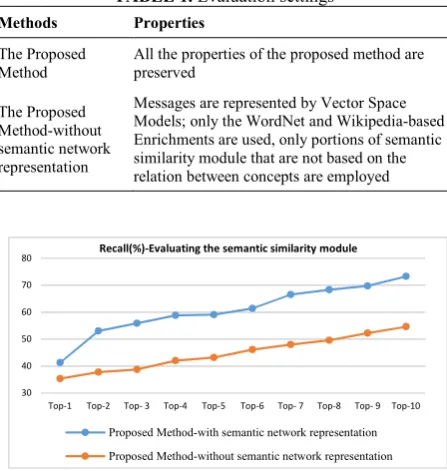
and comprehensive representation of semantics and information-content in messages. Therefore, it is essential to determine the efficacy of the semantic network representation module in modelling the information-content. The evaluation settings are depicted in Table 1. The results are illustrated in Figures 15 and 16. Illustrated results suggest that the proposed representation module is capable of accurate modelling of information-content and semantics in messages.
TABLE 1. Evaluation settings
Methods Properties
The Proposed Method
All the properties of the proposed method are preserved
The Proposed Method-without semantic network representation
Messages are represented by Vector Space Models; only the WordNet and Wikipedia-based Enrichments are used, only portions of semantic similarity module that are not based on the relation between concepts are employed
Figure 15. The Recall values for evaluating the overall effect of the representation module on the proposed method
Figure 16. The Precision values for evaluating the overall effect of the representation module on the proposed method
It also contributes positively to the accuracy and precision of proposed method, even when only a small number of #tags are recommended. The representation module is very effective in capturing the semantic features and structures in messages. It can help the system identify messages that are similar to user’s input message.
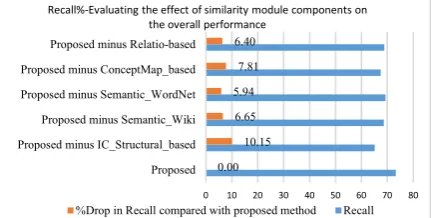
5. 4. 6. Evaluating the Components of the Proposed Similarity Modules and their effect on Overall Performance The representation module is only effective when there is an effective semantic similarity module for calculating the similarity between the messages. Therefore, the precision of the similarity module is just as important as the comprehensiveness of the representation module. In this section, a number of experiments are prepared to evaluate the components of proposed similarity module. The settings of designed experiments are illustrated in Table 2.
The illustrated results suggest that among the components of similarity module, the IC_Structural-based components have the greatest effect on precision and efficiency of the proposed method. The concept_map_based and semantic_based measures are in the second and third place, respectively. The results
TABLE 2. The settings of designed experiments
Description of the Experiment Experiment
#
All the components of proposed similarity module Proposed
1
The proposed similarity module without IC_Structural_based scoring Proposed –
IC_Structural_based 2
The proposed similarity module without Semantic_Wiki scoring Proposed - Semantic_Wiki
3
The proposed similarity module without Semantic_WordNet scoring Proposed -
Semantic_WordNet 4
The proposed similarity module without Concept_Maps_based
scoring Proposed -
Concept_Maps_based 5
The proposed similarity module without Relation-based scoring Proposed - Relation-based
6
0.00 6.28 3.54
8.19 6.98 9.18
0.00 9.73 3.29
6.89 6.31 7.03
0 20 40 60 80
Proposed with contibution score Proposed with CF-IDF score Proposed Minus lexical Proposed Minus Semantic Proposed Minus Hierarchical Proposed Minus co-occurrence
Recall% and Precision%-Evaluating the effect of contribution scoring components on the overall performance
%Drop in Precision compared with proposed method3 Precision
%Drop in Recall compared with proposed method Recall
30 40 50 60 70 80
Top-1 Top-2 Top- 3 Top-4 Top-5 Top-6 Top- 7 Top-8 Top- 9 Top-10
Recall(%)-Evaluating the semantic similarity module
Proposed Method-with semantic network representation
Proposed Method-without semantic network representation
20 30 40 50 60 70
Top-1 Top-2 Top-3 Top-4 Top-5 Top-6 Top-7 Top-8 Top-9 Top-10
Precision(%)-Evaluating the semantic similarity module
demonstrate the superiority of measures that exploit the semantic-based, structural-based and information-content -based features to draw comparison between messages. Therefore, the structured knowledge of ontology, WordNet and Wikipedia makes them the perfect tool for computing semantic similarity (see Figures 7 and 8).
5. 4. 7. Evaluating The System Based on The Required Operational Time In the next step, the mean operational time required to build the representation model, to enrich the content, to find the contextually similar messages and to recommend #tags is computed and compared. The results are illustrated in Table 3.
The results suggest that the proposed method requires negligible operational time compared with other methods considering that the proposed method requires significant
Figure 17. The Recall% when Evaluating the Similarity module
Figure 18. The Precision% when Evaluating the Similarity module
TABLE 3. mean operational time (computed for 10 random messages and then averaged)
Stages of Operation TFIDF Hybrid Proposed
Method
Pre-processing and preparation
(offline) 5ms 5ms 5ms
representation model(offline) 17ms 17ms 89ms
Content enrichment(offline) 19ms 19ms 36ms
Similarity computation and
ranking (offline) 15ms 74ms 216ms
computational operations for identifying and extracting information structures from KBs. Also, the results suggest that the proposed method can be used to provide online recommendations to active users. Although the enrichment module imposes negligible operational time, it has positive effect on the overall performance of system.
6. CONCLUSION
In this paper, a new knowledge-intensive and content-based #tag recommendation approach for social networking platforms was introduced. The proposed system was evaluated on the tweets2011 dataset. The evaluation results suggest that the proposed system demonstrates robust results in terms of recall and precision values. In addition, it is capable of assigning appropriate #tags to messages without #tags and can recommend suitable #tags even when little content is available in messages. This is due to the integration of multiple knowledge sources into the components of the proposed system. This system does not rely solely on the content of the messages, but also identifies latent semantic features and structures using the structured knowledge and exploit all available information about messages to recommend accurate #tags. Moreover, the evaluation of content enrichment module suggests that the proposed method coupled with enrichment module results in higher performance. When little information is available about the content, the enrichment module allows the system to identify related information or semantic structures. The significance of this module lies in the fact that the majority of messages contain little information. Therefore, a mechanism is needed to extend the system understanding of context. The results support the assumption that content enrichment play a pivotal role in optimal performance of the proposed method. The evaluation of representation module indicates the superiority of proposed method compared with vector space models. The robustness of the representation model in modelling the extracted features, enriched contents and semantics is the strength of this model. It presents the system with wide range of information and enables the system to make an informed decision. In addition, the proposed hybrid and multi-layer semantic similarity module exhibits higher accuracy and precision compared with other similarity measures. The multi-layered nature of this module guarantees that system can detect commonalities and differences in all types of extracted features and semantic structures between messages. In other words, it guarantees that all available information about messages are effectively contributing in calculating the similarity between messages. Moreover, similarity methods that exploit semantics-based, information content-based and structural-based features to draw comparison between messages exhibit better 0.00
10.15 6.65 5.94 7.81 6.40
0 10 20 30 40 50 60 70 80
Proposed Proposed minus IC_Structural_based Proposed minus Semantic_Wiki Proposed minus Semantic_WordNet Proposed minus ConceptMap_based Proposed minus Relatio-based
Recall%-Evaluating the effect of similarity module components on the overall performance
%Drop in Recall compared with proposed method Recall
0.00 7.17 6.36 4.73
6.00 4.10
0 20 40 60 80
Proposed Proposed minus IC_Structural_based Proposed minus ConceptMap_Based Proposed minus Semantic_WordNet Proposed minus Semantic_Wiki Proposed minus Relation-based
Precision%-Evaluation the effect of similarity module components on the overall performance
performance and can be used as reliable tools for computing semantic similarity between textual resources. However, the semantic similarity module requires more computational time in comparison with similar methods. Although, based on the volume of computations, the recorded operational time is logical and is suitable for implementing an online system, it has led us to do more to reduce the computational time. In essence, integrating structured knowledge of ontology and KBs is instrumental in robust and optimal performance of the proposed #tag recommendation method. As a future work, we are determined to reduce the computational time in semantic similarity module. In addition, we are planning to use the word-embedding techniques and deep learning methods for feature extraction. As a future work, we are trying to use the proposed system in other text mining applications to determine whether the proposed system is a multi-purpose framework. The illustrated results do not necessarily mean that this method is the best method for #tag recommendation. It just can be considered as a successful implementation of a knowledge-based recommendation system, suitable for #tag recommendation and other text mining applications where little content is available for decision-making.
7. REFERENCES
1. Gong, Y., Zhang, Q., and Huang, X., “Hashtag recommendation
for multimodal microblog posts,” Neurocomputing, Vol. 272,
(2018), 170–177.
2. Bermingham, A. and Smeaton, A. F., “Classifying sentiment in
microblogs: is brevity an advantage?,” In Proceedings of the 19th ACM International Conference on Information and Knowledge Management - CIKM ’10, ACM Press, (2010), 1833–1836.
3. Bollen, J., Mao, H., and Zeng, X., “Twitter mood predicts the
stock market,” Journal of Computational Science, Vol. 2, No. 1,
(2011), 1–8.
4. Izadi, S. and Ghasemzadeh, M., “Using Generalized Language
Model for Question Matching,” International Journal of
Engineering - Transactions C: Aspects, Vol. 26, No. 3, (2012),
241–244.
5. Mohammadi, A. and Hamidi, H., “Analysis and Evaluation of
Privacy Protection Behavior and Information Disclosure
Concerns in Online Social Networks,” International Journal of
Engineering - Transactions B: Applications, Vol. 31, No. 8, (2018), 1234–1239.
6. Sakaki, T., Okazaki, M., and Matsuo, Y., “Earthquake shakes
Twitter users: real-time event detection by social sensors,” In Proceedings of the 19th International Conference on World Wide Web - WWW ’10, ACM Press, (2010), 851–860.
7. Becker, H., Naaman, M., and Gravano, L., “Learning similarity
metrics for event identification in social media,” In Proceedings of the Third ACM International Conference on Web Search and Data Mining - WSDM ’10, ACM Press, (2010), 291–300.
8. Guy, I., Avraham, U., Carmel, D., Ur, S., Jacovi, M. and Ronen,
I., “Mining expertise and interests from social media,” In Proceedings of the 22nd International Conference on World Wide Web - WWW’13, ACM Press, (2013), 515–526.
9. Otsuka, E., Wallace, S. A., and Chiu, D., “Design and evaluation
of a Twitter hashtag recommendation system,” In Proceedings of the 18th International Database Engineering & Applications Symposium on - IDEAS ’14, ACM Press, (2014), 330–333. 10. Tomar, A., Godin, F., Vandersmissen, B., De Neve, W. and Van
de Walle, R., “Towards Twitter hashtag recommendation using distributed word representations and a deep feed forward neural network,” In International Conference on Advances in Computing, Communications and Informatics (ICACCI), IEEE, (2014), 362–368.
11. Wang, Y., Qu, J., Liu, J., Chen, J. and Huang, Y., What to Tag Your Microblog: Hashtag Recommendation Based on Topic Analysis and Collaborative Filtering, Springer, Cham, (2014), 610–618.
12. Hmimida, M. and Kanawati, R., A graph-based meta-approach for tag recommendation, Springer, Cham, (2017), 309–320. 13. Ding, Z., Qiu, X., Zhang, Q. and Huang, X., “Learning topical
translation model for microblog hashtag suggestion,” In Proceedings of the Twenty-Third International Joint Conference on Artificial Intelligence, AAAI Press, (2013), 2078–2084. 14. Kywe, S.M., Hoang, T.A., Lim, E.P. and Zhu, F., On
Recommending Hashtags in Twitter Networks, Springer, Berlin, Heidelberg, (2012), 337–350.
15. Li, J., Xu, H., He, X., Deng, J. and Sun, X., “Tweet modeling
with LSTM recurrent neural networks for hashtag
recommendation,” In International Joint Conference on Neural Networks (IJCNN), IEEE, (2016), 1570–1577.
16. Ben-Lhachemi, N. and Nfaoui, E.H., “Using Tweets Embeddings
For Hashtag Recommendation in Twitter,” Procedia Computer
Science, Vol. 127, (2018), 7–15.
17. Devi, G.R., Veena, P.V., Kumar, M.A. and Soman, K.P., “Entity Extraction for Malayalam Social Media Text Using Structured Skip-gram Based Embedding Features from Unlabeled Data,”
Procedia Computer Science, Vol. 93, (2016), 547–553.
18. Araque, O., Corcuera-Platas, I., Sanchez-Rada, J.F. and Iglesias, C.A., “Enhancing deep learning sentiment analysis with
ensemble techniques in social applications,” Expert Systems with
Applications, Vol. 77, (2017), 236–246.
19. Iyyer, M., Manjunatha, V., Boyd-Graber, J. and Daumé III, H., “Deep Unordered Composition Rivals Syntactic Methods for Text Classification,” In Proceedings of the 53rd Annual Meeting of the Association for Computational Linguistics and the 7th International Joint Conference on Natural Language Processing (Volume 1: Long Papers), (2015), 1681–1691.
20. Wang, Y., Huang, H., Feng, C., Zhou, Q., Gu, J. and Gao, X., “CSE: Conceptual Sentence Embeddings based on Attention Model,” In Proceedings of the 54th Annual Meeting of the Association for Computational Linguistics (Volume 1: Long Papers), (2016), 505–515.
21. Wieting, J., Bansal, M., Gimpel, K. and Livescu, K., “Towards Universal Paraphrastic Sentence Embeddings,” In International Conference on Learning Representations (ICLR 2016), (2015), 1–19.
22. Gong, Y., Zhang, Q., Han, X. and Huang, X., “Phrase-based
hashtag recommendation for microblog posts,” Science China
Information Sciences, Vol. 60, No. 1, (2017), 012109:1–
012109:13.
23. Zangerle, E., Gassler, W., and Specht, G., “Recommending #-tags in twitter,” In Proceedings of the Workshop on Semantic Adaptive Social Web (SASWeb 2011). CEUR Workshop Proceedings (Vol. 730), (2011), 67–78.
24. Mikolov, T., Chen, K., Corrado, G. and Dean, J., “Efficient
Estimation of Word Representations in Vector Space,” Arxiv
Preprint Arxiv:1301.3781, (2013), 1–12.
25. Weston, J., Chopra, S. and Adams, K, “# tagspace: Semantic embeddings from hashtags,” In Proceedings of the 2014 Conference on Empirical Methods in Natural Language Processing (EMNLP), (2014), 1822–1827.
26. Gong, Y. and Zhang, Q., “Hashtag Recommendation Using
Attention-Based Convolutional Neural Network.,” In
Proceedings of the Twenty-Fifth International Joint Conference on Artificial Intelligence, AAAI Press, (2016), 2782–2788. 27. Chen, K., Chen, T., Zheng, G., Jin, O., Yao, E. and Yu, Y.,