International Journal of Finance and Managerial Accounting, Vol.4, No.13, Spring 2019
121
With Cooperation of Islamic Azad University – UAE BranchThe Role of Biased Behavior based on Economic Behavior
and Financial Intelligence on the Process of Investment
Decisions
Zahra Bineshian
Student of Accounting, Department of Accounting, Shahroud Unit, Islamic Azad University, Semnan, Iran [email protected]
Khosro Faghani Makrani
Associate Professor of Accounting, Department of Accounting, Semnan Branch, Islamic Azad University, Semnan, Iran (Corresponding Auhtor)
Khadijeh Eslami
Assistant Professor, Department of Accounting, Bandar Gaz Branch, Islamic Azad University, Bandar Gaz, Iran [email protected]
ABSTRACT
Today, investors consider a wide range of factors for choosing an investment. Effective factors on investor decisions are wider than ever before and the results of these decisions will have an impact on the lives of people. In this research, the role of the role Subjective behaviors based on economic behavior and financial intelligence have been investigated on the investment decision process. In this regard, the effect of indicators of behavioral behavior based on economic behavior and financial intelligence indicators on investor decisions was investigated. To collect information from Two library methods and a researcher-made questionnaire were used D. The surveyor developed a questionnaire and distributed it among 300 employees and investment companies in t he Tehran Stock Exchange in the second half of 1997. Data analysis was performed using combining methods of genetic algorithm and neuro-fuzzy inductive inference system.using.MATLAB.software.
The results indicate that the more biased behaviors based on economic behavior are more controlled and financial intelligence will be strengthened, better investment decisions will be made. Among the subjective indicators based on economic behavior, the liquidity stagnation with a coefficient of 0.843, the highest impact Negative and among the financial intelligence indicators, the analysis of changes in the index of total market efficiency with a coefficient of 0.863 had the greatest impact on investment decisions. Ultimately, the investor can achieve the desired result by knowing the investment paths (0.743).
Keywords:
1. Introduction
Though the behavioral debates in the world of investment and financial issues dating back to the past 30 years, we have seen the growth and transformation of these topics into an independent discipline. The collapse of stock price bubbles in the United States in the late 1990's has added to the importance of understanding the intrinsic behavior of investors, and has led to the use of words like "normal" people against "rational" people. The "normal" man in behavioral financial knowledge represents the description of the real human behavior in economic decision making. A person with behavioral biases and behavior, and individuals with varying degrees of exposure to these biases, some of which can be easily observed in everyday human behaviors (Pumpin, Millslam, 2009). In fact, behavioral finance approaches are an attempt to consider cognitive and emotional components that influence the decision-making process of an individual and extend beyond the presumption of rational thoughts when considering different conditions or decisions. In the discussion of behavioral finance, it was found that emotional influences in investment decisions (Oshoorn et al., 2018: 219). Financial intelligence is now recognized as a powerful tool for strategy and management for governments and corporations globally. Over the past 40 years, financial intelligence policies have been attempting to address the major dangers and threats that have affected the world. . A good financial monitoring system will also have a good financial management. This includes receiving financial information to provide insights into the financial situation. In other words, "achieving financial intelligence." (Zahra Bashishian and Colleagues, 1397) Considering the importance of the issues raised in this paper, we try to investigate the role of subjective
2. Literature Review
2.1. Subjective Behavioral Behavior Based
on Economic Behavior and its Indicators
Behavioral bias has been defined as "systematic errors" in judgment. Some researches seek a meaningful framework for classifying behavioral bias. Some writers mention behavioral tendencies titled "non-documentary" ("rules of thumbnail"), while others call them "preferences" or. "judgments" , "beliefs."
Some scholars classify these biases in two cognitive and emotional categories, both of which can lead to "non-rational judgments." The origin of the cognitive tendencies is incorrect reasoning. Therefore, more information and advice can correct it. In contrast to the desire for emotion, not from conscious calculations that emanate from "motivation" or "intuition", so their correction is difficult. (Hosseini Chegini et al., 2014)
2.2. Economic behavioral bias
This type of administrative error, or so-called behavioral bias, is more based on the risk of the economic interests of investors, which is, in most cases, driven by speculation and short-term and early returns, which often do not stabilize these decisions, and the slightest anxiety And the thrill of the market adopt hasty decisions, and this type of decision-making is based on the collective behavior of investors in the capital market, which usually takes these contradictory and irrational decisions (Tang & Baker, 2016: 15). In The present study has 6 types of economic behavioral breaks including "over-investment", "inefficiency" Investment "," investment restrictions "," valuation over future projects, "" recession liquidity "is considered.
2.3.
Financial
intelligence
and
its
indicators
Financial intelligence does not mean a kind of inherent ability. Some people have a better understanding of numbers. In business, in terms of business, financial intelligence is a set of skills that can be learned through training. People who work in the field of finance can easily get these skills. Basically, financial intelligence refers to four distinct categories of distinctive skills.
Understanding Principles: Managers with financial intelligence know the fundamentals and basis of financial measurement and are able to understand them. They can study profit and loss accounts, balance sheets and cash flow statements. They can understand how balances are on the balance sheet.
intelligence know how to apply artistic aspects of finance to numbers. They know how to use them in different calculations. They are ready to answer questions and challenges in numbers.
Understanding Analyzes:
Once you know the fundamentals and artistic value of your finances, you can use that information more accurately to analyze the numbers. Financial intelligence managers do not underestimate the ratio of return on investment and similar items. They use these analyzes to make the best decision in their work.
Understanding the big picture: Numbers are not able to express all the stories. The financial result of a business must be understood in the form of a big picture. Economics, the competitive environment, rules, changing needs and expectations of the customer, and new technologies all influence the interpretation of numbers and decisions. (Berman and Knight, 2013). Indicators The research objectives are:
"Turnover," "Analysis of changes in the index of total market returns," "Playing with external financial resources (bank facilities and credits)," "lack of collective or emotional support to the market trend," "Analysis of quality indices in Along with the quantitative indexes of companies, "" the use of expert opinions of brokers in decision making. "
2.4.
Investment
decisions
and
its
indicators
Fans of behavioral finance believe that knowledge of the psychological tendencies in the field of investment is absolutely necessary and requires serious development of the field of study and for those who play the role of psychology in financial knowledge as a factor affecting the securities markets and investors' decisions. It is difficult to accept the existence of doubts about behavioral financial credibility (Darabi et al., 1395: 4). Investment involves studying the process of investing and managing shareholder wealth, and the investment process in a coherent state involves an assessment of the essence of investment decisions (Ismailis and Mohammadi Kamalabadi, 1394: 13). The
indicators studied in this study are "Recognition of investment paths," "stock valuation based on the stock index," "specialized capabilities, prioritization of investments," "reliance on statistical methods," "relying on the power of forecasting investment," "Focusing on stock market patterns and indicators," "emphasizing past information."
2.5. Research Background
Basil and Amber (2017) investigated the behavioral flutter in the Pakistan Stock Exchange in their study, "Behavioral Factors and Investor Decisions", and found that behavioral.fears.deeply.affect.the.decisions.of.the.inve stor.
Islam Naglo et al. (2015) in a research entitled "Identifying Effective Factors on Individual Investors' Attitudes: Bankers Study" found that six factors affect the individual investor behavior. Which was the most solidarity between the "conscious behavior of the investor" and "banking and payment behavior". And found that there is a significant relationship between factors affecting the individual's behavior of investors.
Sicilica and Python Citteramani (2017), in a study entitled "An Overview on Intelligent Intelligence and Investment Behavior," presented a conceptual model and showed that investors, while accepting investment decisions, act emotionally. And the investor's emotional.intelligence affects investment.
Friedens et al. (2017) investigated whether investors' confidence could regulate factors such as stock returns and concluded that returns on returns were largely due to the emotional tendency of investors.
Wu and Wong (2016) investigated the impact of institutional ownership on the pricing of stock and corporate pricing. The results show that shareholder (institutional) feelings directly affect corporate investment behavior. Also, the relationship between stock market-pricing pricing in firms with higher institutional equity (such as financial institutions and investments) is stronger.
of investors along with accounting information has a significant effect on stock prices.
Maiural and Rosa (2012) expanded their research into investment decisions, especially on risk-takers' perceptions. Their study explains how investors' perception of risk affects the dynamics of financial markets, and financial decisions are tied together with non-financial factors. According to Starbucks and Mullick (1988), their model consists of two steps: attention and sensation. After testing their model, they concluded that variables such as ambiguity and personality traits such as tolerance of ambiguity affect investor perceptions.of.risk.
The bineshian and Dehdar (2018) found that variables such as logical behavior, mass behavior, reactive behaviors, and the relationship between financial intelligence and behavioral tendencies and their effect on investment decisions based on the theory of planned behavior " Experience-based behavior and test and error on behavioral attitudes and behavior-based attitudes, subjective normative control of perceptual behavior on financial intelligence and ultimately affect investment decisions. The level of behavioral effects is 0.822 and financial intelligence is 0.810, and behavioral tendencies toward financial intelligence have a greater impact on investment decisions.
Bahar Moghaddam and Jokar (2018) conducted a study entitled "The Effect of Accounting Information Quality and Information Uncertainty on Investors' Tendencies." For this purpose, an example of 560 years-company was investigated during the period of 1384-1394 using multivariate regression. The results of the research showed that the quality of accounting information has a positive and significant relationship with investors' tendencies with a negative and significant relationship and uncertainty about the investment intentions of the investors. Also, the results of this study showed that increasing the quality of accounting information and decreasing information uncertainty decreases the emotional behaviors of investors in stock pricing. In addition, the results of further analysis showed that in periods where investors are more optimistic, they tend to have more optimistic forecasts for stock prices with lower quality information and more uncertainty.
Aghassi, Saeed et al. (2016) investigated the relationship between financial risk tolerance and investor characteristics (financial intelligence,
financial management skills, wealth) based on the Donald's indigenous model. The results of the Tehran Stock Exchange case study. There is a significant relationship between the independent variable and the dependent variable, and young people may have a higher risk of financial risk than older peers. The importance of the independent factors or variables examined was not the same for respondents and the factor of financial management skill was the highest. As well as the fitness indexes of the model are in a good position and the LaserLevel software is used to determine the appropriateness of the research model, which means that the fitting model is well suited to represent the suitability of the model, which is in this study 40 /.
Hosseini Chegini et al. (2014) investigated the relationship between short-range behavioral beliefs, optimal nose, self-concept, persuasiveness, latency, ambiguity with investment decisions of investors in Tehran Stock Exchange. The results of the research show that there is a meaningful relationship between short-run horizons, optimal nose, self-concept, persuasiveness and longevity with investment decisions of investors in Tehran Stock Exchange, and the behavioral bias of the ambiguity has a positive and significant effect on the investment decisions of the affected investors. does not have.
3. Methodology
3.1. Research Hypotheses
The purpose of the present research is to investigate the effect of subjective behaviors based on economic behavior and financial intelligence on the investment decision process in Tehran Stock Exchange. To achieve this goal, the following hypotheses have been raised:
1) Behavioral behavior based on economic behavior affects investment decisions. 2) Financial intelligence affects investment
decisions.
3) Behavioral behavior based on economic behavior and financial intelligence has an impact on investment decisions.
3.2. Research methodology
3.2.1. Population and sample
used. Researcher made questionnaires distributed among 300 employees and investment companies of Tehran Stock Exchange in the second half of 1397 and asked them to answer the questions .of .the .questionnaire.
3.2.2. Information Analysis Techniques
Since fuzzy systems have a special place among the new methods of modeling, in this research, a neuro-fuzzy adaptive system is used because of the ability to implement human knowledge using the concepts of time tags and fuzzy rules, non-linearity and the ability to reconcile it. Systems and their accuracy are used in comparison with other methods in terms of data constraints, including the most important feature of these systems. The important point of fuzzy systems is the ability to communicate between the input space and the output space, and the primary mechanism for doing so is a set of fuzzy rules. On the other hand, neural networks, due to their educational capabilities, can create an appropriate connection between input and output variables using different learning patterns. Therefore, the use of a combination of fuzzy inference system and artificial neural network as a powerful tool that can predict results using existing numerical data is introduced as an adaptive neuro-fuzzy inference system. This system uses neural network algorithms and fuzzy logic to design nonlinear mapping between input and output space.
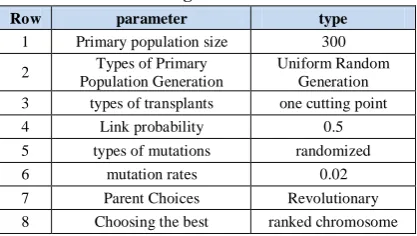
Table 1. Genetic Algorithm Parameters Used
Row parameter type
1 Primary population size 300
2 Types of Primary Population Generation
Uniform Random Generation 3 types of transplants one cutting point
4 Link probability 0.5
5 types of mutations randomized
6 mutation rates 0.02
7 Parent Choices Revolutionary
8 Choosing the best ranked chromosome
To test the research hypotheses, ANFIS adaptive neuro-fuzzy inference system has been used with predictive architecture. This network is a function of predictors (independent variables or inputs) that minimizes the prediction error of the target variables (dependent or output variables). The steps that are
taken during the use of the adaptive-fuzzy-inductive inference system to obtain the result that can be tested on.the.basis.of.the.hypothesis's.result.are:
1) The fuzzy step in the input that converts the numeric value of variables to a fuzzy set. 2) The fuzzy rules base, which is a set of rules
if-then, and apply logical operators that cause the combination of different low, medium, and high inputs of the system to simultaneously affect the output.
3) A fuzzy inference engine or an input step that converts inputs into a series of outputs. 4) The bulk or aggregate step at which all the
rules defined in the matching neuro-fuzzy inference system are. Combined .and .aggregated.
5) The disfazisation or naphysification stage transforms the output of a fuzzy set from its massive stage into a. single ,precise ,and .definite .number.
3.2.3. Input and output variables
Input variables are a set of variables of economic behavior bias and financial intelligence which is based on theoretical studies and research background and shows how different combinations of these variables can play a role in the formation or severity and weakness of the variable of investment decisions.
Table 2. Encoding of inputs and outputs for the adaptive-neural-fuzzy inference system BEB The bias of economic behavior
FIN Financial intelligence
IND Investment decisions
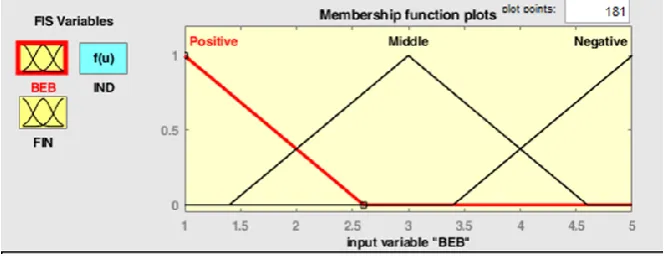
The second step is to define fuzzy sets for each of the input concepts and encode them. Each fuzzy set actually represents one of the levels of its input meaning. In addition to specifying fuzzy sets for each input variable, it is necessary to determine the function determining the degree of membership in each fuzzy set. Therefore, the membership functions for each of the fuzzy sets of its parameters are defined as a triangular membership function. According to the rules of fuzzy sets, the values of each input are classified in three levels: low, medium, and high, which can be represented as follows.
economic behavior. As it is known, these three levels have common seasons, and the horizontal axis represents the data obtained from the field, which are defined on a five-part scale from one to five, and the vertical axis represents the degree of fuzzy
membership, which is from zero Up to one. Here, the range of variable variations is displayed based on the field data in the Range field. The range of variations of the research variables is as follows.
Figure 1: Membership function and variables of economic behavior bias
Table 3. Fuzzy sets of inputs and outputs The range of the range and range of variables changes based on field data
Range Low Medium High
BEB [1.32 4.54] [0.032 1.32 2.608] [1.642 2.93 4.218] [3.252 4.54 5.828] FIN [1.33 4.41] [0.098 1.33 2.562] [1.638 2.87 4.102] [3.178 4.41 5.642]
Range Negative Middle Positive
IND [1 5] [-0.6 1 2.6] [1.4 3 4.6] [3.4 5 6.6]
3.2.4. Model of Neural-Fuzzy Adaptive Inference System
The overview of inputs, fuzzy rules and outputs in a comparative neuro-fuzzy system in MATLAB software can be illustrated as follows.
3.2.5. Steps bunch
A batch or aggregation is a step in which all the rules defined in the neuro-fuzzy inference system are combined and aggregated together. In the present study, all the rules were combined and combined. The cluster follows the principle of displacement, and therefore the different order in the rules defined for the same output will result at this stage. Here the combination of inputs is based on the "and" operator based on the prod function. The deduction is based on the min and bulk function or aggregation based on the max function.
3.2.6. Nappalization step
In this phase, the resulting fuzzy set is converted into a single, precise amount at its mass output. This is a single value of a value in the domain defined for the output variable (scale 1 to 5), which shows that, given
the line vector defined as the input, what is expected of the output according to the defined fuzzy inference system. Thus, although the basis of the fuzzy inference system is collections, numbers and fuzzy rules, the wtaver, which came as a non-phase method, actually indicates that the determination of the output value is based on a weighted average.
3.2.7. Rules governing the model based on the matching neuro-fuzzy inference system
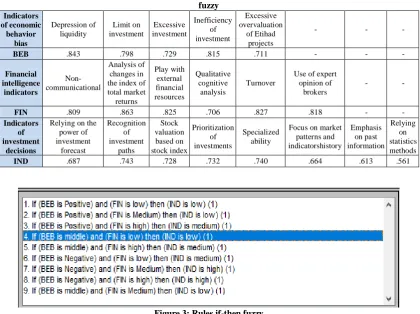
The inference system conforms to the fuzzy rule set if - then it has the ability to learn to approximate non-linear functions. For a particular process, the purpose of constructing fuzzy inference systems is to determine the fuzzy rules governing that process. Fuzzy rules in the form of if-then formulate. The episode is called "intro" or "initiator", and then the part is called "after".
Table 4. Output of the genetic algorithm for each component of the research variables and the rules if then fuzzy Indicators of economic behavior bias Depression of liquidity Limit on investment Excessive investment Inefficiency of investment Excessive overvaluation of Etihad projects - -
-BEB .843 .798 .729 .815 .711 - -
-Financial intelligence indicators Non-communicational Analysis of changes in the index of total market returns Play with external financial resources Qualitative cognitive analysis Turnover
Use of expert opinion of
brokers
-
-FIN .809 .863 .825 .706 .827 .818 -
-Indicators of investment
decisions
Relying on the power of investment forecast Recognition of investment paths Stock valuation based on stock index Prioritization of investments Specialized ability
Focus on market patterns and indicatorshistory Emphasis on past information Relying on statistics methods
IND .687 .743 .728 .732 .740 .664 .613 .561
3.2.8. Fuzzy Network Architecture - Adaptive Neural Network
ANFIS creates a fuzzy inference system (FIS) with the help of a set of input / output data. The membership functions of this system are regulated by the post-propagation algorithm or its combination with the least squares method. This setup operation allows the fuzzy system to retrieve its structure from the data set. Interfaces within the network flow from the input layer to the recursive output layer. The input layer contains a prediction that there are two inputs in this study according to Table 3. This layer contains unobtrusive nodes or units. The value of each hidden unit is a function of the predictor. The output layer includes responses. In this research, dependent variable or target, investment decisions are considered, which are estimated by predictive variables. Although the neural-fuzzy inference system is based on fuzzy sets, numbers, and fuzzy rules, inputs and outputs are exact numbers. In the present study, the method by which dephasing was performed is an average weighted method, which means that the determination of the output value is based on a weighted average.
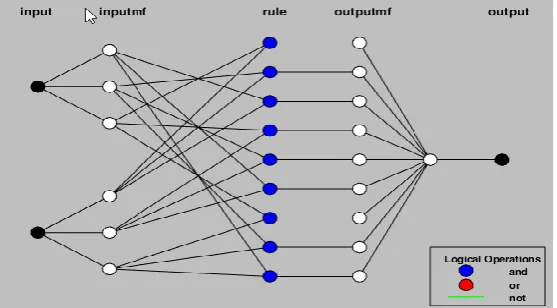
The matching neural-fuzzy inference system is in fact a six-layer network consisting of nodes and nodes joining nodes. The proper structure of the neuro-fuzzy inference system is proportional to the input data, the degree of membership, the rules, and the degrees of membership membership output. Figure 4 shows a demonstration of fuzzy-neural network architecture in the current research.
In the first layer, the input values are entered accurately and definitively. In the second layer, the value of each input is determined by the various fuzzy (low, medium, and high) intervals. The third layer is a rule layer that combines inputs with each other based on it. The fourth layer is the different values of the fuzzy output that results from the application of rules on the input values. The fifth layer is the output fuzzy value that is obtained from the bulk and the combination of different quantities in the fourth layer and is a fuzzy number. The last layer is the definitive output of the network, which is defined in precise and non-phase numerical order in the interval (in this research range 1 to 5).
Figure 4: Overview of the Neural Network-Adaptive Fuzzy Network Architecture
3.2.9. Comparative Neural-Fuzzy Inference System Modeling
Neuro-learning - adaptive has the same function as neural networks. Fuzzy-adaptive learning techniques provide a method for creating a fuzzy modeling procedure for learning information from a dataset. Fuzzy Inference System Modeling is done in two stages of "training" and "testing" the system.
is applied so that the output in the form available to Anfis determines the correctness of the model.
3.2.10. FIS structure and parameter setting
To change the mapping between input and output, a structure similar to that of neural networks can be used. In fact, we can use nerve networks to map inputs to membership functions and its parameters, and then map out the membership functions to outputs.
The parameters related to the membership functions change during the learning process.
Calculation of these parameters (or their adjustment) is facilitated through a gradient vector. This gradient vector provides a measurement criterion for the desirability of modeling the parameters of the fuzzy inference system. After providing a gradient vector, parameters of optimization and error reduction can be used. Usually the error is calculated using the calculation of the sum of squares of errors. Anfis uses an outsourced method to estimate the membership function parameters or combine it with least squares estimates.
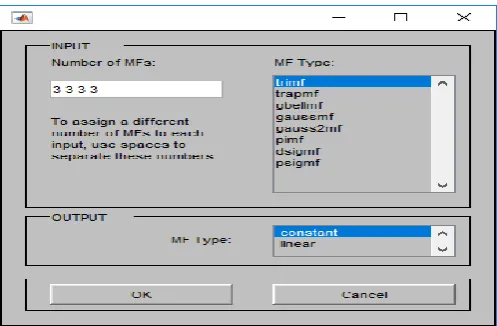
Figure 5: Setting the parameters in the FIS structure
3.2.11. Training System
The purpose of network training is to minimize the output error of the network and the actual output. In the training stage, by adjusting the degree of membership parameters based on the acceptable error rate, the input values are closer to the actual values. The main training method in this system is the postback error method. In this method, using the error descent algorithm, the error value is sent to the inputs and the parameters are corrected.
The.points.that.need.to.be.addressed.about.fuzzy-neural.network.training.are:
A. A.Information.selected.for.testing.and.training. should.be.selected.randomly.
B. The model does not have the ability to simulate information that is beyond the scope of training information.
The.higher.the.number.of.model.training.data,the.b etter.the.model.will.be.
In the Analyst's AnfisEdit software, for the use of the
fuzzy-neural network, there are two methods of grid decompression and partial clustering, the main difference being in the choice of input membership function. In this study, the method of network decompression, which determines the type of user's membership function, is used.
Figure 5. The results of system modeling, system training stage Minimal training RMSE = 0.040393
4. Results
What was presented was the construction and use of intelligent measurement models developed in the form of adaptive fuzzy-inductive inference systems that were used to test the hypotheses of the present study. In this section, how to use these systems in the hypothesis testing section as well as simulation.of.data.and.prediction.are:
To test the hypothesis you can see the result of the output change by changing a input.
4.1. Simulation of data and prediction ability
One of the most important and practical advantages of using fuzzy-comparative neural systems is the possibility of using simulated data. Using simulated data, it can be determined whether changes in one or more inputs, in the situation where other inputs are constant, will result in a change in
output,and.how,in.case.of.change,is.its.quality.and.qua ntity.
4.2. Changes in one entry
Here, we want to examine how the change in an input in the model of this research will affect outcomes. Static inputs can be considered at the beginning of the scale, the middle of the scale, or the end of the scale, or, given their actual status in the studied population, proved them to a certain value. In this study, all inputs were fixed at the middle of the scale. In these conditions, as in the hypothesis testing section, we can change the amount of management innovation from the minimum to maximum, and calculate the output changes for each change value in the input. But MATLAB software also made it possible to create an ANFIS file for the changes in the inputs and the change in the output in a number of ways, which is done in this section.
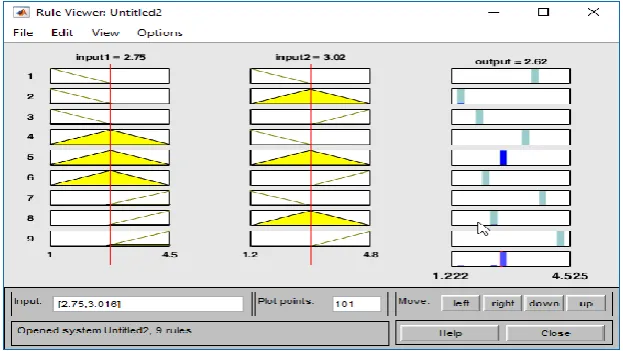
The figure 6 shows that when bias in economic behavior is 2.75 and financial intelligence is 3.2, it is equal to 2.62. In other words, when the bias of mean economic behavior and financial intelligence are modest the amount. Of investment. Decisions is moderate.
Here you can see the change in the output and test the research hypotheses by changing the inputs. It is also possible in MATLAB software to create changes to the input and output in the ANFIS file.In.the.three-dimensional.format,the.following.hypotheses.were.inv estigated.
4.2.1. Testing the first hypothesis
H1: The bias of financial behavior affects investment decisions.
4.2.2. Testing the second hypothesis
H2: Financial intelligence affects investment decisions
4.2.3. Testing the third hypothesis
H3: Bias based on economic behavior and financial intelligence affects investor decisions
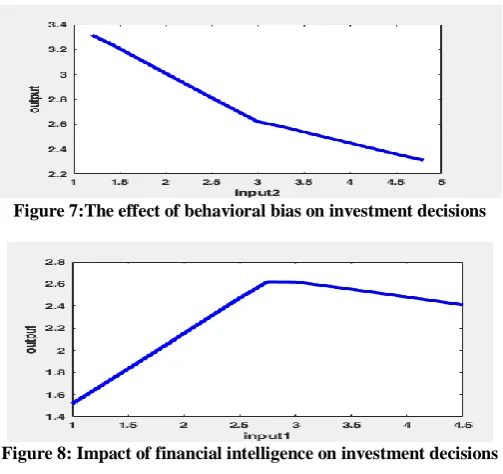
To illustrate the validity of the H3 hypothesis, the x-axis is financial intelligence, we set the y-axis to the bias of financial behavior and the z-axis of the investment decision. Here, with changes in input values in the x and y axes, the changes that have been made to z in the form of the form are shown.
Figure 7:The effect of behavioral bias on investment decisions
Figure 8: Impact of financial intelligence on investment decisions
5. Discussion and Conclusions
The main purpose of this study is to investigate the role of subjective behaviors based on economic behavior and financial intelligence on the investment decision process in Tehran Stock Exchange. For this purpose, the studies were first studied and explained and then, based on the existing theoretical foundations, we tried to examine the above goal. The results of this study are based on the results of previous researches such as Intelligence and Dehdar (1395), Financial Intelligence, Aghasi, Saeed et al. (1395) regarding the financial risk and characteristics of investors (financial intelligence, financial management skills, wealth), Hosseini Chegini and Associates (1393) on the relationship between investment ventures and investment decisions, Sichika and Pichitramani (2017), on intelligent intelligence and investment behavior, Zhou and Yen (2016) coincide with the.emotional.behavior.of.investors.
The results indicate that behavioral behavior based on economic behavior has a negative impact on investment decisions, which leads to incorrect decisions in investor decisions. The effect of its indexes included liquidity stagnation of 0.843, inefficiency of investment 0.815, investment limit of 0.798, over-investment of 0.729, and over-investment of future projects of 0.711. Financial intelligence also affects investor decisions positively And as financial intelligence is strengthened, investment decisions will be made more desirable. The effect of its indicators includes analyzing the changes in the total market return index (0.863), the game with external financial resources (0.825), turnover (0.827), the use of expert opinion of the brokers (0.818), non-communal (0.809) And qualitative cognitive analysis (0.706). Ultimately, an investor can acquire knowledge of investment paths (0.743), increase specialized capabilities (0.740), prioritize investment (0.732), stock valuation based on stock index (0.728), relying on the power of forecasting investments (0.687), focusing on market patterns and indicators (0.664), emphasizing past data (0.613)
and.relying.on.statistical.methods.(0.561).Make optimal investment decisions.
References
1) Ismailis, Majid., Ali Mohammadi, Muslim. (1394), "Evaluation of Investment Decisions Using System Dynamics and Real Investment Opportunities (Investigated in Automotive Production Company), Asset Management and Financing Management, 3 (1): 1-22.
2) Saeed Aghasi, Saeed, Aghasi, Ehsan, Biglari, Sahar, (1395), "Investigating the relationship between financial risk tolerance and the characteristics of investors (financial intelligence, financial management skills, wealth) (based on Donald's native model). Case study: Stock Exchange Tehran Stock Exchange ", Journal of Financial Knowledge Analysis of Securities, Ninth Year, No. thirty, Autumn, 95.
3) Berman, Karen, Knight, Joe, (2013), "Intelligence. Mali," Translation,. Nejad, Qasim, Sanshian, Zahra, Nowruz Publishing, 1397.
4) Bahar Moghadam, Mehdi, Jokar, Hossein. (1397), "Investigating the Effect of Accounting Information Quality and Information Uncertainty on Investor Sentiment", Quarterly Journal of Accounting and Auditing, Volume 25, Issue 1, Spring, 21-50.
5) Insightful, Zahra, Dehdar, Farhad. (1397). "Presentation of the model of financial intelligence with behavioral tendencies and their effect on investment decisions based on the theory of planned behavior". Investment Knowledge, 7 (25), 203-222.
6) Pumpin, Mishlam (2009), "Behavioral Financial Knowledge and Asset Management", translation.by.Dr.Ahmad.Badri,Company.Kayhan Publishing House.
7) Hosseini Chagni, Elham, Haghgoo, Behnaz, Rahmani Nejad, Leila, "Investigating Boyfriend Behavior of Investors in Tehran Stock Exchange Based on Structural Equation Model", Financial Management Strategy, Faculty of Social Sciences and Economics, Alzahra University (Q, second year) , No. 7, 113- P. 133.
9) Friyn, B., Willem F.C., Verschoor R., Zwinkels, C.J. (2017). Excess stock return comovements and the role of investor sentiment. Journal of International Financial Markets, Institutions & Money, 49, 74-87.
10) Rehan, Raja, Umer, Imran, (2017). "Behavioral Biases and Investors Decisions", Market Forces, College of Management Sciences, Vol. XII, No. 2, December 2017.
11) Rosa. M. & Mayoral, Eleuterio Vallelado (2012), The Interaction of Environmental Facts and Individual Character is Investors Perception ", The Spanish Review of Financial Economics, Vol. 10, PP. 62-73.
12) Islamoğlu, Mehmet, Apan, Mehmet, Ayvali, Adem, (2015) Determination of Factors Affecting Individual Investor Behavior: A Study on Bankers, 2015, 5 (2), 531-543.
13) Ozorhon, B., Batmaz, A., Caglayan, S. (2018). Generating a framework to facilitate decision-making in renewable energy investments; Renewable and Sustainable Energy Reviews 95; 217-226.
14) Sashikala V, P.Chitramani, (2017), "A review on emotional intelligence and investment behavior", International Journal of Management (ijm) volume 8, issue 3, May-June 2017, pp.32-41.
15) Tang, N., Baker, A. (2016). Self -Esteem, Financial Knowledge and Financial Behavior, Journal of Economic Psychology, doi: http://dx.doi.org/10.1016/j.joep.2016.04.005. 16) Wu, W., & Wang, L. (2016). Institutional property
mispricing and corporate investment. Open Journal of Business and Management, 4 (2), 282-290. 17) Zhu, B., Niu, F. (2016). Investor sentiment,