Availability evaluation of Software architecture
of object oriented Style using coloured Petri nets
Abdolghader Pourali1
Received (2016-10-24) Accepted (2017-01-03)
Abstract — Software architecture is one of the most fundamental products in the process of software development in the areas of behavioral or non- behavioral features like availability or
transformability change. There are different ways
to evaluate software architecture one of which is the creation of application model. An executable model
of software architecture is an official description of
architecture which if used prior to the running of
architecture, its final behavior and function will be
observed and as a result possible problems could be elevated and promoted. In this study we aimed at availability evaluation in object- oriented style. To ensure the applicability of the style the UML diagrams, especially the sequence diagram, were used to exhibit the architectural behavior. In the later stages, as the UML diagram is inapplicable, the following operations were done. First, metric annotation is used to tag clichés. Then, the studied style diagram was transformed into an applicable one. Afterwards and following the design of petri, using CpnTools, the applicable model based on color petri net was evaluated. In this research the availability evaluation on an ATM for the N=5 users was tested and the results of evaluation showed that the higher the rate of availability (approximately %100) the higher is the rate of usability of the system when needed.
Keywords: Software architecture, integrated modeling language, sequence diagram, colored Petri net (CPN), availability, object-oriented style.
I. INTRODUCTION
I
n the present era, as information technology isadvancing, software architecture researchers
are making efforts to develop better software systems and have achieved success in the field.
In fact, better software systems are developed by modeling important architecture patterns in the initial phases of the life cycle of software
development. Software architecture is a significant index of qualitative characteristics. The selection
of patterns that should be modeled and the way
modeling is performed and, finally, evaluating
the patterns are important decisions upon which
software architecture researchers have focused.
As a matter of fact, the developer can design the software by software modeling before allocating extra sources, returning to the stage prior to design, namely requirement determination,
and making sure of a reliable system. In
addition to describing software and dividing it into components, software architecture styles
substantially affect the qualitative characteristics of the designed software. Hence, it is extremely
necessary to select a suitable architecture style for the system [1] because incorrect decisions cost considerable money and time spent for design in addition to preventing the achievement
of desirable qualitative characteristics. Failing to conduct a quantitative analysis of the effect
of software architecture styles on qualitative characteristics does not allow architecture styles
to be used effectively. The reason lies in the fact
that the decisive factor in selecting software architecture is the extent to which it supports the
respective qualitative characteristics. Therefore,
utilizing a technique or model for the quantitative evaluation of qualitative characteristics in styles
enables system developers to make design
decisions with greater accuracy. The evaluation
of software system architecture aims at analyzing architecture in order to identify potential risks and make sure that the qualitative requirements
are met in the design. As a result, it is absolutely
necessary to make decisions as to the selection of an appropriate architecture for the system and its similar subsystems during software system
development [1].
Various state-based evaluation techniques
have been proposed. In state-based models, the
software architecture behavior is modeled as an
interaction among components. For example,
an evaluation technique was put forward in [2] using discrete-time Markov model that calculates software architecture reliability given the reliability of each component and the probability
of transitions. In [3], to conduct quantitative
evaluation, a technique based on dynamic Bayesian
network was suggested. For the quantitative evaluation of efficiency in software architecture,
a method was developed in [4] that functions according to discrete-time Markov model and
calculates software architecture efficiency in
respect of the time spent in each component and the number of times the components are met
during the execution of the program. In [5], to
conduct a quantitative evaluation of security on discrete-time Markov model, a technique was put forward that calculates software architecture security on the basis of component vulnerability and the number of times the components are met
while the program is executed. Furthermore,
to evaluate security, a model was presented in
[6] on the basis of statistical Petri nets. In [7],
a technique was put forward for the quantitative
evaluation of availability, efficiency, and security
in software architecture according to colored
Petri nets (CPNs) .In [16] Reliability evaluation
of a payment model in mobile-commerce using
colored Petri net was provided.
Software architecture consists of a set of components, the relationships between them, and features of the components that may be observed
from outside. Different methods may be adopted
to represent these components in a variety of
architecture styles. The architecture style is a set
of design rules demonstrating the components and connectors that may be used to develop a
system. Software architecture is evaluated in this
research by studying software architecture styles
and selecting one of the styles under study. The aforesaid style is the object-oriented style. In
this style, data representation and the operation that is in connection with it are enclosed in an
object. The components of this style are objects
that are in connection with each other via calling
functions [8].
Figure1 – Object-oriented style
Components:
• Object: Components that interact via
calling procedures.
• Call-return connectors: They are used by
an object to call the procedures of other
objects.
To arrive at a precise evaluation of important non-functional and metric requirements, such as availability, an executable model should be put
forward. In fact, architecture may be evaluated
using this executable model and its problems may be resolved before spending money and time for
implementation. UML diagrams are adopted to show the behavior of architecture. The sequence diagram indeed displays system behavior. Whereas UML diagrams may not be executed,
excitability should be demonstrated using colored
Petri nets. To evaluate the respective metric using
Writing Stereotypes, the intended labels should be added so that an evaluation of the architecture
would be obtained using CPNTools. In this
way, the setbacks would be precluded before
the execution and implementation phases. The
structure of the rest of the paper is as follows: Section Two addresses the fundamental concepts, statement of the problem, and the presented
and modeling the presented technique to show
its accuracy. Section Five mentions the main, important research results.
II. AVAILABILITY EVALUATION IN SOFTWARE ARCHITECTURE ON
OBJECT-ORIENTED
In addition to describing software and dividing it into components, software architecture styles
substantially affect the qualitative characteristics
of the designed software and amount of support each architecture style provides qualitative
characteristics is different. Thus, an appropriate
architecture style should be selected in order to attain desirable qualitative characteristics in
the system. In general, in IEEE 1990 there are different definitions for quality which are as follows [9].
1- The rate of success a system, a component
or a process gains in facing a group of definite requirements.
2- The rate of success a system, a component or a process gains in facing a group of
users’ expected requirements. From among
conventional architecture styles, object-oriented
style is chosen in the proposed method. Whereas object-oriented architecture style can use UML
modeling language for modeling and architecture
products may be generated using UML modeling language, UML is utilized in this technique for architecture documentation. Moreover, colored
Petri nets, though simple, are mathematically well-supported, and their powerful support tools such as CPNTools are used to develop an
executable model [21].
To develop an executable model, UML diagrams should be at first converted to color Petri nets. Whereas sequence diagram is adopted from among UML diagrams in this paper, UML
diagrams are converted to colored Petri nets using the presented algorithm in what follows and the system is evaluated using availability
-related Annotations. Using model simulation
results and analyzing them, the problems were
identified in the planning phase and the products were modified so that huge economic costs and time for implementation would be avoided. Further, the way availability is evaluated on object-oriented style using Petri nets is described.
1. Software Architecture Description
Various models are adopted to describe the architecture of a software system from the
viewpoint of software engineers. Architecture
itself consists of two parts, namely static and
dynamic. The static part of architecture describes
software components and the relationship
between them. The dynamic part demonstrates the behavior at the time of system execution.
Sequence diagrams are utilized to describe
system behavior. Sequence diagram describes
interactions that are a single behavioral unit which concentrates on exchanging visible information
between elements. Information exchange is done
via messages and the elements participating in
the interaction are displayed with floating lines and messages with arcs [10].
2. Unified Modeling Language
Integrated modeling language, which was introduced by the object management group, is a
standard, quasi-official language to easily describe software architecture [11]. This language has
introduced a powerful set of modeling elements
as well as predefined diagrams and structures to
describe the structural and behavioral features of software architecture and appropriate tools
to support it. The software may be described at various levels of abstraction and with different
outlooks using various diagrams of integrated
modeling language.
3. Sequence Diagram
Message sequence diagram is a language that models the interaction between components and processes as well as between samples and the
environment [12]. In this scenario-based model,
the relationship between samples, namely, sending and receiving messages, local events,
and their order, is described. While providing a detailed definition of the system, this language
imposes limitations on the transferred data
values and the time of events. Moreover, message sequence diagram has a graphical representation.
The lifetime of each sample is shown on the vertical dimension of the diagram and a message is demonstrated as a horizontal arrow between
4. Colored Petri Nets
CPNs present a clear, graphical representation
of the system along with a mathematical approach.
They can be indicative of communication patterns,
control patterns, and information flows. These
nets provide a framework for analysis, validation,
and evaluation of efficiency. Petri nets are based on graphs. It may be unofficially stated that a
Petri net is a two-part directional graph composed
of two elements, namely place and transition.
These nets are status-based and not event based, allowing them to explicitly model status in each
case. Petri nets present models of structural and
behavioral aspects of a discrete event system
[18]. They also provide a framework for analysis, validation, and evaluation of efficiency and reliability [13].
5. Object-Oriented style
This style is a modern version of call and return
architectures. The object-oriented paradigm
relies on the data package and knowledge of the way the operations are carried out and the data
is accessed. Package includes Encapsulation
data and hiding the internal keys of data from
the environment. Accessing an object is only possible via a particular operation called method.
Enclosing increases reusability and variability
because topics are separated in this course. For
instance, the user of service does not need to know
how the service works. The main attribute of the
object-oriented paradigm which is indeed what distinguishes it from various types of abstract
data, is inheritance and polymorphism. When
abstractions of an object build a component that supplies black box services and other components
use the first group, the call-based client-server style comes into being.
Figure2 – Object-oriented software style from [8]
6. Algorithm for Converting UML Sequence Diagrams to CPN
This diagram lays emphasis on the communication pattern between the components;
namely, the interaction between the components.
It is plotted in light of the time of sending
messages [17]. This paper utilizes a conversion
method on the message sender and receiver objects and various types of messages in sequence diagram such as order, selection, parallelism, and
iteration. In this case, each message receiver
and sender component is converted to
place-transition-place. For example, in figures 3, 4, 5
and 6 the conversion of sequence diagram and
its equivalence in Petri Net is shown. [14], [17], [18], [21].
Figure3 – Non-synchronous message and the equivalent colored Petri net
Figure4 – Synchronous message and the equivalent colored Petri net
Figure6 – Iteration structure and the equivalent colored Petri net
7. Annotations associated with availability
This paper introduces a description of a set of
profiles to evaluate availability. These profiles are
added as clichés and labels to integrated modeling
language diagrams that describe architecture. The profiles provide little quantitative information on integrated modeling language models. With
this information, quantitative analysis may
be conducted. In terms of availability, special
elements and structures are used in sequence
diagram to model system load. In the first case,
it is supposed that the time elapsed for sending
messages is not very important. A condition,
which indicates the probability of the message being sent, is assigned to each message in the
diagram. Moreover, a number of messages to
which conditions are assigned can be sent from
the same point and can be executed in parallel.
In case the messages are in an iteration structure,
they may be sent several times. This diagram is used to evaluate efficiency, work load, and delay of each message [15], [21].
8. Calculating the availability Metric
To calculate source availability, the average
time between source error and its modification is available at a time interval. On this basis, the respective metric may be obtained. Availability may be calculated according to Equation (1) [15], [20].
Availibility =MTTF + MTTRMTTF2 3 Equation (1)
Both parameters involved in Equation (1)
depend on architecture. Average error time
typically increases when architecture with high error tolerance is developed, whereas error tolerance is attained by the iteration of important processing elements and connections in the
architecture. The next parameter is the average modification time. The better the architecture,
the average failure time increases and adding
processing elements affects architecture when a crisis occurs.
III. DEVELOPING AN EXECUTABLE MODEL
Colored Petri nets and CPNTools are
employed to develop an executable model. In
fact, an executable model of architecture is an
official description of architecture with which the final behavior may be evaluated, the problems and inefficiencies may be identified, actions may
be taken for implementing architecture with
higher confidence, and additional costs and even
failure may be avoided before implementing
architecture. So far, the way a model converted
to an executable model is known and the process is observed, the plotted model available should
be modeled in the simulator.
Using the algorithm for converting UML
diagram to Petri nets, the Petri net of the account
withdrawal scenario is as follows. Assuming
customer to be equal to C1 and card reader and keyboard, ATM screen, account, cash dispenser, and central database to be respectively equal to
C2, C3, C4, C5, and C6, we have:
Figure7 – Executable model of account withdrawal scenario
2- Mean Time –To- Failures
Journal of Advances in Computer Engineering and Technology, 3(1) 2017 6
get withraw req
Input(request,prob,control) Output (newrequest) Action
Newaddtime (request,0.07,prob)
Sendshow payment req Send enter
amount
get enter amount
Send print balance Get eject card
Send show balance
Card reader & keyboard
Get show payment
req get connect
ATM screen
Account & server
Cash dispencer
Check balance
Send show sufficient money
Get show sufficient money
Not sufficient money
Sent eject card Send show
balance
Get print balance Deduct fund show balance Taking money Print balance Send connect Payment reg Input(request,prob,control) Output (newrequest) Action Newaddtime (request,0.05,prob) [control=1 Prob=getnum(0.15) 0 Input(request,prob,control) Output (newrequest) Action Newaddtime (request,0.02,prob) Input(request,prob,c ontrol) Output (newrequest) Action Newaddtime (request,0.12,prob) Input (request,prob,control) Output (newrequest) Action
Newaddtime (request,0.12,prob)
Input(request,prob,control) Output (newrequest) Action
Newaddtime (request,0.09,prob)
Input(request,prob,control) Output (newrequest) Action
Newaddtime (request,0.09,prob) Input(request,prob,control) Output (newrequest) Action
Newaddtime (request,0.04,prob)
Input(request,prob,control) Output (newrequest) Action verify (request) Eject card Send withraw req regues
Figure8 – Overview of the presented model
IV. CASE STUDY
In the presumed model, a comprehensive example that is as small as possible is selected so that it would represent a small instance of real, huge
examples, while being not highly complicated. To
show that the method is executable and accurate in this paper, account withdrawal using an ATM
is investigated because it is not very complex.
Using the proposed method and simulating the executable model in CPNTools, the availability
metric is studied. Figure 8 is an overview of
the proposed model which is modeled in light
of the described assumptions. The results are investigated in what follows.
To convert UML diagrams to Petri nets,
sequence diagram is employed from among
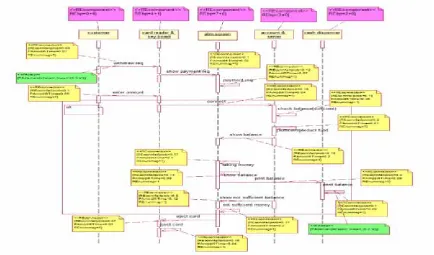
UML diagrams. Figure 9 exhibits the sequence
diagram of account withdrawal in an
object-oriented style. In this diagram, the Annotation of system availability is done. The account
withdrawal model diagram should now be
converted to an executable model. To do so, the proposed algorithm is adopted. The executable
model of the diagram under study is plotted and the resulting model is tested in several stages
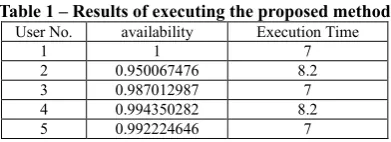
using labeled clichés. The results may be seen in Table 1.
Figure9 – Account withdrawal sequence diagram along with availability labels
Table 1 – Results of executing the proposed method
User No. availability Execution Time
1 1 7
2 0.950067476 8.2
3 0.987012987 7
4 0.994350282 8.2
5 0.992224646 7
The results of model execution with five users in an executable area may be seen in Figure 10.
Average availability by executing the model
of the proposed method with 5 users may be seen in Table 2.
Table 2 – Total average of the proposed method Total average
Number of Users availability Execution Time
5 0.984731078 7.48
Average availability=0.984731078 Average unavailability=-0.015268922
Given model simulation in CPNTools software, system requirements and features
may be evaluated. Figure 11 shows the results of the colored Petri net of account withdrawal.
According to the evaluation results, the studied
system has an availability of 0.984731078
which means the system with the probability of
0.015268922 in the time of need could not be used (it means it can’t provide service).
V. CONCLUSION
This paper addressed availability evaluation at the software architecture level and the use of object-oriented style without considering
hardware context features. Then, the presentation
of an executable, CPN-based model was brought
under spotlight. These nets enjoy a strong mathematical background. This paper mainly
aims to put forward an executable model to evaluate availability at the software architecture
level on object-oriented style. Sequence diagram was adopted in this paper to describe architecture.
The parameters of the metric under study were
1 2 3 4 5
Accessibility Ability 1 0.950067476 0.987012987 0.994350282 0.992224646
execution time 7 8.2 7 8.2 7
0 2 4 6 8 10
Availability
AbilityAccessibility Ability execution time
Annotation to this diagram. In the end, an
executable model was obtained with the aid of
Petri nets using the proposed method. What this
paper actually achieved is the development of an executable model that can investigate availability
in object-oriented style. Using the results obtained
from simulating this model and analyzing
them. First, the problems were identified in the planning phase and the products were modified
accordingly, thereby preventing huge economic
costs as well as a long time for implementation.
Second, the results of availability evaluation show the amount service provided by the system
when needed.
REFERENCES
[1] Bass, L, Clements, P. and Kazman, R. (2010)
“Software Architecture in Practice: Addison- Wesely
Professional”. 2nd edition. Vol. 52, pp. 291-432.
[2] Cheung, C. (2009) “A user-oriented software
reliability model,” Software Engineering, IEEE Transactions
on, pp. 118-125.
[3] Roshandel, R., Medvidovic N. and Golubchik, L. (2007) “A Bayesian model for predicting reliability
of software systems at the architectural level,” Software
Architectures, Components, and Applications, pp. 108-126, 2007.
[4] Goshala, S.S., Wong, W E., (2011) “An analytical
approach to architecture-based software performance and
reliability prediction,” Performance Evaluation, vol. 58, pp. 3, 91-432
[5] Sharma, V.S.and Trivedi, K.S. (2009) “Quantifying
software performance, reliability and security: An architecture-based approach, ” Journal of Systems and
Software, vol. 80, pp. 493-509.
[6] YANG, N. And QIAN, Z. (2010) “Quantifying
Software Security Based on Stochastic Petri nets, ” Journal
of Computational Information Systems, vol. 6, pp. 3049-3056.
[7] Fukuzawa, K. and Saeki, M. (2002) “Evaluating
software architectures by coloured petri nets, ” in Proceedings of the 14th international conference on Software engineering
and knowledge engineering, pp. 263-270
[8] Garlan D. and Shaw, M. (2009) “An introduction to software architecture”.
[9] http://www.iso.org/, ISO/IEC 25010: (2011)”,
Systems and software engineering – Systems and software
Quality Requirements and Evaluation (SquaRE) – System and software quality models” ,” (2009).
[10] Balsamo, S. Marco, A. D. (2004) “Model-Based Performance Prediction in Software Development: A
Survey”, IEEE Transaction On Software Engineering, Vol
30, NO. 5.
[11] Shin, M., Levis, A., Wagenhals, L. (2007). “Transformation of UML-based System Model to Design/
CPN model for Validating System Behavior In proc Of
Compositional Verification of UML Models”, Workshop on Compositional Verification of UML’03 conference, USA, pp.126-145.
[12] Allen, R., Douence, A. (2007). “Specifying Dynamism in Software Architectures”, Journal of Systems Engineering, Vol. 6, No. 4, pp .52-94
[13] Jensen, K. (2013). “Colored Petri Nets: Basic
Concepts, Analysis Methods and Practical Use”, EATCS
Monographs on Theoretical Computer Science, Vol. 29, No .2, pp70-120.
[14] Cheung, R., Roshandel, N., Medvidovic, (2012).
“Early Prediction of Software Component Reliability”,
ICSE’ 08, Leipzig, Germany, pp. 111-120.
[15] “Generating Availibility Data System”, North American Electric Reliability Corporation. July (2011). Pp. 7, 17. Retrieved 13 March 2014.
[16] Pourali, A., Malakoti, M., Yektaie, M.H.,(2014) .” Reliability evaluation Of a payment model in mobile e-commerce using colored Petri net” .(JACST), pp. 221-231.
[17] Email, S., And Shams, F., (2010).” Modeling of
component diagrams using petri nets”, Indian Journal of
Science and Technology, Vol. 3 No. 12, pp. 1151-1161.
[18] Spiteri Staines, T., (2013). “ Transforming UML Sequence Diagrams into Petri Nets”, Journal of Communication and Computer, 10, PP 72-81.
[19] Jensen, k., Kristensen, L.M., (2009) . “Coloured
Petri Nets, Modelling and Validation of Concurrent
Systems”, Springer, July 2009.
[20] Franco, J.M., Barbosa, R., Zenha-Rela, M., (2014),”
Availability Evaluation of Software Architectures through
Formal Methods”, “, IEEE,, Conference: 23-26 Sept. 2014.
[21] Lian-Zhanga, Z, Fan-Sheng K., (2012) “Automatic Conversion from UML to CPN for Software Performance
Evaluation”, International Workshop on Information and