ISSN: 2333-6048 (Print), 2333-6056 (Online) Copyright © The Author(s). All Rights Reserved. Published by American Research Institute for Policy Development DOI: 10.15640/jmpp.v4n2a1 URL: https://doi.org/10.15640/jmpp.v4n2a1
Evaluating Workplace Health Promotion
Tomeka Harbin
1Abstract
Increasing health care costs are indicators of a major threat to short and long term viability of American businesses. As leaders in American businesses and industries face rising health insurance and medical care costs, interest in disease prevention and health promotion increases. Decreasing health care costs coupled with a greater public interest for addressing health issues has led to the workplace health promotion movement. This study utilized quantitative research methods to examine employee perceptions of workplace health promotion in the Mississippi Delta, a rural area identified as one of the three unhealthiest places to live in the United States. Electronic survey distribution and in-person survey collection were used to obtain data. Two hundred thirty-three employees participated from Delta State University and Mississippi Valley State University. Data was analyzed using frequency distribution and logistic regression. Findings from this study suggest when developing or improving workplace health promotion programs, organizations should focus on providing health screenings, healthy food choices, and ensuring program activities are convenient for employees. Developing comprehensive health promotion programs based on the needs of employees and supported by leadership can assist in improving lifestyle behaviors and controlling health care costs for businesses.
Introduction
More than 68% of adults in the U. S. are overweight or obese. Conditions of overweight and obesity affect more than 1.4 billion adult’s worldwide (Fernandez et al., 2015). Obesity correlates with increased risks for coronary heart disease, type two diabetes, cancers, high blood pressure, high cholesterol, and stroke (Jones, Shivaji, Cosby, & Morgan, 2010). More than 18.2 million Americans have diabetes and one-third of these individuals are unaware they have the disease. Heart disease and stroke account for more than 40% of all deaths each year in the United States. Cancer, the second cause of death, kills approximately 500,000 people annually (Carlson & Murphy, 2010. Chronic illnesses are the leading cause of death and disability in the U. S. impacting approximately 1.7 million lives a year (Grillo, 2015).
Increasing health care costs are indicators of a major threat to short and long term viability of American businesses (Grillo, 2015). Private health insurance premiums rose 5% from 1997 to 2000 and nearly doubled to 9.2% from 2000 to 2005. Annual health care expenditures increased from $75 billion in 1970 to $2.8 trillion in 2015 (Grillo, 2015). As leaders in American businesses and industries face rising health insurance and medical care costs, interest in disease prevention and health promotion increases (Pomeranz et al., 2016). The value in decreasing health care costs coupled with a greater public interest for addressing health issues has led to the workplace health promotion movement. Many organization leaders recognize that some costs associated with health care are avoidable through the modification of unhealthy lifestyles (Kunte, 2016). The objectives of health promotion include decreasing health risks, strengthening health and productivity, and lowering health-related costs.
Health promotion and disease prevention initiatives take place in schools, worksites, insurance companies, communities, hospitals and outpatient clinics (Hundley, 2010). The nation’s leading consumer of medical care are businesses. Businesses develop workplace health promotion programs primarily to help control the cost of medical care, while simultaneously increasing productivity (Kunte, 2016). At its best, workplace health promotion contributes to a culture that nurtures life, motivation, and overall effectiveness of human capital. Therefore, programs that promote workplace health can positively influence policies and procedures that increase profitability for the company and employability of the individual (Sirpal, 2014).
Despite increasing evidence suggesting workplace health promotion programs are beneficial for employees and employers; participation in the programs remain low (Clark, 2008; Franklin, Rosenbaum, Carey, &Roizen, 2006; Kwak, Kremers, van Baak, &Brug, 2006; Linnan, Sorensen, Colditz, Klar, & Emmons, 2001). Although many studies have been conducted, most do not include participation rates. Increased participation rates can be used to justify the programs, to increase effectiveness for delivery and evaluation, and to improve the generalization of findings (Ball, 2009; Linnan et al., 2001). The purpose of this research is to describe factors influencing participation in workplace health promotion programs for the purpose of improving the programs for increased participation in the Mississippi Delta region. Increased employee participation in workplace health promotion programs can lead to healthier lifestyles for employees and provide a reduction in medical costs for businesses. The number of individuals with chronic illnesses- coronary heart disease, stroke, cancer, cardiovascular disease, and diabetes; has increased annually in the United States and researchers find that these diseases are concentrated more in minority and low-income populations like those found in Mississippi. In 2005, 133 million Americans had at least one chronic condition (Bodenheimer, Chen, & Bennett, 2009). These diseases represent 70% of chronic disease morbidity and death experienced by U.S. citizens (Wang et al., 2009). Many chronic diseases correlate with obesity. Currently, Mississippi has the highest obesity rates in the nation (Mississippi State Department of Health, 2011). Mississippi Delta citizens are 1.16 to 1.45 times more likely to die from cardiovascular disease, cancer, stroke, and injury than other citizens in the country (Cosby & Bowser, 2008).
Improving educational efforts to prevent chronic diseases requires a better understanding about the attitudes and beliefs individuals have about chronic diseases (Wang et al., 2009). Previous research on workplace health promotion programs focuses on urban areas (Ball, 2009; Hundley, 2010; Isaak 2010; & Weatherill, 2004). The present study examines employee perceptions of workplace health promotion in the Mississippi Delta, a rural area identified as one of the three unhealthiest places to live in the U. S. (Mirvis, Steinberg & Brown, 2009). The following research objectives will be addressed in this study:
RO1: Describe employee socio-demographic characteristics: a) gender, b) race/ethnicity, c) age, d) education level, e) organization, f) job classification, and g) participants and non-participants of workplace health promotion programs.
RO2: Determine if a relationship exists between socio-demographics and factors influencing participation in workplace health promotion programs.
RO3: Determine factors influencing the likelihood of participation in workplace health promotion programs.
The results of this study will contribute to the body of knowledge required to determine the health promotion needs of employees at greatest risk for disease and high health care costs (Ball, 2009). Data from the present study provides an internal assessment that can be used by employers to enhance workplace health promotion programs by attracting and maintaining employee participation and reduce medical costs (Kruger et al., 2007).
Theoretical Framework
Increased employee participation in workplace health promotion programs can lead to healthier lifestyles for employees and provide a reduction in medical costs for businesses. The present study is grounded in social cognitive, organizational change, and human capital theories.
Social cognitive theory provides a conceptual framework, integrating personal behavioral and environmental influences, to understand the circumstances that influence human behavior (McAlister, Perry, & Parcel, 2008). Social cognitive theory includes five key concepts: psychological determinants of behavior, observational learning, and environmental determinants of behavior, self-regulation and moral disengagement. Whitehead (2001) argues that health education is best addressed using social cognitive theory.
----Indicates Potential Outcomes
Figure 1. Conceptual Framework
The focus of SCT is on the individual’s inherent abilities to develop environments to fulfill purposes they discover for themselves and emphasizes a reciprocal effect in the interaction between individuals and their environment. Another aspect of SCT is the human capacity for collective action enabling individuals to work together to achieve environmental changes benefitting the entire group (McAlister et al., 2008). According to McAlister et al. (2008), “SCT provides a comprehensive and well-supported conceptual framework for understanding the factors affecting human behavior and the processes through which learning occurs, offering insight into a wide range of health-related issues” (p. 175).
Four determinants: 1) knowledge; 2) perceived self-efficacy; 3) outcome expectations; and 4) perceived facilitators and impediments are fundamental to translating knowledge into successful health practices (Bandura, 2004). Knowledge of health risks and the benefits of different health practices are required precursors of change (Bandura, 2004). If people are not aware of how lifestyle affects their health, they have no reason to change. The second determinant, perceived self-efficacy, or the belief that one could control habits related to health, plays a crucial role in personal change. Human motivation and engagement derive from self-efficacy (Bandura, 2004). Unless individuals believe they can take actions that produce favorable effects, they have little incentive to engage in the first place or to continue through difficult times. The third determinant, outcome expectations, addresses the costs and benefits of specific health habits, the health goals individuals choose for themselves, and the plans they use to achieve the goals. Outcome expectations could take several forms (Bandura, 2004). Actual outcomes include the positive and adverse effects of the behavior and the resulting material gains and losses.
Demographics
Perceived Incentives
Participation in Workplace
Health Promotion Perceived
Challenges
Services
Human capital theory Social cognitive theory Organizational change
(Schultz, 1961; Becker, 1964) (Bandura, 1987) (Lewin, 1951)
Low Participation in Workplace Health Promotion Programs
Social outcomes refer to the reaction of individuals in one’s social group to an exhibited behavior. Personal outcome involves individuals’ positive and negative evaluation of themselves concerning their health behavior. Individuals tend to behave in ways that increase their sense of worth. Goals based on a value system, provide self-incentives to guide individual health (Bandura, 2004). The fourth determinant for health habits was an individual’s perceived facilitators and impediments. Some of the impediments hindering performance of healthy behavior are self-inflicted. Others reside in the social and economic structure of health systems (Bandura, 2004). Since organizations have personalities just as individuals do, collective values, beliefs, and purposes establish an organization’s culture and affect the behavior of the individuals involved and their effectiveness as a group (Weatherill, 2004). An organization’s culture plays a significant role in the attitude and behavior of its individual employees.
In organizational change theory, change is seen as a multifaceted process progressing through stages. Lewin (1951) states that a group setting is the most effective situation in which to create change in individuals: change occurs in three steps: unfreezing, moving, and refreezing. Health promotion should exist as a systematic structural component within an organization (Lowe, 2003). Incorporating health promotion in organizational cultures requires a change process. Successful implementation of change related to health care requires change readiness from an organization (Weiner, 2009). Based on Lewin’s three-step model of change, change management experts have developed strategies to promote readiness by unfreezing- existing mindsets and creating enthusiasm for change (Weiner, 2009). Egan (1985) stresses the importance of change agent skills; to promote health and well-being in human systems such as family, community, government, and the workplace. Life skills such as self-assessment, planning, problem solving, and decision-making empower individuals to undertake health and wellness enhancing goals (Egan, 1985).
Authors from the National Institute for Occupational Safety and Health states, “A healthy work organization is defined as one whose culture and climate practices create an environment that promotes employee health and safety, as well as organizational effectiveness” (Lowe, 2003, p. 10). Organizations whose members strive for effectiveness in the 21st century value people for their potential to add to the company. In these organizations, helping employees gain additional knowledge is a priority because “human capital is widely recognized as the key ingredient for productivity and innovation in a knowledge-based economy” (Lowe, 2003, p. 7).
Human capital theory refers to the set of abilities and skills an employee gains for financial or productive potential through education or on-the-job training (Becker, 1964). The primary determinants to improve individuals’ standards of living derives from investing in the skill, knowledge and health of the people; these factors are then expected to contribute to a country’s economic structure (Becker, 2002a). For the employer, health promotion programs constitute an investment in reducing medical costs. For the employee, health promotion programs increase time spent in the workplace due to the employee’s health. For the organization, investments in health align health-related benefits and productivity with organizational profitability (Ginn & Henry, 2001).
Methodology
This is a non-experimental, exploratory study. Swanson and Holton (2005) argue quantitative techniques are effective for studying large groups of people and generalizing from the sample studied to broader groups beyond the sample. Quantitative research is experimental, quasi-experimental, correlational, or descriptive. Descriptive research utilizes surveys to gather information about individuals, groups, and organizations. The present study was designed to discover employee perceptions of participation in workplace health promotion programs.
Electronic survey distribution and in-person survey collection opportunities were used to obtain data from employees of two Mississippi universities offering health promotion programs to employees. The questions of the survey are adapted from the Health Styles Syndicated Survey Data (2004), which surveyed consumers by mail throughout the United States about perceptions of workplace health promotion. Kruger et al. (2007), addressed perceived barriers and incentives to participation in workplace health promotion among U. S. companies, and Ball (2009) explored barriers and incentives to participation in a university setting.
The population for the present study includes employees from Delta State University (DSU) and Mississippi Valley State University (MVSU) both located in the Mississippi Delta. DSU and MVSU are two of the largest employers in the region, employ a wide range of individuals in multiple job classifications, have extensive health promotion plans for employees, and a diversity of race/ethnicities and socio-economic statuses among employees. Targeting the entire population in the present study took place through the two university’s network services, employee email accounts, and in-person survey collection opportunities. Zoomerang was used to distribute the survey via the Internet. The survey was distributed electronically via the two universities email systems and a secure webpage. Cobanoglu and Cobanoglu (2003) argue when using web-based surveys researchers should employ other methods for dissemination, such as mail or fax for parts of the population that do not have Internet access. Employees without email accounts were determined with the assistance of each university’s Institution for Research and Planning directors. An additional attempt for increasing the response took place through an in-person distribution of surveys at each university.
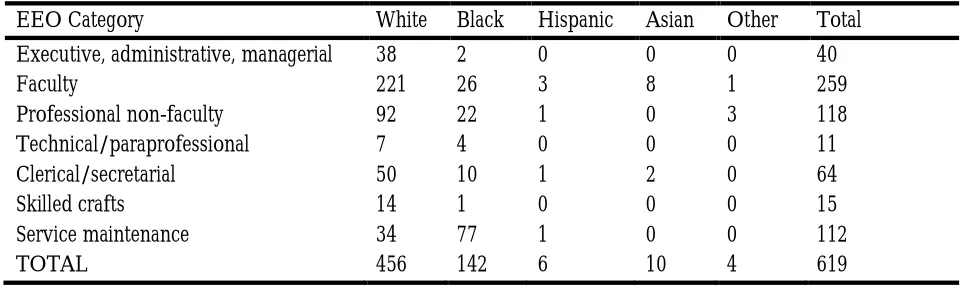
As indicated in Tables 1 & 2, the number of employees at both universities is equivalent; however, the race/ethnicity numbers are different. DSU employs an approximate 74% White population while MVSU employs an approximate 11% White population. There are 160 faculty members at MVSU and 259 faculty members at DSU. To reflect the perceptions of employees accurately, the target population consists of full-time and part-time employees (with the exception of work-study and graduate assistants).
Table 1: Delta State University, 2011 Employee Demographics
EEO Category White Black Hispanic Asian Other Total
Executive, administrative, managerial 38 2 0 0 0 40
Faculty 221 26 3 8 1 259
Professional non-faculty 92 22 1 0 3 118
Technical/paraprofessional 7 4 0 0 0 11
Clerical/secretarial 50 10 1 2 0 64
Skilled crafts 14 1 0 0 0 15
Service maintenance 34 77 1 0 0 112
Table 2: Mississippi Valley State University, 2011 Employee Demographics
EEO Category White Black Hispanic Asian Other Total
Executive, administrative, managerial2 44 0 0 0 46
Faculty 24 117 1 17 1 160
Professional non-faculty 8 127 1 1 1 138
Clerical/secretarial 3 71 0 2 1 77
Technical, paraprofessional 0 23 0 1 0 24
Skilled crafts 1 12 0 0 0 13
Service maintenance 0 103 1 0 1 105
TOTAL 38 497 3 21 4 563
Data Analysis
Data was collected from the population using a survey. The survey includes categorical and ordinal variables with overall percentages and statistical differences calculated to determine variances between demographic groups and factors influencing participation in workplace health promotion programs. Construct areas explored by the survey include demographics, perceived incentives and challenges to participation in workplace health promotion, and use of health promotion services (Ball, 2009). RO1 was analyzed using descriptive statistics. For both RO2 & RO3, a logistic regression was employed.
According to Swanson and Holton (2005), logistic regression is ideally designed for explaining and predicting dichotomous dependent variables. Logistic regression can be viewed as a distinct form of regression analysis utilized to classify participants into a dichotomous dependent variable (Swanson & Holton, 2005). The dependent variable in this study was dichotomous, yielding binary results; "yes" employees participate in workplace health promotion programs or "no" they do not. The binary response enabled an assessment of the association between the independent variables and the response variables (Manor, Matthews, & Power, 2000). The independent variables in the present study were socio-demographics, selected services, and factors influencing workplace health promotion program participation. Logistic regression identified the employees who “do” or “do not” participate in workplace health promotions based on socio-demographics (RO2) and employees “influenced to participate” or “not influenced to participate” based on a list of factors (RO3).
Results
Of the 1,182employees invited to participate in the survey, 230completed the instrument. The socio-demographic characteristics of the sample are shown in Table 3
Table 3: Respondent Socio-demographic Characteristics
Characteristics Category n= %
Gender Male 71 30.9%
Female 149 64.8%
Race/ethnicity African American/Black 93 40.4%
Caucasian/White 113 49.1%
Hispanic, Native American, Asian, Other 12 5.2%
Age 18-34 39 17.0%
35+ 182 40.0%
Education level Some College or Less 43 18.7%
Bachelor's to some graduate work 45 19.6%
Master's or Doctorate degree 132 57.4%
Job classification Executive/administrative/managerial 31 13.5%
Faculty 84 36.5%
Research Objective 1, described the demographic characteristics of employees including age range, highest level of education completed, and job classification. The age range was 35-49 years (40%), and the fewest number of participants were in the 18-34year age range(17%). Participants with a master’s or doctorate degree yielded the most respondents (57.4%)and staff employees were represented more than other job classifications (44.3).Research Objective 2 examined relationships between employee participation in physical and nutritional services and socio-demographic characteristics. There were only two significant findings. The first indicated that respondents with a bachelor’s degree or some graduate work were two times more likely to select healthy food choices as an influence to participate in workplace health promotion programs than respondents with a high school diploma or less. The second indicated that respondents with a high school diploma or some college were least likely to participate in exercise classes than those with a master’s or doctorate degree. The logistic regression models suggested no other significant associations.
Research Objective 3 utilized logistic regression to examine whether factors influenced employee participation in workplace health promotion programs. The first significant finding was respondents age 18-34 were more likely to report having paid time off to attend health promotion activities as an influence to participation than respondents 50 or older. The second significant finding indicated that respondents with a bachelor’s degree or some graduate work were more likely to report having no energy to participate as an influence to participation. All other associations were not significant.
Discussion
Trends in the data suggest health screenings were the most popular physical (require acts of the body) services used by employees. Fitness centers were the second most often used physical service followed by exercise classes. Program leaders should develop comprehensive workplace health promotion programs with an emphasis on preventative activities such as health screenings and immunizations to help encourage employees to participate in other activities. Organizations could survey employees at the health screenings to determine their needs and wants as it relates to health promotion. Designing and implementing programs based on employee feedback may create buy-in from employees. Since 58.4% of the U. S. population aged 16 years or older is employed, workplace health promotion has the potential to reach a large amount of adults fostering participation in program development and sustainability (Fernandez et al., 2015).
Based on this study’s results, selecting healthy food choices was the most popular nutritional service offered as part of the workplace health promotion program. Research suggests individual’s attitudes towards healthy food choices can be changed and sustained if the environment in which choices are made support healthy food selection (Larson & Story, 2009). Providing a healthy company culture in the form of healthy eating classes, healthy food choices in the cafeteria and vending machines, and establishing policies that reinforce healthy eating habits may decrease obesity, chronic illnesses and consequently reduce medical costs for businesses (Goetzel & Ozminkowski, 2008).
Findings suggest convenience was the most influential factor reported for participating in the workplace health promotion programs. The findings are consistent with previous research reporting the times fitness centers were available for employees as barriers for their participation (Gurley, 1999). Ensuring that the time and location of health promotion activities is accessible for all employees is a challenge that may be difficult for employers to eliminate. However, because of the control organizations have over the type of health promotion programs they offer, employers are able to change the environment in which their employees work to accommodate health promotion activities (Chu & Dwyer, 2002).
Conclusion and Future Research
Unhealthy lifestyle behaviors including physical inactivity and poor nutrition contribute to the development of chronic illnesses (Carlson & Murphy, 2010. Chronic disease rates in the Mississippi Delta are among the highest in the United States. The impact of employee health status on organizational costs and performance leads to the emergence of workplace health promotion programs. Workplace health promotion has the potential to improve health while decreasing health care expenditures for businesses, nevertheless employee participation rates remain low.
This study describes factors influencing employee participation in workplace health promotion programs at two universities in the Mississippi Delta. Understanding factors influencing participation in an area with employees at greatest risk for disease and high health care expenditures can provide an internal assessment to enhance workplace health promotion programs by attracting and maintaining employee participation and reducing medical costs (Ball, 2009; Kruger et al., 2007). Findings from this study suggest when developing or improving workplace health promotion programs in the Mississippi Delta, organizations should focus on providing health screenings, healthy food choices, and ensuring program activities are convenient for the employees.
Creating an organizational culture of health and wellness is an important determinant for increasing employee participation rates (Gurley, 1999). Effective workplace health promotion programs depend on the employers’ and employees’ willingness to participate. Developing comprehensive health promotion programs that are based on the needs of employees and supported by leadership can assist in improving lifestyle behaviors and controlling health care costs for businesses (Ball, 2009; Kruger et al., 2007; Lowe, 2003).
Organizations striving to create an effective work environment must be concerned about employee health because of the employee’s potential to add to the company through the effort, knowledge, and skills they possess. By helping employees through providing health promotion activities, services and knowledge, organizations have the opportunity to enhance their human capital, a significant factor in achieving a competitive advantage in the global marketplace.
More in-depth qualitative studies are needed to help determine employee perceptions of workplace health promotions. Understanding the needs of employees, especially those with high health risk, such as obesity/overweight, hypertension, high cholesterol, and diabetes may contribute to decreased health care expenditures for businesses. Since the main force behind organizational interest in workplace health promotion is health care costs, a longitudinal study could be beneficial in tracking changes in employee health and organizational medical care costs.
Works Cited
Ball, T. (2009). Selected barriers and incentives for participation in a university wellness program (master’s thesis). Retrieved from ProQuest (Order No. 1473147)
Bandura, A. (2004). Health promotion by social cognitive means. Health Education and Behavior, 31(2), 143-164.
Becker, G. (1964). Human capital: A theoretical and empirical analysis with special reference to education, New York, NY: National Bureau of Economic Research.
Becker, G. (2002). The age of human capital. Education in the twenty-first century, 3(8). Retrieved from
http://media.hoover.org.proxy.library.msstate.edu/sites/default/files/documents/0817928928_3.pdf
Bodenheimer, T., Chen E., & Bennett, H.D. (2009). Confronting the growing burden of chronic disease: Can the U. S. health care workforce do the job? Health Affairs, 28(1), 64-74.
Carlson, E., & Murphy, M. (2010). Impacting health through on-the-job counseling: Role for professional nurses.
MEDSURG Nursing, 19(5), 295-299.
Chu, C., Breucker, G., Harris, N., Stitzel, A., Gan, X., Gu, X. & Dwyer, S. (2000). Health- promoting workplaces-international settings development. Health Promotion International, 15(2), 155-167.
Chu, C. & Dwyer, S. (2002). Employer role in integrative workplace health management: A new model in progress.
Disease Management Health Outcomes,10(3), 175-186.
Clark, A. (2008). The new frontier of wellness. Benefits Quarterly. 2nd quarter, 23-28.
Cosby, A., & Bowser, D. M. (2008). The health of the Delta region: A story of increasing disparities. Journal of Health
and Human Services Administration, 58-71.
Egan, G. (1985). Change agent skills in helping and human service settings. Monterey, CA: Brooks/Cole.
Fernandez, I. D., Chin, N. P., Devine, Carol M., Dozier, A. M., Martina, Camille A., McIntosh, S., Thevenet-Morrison, K.,Hongmei, Y. (2015) Images of a healthy worksite: A group-randomized trial for worksite weight gain prevention with employee participation in intervention design. American Journal of Public Health. 105(10), 2167-2174.
Foulke, J., & Sherman, B. (2005). Comprehensive workforce health management: Not a cost, but a strategic advantage. Employment Relations Today, 17-29.
Franklin, P.D., Rosenbaum, P.F., Carey, M. P., &Roizen, M.F. (2006). Using sequential email messages to promote health behaviors: Evidence of feasibility and reach in a worksite sample. Journal of Medical Internet Research, Retrieved from http://www.jmir.org.
Ginn, G. O, & Henry, L. J. (2001). Health promotion and wellness programs as a generalized investment in human capital. The International Electronic Journal of Health Education. 4, 323-329.
Goetzel, R. Z., & Ozminkowski, R. J. (2008). The health and cost benefits of work site health promotion programs.
Annual Review Public Health, 29, 303-323.
Grillo, M. C. (2014) Workplace wellness programs: Are they part of the answer to the U.S.’s growing healthcare crisis.Cornell HR Review. 1-9.
Gurley, J. E. (1999). Employees’ needs and interest in an “Employee wellness program” at Wallace State Community College.
(Doctoral dissertation). Retrieved from ProQuest (Order No. 9949376).
Health Styles Syndicated Survey Data. (2004)Washington, DC: Porter Novelli.
Hundley, L. L. (2010). A program evaluation of an integrative wellness program (Doctoral dissertation). Retrieved from ProQuest (Order No. 3433075).
Isaak, M.S. (2010). Effect of employee health, worker limitation, and health culture on job productivity among North Carolina state
government employees (Doctoral dissertation). Retrieved from ProQuest (Order No. 3430239).
Jones, L., Shivaji, S., Cosby, A. G., & Morgan, T. (2010). Obesity, cardiovascular disease & diabetes. A report in What
If We Were Equal: A Mississippi Health Assessment. The Social Science Research Center at Mississippi State
University. Starkville, MS.
Kruger, J., Yore, M. M., Bauer, D. R., & Kohl, H. W. (2007). Selected challenges and incentives for worksite health promotion services and policies. American Journal of Health Promotion, 21, 439-447.
Kunte, M. (2016). Employee wellness practices—A study in selected organizations. SIES Journal of Management. 12 (1), 9-14.
Kwak, L., Kremers, S. P. J., van Baak, M. A., &Brug, J. (2006). Participation rates in worksite-based intervention studies: Health promotion context as a crucial quality criterion. Health Promotion International, 21, 66-69.
Larson, N. & Story, M. (2009). A review of environmental influences on food choices. The Society of Behavioral Medicine,
38(1), 56-73.
Levey, J & Levey, M. (2000). Corporate culture and organizational health. The Center for Corporate Culture and Organizational Health. Retrieved from http:www.wisdomatwork.com/BUSINESS/center/report.html. Lewin, K. (1951). Field theory in social science, New York, NY: Harper and Brothers.
Linnan, L., Sorensen, G., Colditz, G., Klar, D. N., & Emmons, K. M. (2001). Using theory to understand the multiple determinants of low participation in worksite health promotion programs. Health Education and Behavior, 28, 591-607.
Lowe, G. S. (2003).Healthy workplaces and productivity: A discussion paper prepared for the Economic analysis and Evaluation Division, Health Canada. Retrieved from
http://www.grahamlowe.ca/documents/48/Healthy%20workplaces&productivity-English%20report.pdf Lyden, J. A., &Klengele, W. E. (2000). Supervising organizational health. Supervision, 61(12), 3-6.
Manor, O., Matthews, S., & Power, C. (2000). Dichotomous or categorical response? Analyzing self-rated health and lifetime social class. International Journal of Epidemiology, 29, 149-157.
McAlister, A. L., Perry, C. L., & Parcel, G. S. (2008). How individuals, environments, and health behaviors interact: Social cognitive theory. InGlanz, K., Rimer, B. K., & Viswanath, K., Health Behavior and Health Education Theory
Mirvis, D. M., Steinberg, S., & Brown, L. (2009). Health improvement in the lower Mississippi River Delta: Opportunities and challenges. Retrieved from Mississippi State Department of Health website:
msdh.ms.gov/msdhsite/...HealthImprovementMSDeltaReport.pdf
Mississippi State Department of Health. (2011). Chronic disease fact sheet. Retrieved from Mississippi State Department of Health website: http://www.msdh.state.ms.us/msdhsite/_static/43,1160,91,214.html. Nolte, E., & McKee, C. M. (2008). Measuring the health of nations: Updating an earlier analysis. Health Affairs, 27(1),
58-71.
Pomeranz, J. L., Garcia, A. M., Vesprey, R., Davey, A. (2016). Variability and limits of US state laws regulating workplace wellness programs. American Journal of Public Health. 106(6), 1028-1031.
Sirpal, S. (2014). The affordable care act and incentivized health wellness programs—A tale of federalism and shifting administrative burden. Journal of Health & Human Services Administration. 37(3), 327-349.
Swanson, R., & Holton III, E. (2005). Research in organizations. San Francisco, CA: Berrett-Koehler
Thorpe, K. E. (2005). The rise in health care spending and what to do about it. Health Affairs,24(6), 1436-1445.
Wang, C., O’Neill, S. M., Rothrock, N., Gramling, R., Sen, A., Acheson, L. S., Rubenstein, W. S., Nease, D. E. Jr., & Ruffin, M. T. (2009). Comparison of risk perceptions and beliefs across common chronic diseases. Preventative
Medicine, 48(2), 197-202.
Weatherill, M.S. (2004). Workplace wellness in the 21st century Vancouver coastal health (masters thesis). Retrieved from
ProQuest database.
Weiner, B. J. (2009). A theory of organizational readiness for change. Implementation Science, 4(67), Retrieved from the BioMedCen website: http://www.biomedcentral.com/content/pdf/1748-5908-4-67.pdf
Whitehead, D. (2001). A social cognitive model for health education/health promotion practice. Journal of Advanced